
10 Service Desk Best Practices for AI-Powered Financial Services in 2026
10 Service Desk Best Practices for AI-Powered Financial Services in 2026
Discover key service desk best practices for financial services, focusing on AI automation in claims and customer care. Boost efficiency and compliance.
In the high-stakes, heavily regulated world of financial services, the service desk is evolving from a reactive IT support function into a strategic, AI-powered hub for operational excellence. Traditional methods are no longer sufficient to manage the complexity of insurance claims, banking operations, and customer care while meeting strict compliance demands. The future lies in leveraging intelligent automation and proven frameworks to create a service desk that is not only efficient but also a key driver of business value. This shift is critical for AI insurance companies and financial institutions aiming to deliver superior AI customer care and streamlined operations.
This guide outlines 10 critical service desk best practices, specifically tailored for financial institutions looking to automate insurance claims with AI and enhance customer support. We move beyond generic advice to provide a practical, prioritized roadmap for building a resilient, compliant, and customer-centric service operation. Readers will learn how to implement actionable strategies for everything from establishing tiered Service Level Agreements (SLAs) to deploying sophisticated AI for first-line automation.
Each best practice is detailed with implementation guidance, success metrics, and real-world examples relevant to the financial sector. We explore how to manage complex incident response, build comprehensive knowledge bases, and integrate omnichannel support systems. The focus remains on transforming your service desk into a proactive, data-driven function that enhances operational efficiency, improves claims AI reviews, and significantly boosts customer satisfaction. Whether you are an operations leader, a CIO, or part of a risk and compliance team, these insights will help you architect a service desk prepared for the challenges of 2026 and beyond.
1. Service Level Agreements and Incident Response Time SLAs with Tiered Severity Levels
Moving beyond generic response times is a cornerstone of modern service desk best practices, especially within regulated financial services. This involves establishing formal Service Level Agreements (SLAs) directly tied to specific business outcomes and fortified with tiered severity levels. This structure ensures that resources are allocated based on actual business impact, not just the order in which requests arrive.
In this model, every incident or request is assigned a severity level (e.g., Critical, High, Medium, Low) based on a predefined impact and urgency matrix. Each level has a distinct, non-negotiable target for both response and resolution. This approach is critical in environments where operational failures have cascading regulatory and financial consequences. For instance, a system outage affecting trade execution (Critical) demands an immediate response, while a minor user interface bug (Low) can be addressed in a less urgent timeframe.
Implementation in Practice
Insurance Carriers: A leading carrier implemented AI-powered severity assignment for their claims operations. When a First Notice of Loss (FNOL) is submitted, an AI model analyzes the claim details for keywords related to potential high-cost litigation or fraud, automatically flagging it as a "High" severity case. This triggers an immediate SLA for a specialized adjuster to review within four hours, drastically reducing claims leakage and improving the accuracy of claims AI reviews.
Banking Operations: A major bank integrated its ServiceNow platform with its core banking system to automate SLA management for fraud alerts. An alert indicating a potential high-value wire transfer fraud is automatically assigned a "Critical" severity, initiating a 15-minute response SLA and triggering an automated playbook that locks the account and notifies the fraud team.
Actionable Tips for Implementation
Involve Cross-Functional Stakeholders: Define your severity matrix and corresponding SLAs in collaboration with business leaders, compliance officers, and legal teams to ensure they align with business priorities and regulatory obligations.
Automate SLA Monitoring and Escalation: Utilize your service desk platform (e.g., ServiceNow) to automatically track SLA performance. Configure automated notifications and escalations for impending breaches to ensure proactive intervention.
Train for Consistent Classification: Your service desk's success hinges on accurate initial classification. Conduct regular training for frontline staff on how to properly assess and assign severity levels during ticket intake. You can learn more about crafting effective SLAs with a service-level-agreement-inquiry-form-inquiry-form).
2. Knowledge Base Management and Self-Service Portals
Establishing a centralized, dynamic knowledge base and an intuitive self-service portal is a fundamental pillar of modern service desk best practices. This approach shifts the support model from reactive to proactive by empowering both customers and internal agents to find solutions independently. For financial services, this strategy directly reduces operational overhead, ensures consistent policy application, and improves first-contact resolution rates.
Advanced portals leverage AI-powered search and recommendation engines to enhance discoverability, transforming a static repository into an intelligent resource. For instance, in the context of ai insurance companies, a well-managed knowledge base ensures that automated systems and human agents alike provide accurate, compliant information consistently. It serves as the single source of truth for everything from complex regulatory procedures to common customer inquiries.

Implementation in Practice
Insurance Operations: A major property and casualty insurer implemented a Salesforce Knowledge Base to support its policyholders. The portal features AI-driven FAQs that guide users through the claims submission process, significantly reducing inbound calls for simple status checks and documentation questions, which is a key goal for AI customer care.
Fintech Customer Support: A prominent fintech company reduced its contact center volume by over 25% after launching a Zendesk-powered self-service portal. The system uses natural language processing (NLP) to understand user queries and surface relevant articles, effectively deflecting a high volume of routine support tickets.
Banking Compliance: A global bank maintains a rigorous internal knowledge base documenting all regulatory compliance procedures. This ensures that when auditors request information, or when new employees are onboarded, there is a clear, version-controlled record of approved operational processes.
Actionable Tips for Implementation
Establish Content Governance: Create a formal content lifecycle process involving subject matter experts (SMEs) from claims, underwriting, and compliance. Ensure all articles are reviewed, approved, and regularly updated to reflect policy changes.
Leverage Search Analytics: Actively monitor search queries and article engagement within your portal. Use this data to identify content gaps, create high-demand articles, and optimize existing content for better discoverability.
Implement Version Control: For all regulated content, implement strict version control and an audit trail. This is critical for demonstrating compliance and tracking the history of procedural changes over time. You can streamline this process with a knowledge-base-suggestion-form-template.
3. Omnichannel Service Integration (Email, Phone, Chat, Social Media)
Adopting a true omnichannel approach is a critical service desk best practice for financial institutions aiming to deliver seamless, context-aware customer experiences. This model unifies all communication channels (email, phone, chat, social media) into a single, cohesive system, ensuring that customer context and history travel with them, regardless of how they choose to interact. This is paramount in regulated environments where maintaining a complete, auditable record of all client communications is a non-negotiable compliance requirement.
In this integrated framework, an agent handling a phone call can instantly see the customer's recent chat transcript or email inquiry. This eliminates the frustration of customers having to repeat themselves and empowers agents to provide faster, more accurate resolutions. For instance, a high-net-worth banking client can start a query via a secure web chat and seamlessly transition to a phone call with a private banker who already has the full context, ensuring a premium service experience.
Implementation in Practice
Insurance Carriers: A leading P&C insurer uses Genesys Cloud to unify claimant communications. A claimant can submit initial claim photos via a mobile app, ask a question via web chat, and later call for an update. The claims adjuster sees this entire journey in a single timeline, enabling more informed and empathetic service and improving the efficiency of claims AI reviews.
Banking Operations: A retail bank leverages Salesforce Service Cloud to provide AI customer care. When a customer initiates a chat about a suspicious transaction, an AI bot handles initial data gathering before seamlessly escalating to a live fraud specialist. The specialist receives the full chat history and customer profile, reducing handling time and improving fraud detection accuracy.
Actionable Tips for Implementation
Start Incrementally: Begin by integrating your top 2-3 customer channels (e.g., phone, email, and chat) before expanding to others. This allows you to refine processes and ensure a stable foundation.
Prioritize Identity Verification: Implement robust, multi-factor authentication protocols across all digital channels to safeguard sensitive financial information and prevent unauthorized access.
Unify Interaction Data: Ensure that every interaction, regardless of the channel, is logged centrally in your CRM or system of record. This creates a single source of truth for service history, compliance, and audit purposes.
Train for Channel Nuance: Equip agents with channel-specific best practices. For example, train them on the concise, professional tone required for chat versus the more detailed, formal communication needed for email, while adhering to regulatory disclosure requirements on each.
4. AI-Powered First-Line Automation and Chatbots
Adopting intelligent automation is a pivotal step in modernizing financial service desks. This best practice involves deploying AI-powered agents and chatbots to handle routine inquiries, execute standard transactions, and capture initial data without immediate human intervention. In regulated environments, these AI systems are trained on specific company SOPs, compliance rules, and product knowledge, enabling them to manage tasks like verifying customer information, checking account statuses, and processing initial claims intake while adhering to strict governance.
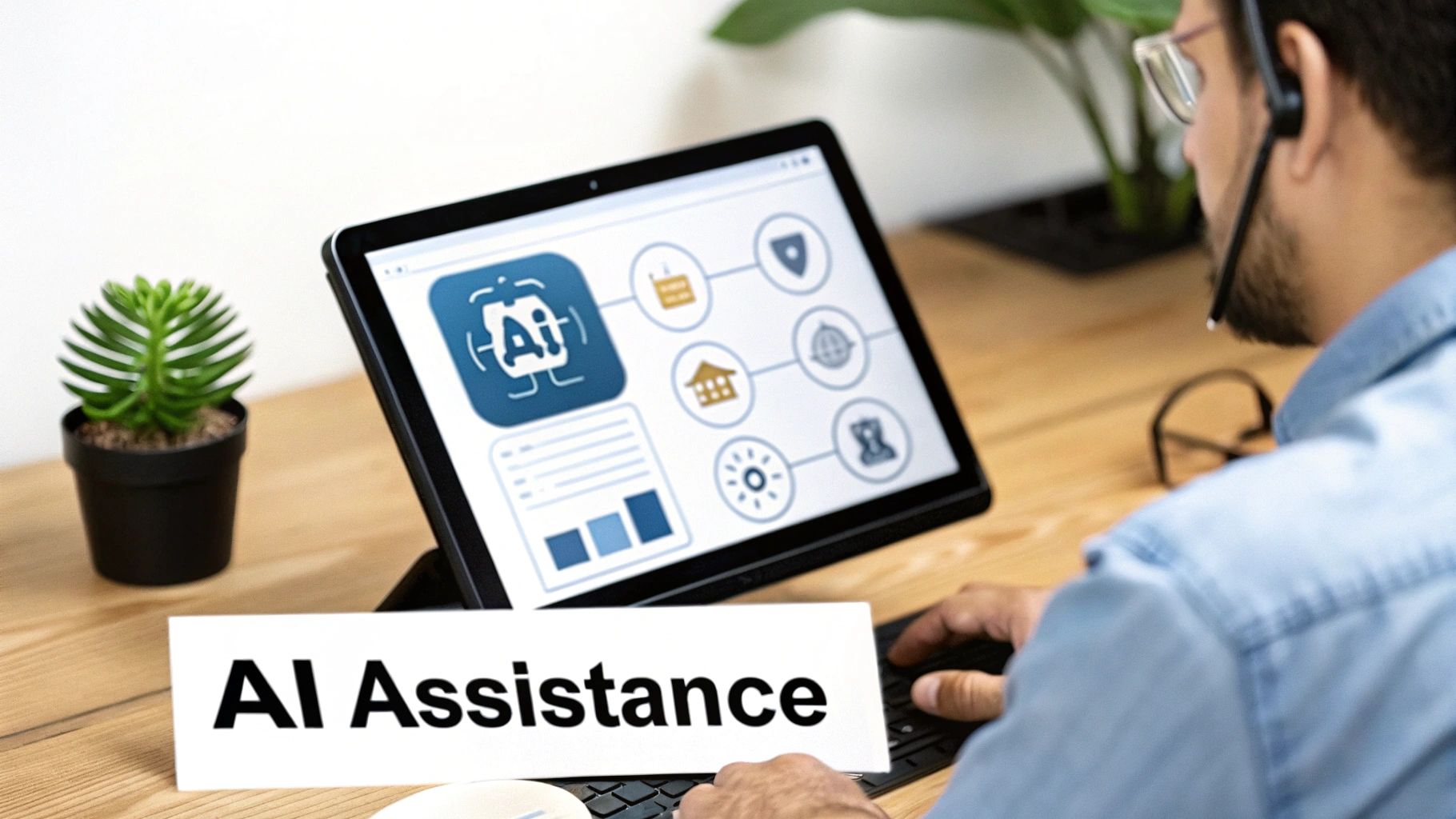
This approach dramatically improves efficiency, allowing human agents to focus on complex, high-value cases that require nuanced judgment. By automating the front line, financial institutions can offer 24/7 support, reduce operational costs, and ensure consistent, compliant customer interactions. The key is a sophisticated escalation protocol that seamlessly transfers complex issues to human experts with full context, preventing customer frustration.
Implementation in Practice
Insurance Claims Triage: Leading AI insurance companies utilize chatbots to handle first notice of loss (FNOL). The AI agent guides policyholders through submitting claim details and uploading documents, then uses natural language processing to perform initial triage and assign the case to the appropriate adjuster, accelerating the claims lifecycle.
Banking Customer Care: A major retail bank deployed an AI-powered virtual assistant for its digital banking platform. This tool securely handles high-volume requests like password resets, balance inquiries, and transaction confirmations, significantly reducing call volume to the contact center and improving AI customer care response times.
KYC and Onboarding: A wealth management firm uses Nolana AI agents to automate initial Know Your Customer (KYC) data capture and verification. The AI interacts with new clients to collect required information and cross-references it against trusted data sources, flagging any discrepancies for manual review by a compliance officer.
Actionable Tips for Implementation
Start with High-Volume Processes: Begin your automation journey with low-complexity, high-frequency interactions such as status inquiries or document uploads to demonstrate quick wins and build institutional confidence.
Train on Specific Compliance Guardrails: Ensure your AI agents are meticulously trained on your organization's specific SOPs, policies, and regulatory requirements to maintain compliance in every automated interaction.
Implement Human-in-the-Loop Escalation: Design a clear and seamless handoff process for when the AI encounters a query it cannot resolve. The escalation should provide the human agent with the full transcript and context of the AI interaction. For a deeper understanding of how intelligent automation can transform your support operations, consider the capabilities of AI customer support software.
Maintain Detailed Audit Logs: Log every AI decision and interaction to create a comprehensive audit trail. This is non-negotiable for regulatory examinations and for continuously improving AI accuracy through feedback loops.
5. Root Cause Analysis (RCA) and Problem Management
Implementing a formal Root Cause Analysis (RCA) and Problem Management process is a critical service desk best practice that shifts the focus from reactively fixing incidents to proactively preventing their recurrence. This systematic approach digs deeper than surface-level symptoms to identify and resolve the underlying causes of operational failures. In highly regulated financial services, where even minor recurring issues can lead to significant compliance risks, financial losses, and degraded customer trust, this move from incident management to problem elimination is non-negotiable.
Problem management aims to minimize the adverse impact of incidents by preventing them from happening in the first place. Instead of repeatedly closing tickets for the same issue, a dedicated process is initiated to investigate, document, and implement a permanent fix. This reduces overall ticket volume, lessens the burden on support staff, and significantly improves system stability and reliability over time.
Implementation in Practice
Insurance Carriers: An insurer leveraged its ServiceNow Problem Management module to address a recurring issue where automated document verification was failing for certain claim types. The RCA identified a flaw in the OCR software's handling of specific scanned document formats. By implementing a system upgrade and refining the intake validation rules, the carrier eliminated thousands of manual review tickets per month and accelerated the timeline for claims AI reviews.
Banking Operations: A retail bank noticed a high volume of calls related to failed multi-factor authentication (MFA) attempts. The problem management team’s RCA revealed that a recent mobile app update was incompatible with older smartphone operating systems. The permanent fix involved releasing a patch and proactively communicating with affected customers, preventing a widespread service disruption and reducing call center strain.
Actionable Tips for Implementation
Automate Problem Identification: Utilize AI-powered incident clustering within your service desk tool to automatically identify patterns and group related incidents into a single problem record, flagging areas for immediate RCA.
Form Cross-Functional RCA Teams: Assemble teams that include technical, business operations, and compliance stakeholders to ensure a holistic analysis of any problem, considering its full impact across the organization.
Document and Track Action Items: Maintain a centralized repository for all RCA findings and the resulting action plans. Assign clear ownership and deadlines for each remedial action to ensure accountability and track progress toward resolution. A structured approach, such as using a service outage report form, can ensure all necessary details are captured for future audit.
6. Service Desk Analytics and Performance Dashboards
Effective service desk best practices depend on moving from reactive problem-solving to proactive, data-driven management. This is achieved through real-time and historical analytics, visualized in performance dashboards. For financial services, these tools are not just operational aids; they are critical for governance, providing transparency into the health of key processes and generating auditable data for regulatory compliance. Analytics enable leaders to identify trends, pinpoint bottlenecks, and make informed decisions that enhance both efficiency and customer satisfaction.

This approach transforms raw operational data into strategic intelligence, allowing organizations to monitor KPIs, track SLA adherence, and understand the impact of new initiatives, such as deploying AI customer care solutions. By visualizing performance, teams can quickly see what’s working and what isn’t, fostering a culture of continuous improvement supported by concrete evidence.
Implementation in Practice
AI Insurance Companies: A top-tier insurer leverages a ServiceNow dashboard to monitor the performance of its automated claims processing system. The dashboard tracks metrics like First Contact Resolution (FCR) for initial inquiries, the accuracy of automated damage assessments from claims AI reviews, and processing times by claim type. This visibility allows them to fine-tune their AI models and identify complex claims that require immediate human intervention.
Banking Operations: A retail bank uses a Salesforce Analytics dashboard to oversee its customer onboarding process. The dashboard displays real-time data on KYC verification completion rates, application drop-off points, and agent handling times. This has enabled the bank to identify and resolve process inefficiencies, reducing onboarding times by 30% and improving compliance adherence.
Actionable Tips for Implementation
Start with Core Metrics: Begin by tracking 5-7 essential KPIs, such as ticket volume, resolution time, and customer satisfaction (CSAT). Expand your dashboards gradually as your analytical maturity grows to avoid overwhelming teams with data.
Tailor Views for Different Audiences: Create distinct dashboard views for different stakeholders. Executives need high-level summaries of business impact and risk, while operational managers require granular data on team performance and SLA compliance.
Ensure Data Integrity: Implement automated data quality checks to confirm the accuracy and reliability of the information feeding your dashboards. Inaccurate data leads to poor decisions and erodes trust in the system. For practical guidance on visualizing key metrics, you can learn about creating a Power BI dashboard to enhance your service desk analytics.
7. Incident Communication and Stakeholder Management
Effective stakeholder communication during service disruptions is a critical service desk best practice, particularly in financial services where transparency is a regulatory mandate and a driver of customer trust. This involves a structured, multi-channel approach to keep customers, internal teams, and executives informed during incidents. Proactive communication manages expectations, contains reputational risk, and demonstrates operational control, which is essential when core systems like payment processing or claims management fail.
In regulated environments, timely and accurate communication is not just good practice; it's often a legal requirement. A well-defined communication plan ensures that all messaging is consistent, approved by legal and compliance, and delivered to the right audience at the right time. This strategy prevents misinformation and provides a clear, auditable record of all correspondence, which is vital for post-incident reviews and regulatory inquiries.
Implementation in Practice
Banks Communicating Outages: A retail bank uses its AI customer care platform to manage communications during a mobile banking app outage. Pre-approved templates are automatically deployed via SMS, in-app banners, and social media, informing customers of the issue and providing an estimated resolution time. This automated approach ensures rapid, consistent messaging, reducing inbound call volume to the contact center.
Insurance Carriers and Claims Systems: When a core claims processing system experiences a delay, a top insurance carrier triggers an automated communication workflow. The system notifies policyholders who have recently submitted a claim via email about the potential delay. This proactive step manages expectations and prevents a surge of status inquiry calls, preserving agent capacity for more complex issues.
Actionable Tips for Implementation
Develop Pre-Approved Communication Templates: Create and get compliance approval for incident communication templates for various scenarios and severity levels before an incident occurs.
Establish Tiered Communication Frequency: Define clear guidelines for communication intervals based on incident severity (e.g., Critical: every 30 minutes, High: every hour) to ensure consistent updates.
Use Multiple Channels for Broad Reach: Leverage a mix of communication channels, including email, SMS, customer portals, and social media, to ensure you reach all affected stakeholders effectively.
Document Everything for Auditability: Maintain a detailed log of all communications sent, including timestamp, channel, and audience. This creates an indispensable audit trail for post-incident analysis and regulatory reporting.
8. Agent Training, Certification, and Quality Management
A robust program for agent training, certification, and quality management is a non-negotiable component of service desk best practices in the financial sector. This goes beyond basic product knowledge, encompassing a structured framework to ensure every agent possesses the skills, compliance awareness, and procedural discipline required to operate effectively. In an industry where a single agent error can lead to significant compliance violations or customer harm, this structured approach is fundamental to mitigating risk.
This practice involves creating a continuous learning loop: initial onboarding, ongoing professional development, formal certification for specific products or regulations, and systematic quality assurance. The goal is to build a team that not only resolves issues efficiently but also acts as a vigilant first line of defense, upholding the institution's regulatory and customer service standards in every interaction.
Implementation in Practice
Banking Compliance: A large retail bank implemented a mandatory certification program for its service desk agents focused on Anti-Money Laundering (AML) and Know Your Customer (KYC) regulations. Agents must pass a quarterly exam with simulated scenarios. This program reduced compliance-related escalations by 30% and provided a clear audit trail for regulators.
Insurance Claims Operations: A leading property and casualty insurer uses an AI-driven quality management system. The platform automatically samples 10% of all customer interactions (calls, chats, emails) related to claims intake. It flags interactions with keywords indicating potential fraud or compliance deviations for human review, improving the consistency of claims AI reviews and agent performance.
Actionable Tips for Implementation
Develop Role-Specific Competency Frameworks: Define the exact knowledge, skills, and compliance certifications required for each service desk role. This creates a clear roadmap for agent development and performance evaluation.
Implement Blended and Scenario-Based Learning: Combine online modules, classroom instruction, and on-the-job training with realistic, role-specific scenarios. For example, use simulated phishing attempts or complex fraud inquiries to test agent responses in a controlled environment.
Systematize Quality Assurance: Implement a formal Quality Assurance (QA) program that monitors a consistent sample (e.g., 5-10%) of all agent interactions. Use a standardized scorecard to provide objective feedback and identify performance trends.
Focus on Performance Coaching: Use QA findings to inform targeted coaching sessions that address specific performance gaps. Frame feedback constructively to build skills rather than simply correct mistakes, fostering a culture of continuous improvement.
9. Change Management and Service Impact Planning
In regulated financial services, unmanaged change is a direct path to service disruption, audit findings, and regulatory penalties. A structured change management process is a critical service desk best practice that ensures any modification to technology, processes, or policies is implemented with minimal negative impact. This disciplined approach moves an organization from reactive fire-fighting to proactive service continuity, which is essential when deploying sensitive technologies like AI for customer care.
The core principle is to formally assess, approve, and communicate every change before it goes live. This involves a clear process for evaluating the potential impact on operations, customers, and compliance obligations. For example, updating the AI model that handles claims AI reviews isn't just a technical task; it's a business change that requires rigorous validation, communication planning, and rollback procedures to prevent inaccurate assessments and maintain regulatory alignment.
Implementation in Practice
Insurance Carriers: A large insurance carrier updated its core policy administration system, a high-risk change impacting thousands of agents. They used ServiceNow's Change Management module to orchestrate a phased rollout, starting with a pilot group of agents. Automated pre- and post-change testing scripts validated key functions, ensuring a smooth transition and preventing widespread disruption to policy issuance.
Banking Operations: To enhance their AI customer care capabilities, a retail bank deployed a new IVR routing algorithm. They categorized this as a "Major" change, requiring approval from a Change Advisory Board (CAB) that included compliance and risk managers. The rollout was preceded by a comprehensive communication plan to inform contact center staff two weeks in advance, preventing confusion and ensuring consistent customer service.
Actionable Tips for Implementation
Categorize and Assign Authority: Classify changes by risk and impact (e.g., Minor, Significant, Major). Establish clear approval workflows and authorities for each category, ensuring that high-risk changes receive senior-level and cross-functional scrutiny, including from compliance teams.
Mandate Impact Assessments: Require a formal impact assessment for all non-standard changes. This document must detail the potential effects on customers, internal operations, system performance, and regulatory compliance.
Document for Auditability: Use a centralized platform to document every change request, including its business justification, approval record, and implementation details. This creates an auditable trail that is invaluable for regulatory reviews and internal governance.
Plan for Contingencies: Every significant change plan must include a detailed rollback procedure. This ensures that if a change causes unexpected negative consequences, the service desk can quickly revert to the previous stable state, minimizing business impact.
10. Customer Feedback and Satisfaction Management
Systematically collecting and analyzing customer feedback is a crucial service desk best practice that moves beyond operational metrics to focus on customer experience. In regulated financial services, where customer trust and retention are paramount, this involves combining quantitative scores like Customer Satisfaction (CSAT) and Net Promoter Score (NPS) with qualitative feedback analysis. This approach allows organizations to identify specific drivers of satisfaction or dissatisfaction, directly linking service performance to business outcomes and regulatory perception.
This strategy is not merely about sending surveys; it is a continuous improvement loop. By actively listening to the customer, financial institutions can pinpoint friction in key processes, such as claims handling or fraud reporting. For AI-powered insurance companies, this feedback is invaluable for refining automated workflows and ensuring that AI customer care models are enhancing, not hindering, the user experience. A high CSAT score following a complex interaction signals a well-designed, effective service delivery model.
Implementation in Practice
Insurance Carriers: An insurer leveraged AI to analyze unstructured text from post-claim CSAT surveys. The system identified "communication clarity" as the top detractor. This insight led to a project that redesigned claims correspondence templates and provided agents with real-time AI-powered communication coaching, improving CSAT by 12% in six months.
Banking Operations: A digital bank implemented real-time sentiment monitoring within its online banking support chat. When the AI detects negative sentiment, it automatically flags the conversation for a supervisor to review and potentially intervene, preventing escalations and improving first-contact resolution for issues related to online banking.
Actionable Tips for Implementation
Automate Post-Interaction Surveys: Implement automated CSAT or NPS surveys triggered immediately after a ticket is resolved. Target a completion rate of 20-30% to ensure a statistically relevant sample size.
Ask Specific, Actionable Questions: Instead of a generic "Were you satisfied?", ask about the ease of the process, the clarity of the resolution, and the helpfulness of the agent. This provides more granular data for targeted improvements.
Link Feedback to Performance: Review customer feedback in weekly team huddles. Tie positive trends and achievement of CSAT targets to agent and team performance metrics, creating a culture of customer-centricity.
Ensure Privacy Compliance: When collecting feedback, especially in financial services, be transparent about data usage and ensure full compliance with privacy regulations like GDPR or CCPA. You can find guidance on structuring effective feedback forms with a customer-satisfaction-survey-(csat)-template-template).
Service Desk Best Practices — 10-Point Comparison
Practice | Implementation complexity | Resource requirements | Expected outcomes | Ideal use cases | Key advantages |
|---|---|---|---|---|---|
Service Level Agreements and Incident Response Time SLAs with Tiered Severity Levels | Medium–High: policy, automation, and governance needed | SLA owners, monitoring/alerting tools, historical data, escalation roles | Faster response for critical issues; reduced MTTR; audit evidence | Regulated banking, fraud response, high-impact services | Aligns service to business impact; predictable expectations; compliance support |
Knowledge Base Management and Self-Service Portals | Medium: heavy initial content work and governance | KM platform, SMEs, content authors, AI search/NLP | Reduced ticket volume; faster onboarding; consistent answers | High-volume FAQs, distributed teams, self-service emphasis | Lowers cost per resolution; improves FCR; consistent policy application |
Omnichannel Service Integration (Email, Phone, Chat, Social Media) | High: integrates disparate systems and channels | Integration platform, unified CRM, routing/AI, training, compliance capture | Seamless customer journeys; full interaction history; improved CX | Contact centers, retail banking, complex customer journeys | Consistent service across channels; richer context; audit trails |
AI-Powered First-Line Automation and Chatbots | High: model training, integrations, and guardrails | ML models, training data, secure APIs, monitoring, compliance reviews | Handles many routine inquiries; instant responses; cost savings | 24/7 support, high-volume simple transactions, KYC intake (with oversight) | Scales support, reduces human load, improves response speed |
Root Cause Analysis (RCA) and Problem Management | Medium: process-driven, cross-functional facilitation | Skilled facilitators, incident clustering tools, time for RCA sessions | Fewer repeat incidents; systemic fixes; improved reliability | Recurring outages, systemic process failures, risk reduction efforts | Prevents recurrence; lowers long-term service cost; builds organizational learning |
Service Desk Analytics and Performance Dashboards | Medium–High: data integration and visualization design | BI tools (Tableau/Power BI), data engineers, clean ticket/CRM data | Data-driven decisions; trend detection; capacity planning; compliance reports | Operations optimization, staffing forecasts, regulatory reporting | Visibility into performance; forecasting; accountability |
Incident Communication and Stakeholder Management | Medium: templates, approval workflows, and coordination | Communication templates, stakeholder registry, legal/compliance involvement | Reduced customer frustration; maintained trust; regulatory notifications | Major outages, breaches, high-visibility incidents | Proactive transparency; controls narrative; supports compliance |
Agent Training, Certification, and Quality Management | Medium: structured programs and QA processes | LMS, training content, QA staff, certification processes, coaching | Higher FCR, fewer compliance errors, better agent retention | Regulated products, complex processes, high-touch service roles | Ensures consistent quality; audit-ready training records; improved morale |
Change Management and Service Impact Planning | Medium–High: governance, CAB, and testing required | Change platform, CAB members, testing environments, rollback plans | Fewer unintended disruptions; higher change success; audit trail | System upgrades, policy/process changes, customer-impacting releases | Risk mitigation; controlled rollouts; improved recovery readiness |
Customer Feedback and Satisfaction Management | Low–Medium: survey pipelines and analysis required | Survey tools, analytics, feedback follow-up processes | Clear drivers for improvement; measured CSAT/NPS; prioritized actions | Service quality improvement, product changes, agent performance tracking | Identifies improvement priorities; benchmarks performance; drives accountability |
Activating Your AI-Powered Service Desk Transformation
Transforming your service desk from a reactive cost center into a proactive, AI-powered engine for growth is no longer an aspirational goal; it's a strategic necessity. Throughout this guide, we've explored the foundational pillars of elite service operations, from establishing rigorous SLAs and implementing comprehensive knowledge management to integrating omnichannel support and mastering root cause analysis. Each of these service desk best practices serves as a critical component in building a resilient, efficient, and customer-centric framework. The true differentiator, however, lies in how you weave these elements together with intelligent automation.
The journey toward an optimized service desk is not about replacing human expertise but augmenting it. The practices discussed, particularly those centered on AI customer care and automated workflows, create an environment where technology handles the repetitive, high-volume tasks, freeing your skilled agents to focus on complex problem-solving, empathetic engagement, and high-value customer interactions. This strategic blend of human insight and machine efficiency is the cornerstone of a modern service operation that can meet the stringent demands of the regulated financial services and insurance industries.
From Theory to Tangible ROI
The path forward requires a shift in mindset from incremental tweaks to a holistic transformation. It means viewing your service desk not just as a support function but as a central nervous system for your operations, gathering critical data and driving continuous improvement. For AI insurance companies, this translates into faster, more accurate claims processing and a significant reduction in fraudulent activity. For financial institutions, it means delivering secure, compliant, and highly personalized customer experiences at scale.
To begin activating this transformation, focus on a phased, data-driven approach:
Prioritize High-Impact Workflows: Start by identifying the processes with the most friction and the greatest potential for ROI. Initial use cases like automating initial claims intake, triaging customer inquiries with AI, or providing instant policy information via self-service portals can deliver quick wins and build momentum.
Embrace Human-in-the-Loop Automation: True operational excellence isn't about full automation; it's about smart augmentation. Implement AI systems that can handle the initial stages of a process, like analyzing a submitted claim document, and then seamlessly escalate to a human agent with a complete, contextual summary for final review and decision-making. This approach accelerates resolution times while maintaining critical oversight and compliance.
Establish a Culture of Continuous Measurement: The dashboards and analytics we discussed are not just for reporting; they are for learning. Regularly review KPIs, analyze trends from claims AI reviews, and actively solicit customer feedback. Use these insights to refine your AI models, update your knowledge base, and continuously optimize your processes.
The Future of Service is Intelligent and Integrated
Mastering these service desk best practices is about more than just improving efficiency; it's about future-proofing your organization. As customer expectations evolve and regulatory landscapes shift, the ability to adapt quickly and intelligently will define market leaders. An AI-powered service desk becomes your engine for this agility, enabling you to scale operations, enhance security, and deliver a level of service that builds lasting customer loyalty. By moving beyond traditional, siloed support models and embracing an integrated, AI-native approach, you are not just solving today's challenges but are building a foundation for sustained competitive advantage in a digital-first world.
Ready to move beyond theory and activate your AI-powered operational transformation? The Nolana platform provides an AI-native operating system designed to automate complex workflows like insurance claims and customer care for regulated industries. Discover how you can implement these best practices with a unified, intelligent platform by exploring Nolana today.
In the high-stakes, heavily regulated world of financial services, the service desk is evolving from a reactive IT support function into a strategic, AI-powered hub for operational excellence. Traditional methods are no longer sufficient to manage the complexity of insurance claims, banking operations, and customer care while meeting strict compliance demands. The future lies in leveraging intelligent automation and proven frameworks to create a service desk that is not only efficient but also a key driver of business value. This shift is critical for AI insurance companies and financial institutions aiming to deliver superior AI customer care and streamlined operations.
This guide outlines 10 critical service desk best practices, specifically tailored for financial institutions looking to automate insurance claims with AI and enhance customer support. We move beyond generic advice to provide a practical, prioritized roadmap for building a resilient, compliant, and customer-centric service operation. Readers will learn how to implement actionable strategies for everything from establishing tiered Service Level Agreements (SLAs) to deploying sophisticated AI for first-line automation.
Each best practice is detailed with implementation guidance, success metrics, and real-world examples relevant to the financial sector. We explore how to manage complex incident response, build comprehensive knowledge bases, and integrate omnichannel support systems. The focus remains on transforming your service desk into a proactive, data-driven function that enhances operational efficiency, improves claims AI reviews, and significantly boosts customer satisfaction. Whether you are an operations leader, a CIO, or part of a risk and compliance team, these insights will help you architect a service desk prepared for the challenges of 2026 and beyond.
1. Service Level Agreements and Incident Response Time SLAs with Tiered Severity Levels
Moving beyond generic response times is a cornerstone of modern service desk best practices, especially within regulated financial services. This involves establishing formal Service Level Agreements (SLAs) directly tied to specific business outcomes and fortified with tiered severity levels. This structure ensures that resources are allocated based on actual business impact, not just the order in which requests arrive.
In this model, every incident or request is assigned a severity level (e.g., Critical, High, Medium, Low) based on a predefined impact and urgency matrix. Each level has a distinct, non-negotiable target for both response and resolution. This approach is critical in environments where operational failures have cascading regulatory and financial consequences. For instance, a system outage affecting trade execution (Critical) demands an immediate response, while a minor user interface bug (Low) can be addressed in a less urgent timeframe.
Implementation in Practice
Insurance Carriers: A leading carrier implemented AI-powered severity assignment for their claims operations. When a First Notice of Loss (FNOL) is submitted, an AI model analyzes the claim details for keywords related to potential high-cost litigation or fraud, automatically flagging it as a "High" severity case. This triggers an immediate SLA for a specialized adjuster to review within four hours, drastically reducing claims leakage and improving the accuracy of claims AI reviews.
Banking Operations: A major bank integrated its ServiceNow platform with its core banking system to automate SLA management for fraud alerts. An alert indicating a potential high-value wire transfer fraud is automatically assigned a "Critical" severity, initiating a 15-minute response SLA and triggering an automated playbook that locks the account and notifies the fraud team.
Actionable Tips for Implementation
Involve Cross-Functional Stakeholders: Define your severity matrix and corresponding SLAs in collaboration with business leaders, compliance officers, and legal teams to ensure they align with business priorities and regulatory obligations.
Automate SLA Monitoring and Escalation: Utilize your service desk platform (e.g., ServiceNow) to automatically track SLA performance. Configure automated notifications and escalations for impending breaches to ensure proactive intervention.
Train for Consistent Classification: Your service desk's success hinges on accurate initial classification. Conduct regular training for frontline staff on how to properly assess and assign severity levels during ticket intake. You can learn more about crafting effective SLAs with a service-level-agreement-inquiry-form-inquiry-form).
2. Knowledge Base Management and Self-Service Portals
Establishing a centralized, dynamic knowledge base and an intuitive self-service portal is a fundamental pillar of modern service desk best practices. This approach shifts the support model from reactive to proactive by empowering both customers and internal agents to find solutions independently. For financial services, this strategy directly reduces operational overhead, ensures consistent policy application, and improves first-contact resolution rates.
Advanced portals leverage AI-powered search and recommendation engines to enhance discoverability, transforming a static repository into an intelligent resource. For instance, in the context of ai insurance companies, a well-managed knowledge base ensures that automated systems and human agents alike provide accurate, compliant information consistently. It serves as the single source of truth for everything from complex regulatory procedures to common customer inquiries.
Implementation in Practice
Insurance Operations: A major property and casualty insurer implemented a Salesforce Knowledge Base to support its policyholders. The portal features AI-driven FAQs that guide users through the claims submission process, significantly reducing inbound calls for simple status checks and documentation questions, which is a key goal for AI customer care.
Fintech Customer Support: A prominent fintech company reduced its contact center volume by over 25% after launching a Zendesk-powered self-service portal. The system uses natural language processing (NLP) to understand user queries and surface relevant articles, effectively deflecting a high volume of routine support tickets.
Banking Compliance: A global bank maintains a rigorous internal knowledge base documenting all regulatory compliance procedures. This ensures that when auditors request information, or when new employees are onboarded, there is a clear, version-controlled record of approved operational processes.
Actionable Tips for Implementation
Establish Content Governance: Create a formal content lifecycle process involving subject matter experts (SMEs) from claims, underwriting, and compliance. Ensure all articles are reviewed, approved, and regularly updated to reflect policy changes.
Leverage Search Analytics: Actively monitor search queries and article engagement within your portal. Use this data to identify content gaps, create high-demand articles, and optimize existing content for better discoverability.
Implement Version Control: For all regulated content, implement strict version control and an audit trail. This is critical for demonstrating compliance and tracking the history of procedural changes over time. You can streamline this process with a knowledge-base-suggestion-form-template.
3. Omnichannel Service Integration (Email, Phone, Chat, Social Media)
Adopting a true omnichannel approach is a critical service desk best practice for financial institutions aiming to deliver seamless, context-aware customer experiences. This model unifies all communication channels (email, phone, chat, social media) into a single, cohesive system, ensuring that customer context and history travel with them, regardless of how they choose to interact. This is paramount in regulated environments where maintaining a complete, auditable record of all client communications is a non-negotiable compliance requirement.
In this integrated framework, an agent handling a phone call can instantly see the customer's recent chat transcript or email inquiry. This eliminates the frustration of customers having to repeat themselves and empowers agents to provide faster, more accurate resolutions. For instance, a high-net-worth banking client can start a query via a secure web chat and seamlessly transition to a phone call with a private banker who already has the full context, ensuring a premium service experience.
Implementation in Practice
Insurance Carriers: A leading P&C insurer uses Genesys Cloud to unify claimant communications. A claimant can submit initial claim photos via a mobile app, ask a question via web chat, and later call for an update. The claims adjuster sees this entire journey in a single timeline, enabling more informed and empathetic service and improving the efficiency of claims AI reviews.
Banking Operations: A retail bank leverages Salesforce Service Cloud to provide AI customer care. When a customer initiates a chat about a suspicious transaction, an AI bot handles initial data gathering before seamlessly escalating to a live fraud specialist. The specialist receives the full chat history and customer profile, reducing handling time and improving fraud detection accuracy.
Actionable Tips for Implementation
Start Incrementally: Begin by integrating your top 2-3 customer channels (e.g., phone, email, and chat) before expanding to others. This allows you to refine processes and ensure a stable foundation.
Prioritize Identity Verification: Implement robust, multi-factor authentication protocols across all digital channels to safeguard sensitive financial information and prevent unauthorized access.
Unify Interaction Data: Ensure that every interaction, regardless of the channel, is logged centrally in your CRM or system of record. This creates a single source of truth for service history, compliance, and audit purposes.
Train for Channel Nuance: Equip agents with channel-specific best practices. For example, train them on the concise, professional tone required for chat versus the more detailed, formal communication needed for email, while adhering to regulatory disclosure requirements on each.
4. AI-Powered First-Line Automation and Chatbots
Adopting intelligent automation is a pivotal step in modernizing financial service desks. This best practice involves deploying AI-powered agents and chatbots to handle routine inquiries, execute standard transactions, and capture initial data without immediate human intervention. In regulated environments, these AI systems are trained on specific company SOPs, compliance rules, and product knowledge, enabling them to manage tasks like verifying customer information, checking account statuses, and processing initial claims intake while adhering to strict governance.
This approach dramatically improves efficiency, allowing human agents to focus on complex, high-value cases that require nuanced judgment. By automating the front line, financial institutions can offer 24/7 support, reduce operational costs, and ensure consistent, compliant customer interactions. The key is a sophisticated escalation protocol that seamlessly transfers complex issues to human experts with full context, preventing customer frustration.
Implementation in Practice
Insurance Claims Triage: Leading AI insurance companies utilize chatbots to handle first notice of loss (FNOL). The AI agent guides policyholders through submitting claim details and uploading documents, then uses natural language processing to perform initial triage and assign the case to the appropriate adjuster, accelerating the claims lifecycle.
Banking Customer Care: A major retail bank deployed an AI-powered virtual assistant for its digital banking platform. This tool securely handles high-volume requests like password resets, balance inquiries, and transaction confirmations, significantly reducing call volume to the contact center and improving AI customer care response times.
KYC and Onboarding: A wealth management firm uses Nolana AI agents to automate initial Know Your Customer (KYC) data capture and verification. The AI interacts with new clients to collect required information and cross-references it against trusted data sources, flagging any discrepancies for manual review by a compliance officer.
Actionable Tips for Implementation
Start with High-Volume Processes: Begin your automation journey with low-complexity, high-frequency interactions such as status inquiries or document uploads to demonstrate quick wins and build institutional confidence.
Train on Specific Compliance Guardrails: Ensure your AI agents are meticulously trained on your organization's specific SOPs, policies, and regulatory requirements to maintain compliance in every automated interaction.
Implement Human-in-the-Loop Escalation: Design a clear and seamless handoff process for when the AI encounters a query it cannot resolve. The escalation should provide the human agent with the full transcript and context of the AI interaction. For a deeper understanding of how intelligent automation can transform your support operations, consider the capabilities of AI customer support software.
Maintain Detailed Audit Logs: Log every AI decision and interaction to create a comprehensive audit trail. This is non-negotiable for regulatory examinations and for continuously improving AI accuracy through feedback loops.
5. Root Cause Analysis (RCA) and Problem Management
Implementing a formal Root Cause Analysis (RCA) and Problem Management process is a critical service desk best practice that shifts the focus from reactively fixing incidents to proactively preventing their recurrence. This systematic approach digs deeper than surface-level symptoms to identify and resolve the underlying causes of operational failures. In highly regulated financial services, where even minor recurring issues can lead to significant compliance risks, financial losses, and degraded customer trust, this move from incident management to problem elimination is non-negotiable.
Problem management aims to minimize the adverse impact of incidents by preventing them from happening in the first place. Instead of repeatedly closing tickets for the same issue, a dedicated process is initiated to investigate, document, and implement a permanent fix. This reduces overall ticket volume, lessens the burden on support staff, and significantly improves system stability and reliability over time.
Implementation in Practice
Insurance Carriers: An insurer leveraged its ServiceNow Problem Management module to address a recurring issue where automated document verification was failing for certain claim types. The RCA identified a flaw in the OCR software's handling of specific scanned document formats. By implementing a system upgrade and refining the intake validation rules, the carrier eliminated thousands of manual review tickets per month and accelerated the timeline for claims AI reviews.
Banking Operations: A retail bank noticed a high volume of calls related to failed multi-factor authentication (MFA) attempts. The problem management team’s RCA revealed that a recent mobile app update was incompatible with older smartphone operating systems. The permanent fix involved releasing a patch and proactively communicating with affected customers, preventing a widespread service disruption and reducing call center strain.
Actionable Tips for Implementation
Automate Problem Identification: Utilize AI-powered incident clustering within your service desk tool to automatically identify patterns and group related incidents into a single problem record, flagging areas for immediate RCA.
Form Cross-Functional RCA Teams: Assemble teams that include technical, business operations, and compliance stakeholders to ensure a holistic analysis of any problem, considering its full impact across the organization.
Document and Track Action Items: Maintain a centralized repository for all RCA findings and the resulting action plans. Assign clear ownership and deadlines for each remedial action to ensure accountability and track progress toward resolution. A structured approach, such as using a service outage report form, can ensure all necessary details are captured for future audit.
6. Service Desk Analytics and Performance Dashboards
Effective service desk best practices depend on moving from reactive problem-solving to proactive, data-driven management. This is achieved through real-time and historical analytics, visualized in performance dashboards. For financial services, these tools are not just operational aids; they are critical for governance, providing transparency into the health of key processes and generating auditable data for regulatory compliance. Analytics enable leaders to identify trends, pinpoint bottlenecks, and make informed decisions that enhance both efficiency and customer satisfaction.
This approach transforms raw operational data into strategic intelligence, allowing organizations to monitor KPIs, track SLA adherence, and understand the impact of new initiatives, such as deploying AI customer care solutions. By visualizing performance, teams can quickly see what’s working and what isn’t, fostering a culture of continuous improvement supported by concrete evidence.
Implementation in Practice
AI Insurance Companies: A top-tier insurer leverages a ServiceNow dashboard to monitor the performance of its automated claims processing system. The dashboard tracks metrics like First Contact Resolution (FCR) for initial inquiries, the accuracy of automated damage assessments from claims AI reviews, and processing times by claim type. This visibility allows them to fine-tune their AI models and identify complex claims that require immediate human intervention.
Banking Operations: A retail bank uses a Salesforce Analytics dashboard to oversee its customer onboarding process. The dashboard displays real-time data on KYC verification completion rates, application drop-off points, and agent handling times. This has enabled the bank to identify and resolve process inefficiencies, reducing onboarding times by 30% and improving compliance adherence.
Actionable Tips for Implementation
Start with Core Metrics: Begin by tracking 5-7 essential KPIs, such as ticket volume, resolution time, and customer satisfaction (CSAT). Expand your dashboards gradually as your analytical maturity grows to avoid overwhelming teams with data.
Tailor Views for Different Audiences: Create distinct dashboard views for different stakeholders. Executives need high-level summaries of business impact and risk, while operational managers require granular data on team performance and SLA compliance.
Ensure Data Integrity: Implement automated data quality checks to confirm the accuracy and reliability of the information feeding your dashboards. Inaccurate data leads to poor decisions and erodes trust in the system. For practical guidance on visualizing key metrics, you can learn about creating a Power BI dashboard to enhance your service desk analytics.
7. Incident Communication and Stakeholder Management
Effective stakeholder communication during service disruptions is a critical service desk best practice, particularly in financial services where transparency is a regulatory mandate and a driver of customer trust. This involves a structured, multi-channel approach to keep customers, internal teams, and executives informed during incidents. Proactive communication manages expectations, contains reputational risk, and demonstrates operational control, which is essential when core systems like payment processing or claims management fail.
In regulated environments, timely and accurate communication is not just good practice; it's often a legal requirement. A well-defined communication plan ensures that all messaging is consistent, approved by legal and compliance, and delivered to the right audience at the right time. This strategy prevents misinformation and provides a clear, auditable record of all correspondence, which is vital for post-incident reviews and regulatory inquiries.
Implementation in Practice
Banks Communicating Outages: A retail bank uses its AI customer care platform to manage communications during a mobile banking app outage. Pre-approved templates are automatically deployed via SMS, in-app banners, and social media, informing customers of the issue and providing an estimated resolution time. This automated approach ensures rapid, consistent messaging, reducing inbound call volume to the contact center.
Insurance Carriers and Claims Systems: When a core claims processing system experiences a delay, a top insurance carrier triggers an automated communication workflow. The system notifies policyholders who have recently submitted a claim via email about the potential delay. This proactive step manages expectations and prevents a surge of status inquiry calls, preserving agent capacity for more complex issues.
Actionable Tips for Implementation
Develop Pre-Approved Communication Templates: Create and get compliance approval for incident communication templates for various scenarios and severity levels before an incident occurs.
Establish Tiered Communication Frequency: Define clear guidelines for communication intervals based on incident severity (e.g., Critical: every 30 minutes, High: every hour) to ensure consistent updates.
Use Multiple Channels for Broad Reach: Leverage a mix of communication channels, including email, SMS, customer portals, and social media, to ensure you reach all affected stakeholders effectively.
Document Everything for Auditability: Maintain a detailed log of all communications sent, including timestamp, channel, and audience. This creates an indispensable audit trail for post-incident analysis and regulatory reporting.
8. Agent Training, Certification, and Quality Management
A robust program for agent training, certification, and quality management is a non-negotiable component of service desk best practices in the financial sector. This goes beyond basic product knowledge, encompassing a structured framework to ensure every agent possesses the skills, compliance awareness, and procedural discipline required to operate effectively. In an industry where a single agent error can lead to significant compliance violations or customer harm, this structured approach is fundamental to mitigating risk.
This practice involves creating a continuous learning loop: initial onboarding, ongoing professional development, formal certification for specific products or regulations, and systematic quality assurance. The goal is to build a team that not only resolves issues efficiently but also acts as a vigilant first line of defense, upholding the institution's regulatory and customer service standards in every interaction.
Implementation in Practice
Banking Compliance: A large retail bank implemented a mandatory certification program for its service desk agents focused on Anti-Money Laundering (AML) and Know Your Customer (KYC) regulations. Agents must pass a quarterly exam with simulated scenarios. This program reduced compliance-related escalations by 30% and provided a clear audit trail for regulators.
Insurance Claims Operations: A leading property and casualty insurer uses an AI-driven quality management system. The platform automatically samples 10% of all customer interactions (calls, chats, emails) related to claims intake. It flags interactions with keywords indicating potential fraud or compliance deviations for human review, improving the consistency of claims AI reviews and agent performance.
Actionable Tips for Implementation
Develop Role-Specific Competency Frameworks: Define the exact knowledge, skills, and compliance certifications required for each service desk role. This creates a clear roadmap for agent development and performance evaluation.
Implement Blended and Scenario-Based Learning: Combine online modules, classroom instruction, and on-the-job training with realistic, role-specific scenarios. For example, use simulated phishing attempts or complex fraud inquiries to test agent responses in a controlled environment.
Systematize Quality Assurance: Implement a formal Quality Assurance (QA) program that monitors a consistent sample (e.g., 5-10%) of all agent interactions. Use a standardized scorecard to provide objective feedback and identify performance trends.
Focus on Performance Coaching: Use QA findings to inform targeted coaching sessions that address specific performance gaps. Frame feedback constructively to build skills rather than simply correct mistakes, fostering a culture of continuous improvement.
9. Change Management and Service Impact Planning
In regulated financial services, unmanaged change is a direct path to service disruption, audit findings, and regulatory penalties. A structured change management process is a critical service desk best practice that ensures any modification to technology, processes, or policies is implemented with minimal negative impact. This disciplined approach moves an organization from reactive fire-fighting to proactive service continuity, which is essential when deploying sensitive technologies like AI for customer care.
The core principle is to formally assess, approve, and communicate every change before it goes live. This involves a clear process for evaluating the potential impact on operations, customers, and compliance obligations. For example, updating the AI model that handles claims AI reviews isn't just a technical task; it's a business change that requires rigorous validation, communication planning, and rollback procedures to prevent inaccurate assessments and maintain regulatory alignment.
Implementation in Practice
Insurance Carriers: A large insurance carrier updated its core policy administration system, a high-risk change impacting thousands of agents. They used ServiceNow's Change Management module to orchestrate a phased rollout, starting with a pilot group of agents. Automated pre- and post-change testing scripts validated key functions, ensuring a smooth transition and preventing widespread disruption to policy issuance.
Banking Operations: To enhance their AI customer care capabilities, a retail bank deployed a new IVR routing algorithm. They categorized this as a "Major" change, requiring approval from a Change Advisory Board (CAB) that included compliance and risk managers. The rollout was preceded by a comprehensive communication plan to inform contact center staff two weeks in advance, preventing confusion and ensuring consistent customer service.
Actionable Tips for Implementation
Categorize and Assign Authority: Classify changes by risk and impact (e.g., Minor, Significant, Major). Establish clear approval workflows and authorities for each category, ensuring that high-risk changes receive senior-level and cross-functional scrutiny, including from compliance teams.
Mandate Impact Assessments: Require a formal impact assessment for all non-standard changes. This document must detail the potential effects on customers, internal operations, system performance, and regulatory compliance.
Document for Auditability: Use a centralized platform to document every change request, including its business justification, approval record, and implementation details. This creates an auditable trail that is invaluable for regulatory reviews and internal governance.
Plan for Contingencies: Every significant change plan must include a detailed rollback procedure. This ensures that if a change causes unexpected negative consequences, the service desk can quickly revert to the previous stable state, minimizing business impact.
10. Customer Feedback and Satisfaction Management
Systematically collecting and analyzing customer feedback is a crucial service desk best practice that moves beyond operational metrics to focus on customer experience. In regulated financial services, where customer trust and retention are paramount, this involves combining quantitative scores like Customer Satisfaction (CSAT) and Net Promoter Score (NPS) with qualitative feedback analysis. This approach allows organizations to identify specific drivers of satisfaction or dissatisfaction, directly linking service performance to business outcomes and regulatory perception.
This strategy is not merely about sending surveys; it is a continuous improvement loop. By actively listening to the customer, financial institutions can pinpoint friction in key processes, such as claims handling or fraud reporting. For AI-powered insurance companies, this feedback is invaluable for refining automated workflows and ensuring that AI customer care models are enhancing, not hindering, the user experience. A high CSAT score following a complex interaction signals a well-designed, effective service delivery model.
Implementation in Practice
Insurance Carriers: An insurer leveraged AI to analyze unstructured text from post-claim CSAT surveys. The system identified "communication clarity" as the top detractor. This insight led to a project that redesigned claims correspondence templates and provided agents with real-time AI-powered communication coaching, improving CSAT by 12% in six months.
Banking Operations: A digital bank implemented real-time sentiment monitoring within its online banking support chat. When the AI detects negative sentiment, it automatically flags the conversation for a supervisor to review and potentially intervene, preventing escalations and improving first-contact resolution for issues related to online banking.
Actionable Tips for Implementation
Automate Post-Interaction Surveys: Implement automated CSAT or NPS surveys triggered immediately after a ticket is resolved. Target a completion rate of 20-30% to ensure a statistically relevant sample size.
Ask Specific, Actionable Questions: Instead of a generic "Were you satisfied?", ask about the ease of the process, the clarity of the resolution, and the helpfulness of the agent. This provides more granular data for targeted improvements.
Link Feedback to Performance: Review customer feedback in weekly team huddles. Tie positive trends and achievement of CSAT targets to agent and team performance metrics, creating a culture of customer-centricity.
Ensure Privacy Compliance: When collecting feedback, especially in financial services, be transparent about data usage and ensure full compliance with privacy regulations like GDPR or CCPA. You can find guidance on structuring effective feedback forms with a customer-satisfaction-survey-(csat)-template-template).
Service Desk Best Practices — 10-Point Comparison
Practice | Implementation complexity | Resource requirements | Expected outcomes | Ideal use cases | Key advantages |
|---|---|---|---|---|---|
Service Level Agreements and Incident Response Time SLAs with Tiered Severity Levels | Medium–High: policy, automation, and governance needed | SLA owners, monitoring/alerting tools, historical data, escalation roles | Faster response for critical issues; reduced MTTR; audit evidence | Regulated banking, fraud response, high-impact services | Aligns service to business impact; predictable expectations; compliance support |
Knowledge Base Management and Self-Service Portals | Medium: heavy initial content work and governance | KM platform, SMEs, content authors, AI search/NLP | Reduced ticket volume; faster onboarding; consistent answers | High-volume FAQs, distributed teams, self-service emphasis | Lowers cost per resolution; improves FCR; consistent policy application |
Omnichannel Service Integration (Email, Phone, Chat, Social Media) | High: integrates disparate systems and channels | Integration platform, unified CRM, routing/AI, training, compliance capture | Seamless customer journeys; full interaction history; improved CX | Contact centers, retail banking, complex customer journeys | Consistent service across channels; richer context; audit trails |
AI-Powered First-Line Automation and Chatbots | High: model training, integrations, and guardrails | ML models, training data, secure APIs, monitoring, compliance reviews | Handles many routine inquiries; instant responses; cost savings | 24/7 support, high-volume simple transactions, KYC intake (with oversight) | Scales support, reduces human load, improves response speed |
Root Cause Analysis (RCA) and Problem Management | Medium: process-driven, cross-functional facilitation | Skilled facilitators, incident clustering tools, time for RCA sessions | Fewer repeat incidents; systemic fixes; improved reliability | Recurring outages, systemic process failures, risk reduction efforts | Prevents recurrence; lowers long-term service cost; builds organizational learning |
Service Desk Analytics and Performance Dashboards | Medium–High: data integration and visualization design | BI tools (Tableau/Power BI), data engineers, clean ticket/CRM data | Data-driven decisions; trend detection; capacity planning; compliance reports | Operations optimization, staffing forecasts, regulatory reporting | Visibility into performance; forecasting; accountability |
Incident Communication and Stakeholder Management | Medium: templates, approval workflows, and coordination | Communication templates, stakeholder registry, legal/compliance involvement | Reduced customer frustration; maintained trust; regulatory notifications | Major outages, breaches, high-visibility incidents | Proactive transparency; controls narrative; supports compliance |
Agent Training, Certification, and Quality Management | Medium: structured programs and QA processes | LMS, training content, QA staff, certification processes, coaching | Higher FCR, fewer compliance errors, better agent retention | Regulated products, complex processes, high-touch service roles | Ensures consistent quality; audit-ready training records; improved morale |
Change Management and Service Impact Planning | Medium–High: governance, CAB, and testing required | Change platform, CAB members, testing environments, rollback plans | Fewer unintended disruptions; higher change success; audit trail | System upgrades, policy/process changes, customer-impacting releases | Risk mitigation; controlled rollouts; improved recovery readiness |
Customer Feedback and Satisfaction Management | Low–Medium: survey pipelines and analysis required | Survey tools, analytics, feedback follow-up processes | Clear drivers for improvement; measured CSAT/NPS; prioritized actions | Service quality improvement, product changes, agent performance tracking | Identifies improvement priorities; benchmarks performance; drives accountability |
Activating Your AI-Powered Service Desk Transformation
Transforming your service desk from a reactive cost center into a proactive, AI-powered engine for growth is no longer an aspirational goal; it's a strategic necessity. Throughout this guide, we've explored the foundational pillars of elite service operations, from establishing rigorous SLAs and implementing comprehensive knowledge management to integrating omnichannel support and mastering root cause analysis. Each of these service desk best practices serves as a critical component in building a resilient, efficient, and customer-centric framework. The true differentiator, however, lies in how you weave these elements together with intelligent automation.
The journey toward an optimized service desk is not about replacing human expertise but augmenting it. The practices discussed, particularly those centered on AI customer care and automated workflows, create an environment where technology handles the repetitive, high-volume tasks, freeing your skilled agents to focus on complex problem-solving, empathetic engagement, and high-value customer interactions. This strategic blend of human insight and machine efficiency is the cornerstone of a modern service operation that can meet the stringent demands of the regulated financial services and insurance industries.
From Theory to Tangible ROI
The path forward requires a shift in mindset from incremental tweaks to a holistic transformation. It means viewing your service desk not just as a support function but as a central nervous system for your operations, gathering critical data and driving continuous improvement. For AI insurance companies, this translates into faster, more accurate claims processing and a significant reduction in fraudulent activity. For financial institutions, it means delivering secure, compliant, and highly personalized customer experiences at scale.
To begin activating this transformation, focus on a phased, data-driven approach:
Prioritize High-Impact Workflows: Start by identifying the processes with the most friction and the greatest potential for ROI. Initial use cases like automating initial claims intake, triaging customer inquiries with AI, or providing instant policy information via self-service portals can deliver quick wins and build momentum.
Embrace Human-in-the-Loop Automation: True operational excellence isn't about full automation; it's about smart augmentation. Implement AI systems that can handle the initial stages of a process, like analyzing a submitted claim document, and then seamlessly escalate to a human agent with a complete, contextual summary for final review and decision-making. This approach accelerates resolution times while maintaining critical oversight and compliance.
Establish a Culture of Continuous Measurement: The dashboards and analytics we discussed are not just for reporting; they are for learning. Regularly review KPIs, analyze trends from claims AI reviews, and actively solicit customer feedback. Use these insights to refine your AI models, update your knowledge base, and continuously optimize your processes.
The Future of Service is Intelligent and Integrated
Mastering these service desk best practices is about more than just improving efficiency; it's about future-proofing your organization. As customer expectations evolve and regulatory landscapes shift, the ability to adapt quickly and intelligently will define market leaders. An AI-powered service desk becomes your engine for this agility, enabling you to scale operations, enhance security, and deliver a level of service that builds lasting customer loyalty. By moving beyond traditional, siloed support models and embracing an integrated, AI-native approach, you are not just solving today's challenges but are building a foundation for sustained competitive advantage in a digital-first world.
Ready to move beyond theory and activate your AI-powered operational transformation? The Nolana platform provides an AI-native operating system designed to automate complex workflows like insurance claims and customer care for regulated industries. Discover how you can implement these best practices with a unified, intelligent platform by exploring Nolana today.
Want early access?
© 2026 Nolana Limited. All rights reserved.
Leroy House, Unit G01, 436 Essex Rd, London N1 3QP
Want early access?
© 2026 Nolana Limited. All rights reserved.
Leroy House, Unit G01, 436 Essex Rd, London N1 3QP
Want early access?
© 2026 Nolana Limited. All rights reserved.
Leroy House, Unit G01, 436 Essex Rd, London N1 3QP
Want early access?
© 2026 Nolana Limited. All rights reserved.
Leroy House, Unit G01, 436 Essex Rd, London N1 3QP