Intelligent Automation in Insurance: A Practical Guide
Intelligent Automation in Insurance: A Practical Guide
Explore our practical guide to intelligent automation in insurance. Learn how AI transforms claims processing, enhances customer care, and drives real ROI.
Think of intelligent automation as the new operational engine for the insurance industry. It’s a powerful combination of Artificial Intelligence (AI) and Robotic Process Automation (RPA) designed to manage complex, end-to-end business processes. For modern AI insurance companies, this isn't just about speeding up old tasks; it's about creating a more responsive, efficient, and data-fluent organization.
This shift is crucial for everything from automating insurance claims with AI to delivering the kind of seamless experience customers now demand.
The New Engine Powering Modern Insurance
For decades, insurance has run on established, often manual, workflows for underwriting, claims, and customer service. These processes, while dependable, are slow, expensive, and frankly out of step with today's expectations for speed and convenience. Intelligent automation completely rewrites this playbook, installing a new, smarter operational core.
Leading carriers no longer see this as some far-off concept—it's a present-day necessity. The goal has moved beyond simple cost-cutting to fundamentally redesigning how work gets done. By orchestrating a team of AI agents, machine learning models, and RPA bots, insurers can build workflows that are not only faster but also more intelligent and resilient.
Shifting from Manual Work to Intelligent Workflows
The real impact comes from tackling the industry's biggest pain points. Let's look at two of the most critical functions in any insurance operation: processing claims and serving customers.
Automating Insurance Claims with AI: We all know manual claims processing can be a bottleneck, leading to delays and errors. Intelligent automation introduces tools that can instantly review a first notice of loss, analyze damage from photos using computer vision, and even approve and process simple payments without a human ever touching them. This dramatically speeds up settlement times and ensures greater accuracy in claims AI reviews.
Enhancing AI Customer Care: Policyholders expect answers now, not tomorrow. AI customer care systems, like chatbots and virtual assistants, offer 24/7 support for financial services. They can answer policy questions, give claim status updates, and know exactly when to hand off a complex issue to a human expert.
At its core, intelligent automation is about creating a powerful partnership between people and machines. By handing off the high-volume, repetitive work, it frees up your most skilled professionals—the claims adjusters, underwriters, and service agents—to focus on what they do best: applying empathy, critical thinking, and expert judgment to complex situations.
Preparing for an AI-Driven Future
The industry is voting with its budget, and the commitment to this new way of working is clear. Spending on artificial intelligence in insurance is projected to jump by more than 25% in 2026. This isn't just a trend; it's a fundamental rewiring of core operations. In fact, 89% of insurance CIOs are actively boosting their AI investments specifically to improve the customer experience.
Throughout this guide, we’ll move past the theory and get into the practical applications. We'll explore real-world use cases showing how intelligent automation in insurance has become a strategic business imperative, not just another IT project. For a deeper dive into the foundational ideas, check out our guide on intelligent process automation.
Automating Insurance Claims with AI: From Notice to Settlement
The claims process is the moment of truth in any insurance relationship. It’s where promises are put to the test, and customer loyalty is either cemented or shattered. For decades, this journey was a marathon of paperwork, phone calls, and manual reviews, creating a slow and often frustrating experience for everyone involved.
Today, automating insurance claims with AI is completely flipping that script. It's helping the industry move from a reactive, labor-intensive model to a proactive, data-driven workflow that actually works for the customer.
It all starts at the very first touchpoint: the First Notice of Loss (FNOL). Instead of a policyholder hunting for a form to fill out, they can now file a claim through a mobile app in just a few minutes. They upload photos and videos of the damage, and an AI agent immediately gets to work. This isn't just about collecting data; it's about understanding it on the spot.
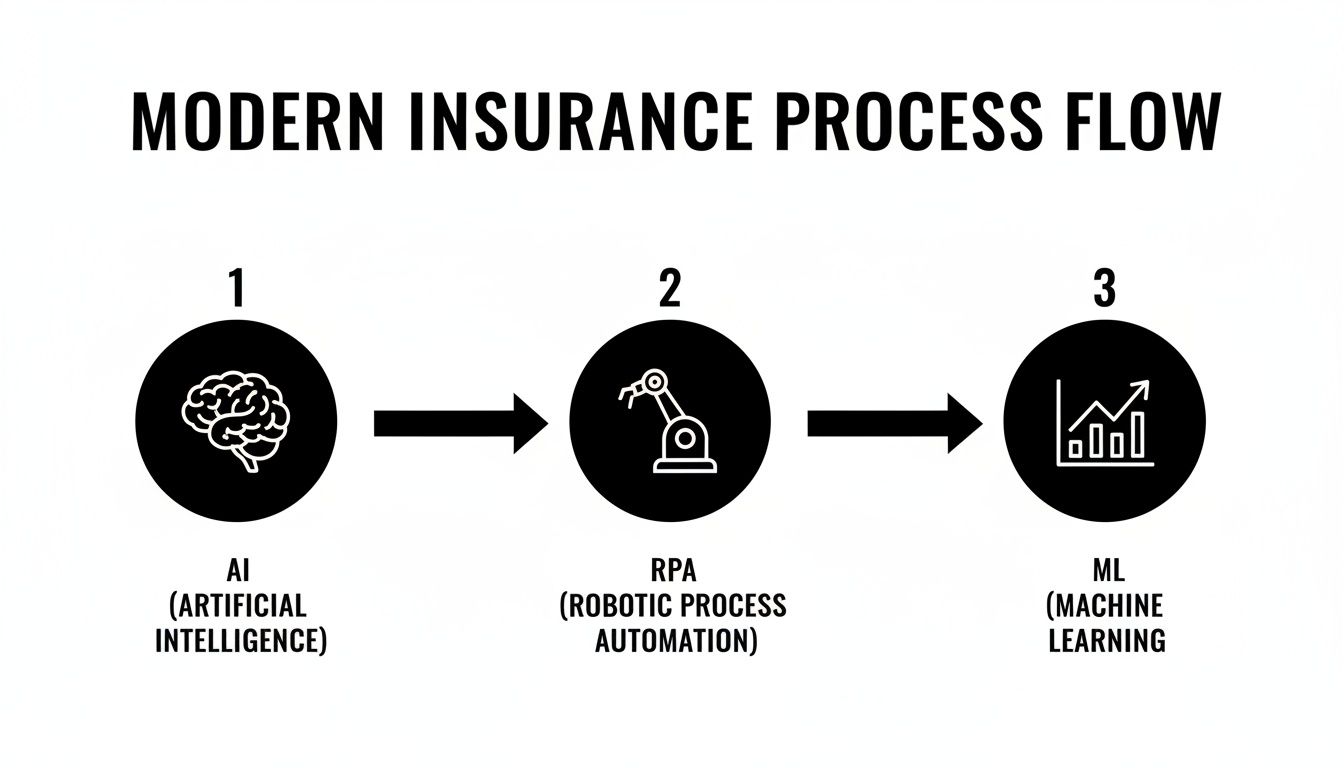
Natural Language Processing (NLP) models can pull key information from unstructured claim descriptions, while computer vision analyzes the uploaded images to perform an initial damage assessment. This triage happens in seconds, not hours, setting an entirely new standard for responsiveness.
From Initial Triage to Automated Assessment
Once the claim is filed, a whole suite of AI-powered tools takes the reins. For common, low-complexity claims like minor auto damage, the process can be almost entirely touchless. Computer vision models, trained on millions of historical claims images, can estimate repair costs with remarkable accuracy right from a customer's smartphone photos.
These claims AI reviews deliver an instant, consistent, and unbiased assessment, which is a game-changer for both speed and fairness.
This is arguably the most mature application of intelligent automation in the industry right now. Some studies show that AI-enhanced claims processing can slash cycle times by up to 70%. This isn't just an incremental improvement; it fundamentally changes how insurers handle damage assessments and customer interactions by combining multiple AI capabilities.
The contrast between the old way and the new way is stark. Let's break it down.
Comparing Traditional vs. AI-Powered Insurance Claims Processing
This table shows just how different the claims journey looks when intelligent automation is put to work, highlighting the massive gains in speed, efficiency, and accuracy at every stage.
Claims Stage | Traditional Manual Process | Intelligent Automation Process |
|---|---|---|
First Notice of Loss (FNOL) | Policyholder calls an agent or fills out paper/PDF forms. Manual data entry required. | Customer submits claim via mobile app with photos/videos. AI extracts data instantly. |
Damage Assessment | Adjuster physically inspects damage, schedules appointments, and writes a manual estimate. | Computer vision AI analyzes images/videos to generate an initial estimate in minutes. |
Claim Validation | Manual review of policy documents, police reports, and other paperwork to verify coverage. | AI automatically cross-references claim details with policy data, flagging discrepancies. |
Fraud Detection | Relies on adjuster's experience and manual checks, often after the fact. | Machine learning algorithms analyze claim data in real-time to detect suspicious patterns. |
Settlement & Payment | Adjuster manually calculates settlement, gets approvals, and initiates payment via check. | For simple claims, AI approves and triggers instant digital payment via RPA bots. |
Customer Communication | Reactive. Customer calls in for status updates, often waiting on hold. | Proactive. Automated text/email alerts keep the customer informed at every milestone. |
As you can see, intelligent automation doesn't just speed up isolated tasks; it creates a connected, transparent, and far more efficient experience from beginning to end.
The Human-in-the-Loop Advantage
A common myth is that automation is here to replace human adjusters. The reality is far more interesting. The goal is to create a "human-in-the-loop" model where technology and human expertise work in tandem.
By automating insurance claims with AI for the straightforward, high-volume cases, you free up your most experienced adjusters to do what they do best. Their time is no longer buried in administrative tasks but focused on applying critical thinking, negotiation skills, and empathy to the most complex and sensitive cases.
Think of it as a smarter way to allocate your best resources. While an AI agent can approve a simple windshield replacement in minutes, a seasoned adjuster can focus their energy on a multi-vehicle accident with conflicting reports or a severe property damage claim that requires delicate customer conversations. The AI acts as a powerful assistant, gathering data, summarizing police reports, and organizing evidence, presenting a complete file to the human expert.
This symbiotic relationship boosts both efficiency and the quality of the final outcome.
Orchestrating the Final Settlement
The final stage—payment and settlement—also gets a major upgrade through automation. Once a claim is approved (either by an AI agent or a human adjuster), Robotic Process Automation (RPA) bots take over the busywork. These bots can execute the payment, update the core claims system, and trigger all the necessary communications to the policyholder.
This end-to-end orchestration ensures the customer is kept in the loop at every step. Proactive AI customer care systems can send real-time status updates via text or email, answering "What's the status of my claim?" before the customer even has to ask.
As you build this engine for modern insurance, these solutions must also handle a variety of data formats seamlessly. This includes capabilities like translating a PDF and preserving its formatting, which is crucial for maintaining accurate records and meeting compliance standards, especially with international claims.
By connecting all these moving parts, intelligent automation creates a claims experience that is faster, more transparent, and dramatically more efficient. To dive deeper into optimizing this core function, you can read our complete guide on https://nolana.com/insurance-claims-processing.
Delivering Superior Service With AI Customer Care for Financial Services
Let’s be honest: for most people, interacting with their insurance company feels reactive and complicated. The old model of call centers, long hold times, and rigid 9-to-5 business hours just doesn't cut it anymore. This is where AI customer care for financial services is changing the game, moving past the stereotype of clunky, impersonal bots to deliver genuinely better service.
The point isn't just to answer questions faster. It’s about creating a support experience that is personalized, empathetic, and incredibly efficient, day or night. The most forward-thinking AI insurance companies are building service models that actually anticipate what a customer needs, offer instant help for common problems, and free up their human experts to handle the complex situations that require real insight and care.
The Always-On, Always-Informed Virtual Agent
Picture this: a policyholder needs to check their coverage details at 11 PM on a Sunday. Instead of waiting for the office to open, they can open the company's app and chat with an AI-powered virtual assistant. This isn't your basic chatbot. We're talking about a sophisticated agent that is plugged directly into the core insurance systems.
This virtual assistant can:
Verify the policyholder's identity securely.
Pull up their specific policy to give them accurate numbers on deductibles and coverage limits.
Explain confusing insurance terms in plain English.
Kick off a First Notice of Loss (FNOL) if the customer needs to start a claim right then and there.
This kind of immediate, 24/7 availability for routine questions is the new foundation of modern AI customer care. It clears a huge volume of simple queries off the board instantly, which frees up your human agents for more meaningful work and brings down operational costs.
Enhancing Human Expertise, Not Replacing It
There's a common myth that AI is coming for everyone's jobs in customer service. The reality is that intelligent automation actually makes human interactions more valuable. The goal isn't to replace people; it's to supercharge their abilities.
By handling the high-volume, repetitive tasks, AI gives human agents the time and data they need to resolve complex issues faster and build stronger, trust-based relationships. It turns them from information retrievers into true problem-solvers.
Think about a customer who's frustrated about their claim's status. Sentiment analysis tools can pick up on the tone and urgency in their chat messages or their voice on a call. Before that frustration boils over, the AI can seamlessly route the conversation to a specialized human agent in a heartbeat.
When the agent gets the call, their screen is already loaded with the customer's entire history—policy details, past conversations, and the full context of the current issue. This complete picture, often powered by deep integrations with core systems like Guidewire or Duck Creek, means the customer never has to repeat their story. The agent can dive right in with empathy and a full grasp of the situation. This blend of smart technology and human expertise is what truly sets leading AI insurance companies apart. If you want to dive deeper, you can learn more about AI customer care in our dedicated article.
Proactive Communication That Builds Trust
One of the biggest sources of anxiety for a customer is uncertainty, especially during a claim. Intelligent automation flips the script on communication, turning it from reactive to proactive. It's all about keeping policyholders in the loop.
Once a claim is filed, an automated system can push out real-time updates via text, email, or a mobile app notification—whatever the customer prefers. These messages can confirm documents were received, let them know an adjuster has been assigned, and even provide an estimated timeline for their claims AI reviews.
This proactive approach accomplishes several key things:
Reduces Inbound Calls: It answers the question, "What's the status of my claim?" before it's even asked, which dramatically lowers call volumes.
Manages Expectations: Clear, consistent communication helps manage policyholder expectations, cutting down on frustration and worry.
Builds Lasting Trust: Keeping customers informed shows transparency and reliability, strengthening the relationship at a time when it matters most.
Ultimately, this intelligent approach creates a smooth, low-effort experience that finally aligns with what customers have come to expect from every other industry. It’s fast, it’s personal, and it’s always on.
Shifting From Reactive Payouts To Proactive Prevention
For generations, the insurance business model was simple and reactive. Something bad happened—a car crash, a house fire, a flood—and the insurer would step in to pay for the damages. But intelligent automation in insurance is flipping that entire script. The industry is moving away from a model of reactive compensation toward one of proactive prevention. Insurers are no longer just financial first responders; they're becoming co-pilots in their customers' lives.
This fundamental change is fueled by a constant flow of real-time data from an ever-expanding network of connected devices. Think about telematics in a car that track driving habits or smart home sensors that can spot a tiny water leak long before it turns into a catastrophe. By channeling this data into AI-powered analytical systems, insurers can identify and act on risks before they ever become claims.

From Risk Pricing to Risk Mitigation
The old way was to price a policy based on historical data and probabilities. The new way is to actively work with the customer to lower that risk in the here and now. Instead of just cutting a check after a hailstorm, an insurer's AI can analyze meteorological data and automatically push a targeted alert to a policyholder in the storm's path, advising them to move their car into the garage.
This isn't just a generic notification; it's a precise, strategic intervention. These automated alerts can be incredibly powerful:
Weather Alerts: Sending push notifications about approaching hailstorms or floods with clear, actionable advice.
Maintenance Reminders: Using data from smart home sensors to suggest a plumbing inspection after detecting odd pressure changes, heading off a massive water damage claim.
Driving Feedback: Analyzing telematics data to give personalized tips for safer driving, directly reducing the odds of an accident.
This move from prediction to prevention is a complete re-imagining of what an insurer does. Rather than just modeling what might happen, AI insurance companies are using technology to influence outcomes and reduce risk through direct, proactive engagement. This evolution is only possible by integrating data from IoT and telematic devices that deliver real-time insights. You can discover more about this shift toward AI-driven prevention at Roots.ai.
A New Value Proposition for the Customer
This proactive approach completely redefines the value of an insurance policy. The company is no longer just a distant financial safety net. It becomes an active partner in protecting the people and things that matter most to the customer. This builds a kind of loyalty that no discount or marketing slogan ever could.
When an insurer helps a customer avoid a disaster altogether, the perceived value of that policy goes through the roof. It’s no longer an abstract promise for some unknown future event; it’s a tangible, real-world service that provides genuine peace of mind today.
This strategy of proactive prevention has a powerful dual benefit. It directly improves the insurer's loss ratios by reducing the number and severity of claims, while simultaneously strengthening the customer relationship by demonstrating a genuine commitment to their well-being.
This creates a positive feedback loop. Customers who feel their insurer is looking out for them are far more likely to stay, share more data, and listen to personalized advice. Think about it: a homeowner who avoids a flooded basement because of a timely alert is not shopping for a new policy next year. They're telling their friends about it. This model transforms insurance from a grudging necessity into a valuable, ongoing service, rewriting the rules of customer engagement for the whole industry.
Your Roadmap To Implementing IntelligentAutomation
Getting started with intelligent automation in insurance can feel like a massive undertaking, but it doesn't have to be. The most successful initiatives I've seen don't try to boil the ocean. Instead, they follow a smart, phased roadmap that builds momentum with early, tangible wins.
It’s about being strategic. A well-thought-out plan turns a daunting project into a series of manageable steps, ensuring you deliver real business value right from the start. The journey begins not by picking technology, but by identifying the right problems to solve.
Phase 1: Identify High-Impact Use Cases
The best place to begin is where automation can make the biggest difference with the least amount of friction. Look for processes that are bogged down by repetitive, rules-based work and cause clear bottlenecks. These are your ideal pilot projects.
Here are a few classic starting points that deliver quick wins:
FNOL Intake: Capturing and validating first notice of loss information is a perfect candidate. It's a high-volume activity where speed and accuracy have a massive downstream impact on the entire claims journey.
Common Service Questions: Think about deploying AI customer care agents to handle the simple, frequent inquiries like, "What's my policy deductible?" or "Can I get a status update on my claim?" This frees up your human team for the tough stuff.
Simple Claims Adjudication: For straightforward claims like a chipped windshield, an AI agent can often handle everything from reviewing the photo to issuing payment without any human touch. To see how this works in more detail, check out our guide on automating insurance claims processing.
By targeting these areas first, you can demonstrate undeniable value almost immediately. Faster intake and 24/7 customer support are highly visible improvements that build a powerful case for expanding your automation efforts.
Phase 2: Plan a Phased Rollout and Integration
Once you’ve picked your initial targets, it’s time to map out a phased implementation. Resist the temptation of a "big bang" launch—it's far too risky. A methodical rollout allows you to learn, adapt, and build confidence across the business.
A critical piece of this puzzle is integration. Your automation platform must be able to talk to your existing core systems. For AI insurance companies, this means seamless, deep connections with platforms like Guidewire, Duck Creek, and Salesforce. After all, your automation tools are only as smart as the data they can access.
A successful intelligent automation strategy is built on a foundation of clean, accessible data. Before deploying a single AI agent, you must have a clear plan for data readiness and API-driven integration to create a single source of truth that powers your automated workflows.
This is also the phase where you choose your technology partners. Look for vendors who genuinely understand the unique regulatory and operational headaches of the insurance industry. Their experience can be a game-changer when it comes to marrying modern AI with your legacy systems.
Phase 3: Establish a Strong Governance Framework
Finally, to scale your automation confidently, you need a rock-solid governance framework. This is about more than just technology; it's about setting clear rules of engagement for how your human and digital workforces will collaborate.
Your framework should be built on three pillars:
Clear Guardrails: Define exactly where AI agents can operate and make decisions on their own. What's the limit of their authority?
Human Escalation Paths: Create a foolproof process for handing off a case when it gets too complex or requires a human's empathetic judgment. The system must know precisely when to flag an expert.
Audit and Compliance Trails: Ensure every single action taken by an AI is logged and fully auditable. This isn't just good practice; it's essential for meeting strict regulatory demands.
This structure provides the control and oversight you need to scale. It creates a secure, trusted environment where your claims AI reviews and automated customer interactions are both hyper-efficient and completely reliable.
Measuring The Real ROI Of Your Automation Strategy
Putting intelligent automation in insurance to work is a significant investment, so you need to prove its worth by looking past simple cost-cutting. Yes, lowering operational expenses is a major win, but the real return on investment (ROI) comes from a much wider view of performance—one that includes better efficiency, happier customers, and a more resilient business.
To make a convincing case for automation, you need a solid ROI model that captures both the hard-dollar savings and the equally important indirect benefits. This means tracking how automation touches every part of the insurance lifecycle, from the first time a customer calls to the moment a claim is settled. A clear framework doesn't just justify the initial spend; it gives you a blueprint for getting better over time.
Key Performance Indicators Beyond Cost Savings
The true test of your automation strategy is how well it improves the core functions of your insurance business. For AI insurance companies, this boils down to measuring gains in speed, accuracy, and customer satisfaction.
Here are the metrics that really matter:
Shorter Claims Cycle Times: This is a huge one. Track the average time it takes to get from the First Notice of Loss (FNOL) to a final settlement. When claims AI reviews speed things up, you not only reduce loss adjustment expenses but also make policyholders much, much happier.
Higher Customer Satisfaction (CSAT) Scores: Once your AI customer care agents are live, keep a close eye on your CSAT and Net Promoter Score (NPS). Customers notice when they get faster answers, 24/7 support, and clear communication. That directly translates into loyalty and retention.
Better Adjuster and Agent Productivity: It’s not about cutting headcount; it’s about increasing output. How many more claims can a single adjuster now handle? How many more customer questions can an agent answer in a day? Automation should be a force multiplier for your people.
Improved Fraud Detection Rates: AI is brilliant at spotting patterns humans would never catch, flagging suspicious claims with incredible precision. Tracking the drop in fraudulent payouts gives you a direct, hard-to-argue-with financial ROI.
Building a Comprehensive ROI Model
A truly effective ROI model tells the whole story, connecting your investment in technology directly to your bottom line. It should calculate not only the money you save but also the new value you create. For instance, slashing claim cycle times by 25% doesn't just trim operational costs—it stops frustrated customers from leaving, and that has a very real dollar value.
A holistic view of ROI includes softer, yet crucial, benefits. Consider the impact on employee morale when tedious, repetitive work is automated, allowing staff to focus on more engaging, high-value tasks. Also, factor in the value of enhanced compliance, as automated systems ensure processes are followed consistently, reducing regulatory risk.
By tracking these diverse metrics, you can build an undeniable business case for your stakeholders. This data-first approach shows that intelligent automation isn't just another IT project; it's a strategic move that fuels real, sustainable growth. For more insights on this topic, you can learn how to measure operational efficiency in our detailed guide.
Frequently Asked Questions
When we start talking about intelligent automation, some excellent and very practical questions always come up. Leaders want to get past the buzzwords and understand how these tools really perform when the rubber meets the road. Let's dig into a few of the most common ones.
How Does Automation Handle Complex Claims?
This is a great question because it gets to the heart of the human-machine partnership. The goal isn't to replace your seasoned adjusters; it's to supercharge them.
For a simple, clear-cut claim, an automated system can often handle the whole thing from start to finish. But what about the messy, complex cases that require real judgment? That's where automation shines as an expert's assistant. It does the grunt work—gathering data, pulling documents, and organizing everything into a neat, actionable file.
This frees up your human adjuster to focus on what they do best: critical thinking, nuanced negotiation, and empathetic customer communication. They get to apply their hard-won experience where it matters most, instead of getting bogged down in administrative tasks.
What Is the Biggest Challenge for AI in Insurance?
From what I've seen over the years, the single biggest hurdle for AI insurance companies is almost always data readiness. You can have the most sophisticated AI on the planet, but it's only as good as the data it can access.
Many carriers are still working with legacy systems where policy information is in one silo and claims data is in another. For an AI agent to be effective, it needs a direct, clean line into core platforms like Guidewire or Duck Creek. Without that unified view, its hands are tied.
Any serious automation strategy has to start with a solid plan for data integration and API connectivity. You have to build that "single source of truth" first; it's the foundation for everything else.
Can AI Customer Care Genuinely Improve the Customer Experience?
Without a doubt. We've moved far beyond the clunky, first-generation chatbots that frustrated everyone. Modern AI customer care is a whole different ballgame.
By plugging directly into your core systems, today's AI agents can provide personalized, context-aware support 24/7. They can pull up a customer's entire history in an instant to answer specific policy questions accurately.
It gets even smarter. Sentiment analysis can detect frustration in a customer's tone or language and immediately hand the conversation off to a human agent. This creates the perfect balance: policyholders get instant answers for simple queries and empathetic, human support for more sensitive issues. It's a powerful way to build both satisfaction and brand trust.
Ready to see how AI agents can truly reshape your insurance operations? Nolana offers an AI-native operating system built to automate complex claims, customer service, and case management workflows with unmatched precision and compliance. Schedule a demo to learn more.
Think of intelligent automation as the new operational engine for the insurance industry. It’s a powerful combination of Artificial Intelligence (AI) and Robotic Process Automation (RPA) designed to manage complex, end-to-end business processes. For modern AI insurance companies, this isn't just about speeding up old tasks; it's about creating a more responsive, efficient, and data-fluent organization.
This shift is crucial for everything from automating insurance claims with AI to delivering the kind of seamless experience customers now demand.
The New Engine Powering Modern Insurance
For decades, insurance has run on established, often manual, workflows for underwriting, claims, and customer service. These processes, while dependable, are slow, expensive, and frankly out of step with today's expectations for speed and convenience. Intelligent automation completely rewrites this playbook, installing a new, smarter operational core.
Leading carriers no longer see this as some far-off concept—it's a present-day necessity. The goal has moved beyond simple cost-cutting to fundamentally redesigning how work gets done. By orchestrating a team of AI agents, machine learning models, and RPA bots, insurers can build workflows that are not only faster but also more intelligent and resilient.
Shifting from Manual Work to Intelligent Workflows
The real impact comes from tackling the industry's biggest pain points. Let's look at two of the most critical functions in any insurance operation: processing claims and serving customers.
Automating Insurance Claims with AI: We all know manual claims processing can be a bottleneck, leading to delays and errors. Intelligent automation introduces tools that can instantly review a first notice of loss, analyze damage from photos using computer vision, and even approve and process simple payments without a human ever touching them. This dramatically speeds up settlement times and ensures greater accuracy in claims AI reviews.
Enhancing AI Customer Care: Policyholders expect answers now, not tomorrow. AI customer care systems, like chatbots and virtual assistants, offer 24/7 support for financial services. They can answer policy questions, give claim status updates, and know exactly when to hand off a complex issue to a human expert.
At its core, intelligent automation is about creating a powerful partnership between people and machines. By handing off the high-volume, repetitive work, it frees up your most skilled professionals—the claims adjusters, underwriters, and service agents—to focus on what they do best: applying empathy, critical thinking, and expert judgment to complex situations.
Preparing for an AI-Driven Future
The industry is voting with its budget, and the commitment to this new way of working is clear. Spending on artificial intelligence in insurance is projected to jump by more than 25% in 2026. This isn't just a trend; it's a fundamental rewiring of core operations. In fact, 89% of insurance CIOs are actively boosting their AI investments specifically to improve the customer experience.
Throughout this guide, we’ll move past the theory and get into the practical applications. We'll explore real-world use cases showing how intelligent automation in insurance has become a strategic business imperative, not just another IT project. For a deeper dive into the foundational ideas, check out our guide on intelligent process automation.
Automating Insurance Claims with AI: From Notice to Settlement
The claims process is the moment of truth in any insurance relationship. It’s where promises are put to the test, and customer loyalty is either cemented or shattered. For decades, this journey was a marathon of paperwork, phone calls, and manual reviews, creating a slow and often frustrating experience for everyone involved.
Today, automating insurance claims with AI is completely flipping that script. It's helping the industry move from a reactive, labor-intensive model to a proactive, data-driven workflow that actually works for the customer.
It all starts at the very first touchpoint: the First Notice of Loss (FNOL). Instead of a policyholder hunting for a form to fill out, they can now file a claim through a mobile app in just a few minutes. They upload photos and videos of the damage, and an AI agent immediately gets to work. This isn't just about collecting data; it's about understanding it on the spot.
Natural Language Processing (NLP) models can pull key information from unstructured claim descriptions, while computer vision analyzes the uploaded images to perform an initial damage assessment. This triage happens in seconds, not hours, setting an entirely new standard for responsiveness.
From Initial Triage to Automated Assessment
Once the claim is filed, a whole suite of AI-powered tools takes the reins. For common, low-complexity claims like minor auto damage, the process can be almost entirely touchless. Computer vision models, trained on millions of historical claims images, can estimate repair costs with remarkable accuracy right from a customer's smartphone photos.
These claims AI reviews deliver an instant, consistent, and unbiased assessment, which is a game-changer for both speed and fairness.
This is arguably the most mature application of intelligent automation in the industry right now. Some studies show that AI-enhanced claims processing can slash cycle times by up to 70%. This isn't just an incremental improvement; it fundamentally changes how insurers handle damage assessments and customer interactions by combining multiple AI capabilities.
The contrast between the old way and the new way is stark. Let's break it down.
Comparing Traditional vs. AI-Powered Insurance Claims Processing
This table shows just how different the claims journey looks when intelligent automation is put to work, highlighting the massive gains in speed, efficiency, and accuracy at every stage.
Claims Stage | Traditional Manual Process | Intelligent Automation Process |
|---|---|---|
First Notice of Loss (FNOL) | Policyholder calls an agent or fills out paper/PDF forms. Manual data entry required. | Customer submits claim via mobile app with photos/videos. AI extracts data instantly. |
Damage Assessment | Adjuster physically inspects damage, schedules appointments, and writes a manual estimate. | Computer vision AI analyzes images/videos to generate an initial estimate in minutes. |
Claim Validation | Manual review of policy documents, police reports, and other paperwork to verify coverage. | AI automatically cross-references claim details with policy data, flagging discrepancies. |
Fraud Detection | Relies on adjuster's experience and manual checks, often after the fact. | Machine learning algorithms analyze claim data in real-time to detect suspicious patterns. |
Settlement & Payment | Adjuster manually calculates settlement, gets approvals, and initiates payment via check. | For simple claims, AI approves and triggers instant digital payment via RPA bots. |
Customer Communication | Reactive. Customer calls in for status updates, often waiting on hold. | Proactive. Automated text/email alerts keep the customer informed at every milestone. |
As you can see, intelligent automation doesn't just speed up isolated tasks; it creates a connected, transparent, and far more efficient experience from beginning to end.
The Human-in-the-Loop Advantage
A common myth is that automation is here to replace human adjusters. The reality is far more interesting. The goal is to create a "human-in-the-loop" model where technology and human expertise work in tandem.
By automating insurance claims with AI for the straightforward, high-volume cases, you free up your most experienced adjusters to do what they do best. Their time is no longer buried in administrative tasks but focused on applying critical thinking, negotiation skills, and empathy to the most complex and sensitive cases.
Think of it as a smarter way to allocate your best resources. While an AI agent can approve a simple windshield replacement in minutes, a seasoned adjuster can focus their energy on a multi-vehicle accident with conflicting reports or a severe property damage claim that requires delicate customer conversations. The AI acts as a powerful assistant, gathering data, summarizing police reports, and organizing evidence, presenting a complete file to the human expert.
This symbiotic relationship boosts both efficiency and the quality of the final outcome.
Orchestrating the Final Settlement
The final stage—payment and settlement—also gets a major upgrade through automation. Once a claim is approved (either by an AI agent or a human adjuster), Robotic Process Automation (RPA) bots take over the busywork. These bots can execute the payment, update the core claims system, and trigger all the necessary communications to the policyholder.
This end-to-end orchestration ensures the customer is kept in the loop at every step. Proactive AI customer care systems can send real-time status updates via text or email, answering "What's the status of my claim?" before the customer even has to ask.
As you build this engine for modern insurance, these solutions must also handle a variety of data formats seamlessly. This includes capabilities like translating a PDF and preserving its formatting, which is crucial for maintaining accurate records and meeting compliance standards, especially with international claims.
By connecting all these moving parts, intelligent automation creates a claims experience that is faster, more transparent, and dramatically more efficient. To dive deeper into optimizing this core function, you can read our complete guide on https://nolana.com/insurance-claims-processing.
Delivering Superior Service With AI Customer Care for Financial Services
Let’s be honest: for most people, interacting with their insurance company feels reactive and complicated. The old model of call centers, long hold times, and rigid 9-to-5 business hours just doesn't cut it anymore. This is where AI customer care for financial services is changing the game, moving past the stereotype of clunky, impersonal bots to deliver genuinely better service.
The point isn't just to answer questions faster. It’s about creating a support experience that is personalized, empathetic, and incredibly efficient, day or night. The most forward-thinking AI insurance companies are building service models that actually anticipate what a customer needs, offer instant help for common problems, and free up their human experts to handle the complex situations that require real insight and care.
The Always-On, Always-Informed Virtual Agent
Picture this: a policyholder needs to check their coverage details at 11 PM on a Sunday. Instead of waiting for the office to open, they can open the company's app and chat with an AI-powered virtual assistant. This isn't your basic chatbot. We're talking about a sophisticated agent that is plugged directly into the core insurance systems.
This virtual assistant can:
Verify the policyholder's identity securely.
Pull up their specific policy to give them accurate numbers on deductibles and coverage limits.
Explain confusing insurance terms in plain English.
Kick off a First Notice of Loss (FNOL) if the customer needs to start a claim right then and there.
This kind of immediate, 24/7 availability for routine questions is the new foundation of modern AI customer care. It clears a huge volume of simple queries off the board instantly, which frees up your human agents for more meaningful work and brings down operational costs.
Enhancing Human Expertise, Not Replacing It
There's a common myth that AI is coming for everyone's jobs in customer service. The reality is that intelligent automation actually makes human interactions more valuable. The goal isn't to replace people; it's to supercharge their abilities.
By handling the high-volume, repetitive tasks, AI gives human agents the time and data they need to resolve complex issues faster and build stronger, trust-based relationships. It turns them from information retrievers into true problem-solvers.
Think about a customer who's frustrated about their claim's status. Sentiment analysis tools can pick up on the tone and urgency in their chat messages or their voice on a call. Before that frustration boils over, the AI can seamlessly route the conversation to a specialized human agent in a heartbeat.
When the agent gets the call, their screen is already loaded with the customer's entire history—policy details, past conversations, and the full context of the current issue. This complete picture, often powered by deep integrations with core systems like Guidewire or Duck Creek, means the customer never has to repeat their story. The agent can dive right in with empathy and a full grasp of the situation. This blend of smart technology and human expertise is what truly sets leading AI insurance companies apart. If you want to dive deeper, you can learn more about AI customer care in our dedicated article.
Proactive Communication That Builds Trust
One of the biggest sources of anxiety for a customer is uncertainty, especially during a claim. Intelligent automation flips the script on communication, turning it from reactive to proactive. It's all about keeping policyholders in the loop.
Once a claim is filed, an automated system can push out real-time updates via text, email, or a mobile app notification—whatever the customer prefers. These messages can confirm documents were received, let them know an adjuster has been assigned, and even provide an estimated timeline for their claims AI reviews.
This proactive approach accomplishes several key things:
Reduces Inbound Calls: It answers the question, "What's the status of my claim?" before it's even asked, which dramatically lowers call volumes.
Manages Expectations: Clear, consistent communication helps manage policyholder expectations, cutting down on frustration and worry.
Builds Lasting Trust: Keeping customers informed shows transparency and reliability, strengthening the relationship at a time when it matters most.
Ultimately, this intelligent approach creates a smooth, low-effort experience that finally aligns with what customers have come to expect from every other industry. It’s fast, it’s personal, and it’s always on.
Shifting From Reactive Payouts To Proactive Prevention
For generations, the insurance business model was simple and reactive. Something bad happened—a car crash, a house fire, a flood—and the insurer would step in to pay for the damages. But intelligent automation in insurance is flipping that entire script. The industry is moving away from a model of reactive compensation toward one of proactive prevention. Insurers are no longer just financial first responders; they're becoming co-pilots in their customers' lives.
This fundamental change is fueled by a constant flow of real-time data from an ever-expanding network of connected devices. Think about telematics in a car that track driving habits or smart home sensors that can spot a tiny water leak long before it turns into a catastrophe. By channeling this data into AI-powered analytical systems, insurers can identify and act on risks before they ever become claims.
From Risk Pricing to Risk Mitigation
The old way was to price a policy based on historical data and probabilities. The new way is to actively work with the customer to lower that risk in the here and now. Instead of just cutting a check after a hailstorm, an insurer's AI can analyze meteorological data and automatically push a targeted alert to a policyholder in the storm's path, advising them to move their car into the garage.
This isn't just a generic notification; it's a precise, strategic intervention. These automated alerts can be incredibly powerful:
Weather Alerts: Sending push notifications about approaching hailstorms or floods with clear, actionable advice.
Maintenance Reminders: Using data from smart home sensors to suggest a plumbing inspection after detecting odd pressure changes, heading off a massive water damage claim.
Driving Feedback: Analyzing telematics data to give personalized tips for safer driving, directly reducing the odds of an accident.
This move from prediction to prevention is a complete re-imagining of what an insurer does. Rather than just modeling what might happen, AI insurance companies are using technology to influence outcomes and reduce risk through direct, proactive engagement. This evolution is only possible by integrating data from IoT and telematic devices that deliver real-time insights. You can discover more about this shift toward AI-driven prevention at Roots.ai.
A New Value Proposition for the Customer
This proactive approach completely redefines the value of an insurance policy. The company is no longer just a distant financial safety net. It becomes an active partner in protecting the people and things that matter most to the customer. This builds a kind of loyalty that no discount or marketing slogan ever could.
When an insurer helps a customer avoid a disaster altogether, the perceived value of that policy goes through the roof. It’s no longer an abstract promise for some unknown future event; it’s a tangible, real-world service that provides genuine peace of mind today.
This strategy of proactive prevention has a powerful dual benefit. It directly improves the insurer's loss ratios by reducing the number and severity of claims, while simultaneously strengthening the customer relationship by demonstrating a genuine commitment to their well-being.
This creates a positive feedback loop. Customers who feel their insurer is looking out for them are far more likely to stay, share more data, and listen to personalized advice. Think about it: a homeowner who avoids a flooded basement because of a timely alert is not shopping for a new policy next year. They're telling their friends about it. This model transforms insurance from a grudging necessity into a valuable, ongoing service, rewriting the rules of customer engagement for the whole industry.
Your Roadmap To Implementing IntelligentAutomation
Getting started with intelligent automation in insurance can feel like a massive undertaking, but it doesn't have to be. The most successful initiatives I've seen don't try to boil the ocean. Instead, they follow a smart, phased roadmap that builds momentum with early, tangible wins.
It’s about being strategic. A well-thought-out plan turns a daunting project into a series of manageable steps, ensuring you deliver real business value right from the start. The journey begins not by picking technology, but by identifying the right problems to solve.
Phase 1: Identify High-Impact Use Cases
The best place to begin is where automation can make the biggest difference with the least amount of friction. Look for processes that are bogged down by repetitive, rules-based work and cause clear bottlenecks. These are your ideal pilot projects.
Here are a few classic starting points that deliver quick wins:
FNOL Intake: Capturing and validating first notice of loss information is a perfect candidate. It's a high-volume activity where speed and accuracy have a massive downstream impact on the entire claims journey.
Common Service Questions: Think about deploying AI customer care agents to handle the simple, frequent inquiries like, "What's my policy deductible?" or "Can I get a status update on my claim?" This frees up your human team for the tough stuff.
Simple Claims Adjudication: For straightforward claims like a chipped windshield, an AI agent can often handle everything from reviewing the photo to issuing payment without any human touch. To see how this works in more detail, check out our guide on automating insurance claims processing.
By targeting these areas first, you can demonstrate undeniable value almost immediately. Faster intake and 24/7 customer support are highly visible improvements that build a powerful case for expanding your automation efforts.
Phase 2: Plan a Phased Rollout and Integration
Once you’ve picked your initial targets, it’s time to map out a phased implementation. Resist the temptation of a "big bang" launch—it's far too risky. A methodical rollout allows you to learn, adapt, and build confidence across the business.
A critical piece of this puzzle is integration. Your automation platform must be able to talk to your existing core systems. For AI insurance companies, this means seamless, deep connections with platforms like Guidewire, Duck Creek, and Salesforce. After all, your automation tools are only as smart as the data they can access.
A successful intelligent automation strategy is built on a foundation of clean, accessible data. Before deploying a single AI agent, you must have a clear plan for data readiness and API-driven integration to create a single source of truth that powers your automated workflows.
This is also the phase where you choose your technology partners. Look for vendors who genuinely understand the unique regulatory and operational headaches of the insurance industry. Their experience can be a game-changer when it comes to marrying modern AI with your legacy systems.
Phase 3: Establish a Strong Governance Framework
Finally, to scale your automation confidently, you need a rock-solid governance framework. This is about more than just technology; it's about setting clear rules of engagement for how your human and digital workforces will collaborate.
Your framework should be built on three pillars:
Clear Guardrails: Define exactly where AI agents can operate and make decisions on their own. What's the limit of their authority?
Human Escalation Paths: Create a foolproof process for handing off a case when it gets too complex or requires a human's empathetic judgment. The system must know precisely when to flag an expert.
Audit and Compliance Trails: Ensure every single action taken by an AI is logged and fully auditable. This isn't just good practice; it's essential for meeting strict regulatory demands.
This structure provides the control and oversight you need to scale. It creates a secure, trusted environment where your claims AI reviews and automated customer interactions are both hyper-efficient and completely reliable.
Measuring The Real ROI Of Your Automation Strategy
Putting intelligent automation in insurance to work is a significant investment, so you need to prove its worth by looking past simple cost-cutting. Yes, lowering operational expenses is a major win, but the real return on investment (ROI) comes from a much wider view of performance—one that includes better efficiency, happier customers, and a more resilient business.
To make a convincing case for automation, you need a solid ROI model that captures both the hard-dollar savings and the equally important indirect benefits. This means tracking how automation touches every part of the insurance lifecycle, from the first time a customer calls to the moment a claim is settled. A clear framework doesn't just justify the initial spend; it gives you a blueprint for getting better over time.
Key Performance Indicators Beyond Cost Savings
The true test of your automation strategy is how well it improves the core functions of your insurance business. For AI insurance companies, this boils down to measuring gains in speed, accuracy, and customer satisfaction.
Here are the metrics that really matter:
Shorter Claims Cycle Times: This is a huge one. Track the average time it takes to get from the First Notice of Loss (FNOL) to a final settlement. When claims AI reviews speed things up, you not only reduce loss adjustment expenses but also make policyholders much, much happier.
Higher Customer Satisfaction (CSAT) Scores: Once your AI customer care agents are live, keep a close eye on your CSAT and Net Promoter Score (NPS). Customers notice when they get faster answers, 24/7 support, and clear communication. That directly translates into loyalty and retention.
Better Adjuster and Agent Productivity: It’s not about cutting headcount; it’s about increasing output. How many more claims can a single adjuster now handle? How many more customer questions can an agent answer in a day? Automation should be a force multiplier for your people.
Improved Fraud Detection Rates: AI is brilliant at spotting patterns humans would never catch, flagging suspicious claims with incredible precision. Tracking the drop in fraudulent payouts gives you a direct, hard-to-argue-with financial ROI.
Building a Comprehensive ROI Model
A truly effective ROI model tells the whole story, connecting your investment in technology directly to your bottom line. It should calculate not only the money you save but also the new value you create. For instance, slashing claim cycle times by 25% doesn't just trim operational costs—it stops frustrated customers from leaving, and that has a very real dollar value.
A holistic view of ROI includes softer, yet crucial, benefits. Consider the impact on employee morale when tedious, repetitive work is automated, allowing staff to focus on more engaging, high-value tasks. Also, factor in the value of enhanced compliance, as automated systems ensure processes are followed consistently, reducing regulatory risk.
By tracking these diverse metrics, you can build an undeniable business case for your stakeholders. This data-first approach shows that intelligent automation isn't just another IT project; it's a strategic move that fuels real, sustainable growth. For more insights on this topic, you can learn how to measure operational efficiency in our detailed guide.
Frequently Asked Questions
When we start talking about intelligent automation, some excellent and very practical questions always come up. Leaders want to get past the buzzwords and understand how these tools really perform when the rubber meets the road. Let's dig into a few of the most common ones.
How Does Automation Handle Complex Claims?
This is a great question because it gets to the heart of the human-machine partnership. The goal isn't to replace your seasoned adjusters; it's to supercharge them.
For a simple, clear-cut claim, an automated system can often handle the whole thing from start to finish. But what about the messy, complex cases that require real judgment? That's where automation shines as an expert's assistant. It does the grunt work—gathering data, pulling documents, and organizing everything into a neat, actionable file.
This frees up your human adjuster to focus on what they do best: critical thinking, nuanced negotiation, and empathetic customer communication. They get to apply their hard-won experience where it matters most, instead of getting bogged down in administrative tasks.
What Is the Biggest Challenge for AI in Insurance?
From what I've seen over the years, the single biggest hurdle for AI insurance companies is almost always data readiness. You can have the most sophisticated AI on the planet, but it's only as good as the data it can access.
Many carriers are still working with legacy systems where policy information is in one silo and claims data is in another. For an AI agent to be effective, it needs a direct, clean line into core platforms like Guidewire or Duck Creek. Without that unified view, its hands are tied.
Any serious automation strategy has to start with a solid plan for data integration and API connectivity. You have to build that "single source of truth" first; it's the foundation for everything else.
Can AI Customer Care Genuinely Improve the Customer Experience?
Without a doubt. We've moved far beyond the clunky, first-generation chatbots that frustrated everyone. Modern AI customer care is a whole different ballgame.
By plugging directly into your core systems, today's AI agents can provide personalized, context-aware support 24/7. They can pull up a customer's entire history in an instant to answer specific policy questions accurately.
It gets even smarter. Sentiment analysis can detect frustration in a customer's tone or language and immediately hand the conversation off to a human agent. This creates the perfect balance: policyholders get instant answers for simple queries and empathetic, human support for more sensitive issues. It's a powerful way to build both satisfaction and brand trust.
Ready to see how AI agents can truly reshape your insurance operations? Nolana offers an AI-native operating system built to automate complex claims, customer service, and case management workflows with unmatched precision and compliance. Schedule a demo to learn more.


All systems operational
1 Lime Street, London EC3M 7HA | 222E 3rd Street, New York 10009
Copyright © 2026, Nolana. All rights reserved
All systems operational
1 Lime Street, London EC3M 7HA | 222E 3rd Street, New York 10009
Copyright © 2026, Nolana. All rights reserved
All systems operational
1 Lime Street, London EC3M 7HA | 222E 3rd Street, New York 10009
Copyright © 2026, Nolana. All rights reserved
All systems operational
1 Lime Street, London EC3M 7HA | 222E 3rd Street, New York 10009
Copyright © 2026, Nolana. All rights reserved