How AI Customer Care Is Redefining Finance and Insurance
How AI Customer Care Is Redefining Finance and Insurance
Discover how AI customer care is transforming financial services and insurance. Learn proven use cases, benefits, and strategies for implementation.
AI customer care is simply about using artificial intelligence to make every customer interaction better, faster, and smarter. In high-stakes industries like financial services and insurance, this goes way beyond a simple website chatbot. We're talking about sophisticated systems that can process claims, offer personalized financial guidance, and even spot fraud in real-time.
The result? Customers get the instant, 24/7 support they expect, and businesses run more efficiently.
The New Digital Standard in Finance and Insurance
Imagine a world where insurance claims are settled in minutes, not weeks, and personalized financial advice is available on your phone at 3 AM. This isn't some far-off vision; for many firms, it's the new reality being built with AI customer care. This technology is fundamentally changing the game in finance and insurance, creating a new benchmark for what great service looks like.
The technology has grown up fast. Early AI was all about basic chatbots answering simple questions. Now, we have intelligent systems orchestrating entire workflows, from the first notice of an insurance claim to providing tailored investment insights. It’s like giving every customer their own digital specialist, one that works hand-in-hand with your human experts to deliver faster, more accurate service around the clock.
Shifting Customer Expectations
Let's face it, today's customers want everything now. They expect immediate, personalized, and hassle-free service, whether they're opening a bank account or filing a claim. The old way of doing things in finance and insurance—heavy on paperwork, phone tag, and long waits—just doesn't cut it anymore. AI customer care tackles these frustrations head-on by automating the routine stuff and delivering instant answers.
For instance, leading AI insurance companies are completely overhauling the claims experience. Instead of a mountain of forms and endless follow-up calls, a customer can now submit a claim through an app, have AI analyze the damage from a photo, and get a decision in a fraction of the time. This kind of speed and simplicity turns a traditionally stressful event into a positive brand experience. At its core, this shift shows how AI and Big Data are revolutionizing industries and banking, raising the bar for everyone.
By automating high-volume, data-intensive tasks, AI frees human agents to focus on complex problem-solving and building stronger customer relationships, which is where they add the most value.
The Business Value of AI Adoption
Bringing AI into your customer operations isn't just about keeping up with trends—it’s a powerful strategic decision with a clear return on investment. Financial institutions that get this right see major improvements across the board.
The table below breaks down the core impact of AI on customer-facing operations in these highly regulated fields.
Core Impact of AI Customer Care in Regulated Industries
Area of Impact | Key Benefit | Real-World Application |
|---|---|---|
Operational Efficiency | Drastically lower costs and fewer errors | Automating data entry for new accounts or verifying claim details without manual review. |
Service Speed | Near-instant processing and decisions | Approving a personal loan in minutes or authorizing an insurance payout immediately after submission. |
Customer Experience | Higher satisfaction and brand loyalty | Offering 24/7 intelligent support that resolves issues on the first contact, at any time of day. |
Risk & Compliance | Stronger fraud detection and regulatory adherence | Monitoring transactions in real-time to flag suspicious activity or ensuring all communications meet compliance rules. |
As you can see, the benefits are tangible and far-reaching. But integrating these advanced systems requires more than just new software; it demands a solid plan for organizational change.
Reduced Operational Costs: Automating tasks like data entry, claims verification, and query resolution lowers labor costs and minimizes costly human error.
Faster Service Delivery: AI can process information and make decisions in seconds, drastically cutting down cycle times for everything from loan approvals to insurance payouts.
Enhanced Customer Experience: Providing 24/7 support and personalized interactions leads to higher satisfaction and loyalty.
Improved Compliance and Security: AI systems can monitor transactions in real-time to detect fraud and ensure adherence to regulatory standards with much greater precision.
Successfully bringing these systems into your organization is a major undertaking. To learn more about navigating this shift, check out our guide on effective change management in digital transformation. It provides a framework for managing the people and process side of the equation.
Automating Insurance Claims Processing with AI
Anyone who’s filed an insurance claim knows the drill: endless paperwork, long waits on hold, and a process that feels anything but reassuring during a stressful time. This old-school model is finally being overhauled by AI customer care, which brings much-needed speed, accuracy, and ease to every step. The change is felt right from the moment a customer first reports an incident.
Instead of getting lost in a phone menu or drowning in forms, customers can now simply talk to an intelligent system. This first touchpoint, the First Notice of Loss (FNOL), is where AI immediately proves its worth. A customer can use conversational AI to report what happened just like they would to a person.

The system asks for the essential details, and thanks to computer vision, the customer can just snap a picture of the damage with their phone and upload it. The AI gets to work right away—verifying the policy, logging the details, and kicking off the claims process in a matter of minutes.
From Photos to Payouts in Record Time
After the initial report, the next big delay has always been the damage assessment. This used to mean scheduling an adjuster, waiting for them to travel to the site, and then waiting again for their manual inspection—a process that could easily stretch into days or weeks. Today, AI insurance companies are using sophisticated algorithms to do this work almost instantly.
An AI model, trained on millions of images of vehicle or property damage, can look at a customer’s photos and give a shockingly accurate assessment of the loss. It can pinpoint specific problems, like hail dents on a car or water stains from a burst pipe, and check that against a massive parts and labor database to create a preliminary repair estimate on the spot.
This immediate analysis is a true game-changer. For simple, clear-cut claims, an AI can approve a payout within minutes of the initial report, sending the money straight to the customer's account. Not only does this create a fantastic customer experience, but it also slashes the operational costs for the insurer. To appreciate the complexities AI helps manage, it helps to understand scenarios like what a diminished value claim entails.
Ensuring Accuracy with Intelligent Claims AI Reviews
While speed is great, accuracy is non-negotiable in a regulated field like insurance. This is where claims AI reviews add incredible value. These AI systems don't just speed things up; they make the process more consistent and fair by taking human subjectivity out of the initial assessment.
The systems make sure every claim is judged against the exact same criteria laid out in the policy. This brings a few major advantages:
Consistency: The AI applies the same rulebook to every single claim, which reduces wildly different outcomes.
Accuracy: By crunching huge datasets, the AI can estimate costs with impressive precision, cutting down on overpayments and underpayments.
Auditability: Every single step the AI takes is logged, creating a transparent, easy-to-follow trail for any compliance checks.
Think of the AI as a tireless, completely objective adjudicator. It reviews claim details against policy rules and mountains of historical data to ensure every decision is fair, fully documented, and compliant. That’s how you build trust with customers and regulators alike.
Proactively Detecting and Preventing Fraud
Insurance fraud costs the industry billions and drives up premiums for everyone. AI offers a powerful new line of defense by spotting subtle red flags that even the most experienced human investigator might miss.
Machine learning algorithms scan incoming claims in real-time, searching for suspicious patterns. This could be anything from inconsistencies in the story and digitally altered photos to hidden connections with known fraud rings. By flagging these high-risk claims for human review, AI lets investigators zero in on where they're needed most, protecting the company and its honest customers. This is a perfect example of how platforms are transforming insurance claims with agentic AI to build smarter, more secure workflows.
How AI is Changing Customer Interactions in Financial Services
While the insurance world has seen huge gains from AI in claims, the impact of AI customer care is just as profound across the entire financial services industry. Banks, credit unions, and wealth management firms are all discovering powerful new ways to serve their clients, moving well beyond old-school service models to provide support that’s personal, secure, and immediate.
This whole shift is happening because AI can now manage complex, data-heavy tasks that used to require a human expert. The result is a complete rethinking of how people manage their money, get advice, and keep their assets safe.
Personalized Financial Guidance at Scale
For a long time, truly personal financial advice was a luxury reserved for the wealthy. AI is changing that, bringing sophisticated financial insights to the masses. These days, a banking app is for much more than just checking your balance—it's becoming a smart financial assistant in your pocket.
These AI-driven tools can analyze spending habits, monitor progress toward savings goals, and offer proactive tips. For instance, an AI assistant might pop up with a message saying you're on track for your retirement goal, or it could suggest budget tweaks based on last month's spending. It can even recommend investment options that fit your specific risk tolerance and financial goals. This kind of ongoing, personalized guidance helps people make smarter financial choices every single day.
AI essentially acts as a digital financial coach, available 24/7. It can spot opportunities and risks in a customer's financial life that might otherwise go unnoticed, turning a reactive service model into a proactive partnership.
This deep level of personalization doesn't just make banking easier; it builds trust and turns a simple service into a genuinely valuable advisory relationship.
Proactive Fraud Detection and Enhanced Security
Security is everything in finance. The ever-present threat of fraud demands a defense system that never sleeps, which is something human teams struggle to provide on their own. This is where AI offers a game-changing solution, analyzing transaction data in real time to spot and stop suspicious activity before damage is done.
Unlike older, rule-based systems that only catch known fraud patterns, machine learning algorithms can detect subtle anomalies that point to new and sophisticated threats. For example, an AI might flag a transaction that’s out of character for a particular customer, even if it doesn't fit a predefined "fraud" rule.
Behavioral Analytics: The AI learns a customer's typical transaction patterns—where they shop, when they spend, and how much—to instantly recognize when something is off.
Real-Time Intervention: If a high-risk transaction is detected, the AI can automatically put a temporary hold on the account and send an alert to the customer's phone to verify the charge.
Reduced False Positives: Modern AI models are much better at telling the difference between a legitimate but unusual purchase (like booking a big vacation) and actual fraud. This cuts down on the frustration customers feel from unnecessary alerts.
This proactive stance doesn't just protect customer accounts; it builds immense confidence in the institution's commitment to keeping them safe.
Seamless and Secure Customer Onboarding
Opening a new account or applying for a loan used to be a painful, paper-filled ordeal. AI is turning this major point of friction into a fast, secure, and fully digital experience.
Using AI-powered tools like optical character recognition (OCR) and computer vision, a new customer can simply snap a photo of their ID and other documents. The AI instantly pulls the necessary information, checks its authenticity against official databases, and runs the required anti-money laundering (AML) and know-your-customer (KYC) checks in seconds. A process that once took days and involved manual paperwork can now be wrapped up in minutes on a smartphone. To learn more about how these systems understand and act on user requests, it's worth reading our guide on what is conversational AI.
This automation creates a fantastic first impression and allows financial institutions to bring new clients on board much faster and more efficiently, all while staying firmly within strict compliance rules.
Implementing a Secure and Compliant AI Framework
Bringing AI into the worlds of finance and insurance isn't just a technology project; it’s an exercise in trust. These industries are built on it. That’s why deploying an AI customer care platform requires a governance and security strategy that’s every bit as intelligent as the AI itself.
It all starts with an uncompromising focus on data privacy. Financial firms are custodians of some of the most sensitive information imaginable. Any AI system touching that data has to be built with privacy at its core, not as a feature bolted on later. This means locking down access, encrypting data whether it’s sitting on a server or moving across the network, and anonymizing information whenever possible.
The Pillar of Explainable AI
One of the biggest hurdles for AI in regulated fields is the "black box" problem. If an AI denies an insurance claim or flags a transaction, you need to know why. Regulators demand it, and customers deserve it.
This is where Explainable AI (XAI) comes in. It’s a discipline focused on making sure AI systems can show their work. For AI insurance companies, this means a flagged claim comes with a clear, auditable trail pointing to the specific policy clauses or evidence that triggered the decision. This transparency is what makes claims AI reviews defensible and fair.
This diagram shows how these different AI functions work together, from generating insights to securing the customer journey.
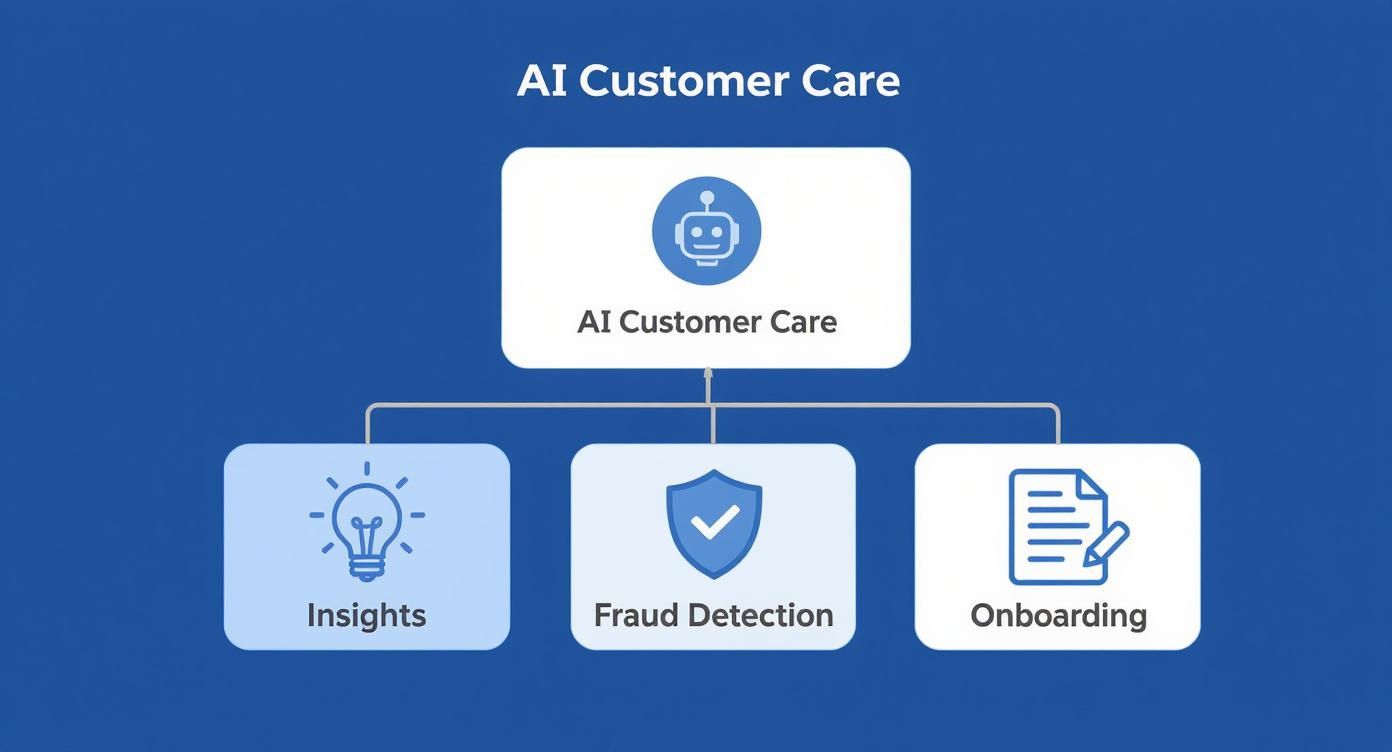
As you can see, AI's role is multi-faceted, covering everything from initial onboarding and fraud detection to ongoing customer insights.
Integrating AI with Legacy Systems
Let's be realistic: most banks and insurers aren't building their tech stack from a blank slate. They have decades of investment in core legacy systems. A smart AI strategy doesn't involve a painful "rip and replace" mission. Instead, it’s about smart integration.
Using APIs and modern middleware, AI can act as an intelligent layer that sits on top of your existing infrastructure. It pulls data from your core systems, automates processes, and pushes enriched information back. This way, you get the benefits of AI without disrupting the operational bedrock of your business.
A successful AI framework is built on three key pillars: unwavering data security, transparent and explainable processes, and seamless integration with the systems you already rely on. Getting these right is non-negotiable for any regulated enterprise.
Before diving into an implementation, it's crucial to map out these foundational elements. The following table breaks down the critical factors that can make or break an AI initiative in a high-stakes environment.
Critical Factors for AI Implementation in Regulated Sectors
Key Consideration | Why It Matters | Recommended Best Practice |
|---|---|---|
Data Governance | Defines who can access what data and how it's used, which is critical for compliance with regulations like GDPR and CCPA. | Establish a clear data governance council with defined roles. Implement role-based access controls (RBAC) and conduct regular data audits. |
Model Explainability | Regulators and internal audit teams require transparent, justifiable reasons behind automated decisions, especially adverse ones. | Choose XAI-native models where possible. For complex models, use post-hoc explanation tools like LIME or SHAP to interpret outputs. |
Human-in-the-Loop | Full automation is risky for high-stakes decisions. Humans provide necessary oversight, empathy, and complex judgment. | Design workflows where AI handles initial analysis and flags exceptions or high-risk cases for human review and final approval. |
Integration Architecture | A poorly planned integration can create data silos, slow down processes, and increase security vulnerabilities. | Use a microservices architecture with well-defined APIs to connect AI tools to legacy systems, ensuring scalability and security. |
Continuous Monitoring | AI models can drift over time as data patterns change, leading to degraded performance and potential compliance breaches. | Implement a robust monitoring system to track model accuracy, fairness metrics, and data drift. Set up automated alerts for significant deviations. |
Nailing these considerations from the outset is the difference between a successful, compliant AI deployment and one that creates more problems than it solves.
Designing a Human-in-the-Loop Workflow
The best AI implementations don’t sideline your experts—they supercharge them. A "human-in-the-loop" model is the gold standard for this. In practice, this means the AI takes on the heavy lifting: verifying data on an insurance application, routing a routine banking question, or flagging a potentially fraudulent transaction.
The system is also smart enough to know its limits. When a case is too complex, emotionally charged, or carries significant financial weight, it’s automatically escalated to a human agent. This creates a powerful partnership, blending the speed and scale of AI with the nuanced judgment and empathy of your best people. To learn more about the frameworks that underpin this level of security and responsibility, you can explore what is SOC 2 compliance and its role in managing customer data.
Measuring ROI and Managing AI-Specific Risks
Putting an AI customer care platform to work is a major investment. To justify the cost and effort, you have to measure its success with more than just vanity metrics. For financial services and insurance firms, this means tracking specific key performance indicators (KPIs) that connect directly to tangible business outcomes.
Forget about simply counting the number of queries handled. The real story is in the quality and efficiency of those interactions. A great place to start is the First Contact Resolution (FCR) rate for your AI. This tells you how often the system actually solves a customer's problem on the first try, without a human ever getting involved.
For AI insurance companies, a game-changing metric is the reduction in claims processing time. When you can show that you’ve cut the cycle from days down to hours—or even minutes—you've found a clear, quantifiable win that slashes operational costs and makes customers much happier.
Key Performance Indicators for AI Success
To get a complete picture of how your AI is doing, you need a balanced scorecard. Your metrics should cover efficiency, quality, and the all-important financial impact. A solid measurement framework not only proves the initial investment was worthwhile but also points you toward future improvements.
Here are a few essential KPIs to keep an eye on:
Claim Processing Accuracy: How often does the AI get it right? Track the error rate of automated claims assessments and compare it to your human teams. This is crucial for validating the reliability of your claims AI reviews.
Fraud Detection Rate: Measure the uptick in successfully flagged fraudulent claims and transactions. This KPI shows a direct line from your AI to a reduction in financial losses.
Cost Per Interaction: Do the math. Calculate what it costs to resolve an issue using AI versus a human agent. This gives you a straightforward metric for operational savings.
Containment Rate: What percentage of customer issues are fully handled by the AI, from start to finish? A high containment rate means your system is working as intended, freeing up your people for more complex work.
Managing the Unique Risks of AI
Measuring returns is only half the battle. You also have to manage the new and specific risks that come with AI. This requires dedicated oversight to maintain compliance and, just as importantly, your customers' trust.
One of the biggest concerns is algorithmic bias. This happens when an AI model, trained on historical data, accidentally learns and perpetuates unfair patterns, leading to biased decisions. It’s a subtle but serious risk.
Another challenge is model drift. This is what happens when an AI's accuracy degrades over time because the real-world data it sees no longer matches the data it was trained on. Without constant monitoring, a model that was once a star performer can become a liability, causing poor customer outcomes and compliance headaches.
Proactively managing AI-specific risks isn't just a compliance exercise; it's fundamental to building a sustainable and trustworthy AI program. A framework that combines performance KPIs with risk metrics ensures you are maximizing value while protecting your customers and your business.
Getting a handle on these operational challenges is a core discipline. To go deeper on this topic, you can learn more about the principles of risk management in operations in our detailed guide.
This proactive approach is where many firms have room to grow. Consider the contact center: by 2025, 88% use AI, but only 25% have truly integrated automation into their core workflows. This creates a massive 75% gap between having the technology and actually using it well. The firms that close this gap see real benefits, like reducing their call handling costs by up to 19% by using performance insights to their full potential. You can find more customer service statistics on amplifai.com.
The Future of Customer Care Is Human-AI Collaboration
Let’s clear up a common misconception right away. When we talk about AI customer care in finance and insurance, the goal isn't to replace your seasoned experts. It’s about supercharging them.
The most forward-thinking organizations are building a collaborative model where AI handles the high-volume, repetitive work that bogs down talented teams. This frees up your human agents to focus on what they do best: navigating complex escalations, building genuine client relationships, and providing the kind of empathetic support that technology simply can't replicate.
This partnership between people and machines is already reshaping the industry. For AI insurance companies, this means letting AI manage the straightforward claims so adjusters can apply their deep expertise to the most intricate cases. In banking, it allows advisors to spend less time on routine account queries and more time offering the high-value guidance clients truly need.

Elevating Human Expertise
Real progress in customer care comes from this smart division of labor. AI is phenomenal at processing immense amounts of data with speed and accuracy, which makes it perfect for initial claims AI reviews or real-time fraud monitoring. But human agents bring something irreplaceable to the table: nuanced judgment and emotional intelligence.
By automating the predictable, you empower your team to shine in the moments that matter most. An AI can process a standard claim payout in minutes, but only a human agent can comfort a distressed policyholder, patiently explain complex coverage details, and provide genuine reassurance. Both are critical for a positive customer journey.
This isn't just theory; it's a market reality. A recent survey found that 72% of industry leaders believe AI provides superior service on many fronts due to its speed and consistency, which is why they're investing heavily. You can explore emerging customer service trends on crescendo.ai to see where the industry is headed.
The ultimate measure of success for AI in customer care is not how many people it replaces, but how much more effective it makes every person on the team. It’s about building a more responsive, resilient, and human-centric service model.
A Strategic Imperative for Growth
Adopting AI is no longer a simple discussion about operational efficiency. It's now a fundamental part of any serious growth strategy.
Financial and insurance firms that thoughtfully weave AI into their customer care workflows are building more agile operations and forging stronger, more loyal customer relationships. By combining the best of machine intelligence with human insight, they are creating a service experience that is both remarkably efficient and deeply personal.
Frequently Asked Questions About AI in Finance and Insurance
When leaders in banking and insurance start exploring AI customer care, a lot of practical questions come up. It's only natural. Let's walk through some of the most common ones we hear about implementation, security, and what this technology actually looks like in the real world.
How Does AI Improve Insurance Claims Processing?
AI completely changes the speed and flow of the claims lifecycle. For AI insurance companies, it all begins the moment a customer reports a loss. An AI can instantly gather and check claim details through a mobile app, then use computer vision to analyze photos of the damage. What used to take days of back-and-forth can now produce an initial assessment in minutes.
This automation feeds directly into intelligent claims AI reviews. The system cross-references the damage assessment against the customer's policy and historical data, flagging inconsistencies and ensuring everything is by the book. The result? Claims that once took weeks can be settled in hours, which makes a world of difference to a customer going through a stressful event.
Is AI Secure Enough for Financial Services?
Security isn't just a feature; it's the foundation. Any AI platform built for this industry has to meet the highest standards, including end-to-end data encryption, rigorous access controls, and frequent third-party security audits.
But here’s the interesting part: these systems actually improve your security posture. AI is incredibly effective at real-time fraud detection, spotting unusual transaction patterns that a human team might easily overlook. A well-built AI framework doesn't just protect customer data—it actively defends it.
A common misconception is that AI replaces human jobs. In reality, it redefines them. AI handles the repetitive, data-heavy tasks, freeing human experts to focus on complex problem-solving, strategic decision-making, and building stronger customer relationships.
Will AI Replace Customer Service Agents?
Not at all. The real value is in the partnership between people and AI. Think of it as giving your team a powerful assistant. AI is perfect for handling the high volume of routine questions and processes, which frees up your human agents to take on the more complex and emotionally charged customer issues.
This lets your team focus their expertise where it truly counts—on interactions that require empathy, critical thinking, and a personal touch. By automating the monotonous work, you empower your people to deliver a much higher caliber of service.
What Is the First Step to Implementing AI?
You don't need to rip and replace your existing systems to get started. The smartest approach is to pick one specific, high-impact area to focus on first.
For example, you could begin by automating just the initial intake part of the claims process. Or, in banking, you could start with an AI that handles simple account balance inquiries. A focused project like this lets you prove the value quickly, learn from the experience, and build a strong case for expanding AI across the organization.
Nolana provides a compliant, AI-native operating system designed to automate high-stakes workflows in finance and insurance. By deploying intelligent agents that integrate with your existing core systems, Nolana helps you reduce costs, accelerate processes, and deliver a superior customer experience with full auditability and control. Discover how our agentic AI can transform your operations at https://nolana.com.
AI customer care is simply about using artificial intelligence to make every customer interaction better, faster, and smarter. In high-stakes industries like financial services and insurance, this goes way beyond a simple website chatbot. We're talking about sophisticated systems that can process claims, offer personalized financial guidance, and even spot fraud in real-time.
The result? Customers get the instant, 24/7 support they expect, and businesses run more efficiently.
The New Digital Standard in Finance and Insurance
Imagine a world where insurance claims are settled in minutes, not weeks, and personalized financial advice is available on your phone at 3 AM. This isn't some far-off vision; for many firms, it's the new reality being built with AI customer care. This technology is fundamentally changing the game in finance and insurance, creating a new benchmark for what great service looks like.
The technology has grown up fast. Early AI was all about basic chatbots answering simple questions. Now, we have intelligent systems orchestrating entire workflows, from the first notice of an insurance claim to providing tailored investment insights. It’s like giving every customer their own digital specialist, one that works hand-in-hand with your human experts to deliver faster, more accurate service around the clock.
Shifting Customer Expectations
Let's face it, today's customers want everything now. They expect immediate, personalized, and hassle-free service, whether they're opening a bank account or filing a claim. The old way of doing things in finance and insurance—heavy on paperwork, phone tag, and long waits—just doesn't cut it anymore. AI customer care tackles these frustrations head-on by automating the routine stuff and delivering instant answers.
For instance, leading AI insurance companies are completely overhauling the claims experience. Instead of a mountain of forms and endless follow-up calls, a customer can now submit a claim through an app, have AI analyze the damage from a photo, and get a decision in a fraction of the time. This kind of speed and simplicity turns a traditionally stressful event into a positive brand experience. At its core, this shift shows how AI and Big Data are revolutionizing industries and banking, raising the bar for everyone.
By automating high-volume, data-intensive tasks, AI frees human agents to focus on complex problem-solving and building stronger customer relationships, which is where they add the most value.
The Business Value of AI Adoption
Bringing AI into your customer operations isn't just about keeping up with trends—it’s a powerful strategic decision with a clear return on investment. Financial institutions that get this right see major improvements across the board.
The table below breaks down the core impact of AI on customer-facing operations in these highly regulated fields.
Core Impact of AI Customer Care in Regulated Industries
Area of Impact | Key Benefit | Real-World Application |
|---|---|---|
Operational Efficiency | Drastically lower costs and fewer errors | Automating data entry for new accounts or verifying claim details without manual review. |
Service Speed | Near-instant processing and decisions | Approving a personal loan in minutes or authorizing an insurance payout immediately after submission. |
Customer Experience | Higher satisfaction and brand loyalty | Offering 24/7 intelligent support that resolves issues on the first contact, at any time of day. |
Risk & Compliance | Stronger fraud detection and regulatory adherence | Monitoring transactions in real-time to flag suspicious activity or ensuring all communications meet compliance rules. |
As you can see, the benefits are tangible and far-reaching. But integrating these advanced systems requires more than just new software; it demands a solid plan for organizational change.
Reduced Operational Costs: Automating tasks like data entry, claims verification, and query resolution lowers labor costs and minimizes costly human error.
Faster Service Delivery: AI can process information and make decisions in seconds, drastically cutting down cycle times for everything from loan approvals to insurance payouts.
Enhanced Customer Experience: Providing 24/7 support and personalized interactions leads to higher satisfaction and loyalty.
Improved Compliance and Security: AI systems can monitor transactions in real-time to detect fraud and ensure adherence to regulatory standards with much greater precision.
Successfully bringing these systems into your organization is a major undertaking. To learn more about navigating this shift, check out our guide on effective change management in digital transformation. It provides a framework for managing the people and process side of the equation.
Automating Insurance Claims Processing with AI
Anyone who’s filed an insurance claim knows the drill: endless paperwork, long waits on hold, and a process that feels anything but reassuring during a stressful time. This old-school model is finally being overhauled by AI customer care, which brings much-needed speed, accuracy, and ease to every step. The change is felt right from the moment a customer first reports an incident.
Instead of getting lost in a phone menu or drowning in forms, customers can now simply talk to an intelligent system. This first touchpoint, the First Notice of Loss (FNOL), is where AI immediately proves its worth. A customer can use conversational AI to report what happened just like they would to a person.
The system asks for the essential details, and thanks to computer vision, the customer can just snap a picture of the damage with their phone and upload it. The AI gets to work right away—verifying the policy, logging the details, and kicking off the claims process in a matter of minutes.
From Photos to Payouts in Record Time
After the initial report, the next big delay has always been the damage assessment. This used to mean scheduling an adjuster, waiting for them to travel to the site, and then waiting again for their manual inspection—a process that could easily stretch into days or weeks. Today, AI insurance companies are using sophisticated algorithms to do this work almost instantly.
An AI model, trained on millions of images of vehicle or property damage, can look at a customer’s photos and give a shockingly accurate assessment of the loss. It can pinpoint specific problems, like hail dents on a car or water stains from a burst pipe, and check that against a massive parts and labor database to create a preliminary repair estimate on the spot.
This immediate analysis is a true game-changer. For simple, clear-cut claims, an AI can approve a payout within minutes of the initial report, sending the money straight to the customer's account. Not only does this create a fantastic customer experience, but it also slashes the operational costs for the insurer. To appreciate the complexities AI helps manage, it helps to understand scenarios like what a diminished value claim entails.
Ensuring Accuracy with Intelligent Claims AI Reviews
While speed is great, accuracy is non-negotiable in a regulated field like insurance. This is where claims AI reviews add incredible value. These AI systems don't just speed things up; they make the process more consistent and fair by taking human subjectivity out of the initial assessment.
The systems make sure every claim is judged against the exact same criteria laid out in the policy. This brings a few major advantages:
Consistency: The AI applies the same rulebook to every single claim, which reduces wildly different outcomes.
Accuracy: By crunching huge datasets, the AI can estimate costs with impressive precision, cutting down on overpayments and underpayments.
Auditability: Every single step the AI takes is logged, creating a transparent, easy-to-follow trail for any compliance checks.
Think of the AI as a tireless, completely objective adjudicator. It reviews claim details against policy rules and mountains of historical data to ensure every decision is fair, fully documented, and compliant. That’s how you build trust with customers and regulators alike.
Proactively Detecting and Preventing Fraud
Insurance fraud costs the industry billions and drives up premiums for everyone. AI offers a powerful new line of defense by spotting subtle red flags that even the most experienced human investigator might miss.
Machine learning algorithms scan incoming claims in real-time, searching for suspicious patterns. This could be anything from inconsistencies in the story and digitally altered photos to hidden connections with known fraud rings. By flagging these high-risk claims for human review, AI lets investigators zero in on where they're needed most, protecting the company and its honest customers. This is a perfect example of how platforms are transforming insurance claims with agentic AI to build smarter, more secure workflows.
How AI is Changing Customer Interactions in Financial Services
While the insurance world has seen huge gains from AI in claims, the impact of AI customer care is just as profound across the entire financial services industry. Banks, credit unions, and wealth management firms are all discovering powerful new ways to serve their clients, moving well beyond old-school service models to provide support that’s personal, secure, and immediate.
This whole shift is happening because AI can now manage complex, data-heavy tasks that used to require a human expert. The result is a complete rethinking of how people manage their money, get advice, and keep their assets safe.
Personalized Financial Guidance at Scale
For a long time, truly personal financial advice was a luxury reserved for the wealthy. AI is changing that, bringing sophisticated financial insights to the masses. These days, a banking app is for much more than just checking your balance—it's becoming a smart financial assistant in your pocket.
These AI-driven tools can analyze spending habits, monitor progress toward savings goals, and offer proactive tips. For instance, an AI assistant might pop up with a message saying you're on track for your retirement goal, or it could suggest budget tweaks based on last month's spending. It can even recommend investment options that fit your specific risk tolerance and financial goals. This kind of ongoing, personalized guidance helps people make smarter financial choices every single day.
AI essentially acts as a digital financial coach, available 24/7. It can spot opportunities and risks in a customer's financial life that might otherwise go unnoticed, turning a reactive service model into a proactive partnership.
This deep level of personalization doesn't just make banking easier; it builds trust and turns a simple service into a genuinely valuable advisory relationship.
Proactive Fraud Detection and Enhanced Security
Security is everything in finance. The ever-present threat of fraud demands a defense system that never sleeps, which is something human teams struggle to provide on their own. This is where AI offers a game-changing solution, analyzing transaction data in real time to spot and stop suspicious activity before damage is done.
Unlike older, rule-based systems that only catch known fraud patterns, machine learning algorithms can detect subtle anomalies that point to new and sophisticated threats. For example, an AI might flag a transaction that’s out of character for a particular customer, even if it doesn't fit a predefined "fraud" rule.
Behavioral Analytics: The AI learns a customer's typical transaction patterns—where they shop, when they spend, and how much—to instantly recognize when something is off.
Real-Time Intervention: If a high-risk transaction is detected, the AI can automatically put a temporary hold on the account and send an alert to the customer's phone to verify the charge.
Reduced False Positives: Modern AI models are much better at telling the difference between a legitimate but unusual purchase (like booking a big vacation) and actual fraud. This cuts down on the frustration customers feel from unnecessary alerts.
This proactive stance doesn't just protect customer accounts; it builds immense confidence in the institution's commitment to keeping them safe.
Seamless and Secure Customer Onboarding
Opening a new account or applying for a loan used to be a painful, paper-filled ordeal. AI is turning this major point of friction into a fast, secure, and fully digital experience.
Using AI-powered tools like optical character recognition (OCR) and computer vision, a new customer can simply snap a photo of their ID and other documents. The AI instantly pulls the necessary information, checks its authenticity against official databases, and runs the required anti-money laundering (AML) and know-your-customer (KYC) checks in seconds. A process that once took days and involved manual paperwork can now be wrapped up in minutes on a smartphone. To learn more about how these systems understand and act on user requests, it's worth reading our guide on what is conversational AI.
This automation creates a fantastic first impression and allows financial institutions to bring new clients on board much faster and more efficiently, all while staying firmly within strict compliance rules.
Implementing a Secure and Compliant AI Framework
Bringing AI into the worlds of finance and insurance isn't just a technology project; it’s an exercise in trust. These industries are built on it. That’s why deploying an AI customer care platform requires a governance and security strategy that’s every bit as intelligent as the AI itself.
It all starts with an uncompromising focus on data privacy. Financial firms are custodians of some of the most sensitive information imaginable. Any AI system touching that data has to be built with privacy at its core, not as a feature bolted on later. This means locking down access, encrypting data whether it’s sitting on a server or moving across the network, and anonymizing information whenever possible.
The Pillar of Explainable AI
One of the biggest hurdles for AI in regulated fields is the "black box" problem. If an AI denies an insurance claim or flags a transaction, you need to know why. Regulators demand it, and customers deserve it.
This is where Explainable AI (XAI) comes in. It’s a discipline focused on making sure AI systems can show their work. For AI insurance companies, this means a flagged claim comes with a clear, auditable trail pointing to the specific policy clauses or evidence that triggered the decision. This transparency is what makes claims AI reviews defensible and fair.
This diagram shows how these different AI functions work together, from generating insights to securing the customer journey.
As you can see, AI's role is multi-faceted, covering everything from initial onboarding and fraud detection to ongoing customer insights.
Integrating AI with Legacy Systems
Let's be realistic: most banks and insurers aren't building their tech stack from a blank slate. They have decades of investment in core legacy systems. A smart AI strategy doesn't involve a painful "rip and replace" mission. Instead, it’s about smart integration.
Using APIs and modern middleware, AI can act as an intelligent layer that sits on top of your existing infrastructure. It pulls data from your core systems, automates processes, and pushes enriched information back. This way, you get the benefits of AI without disrupting the operational bedrock of your business.
A successful AI framework is built on three key pillars: unwavering data security, transparent and explainable processes, and seamless integration with the systems you already rely on. Getting these right is non-negotiable for any regulated enterprise.
Before diving into an implementation, it's crucial to map out these foundational elements. The following table breaks down the critical factors that can make or break an AI initiative in a high-stakes environment.
Critical Factors for AI Implementation in Regulated Sectors
Key Consideration | Why It Matters | Recommended Best Practice |
|---|---|---|
Data Governance | Defines who can access what data and how it's used, which is critical for compliance with regulations like GDPR and CCPA. | Establish a clear data governance council with defined roles. Implement role-based access controls (RBAC) and conduct regular data audits. |
Model Explainability | Regulators and internal audit teams require transparent, justifiable reasons behind automated decisions, especially adverse ones. | Choose XAI-native models where possible. For complex models, use post-hoc explanation tools like LIME or SHAP to interpret outputs. |
Human-in-the-Loop | Full automation is risky for high-stakes decisions. Humans provide necessary oversight, empathy, and complex judgment. | Design workflows where AI handles initial analysis and flags exceptions or high-risk cases for human review and final approval. |
Integration Architecture | A poorly planned integration can create data silos, slow down processes, and increase security vulnerabilities. | Use a microservices architecture with well-defined APIs to connect AI tools to legacy systems, ensuring scalability and security. |
Continuous Monitoring | AI models can drift over time as data patterns change, leading to degraded performance and potential compliance breaches. | Implement a robust monitoring system to track model accuracy, fairness metrics, and data drift. Set up automated alerts for significant deviations. |
Nailing these considerations from the outset is the difference between a successful, compliant AI deployment and one that creates more problems than it solves.
Designing a Human-in-the-Loop Workflow
The best AI implementations don’t sideline your experts—they supercharge them. A "human-in-the-loop" model is the gold standard for this. In practice, this means the AI takes on the heavy lifting: verifying data on an insurance application, routing a routine banking question, or flagging a potentially fraudulent transaction.
The system is also smart enough to know its limits. When a case is too complex, emotionally charged, or carries significant financial weight, it’s automatically escalated to a human agent. This creates a powerful partnership, blending the speed and scale of AI with the nuanced judgment and empathy of your best people. To learn more about the frameworks that underpin this level of security and responsibility, you can explore what is SOC 2 compliance and its role in managing customer data.
Measuring ROI and Managing AI-Specific Risks
Putting an AI customer care platform to work is a major investment. To justify the cost and effort, you have to measure its success with more than just vanity metrics. For financial services and insurance firms, this means tracking specific key performance indicators (KPIs) that connect directly to tangible business outcomes.
Forget about simply counting the number of queries handled. The real story is in the quality and efficiency of those interactions. A great place to start is the First Contact Resolution (FCR) rate for your AI. This tells you how often the system actually solves a customer's problem on the first try, without a human ever getting involved.
For AI insurance companies, a game-changing metric is the reduction in claims processing time. When you can show that you’ve cut the cycle from days down to hours—or even minutes—you've found a clear, quantifiable win that slashes operational costs and makes customers much happier.
Key Performance Indicators for AI Success
To get a complete picture of how your AI is doing, you need a balanced scorecard. Your metrics should cover efficiency, quality, and the all-important financial impact. A solid measurement framework not only proves the initial investment was worthwhile but also points you toward future improvements.
Here are a few essential KPIs to keep an eye on:
Claim Processing Accuracy: How often does the AI get it right? Track the error rate of automated claims assessments and compare it to your human teams. This is crucial for validating the reliability of your claims AI reviews.
Fraud Detection Rate: Measure the uptick in successfully flagged fraudulent claims and transactions. This KPI shows a direct line from your AI to a reduction in financial losses.
Cost Per Interaction: Do the math. Calculate what it costs to resolve an issue using AI versus a human agent. This gives you a straightforward metric for operational savings.
Containment Rate: What percentage of customer issues are fully handled by the AI, from start to finish? A high containment rate means your system is working as intended, freeing up your people for more complex work.
Managing the Unique Risks of AI
Measuring returns is only half the battle. You also have to manage the new and specific risks that come with AI. This requires dedicated oversight to maintain compliance and, just as importantly, your customers' trust.
One of the biggest concerns is algorithmic bias. This happens when an AI model, trained on historical data, accidentally learns and perpetuates unfair patterns, leading to biased decisions. It’s a subtle but serious risk.
Another challenge is model drift. This is what happens when an AI's accuracy degrades over time because the real-world data it sees no longer matches the data it was trained on. Without constant monitoring, a model that was once a star performer can become a liability, causing poor customer outcomes and compliance headaches.
Proactively managing AI-specific risks isn't just a compliance exercise; it's fundamental to building a sustainable and trustworthy AI program. A framework that combines performance KPIs with risk metrics ensures you are maximizing value while protecting your customers and your business.
Getting a handle on these operational challenges is a core discipline. To go deeper on this topic, you can learn more about the principles of risk management in operations in our detailed guide.
This proactive approach is where many firms have room to grow. Consider the contact center: by 2025, 88% use AI, but only 25% have truly integrated automation into their core workflows. This creates a massive 75% gap between having the technology and actually using it well. The firms that close this gap see real benefits, like reducing their call handling costs by up to 19% by using performance insights to their full potential. You can find more customer service statistics on amplifai.com.
The Future of Customer Care Is Human-AI Collaboration
Let’s clear up a common misconception right away. When we talk about AI customer care in finance and insurance, the goal isn't to replace your seasoned experts. It’s about supercharging them.
The most forward-thinking organizations are building a collaborative model where AI handles the high-volume, repetitive work that bogs down talented teams. This frees up your human agents to focus on what they do best: navigating complex escalations, building genuine client relationships, and providing the kind of empathetic support that technology simply can't replicate.
This partnership between people and machines is already reshaping the industry. For AI insurance companies, this means letting AI manage the straightforward claims so adjusters can apply their deep expertise to the most intricate cases. In banking, it allows advisors to spend less time on routine account queries and more time offering the high-value guidance clients truly need.
Elevating Human Expertise
Real progress in customer care comes from this smart division of labor. AI is phenomenal at processing immense amounts of data with speed and accuracy, which makes it perfect for initial claims AI reviews or real-time fraud monitoring. But human agents bring something irreplaceable to the table: nuanced judgment and emotional intelligence.
By automating the predictable, you empower your team to shine in the moments that matter most. An AI can process a standard claim payout in minutes, but only a human agent can comfort a distressed policyholder, patiently explain complex coverage details, and provide genuine reassurance. Both are critical for a positive customer journey.
This isn't just theory; it's a market reality. A recent survey found that 72% of industry leaders believe AI provides superior service on many fronts due to its speed and consistency, which is why they're investing heavily. You can explore emerging customer service trends on crescendo.ai to see where the industry is headed.
The ultimate measure of success for AI in customer care is not how many people it replaces, but how much more effective it makes every person on the team. It’s about building a more responsive, resilient, and human-centric service model.
A Strategic Imperative for Growth
Adopting AI is no longer a simple discussion about operational efficiency. It's now a fundamental part of any serious growth strategy.
Financial and insurance firms that thoughtfully weave AI into their customer care workflows are building more agile operations and forging stronger, more loyal customer relationships. By combining the best of machine intelligence with human insight, they are creating a service experience that is both remarkably efficient and deeply personal.
Frequently Asked Questions About AI in Finance and Insurance
When leaders in banking and insurance start exploring AI customer care, a lot of practical questions come up. It's only natural. Let's walk through some of the most common ones we hear about implementation, security, and what this technology actually looks like in the real world.
How Does AI Improve Insurance Claims Processing?
AI completely changes the speed and flow of the claims lifecycle. For AI insurance companies, it all begins the moment a customer reports a loss. An AI can instantly gather and check claim details through a mobile app, then use computer vision to analyze photos of the damage. What used to take days of back-and-forth can now produce an initial assessment in minutes.
This automation feeds directly into intelligent claims AI reviews. The system cross-references the damage assessment against the customer's policy and historical data, flagging inconsistencies and ensuring everything is by the book. The result? Claims that once took weeks can be settled in hours, which makes a world of difference to a customer going through a stressful event.
Is AI Secure Enough for Financial Services?
Security isn't just a feature; it's the foundation. Any AI platform built for this industry has to meet the highest standards, including end-to-end data encryption, rigorous access controls, and frequent third-party security audits.
But here’s the interesting part: these systems actually improve your security posture. AI is incredibly effective at real-time fraud detection, spotting unusual transaction patterns that a human team might easily overlook. A well-built AI framework doesn't just protect customer data—it actively defends it.
A common misconception is that AI replaces human jobs. In reality, it redefines them. AI handles the repetitive, data-heavy tasks, freeing human experts to focus on complex problem-solving, strategic decision-making, and building stronger customer relationships.
Will AI Replace Customer Service Agents?
Not at all. The real value is in the partnership between people and AI. Think of it as giving your team a powerful assistant. AI is perfect for handling the high volume of routine questions and processes, which frees up your human agents to take on the more complex and emotionally charged customer issues.
This lets your team focus their expertise where it truly counts—on interactions that require empathy, critical thinking, and a personal touch. By automating the monotonous work, you empower your people to deliver a much higher caliber of service.
What Is the First Step to Implementing AI?
You don't need to rip and replace your existing systems to get started. The smartest approach is to pick one specific, high-impact area to focus on first.
For example, you could begin by automating just the initial intake part of the claims process. Or, in banking, you could start with an AI that handles simple account balance inquiries. A focused project like this lets you prove the value quickly, learn from the experience, and build a strong case for expanding AI across the organization.
Nolana provides a compliant, AI-native operating system designed to automate high-stakes workflows in finance and insurance. By deploying intelligent agents that integrate with your existing core systems, Nolana helps you reduce costs, accelerate processes, and deliver a superior customer experience with full auditability and control. Discover how our agentic AI can transform your operations at https://nolana.com.


All systems operational
Lloyd's Lab, One Lime Street, London EC3M 7HA
Copyright © 2026, Nolana. All rights reserved
All systems operational
Lloyd's Lab, One Lime Street, London EC3M 7HA
Copyright © 2026, Nolana. All rights reserved
All systems operational
Lloyd's Lab, One Lime Street, London EC3M 7HA
Copyright © 2026, Nolana. All rights reserved
All systems operational
Lloyd's Lab, One Lime Street, London EC3M 7HA
Copyright © 2026, Nolana. All rights reserved