How Duck Creek Technologies Inc Drives Insurance AI
How Duck Creek Technologies Inc Drives Insurance AI
Discover how Duck Creek Technologies Inc is transforming insurance with AI-powered claims automation and enhanced customer care for leading insurance companies.
At its core, Duck Creek Technologies Inc provides the engine that helps insurance carriers modernize their operations. As customer expectations for speed and personalization skyrocket, Duck Creek offers the foundational tech needed to ditch slow, legacy systems for a more intelligent, responsive way of doing business, especially in automating insurance claims with AI.
The AI Revolution in Modern Insurance
The insurance world is in the middle of a massive shift, leaving behind decades of slow, manual work for a future driven by AI. For a long time, traditional insurers have been bogged down by frustratingly slow claims processing and inconsistent customer service. In a world that runs on instant results and personalized experiences, these old systems just can't keep up.
Think of it like swapping a horse-drawn carriage for a self-driving car. The destination is the same—settle a claim, manage a policy—but the speed, efficiency, and intelligence of the journey are entirely different. AI isn't just a minor upgrade; it's a complete reimagining of how ai insurance companies function and serve their customers. The industry has woken up to the fact that manual data entry, endless review cycles, and reactive service models just create friction and drive up costs.
Addressing Core Industry Challenges
This evolution is all about tackling long-standing industry pain points with smarter technology. Outdated methods have been a source of frustration for everyone involved, from the insurer to the policyholder. A few key areas are finally getting the disruption they need:
Delayed Claims Processing: Manual reviews and data lookups can turn a simple claim into a multi-week ordeal, which is a sure way to erode customer trust.
Inconsistent Customer Support: When you rely only on human agents, your service is limited to business hours and the quality can be a mixed bag, hurting the customer experience.
High Operational Costs: Labor-intensive, repetitive tasks eat up resources that could be poured back into growing the business or developing better products.
Duck Creek Technologies Inc came onto the scene as a key player in this movement. Founded way back in 2000, the company’s goal was to bring the property and casualty insurance industry into the modern era with a flexible tech platform for core systems—policy, billing, and claims. Their early move to cloud-based SaaS solutions was a game-changer, helping carriers break free from rigid, on-premise software. You can get more details on their journey over at canvasbusinessmodel.com.
By delivering the tools for sophisticated AI customer care and claims automation, Duck Creek helps build a smarter, faster, and more agile insurance ecosystem. To see how this works in the real world, check out our guide on intelligent process automation. This kind of technology is the key to improving claims AI reviews and building a more efficient future.
Using Intelligent AI to Reinvent Insurance Claims
For many customers, the claims process is the ultimate moment of truth. It's where an insurer's promises are put to the test, and unfortunately, it's often a point of frustration. The old way of doing things—riddled with manual data entry, long waits, and the potential for human error—just doesn't cut it anymore. Duck Creek Technologies Inc steps directly into this gap, using smart automation to overhaul the entire claims lifecycle.
This isn't just about scanning documents or digitizing old forms. Think of the AI as a seasoned claims investigator who can sift through thousands of data points in seconds. It can connect the dots between a claimant's history, public records, and the specifics of the incident to spot anomalies that a person might overlook. This is how modern AI insurance companies are moving from a reactive, paper-shuffling function to a proactive, intelligent operation.
From First Call to Final Payment
The transformation starts the second a customer needs to file a claim. Instead of navigating phone trees or waiting for office hours, they can report an incident through an AI-powered First Notice of Loss (FNOL) tool. It’s available 24/7, capturing the essential details instantly and without errors.
From that initial touchpoint, automation kicks in to handle critical steps:
Automated Damage Assessment: For something like a minor car accident, the policyholder can simply upload photos of the damage. Image recognition AI gets to work, analyzing the photos to estimate repair costs and even identify the parts needed. For straightforward claims, this can all happen in minutes, eliminating the need to wait for a field adjuster.
Intelligent Routing: The system is smart enough to know that a fender bender is different from a multi-car pileup. It automatically triages each claim by complexity, routing it to the right adjuster with the right skills. Simple claims fly through an automated path, while complex ones get immediate attention from an expert.
Fraud Detection: As claims come in, AI algorithms work quietly in the background, scanning for red flags and suspicious patterns. This proactive monitoring helps carriers stop fraud before it happens, allowing them to focus investigative resources where they're truly needed.
The image below shows just how far the industry has come, moving from cumbersome manual processes to the kind of integrated, AI-driven workflow that Duck Creek enables.
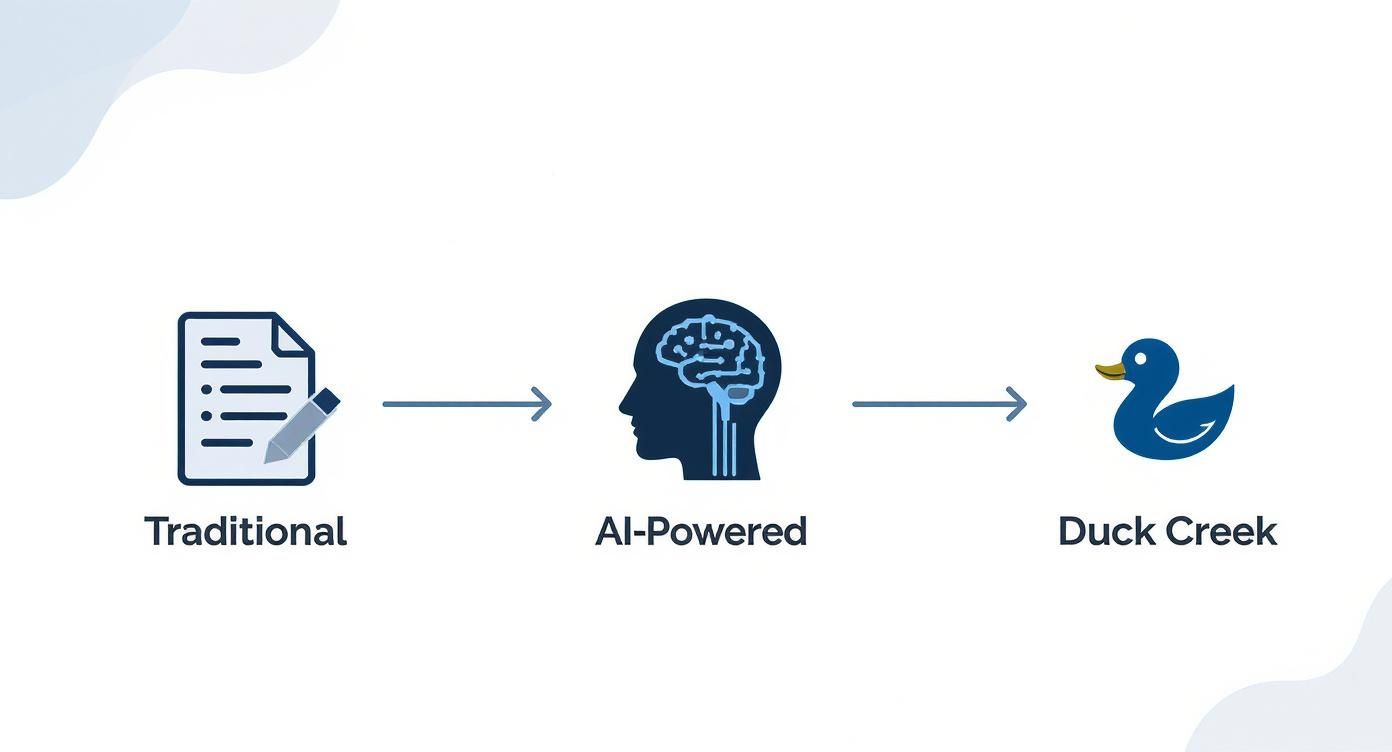
It's a clear shift from siloed tasks to a connected, technology-first approach that defines the modern insurance carrier.
What This Really Means for Insurers
The payoff from this AI-driven model is huge, and it goes well beyond simply moving faster. The precision of claims AI reviews leads to fairer, more consistent settlements, which cuts down on disputes and keeps customers happy. More importantly, when you automate the routine, administrative work, your skilled adjusters are free to focus on what they do best: handling complex cases that require human judgment and empathy.
By automating key steps like intake, assessment, and routing, carriers can slash claims processing times by as much as 50% or more. This not only lowers operational costs but also delivers the kind of fast, easy experience that today’s customers demand.
Better yet, this automated process generates a goldmine of data. Insurers can analyze claims trends to spot new risk patterns, giving underwriters the insights they need to price policies more accurately and even design better products. It creates a powerful feedback loop of efficiency and intelligence. You can see more examples of these advanced systems in our guide to modern insurance claims processing.
Ultimately, Duck Creek Technologies Inc gives insurers the tools to build a claims operation that isn't just faster, but fundamentally smarter. It’s about managing costs effectively while delivering a standout service that builds real, long-term customer loyalty.
Using AI to Go Beyond Claims and Elevate Customer Care
A fast, fair claims process is table stakes in today's insurance market. But what truly sets modern carriers apart is the quality of the customer experience they deliver across the entire policy lifecycle. Simply reacting to problems is no longer enough; policyholders now expect proactive, almost concierge-level support. This is where a platform like Duck Creek Technologies Inc. really shines, using AI to redefine service from the ground up, especially for financial services.
The real goal here is to anticipate a customer's needs before they even have to ask. Think about it: what if an AI system flags that a policyholder lives in a high-risk area for a predicted hailstorm? It could automatically push an alert to their phone with tips on protecting their car and a quick reminder of their comprehensive coverage. That small, proactive gesture transforms the insurer-policyholder relationship, building genuine trust and turning AI customer care into a powerful loyalty driver.

Providing Support Around the Clock
One of the most powerful applications of AI is its ability to offer instant, 24/7 assistance. Life doesn't run on a 9-to-5 schedule, and neither do your customers' questions. Duck Creek's platform enables carriers to deploy intelligent virtual assistants that can handle this reality with ease.
These aren't your old-school, keyword-based chatbots. We're talking about sophisticated AI that can:
Handle Complex Policy Questions: A customer can ask, "Is my laptop covered if I take it with me on a business trip?" The AI can instantly parse their specific policy documents to give a personalized, accurate answer.
Give Real-Time Claim Updates: Instead of waiting on hold, a policyholder can simply ask their app, "What's the status of my claim?" and get an immediate update, whether it's "under review" or "payment has been issued."
Guide Customers Through Processes: The AI can actively walk someone through adding a new driver to their policy or updating a payment method, making self-service feel effortless and intuitive.
This kind of immediate access removes the friction that so often frustrates customers, ensuring a consistent, high-quality interaction every single time.
From Reactive Fixes to Proactive Engagement
Beyond just answering inbound questions, advanced AI gives insurers the power to get ahead of problems. By analyzing massive datasets, predictive models can pinpoint customers who might be at risk of letting their policy lapse or those who seem confused about a recent change in their coverage terms.
This capability is like an early warning system for your business. By flagging these potential issues before they become full-blown problems, insurers can reach out with targeted, genuinely helpful communication. This proactive outreach can reduce customer churn by 15% or more, turning a potential complaint into a moment of positive reinforcement.
It’s a fundamental change in the service model. Instead of waiting for an angry call, the insurer starts the conversation, armed with the context needed to resolve the issue quickly. It proves to the customer that the company is paying attention and is truly invested in their satisfaction.
The same AI engines that personalize customer support also bring incredible efficiency to the claims process. While the goal for customer care is engagement and support, the goal for claims is speed, accuracy, and fraud detection.
Duck Creek AI Features for Customer Care vs Claims Automation
AI Capability | Application in Customer Care | Application in Claims Automation |
|---|---|---|
Natural Language Processing (NLP) | Powers virtual assistants to understand and answer complex policyholder questions in a conversational way. | Extracts key information from unstructured documents like police reports and medical records to speed up claim assessment. |
Predictive Analytics | Identifies customers at risk of churn based on communication patterns, payment history, and engagement levels. | Scores incoming claims for potential fraud or complexity, flagging them for human review and routing simple claims for straight-through processing. |
Automated Workflows | Triggers proactive communications, like weather alerts or policy reminders, based on customer data and external events. | Automates task assignments, adjuster scheduling, and payment issuance once a claim is approved, drastically reducing cycle times. |
As the table shows, a single underlying AI technology can be aimed at very different business outcomes—one focused on building relationships, the other on driving operational efficiency.
Building Trust Through Transparent Communication
Throughout the entire insurance journey, but especially during a claim, clear and consistent communication is paramount. Silence is the fastest way to erode trust. Duck Creek provides automated communication engines designed to keep policyholders in the loop at every single step.
When a claim is filed, for instance, the system can automatically push updates through the customer's preferred channel—SMS, email, or a mobile app notification. These messages confirm the claim was received, notify them when an adjuster is on the case, and confirm when payment is on its way. This constant, transparent flow of information gives customers peace of mind and eliminates the anxiety of being left in the dark.
Ultimately, these AI-driven tools work in concert to create a customer experience that feels not just efficient, but empathetic. By anticipating needs, providing instant help, and communicating with transparency, AI insurance companies using platforms like Duck Creek can forge lasting relationships built on a solid foundation of trust.
The Technology Powering Duck Creek Solutions
https://www.youtube.com/embed/4Mwqqf_AO-w
The advanced AI capabilities we've discussed for automating insurance claims and customer care don't just appear out of thin air. They're built on a modern, flexible foundation designed specifically for the real-world demands of today's insurance market. The true power behind Duck Creek Technologies Inc is its underlying architecture, which is what allows AI insurance companies to build, adapt, and scale their operations with impressive speed.
At its core, this foundation is built with a SaaS-first mentality. This is a world away from traditional on-premise software that demanded huge upfront investments and painfully long implementation cycles. Duck Creek's model treats insurance technology as a dynamic, evolving service, not a static product you buy off the shelf.
This means carriers get the latest features and security updates automatically, without the disruptive, all-hands-on-deck upgrade projects of the past. It effectively shifts the burden of system maintenance from a carrier's internal IT team over to Duck Creek, freeing them up to focus on strategic work that actually moves the business forward.
A Foundation Built on Flexibility
The platform’s entire design philosophy revolves around adaptability, achieved through low-code configuration. Think of it less like writing code from scratch and more like working with a sophisticated set of building blocks. This approach empowers insurers to modify workflows, launch new products, and adjust business rules on the fly.
For example, when a new regulation forces a change in the claims process, a business analyst can jump in and make those adjustments through a visual interface. They don't have to get in a developer's queue and wait weeks for code to be rewritten. This is a game-changer for speed-to-market, letting carriers pivot quickly as conditions change.
The big idea here is to put control back into the hands of the business users—the people who actually understand insurance. This low-code environment makes development more accessible, allowing the platform to be far more responsive to the immediate needs of underwriters, adjusters, and customer service teams.
This kind of flexibility is also what makes implementing specialized AI functions possible. When new AI models for things like fraud detection or customer sentiment analysis come along, they can be plugged into existing workflows with far less friction than you'd find in a rigid, hard-coded system.
Open Architecture and a Powerful Ecosystem
No modern insurance operation relies on a single vendor anymore. Real success comes from connecting a variety of specialized tools for things like data analytics, payment processing, and customer communications. Duck Creek Technologies Inc was built for this reality, with an open API design that essentially acts as a universal adapter for its software.
This open approach makes it possible to seamlessly integrate with third-party systems and a carrier’s own proprietary tools. It prevents vendor lock-in and lets you assemble a "best-of-breed" technology stack tailored to your specific needs. The company's significant growth highlights just how much the market craves this connectivity. By 2025, Duck Creek had grown to over 1,200 employees, supporting roughly 300 P&C clients worldwide with help from an ecosystem of over 140 partners. You can explore more about the company’s journey and scale on their website.
This partner network is a massive asset, offering pre-built integrations that slash implementation time and reduce risk. For a closer look at the types of tools that fuel these innovations, understanding the world of intelligent document processing software offers great context on how unstructured data is tamed within these ecosystems.
Finally, this entire framework is delivered through Duck Creek OnDemand, the company’s fully managed cloud solution. It packages the core software with all the benefits of cloud infrastructure—scalability, security, and reliability—to create a complete platform. This is the backbone that enables carriers to deploy advanced AI customer care and claims automation, turning technological potential into tangible business performance.
Real World Results and Strategic Impact
Any technology platform is ultimately judged by the business outcomes it delivers. For Duck Creek Technologies Inc, the real story isn't just about features—it's about the measurable impact its solutions have on an insurer's bottom line. The proof comes from the field, where carriers are turning AI theory into tangible, proven results.

When implemented thoughtfully, AI can fundamentally reshape how AI insurance companies operate. We're not talking about small adjustments here; we're talking about foundational improvements that influence everything from cost structures to customer loyalty. The true strategic impact becomes crystal clear when key performance indicators (KPIs) start moving in the right direction.
Slashing Claims Settlement Times
One of the most immediate and impressive results carriers experience is a radical reduction in the claims lifecycle. Take, for example, a regional P&C carrier that brought in Duck Creek's automated claims solution. They watched their average settlement time for straightforward auto claims plummet from over two weeks to just 48 hours.
How did they pull that off? By automating a few critical steps:
Instant First Notice of Loss (FNOL): AI chatbots captured initial claim details on the spot, cutting out the typical intake delays.
AI-Powered Damage Assessment: Policyholders simply uploaded photos of vehicle damage. Image recognition AI analyzed them and produced an initial repair estimate in minutes.
Automated Workflow Routing: The system automatically greenlit the claim and sent it for payment, only flagging exceptions for a human adjuster to review.
This kind of speed not only makes for happier customers but also drives down the administrative costs associated with handling each claim.
Boosting Customer Satisfaction and Retention
Of course, efficiency is only half the battle. A superior customer experience is what truly builds loyalty and secures long-term success. Another insurer made a strategic push to deploy Duck Creek’s AI customer care tools, focusing on its proactive communication engine and 24/7 virtual assistants.
The results were undeniable. After just six months, the carrier documented a 15-point increase in its Customer Satisfaction (CSAT) score. Policyholders consistently mentioned how much they valued the real-time claim status updates and the ability to get policy questions answered instantly, any time of day. This better service led directly to a visible increase in customer retention.
It’s a great reminder that positive claims AI reviews are often the result of excellent, transparent communication—an area where automation shines. When customers feel informed and in control, their trust in their insurer deepens, making them far more likely to stick around.
Optimizing Operational Efficiency
Beyond the customer-facing wins, the platform delivers significant improvements internally. A critical KPI for any claims department is the loss adjustment expense (LAE)—the total cost of investigating and settling a claim. By automating insurance claims with AI, specifically the repetitive, low-value tasks, Duck Creek’s AI frees up experienced adjusters to handle complex negotiations, fraud investigations, and other high-impact work.
One carrier calculated that its new automated workflows cut its LAE by over 20% in the first year alone. The system handled the administrative grind, allowing the company to process more claims without adding to its headcount. To see more on how modern AI can reshape insurance processes, check out these case studies on transforming insurance claims with agentic AI.
These real-world examples speak for themselves. For Duck Creek Technologies Inc, the strategic impact is clear: technology investments are being converted into measurable gains in speed, customer loyalty, and operational efficiency.
Making an Informed Implementation Decision
Choosing a core systems provider like Duck Creek Technologies Inc is a massive strategic move for any insurer. Getting this right is about so much more than just the tech itself. It demands a serious, practical plan covering everything from the project's scope and data migration to, perhaps most crucially, managing the human side of the change. To get the business on board and secure buy-in from stakeholders, you have to present a crystal-clear picture of the total cost of ownership (TCO) and the return on investment (ROI) you expect to see from this kind of AI-driven shift.
The first step? Be realistic about the project scope. Trying to do a "big bang" replacement of every system at once is a classic recipe for chaos. The smarter play, and one we see successful AI insurance companies use all the time, is to go phase-by-phase. Start with a single line of business or a specific workflow, like automating personal auto claims. This gives your team a chance to learn the ropes, adapt, and score some early, tangible wins, which builds the momentum you'll need for the bigger rollout. For instance, something as simple as improving the intake process with a solid https://nolana.com/templates/insurance-claim-form-template can be a fantastic, low-risk starting point.
Strategic Considerations for a Smooth Transition
Then there's the data migration—often one of the biggest headaches. You're potentially moving decades of policy and claims history from old, clunky legacy systems. Without a bulletproof strategy to maintain data integrity, you're asking for trouble. Just as important is getting your team ready for a new way of working. Good change management isn't just about sending a few emails; it's about constant communication and solid training that helps your people see how new AI-powered tools are there to enhance their expertise, not replace it.
A huge part of this journey is picking the right integration partners. The real power of Duck Creek’s ecosystem is how it connects with specialized third-party solutions. When you choose partners who genuinely get your specific business challenges, you ensure the platform starts delivering real value right out of the gate.
The financial journey of Duck Creek Technologies Inc really highlights its established market presence and consistent growth. The company locked in a $7 million Series B funding round way back in May 2005, which was the fuel for its early product development. This growth eventually led to a 2020 Nasdaq IPO and, by 2019, a solid client base of over 230 P&C insurers. To get a better sense of the company's story, you can discover more insights about Duck Creek's return to independence on duckcreek.com.
Navigating the Competitive and Regulatory Landscape
As you weigh your options, you also have to keep an eye on the wider market and the regulatory maze. Duck Creek is a clear leader, no doubt, but other platforms have different strengths, so doing a thorough competitive analysis is just good business. And as you weave AI into your operations, you absolutely must have a firm grasp on the rules. Following a practical guide to AI GDPR compliance, for example, isn't optional. It ensures your AI customer care and automated claims initiatives are not just efficient but completely compliant, which protects both your company and your policyholders.
By carefully thinking through all these factors, insurance leaders can step into the adoption process with real confidence.
Frequently Asked Questions
When you're looking at a platform as comprehensive as Duck Creek, it’s natural to have questions. Let's break down some of the most common ones to give you a clearer picture of how it works and what it can do for your insurance operations.
What Core Problems Does Duck Creek AI Solve for Insurers?
Ultimately, Duck Creek’s AI capabilities are designed to fix two of the biggest headaches in the insurance world: painfully slow claims cycles and fragmented customer interactions.
On the claims side, it’s all about automating the tedious, repetitive work—think initial data entry, flagging potential fraud, and even running preliminary damage assessments. This dramatically cuts down on the time it takes to process a claim, which not only lowers your internal costs but also leads to much happier customers, boosting positive claims AI reviews. At the same time, its AI customer care tools provide instant, 24/7 support through smart assistants and predictive insights, building the kind of loyalty that keeps policyholders around.
How Does Duck Creek Integrate with Existing Insurance Systems?
The good news is that Duck Creek was built from the ground up to play well with others. Its entire design is based on an open, API-first architecture, which is just a technical way of saying it's made to connect smoothly with the systems you already have, whether that's a legacy core platform or other third-party tools.
This isn't a "rip and replace" scenario. The platform is supported by a massive partner ecosystem around Duck Creek Technologies Inc, with a ton of pre-built connectors ready to go. This allows you to build a unified tech stack using the best tools for the job, rather than being locked into a single vendor’s ecosystem.
Is Duck Creek Suitable for Both Large and Small Carriers?
Yes, absolutely. The platform was designed to scale. Its primary cloud solution, Duck Creek OnDemand, has all the muscle needed to support huge global carriers, but its flexible delivery model makes it just as accessible for small and mid-sized insurers.
One of the biggest advantages here is the low-code configuration. It gives business users the power to tweak workflows and update business rules without needing a huge IT department on standby. This really levels the playing field, giving smaller carriers the same kind of agility to adapt and innovate as their larger competitors.
This flexibility means you can shape the system to fit your specific needs today and confidently scale it up as your business grows.
Nolana is an AI-native operating system built to automate complex insurance operations. By deploying compliant AI agents, Nolana works alongside platforms like Duck Creek to manage entire processes within claims, case management, and customer service. This creates a truly unified environment where your team and AI agents collaborate effortlessly. Find out how Nolana can fast-track your automation efforts at https://nolana.com.
At its core, Duck Creek Technologies Inc provides the engine that helps insurance carriers modernize their operations. As customer expectations for speed and personalization skyrocket, Duck Creek offers the foundational tech needed to ditch slow, legacy systems for a more intelligent, responsive way of doing business, especially in automating insurance claims with AI.
The AI Revolution in Modern Insurance
The insurance world is in the middle of a massive shift, leaving behind decades of slow, manual work for a future driven by AI. For a long time, traditional insurers have been bogged down by frustratingly slow claims processing and inconsistent customer service. In a world that runs on instant results and personalized experiences, these old systems just can't keep up.
Think of it like swapping a horse-drawn carriage for a self-driving car. The destination is the same—settle a claim, manage a policy—but the speed, efficiency, and intelligence of the journey are entirely different. AI isn't just a minor upgrade; it's a complete reimagining of how ai insurance companies function and serve their customers. The industry has woken up to the fact that manual data entry, endless review cycles, and reactive service models just create friction and drive up costs.
Addressing Core Industry Challenges
This evolution is all about tackling long-standing industry pain points with smarter technology. Outdated methods have been a source of frustration for everyone involved, from the insurer to the policyholder. A few key areas are finally getting the disruption they need:
Delayed Claims Processing: Manual reviews and data lookups can turn a simple claim into a multi-week ordeal, which is a sure way to erode customer trust.
Inconsistent Customer Support: When you rely only on human agents, your service is limited to business hours and the quality can be a mixed bag, hurting the customer experience.
High Operational Costs: Labor-intensive, repetitive tasks eat up resources that could be poured back into growing the business or developing better products.
Duck Creek Technologies Inc came onto the scene as a key player in this movement. Founded way back in 2000, the company’s goal was to bring the property and casualty insurance industry into the modern era with a flexible tech platform for core systems—policy, billing, and claims. Their early move to cloud-based SaaS solutions was a game-changer, helping carriers break free from rigid, on-premise software. You can get more details on their journey over at canvasbusinessmodel.com.
By delivering the tools for sophisticated AI customer care and claims automation, Duck Creek helps build a smarter, faster, and more agile insurance ecosystem. To see how this works in the real world, check out our guide on intelligent process automation. This kind of technology is the key to improving claims AI reviews and building a more efficient future.
Using Intelligent AI to Reinvent Insurance Claims
For many customers, the claims process is the ultimate moment of truth. It's where an insurer's promises are put to the test, and unfortunately, it's often a point of frustration. The old way of doing things—riddled with manual data entry, long waits, and the potential for human error—just doesn't cut it anymore. Duck Creek Technologies Inc steps directly into this gap, using smart automation to overhaul the entire claims lifecycle.
This isn't just about scanning documents or digitizing old forms. Think of the AI as a seasoned claims investigator who can sift through thousands of data points in seconds. It can connect the dots between a claimant's history, public records, and the specifics of the incident to spot anomalies that a person might overlook. This is how modern AI insurance companies are moving from a reactive, paper-shuffling function to a proactive, intelligent operation.
From First Call to Final Payment
The transformation starts the second a customer needs to file a claim. Instead of navigating phone trees or waiting for office hours, they can report an incident through an AI-powered First Notice of Loss (FNOL) tool. It’s available 24/7, capturing the essential details instantly and without errors.
From that initial touchpoint, automation kicks in to handle critical steps:
Automated Damage Assessment: For something like a minor car accident, the policyholder can simply upload photos of the damage. Image recognition AI gets to work, analyzing the photos to estimate repair costs and even identify the parts needed. For straightforward claims, this can all happen in minutes, eliminating the need to wait for a field adjuster.
Intelligent Routing: The system is smart enough to know that a fender bender is different from a multi-car pileup. It automatically triages each claim by complexity, routing it to the right adjuster with the right skills. Simple claims fly through an automated path, while complex ones get immediate attention from an expert.
Fraud Detection: As claims come in, AI algorithms work quietly in the background, scanning for red flags and suspicious patterns. This proactive monitoring helps carriers stop fraud before it happens, allowing them to focus investigative resources where they're truly needed.
The image below shows just how far the industry has come, moving from cumbersome manual processes to the kind of integrated, AI-driven workflow that Duck Creek enables.
It's a clear shift from siloed tasks to a connected, technology-first approach that defines the modern insurance carrier.
What This Really Means for Insurers
The payoff from this AI-driven model is huge, and it goes well beyond simply moving faster. The precision of claims AI reviews leads to fairer, more consistent settlements, which cuts down on disputes and keeps customers happy. More importantly, when you automate the routine, administrative work, your skilled adjusters are free to focus on what they do best: handling complex cases that require human judgment and empathy.
By automating key steps like intake, assessment, and routing, carriers can slash claims processing times by as much as 50% or more. This not only lowers operational costs but also delivers the kind of fast, easy experience that today’s customers demand.
Better yet, this automated process generates a goldmine of data. Insurers can analyze claims trends to spot new risk patterns, giving underwriters the insights they need to price policies more accurately and even design better products. It creates a powerful feedback loop of efficiency and intelligence. You can see more examples of these advanced systems in our guide to modern insurance claims processing.
Ultimately, Duck Creek Technologies Inc gives insurers the tools to build a claims operation that isn't just faster, but fundamentally smarter. It’s about managing costs effectively while delivering a standout service that builds real, long-term customer loyalty.
Using AI to Go Beyond Claims and Elevate Customer Care
A fast, fair claims process is table stakes in today's insurance market. But what truly sets modern carriers apart is the quality of the customer experience they deliver across the entire policy lifecycle. Simply reacting to problems is no longer enough; policyholders now expect proactive, almost concierge-level support. This is where a platform like Duck Creek Technologies Inc. really shines, using AI to redefine service from the ground up, especially for financial services.
The real goal here is to anticipate a customer's needs before they even have to ask. Think about it: what if an AI system flags that a policyholder lives in a high-risk area for a predicted hailstorm? It could automatically push an alert to their phone with tips on protecting their car and a quick reminder of their comprehensive coverage. That small, proactive gesture transforms the insurer-policyholder relationship, building genuine trust and turning AI customer care into a powerful loyalty driver.
Providing Support Around the Clock
One of the most powerful applications of AI is its ability to offer instant, 24/7 assistance. Life doesn't run on a 9-to-5 schedule, and neither do your customers' questions. Duck Creek's platform enables carriers to deploy intelligent virtual assistants that can handle this reality with ease.
These aren't your old-school, keyword-based chatbots. We're talking about sophisticated AI that can:
Handle Complex Policy Questions: A customer can ask, "Is my laptop covered if I take it with me on a business trip?" The AI can instantly parse their specific policy documents to give a personalized, accurate answer.
Give Real-Time Claim Updates: Instead of waiting on hold, a policyholder can simply ask their app, "What's the status of my claim?" and get an immediate update, whether it's "under review" or "payment has been issued."
Guide Customers Through Processes: The AI can actively walk someone through adding a new driver to their policy or updating a payment method, making self-service feel effortless and intuitive.
This kind of immediate access removes the friction that so often frustrates customers, ensuring a consistent, high-quality interaction every single time.
From Reactive Fixes to Proactive Engagement
Beyond just answering inbound questions, advanced AI gives insurers the power to get ahead of problems. By analyzing massive datasets, predictive models can pinpoint customers who might be at risk of letting their policy lapse or those who seem confused about a recent change in their coverage terms.
This capability is like an early warning system for your business. By flagging these potential issues before they become full-blown problems, insurers can reach out with targeted, genuinely helpful communication. This proactive outreach can reduce customer churn by 15% or more, turning a potential complaint into a moment of positive reinforcement.
It’s a fundamental change in the service model. Instead of waiting for an angry call, the insurer starts the conversation, armed with the context needed to resolve the issue quickly. It proves to the customer that the company is paying attention and is truly invested in their satisfaction.
The same AI engines that personalize customer support also bring incredible efficiency to the claims process. While the goal for customer care is engagement and support, the goal for claims is speed, accuracy, and fraud detection.
Duck Creek AI Features for Customer Care vs Claims Automation
AI Capability | Application in Customer Care | Application in Claims Automation |
|---|---|---|
Natural Language Processing (NLP) | Powers virtual assistants to understand and answer complex policyholder questions in a conversational way. | Extracts key information from unstructured documents like police reports and medical records to speed up claim assessment. |
Predictive Analytics | Identifies customers at risk of churn based on communication patterns, payment history, and engagement levels. | Scores incoming claims for potential fraud or complexity, flagging them for human review and routing simple claims for straight-through processing. |
Automated Workflows | Triggers proactive communications, like weather alerts or policy reminders, based on customer data and external events. | Automates task assignments, adjuster scheduling, and payment issuance once a claim is approved, drastically reducing cycle times. |
As the table shows, a single underlying AI technology can be aimed at very different business outcomes—one focused on building relationships, the other on driving operational efficiency.
Building Trust Through Transparent Communication
Throughout the entire insurance journey, but especially during a claim, clear and consistent communication is paramount. Silence is the fastest way to erode trust. Duck Creek provides automated communication engines designed to keep policyholders in the loop at every single step.
When a claim is filed, for instance, the system can automatically push updates through the customer's preferred channel—SMS, email, or a mobile app notification. These messages confirm the claim was received, notify them when an adjuster is on the case, and confirm when payment is on its way. This constant, transparent flow of information gives customers peace of mind and eliminates the anxiety of being left in the dark.
Ultimately, these AI-driven tools work in concert to create a customer experience that feels not just efficient, but empathetic. By anticipating needs, providing instant help, and communicating with transparency, AI insurance companies using platforms like Duck Creek can forge lasting relationships built on a solid foundation of trust.
The Technology Powering Duck Creek Solutions
https://www.youtube.com/embed/4Mwqqf_AO-w
The advanced AI capabilities we've discussed for automating insurance claims and customer care don't just appear out of thin air. They're built on a modern, flexible foundation designed specifically for the real-world demands of today's insurance market. The true power behind Duck Creek Technologies Inc is its underlying architecture, which is what allows AI insurance companies to build, adapt, and scale their operations with impressive speed.
At its core, this foundation is built with a SaaS-first mentality. This is a world away from traditional on-premise software that demanded huge upfront investments and painfully long implementation cycles. Duck Creek's model treats insurance technology as a dynamic, evolving service, not a static product you buy off the shelf.
This means carriers get the latest features and security updates automatically, without the disruptive, all-hands-on-deck upgrade projects of the past. It effectively shifts the burden of system maintenance from a carrier's internal IT team over to Duck Creek, freeing them up to focus on strategic work that actually moves the business forward.
A Foundation Built on Flexibility
The platform’s entire design philosophy revolves around adaptability, achieved through low-code configuration. Think of it less like writing code from scratch and more like working with a sophisticated set of building blocks. This approach empowers insurers to modify workflows, launch new products, and adjust business rules on the fly.
For example, when a new regulation forces a change in the claims process, a business analyst can jump in and make those adjustments through a visual interface. They don't have to get in a developer's queue and wait weeks for code to be rewritten. This is a game-changer for speed-to-market, letting carriers pivot quickly as conditions change.
The big idea here is to put control back into the hands of the business users—the people who actually understand insurance. This low-code environment makes development more accessible, allowing the platform to be far more responsive to the immediate needs of underwriters, adjusters, and customer service teams.
This kind of flexibility is also what makes implementing specialized AI functions possible. When new AI models for things like fraud detection or customer sentiment analysis come along, they can be plugged into existing workflows with far less friction than you'd find in a rigid, hard-coded system.
Open Architecture and a Powerful Ecosystem
No modern insurance operation relies on a single vendor anymore. Real success comes from connecting a variety of specialized tools for things like data analytics, payment processing, and customer communications. Duck Creek Technologies Inc was built for this reality, with an open API design that essentially acts as a universal adapter for its software.
This open approach makes it possible to seamlessly integrate with third-party systems and a carrier’s own proprietary tools. It prevents vendor lock-in and lets you assemble a "best-of-breed" technology stack tailored to your specific needs. The company's significant growth highlights just how much the market craves this connectivity. By 2025, Duck Creek had grown to over 1,200 employees, supporting roughly 300 P&C clients worldwide with help from an ecosystem of over 140 partners. You can explore more about the company’s journey and scale on their website.
This partner network is a massive asset, offering pre-built integrations that slash implementation time and reduce risk. For a closer look at the types of tools that fuel these innovations, understanding the world of intelligent document processing software offers great context on how unstructured data is tamed within these ecosystems.
Finally, this entire framework is delivered through Duck Creek OnDemand, the company’s fully managed cloud solution. It packages the core software with all the benefits of cloud infrastructure—scalability, security, and reliability—to create a complete platform. This is the backbone that enables carriers to deploy advanced AI customer care and claims automation, turning technological potential into tangible business performance.
Real World Results and Strategic Impact
Any technology platform is ultimately judged by the business outcomes it delivers. For Duck Creek Technologies Inc, the real story isn't just about features—it's about the measurable impact its solutions have on an insurer's bottom line. The proof comes from the field, where carriers are turning AI theory into tangible, proven results.
When implemented thoughtfully, AI can fundamentally reshape how AI insurance companies operate. We're not talking about small adjustments here; we're talking about foundational improvements that influence everything from cost structures to customer loyalty. The true strategic impact becomes crystal clear when key performance indicators (KPIs) start moving in the right direction.
Slashing Claims Settlement Times
One of the most immediate and impressive results carriers experience is a radical reduction in the claims lifecycle. Take, for example, a regional P&C carrier that brought in Duck Creek's automated claims solution. They watched their average settlement time for straightforward auto claims plummet from over two weeks to just 48 hours.
How did they pull that off? By automating a few critical steps:
Instant First Notice of Loss (FNOL): AI chatbots captured initial claim details on the spot, cutting out the typical intake delays.
AI-Powered Damage Assessment: Policyholders simply uploaded photos of vehicle damage. Image recognition AI analyzed them and produced an initial repair estimate in minutes.
Automated Workflow Routing: The system automatically greenlit the claim and sent it for payment, only flagging exceptions for a human adjuster to review.
This kind of speed not only makes for happier customers but also drives down the administrative costs associated with handling each claim.
Boosting Customer Satisfaction and Retention
Of course, efficiency is only half the battle. A superior customer experience is what truly builds loyalty and secures long-term success. Another insurer made a strategic push to deploy Duck Creek’s AI customer care tools, focusing on its proactive communication engine and 24/7 virtual assistants.
The results were undeniable. After just six months, the carrier documented a 15-point increase in its Customer Satisfaction (CSAT) score. Policyholders consistently mentioned how much they valued the real-time claim status updates and the ability to get policy questions answered instantly, any time of day. This better service led directly to a visible increase in customer retention.
It’s a great reminder that positive claims AI reviews are often the result of excellent, transparent communication—an area where automation shines. When customers feel informed and in control, their trust in their insurer deepens, making them far more likely to stick around.
Optimizing Operational Efficiency
Beyond the customer-facing wins, the platform delivers significant improvements internally. A critical KPI for any claims department is the loss adjustment expense (LAE)—the total cost of investigating and settling a claim. By automating insurance claims with AI, specifically the repetitive, low-value tasks, Duck Creek’s AI frees up experienced adjusters to handle complex negotiations, fraud investigations, and other high-impact work.
One carrier calculated that its new automated workflows cut its LAE by over 20% in the first year alone. The system handled the administrative grind, allowing the company to process more claims without adding to its headcount. To see more on how modern AI can reshape insurance processes, check out these case studies on transforming insurance claims with agentic AI.
These real-world examples speak for themselves. For Duck Creek Technologies Inc, the strategic impact is clear: technology investments are being converted into measurable gains in speed, customer loyalty, and operational efficiency.
Making an Informed Implementation Decision
Choosing a core systems provider like Duck Creek Technologies Inc is a massive strategic move for any insurer. Getting this right is about so much more than just the tech itself. It demands a serious, practical plan covering everything from the project's scope and data migration to, perhaps most crucially, managing the human side of the change. To get the business on board and secure buy-in from stakeholders, you have to present a crystal-clear picture of the total cost of ownership (TCO) and the return on investment (ROI) you expect to see from this kind of AI-driven shift.
The first step? Be realistic about the project scope. Trying to do a "big bang" replacement of every system at once is a classic recipe for chaos. The smarter play, and one we see successful AI insurance companies use all the time, is to go phase-by-phase. Start with a single line of business or a specific workflow, like automating personal auto claims. This gives your team a chance to learn the ropes, adapt, and score some early, tangible wins, which builds the momentum you'll need for the bigger rollout. For instance, something as simple as improving the intake process with a solid https://nolana.com/templates/insurance-claim-form-template can be a fantastic, low-risk starting point.
Strategic Considerations for a Smooth Transition
Then there's the data migration—often one of the biggest headaches. You're potentially moving decades of policy and claims history from old, clunky legacy systems. Without a bulletproof strategy to maintain data integrity, you're asking for trouble. Just as important is getting your team ready for a new way of working. Good change management isn't just about sending a few emails; it's about constant communication and solid training that helps your people see how new AI-powered tools are there to enhance their expertise, not replace it.
A huge part of this journey is picking the right integration partners. The real power of Duck Creek’s ecosystem is how it connects with specialized third-party solutions. When you choose partners who genuinely get your specific business challenges, you ensure the platform starts delivering real value right out of the gate.
The financial journey of Duck Creek Technologies Inc really highlights its established market presence and consistent growth. The company locked in a $7 million Series B funding round way back in May 2005, which was the fuel for its early product development. This growth eventually led to a 2020 Nasdaq IPO and, by 2019, a solid client base of over 230 P&C insurers. To get a better sense of the company's story, you can discover more insights about Duck Creek's return to independence on duckcreek.com.
Navigating the Competitive and Regulatory Landscape
As you weigh your options, you also have to keep an eye on the wider market and the regulatory maze. Duck Creek is a clear leader, no doubt, but other platforms have different strengths, so doing a thorough competitive analysis is just good business. And as you weave AI into your operations, you absolutely must have a firm grasp on the rules. Following a practical guide to AI GDPR compliance, for example, isn't optional. It ensures your AI customer care and automated claims initiatives are not just efficient but completely compliant, which protects both your company and your policyholders.
By carefully thinking through all these factors, insurance leaders can step into the adoption process with real confidence.
Frequently Asked Questions
When you're looking at a platform as comprehensive as Duck Creek, it’s natural to have questions. Let's break down some of the most common ones to give you a clearer picture of how it works and what it can do for your insurance operations.
What Core Problems Does Duck Creek AI Solve for Insurers?
Ultimately, Duck Creek’s AI capabilities are designed to fix two of the biggest headaches in the insurance world: painfully slow claims cycles and fragmented customer interactions.
On the claims side, it’s all about automating the tedious, repetitive work—think initial data entry, flagging potential fraud, and even running preliminary damage assessments. This dramatically cuts down on the time it takes to process a claim, which not only lowers your internal costs but also leads to much happier customers, boosting positive claims AI reviews. At the same time, its AI customer care tools provide instant, 24/7 support through smart assistants and predictive insights, building the kind of loyalty that keeps policyholders around.
How Does Duck Creek Integrate with Existing Insurance Systems?
The good news is that Duck Creek was built from the ground up to play well with others. Its entire design is based on an open, API-first architecture, which is just a technical way of saying it's made to connect smoothly with the systems you already have, whether that's a legacy core platform or other third-party tools.
This isn't a "rip and replace" scenario. The platform is supported by a massive partner ecosystem around Duck Creek Technologies Inc, with a ton of pre-built connectors ready to go. This allows you to build a unified tech stack using the best tools for the job, rather than being locked into a single vendor’s ecosystem.
Is Duck Creek Suitable for Both Large and Small Carriers?
Yes, absolutely. The platform was designed to scale. Its primary cloud solution, Duck Creek OnDemand, has all the muscle needed to support huge global carriers, but its flexible delivery model makes it just as accessible for small and mid-sized insurers.
One of the biggest advantages here is the low-code configuration. It gives business users the power to tweak workflows and update business rules without needing a huge IT department on standby. This really levels the playing field, giving smaller carriers the same kind of agility to adapt and innovate as their larger competitors.
This flexibility means you can shape the system to fit your specific needs today and confidently scale it up as your business grows.
Nolana is an AI-native operating system built to automate complex insurance operations. By deploying compliant AI agents, Nolana works alongside platforms like Duck Creek to manage entire processes within claims, case management, and customer service. This creates a truly unified environment where your team and AI agents collaborate effortlessly. Find out how Nolana can fast-track your automation efforts at https://nolana.com.


All systems operational
Lloyd's Lab, One Lime Street, London EC3M 7HA
Copyright © 2026, Nolana. All rights reserved
All systems operational
Lloyd's Lab, One Lime Street, London EC3M 7HA
Copyright © 2026, Nolana. All rights reserved
All systems operational
Lloyd's Lab, One Lime Street, London EC3M 7HA
Copyright © 2026, Nolana. All rights reserved
All systems operational
Lloyd's Lab, One Lime Street, London EC3M 7HA
Copyright © 2026, Nolana. All rights reserved