A Modern Third Party Risk Management Framework
A Modern Third Party Risk Management Framework
Build a resilient third party risk management framework. Our guide covers core components, implementation, and AI automation for financial services.
A third-party risk management (TPRM) framework is the comprehensive game plan a company uses to manage the entire lifecycle of its vendor relationships. Think of it as a systematic approach to identifying, assessing, and neutralizing the risks that come with relying on outside partners, suppliers, and service providers. It's not just a checklist; it's a strategic program designed to shield your business from the financial, reputational, and operational fallout that can happen when a vendor relationship goes wrong.
Why a Modern TPRM Framework is No Longer Optional
We often measure a company’s strength by what we can see on the inside—its people, its technology, its day-to-day processes. But what about the foundation it's all built on?
Imagine your organization is a skyscraper. The real work happens on the floors above, but the entire structure relies completely on the unseen foundation holding it up. In today's interconnected business world, that foundation is your network of third-party vendors. A single crack in that foundation can put the entire building at risk.
This is exactly why a modern third-party risk management framework has moved from a back-office compliance task to a critical business imperative. The old days of treating vendors as simple, interchangeable service providers are long gone. They are now deeply integrated partners who, if not managed properly, can introduce serious vulnerabilities. This is especially true in financial services, where AI insurance companies increasingly depend on external partners for everything from AI customer care to complex, automated insurance claims.
To truly understand why TPRM is so critical today, let's look at the core objectives every modern framework should aim to achieve.
Key Objectives of a Modern TPRM Framework |
|---|
A summary table outlining the core goals of implementing a TPRM framework, connecting each objective to a tangible business outcome. |
Objective |
Business Outcome |
Relevance to Financial Services |
Protect Sensitive Data |
Prevents costly data breaches and preserves customer trust by ensuring vendors meet your security standards. |
Crucial for protecting personally identifiable information (PII) and claims data, especially for AI insurance companies. |
Ensure Regulatory Compliance |
Avoids fines, penalties, and reputational damage from non-compliance with regulations like GDPR, CCPA, and industry-specific mandates. |
Essential for meeting strict oversight from bodies like the OCC, SEC, and FINRA, who hold firms accountable for their vendors' actions. |
Maintain Operational Resilience |
Guarantees business continuity by preventing disruptions caused by a critical vendor's failure or outage. |
Protects core functions like claims AI reviews, payment processing, and AI customer care from third-party downtime. |
Safeguard Company Reputation |
Shields the company’s brand from being tarnished by a vendor’s unethical behavior, security failures, or poor performance. |
A vendor's misconduct, such as misselling products, can directly impact a financial institution's public trust and brand integrity. |
Optimize Vendor Performance & Value |
Moves beyond risk mitigation to ensure you get the best performance, innovation, and value for your investment in third-party services. |
Maximizes the return on investment from FinTech partnerships and ensures that outsourced services like AI customer care meet demanding service level agreements (SLAs). |
Ultimately, these objectives work together to build a resilient and competitive organization. A strong framework doesn't just prevent bad things from happening; it enables the business to partner with confidence.
The Expanding Digital Ecosystem
Today’s business environment is a sprawling, interconnected web. A single organization might share sensitive data with hundreds of different vendors, creating a massive and often poorly understood attack surface. The numbers paint a stark picture: research shows that a staggering 97% of organizations have experienced a breach in their supply chain.
Even more telling, 29% of all data breaches now originate from a third-party vendor. That's nearly one in three, a statistic that underscores the urgent need for a structured defense.
This expanded network brings a host of critical risks to your doorstep:
Cybersecurity Breaches: A vendor with weak security protocols is a wide-open door into your network. This is a top-tier concern for any financial firm that entrusts partners with sensitive policyholder data or confidential client information.
Regulatory Non-Compliance: Regulators don’t care if it was your vendor who messed up; they hold you accountable. A partner’s failure to comply with data privacy or financial regulations can lead to crippling fines and sanctions for your organization.
Operational Disruptions: What happens if a critical vendor goes down? Your own operations could grind to a halt, impacting everything from AI-powered insurance claims processing to the availability of your AI customer care channels.
From Reactive to Proactive Risk Management
Without a framework, organizations are stuck playing defense, constantly reacting to incidents only after the damage is done. A formal TPRM program gives you the structure to get ahead of these threats.
For example, preventing financial misconduct requires real, ongoing oversight—and understanding common third-party risks like 'selling away' by unmonitored advisors shows just how high the stakes are.
By implementing a framework, you gain the visibility and control needed to manage your vendors from onboarding to offboarding. To dig deeper, check out our guide on the principles of https://nolana.com/articles/risk-management-in-operations. In an increasingly interconnected world, a well-designed TPRM framework is the only way to build a resilient, secure, and compliant business foundation.
The Six Pillars of an Effective TPRM Framework
A truly robust third-party risk management framework isn't a one-and-done task; it's a living, breathing cycle. It needs to cover every single interaction you have with a vendor, from the very first conversation about a potential partnership all the way through to the day you securely go your separate ways. This entire lifecycle is supported by six essential pillars, each one building on the last to form a complete defense against third-party risk.
Think of your TPRM framework as the foundation of a skyscraper. It’s the unseen but absolutely critical structure that supports everything you build on top of it, ensuring the stability and safety of your entire operation as it connects with its ecosystem of vendors.
Just as that skyscraper depends on its foundation, your business relies on a solid TPRM program to manage its complex web of vendor relationships safely and effectively.
Pillar 1: Governance and Policy Setting
Before you can even begin to manage risk, you have to define what "risk" actually means to your organization. Governance is the absolute bedrock of your entire third party risk management framework. This is where you create clear, understandable policies, assign roles and responsibilities so everyone knows their part, and establish the organization's official risk appetite.
It’s like setting the rules of the game before the players take the field. For AI insurance companies, this would mean drafting non-negotiable data handling policies for any third-party platform that might touch sensitive claims information. Without a strong governance pillar, any attempt at risk management will be inconsistent and subjective at best.
Pillar 2: Due Diligence and Vendor Onboarding
With the rules in place, it’s time to start vetting potential partners. Due diligence is the investigative phase where you dig deep to assess a vendor's security posture, financial health, and operational controls before any ink hits a contract. This goes far beyond a simple questionnaire; it’s a thorough examination of their ability to safeguard your data and deliver on their promises.
This step is absolutely critical for financial services firms considering a new partner for AI customer care. You have to verify that their AI models are secure, their data centers are compliant, and their teams are trained to handle sensitive financial conversations. Skipping this step is like hiring a CFO without checking their references—a gamble you simply cannot afford to take.
Pillar 3: Contract Management and Negotiation
A well-crafted contract is your single most important enforcement tool. This pillar is all about weaving your risk management requirements directly into legally binding agreements. These contracts must include specific clauses covering data security, service level agreements (SLAs), your right to audit, and crystal-clear protocols for incident response.
For instance, when an insurer integrates a new system for claims AI reviews, the contract must spell out exactly how that vendor will protect policyholder data, the required uptime for the platform, and the financial penalties if they fail to meet those obligations. A strong contract transforms your risk policies from guidelines into enforceable duties.
Pillar 4: Continuous Monitoring and Risk Assessment
Getting a vendor onboarded is just the beginning, not the end of the road. Continuous monitoring is the pillar of ongoing vigilance, ensuring that a vendor's risk profile doesn't deteriorate over time. This means performing regular assessments, using real-time security alerts, and conducting periodic reviews to uncover new vulnerabilities as they emerge.
A vendor that is compliant today may not be compliant tomorrow. The threat landscape is constantly changing, and your monitoring must be dynamic enough to keep pace. Point-in-time assessments are no longer sufficient.
For a bank using a third-party AI customer care chatbot, this pillar means constantly checking for new software flaws or shifts in the vendor's privacy practices. This proactive stance lets you find and fix risks before they can ever be exploited.
Pillar 5: Performance and Relationship Management
Your TPRM framework shouldn't just be about avoiding bad outcomes; it should also ensure you're getting the positive value you paid for. This pillar involves tracking vendor performance against the SLAs in your contract, holding regular business reviews, and actively managing the health of the partnership.
Is the vendor actually delivering on what they promised? Are they hitting the performance targets that justify the investment? For AI insurance companies, this could mean tracking the accuracy rate of an automated claims engine or the customer satisfaction scores generated by an AI support tool.
Pillar 6: Secure Offboarding and Termination
Sooner or later, every business relationship ends. The offboarding pillar makes sure this separation is handled securely and methodically to prevent data leaks or operational chaos. This formal process includes revoking all system access, confirming the secure return or destruction of your data, and finalizing all outstanding contractual duties.
Proper offboarding is not optional. It’s your guarantee that a former partner doesn't become an accidental—or intentional—security threat long after you’ve parted ways. A formal process protects your company from those lingering "ghost" access points that hackers love to find and exploit. Each of these six pillars works together, creating a holistic framework that shields your organization across the entire vendor lifecycle.
Building a Risk-Based Approach to Vendor Management
Let's be realistic: not all of your vendors are created equal. Trying to put every single partner under the same high-powered microscope—from your core banking platform to the company that supplies your coffee—is a surefire way to burn out your team and miss the threats that actually matter.
A risk-based approach is all about focusing your time, energy, and resources where they have the most impact. It means you stop treating every relationship the same and start tailoring your oversight to match the actual risk each vendor introduces. This simple shift is what makes a third party risk management framework manageable, effective, and sustainable in the long run.
Differentiating Inherent and Residual Risk
Before you can tier your vendors, you have to get comfortable with two fundamental concepts: inherent risk and residual risk. Getting this right is the key to building a logical system.
Inherent risk is the raw, out-of-the-box risk that comes with a vendor relationship before you put any controls in place. Think of it as the baseline danger. It’s driven by factors like the kind of data they'll touch, how critical their service is to your daily operations, and what they’re actually doing for you. A third-party partner handling AI customer care for a bank, for example, has an incredibly high inherent risk because they're sitting on a mountain of sensitive customer financial data.
Residual risk, on the other hand, is what’s left over after your security controls, contract clauses, and mitigation plans have done their job. This is the risk you’re ultimately willing to live with. The entire goal of your TPRM framework is to wrestle that high inherent risk down to an acceptable level of residual risk.
A vendor with high inherent risk isn't automatically a "bad" partner. It just means the stakes are higher, and your framework needs to bring its A-game with robust controls—like ironclad contract terms, deep-dive security audits, and continuous monitoring—to bring that risk down to size.
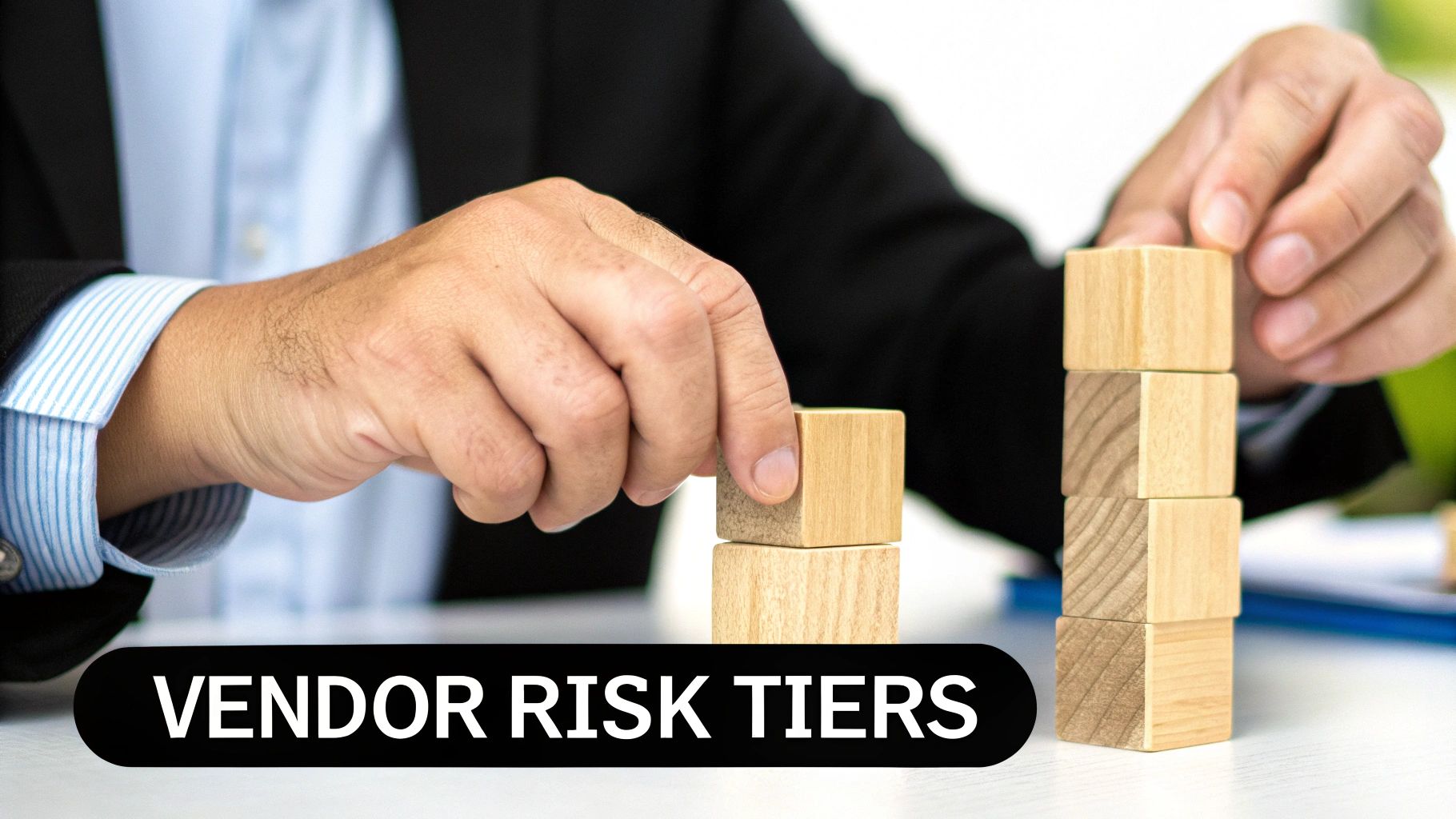
Creating a Vendor Tiering System
Once you've got a handle on risk, you can build a practical tiering system. Most organizations find that a simple three or four-category model works best, defining how much scrutiny each vendor gets. The first step is always gathering the right information from the start; you can get a head start by checking out this vendor registration form template to streamline supplier onboarding.
Let's look at how a financial services firm might structure its tiers.
Sample Vendor Risk Tiering Model
This table gives a practical look at how different vendors might be classified and what level of oversight each tier demands.
Risk Tier | Vendor Example (Financial Services) | Data Access Level | Required Due Diligence |
|---|---|---|---|
Tier 1 (Critical) | Core banking platform provider; Cloud host for production systems; Claims AI reviews engine | Direct access to PII, financial records, and critical infrastructure | Full on-site audits, continuous security monitoring, penetration testing, executive-level review |
Tier 2 (High) | AI customer care platform; Third-party debt collection agency | Access to sensitive, non-public customer or company data | Comprehensive remote security assessment (e.g., SIG), review of SOC 2 Type II, business continuity plan validation |
Tier 3 (Moderate) | Internal project management SaaS tool; Corporate travel booking platform | Limited access to non-public information; no direct access to core customer data | Standardized security questionnaire, review of public-facing security policies |
Tier 4 (Low) | Office supply vendor; Landscaping services; Catering company | No access to company data or systems | Basic vendor registration and financial viability check |
This tiered model is the engine that makes your program efficient. It ensures your due diligence is proportional to the actual risk. For instance, when you are choosing IT asset disposition companies, you’re dealing with a partner handling hardware that could still contain sensitive corporate data. They would almost certainly land in a higher-risk tier, triggering a more rigorous vetting process than, say, your new coffee supplier.
By categorizing vendors this way, you create a clear, defensible, and efficient system for managing every single third-party relationship.
How AI Is Reshaping Third Party Risk Management
Relying on traditional third-party risk management is like navigating a modern highway with a paper map. Manual processes, sprawling spreadsheets, and once-a-year assessments are slow, riddled with human error, and leave massive blind spots. When vendors are woven into the very fabric of your operations, this outdated approach just can’t keep up.
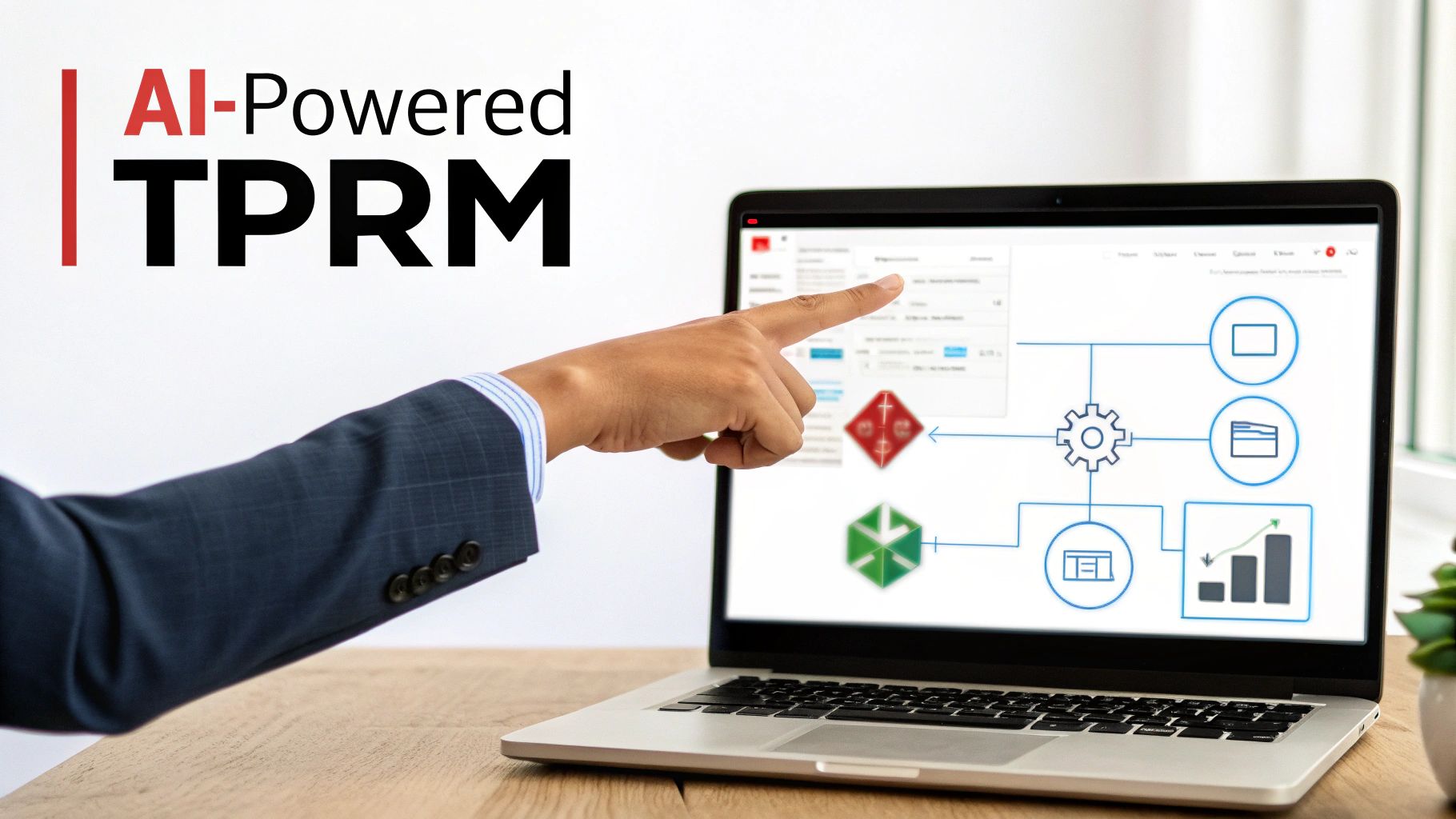
Modernizing your third party risk management framework isn't just about getting better software; it's a fundamental shift in how you operate. This is where Artificial Intelligence comes in, moving the entire practice from reactive, manual check-ins to proactive, automated assurance. AI doesn’t just make the old process faster—it builds an entirely new and far more intelligent way to manage vendor risk.
From Manual Drudgery to Intelligent Orchestration
AI-native platforms directly tackle the biggest headaches of manual TPRM by automating the most time-consuming work. Instead of your team spending weeks just chasing down vendors for documentation, AI agents can run the entire data collection process. They can automatically request, receive, and even perform initial analysis on evidence like SOC 2 reports or security questionnaires.
This automation is a game-changer, especially in heavily regulated industries like financial services. Imagine the challenges faced by AI insurance companies that rely on third-party data processors to handle sensitive claims. An AI-driven framework can watch over these vendors continuously, flagging any drift from their contractual security duties in real-time. This frees up your human experts to focus on strategy and risk mitigation, not administrative busywork.
Automating Evidence Collection and Control Assessments
One of the most powerful things AI brings to the table is its ability to connect what a vendor says they do with hard proof. You can train an AI-powered system on your organization's specific control requirements, and it can then automatically map the evidence a vendor provides directly against those controls.
For example, if a vendor providing AI customer care for a bank claims to have multi-factor authentication in place, an AI agent can actually verify this by analyzing system configurations or security logs. It moves you from a "trust but verify" posture to a state of "continuous verification."
This is crucial for managing complex relationships, like those with platforms that handle claims AI reviews. The AI can analyze a vendor's performance metrics and security posture at the same time, ensuring they are both effective and compliant. You can see how this works by exploring the concepts behind AI-powered decision-making.
AI doesn't replace human judgment in risk management; it elevates it. By handling the high-volume, repetitive tasks of evidence collection and initial analysis, AI empowers human experts to focus their attention on complex, high-stakes decisions and strategic vendor relationships.
Intelligent Escalation for Proactive Mitigation
Maybe the most profound change AI introduces is the move from scheduled, calendar-based reviews to intelligent, event-driven alerts. Manual processes often uncover critical risks long after the damage has started. An AI system, on the other hand, can spot a high-risk finding—like a major vulnerability in a vendor's software—and instantly escalate it to the right team with all the necessary context.
This isn't a luxury anymore; it's a competitive necessity. Research from EY highlights that 36% of organizations using automation have gained a better understanding of their third-party risk. Among top-performing programs, 45% believe ongoing investment in technology is critical for success, while regulatory pressure drives improvements for another 34%. You can dig into the full findings on how technology is reshaping TPRM at EY.com.
For financial institutions, this means achieving a much higher level of accuracy and being able to head off problems before they escalate. It’s not just about efficiency—it's about building a resilient, auditable, and intelligent third party risk management framework that can stand up to a world of complex threats and regulations.
Your Roadmap to Implementing a TPRM Framework
Building a solid third party risk management framework from scratch can feel overwhelming. The secret is to break the challenge down into manageable phases. The most durable and effective TPRM programs I've seen are always built on three pillars: the right People, a clear Process, and enabling Technology.
Thinking about these three elements together gives you a practical roadmap for either launching a new program or giving your existing one a much-needed upgrade. It’s the difference between just buying a tool and actually building a lasting capability that protects your business as it grows.
Assembling the Right People
A TPRM framework is only as good as the people who run it. Your first move should be to create a cross-functional team—think of it as a TPRM committee or working group. Getting the right people in the room from the start ensures you cover all your bases.
Make sure you include representatives from these key areas:
Procurement: They are on the front lines and can weave risk assessments right into the initial vendor sourcing and selection process.
IT and Information Security: These are your technical experts who can properly vet a vendor's cybersecurity posture, controls, and how they handle your data.
Legal and Compliance: They’ll ensure every contract and vendor activity aligns with regulatory mandates and your own internal policies.
Business Unit Leaders: These are the people who actually work with the vendor day-to-day. Their input on a vendor’s operational importance is invaluable.
This kind of collaboration breaks down the organizational silos that so often let risks slip through the cracks. It ensures every risk decision is made with a 360-degree view of its business impact.
Defining a Clear and Repeatable Process
Once your team is in place, it's time to map out the process. This means documenting a clear, standardized set of procedures that will guide everyone through the entire vendor lifecycle, from the moment you start talking to a new vendor until the day you part ways. A well-defined process eliminates ambiguity and drives consistency.
Start by formalizing your core TPRM policies and defining your organization's official risk appetite. From there, detail the specific due diligence steps required for each vendor risk tier. For example, the scrutiny you apply to a high-risk vendor providing AI customer care will be worlds apart from what's needed for a low-risk office supply company. Creating a comprehensive risk assessment form is a vital part of this stage; you can explore our risk assessment form template for AI-generated examples to see how this can be structured.
Selecting and Integrating Enabling Technology
People and process lay the foundation, but technology is what makes a modern TPRM framework work at scale. Let’s be realistic: manual methods just can't keep up anymore. For a financial services firm—especially AI insurance companies managing sensitive claims AI reviews—trying to track vendor risk on spreadsheets isn't just inefficient, it's a massive operational gamble.
Despite the obvious need for automation, many organizations are still playing catch-up. A recent study found that only 39% of organizations feel their third-party risk mitigation is highly effective. And while 64% have adopted dedicated TPRM software, a shocking 12% are still relying mainly on spreadsheets. That gap between knowing the risk and actually managing it is where things go wrong. For more on this, you can learn more about third-party risk statistics on secureframe.com.
A phased rollout is the key to getting this right. Start with your most critical, high-risk vendors. This strategy allows you to fine-tune your process and demonstrate clear wins early on, making it much easier to get buy-in before expanding the program across your entire vendor portfolio.
This focused approach helps your team learn the ropes, adapt, and build crucial momentum. By starting small and proving the model, you can secure the support needed to build a comprehensive, enterprise-wide third party risk management framework that genuinely protects the business.
Building a Resilient and Future-Ready Program
Think of your third party risk management framework not as a dusty binder of rules, but as a living, breathing program that builds resilience directly into your organization. It’s about moving past a reactive, check-the-box mentality and developing a truly proactive stance against vendor-related risks.
Each part of the framework, from initial governance to the final offboarding handshake, works together to protect your operations, your data, and your hard-won reputation throughout the entire vendor relationship.
This is where intelligent automation becomes a game-changer. Imagine you're an AI insurance company; you need a way to continuously confirm that partners managing sensitive claims AI reviews are locked down tight. Or, if you're a bank rolling out AI customer care, you need assurance that compliance is being met without drowning your team in manual checks. Automation creates a single, auditable system where your human experts and AI agents can work in tandem.
Ultimately, a truly future-ready program is born from the fusion of a solid process and smart technology. When you weave automation into your TPRM function, you’re not just building something efficient—you're creating a system that's both resilient and deeply compliant. A big part of this is understanding the kind of controls and evidence required, which is why we recommend reading our guide on what is SOC 2 compliance to get a clearer picture.
Take a hard look at where your TPRM program stands today. An AI-native platform can be the catalyst that prepares you for the challenges just over the horizon.
Frequently Asked Questions About TPRM
Even the most seasoned risk professionals run into tricky questions when building and scaling a Third-Party Risk Management program. Here are some of the most common ones we hear from financial services leaders, along with straightforward answers.
What Is the Difference Between TPRM and Vendor Management?
It’s easy to confuse these two, but they operate on completely different levels. Think of it this way: traditional vendor management is all about procurement and performance. It asks, "Are we getting the services we paid for at the agreed-upon price?"
TPRM, on the other hand, is a strategic security function. It goes much deeper, asking a far more critical question: "What damage could this partner do to our business, our customers, or our reputation?" It's a holistic view that covers everything from a vendor’s cybersecurity defenses and regulatory standing to their financial stability and operational resilience, ensuring they don't become an unintentional weak link in your security chain.
How Can We Automate Risk Management for AI Vendors?
Managing partners who provide specialized services like AI customer care or claims AI reviews is a whole new ballgame. Annual questionnaires just won’t cut it when the technology and its risks move so quickly. This is where an AI-native automation platform becomes essential.
Instead of a static, point-in-time check, a modern system can:
Continuously validate controls by automatically requesting and parsing evidence of security measures.
Monitor for security posture changes, flagging things like new software vulnerabilities or a sudden drop in compliance scores.
Intelligently escalate findings to the right people the moment a vendor's risk profile deviates from your standards.
For AI insurance companies, this is non-negotiable. A partner handling sensitive claims data has to be watched like a hawk. Automation turns TPRM from a periodic chore into a state of constant vigilance, making sure your tech partners stay secure.
The goal of automation in TPRM isn't to replace your experts—it's to give them superpowers. By taking over the tedious, high-volume work of data collection and analysis, it frees up your team to focus on strategic judgment and managing the relationships that matter most.
What Are the First Steps for a Small Organization?
If you're just starting out, don't try to boil the ocean. The key is to be pragmatic and focus your efforts where they'll have the biggest impact.
Identify Your Critical Vendors: Who are the 5-10 partners you absolutely cannot operate without? Who has the keys to your most sensitive data? Start there.
Define Your Basic Requirements: Write down your non-negotiables. What are the absolute minimum security and compliance standards any partner must meet to do business with you?
Start with Simple Assessments: You don’t need a hundred-page questionnaire on day one. A standardized, straightforward assessment for your most critical vendors will help you spot the most glaring risks right away.
This targeted, risk-based approach lets you build momentum and show real progress without needing a huge budget or a dedicated army of analysts.
At Nolana, we deploy compliant AI agents to automate high-stakes financial services operations. Our platform provides the continuous monitoring and intelligent orchestration needed to manage vendor risk effectively, helping you build a resilient, auditable, and future-ready TPRM program. Learn how Nolana can transform your risk management.
A third-party risk management (TPRM) framework is the comprehensive game plan a company uses to manage the entire lifecycle of its vendor relationships. Think of it as a systematic approach to identifying, assessing, and neutralizing the risks that come with relying on outside partners, suppliers, and service providers. It's not just a checklist; it's a strategic program designed to shield your business from the financial, reputational, and operational fallout that can happen when a vendor relationship goes wrong.
Why a Modern TPRM Framework is No Longer Optional
We often measure a company’s strength by what we can see on the inside—its people, its technology, its day-to-day processes. But what about the foundation it's all built on?
Imagine your organization is a skyscraper. The real work happens on the floors above, but the entire structure relies completely on the unseen foundation holding it up. In today's interconnected business world, that foundation is your network of third-party vendors. A single crack in that foundation can put the entire building at risk.
This is exactly why a modern third-party risk management framework has moved from a back-office compliance task to a critical business imperative. The old days of treating vendors as simple, interchangeable service providers are long gone. They are now deeply integrated partners who, if not managed properly, can introduce serious vulnerabilities. This is especially true in financial services, where AI insurance companies increasingly depend on external partners for everything from AI customer care to complex, automated insurance claims.
To truly understand why TPRM is so critical today, let's look at the core objectives every modern framework should aim to achieve.
Key Objectives of a Modern TPRM Framework |
|---|
A summary table outlining the core goals of implementing a TPRM framework, connecting each objective to a tangible business outcome. |
Objective |
Business Outcome |
Relevance to Financial Services |
Protect Sensitive Data |
Prevents costly data breaches and preserves customer trust by ensuring vendors meet your security standards. |
Crucial for protecting personally identifiable information (PII) and claims data, especially for AI insurance companies. |
Ensure Regulatory Compliance |
Avoids fines, penalties, and reputational damage from non-compliance with regulations like GDPR, CCPA, and industry-specific mandates. |
Essential for meeting strict oversight from bodies like the OCC, SEC, and FINRA, who hold firms accountable for their vendors' actions. |
Maintain Operational Resilience |
Guarantees business continuity by preventing disruptions caused by a critical vendor's failure or outage. |
Protects core functions like claims AI reviews, payment processing, and AI customer care from third-party downtime. |
Safeguard Company Reputation |
Shields the company’s brand from being tarnished by a vendor’s unethical behavior, security failures, or poor performance. |
A vendor's misconduct, such as misselling products, can directly impact a financial institution's public trust and brand integrity. |
Optimize Vendor Performance & Value |
Moves beyond risk mitigation to ensure you get the best performance, innovation, and value for your investment in third-party services. |
Maximizes the return on investment from FinTech partnerships and ensures that outsourced services like AI customer care meet demanding service level agreements (SLAs). |
Ultimately, these objectives work together to build a resilient and competitive organization. A strong framework doesn't just prevent bad things from happening; it enables the business to partner with confidence.
The Expanding Digital Ecosystem
Today’s business environment is a sprawling, interconnected web. A single organization might share sensitive data with hundreds of different vendors, creating a massive and often poorly understood attack surface. The numbers paint a stark picture: research shows that a staggering 97% of organizations have experienced a breach in their supply chain.
Even more telling, 29% of all data breaches now originate from a third-party vendor. That's nearly one in three, a statistic that underscores the urgent need for a structured defense.
This expanded network brings a host of critical risks to your doorstep:
Cybersecurity Breaches: A vendor with weak security protocols is a wide-open door into your network. This is a top-tier concern for any financial firm that entrusts partners with sensitive policyholder data or confidential client information.
Regulatory Non-Compliance: Regulators don’t care if it was your vendor who messed up; they hold you accountable. A partner’s failure to comply with data privacy or financial regulations can lead to crippling fines and sanctions for your organization.
Operational Disruptions: What happens if a critical vendor goes down? Your own operations could grind to a halt, impacting everything from AI-powered insurance claims processing to the availability of your AI customer care channels.
From Reactive to Proactive Risk Management
Without a framework, organizations are stuck playing defense, constantly reacting to incidents only after the damage is done. A formal TPRM program gives you the structure to get ahead of these threats.
For example, preventing financial misconduct requires real, ongoing oversight—and understanding common third-party risks like 'selling away' by unmonitored advisors shows just how high the stakes are.
By implementing a framework, you gain the visibility and control needed to manage your vendors from onboarding to offboarding. To dig deeper, check out our guide on the principles of https://nolana.com/articles/risk-management-in-operations. In an increasingly interconnected world, a well-designed TPRM framework is the only way to build a resilient, secure, and compliant business foundation.
The Six Pillars of an Effective TPRM Framework
A truly robust third-party risk management framework isn't a one-and-done task; it's a living, breathing cycle. It needs to cover every single interaction you have with a vendor, from the very first conversation about a potential partnership all the way through to the day you securely go your separate ways. This entire lifecycle is supported by six essential pillars, each one building on the last to form a complete defense against third-party risk.
Think of your TPRM framework as the foundation of a skyscraper. It’s the unseen but absolutely critical structure that supports everything you build on top of it, ensuring the stability and safety of your entire operation as it connects with its ecosystem of vendors.
Just as that skyscraper depends on its foundation, your business relies on a solid TPRM program to manage its complex web of vendor relationships safely and effectively.
Pillar 1: Governance and Policy Setting
Before you can even begin to manage risk, you have to define what "risk" actually means to your organization. Governance is the absolute bedrock of your entire third party risk management framework. This is where you create clear, understandable policies, assign roles and responsibilities so everyone knows their part, and establish the organization's official risk appetite.
It’s like setting the rules of the game before the players take the field. For AI insurance companies, this would mean drafting non-negotiable data handling policies for any third-party platform that might touch sensitive claims information. Without a strong governance pillar, any attempt at risk management will be inconsistent and subjective at best.
Pillar 2: Due Diligence and Vendor Onboarding
With the rules in place, it’s time to start vetting potential partners. Due diligence is the investigative phase where you dig deep to assess a vendor's security posture, financial health, and operational controls before any ink hits a contract. This goes far beyond a simple questionnaire; it’s a thorough examination of their ability to safeguard your data and deliver on their promises.
This step is absolutely critical for financial services firms considering a new partner for AI customer care. You have to verify that their AI models are secure, their data centers are compliant, and their teams are trained to handle sensitive financial conversations. Skipping this step is like hiring a CFO without checking their references—a gamble you simply cannot afford to take.
Pillar 3: Contract Management and Negotiation
A well-crafted contract is your single most important enforcement tool. This pillar is all about weaving your risk management requirements directly into legally binding agreements. These contracts must include specific clauses covering data security, service level agreements (SLAs), your right to audit, and crystal-clear protocols for incident response.
For instance, when an insurer integrates a new system for claims AI reviews, the contract must spell out exactly how that vendor will protect policyholder data, the required uptime for the platform, and the financial penalties if they fail to meet those obligations. A strong contract transforms your risk policies from guidelines into enforceable duties.
Pillar 4: Continuous Monitoring and Risk Assessment
Getting a vendor onboarded is just the beginning, not the end of the road. Continuous monitoring is the pillar of ongoing vigilance, ensuring that a vendor's risk profile doesn't deteriorate over time. This means performing regular assessments, using real-time security alerts, and conducting periodic reviews to uncover new vulnerabilities as they emerge.
A vendor that is compliant today may not be compliant tomorrow. The threat landscape is constantly changing, and your monitoring must be dynamic enough to keep pace. Point-in-time assessments are no longer sufficient.
For a bank using a third-party AI customer care chatbot, this pillar means constantly checking for new software flaws or shifts in the vendor's privacy practices. This proactive stance lets you find and fix risks before they can ever be exploited.
Pillar 5: Performance and Relationship Management
Your TPRM framework shouldn't just be about avoiding bad outcomes; it should also ensure you're getting the positive value you paid for. This pillar involves tracking vendor performance against the SLAs in your contract, holding regular business reviews, and actively managing the health of the partnership.
Is the vendor actually delivering on what they promised? Are they hitting the performance targets that justify the investment? For AI insurance companies, this could mean tracking the accuracy rate of an automated claims engine or the customer satisfaction scores generated by an AI support tool.
Pillar 6: Secure Offboarding and Termination
Sooner or later, every business relationship ends. The offboarding pillar makes sure this separation is handled securely and methodically to prevent data leaks or operational chaos. This formal process includes revoking all system access, confirming the secure return or destruction of your data, and finalizing all outstanding contractual duties.
Proper offboarding is not optional. It’s your guarantee that a former partner doesn't become an accidental—or intentional—security threat long after you’ve parted ways. A formal process protects your company from those lingering "ghost" access points that hackers love to find and exploit. Each of these six pillars works together, creating a holistic framework that shields your organization across the entire vendor lifecycle.
Building a Risk-Based Approach to Vendor Management
Let's be realistic: not all of your vendors are created equal. Trying to put every single partner under the same high-powered microscope—from your core banking platform to the company that supplies your coffee—is a surefire way to burn out your team and miss the threats that actually matter.
A risk-based approach is all about focusing your time, energy, and resources where they have the most impact. It means you stop treating every relationship the same and start tailoring your oversight to match the actual risk each vendor introduces. This simple shift is what makes a third party risk management framework manageable, effective, and sustainable in the long run.
Differentiating Inherent and Residual Risk
Before you can tier your vendors, you have to get comfortable with two fundamental concepts: inherent risk and residual risk. Getting this right is the key to building a logical system.
Inherent risk is the raw, out-of-the-box risk that comes with a vendor relationship before you put any controls in place. Think of it as the baseline danger. It’s driven by factors like the kind of data they'll touch, how critical their service is to your daily operations, and what they’re actually doing for you. A third-party partner handling AI customer care for a bank, for example, has an incredibly high inherent risk because they're sitting on a mountain of sensitive customer financial data.
Residual risk, on the other hand, is what’s left over after your security controls, contract clauses, and mitigation plans have done their job. This is the risk you’re ultimately willing to live with. The entire goal of your TPRM framework is to wrestle that high inherent risk down to an acceptable level of residual risk.
A vendor with high inherent risk isn't automatically a "bad" partner. It just means the stakes are higher, and your framework needs to bring its A-game with robust controls—like ironclad contract terms, deep-dive security audits, and continuous monitoring—to bring that risk down to size.
Creating a Vendor Tiering System
Once you've got a handle on risk, you can build a practical tiering system. Most organizations find that a simple three or four-category model works best, defining how much scrutiny each vendor gets. The first step is always gathering the right information from the start; you can get a head start by checking out this vendor registration form template to streamline supplier onboarding.
Let's look at how a financial services firm might structure its tiers.
Sample Vendor Risk Tiering Model
This table gives a practical look at how different vendors might be classified and what level of oversight each tier demands.
Risk Tier | Vendor Example (Financial Services) | Data Access Level | Required Due Diligence |
|---|---|---|---|
Tier 1 (Critical) | Core banking platform provider; Cloud host for production systems; Claims AI reviews engine | Direct access to PII, financial records, and critical infrastructure | Full on-site audits, continuous security monitoring, penetration testing, executive-level review |
Tier 2 (High) | AI customer care platform; Third-party debt collection agency | Access to sensitive, non-public customer or company data | Comprehensive remote security assessment (e.g., SIG), review of SOC 2 Type II, business continuity plan validation |
Tier 3 (Moderate) | Internal project management SaaS tool; Corporate travel booking platform | Limited access to non-public information; no direct access to core customer data | Standardized security questionnaire, review of public-facing security policies |
Tier 4 (Low) | Office supply vendor; Landscaping services; Catering company | No access to company data or systems | Basic vendor registration and financial viability check |
This tiered model is the engine that makes your program efficient. It ensures your due diligence is proportional to the actual risk. For instance, when you are choosing IT asset disposition companies, you’re dealing with a partner handling hardware that could still contain sensitive corporate data. They would almost certainly land in a higher-risk tier, triggering a more rigorous vetting process than, say, your new coffee supplier.
By categorizing vendors this way, you create a clear, defensible, and efficient system for managing every single third-party relationship.
How AI Is Reshaping Third Party Risk Management
Relying on traditional third-party risk management is like navigating a modern highway with a paper map. Manual processes, sprawling spreadsheets, and once-a-year assessments are slow, riddled with human error, and leave massive blind spots. When vendors are woven into the very fabric of your operations, this outdated approach just can’t keep up.
Modernizing your third party risk management framework isn't just about getting better software; it's a fundamental shift in how you operate. This is where Artificial Intelligence comes in, moving the entire practice from reactive, manual check-ins to proactive, automated assurance. AI doesn’t just make the old process faster—it builds an entirely new and far more intelligent way to manage vendor risk.
From Manual Drudgery to Intelligent Orchestration
AI-native platforms directly tackle the biggest headaches of manual TPRM by automating the most time-consuming work. Instead of your team spending weeks just chasing down vendors for documentation, AI agents can run the entire data collection process. They can automatically request, receive, and even perform initial analysis on evidence like SOC 2 reports or security questionnaires.
This automation is a game-changer, especially in heavily regulated industries like financial services. Imagine the challenges faced by AI insurance companies that rely on third-party data processors to handle sensitive claims. An AI-driven framework can watch over these vendors continuously, flagging any drift from their contractual security duties in real-time. This frees up your human experts to focus on strategy and risk mitigation, not administrative busywork.
Automating Evidence Collection and Control Assessments
One of the most powerful things AI brings to the table is its ability to connect what a vendor says they do with hard proof. You can train an AI-powered system on your organization's specific control requirements, and it can then automatically map the evidence a vendor provides directly against those controls.
For example, if a vendor providing AI customer care for a bank claims to have multi-factor authentication in place, an AI agent can actually verify this by analyzing system configurations or security logs. It moves you from a "trust but verify" posture to a state of "continuous verification."
This is crucial for managing complex relationships, like those with platforms that handle claims AI reviews. The AI can analyze a vendor's performance metrics and security posture at the same time, ensuring they are both effective and compliant. You can see how this works by exploring the concepts behind AI-powered decision-making.
AI doesn't replace human judgment in risk management; it elevates it. By handling the high-volume, repetitive tasks of evidence collection and initial analysis, AI empowers human experts to focus their attention on complex, high-stakes decisions and strategic vendor relationships.
Intelligent Escalation for Proactive Mitigation
Maybe the most profound change AI introduces is the move from scheduled, calendar-based reviews to intelligent, event-driven alerts. Manual processes often uncover critical risks long after the damage has started. An AI system, on the other hand, can spot a high-risk finding—like a major vulnerability in a vendor's software—and instantly escalate it to the right team with all the necessary context.
This isn't a luxury anymore; it's a competitive necessity. Research from EY highlights that 36% of organizations using automation have gained a better understanding of their third-party risk. Among top-performing programs, 45% believe ongoing investment in technology is critical for success, while regulatory pressure drives improvements for another 34%. You can dig into the full findings on how technology is reshaping TPRM at EY.com.
For financial institutions, this means achieving a much higher level of accuracy and being able to head off problems before they escalate. It’s not just about efficiency—it's about building a resilient, auditable, and intelligent third party risk management framework that can stand up to a world of complex threats and regulations.
Your Roadmap to Implementing a TPRM Framework
Building a solid third party risk management framework from scratch can feel overwhelming. The secret is to break the challenge down into manageable phases. The most durable and effective TPRM programs I've seen are always built on three pillars: the right People, a clear Process, and enabling Technology.
Thinking about these three elements together gives you a practical roadmap for either launching a new program or giving your existing one a much-needed upgrade. It’s the difference between just buying a tool and actually building a lasting capability that protects your business as it grows.
Assembling the Right People
A TPRM framework is only as good as the people who run it. Your first move should be to create a cross-functional team—think of it as a TPRM committee or working group. Getting the right people in the room from the start ensures you cover all your bases.
Make sure you include representatives from these key areas:
Procurement: They are on the front lines and can weave risk assessments right into the initial vendor sourcing and selection process.
IT and Information Security: These are your technical experts who can properly vet a vendor's cybersecurity posture, controls, and how they handle your data.
Legal and Compliance: They’ll ensure every contract and vendor activity aligns with regulatory mandates and your own internal policies.
Business Unit Leaders: These are the people who actually work with the vendor day-to-day. Their input on a vendor’s operational importance is invaluable.
This kind of collaboration breaks down the organizational silos that so often let risks slip through the cracks. It ensures every risk decision is made with a 360-degree view of its business impact.
Defining a Clear and Repeatable Process
Once your team is in place, it's time to map out the process. This means documenting a clear, standardized set of procedures that will guide everyone through the entire vendor lifecycle, from the moment you start talking to a new vendor until the day you part ways. A well-defined process eliminates ambiguity and drives consistency.
Start by formalizing your core TPRM policies and defining your organization's official risk appetite. From there, detail the specific due diligence steps required for each vendor risk tier. For example, the scrutiny you apply to a high-risk vendor providing AI customer care will be worlds apart from what's needed for a low-risk office supply company. Creating a comprehensive risk assessment form is a vital part of this stage; you can explore our risk assessment form template for AI-generated examples to see how this can be structured.
Selecting and Integrating Enabling Technology
People and process lay the foundation, but technology is what makes a modern TPRM framework work at scale. Let’s be realistic: manual methods just can't keep up anymore. For a financial services firm—especially AI insurance companies managing sensitive claims AI reviews—trying to track vendor risk on spreadsheets isn't just inefficient, it's a massive operational gamble.
Despite the obvious need for automation, many organizations are still playing catch-up. A recent study found that only 39% of organizations feel their third-party risk mitigation is highly effective. And while 64% have adopted dedicated TPRM software, a shocking 12% are still relying mainly on spreadsheets. That gap between knowing the risk and actually managing it is where things go wrong. For more on this, you can learn more about third-party risk statistics on secureframe.com.
A phased rollout is the key to getting this right. Start with your most critical, high-risk vendors. This strategy allows you to fine-tune your process and demonstrate clear wins early on, making it much easier to get buy-in before expanding the program across your entire vendor portfolio.
This focused approach helps your team learn the ropes, adapt, and build crucial momentum. By starting small and proving the model, you can secure the support needed to build a comprehensive, enterprise-wide third party risk management framework that genuinely protects the business.
Building a Resilient and Future-Ready Program
Think of your third party risk management framework not as a dusty binder of rules, but as a living, breathing program that builds resilience directly into your organization. It’s about moving past a reactive, check-the-box mentality and developing a truly proactive stance against vendor-related risks.
Each part of the framework, from initial governance to the final offboarding handshake, works together to protect your operations, your data, and your hard-won reputation throughout the entire vendor relationship.
This is where intelligent automation becomes a game-changer. Imagine you're an AI insurance company; you need a way to continuously confirm that partners managing sensitive claims AI reviews are locked down tight. Or, if you're a bank rolling out AI customer care, you need assurance that compliance is being met without drowning your team in manual checks. Automation creates a single, auditable system where your human experts and AI agents can work in tandem.
Ultimately, a truly future-ready program is born from the fusion of a solid process and smart technology. When you weave automation into your TPRM function, you’re not just building something efficient—you're creating a system that's both resilient and deeply compliant. A big part of this is understanding the kind of controls and evidence required, which is why we recommend reading our guide on what is SOC 2 compliance to get a clearer picture.
Take a hard look at where your TPRM program stands today. An AI-native platform can be the catalyst that prepares you for the challenges just over the horizon.
Frequently Asked Questions About TPRM
Even the most seasoned risk professionals run into tricky questions when building and scaling a Third-Party Risk Management program. Here are some of the most common ones we hear from financial services leaders, along with straightforward answers.
What Is the Difference Between TPRM and Vendor Management?
It’s easy to confuse these two, but they operate on completely different levels. Think of it this way: traditional vendor management is all about procurement and performance. It asks, "Are we getting the services we paid for at the agreed-upon price?"
TPRM, on the other hand, is a strategic security function. It goes much deeper, asking a far more critical question: "What damage could this partner do to our business, our customers, or our reputation?" It's a holistic view that covers everything from a vendor’s cybersecurity defenses and regulatory standing to their financial stability and operational resilience, ensuring they don't become an unintentional weak link in your security chain.
How Can We Automate Risk Management for AI Vendors?
Managing partners who provide specialized services like AI customer care or claims AI reviews is a whole new ballgame. Annual questionnaires just won’t cut it when the technology and its risks move so quickly. This is where an AI-native automation platform becomes essential.
Instead of a static, point-in-time check, a modern system can:
Continuously validate controls by automatically requesting and parsing evidence of security measures.
Monitor for security posture changes, flagging things like new software vulnerabilities or a sudden drop in compliance scores.
Intelligently escalate findings to the right people the moment a vendor's risk profile deviates from your standards.
For AI insurance companies, this is non-negotiable. A partner handling sensitive claims data has to be watched like a hawk. Automation turns TPRM from a periodic chore into a state of constant vigilance, making sure your tech partners stay secure.
The goal of automation in TPRM isn't to replace your experts—it's to give them superpowers. By taking over the tedious, high-volume work of data collection and analysis, it frees up your team to focus on strategic judgment and managing the relationships that matter most.
What Are the First Steps for a Small Organization?
If you're just starting out, don't try to boil the ocean. The key is to be pragmatic and focus your efforts where they'll have the biggest impact.
Identify Your Critical Vendors: Who are the 5-10 partners you absolutely cannot operate without? Who has the keys to your most sensitive data? Start there.
Define Your Basic Requirements: Write down your non-negotiables. What are the absolute minimum security and compliance standards any partner must meet to do business with you?
Start with Simple Assessments: You don’t need a hundred-page questionnaire on day one. A standardized, straightforward assessment for your most critical vendors will help you spot the most glaring risks right away.
This targeted, risk-based approach lets you build momentum and show real progress without needing a huge budget or a dedicated army of analysts.
At Nolana, we deploy compliant AI agents to automate high-stakes financial services operations. Our platform provides the continuous monitoring and intelligent orchestration needed to manage vendor risk effectively, helping you build a resilient, auditable, and future-ready TPRM program. Learn how Nolana can transform your risk management.


All systems operational
1 Lime Street, London EC3M 7HA | 222E 3rd Street, New York 10009
Copyright © 2026, Nolana. All rights reserved
All systems operational
1 Lime Street, London EC3M 7HA | 222E 3rd Street, New York 10009
Copyright © 2026, Nolana. All rights reserved
All systems operational
1 Lime Street, London EC3M 7HA | 222E 3rd Street, New York 10009
Copyright © 2026, Nolana. All rights reserved
All systems operational
1 Lime Street, London EC3M 7HA | 222E 3rd Street, New York 10009
Copyright © 2026, Nolana. All rights reserved