AI Agents for Customer Service in Finance and Insurance
AI Agents for Customer Service in Finance and Insurance
Discover how AI agents for customer service are transforming finance and insurance. Our guide covers implementation, compliance, and measuring success.
Let's be clear: when we talk about AI agents for customer service, we're not talking about your average chatbot. These are sophisticated digital employees, built to take on complex, high-stakes work. In finance and insurance, this means they’re processing claims, providing regulated advice, and resolving sensitive customer problems around the clock, 24/7.
This isn't just about improving efficiency; it's about fundamentally changing how the customer experience is delivered.
The New Digital Workforce in Finance and Insurance
Forget thinking of this as a future concept. AI agents for customer service are already an active, powerful workforce in finance and insurance today. We've moved well beyond the simple, scripted chatbots that could only answer basic FAQs. The reality now is a team of intelligent digital employees that can handle intricate tasks once reserved only for human specialists.
These agents are on the front lines, automating insurance claims and elevating AI customer care in financial services. Think of a system that doesn't just pass along a query but actually executes an entire process from start to finish. From the moment a policyholder submits a claim to the final payout, an AI agent can manage the entire workflow with incredible speed and accuracy.
This is exactly why leading ai insurance companies are seeing massive gains in both operational efficiency and customer satisfaction. It's completely resetting the standard for claims ai reviews.
Redefining Operational Boundaries
The impact here goes right to the core of how regulated industries operate. These AI agents aren't just separate tools; they're woven directly into your existing workflows, acting as a genuine digital extension of your team. This allows organizations to manage a much higher volume of work without having to scale their human headcount proportionally, tackling operational bottlenecks head-on.
By automating routine yet complex tasks like claim validation and fraud detection, AI agents free up human experts to focus on the most sensitive and strategic cases, boosting both productivity and employee morale.
This shift helps create a far more responsive and resilient operational model. Instead of making customers wait in queues or for the next business day, you can offer them immediate, intelligent help at any time. The outcome is a smooth, seamless experience that builds real trust and loyalty.
To see how this technology is being applied in other areas, you can explore our overview of agentic AI use cases. Building this foundation is crucial for any financial institution that wants to deliver top-tier service while keeping costs and compliance in check in a very demanding market.
How AI Agents Automate Insurance Claims
Let's move past the abstract and see what AI agents for customer service look like on the ground. The best way to understand their impact is to walk through a scenario every auto insurer knows well.
Picture this: your policyholder, Sarah, has a minor fender bender. In the old days, this would kick off a painful process of phone tag, endless paperwork, and waiting. With an AI agent, the entire experience is different from the moment it happens. Sarah just opens your company’s mobile app, reports the accident, and uploads a few photos of the damage. That’s it. The AI agent takes over from there.
The agent’s first job is to handle the First Notice of Loss (FNOL). It doesn’t just log a ticket; it instantly cross-references Sarah’s policy, confirms her coverage is active, and validates the details she submitted. This initial step, which used to take a human agent hours, is done in less than a minute.
From Photo to Payout: The AI Workflow in Action
With the basic claim validated, the AI agent gets to work on the analysis. It uses computer vision to inspect the photos Sarah sent, measuring the extent of the vehicle damage. By comparing these images against a massive database of past accidents, it can generate a surprisingly accurate repair cost estimate.
At the same time, the agent is running a quiet fraud detection analysis in the background. It scans the claim for any red flags or inconsistencies by checking it against historical data, adding a crucial layer of security without slowing things down for legitimate customers like Sarah.
Next up: logistics. The AI agent taps into a network of approved repair shops in Sarah's area, checks their current availability, and pushes a list of options directly to her in the app. She can pick a shop and book a time with a single tap. The AI handles the rest.
This flow shows how an AI agent moves a claim from intake to resolution.
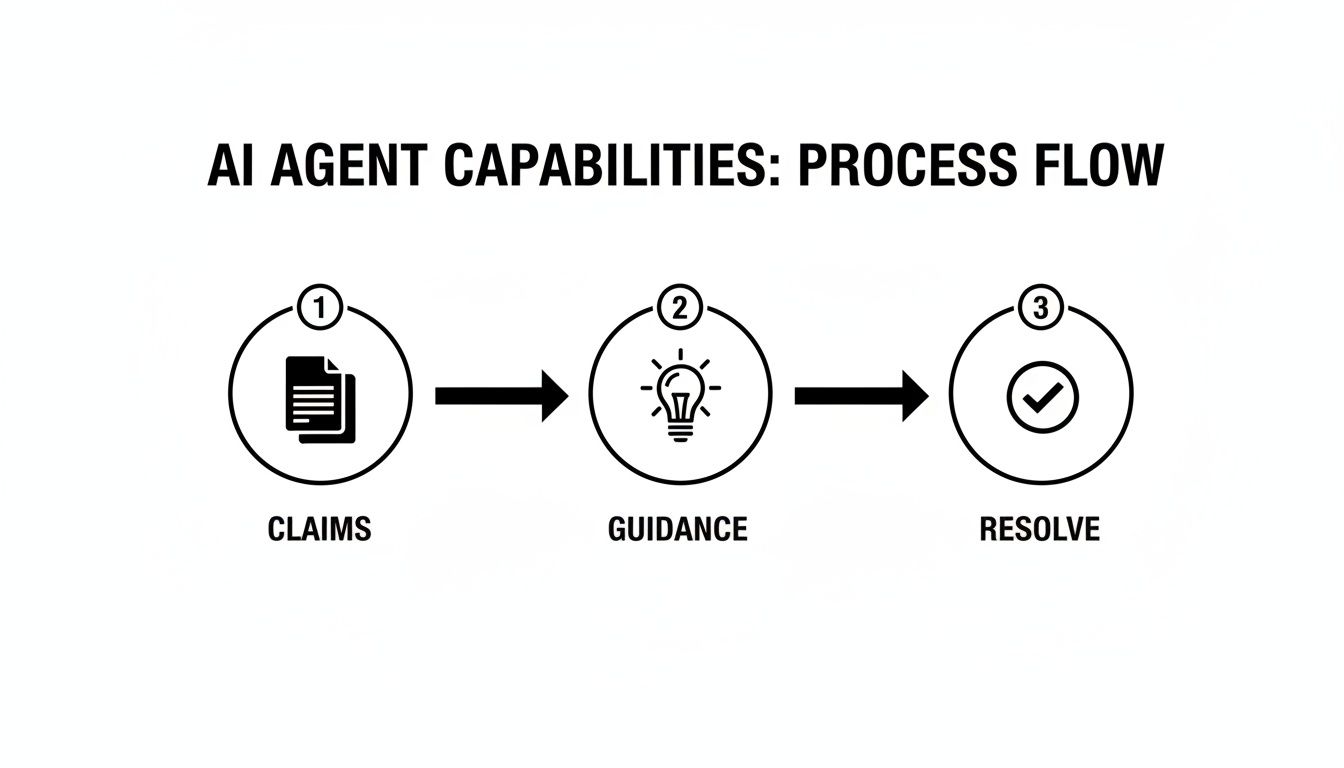
As you can see, the agent doesn't just complete tasks—it intelligently guides the process from one stage to the next.
Redefining Customer Communication and Satisfaction
Throughout this whole process, the AI agent delivers proactive AI customer care. Sarah gets real-time updates via text or app notifications about her claim status, the repair schedule, and what’s coming next. She never has to wonder, "What's going on with my claim?" The information finds her.
This kind of constant, transparent communication completely changes the customer experience. It replaces the anxiety and uncertainty that have always defined the claims process with a sense of control and clarity.
For leading AI insurance companies, this isn't just about saving money on operations. It's about strengthening the customer relationship at its most critical moment.
Once the repairs are done, the AI agent handles the final steps. It confirms the repair shop's invoice matches its initial estimate (flagging any big differences for a human to review) and then triggers the payment directly to the shop. Sarah gets a notification that her car is ready, and the claim is closed.
A process that once took weeks of phone calls and emails is now finished in days, sometimes even hours. The efficiency boost is huge, with some insurers cutting their claim cycle times by over 50%. You can explore more about the mechanics behind this in our guide to insurance claims processing automation.
This example shows how one AI agent can manage a complex workflow from start to finish, turning a stressful event into a surprisingly simple, modern experience. It’s a perfect illustration of how AI is becoming a core part of the modern operational workforce.
Setting a New Standard for Customer Care in Financial Services
While overhauling the insurance claims process is a massive win, the real story is how AI agents for customer service are redefining support across the entire financial world. From retail banking to wealth management, these aren't just chatbots; they are sophisticated agents creating a new benchmark for AI customer care. They're delivering personalized, compliant, and secure support on a scale we just couldn't achieve before.
Financial services are a whirlwind of high-volume, complex customer interactions—the perfect environment for these agents to shine. We're moving way beyond simple balance checks. Today’s AI agents can handle the intricate, multi-step journeys that build—or break—a customer relationship.

This isn't just a niche trend; it's a fundamental industry shift. Projections show that by 2025, a staggering 95% of all customer interactions will be touched by AI in some way. Why the rush? Because modern customers expect fast, consistent, and deeply personal service, and this technology delivers it.
Practical Applications in Banking and Wealth Management
So, what does this look like day-to-day? Let's move from theory to reality with a few concrete examples. These aren't futuristic concepts; they are real-world use cases where agents handle sensitive, regulated tasks with absolute precision.
Mortgage Application Guidance: Imagine an AI agent walking a first-time homebuyer through their entire mortgage application. It can ask for clarification on income details, help securely upload documents, and provide instant status updates. No more waiting days for a callback just to find out you missed a form.
Instant Fraud Resolution: A credit card gets flagged for a suspicious charge at 2 a.m. Instead of a frustrating automated call, an AI agent instantly texts the customer, verifies the transaction, and—if it's fraud—locks the card and kicks off the dispute process. The whole thing is over in seconds.
Personalized Portfolio Updates: A wealth management client wants to know how market volatility is affecting their retirement goals. An AI agent can provide a personalized video summary, answer follow-up questions, and even schedule a meeting with their human advisor for a deeper strategic conversation.
These interactions are far more than simple Q&A. They are complex workflows that require secure access to customer data, strict adherence to procedural rules, and perfect documentation for every single step. For a closer look at the mechanics, you can explore our in-depth article on AI customer care.
The Compliance Advantage in Regulated Environments
In finance, every customer conversation is scrutinized under a regulatory microscope. This is where advanced AI agents truly prove their worth, leaving simpler automation tools in the dust. They are built from the ground up to navigate the tangled web of industry regulations, ensuring every piece of information and every action taken is fully compliant.
Think of the AI agent as a built-in compliance officer for every single conversation. It creates a perfect, unchangeable audit trail, which is absolutely invaluable for resolving disputes and satisfying regulators.
This built-in oversight drastically cuts down on the risk of human error—the kind of small mistakes that can snowball into massive compliance fines and lasting reputational damage. The agent guarantees that policies are explained and procedures are followed the exact same way every time, for every customer.
Comparing Customer Service Models in Financial Services
To really grasp the impact of these advanced agents, it helps to see how they stack up against traditional human support and the basic chatbots we've all encountered. Each model has its place, but their capabilities differ dramatically in the high-stakes world of finance.
The table below breaks down the key differences.
Comparing Customer Service Models in Financial Services
Capability | Human Agent | Basic Chatbot | Advanced AI Agent |
|---|---|---|---|
Availability | Business hours only | 24/7 | 24/7 |
Handling Complexity | High, but variable | Low (scripted FAQs) | High (multi-step processes) |
Compliance Adherence | Prone to human error | High, but limited scope | Consistently high and auditable |
Personalization | High, but manual | Low (generic responses) | High (uses real-time data) |
Scalability | Low (requires hiring) | High | Instantly scalable |
As you can see, the choice becomes pretty clear. Advanced AI agents for customer service offer the best of both worlds. They deliver the scalability and flawless consistency of automation while handling the complex, nuanced problems that were once the exclusive domain of your best human experts. It's a more reliable and effective model for the future of finance.
Integrating AI Agents with Your Core Systems
How do these sophisticated AI agents for customer service actually plug into your complex, established infrastructure? It’s helpful to think of the agent as a brand-new digital employee. We give this agent its own secure, role-based credentials, which let it access and act within your core systems just like any human member of the team.
This "digital employee" isn't a single piece of tech; it's a symphony of several key technologies working together. Natural Language Processing (NLP) and Large Language Models (LLMs) serve as its ears and brain, figuring out what a customer actually wants from an email, chat, or phone call. At the same time, Robotic Process Automation (RPA) acts as its hands, letting it execute tasks like updating a customer record or processing a transaction.
This combination is what allows the agent to do more than just talk—it can act. It can understand a customer's request to update their policy, securely log into the main system, make the change, and then circle back to confirm with the customer. All without a human ever touching it.

Creating a Connected Ecosystem with APIs
The real magic behind this smooth operation is a set of tools called Application Programming Interfaces (APIs). Think of APIs as the digital handshakes that let different software systems talk to each other and securely share information. Your AI agent uses these connections to plug directly into the tools your team already uses every single day.
This integration is absolutely crucial for creating a single, unified workflow. When an AI agent connects to your core systems, it starts breaking down the data silos that so often drag down customer service and lead to frustrating, disconnected experiences for everyone.
Customer Relationship Management (CRM): By hooking into platforms like Salesforce, the AI agent gets the full picture of a customer's history. It instantly knows about past interactions and their account status, which is the key to providing truly personal and context-aware AI customer care.
Service Desks: Connecting to systems like ServiceNow lets the agent create, update, and resolve support tickets on its own. It can even escalate tricky issues to human agents with a complete, pre-filled ticket, saving everyone precious time.
Contact Center Platforms: Integrating with software like Genesys allows the AI agent to handle the first point of contact, manage call routing, and even whisper real-time suggestions to human agents during live conversations.
Getting this level of integration right is a big step, but the industry is still working toward full automation. For everything to run smoothly, this requires a solid data infrastructure, which includes new capabilities for unlocking low-latency analytics and GenAI with real-time data streaming.
Building a Reliable and Intelligent Data Pipeline
For an AI agent to be truly effective—especially for ai insurance companies dealing with complex claims—it needs to be constantly learning from your specific operational data. This means building a reliable data pipeline that continuously feeds the AI your company’s unique knowledge.
This pipeline is what turns a generic AI model into a specialist on your products, policies, and customer histories. It's constantly training the agent on your Standard Operating Procedures (SOPs), past customer tickets, and internal knowledge bases.
The goal is to ensure the AI agent’s responses are not just intelligent, but also deeply contextual and accurate to your business. This continuous training loop is what prevents generic answers and ensures every interaction is relevant and helpful.
This is a key difference between a basic chatbot and an advanced AI agent. A well-designed data pipeline ensures the agent gets smarter over time, constantly improving the quality of its service and the accuracy of its decisions.
Adoption of this tech is widespread, but how deep the implementations go varies a lot. By 2025, while 88% of contact centers globally are using AI, only 25% have fully automated their daily operations. This gap shows just how challenging deep system integration can be, but the early movers are seeing clear rewards. For instance, AI-enhanced coaching is already cutting call handling costs by up to 19%. This proves that while the journey can be complex, the payoff for getting the integration right is huge.
Building a Governance Framework for Financial AI
In the high-stakes world of finance and insurance, deploying AI agents without a solid governance framework is a recipe for disaster. It’s not a question of if you’ll run into trouble, but when. You absolutely need a clear set of rules and a robust oversight process to manage risk, stay compliant, and build lasting customer trust.
Think of this framework as the guardrails on a winding mountain road. It’s designed to keep your AI operations safe, predictable, and effective. These guardrails prevent erratic behavior or "hallucinations" and ensure every automated interaction meets the strict standards set by regulators like FINRA or the SEC. This isn't just a technical exercise; it's a core business strategy for adopting AI responsibly.
A well-designed governance model elevates AI from a powerful but unpredictable tool to a trusted, accountable member of your team. It provides the structure needed to confidently automate sensitive processes, whether it's AI customer care in a bank or claims processing for an AI insurance company.
Core Pillars of AI Governance
To build a framework that stands up to regulatory scrutiny, you need to focus on three critical pillars. These components work together to create a system that is transparent, secure, and always keeps a human in the loop when it matters most.
Data Privacy and Security: Your AI agent will be handling sensitive customer data, so security has to be ironclad. This means implementing end-to-end encryption, strict access controls, and adhering to regulations like GDPR. For a deeper look at the security standards involved, you can learn more about what is SOC 2 compliance.
Model Explainability and Auditability: Regulators, and your customers, will want to know why an AI made a specific decision. Explainability means you can actually trace the AI’s logic. Every single action, decision, and data point accessed by the agent must be logged in an immutable audit trail, creating a bulletproof record for compliance reviews and dispute resolution.
Human-in-the-Loop Workflow: No AI is perfect. A smart governance model must include a seamless process for escalating complex or sensitive cases to a human expert. The AI needs to recognize its own limitations and hand off the conversation smoothly, giving the human agent a complete summary and all the necessary context to take over.
This structured approach ensures that automation enhances human oversight, rather than attempting to replace it.
Implementing Practical Guardrails
Putting governance into practice means setting clear operational rules. For example, an AI agent in an insurance company could be empowered to automatically approve claims under a certain threshold, say $2,500. But any claim above that amount, or one that looks potentially fraudulent, must be flagged for human review. This mix of automation and oversight boosts efficiency without giving up an ounce of control.
The public's growing comfort with AI makes getting this right even more critical. Surveys show that 65% of consumers are fine with using AI for routine tasks. And with 80% of companies planning to adopt AI chatbots by 2025, the pressure to deploy responsibly is immense. You can find more insights in these AI customer service statistics on Zendesk.com.
By establishing these guardrails, you create a system where AI agents for customer service can handle the high-volume, routine work, freeing up your human experts to manage the exceptions. This not only mitigates risk but also improves the overall quality of your service delivery.
In the end, a strong governance framework isn't a roadblock to innovation. It’s the very foundation that makes responsible, scalable automation possible in the first place.
How to Measure Success and Select the Right AI Partner
Bringing AI agents for customer service into your operations is a serious investment. To make it count, you have to look past simple efficiency gains like a lower Average Handling Time (AHT). The real win is measuring the tangible business value these agents deliver, especially when they’re automating complex tasks like insurance claims or improving AI customer care for financial products.
The whole point is to track metrics that show a genuine, positive shift in both your operations and your customer relationships. These Key Performance Indicators (KPIs) paint a clear picture of the impact on your bottom line and customer loyalty, proving the investment was worthwhile.
Key Metrics for Measuring AI Agent Performance
To get a true read on how well your AI agents are performing, you need to focus on a few critical KPIs. Together, they give you a complete picture that balances operational efficiency with the quality of the customer experience.
First Contact Resolution (FCR): What percentage of customer issues does the AI agent solve on the first try, with no human hand-off? A high FCR is a powerful sign of a competent agent and a huge driver of customer satisfaction.
Customer Satisfaction (CSAT) and Net Promoter Score (NPS): It’s simple: ask customers to rate their experience right after they interact with the agent. Consistently high CSAT and NPS scores are proof that your AI is delivering helpful, effective service that builds trust in your brand. These are especially vital when you're looking at claims AI reviews for AI insurance companies.
Containment Rate: This metric shows you how many conversations the AI handles completely from start to finish. A high containment rate means the agent can manage complex, multi-step processes on its own, which directly frees up your human teams for more strategic work.
Operational Cost Reduction: This is where you calculate the direct savings. Tally up the reduced labor costs, lower training expenses, and the financial gains from faster cycle times—like getting an insurance claim processed and paid in a fraction of the time it used to take.
Choosing the Right Technology Partner
Picking the right vendor is just as crucial as the technology itself. You need a partner who gets the unique pressures and rules of working in a regulated financial environment. When you're vetting potential vendors, you have to ask the tough questions to make sure they're aligned with where you want to go.
The right partner doesn’t just sell you software; they provide a solution built on deep industry expertise, with a clear understanding of the compliance and security challenges you face every day.
Look closely at a vendor's track record in your industry. A partner with proven experience can offer insights and ready-made solutions that speed up deployment and lower your risk. For a great example of this in action, see how Nolana is transforming insurance claims with agentic AI.
In the end, this has to be a data-driven decision. A partner who can show you a clear path to ROI, provide rock-solid security credentials, and offer seamless integration will give you the confidence to deploy AI agents for customer service effectively and successfully.
Your Questions About AI Agents, Answered
Diving into the world of AI agents for customer service can bring up some serious questions, especially for leaders in highly regulated fields like finance and insurance. It's only natural. Getting straight answers is the first step toward making a smart decision about this technology.
A big one we hear all the time is about whether an AI can really handle the intricate processes that define financial services. For anyone just getting started, it helps to build on the familiar concept of chatbots. A great primer on this is Understanding Chatbots: The Digital Assistants Of Today. But the agents we’re talking about here are in a completely different league, built from the ground up for high-stakes work.
How Do AI Agents Handle Complex Financial and Insurance Tasks?
So, how does an AI agent actually process something as complicated as an insurance claim? It starts with training. These agents are powered by advanced language models that have been fed vast amounts of industry-specific data.
This specialized training allows them to understand the nuances of insurance jargon, interpret evidence like photos of a damaged car, cross-reference the details against the customer’s policy, and even flag potential signs of fraud. It's no wonder the top ai insurance companies are reporting huge gains in their claims ai reviews.
This isn't just for insurance, either. In financial services, an agent can walk a customer through a mortgage application, instantly verify their information with your internal systems, and make sure every single regulatory box is ticked. The result is a process that’s not only faster but also more accurate and leaves a perfect audit trail, completely rethinking AI customer care.
The real game-changer is this: these AI agents don't just provide answers, they perform multi-step actions. They are meticulously trained on your company’s own Standard Operating Procedures (SOPs), guaranteeing every step they take is perfectly in line with your workflows and compliance rules.
By taking on these complex, repeatable tasks, AI agents for customer service give your human experts the freedom to focus on the high-value, strategic work that truly requires their experience. It’s about creating a smarter, more responsive operation from the ground up.
Ready to see how Nolana can automate your most complex customer service operations? Explore our agentic operating system designed for the high-stakes world of financial services and insurance. Visit https://nolana.com to learn more.
Let's be clear: when we talk about AI agents for customer service, we're not talking about your average chatbot. These are sophisticated digital employees, built to take on complex, high-stakes work. In finance and insurance, this means they’re processing claims, providing regulated advice, and resolving sensitive customer problems around the clock, 24/7.
This isn't just about improving efficiency; it's about fundamentally changing how the customer experience is delivered.
The New Digital Workforce in Finance and Insurance
Forget thinking of this as a future concept. AI agents for customer service are already an active, powerful workforce in finance and insurance today. We've moved well beyond the simple, scripted chatbots that could only answer basic FAQs. The reality now is a team of intelligent digital employees that can handle intricate tasks once reserved only for human specialists.
These agents are on the front lines, automating insurance claims and elevating AI customer care in financial services. Think of a system that doesn't just pass along a query but actually executes an entire process from start to finish. From the moment a policyholder submits a claim to the final payout, an AI agent can manage the entire workflow with incredible speed and accuracy.
This is exactly why leading ai insurance companies are seeing massive gains in both operational efficiency and customer satisfaction. It's completely resetting the standard for claims ai reviews.
Redefining Operational Boundaries
The impact here goes right to the core of how regulated industries operate. These AI agents aren't just separate tools; they're woven directly into your existing workflows, acting as a genuine digital extension of your team. This allows organizations to manage a much higher volume of work without having to scale their human headcount proportionally, tackling operational bottlenecks head-on.
By automating routine yet complex tasks like claim validation and fraud detection, AI agents free up human experts to focus on the most sensitive and strategic cases, boosting both productivity and employee morale.
This shift helps create a far more responsive and resilient operational model. Instead of making customers wait in queues or for the next business day, you can offer them immediate, intelligent help at any time. The outcome is a smooth, seamless experience that builds real trust and loyalty.
To see how this technology is being applied in other areas, you can explore our overview of agentic AI use cases. Building this foundation is crucial for any financial institution that wants to deliver top-tier service while keeping costs and compliance in check in a very demanding market.
How AI Agents Automate Insurance Claims
Let's move past the abstract and see what AI agents for customer service look like on the ground. The best way to understand their impact is to walk through a scenario every auto insurer knows well.
Picture this: your policyholder, Sarah, has a minor fender bender. In the old days, this would kick off a painful process of phone tag, endless paperwork, and waiting. With an AI agent, the entire experience is different from the moment it happens. Sarah just opens your company’s mobile app, reports the accident, and uploads a few photos of the damage. That’s it. The AI agent takes over from there.
The agent’s first job is to handle the First Notice of Loss (FNOL). It doesn’t just log a ticket; it instantly cross-references Sarah’s policy, confirms her coverage is active, and validates the details she submitted. This initial step, which used to take a human agent hours, is done in less than a minute.
From Photo to Payout: The AI Workflow in Action
With the basic claim validated, the AI agent gets to work on the analysis. It uses computer vision to inspect the photos Sarah sent, measuring the extent of the vehicle damage. By comparing these images against a massive database of past accidents, it can generate a surprisingly accurate repair cost estimate.
At the same time, the agent is running a quiet fraud detection analysis in the background. It scans the claim for any red flags or inconsistencies by checking it against historical data, adding a crucial layer of security without slowing things down for legitimate customers like Sarah.
Next up: logistics. The AI agent taps into a network of approved repair shops in Sarah's area, checks their current availability, and pushes a list of options directly to her in the app. She can pick a shop and book a time with a single tap. The AI handles the rest.
This flow shows how an AI agent moves a claim from intake to resolution.
As you can see, the agent doesn't just complete tasks—it intelligently guides the process from one stage to the next.
Redefining Customer Communication and Satisfaction
Throughout this whole process, the AI agent delivers proactive AI customer care. Sarah gets real-time updates via text or app notifications about her claim status, the repair schedule, and what’s coming next. She never has to wonder, "What's going on with my claim?" The information finds her.
This kind of constant, transparent communication completely changes the customer experience. It replaces the anxiety and uncertainty that have always defined the claims process with a sense of control and clarity.
For leading AI insurance companies, this isn't just about saving money on operations. It's about strengthening the customer relationship at its most critical moment.
Once the repairs are done, the AI agent handles the final steps. It confirms the repair shop's invoice matches its initial estimate (flagging any big differences for a human to review) and then triggers the payment directly to the shop. Sarah gets a notification that her car is ready, and the claim is closed.
A process that once took weeks of phone calls and emails is now finished in days, sometimes even hours. The efficiency boost is huge, with some insurers cutting their claim cycle times by over 50%. You can explore more about the mechanics behind this in our guide to insurance claims processing automation.
This example shows how one AI agent can manage a complex workflow from start to finish, turning a stressful event into a surprisingly simple, modern experience. It’s a perfect illustration of how AI is becoming a core part of the modern operational workforce.
Setting a New Standard for Customer Care in Financial Services
While overhauling the insurance claims process is a massive win, the real story is how AI agents for customer service are redefining support across the entire financial world. From retail banking to wealth management, these aren't just chatbots; they are sophisticated agents creating a new benchmark for AI customer care. They're delivering personalized, compliant, and secure support on a scale we just couldn't achieve before.
Financial services are a whirlwind of high-volume, complex customer interactions—the perfect environment for these agents to shine. We're moving way beyond simple balance checks. Today’s AI agents can handle the intricate, multi-step journeys that build—or break—a customer relationship.
This isn't just a niche trend; it's a fundamental industry shift. Projections show that by 2025, a staggering 95% of all customer interactions will be touched by AI in some way. Why the rush? Because modern customers expect fast, consistent, and deeply personal service, and this technology delivers it.
Practical Applications in Banking and Wealth Management
So, what does this look like day-to-day? Let's move from theory to reality with a few concrete examples. These aren't futuristic concepts; they are real-world use cases where agents handle sensitive, regulated tasks with absolute precision.
Mortgage Application Guidance: Imagine an AI agent walking a first-time homebuyer through their entire mortgage application. It can ask for clarification on income details, help securely upload documents, and provide instant status updates. No more waiting days for a callback just to find out you missed a form.
Instant Fraud Resolution: A credit card gets flagged for a suspicious charge at 2 a.m. Instead of a frustrating automated call, an AI agent instantly texts the customer, verifies the transaction, and—if it's fraud—locks the card and kicks off the dispute process. The whole thing is over in seconds.
Personalized Portfolio Updates: A wealth management client wants to know how market volatility is affecting their retirement goals. An AI agent can provide a personalized video summary, answer follow-up questions, and even schedule a meeting with their human advisor for a deeper strategic conversation.
These interactions are far more than simple Q&A. They are complex workflows that require secure access to customer data, strict adherence to procedural rules, and perfect documentation for every single step. For a closer look at the mechanics, you can explore our in-depth article on AI customer care.
The Compliance Advantage in Regulated Environments
In finance, every customer conversation is scrutinized under a regulatory microscope. This is where advanced AI agents truly prove their worth, leaving simpler automation tools in the dust. They are built from the ground up to navigate the tangled web of industry regulations, ensuring every piece of information and every action taken is fully compliant.
Think of the AI agent as a built-in compliance officer for every single conversation. It creates a perfect, unchangeable audit trail, which is absolutely invaluable for resolving disputes and satisfying regulators.
This built-in oversight drastically cuts down on the risk of human error—the kind of small mistakes that can snowball into massive compliance fines and lasting reputational damage. The agent guarantees that policies are explained and procedures are followed the exact same way every time, for every customer.
Comparing Customer Service Models in Financial Services
To really grasp the impact of these advanced agents, it helps to see how they stack up against traditional human support and the basic chatbots we've all encountered. Each model has its place, but their capabilities differ dramatically in the high-stakes world of finance.
The table below breaks down the key differences.
Comparing Customer Service Models in Financial Services
Capability | Human Agent | Basic Chatbot | Advanced AI Agent |
|---|---|---|---|
Availability | Business hours only | 24/7 | 24/7 |
Handling Complexity | High, but variable | Low (scripted FAQs) | High (multi-step processes) |
Compliance Adherence | Prone to human error | High, but limited scope | Consistently high and auditable |
Personalization | High, but manual | Low (generic responses) | High (uses real-time data) |
Scalability | Low (requires hiring) | High | Instantly scalable |
As you can see, the choice becomes pretty clear. Advanced AI agents for customer service offer the best of both worlds. They deliver the scalability and flawless consistency of automation while handling the complex, nuanced problems that were once the exclusive domain of your best human experts. It's a more reliable and effective model for the future of finance.
Integrating AI Agents with Your Core Systems
How do these sophisticated AI agents for customer service actually plug into your complex, established infrastructure? It’s helpful to think of the agent as a brand-new digital employee. We give this agent its own secure, role-based credentials, which let it access and act within your core systems just like any human member of the team.
This "digital employee" isn't a single piece of tech; it's a symphony of several key technologies working together. Natural Language Processing (NLP) and Large Language Models (LLMs) serve as its ears and brain, figuring out what a customer actually wants from an email, chat, or phone call. At the same time, Robotic Process Automation (RPA) acts as its hands, letting it execute tasks like updating a customer record or processing a transaction.
This combination is what allows the agent to do more than just talk—it can act. It can understand a customer's request to update their policy, securely log into the main system, make the change, and then circle back to confirm with the customer. All without a human ever touching it.
Creating a Connected Ecosystem with APIs
The real magic behind this smooth operation is a set of tools called Application Programming Interfaces (APIs). Think of APIs as the digital handshakes that let different software systems talk to each other and securely share information. Your AI agent uses these connections to plug directly into the tools your team already uses every single day.
This integration is absolutely crucial for creating a single, unified workflow. When an AI agent connects to your core systems, it starts breaking down the data silos that so often drag down customer service and lead to frustrating, disconnected experiences for everyone.
Customer Relationship Management (CRM): By hooking into platforms like Salesforce, the AI agent gets the full picture of a customer's history. It instantly knows about past interactions and their account status, which is the key to providing truly personal and context-aware AI customer care.
Service Desks: Connecting to systems like ServiceNow lets the agent create, update, and resolve support tickets on its own. It can even escalate tricky issues to human agents with a complete, pre-filled ticket, saving everyone precious time.
Contact Center Platforms: Integrating with software like Genesys allows the AI agent to handle the first point of contact, manage call routing, and even whisper real-time suggestions to human agents during live conversations.
Getting this level of integration right is a big step, but the industry is still working toward full automation. For everything to run smoothly, this requires a solid data infrastructure, which includes new capabilities for unlocking low-latency analytics and GenAI with real-time data streaming.
Building a Reliable and Intelligent Data Pipeline
For an AI agent to be truly effective—especially for ai insurance companies dealing with complex claims—it needs to be constantly learning from your specific operational data. This means building a reliable data pipeline that continuously feeds the AI your company’s unique knowledge.
This pipeline is what turns a generic AI model into a specialist on your products, policies, and customer histories. It's constantly training the agent on your Standard Operating Procedures (SOPs), past customer tickets, and internal knowledge bases.
The goal is to ensure the AI agent’s responses are not just intelligent, but also deeply contextual and accurate to your business. This continuous training loop is what prevents generic answers and ensures every interaction is relevant and helpful.
This is a key difference between a basic chatbot and an advanced AI agent. A well-designed data pipeline ensures the agent gets smarter over time, constantly improving the quality of its service and the accuracy of its decisions.
Adoption of this tech is widespread, but how deep the implementations go varies a lot. By 2025, while 88% of contact centers globally are using AI, only 25% have fully automated their daily operations. This gap shows just how challenging deep system integration can be, but the early movers are seeing clear rewards. For instance, AI-enhanced coaching is already cutting call handling costs by up to 19%. This proves that while the journey can be complex, the payoff for getting the integration right is huge.
Building a Governance Framework for Financial AI
In the high-stakes world of finance and insurance, deploying AI agents without a solid governance framework is a recipe for disaster. It’s not a question of if you’ll run into trouble, but when. You absolutely need a clear set of rules and a robust oversight process to manage risk, stay compliant, and build lasting customer trust.
Think of this framework as the guardrails on a winding mountain road. It’s designed to keep your AI operations safe, predictable, and effective. These guardrails prevent erratic behavior or "hallucinations" and ensure every automated interaction meets the strict standards set by regulators like FINRA or the SEC. This isn't just a technical exercise; it's a core business strategy for adopting AI responsibly.
A well-designed governance model elevates AI from a powerful but unpredictable tool to a trusted, accountable member of your team. It provides the structure needed to confidently automate sensitive processes, whether it's AI customer care in a bank or claims processing for an AI insurance company.
Core Pillars of AI Governance
To build a framework that stands up to regulatory scrutiny, you need to focus on three critical pillars. These components work together to create a system that is transparent, secure, and always keeps a human in the loop when it matters most.
Data Privacy and Security: Your AI agent will be handling sensitive customer data, so security has to be ironclad. This means implementing end-to-end encryption, strict access controls, and adhering to regulations like GDPR. For a deeper look at the security standards involved, you can learn more about what is SOC 2 compliance.
Model Explainability and Auditability: Regulators, and your customers, will want to know why an AI made a specific decision. Explainability means you can actually trace the AI’s logic. Every single action, decision, and data point accessed by the agent must be logged in an immutable audit trail, creating a bulletproof record for compliance reviews and dispute resolution.
Human-in-the-Loop Workflow: No AI is perfect. A smart governance model must include a seamless process for escalating complex or sensitive cases to a human expert. The AI needs to recognize its own limitations and hand off the conversation smoothly, giving the human agent a complete summary and all the necessary context to take over.
This structured approach ensures that automation enhances human oversight, rather than attempting to replace it.
Implementing Practical Guardrails
Putting governance into practice means setting clear operational rules. For example, an AI agent in an insurance company could be empowered to automatically approve claims under a certain threshold, say $2,500. But any claim above that amount, or one that looks potentially fraudulent, must be flagged for human review. This mix of automation and oversight boosts efficiency without giving up an ounce of control.
The public's growing comfort with AI makes getting this right even more critical. Surveys show that 65% of consumers are fine with using AI for routine tasks. And with 80% of companies planning to adopt AI chatbots by 2025, the pressure to deploy responsibly is immense. You can find more insights in these AI customer service statistics on Zendesk.com.
By establishing these guardrails, you create a system where AI agents for customer service can handle the high-volume, routine work, freeing up your human experts to manage the exceptions. This not only mitigates risk but also improves the overall quality of your service delivery.
In the end, a strong governance framework isn't a roadblock to innovation. It’s the very foundation that makes responsible, scalable automation possible in the first place.
How to Measure Success and Select the Right AI Partner
Bringing AI agents for customer service into your operations is a serious investment. To make it count, you have to look past simple efficiency gains like a lower Average Handling Time (AHT). The real win is measuring the tangible business value these agents deliver, especially when they’re automating complex tasks like insurance claims or improving AI customer care for financial products.
The whole point is to track metrics that show a genuine, positive shift in both your operations and your customer relationships. These Key Performance Indicators (KPIs) paint a clear picture of the impact on your bottom line and customer loyalty, proving the investment was worthwhile.
Key Metrics for Measuring AI Agent Performance
To get a true read on how well your AI agents are performing, you need to focus on a few critical KPIs. Together, they give you a complete picture that balances operational efficiency with the quality of the customer experience.
First Contact Resolution (FCR): What percentage of customer issues does the AI agent solve on the first try, with no human hand-off? A high FCR is a powerful sign of a competent agent and a huge driver of customer satisfaction.
Customer Satisfaction (CSAT) and Net Promoter Score (NPS): It’s simple: ask customers to rate their experience right after they interact with the agent. Consistently high CSAT and NPS scores are proof that your AI is delivering helpful, effective service that builds trust in your brand. These are especially vital when you're looking at claims AI reviews for AI insurance companies.
Containment Rate: This metric shows you how many conversations the AI handles completely from start to finish. A high containment rate means the agent can manage complex, multi-step processes on its own, which directly frees up your human teams for more strategic work.
Operational Cost Reduction: This is where you calculate the direct savings. Tally up the reduced labor costs, lower training expenses, and the financial gains from faster cycle times—like getting an insurance claim processed and paid in a fraction of the time it used to take.
Choosing the Right Technology Partner
Picking the right vendor is just as crucial as the technology itself. You need a partner who gets the unique pressures and rules of working in a regulated financial environment. When you're vetting potential vendors, you have to ask the tough questions to make sure they're aligned with where you want to go.
The right partner doesn’t just sell you software; they provide a solution built on deep industry expertise, with a clear understanding of the compliance and security challenges you face every day.
Look closely at a vendor's track record in your industry. A partner with proven experience can offer insights and ready-made solutions that speed up deployment and lower your risk. For a great example of this in action, see how Nolana is transforming insurance claims with agentic AI.
In the end, this has to be a data-driven decision. A partner who can show you a clear path to ROI, provide rock-solid security credentials, and offer seamless integration will give you the confidence to deploy AI agents for customer service effectively and successfully.
Your Questions About AI Agents, Answered
Diving into the world of AI agents for customer service can bring up some serious questions, especially for leaders in highly regulated fields like finance and insurance. It's only natural. Getting straight answers is the first step toward making a smart decision about this technology.
A big one we hear all the time is about whether an AI can really handle the intricate processes that define financial services. For anyone just getting started, it helps to build on the familiar concept of chatbots. A great primer on this is Understanding Chatbots: The Digital Assistants Of Today. But the agents we’re talking about here are in a completely different league, built from the ground up for high-stakes work.
How Do AI Agents Handle Complex Financial and Insurance Tasks?
So, how does an AI agent actually process something as complicated as an insurance claim? It starts with training. These agents are powered by advanced language models that have been fed vast amounts of industry-specific data.
This specialized training allows them to understand the nuances of insurance jargon, interpret evidence like photos of a damaged car, cross-reference the details against the customer’s policy, and even flag potential signs of fraud. It's no wonder the top ai insurance companies are reporting huge gains in their claims ai reviews.
This isn't just for insurance, either. In financial services, an agent can walk a customer through a mortgage application, instantly verify their information with your internal systems, and make sure every single regulatory box is ticked. The result is a process that’s not only faster but also more accurate and leaves a perfect audit trail, completely rethinking AI customer care.
The real game-changer is this: these AI agents don't just provide answers, they perform multi-step actions. They are meticulously trained on your company’s own Standard Operating Procedures (SOPs), guaranteeing every step they take is perfectly in line with your workflows and compliance rules.
By taking on these complex, repeatable tasks, AI agents for customer service give your human experts the freedom to focus on the high-value, strategic work that truly requires their experience. It’s about creating a smarter, more responsive operation from the ground up.
Ready to see how Nolana can automate your most complex customer service operations? Explore our agentic operating system designed for the high-stakes world of financial services and insurance. Visit https://nolana.com to learn more.


All systems operational
1 Lime Street, London EC3M 7HA | 222E 3rd Street, New York 10009
Copyright © 2026, Nolana. All rights reserved
All systems operational
1 Lime Street, London EC3M 7HA | 222E 3rd Street, New York 10009
Copyright © 2026, Nolana. All rights reserved
All systems operational
1 Lime Street, London EC3M 7HA | 222E 3rd Street, New York 10009
Copyright © 2026, Nolana. All rights reserved
All systems operational
1 Lime Street, London EC3M 7HA | 222E 3rd Street, New York 10009
Copyright © 2026, Nolana. All rights reserved