A Guide to AI-Driven Efficiency: insurance claims processing automation
A Guide to AI-Driven Efficiency: insurance claims processing automation
Discover how insurance claims processing automation can streamline workflows, reduce errors, and speed claim resolutions with AI-powered tools.
Staring at a mountain of paperwork, fielding endless calls, and apologizing for delays—this used to be the unavoidable reality of processing insurance claims. It’s slow, costly, and a source of deep frustration for customers at their most vulnerable. Thankfully, that reality is changing.
This guide is all about insurance claims processing automation, the modern approach that overhauls the entire claims lifecycle, from the first notice of loss to the final settlement, with a special focus on automating insurance claims with AI and enhancing customer care with AI for financial services.
The End of the Waiting Game in Insurance Claims
The traditional path for handling an insurance claim is riddled with friction points. It forces adjusters to manually key in data, cross-reference policy details from dense documents, and make judgment calls based on stacks of paper. This process isn't just inefficient; it's a huge drain on resources and a leading cause of terrible customer experiences.
Now, imagine an intelligent, automated path powered by AI. It’s a completely different world. For AI insurance companies, this means claims that once took weeks can now be processed in minutes or hours. Costs plummet, accuracy soars, and your most skilled people are freed from monotonous, repetitive work to focus on complex cases that truly need their expertise.
A Stark Contrast in Efficiency
To really grasp the difference, it helps to see the two approaches side-by-side. The gap between the old way and the new way is staggering, impacting everything from initial intake to final payout.
Manual vs. Automated Claims: A Side-by-Side Comparison
Process Step | The Traditional Manual Way | The Modern Automated Way |
|---|---|---|
First Notice of Loss (FNOL) | Phone calls during business hours, paper forms, long wait times. | 24/7 intake via chatbots or mobile apps, instant confirmation. |
Data Collection & Entry | Manual keying of data from forms, emails, and PDFs. High risk of human error. | AI extracts data automatically from documents, photos, and reports. 95% or higher accuracy. |
Damage Assessment | Relies on adjusters' schedules, in-person visits, and subjective analysis. | AI analyzes uploaded photos/videos to assess damage instantly. |
Fraud Detection | Dependent on adjuster's experience and manual red flag checks. | AI algorithms cross-reference data points to flag suspicious patterns in real-time. |
Settlement & Payout | Multi-step manual approval process taking days or weeks. | Automated validation and straight-through processing for simple claims, enabling instant payouts. |
Customer Communication | Reactive. Customers must call for updates, often waiting on hold. | Proactive, automated status updates sent via SMS or email at every milestone. |
This comparison makes it clear: automation isn't just a minor improvement. It's a complete reimagining of what claims processing can be—fast, accurate, and customer-focused.
Transforming Customer Care with AI
Ultimately, the most profound impact is felt by the policyholder. A moment of crisis, like a car accident or a flooded basement, is met with speed and clarity instead of confusion and waiting. This is a game-changer for AI customer care in financial services.
By automating routine data validation and communication, insurers can deliver instant updates and faster payouts. This turns a potentially negative interaction into a positive one, building trust and loyalty when it matters most.
This is where automation proves its true value. It’s not just about back-office efficiency; it’s about fundamentally improving the customer relationship. As you can see when you explore the essentials of insurance claims processing, this technology is quickly becoming a competitive necessity.
The New Standard for Claims
The modern claims journey is built on several key advancements that improve how things work behind the scenes and what the customer experiences.
Instant First Notice of Loss (FNOL): AI-powered chatbots and intelligent forms capture initial claim details 24/7, giving immediate confirmation and peace of mind to the policyholder.
Automated Data Triage: The system instantly reads, classifies, and extracts critical information from documents, photos, and reports, wiping out manual data entry.
Proactive Status Updates: Policyholders receive automated, personalized updates via text or email, so they are never left in the dark wondering about their claim's status.
In the end, insurance claims processing automation isn't just a technological upgrade. It’s a strategic move to put speed, accuracy, and customer satisfaction first, setting a new industry standard that benefits everyone involved.
The AI Engine Driving Modern Claims Automation
To really get what's happening with claims automation, you have to look under the hood at the "digital workforce" that makes it all possible. It’s not just one piece of software; it's a whole team of specialized AI technologies working together. This engine is what truly separates a modern, fast-moving claims process from the slow, manual slog of the past.
At the base level, you have Robotic Process Automation (RPA). Think of RPA bots as the ultimate administrative assistants. They're programmed to execute the repetitive, rules-based tasks that eat up an adjuster's day—things like copying data from a claim form into your core system or firing off standard confirmation emails. They just work, 24/7, without making mistakes.
Moving Beyond Simple Tasks with Intelligent AI
While RPA is great for the grunt work, the real magic happens when more advanced AI joins the team. This is where you see leading AI insurance companies pulling away from the pack, as they can now understand and analyze complex, unstructured information.
Natural Language Processing (NLP): This is the communications expert. NLP algorithms can actually read and understand human language across thousands of documents, from police reports and medical records to customer emails. It spots key details, figures out what kind of document it's looking at, and can even pick up on customer sentiment. It’s all about turning mountains of text into clean, structured data.
Machine Learning (ML): This is your sharpest analyst. ML models are trained on your historical claims data, allowing them to spot subtle patterns a human might never see. This makes them incredibly good at predicting a claim's potential severity, flagging fraud risks, and forecasting settlement costs with impressive accuracy.
The overall AI system acts as the conductor, orchestrating this entire workflow. It knows when to hand a task to an RPA bot for simple data entry, when to use NLP to make sense of a document, and when to call on an ML model for a deep-dive analysis. You can see how these systems come together in our guide on intelligent process automation.
This simple visual nails the transition from clunky manual work to a smooth, automated process.
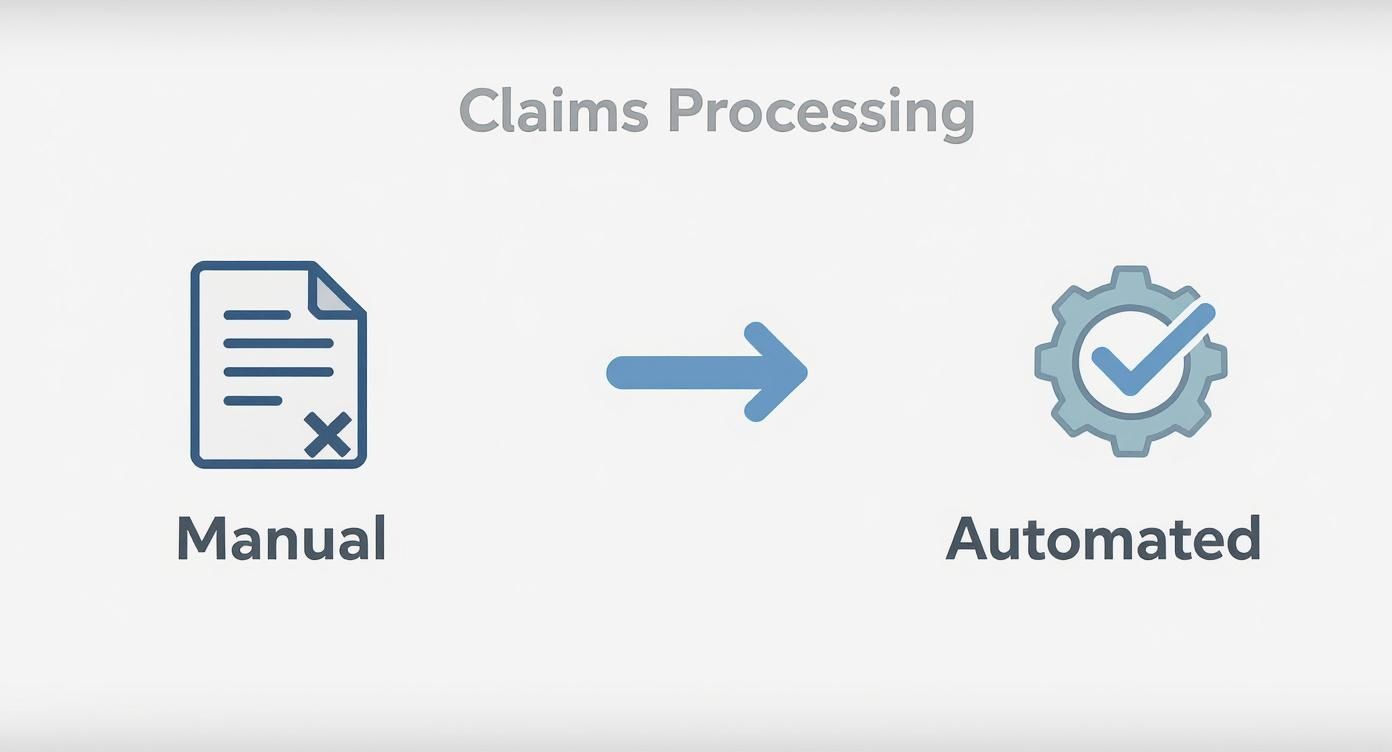
What you're seeing here is technology replacing manual bottlenecks with efficient, repeatable automation, which naturally leads to faster, more accurate results.
The Real-World Impact on Efficiency
When these technologies work in concert, the results are powerful and easy to measure. A huge piece of the puzzle is the ability to accurately extract data from PDF files, since that’s how most of your documentation arrives. Getting that right slashes manual data entry time.
The goal of the AI engine is to build a self-sufficient process that handles the bulk of the claims workload on its own, freeing up your human experts to step in only when their judgment is truly needed.
This isn't just theory; industry data backs it up. We're seeing automation drive incredible efficiency gains globally, cutting claim processing times by as much as 80%. This speed helps insurers reduce claim recovery turnaround by over 30% and deliver 85% faster claim settlements compared to the old way of doing things.
How Automation Redefines Customer Care in Insurance
When you think about insurance automation, it's easy to focus on back-office efficiencies and cost savings. But the real win? It's about completely overhauling the customer experience, especially when people need you most. For today's leading AI insurance companies, insurance claims processing automation isn’t just an operational upgrade; it's a core customer service strategy. It’s a shift from internal process-chasing to proactive, external support.
Think about it from the policyholder's perspective. After an accident or loss, their world is spinning. They need two things above all else: speed and clarity. They want to know their claim is in the system, what happens next, and when they can expect a resolution. The old manual way of doing things creates long, anxious silences that can shatter trust right when it matters most.

This is where automation makes a tangible difference in AI customer care. It swaps out the waiting game for instant acknowledgement and continuous updates, turning a stressful transaction into a genuinely supportive journey.
Providing Instant Peace of Mind
The first few moments after an incident are absolutely critical. Instead of forcing a customer to wait until 9 AM on Monday to call an agent, automation lets them start the claims process right away, on their own terms.
AI-powered chatbots and smart online forms act as a 24/7 digital front door. They can guide a stressed customer through the First Notice of Loss (FNOL) with simple, clear prompts, provide an instant confirmation, and issue a claim number on the spot. This immediate response delivers a powerful dose of reassurance when it's needed most.
By automating the initial intake, insurers can reduce claim cycle times by as much as 50%. This speed isn't just an operational metric; it's a powerful tool for building customer confidence from the very first interaction.
That first positive touchpoint sets a completely new bar for customer care—one that legacy systems just can't clear. It immediately signals to the policyholder that their insurer is on the ball and ready to help.
Keeping Customers Informed Proactively
One of the biggest frustrations with traditional claims is the "black box" problem. A customer sends in their information and then... radio silence for days or even weeks. Automating insurance claims with AI completely flips the script by delivering personalized updates at every stage.
Once a claim is filed, the system can automatically send out notifications for every key milestone.
Confirmation: "We've received your claim #12345. A digital copy of your submission is attached."
Document Review: "Our system has finished reviewing your documents. We'll notify you once an adjuster is assigned."
Approval: "Great news! Your claim has been approved. Payment will be processed within 24 hours."
Payment: "Your settlement of $2,500 has been sent. You should see it in your account shortly."
These automated messages mean policyholders are never left in the dark, wondering what’s going on. If you want to dive deeper into this, our guide on AI customer care explains how these communication strategies create real, lasting loyalty.
From Transactional to Supportive
It gets even better. Beyond just sending status updates, advanced AI can actually understand how a customer is feeling. Using Natural Language Processing (NLP), the system can analyze emails and chat logs to pick up on words and phrases that signal frustration, confusion, or distress.
When the system detects negative sentiment, it can automatically flag the case for a human to step in. This allows your best claims adjusters to intervene at the perfect moment, armed with context and ready to provide a dose of empathy to solve a tricky problem. This smart escalation can turn a bad experience into a great one, proving that the insurer is truly listening. It’s an approach often praised in claims AI reviews because it shows that automation is there to enhance the human touch, not get rid of it.
Measuring the Real-World Business Impact of Automation
Any conversation about new technology eventually lands on one critical question: what’s the real impact on the bottom line? For insurance claims processing automation, the answer is refreshingly clear and backed by hard data. We can measure the return on investment across three core areas: operational efficiency, risk management, and the all-important customer experience.
The gains in efficiency are often the first and most dramatic. Automating insurance claims with AI goes straight for the biggest time and resource sinks in the claims process—things like manual data entry, tedious document checks, and routine follow-ups. By bringing in an AI-powered digital workforce, insurers can compress claim cycle times from weeks down to days. For simple claims, we're talking hours.
This speed isn't just for show; it directly impacts cost. Every time a human has to touch a claim, it adds to the expense. Automation smooths out these friction points, driving down the cost to process each claim and, just as importantly, freeing up your expert adjusters to focus on the complex, high-stakes work where their judgment truly matters.
Slashing Costs and Boosting Accuracy
The financial upside is significant. Across the industry, we're seeing workflow automation deliver a 50% reduction in processing times while cutting operational costs by a solid 20-30%. But it’s not just about doing things faster; it’s about doing them better. Automation brings a new level of precision to the table, with some insurers reporting 30% greater accuracy in claims assessments simply by taking human error out of the equation.
Fraud detection also gets a major boost. Machine learning models can spot suspicious patterns 50% faster than manual reviews, helping to cut fraudulent payouts by as much as 40%. You can discover more insights about these automation statistics on feathery.io.
Accuracy and risk management are deeply intertwined. A single typo or an overlooked policy detail can spiral into incorrect payouts, compliance headaches, and expensive rework. AI acts as a safeguard, ensuring data is captured and validated correctly right from the start.
Automation shifts risk management from a reactive, checklist-based exercise to a proactive, data-driven strategy. It empowers insurers to catch errors and potential fraud before they turn into financial losses.
This is where AI’s analytical horsepower really shines. Algorithms can sift through thousands of data points in a split second, flagging anomalies that would be nearly impossible for a human to catch. This fortifies your defenses against fraud, directly protecting your bottom line. This level of diligence also explains why you'll often see positive claims AI reviews. For a wider look at the advantages, it's worth exploring some of the key business process automation benefits.
Enhancing Customer Loyalty and Retention
The third, and arguably most strategic, benefit is customer loyalty. A fast, transparent, and easy claims process is one of the most powerful retention tools an insurer has. When a policyholder has a good experience during a difficult time, they don't just stay—they become advocates for your brand. This is where top-notch AI customer care makes all the difference.
Quicker settlements mean people get the help they need, when they need it, building tremendous goodwill. Automated, proactive communication keeps policyholders in the loop, getting rid of the anxiety that comes from being left in the dark. This improved experience shows up directly in the KPIs that matter most. When you connect operational wins to customer-facing results, the value of automation becomes impossible to ignore. A great real-world example of this is detailed in our case study on transforming insurance claims with agentic AI.
Tracking Your ROI on Claims Automation
To build a compelling business case, you need to focus on tangible, measurable outcomes. The table below outlines the key performance indicators that truly demonstrate the value your automation initiatives are delivering.
Key Performance Indicator (KPI) | What It Measures | Why Automation Improves It |
|---|---|---|
Cost Per Claim | The total administrative and labor cost to process a single claim, from start to finish. | Automation minimizes manual touchpoints and administrative overhead, directly lowering this cost. |
Claim Cycle Time | The average duration from the First Notice of Loss (FNOL) to final settlement and payment. | Drastically reduces processing delays by automating data entry, validation, and routine tasks. |
Net Promoter Score (NPS) | A measure of customer satisfaction and their willingness to recommend your company to others. | A fast, transparent, and hassle-free claims process is a major driver of positive customer experiences and higher NPS. |
Employee Productivity | The volume of high-value work (e.g., complex investigations) completed by claims staff. | By offloading repetitive work, automation frees up adjusters to focus on tasks requiring human expertise and judgment. |
By consistently tracking these metrics, you move the conversation from "what automation could do" to "what automation is doing" for your business. It provides a clear, data-backed narrative of success that resonates with stakeholders across the organization.
Your Roadmap to Implementing Claims Automation
Getting from an interesting idea to a real-world, value-driving solution takes a smart and strategic plan. Bringing automation into your claims processing isn't something you do overnight; it’s a journey that unfolds in well-thought-out phases. A carefully planned, gradual rollout helps build momentum, proves the concept's value early on, and gets the entire organization on board for the change. This roadmap is your playbook for getting it right.

The first step has nothing to do with technology. It’s all about getting a crystal-clear picture of where you are right now. Before you can automate anything, you need to analyze everything. This foundational work ensures your investment goes exactly where it will make the biggest difference.
Step 1: Start with a Thorough Process Audit
First things first: you need to conduct a deep dive into your current claims workflows. The goal is to pinpoint the exact bottlenecks, mind-numbing repetitive tasks, and high-friction points that are slowing your team down and frustrating your customers. Where do claims get stuck the longest? Which tasks are most susceptible to human error?
Answering these questions will illuminate the best opportunities for automation. You might discover, for example, that manually keying in data from First Notice of Loss (FNOL) forms is eating up hundreds of team hours every month. That single insight is the perfect target for an initial project, setting you up for a quick, visible win.
Step 2: Choose the Right Technology Partner
Once you’ve identified your biggest pain points, it’s time to find a technology partner who actually gets the insurance industry. The market is crowded, but not all vendors are built the same. You need to look past the generic automation platforms and find partners with a proven track record in a regulated field like ours. Reading unbiased claims AI reviews can give you a real sense of how different solutions perform in the wild.
A great partner will be more of a strategic advisor than just a software vendor. They should help you refine your implementation plan and ensure any new tech plays nicely with your existing core systems, like Guidewire or Duck Creek. This is crucial for avoiding new data silos and creating a truly integrated system.
The right technology partnership is less about buying a product and more about co-creating a solution. The best partners understand that successful implementation hinges on both technical integration and aligning with your business goals.
Step 3: Launch a Targeted Pilot Project
Resist the urge to go for a massive, "big bang" overhaul. Instead, start small with a focused pilot project. The perfect candidate for a pilot is a process that is high-volume, relatively low-complexity, and has a clear path to a solid return on investment. The FNOL process is a classic—and highly effective—starting point for many AI insurance companies.
By automating this initial intake, you can score a quick win that shows real, tangible value. It cuts down on manual work, boosts data accuracy right from the start, and gives your AI customer care an immediate lift. A successful pilot acts as powerful proof that the concept works, making it much easier to get the buy-in you need to expand the project. For example, an intelligent digital form can be a game-changer here; you can see what that looks like with our insurance claim form template.
Step 4: Lead the Change Internally
Technology is only half the equation; your people are the other half. A successful rollout absolutely depends on solid change management. It is critical to frame AI not as a threat to jobs, but as a powerful tool that enhances your team's skills by taking the most tedious work off their plates.
Invest in training programs that show your adjusters how automation will free them up to focus on higher-value work—things like complex negotiations, fraud investigation, and delivering empathetic customer support when it matters most. When your team sees AI as a co-pilot designed to make them better, you’ll turn potential resistance into enthusiastic advocacy.
Step 5: Scale the Solution Thoughtfully
With a successful pilot under your belt and an engaged team behind you, you’re ready to scale. Take the lessons you learned from that initial project and use them to guide a wider rollout. This could mean extending automation to adjacent processes, like document verification or initial damage assessment, or applying the same model to different lines of business.
This phased approach allows you to build on your wins, manage costs effectively, and adjust your strategy as you learn more. By scaling your insurance claims processing automation initiative in this deliberate way, you ensure that each new phase delivers even more value to the organization.
The Future of Insurance Is Proactive, Not Reactive
For years, the goal of insurance claims processing automation has been about efficiency—making a reactive process faster. But we're on the cusp of a much deeper transformation. The entire industry is shifting its focus from simply paying for losses after they happen to actively predicting and even preventing them in the first place.
This isn't science fiction. It's a fundamental change in the relationship between an insurer and a policyholder, all powered by a new wave of interconnected technology.
Imagine your home insurance provider sending you an alert because a smart sensor detected a potential pipe leak before it bursts. Or your car scheduling its own maintenance to fix a part that's about to fail. This is the world being built by the Internet of Things (IoT). For AI insurance companies, the constant stream of data from telematics, smart home devices, and wearables is a goldmine for building predictive models that spot risk in real-time.
The Rise of Predictive and Transparent Claims
This proactive model isn't just a concept; it's rapidly becoming the new standard. According to forecasts from IDC, a staggering 65% of all claims will be processed automatically by 2026. This isn't just about speed. The combination of AI, IoT, and blockchain is expected to slash claims processing costs by 30-40% while boosting customer satisfaction scores by 25-35 points.
IoT is the real game-changer here, flipping the old reactive model on its head. By enabling remote assessments and feeding live data into the system, it has the potential to cut damage investigation costs by as much as 60%. You can dive deeper into these trends by reading the full analysis on iankhan.com.
At the same time, blockchain technology is poised to bring an unprecedented level of trust and transparency to the process. By creating a secure, unchangeable record of every claim event, it can virtually eliminate fraud and disputes. Every document, photo, and payment is time-stamped on a shared ledger, creating a single source of truth that everyone can rely on.
Hyper-Personalized and Empathetic Communication
The final piece of the puzzle is how we communicate with customers. Generative AI is set to completely overhaul AI customer care. Forget about robotic status updates. The next generation of AI will deliver hyper-personalized and genuinely empathetic messages that guide policyholders through what is often a stressful time.
It can draft sensitive emails, break down complex policy language into simple terms, and offer the kind of reassurance that builds lasting trust.
This trifecta of IoT, blockchain, and generative AI represents the future. It’s a model where insurance is not just a safety net but a proactive partner, solidifying automation as the essential foundation for success.
This future isn't decades away. The groundwork is being laid right now, and the insurers who lean into this proactive, tech-driven mindset are the ones who will define the industry for years to come.
Common Questions About AI in Claims Processing
Even with the obvious upside, bringing any new technology into your operations is going to stir up some questions. Insurance leaders need to know what insurance claims processing automation really means for their business—not just on a spreadsheet, but for their people, their budgets, and their day-to-day reality. Let's tackle the most common questions head-on.
Will AI Replace Our Human Claims Adjusters?
In a word, no. The goal here is to augment your team, not replace them. Think about all the high-volume, repetitive work that burns out your best people—things like data entry, document sorting, and basic validation. That’s where automation shines.
By taking that administrative grind off their plates, you free up your seasoned adjusters to focus on the work that truly requires human expertise. They can dedicate their time to navigating complex claims, negotiating fair settlements, and providing genuine, empathetic AI customer care when policyholders need it most. AI isn't the new adjuster; it's a powerful sidekick that sharpens the skills and judgment of your expert team.
What Is the Biggest Hurdle to Implementation?
Interestingly, the biggest roadblock usually isn't the technology itself. It’s a tie between data readiness and change management. AI systems are hungry for clean, well-organized data pulled from various sources, and many AI insurance companies find their legacy systems just aren't up to the task. Getting your data house in order from the very beginning is non-negotiable.
Equally critical is managing the people side of this shift. You have to clearly and consistently show your team how this technology makes their jobs better, not how it makes their roles obsolete. Some of the most positive claims AI reviews come from companies that focused heavily on getting this internal buy-in.
Successful AI adoption hinges on a dual strategy: cleaning up your data and clearly communicating the technology's role as a supportive tool for your team, not a replacement.
How Can a Smaller Insurer Get Started?
You don't need a massive, "boil the ocean" budget to get in the game. The smart approach is to start small and aim for a specific, high-impact win. Forget overhauling the entire claims process at once. Instead, find a single, glaring pain point in your current workflow. A perfect candidate is the First Notice of Loss (FNOL) process.
FNOL is high-volume, relatively predictable, and can be automated effectively using tools like intelligent webforms or chatbots. Nailing a pilot project here gives you a quick, visible return on investment, immediately cuts down on manual work, and builds a rock-solid business case for expanding automation in a phased, manageable way.
Ready to see how an AI-native operating system can transform your claims operations? Nolana deploys compliant AI agents that automate high-stakes workflows from end to end, ensuring accuracy, auditability, and control.
Staring at a mountain of paperwork, fielding endless calls, and apologizing for delays—this used to be the unavoidable reality of processing insurance claims. It’s slow, costly, and a source of deep frustration for customers at their most vulnerable. Thankfully, that reality is changing.
This guide is all about insurance claims processing automation, the modern approach that overhauls the entire claims lifecycle, from the first notice of loss to the final settlement, with a special focus on automating insurance claims with AI and enhancing customer care with AI for financial services.
The End of the Waiting Game in Insurance Claims
The traditional path for handling an insurance claim is riddled with friction points. It forces adjusters to manually key in data, cross-reference policy details from dense documents, and make judgment calls based on stacks of paper. This process isn't just inefficient; it's a huge drain on resources and a leading cause of terrible customer experiences.
Now, imagine an intelligent, automated path powered by AI. It’s a completely different world. For AI insurance companies, this means claims that once took weeks can now be processed in minutes or hours. Costs plummet, accuracy soars, and your most skilled people are freed from monotonous, repetitive work to focus on complex cases that truly need their expertise.
A Stark Contrast in Efficiency
To really grasp the difference, it helps to see the two approaches side-by-side. The gap between the old way and the new way is staggering, impacting everything from initial intake to final payout.
Manual vs. Automated Claims: A Side-by-Side Comparison
Process Step | The Traditional Manual Way | The Modern Automated Way |
|---|---|---|
First Notice of Loss (FNOL) | Phone calls during business hours, paper forms, long wait times. | 24/7 intake via chatbots or mobile apps, instant confirmation. |
Data Collection & Entry | Manual keying of data from forms, emails, and PDFs. High risk of human error. | AI extracts data automatically from documents, photos, and reports. 95% or higher accuracy. |
Damage Assessment | Relies on adjusters' schedules, in-person visits, and subjective analysis. | AI analyzes uploaded photos/videos to assess damage instantly. |
Fraud Detection | Dependent on adjuster's experience and manual red flag checks. | AI algorithms cross-reference data points to flag suspicious patterns in real-time. |
Settlement & Payout | Multi-step manual approval process taking days or weeks. | Automated validation and straight-through processing for simple claims, enabling instant payouts. |
Customer Communication | Reactive. Customers must call for updates, often waiting on hold. | Proactive, automated status updates sent via SMS or email at every milestone. |
This comparison makes it clear: automation isn't just a minor improvement. It's a complete reimagining of what claims processing can be—fast, accurate, and customer-focused.
Transforming Customer Care with AI
Ultimately, the most profound impact is felt by the policyholder. A moment of crisis, like a car accident or a flooded basement, is met with speed and clarity instead of confusion and waiting. This is a game-changer for AI customer care in financial services.
By automating routine data validation and communication, insurers can deliver instant updates and faster payouts. This turns a potentially negative interaction into a positive one, building trust and loyalty when it matters most.
This is where automation proves its true value. It’s not just about back-office efficiency; it’s about fundamentally improving the customer relationship. As you can see when you explore the essentials of insurance claims processing, this technology is quickly becoming a competitive necessity.
The New Standard for Claims
The modern claims journey is built on several key advancements that improve how things work behind the scenes and what the customer experiences.
Instant First Notice of Loss (FNOL): AI-powered chatbots and intelligent forms capture initial claim details 24/7, giving immediate confirmation and peace of mind to the policyholder.
Automated Data Triage: The system instantly reads, classifies, and extracts critical information from documents, photos, and reports, wiping out manual data entry.
Proactive Status Updates: Policyholders receive automated, personalized updates via text or email, so they are never left in the dark wondering about their claim's status.
In the end, insurance claims processing automation isn't just a technological upgrade. It’s a strategic move to put speed, accuracy, and customer satisfaction first, setting a new industry standard that benefits everyone involved.
The AI Engine Driving Modern Claims Automation
To really get what's happening with claims automation, you have to look under the hood at the "digital workforce" that makes it all possible. It’s not just one piece of software; it's a whole team of specialized AI technologies working together. This engine is what truly separates a modern, fast-moving claims process from the slow, manual slog of the past.
At the base level, you have Robotic Process Automation (RPA). Think of RPA bots as the ultimate administrative assistants. They're programmed to execute the repetitive, rules-based tasks that eat up an adjuster's day—things like copying data from a claim form into your core system or firing off standard confirmation emails. They just work, 24/7, without making mistakes.
Moving Beyond Simple Tasks with Intelligent AI
While RPA is great for the grunt work, the real magic happens when more advanced AI joins the team. This is where you see leading AI insurance companies pulling away from the pack, as they can now understand and analyze complex, unstructured information.
Natural Language Processing (NLP): This is the communications expert. NLP algorithms can actually read and understand human language across thousands of documents, from police reports and medical records to customer emails. It spots key details, figures out what kind of document it's looking at, and can even pick up on customer sentiment. It’s all about turning mountains of text into clean, structured data.
Machine Learning (ML): This is your sharpest analyst. ML models are trained on your historical claims data, allowing them to spot subtle patterns a human might never see. This makes them incredibly good at predicting a claim's potential severity, flagging fraud risks, and forecasting settlement costs with impressive accuracy.
The overall AI system acts as the conductor, orchestrating this entire workflow. It knows when to hand a task to an RPA bot for simple data entry, when to use NLP to make sense of a document, and when to call on an ML model for a deep-dive analysis. You can see how these systems come together in our guide on intelligent process automation.
This simple visual nails the transition from clunky manual work to a smooth, automated process.
What you're seeing here is technology replacing manual bottlenecks with efficient, repeatable automation, which naturally leads to faster, more accurate results.
The Real-World Impact on Efficiency
When these technologies work in concert, the results are powerful and easy to measure. A huge piece of the puzzle is the ability to accurately extract data from PDF files, since that’s how most of your documentation arrives. Getting that right slashes manual data entry time.
The goal of the AI engine is to build a self-sufficient process that handles the bulk of the claims workload on its own, freeing up your human experts to step in only when their judgment is truly needed.
This isn't just theory; industry data backs it up. We're seeing automation drive incredible efficiency gains globally, cutting claim processing times by as much as 80%. This speed helps insurers reduce claim recovery turnaround by over 30% and deliver 85% faster claim settlements compared to the old way of doing things.
How Automation Redefines Customer Care in Insurance
When you think about insurance automation, it's easy to focus on back-office efficiencies and cost savings. But the real win? It's about completely overhauling the customer experience, especially when people need you most. For today's leading AI insurance companies, insurance claims processing automation isn’t just an operational upgrade; it's a core customer service strategy. It’s a shift from internal process-chasing to proactive, external support.
Think about it from the policyholder's perspective. After an accident or loss, their world is spinning. They need two things above all else: speed and clarity. They want to know their claim is in the system, what happens next, and when they can expect a resolution. The old manual way of doing things creates long, anxious silences that can shatter trust right when it matters most.
This is where automation makes a tangible difference in AI customer care. It swaps out the waiting game for instant acknowledgement and continuous updates, turning a stressful transaction into a genuinely supportive journey.
Providing Instant Peace of Mind
The first few moments after an incident are absolutely critical. Instead of forcing a customer to wait until 9 AM on Monday to call an agent, automation lets them start the claims process right away, on their own terms.
AI-powered chatbots and smart online forms act as a 24/7 digital front door. They can guide a stressed customer through the First Notice of Loss (FNOL) with simple, clear prompts, provide an instant confirmation, and issue a claim number on the spot. This immediate response delivers a powerful dose of reassurance when it's needed most.
By automating the initial intake, insurers can reduce claim cycle times by as much as 50%. This speed isn't just an operational metric; it's a powerful tool for building customer confidence from the very first interaction.
That first positive touchpoint sets a completely new bar for customer care—one that legacy systems just can't clear. It immediately signals to the policyholder that their insurer is on the ball and ready to help.
Keeping Customers Informed Proactively
One of the biggest frustrations with traditional claims is the "black box" problem. A customer sends in their information and then... radio silence for days or even weeks. Automating insurance claims with AI completely flips the script by delivering personalized updates at every stage.
Once a claim is filed, the system can automatically send out notifications for every key milestone.
Confirmation: "We've received your claim #12345. A digital copy of your submission is attached."
Document Review: "Our system has finished reviewing your documents. We'll notify you once an adjuster is assigned."
Approval: "Great news! Your claim has been approved. Payment will be processed within 24 hours."
Payment: "Your settlement of $2,500 has been sent. You should see it in your account shortly."
These automated messages mean policyholders are never left in the dark, wondering what’s going on. If you want to dive deeper into this, our guide on AI customer care explains how these communication strategies create real, lasting loyalty.
From Transactional to Supportive
It gets even better. Beyond just sending status updates, advanced AI can actually understand how a customer is feeling. Using Natural Language Processing (NLP), the system can analyze emails and chat logs to pick up on words and phrases that signal frustration, confusion, or distress.
When the system detects negative sentiment, it can automatically flag the case for a human to step in. This allows your best claims adjusters to intervene at the perfect moment, armed with context and ready to provide a dose of empathy to solve a tricky problem. This smart escalation can turn a bad experience into a great one, proving that the insurer is truly listening. It’s an approach often praised in claims AI reviews because it shows that automation is there to enhance the human touch, not get rid of it.
Measuring the Real-World Business Impact of Automation
Any conversation about new technology eventually lands on one critical question: what’s the real impact on the bottom line? For insurance claims processing automation, the answer is refreshingly clear and backed by hard data. We can measure the return on investment across three core areas: operational efficiency, risk management, and the all-important customer experience.
The gains in efficiency are often the first and most dramatic. Automating insurance claims with AI goes straight for the biggest time and resource sinks in the claims process—things like manual data entry, tedious document checks, and routine follow-ups. By bringing in an AI-powered digital workforce, insurers can compress claim cycle times from weeks down to days. For simple claims, we're talking hours.
This speed isn't just for show; it directly impacts cost. Every time a human has to touch a claim, it adds to the expense. Automation smooths out these friction points, driving down the cost to process each claim and, just as importantly, freeing up your expert adjusters to focus on the complex, high-stakes work where their judgment truly matters.
Slashing Costs and Boosting Accuracy
The financial upside is significant. Across the industry, we're seeing workflow automation deliver a 50% reduction in processing times while cutting operational costs by a solid 20-30%. But it’s not just about doing things faster; it’s about doing them better. Automation brings a new level of precision to the table, with some insurers reporting 30% greater accuracy in claims assessments simply by taking human error out of the equation.
Fraud detection also gets a major boost. Machine learning models can spot suspicious patterns 50% faster than manual reviews, helping to cut fraudulent payouts by as much as 40%. You can discover more insights about these automation statistics on feathery.io.
Accuracy and risk management are deeply intertwined. A single typo or an overlooked policy detail can spiral into incorrect payouts, compliance headaches, and expensive rework. AI acts as a safeguard, ensuring data is captured and validated correctly right from the start.
Automation shifts risk management from a reactive, checklist-based exercise to a proactive, data-driven strategy. It empowers insurers to catch errors and potential fraud before they turn into financial losses.
This is where AI’s analytical horsepower really shines. Algorithms can sift through thousands of data points in a split second, flagging anomalies that would be nearly impossible for a human to catch. This fortifies your defenses against fraud, directly protecting your bottom line. This level of diligence also explains why you'll often see positive claims AI reviews. For a wider look at the advantages, it's worth exploring some of the key business process automation benefits.
Enhancing Customer Loyalty and Retention
The third, and arguably most strategic, benefit is customer loyalty. A fast, transparent, and easy claims process is one of the most powerful retention tools an insurer has. When a policyholder has a good experience during a difficult time, they don't just stay—they become advocates for your brand. This is where top-notch AI customer care makes all the difference.
Quicker settlements mean people get the help they need, when they need it, building tremendous goodwill. Automated, proactive communication keeps policyholders in the loop, getting rid of the anxiety that comes from being left in the dark. This improved experience shows up directly in the KPIs that matter most. When you connect operational wins to customer-facing results, the value of automation becomes impossible to ignore. A great real-world example of this is detailed in our case study on transforming insurance claims with agentic AI.
Tracking Your ROI on Claims Automation
To build a compelling business case, you need to focus on tangible, measurable outcomes. The table below outlines the key performance indicators that truly demonstrate the value your automation initiatives are delivering.
Key Performance Indicator (KPI) | What It Measures | Why Automation Improves It |
|---|---|---|
Cost Per Claim | The total administrative and labor cost to process a single claim, from start to finish. | Automation minimizes manual touchpoints and administrative overhead, directly lowering this cost. |
Claim Cycle Time | The average duration from the First Notice of Loss (FNOL) to final settlement and payment. | Drastically reduces processing delays by automating data entry, validation, and routine tasks. |
Net Promoter Score (NPS) | A measure of customer satisfaction and their willingness to recommend your company to others. | A fast, transparent, and hassle-free claims process is a major driver of positive customer experiences and higher NPS. |
Employee Productivity | The volume of high-value work (e.g., complex investigations) completed by claims staff. | By offloading repetitive work, automation frees up adjusters to focus on tasks requiring human expertise and judgment. |
By consistently tracking these metrics, you move the conversation from "what automation could do" to "what automation is doing" for your business. It provides a clear, data-backed narrative of success that resonates with stakeholders across the organization.
Your Roadmap to Implementing Claims Automation
Getting from an interesting idea to a real-world, value-driving solution takes a smart and strategic plan. Bringing automation into your claims processing isn't something you do overnight; it’s a journey that unfolds in well-thought-out phases. A carefully planned, gradual rollout helps build momentum, proves the concept's value early on, and gets the entire organization on board for the change. This roadmap is your playbook for getting it right.
The first step has nothing to do with technology. It’s all about getting a crystal-clear picture of where you are right now. Before you can automate anything, you need to analyze everything. This foundational work ensures your investment goes exactly where it will make the biggest difference.
Step 1: Start with a Thorough Process Audit
First things first: you need to conduct a deep dive into your current claims workflows. The goal is to pinpoint the exact bottlenecks, mind-numbing repetitive tasks, and high-friction points that are slowing your team down and frustrating your customers. Where do claims get stuck the longest? Which tasks are most susceptible to human error?
Answering these questions will illuminate the best opportunities for automation. You might discover, for example, that manually keying in data from First Notice of Loss (FNOL) forms is eating up hundreds of team hours every month. That single insight is the perfect target for an initial project, setting you up for a quick, visible win.
Step 2: Choose the Right Technology Partner
Once you’ve identified your biggest pain points, it’s time to find a technology partner who actually gets the insurance industry. The market is crowded, but not all vendors are built the same. You need to look past the generic automation platforms and find partners with a proven track record in a regulated field like ours. Reading unbiased claims AI reviews can give you a real sense of how different solutions perform in the wild.
A great partner will be more of a strategic advisor than just a software vendor. They should help you refine your implementation plan and ensure any new tech plays nicely with your existing core systems, like Guidewire or Duck Creek. This is crucial for avoiding new data silos and creating a truly integrated system.
The right technology partnership is less about buying a product and more about co-creating a solution. The best partners understand that successful implementation hinges on both technical integration and aligning with your business goals.
Step 3: Launch a Targeted Pilot Project
Resist the urge to go for a massive, "big bang" overhaul. Instead, start small with a focused pilot project. The perfect candidate for a pilot is a process that is high-volume, relatively low-complexity, and has a clear path to a solid return on investment. The FNOL process is a classic—and highly effective—starting point for many AI insurance companies.
By automating this initial intake, you can score a quick win that shows real, tangible value. It cuts down on manual work, boosts data accuracy right from the start, and gives your AI customer care an immediate lift. A successful pilot acts as powerful proof that the concept works, making it much easier to get the buy-in you need to expand the project. For example, an intelligent digital form can be a game-changer here; you can see what that looks like with our insurance claim form template.
Step 4: Lead the Change Internally
Technology is only half the equation; your people are the other half. A successful rollout absolutely depends on solid change management. It is critical to frame AI not as a threat to jobs, but as a powerful tool that enhances your team's skills by taking the most tedious work off their plates.
Invest in training programs that show your adjusters how automation will free them up to focus on higher-value work—things like complex negotiations, fraud investigation, and delivering empathetic customer support when it matters most. When your team sees AI as a co-pilot designed to make them better, you’ll turn potential resistance into enthusiastic advocacy.
Step 5: Scale the Solution Thoughtfully
With a successful pilot under your belt and an engaged team behind you, you’re ready to scale. Take the lessons you learned from that initial project and use them to guide a wider rollout. This could mean extending automation to adjacent processes, like document verification or initial damage assessment, or applying the same model to different lines of business.
This phased approach allows you to build on your wins, manage costs effectively, and adjust your strategy as you learn more. By scaling your insurance claims processing automation initiative in this deliberate way, you ensure that each new phase delivers even more value to the organization.
The Future of Insurance Is Proactive, Not Reactive
For years, the goal of insurance claims processing automation has been about efficiency—making a reactive process faster. But we're on the cusp of a much deeper transformation. The entire industry is shifting its focus from simply paying for losses after they happen to actively predicting and even preventing them in the first place.
This isn't science fiction. It's a fundamental change in the relationship between an insurer and a policyholder, all powered by a new wave of interconnected technology.
Imagine your home insurance provider sending you an alert because a smart sensor detected a potential pipe leak before it bursts. Or your car scheduling its own maintenance to fix a part that's about to fail. This is the world being built by the Internet of Things (IoT). For AI insurance companies, the constant stream of data from telematics, smart home devices, and wearables is a goldmine for building predictive models that spot risk in real-time.
The Rise of Predictive and Transparent Claims
This proactive model isn't just a concept; it's rapidly becoming the new standard. According to forecasts from IDC, a staggering 65% of all claims will be processed automatically by 2026. This isn't just about speed. The combination of AI, IoT, and blockchain is expected to slash claims processing costs by 30-40% while boosting customer satisfaction scores by 25-35 points.
IoT is the real game-changer here, flipping the old reactive model on its head. By enabling remote assessments and feeding live data into the system, it has the potential to cut damage investigation costs by as much as 60%. You can dive deeper into these trends by reading the full analysis on iankhan.com.
At the same time, blockchain technology is poised to bring an unprecedented level of trust and transparency to the process. By creating a secure, unchangeable record of every claim event, it can virtually eliminate fraud and disputes. Every document, photo, and payment is time-stamped on a shared ledger, creating a single source of truth that everyone can rely on.
Hyper-Personalized and Empathetic Communication
The final piece of the puzzle is how we communicate with customers. Generative AI is set to completely overhaul AI customer care. Forget about robotic status updates. The next generation of AI will deliver hyper-personalized and genuinely empathetic messages that guide policyholders through what is often a stressful time.
It can draft sensitive emails, break down complex policy language into simple terms, and offer the kind of reassurance that builds lasting trust.
This trifecta of IoT, blockchain, and generative AI represents the future. It’s a model where insurance is not just a safety net but a proactive partner, solidifying automation as the essential foundation for success.
This future isn't decades away. The groundwork is being laid right now, and the insurers who lean into this proactive, tech-driven mindset are the ones who will define the industry for years to come.
Common Questions About AI in Claims Processing
Even with the obvious upside, bringing any new technology into your operations is going to stir up some questions. Insurance leaders need to know what insurance claims processing automation really means for their business—not just on a spreadsheet, but for their people, their budgets, and their day-to-day reality. Let's tackle the most common questions head-on.
Will AI Replace Our Human Claims Adjusters?
In a word, no. The goal here is to augment your team, not replace them. Think about all the high-volume, repetitive work that burns out your best people—things like data entry, document sorting, and basic validation. That’s where automation shines.
By taking that administrative grind off their plates, you free up your seasoned adjusters to focus on the work that truly requires human expertise. They can dedicate their time to navigating complex claims, negotiating fair settlements, and providing genuine, empathetic AI customer care when policyholders need it most. AI isn't the new adjuster; it's a powerful sidekick that sharpens the skills and judgment of your expert team.
What Is the Biggest Hurdle to Implementation?
Interestingly, the biggest roadblock usually isn't the technology itself. It’s a tie between data readiness and change management. AI systems are hungry for clean, well-organized data pulled from various sources, and many AI insurance companies find their legacy systems just aren't up to the task. Getting your data house in order from the very beginning is non-negotiable.
Equally critical is managing the people side of this shift. You have to clearly and consistently show your team how this technology makes their jobs better, not how it makes their roles obsolete. Some of the most positive claims AI reviews come from companies that focused heavily on getting this internal buy-in.
Successful AI adoption hinges on a dual strategy: cleaning up your data and clearly communicating the technology's role as a supportive tool for your team, not a replacement.
How Can a Smaller Insurer Get Started?
You don't need a massive, "boil the ocean" budget to get in the game. The smart approach is to start small and aim for a specific, high-impact win. Forget overhauling the entire claims process at once. Instead, find a single, glaring pain point in your current workflow. A perfect candidate is the First Notice of Loss (FNOL) process.
FNOL is high-volume, relatively predictable, and can be automated effectively using tools like intelligent webforms or chatbots. Nailing a pilot project here gives you a quick, visible return on investment, immediately cuts down on manual work, and builds a rock-solid business case for expanding automation in a phased, manageable way.
Ready to see how an AI-native operating system can transform your claims operations? Nolana deploys compliant AI agents that automate high-stakes workflows from end to end, ensuring accuracy, auditability, and control.


All systems operational
1 Lime Street, London EC3M 7HA | 222E 3rd Street, New York 10009
Copyright © 2026, Nolana. All rights reserved
All systems operational
1 Lime Street, London EC3M 7HA | 222E 3rd Street, New York 10009
Copyright © 2026, Nolana. All rights reserved
All systems operational
1 Lime Street, London EC3M 7HA | 222E 3rd Street, New York 10009
Copyright © 2026, Nolana. All rights reserved
All systems operational
1 Lime Street, London EC3M 7HA | 222E 3rd Street, New York 10009
Copyright © 2026, Nolana. All rights reserved