Boost ai customer support with AI-Driven Claims and Compliance
Boost ai customer support with AI-Driven Claims and Compliance
Discover how ai customer support transforms finance and insurance by automating claims, boosting compliance, and elevating customer care.
When you hear "AI customer support," you might picture the simple, scripted chatbots of a few years ago. But that's like comparing a pocket calculator to a fully autonomous accounting department. We're talking about a completely different class of technology now.
For industries like finance and insurance, where regulations are strict and mistakes are costly, modern AI isn't just about answering questions. It's about intelligently executing entire operational workflows from start to finish. Think automating insurance claims or handling a multi-step financial service request, all with full compliance baked in.
Redefining AI Customer Support in Regulated Industries
The new frontier of AI customer support involves intelligent agents that don't just talk—they do. They are designed to manage high-stakes, end-to-end processes, becoming active participants in your core business operations.
This is a critical distinction in sectors where every single action needs to be precise, auditable, and compliant with a mountain of regulations. These systems move far beyond conversation to become genuine extensions of your operations team.
The Challenge of Compliant Automation
For any executive in a regulated industry, the central challenge is a constant balancing act: how do you drive operational efficiency without opening the door to new compliance risks?
This is precisely where the idea of compliant automation becomes so powerful. The focus of AI customer care is no longer just on speed. It's about building accuracy, control, and auditability directly into the automated process itself.
Let's take a real-world example, like automating insurance claims:
An AI agent can instantly capture and validate First Notice of Loss (FNOL) data.
It then checks the claimant's policy details against the submitted information in real-time.
Most importantly, it creates a complete, transparent audit trail for every single decision it makes.
This kind of built-in precision directly addresses the biggest concerns of both operations and compliance leaders. The goal isn't just to make a process faster; it's to make it fundamentally more reliable and transparent than its manual equivalent.
By doing this, AI insurance companies can slash human error, dramatically shorten claim settlement times, and guarantee that every step aligns perfectly with regulatory standards. The numbers back this up. In the high-pressure world of customer service, AI has become indispensable, with 95% of organizations using it reporting major time and cost savings. More specifically, AI-enabled teams in finance and insurance cut call handling time by 45% and resolve customer issues 44% faster.
True AI in financial services isn't about replacing human judgment. It's about augmenting it with perfect data recall and flawless process execution, ensuring that compliance is the default setting, not an afterthought.
Before we dive deeper, it's helpful to see how this trend is playing out across different regulated sectors. For instance, looking at the latest innovations in UK automotive technology shows similar movements toward sophisticated automation and intelligent systems. This broader context confirms that the shift toward AI is a cross-industry phenomenon, driven by the universal need for greater efficiency and precision.
By focusing on AI agents that execute complex tasks, financial and insurance firms can finally achieve the holy grail: automation that satisfies both operational and regulatory demands.
To really grasp the shift, let's compare the old way with the new.
Comparing Traditional Support vs AI Automation in Finance
The move from a traditional, manual support model to one powered by an AI agentic system represents a fundamental change in how operations are run. The following table breaks down the key differences and highlights the business impact.
Metric | Traditional Support Model | AI Customer Support Model |
|---|---|---|
Response Time | Minutes to hours; dependent on agent availability. | Instant to seconds; 24/7 availability. |
Scalability | Linear; requires hiring and training more staff. | Elastic; scales instantly to meet demand spikes. |
Compliance & Audit | Manual checks; prone to human error and inconsistency. | Automated; built-in rules ensure 100% compliance with a perfect audit trail. |
Data Handling | Manual data entry across multiple systems; risk of errors. | Seamless data integration; single source of truth. |
Cost to Serve | High; driven by salary, training, and overhead. | Significantly lower; driven by SaaS fees and transaction volume. |
Human Agent Role | Frontline query resolution and repetitive tasks. | Handles complex escalations and high-value customer relationships. |
As the table shows, this isn't just an incremental improvement. It's a complete reimagining of the customer support function, turning it from a cost center into a strategic asset that delivers speed, accuracy, and compliance at scale.
How AI Is Automating Insurance Claims Processing
If there's one area where AI customer support is making a massive impact, it's in the world of insurance claims. For decades, the claims lifecycle has been notoriously slow and paper-laden, a process ripe for human error. Now, forward-thinking AI insurance companies are completely redesigning it for speed, accuracy, and a much better customer experience.
The whole game changes right from the moment a policyholder reports an incident.
From First Notice to Final Settlement
Instead of waiting on hold to explain a fender bender, a customer can now open an app, upload a few photos, and provide key details in minutes. That simple action triggers an entire workflow managed by an intelligent AI agent. This is where the real magic happens.
The AI agent doesn't just log the information; it acts on it. It immediately begins handling the tedious tasks that used to bog down human adjusters for hours, sometimes days. This includes gathering the initial report, checking the policy details to confirm coverage, and even performing a preliminary damage assessment from the photos provided.
This diagram shows how support is evolving—from simple chatbots to sophisticated AI agents that can manage an entire claims process on their own.
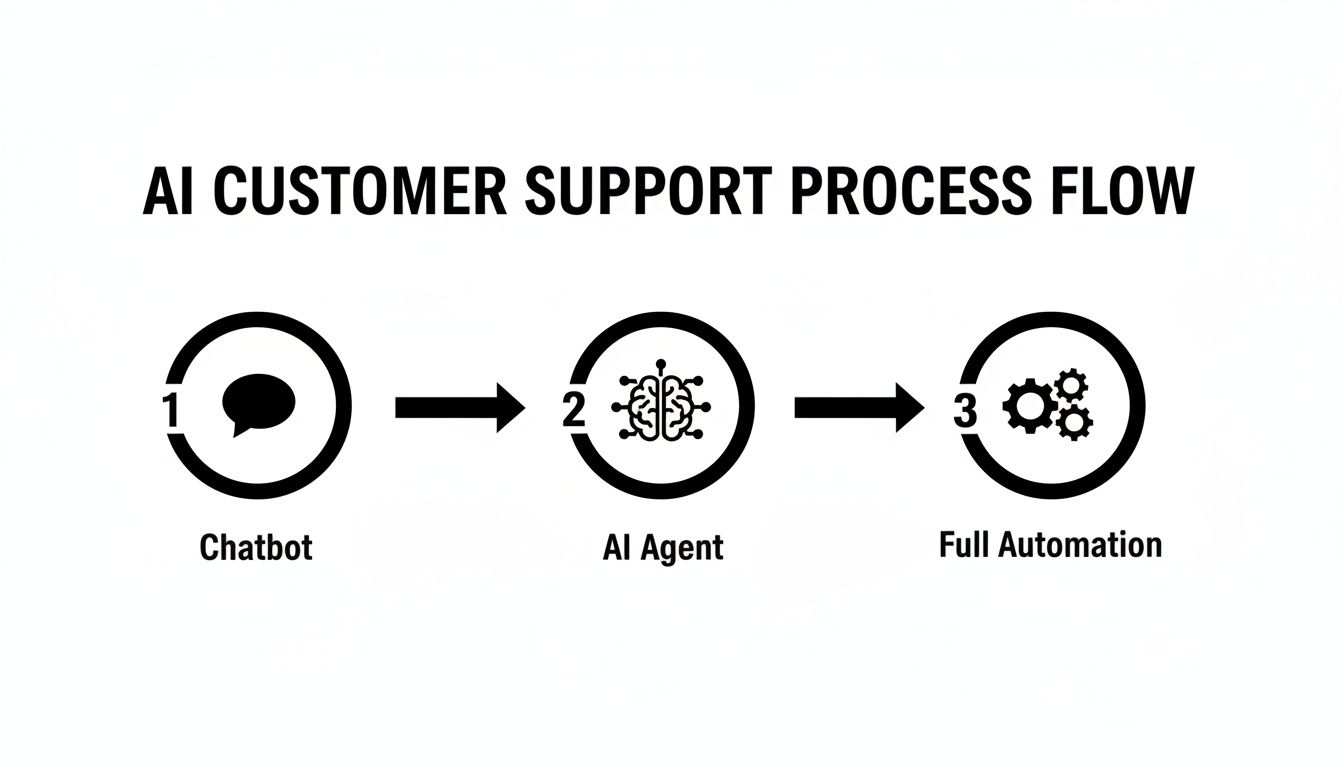
It’s a clear shift away from basic, reactive Q&A toward proactive, end-to-end automation where AI is truly executing the work.
Driving Efficiency at Every Step
Take the initial data intake. An AI agent can instantly cross-reference a claimant's report with their active policy, flagging any missing information or discrepancies on the spot. Getting this right from the start prevents countless downstream headaches and delays. Using standardized documents, like a Certificate of Insurance Template, can also make the intake process much smoother and more compliant.
These systems are also incredibly good at spotting potential fraud in real-time. The AI sifts through the claim details, comparing them against huge datasets of past claims to find patterns and red flags that a human might miss. Suspicious cases are automatically escalated for human review, allowing your expert adjusters to focus their attention where it's needed most: on complex, high-risk claims.
The real power of AI customer care in insurance isn't just about being faster. It's about applying complex underwriting rules and fraud checks with perfect consistency, 24/7. This creates a process that’s more fair, transparent, and reliable for everyone involved.
This evolution is happening just as customer expectations are changing. We're seeing a clear preference for digital-first interactions, with 51% of consumers now saying they'd rather deal with a bot for quick service. In high-stakes financial services, this pays off—AI-assisted agents resolve issues 47% faster and boast a 25% higher first-contact resolution rate.
Enhancing Human Decisions with Claims AI Reviews
Of course, this isn't about replacing humans entirely. It's about augmenting their expertise. This is where claims AI reviews come into play. For nuanced cases that need a human eye, the AI agent does all the heavy lifting upfront.
It prepares a neat, comprehensive summary for the human adjuster, which includes:
All relevant policy and claimant information.
A preliminary assessment of the damage.
Any fraud indicators or compliance flags it identified.
A recommended next step based on your company's standard operating procedures.
Armed with this data-rich package, an adjuster can make a final, well-informed decision in a fraction of the time it used to take. This "human-in-the-loop" model ensures every resolution is fast, compliant, and consistent. For a deeper look at designing these workflows, check out our guide on insurance claims processing automation.
The result? A claims process that is dramatically faster, far more accurate, and much less stressful for the customer. Cycle times shrink, adjusters become more productive, and policyholders walk away happier. It's no wonder AI is quickly becoming a non-negotiable part of modern insurance operations.
Transforming AI Customer Care in Financial Services
When we talk about AI customer support in financial services, we've moved far beyond simple FAQ bots. The real value lies in what we call AI customer care—a sophisticated “digital financial concierge” that can handle the complex, multi-step tasks at the heart of banking and investing.
This is a whole different ballgame from basic conversational AI. Think of an AI agent that doesn't just quote loan rates but actually kicks off the application process securely. It can manage detailed client onboarding, run Know Your Customer (KYC) and Anti-Money Laundering (AML) checks automatically, and process investment service requests from start to finish.

These agents are built to plug directly into core banking systems and CRMs like Salesforce or ServiceNow, executing tasks with a degree of precision that’s tough to match manually. In today's market, this kind of capability is quickly becoming a core requirement, not just a nice-to-have.
The Critical Need for Accuracy and Traceability
In the tightly regulated world of finance, every action and decision needs a paper trail. The old saying, "if it wasn't documented, it didn't happen," has serious teeth here. This is where modern AI platforms really shine and set themselves apart from older automation tools.
You simply can’t overstate the importance of accuracy and traceability. One mistake on a loan application or a single missed step in an AML check can lead to massive financial and legal headaches. That’s why a non-negotiable feature for any enterprise-grade AI system is a complete, unchangeable audit trail for every single thing an AI agent does.
For risk and compliance teams, this is the most important feature. True AI customer care in finance provides a transparent, verifiable record of every interaction, decision, and transaction, giving leaders the full visibility and control needed to embrace automation with confidence.
This intense level of scrutiny means operations don’t just get faster—they get more compliant. By building regulatory rules right into the AI’s DNA, financial firms can ensure policies are applied consistently across thousands of daily transactions, dramatically cutting down the risk of human error.
How AI Executes Complex Financial Workflows
So, what does this look like in practice? Let's take a common but complicated process: client onboarding. Traditionally, this is a slow-moving beast involving multiple departments, a ton of manual data entry, and a gauntlet of compliance checks.
An AI agent completely redraws this map:
Initiating and Collecting Data: The agent connects with the new client through a secure channel, walking them through the required forms and document uploads.
Verifying Identity: It taps into KYC/AML verification services to instantly screen identities against global watchlists, flagging any potential risks in real-time.
Integrating with Core Systems: All the verified client data is pushed directly into the company’s CRM and other backend systems, which kills the risk of manual data entry mistakes.
Executing Account Setup: Following pre-set rules, the agent can provision new accounts, activate initial services, and even send out welcome communications.
Every single step is logged, timestamped, and ready for an audit. This systematic approach doesn't just shrink the onboarding timeline from weeks to days (or even hours); it builds a rock-solid foundation of compliance from the very first touchpoint. You can dive deeper into these advanced applications in our complete guide to AI customer care.
The market growth tells the same story. The AI customer service sector is set to expand at a 34.9% CAGR, with adoption climbing as 43% of companies invest in automation to gain speed and scale. For financial firms, the payback is clear: up to 30% in operational cost savings and 52% faster resolutions, as highlighted by AI customer service statistics on desk365.io. By automating these high-stakes workflows, financial institutions aren't just boosting efficiency; they're building more resilient, accurate, and compliant businesses.
Building a Compliant Human-in-the-Loop Workflow
In highly regulated fields like finance and insurance, letting an AI run the show completely can feel like a massive gamble. What if it makes a mistake on a high-stakes, complex case? It’s a valid concern. But the goal of smart AI customer support isn't to replace your experts; it's to create a powerful partnership between them.
This is where a Human-in-the-Loop (HITL) model comes in. It’s not about seeing human intervention as a failure, but as a deliberate and essential part of the design.
The idea is simple: engineer the workflow so the AI handles the bulk of the predictable, rules-based work—often 80-90% of a case—flawlessly, every single time. When it hits a wall, like an ambiguous situation or a high-risk flag it hasn't seen before, it knows its own limits and gracefully hands it off.
That seamless handoff is the secret sauce.
Designing a Smart Escalation Path
An intelligent escalation is much more than just dumping a ticket into a human’s queue. In a well-designed HITL workflow, the AI agent does all the grunt work before an expert ever lays eyes on the case. It acts like a world-class assistant, preparing a neat, comprehensive package for the specialist.
When an AI agent flags a case for human review, it automatically:
Gathers all relevant case data, pulling in documents and communication logs.
Pinpoints the exact reason for the escalation—the ambiguity or the specific risk factor it detected.
Drafts a clear, concise recommendation based on your company’s standard operating procedures.
This completely changes the role of your team. They stop being data miners and become strategic validators. Instead of digging through piles of raw information, they act on pre-vetted, data-rich summaries.
The most compliant AI customer care systems are designed with clear guardrails. The human-in-the-loop workflow ensures that for every high-stakes decision, a human expert has the final say, backed by AI-driven insights and a complete audit trail.
This approach is non-negotiable for AI insurance companies navigating nuanced claims. For example, an AI can instantly review claims and flag a policy with unusual riders, but the final judgment call on coverage interpretation rests with an experienced human adjuster. The AI does the fact-finding, and the human provides the expert validation.

A system like this gives you a clear, auditable view of both automated actions and human interventions, making it far easier to prove compliance at every single step.
Securing Buy-In and Building Trust
Let's be honest—one of the biggest roadblocks to adopting AI is often internal resistance. People worry about their jobs. A thoughtfully designed HITL model is the perfect way to address these fears directly.
When you position AI as an assistant that enhances human expertise rather than replaces it, you get buy-in from everyone, from the front lines to the C-suite. It proves the technology is here to handle the tedious work, freeing up your specialists to focus on the high-value, strategic challenges that truly require their experience.
Of course, the entire process has to be auditable, a fundamental principle of any robust security framework. To get a better sense of the standards involved, our guide explains what is SOC 2 compliance and why it's so critical for any platform managing sensitive customer data. Ultimately, this strategic partnership creates a more resilient, accurate, and surprisingly more human-centric operation.
Measuring the ROI of Your AI Customer Support
For any operations leader or CIO, the business case for AI isn't just a "nice to have"—it's a must-have. Proving the value of an AI customer support initiative means looking past surface-level metrics like ticket deflection. In the high-stakes worlds of finance and insurance, where every efficiency gain and risk reduction matters, true success is measured by KPIs that hit the bottom line.
To make a convincing case for return on investment (ROI), you need a practical framework that captures both direct cost savings and the less obvious, but equally important, value created. This involves tracking tangible improvements in operational speed, cost per case, compliance adherence, and even customer retention. Only with this complete picture can you build a data-driven argument for scaling up automation with confidence.
Beyond Cost Savings: Direct Financial Gains
The first place you'll see returns is in direct cost reductions. It's the most straightforward part of the equation. When an AI agent automates a high-volume process, like the initial intake for insurance claims, the operational savings are easy to calculate. You're no longer measuring the cost of a human agent's time but the cost of the AI's transaction—which is almost always a fraction of the manual expense.
But the financial impact runs deeper than that. Think about these key metrics:
Reduced Claims Processing Time: For AI insurance companies, cutting the claims lifecycle from weeks to just a few days directly speeds up revenue cycles and reduces the capital you have to hold in reserve.
Lowered Operational Cost Per Case: AI minimizes the manual touchpoints needed to resolve a case by automating data collection, verification, and system updates. This applies whether it's a claim or a simple banking service request.
Decreased Error Rates: Automation all but eliminates human data entry mistakes. Fewer errors mean less costly, time-consuming downstream work to fix them.
These metrics offer a clear, quantifiable look at how AI customer care directly slashes operational overhead.
Quantifying Value Creation and Strategic Impact
Real ROI isn't just about cutting costs. The strategic value that AI creates—though sometimes tougher to pin down—can be even more significant. This is where automation takes the business from being merely efficient to being genuinely competitive.
The most powerful ROI calculations capture not just the money saved but the value created. An improved customer experience leads to higher retention, and faster service cycles lead to accelerated revenue—both are critical drivers of long-term growth.
For instance, claims AI reviews can give human adjusters instant, data-backed insights. This helps them make faster, more consistent decisions, which not only makes them more productive but also improves the fairness and transparency of the process. The result? Happier claimants.
A simple formula to frame your thinking is:
ROI = (Cost Savings + Value Creation - AI Implementation Cost) / AI Implementation Cost
To bring this formula to life, you need to track KPIs that reflect these strategic gains. We've compiled a few essential metrics that move beyond basic operational efficiency to capture the real business impact of AI.
Key Performance Indicators for AI in Financial Operations
This table breaks down crucial metrics, from operational to strategic, helping you paint a full picture of AI's contribution.
KPI Category | Metric | Business Impact |
|---|---|---|
Operational Efficiency | Average Handling Time (AHT) | Measures the time saved per interaction, directly translating to cost reduction and increased capacity. |
Operational Efficiency | Cost Per Resolution | Tracks the direct expense of resolving a case, showing clear savings from automation. |
Risk & Compliance | Compliance Adherence Rate | Percentage of interactions meeting regulatory standards, reducing fines and legal exposure. |
Risk & Compliance | Error Reduction Rate | Measures the decrease in human errors, lowering rework costs and operational risk. |
Customer Experience | First Contact Resolution (FCR) | Shows how often issues are solved in one interaction, a key driver of customer satisfaction. |
Customer Experience | Customer Satisfaction (CSAT) | Directly correlates improved service quality and speed with customer happiness and loyalty. |
Strategic Growth | Agent Productivity | Tracks the increase in high-value tasks handled by human staff, maximizing your expert talent. |
Strategic Growth | Customer Retention Rate | Links better service experiences to long-term loyalty and increased customer lifetime value. |
Tracking these KPIs allows you to move the conversation from "How much did we save?" to "How much value did we create?". By combining these hard and soft metrics, you can build a comprehensive business case that resonates with every stakeholder.
To see how these principles work in a real-world scenario, check out our case study on transforming insurance claims with agentic AI. It's a perfect example of how a well-measured AI initiative delivers both substantial and sustainable returns.
Choosing Your Partner for Compliant AI Automation
Bringing AI customer support into a regulated environment like finance isn't just a technology project—it's a strategic partnership. The AI provider you choose is easily the most critical decision you'll make. Get it right, and automation becomes a massive competitive advantage. Get it wrong, and it’s a compliance nightmare waiting to happen.
The real goal here is to move past the limitations of basic chatbots and find a platform built for the unique pressures of high-stakes financial services. For AI insurance companies and banking operations, a generic, one-size-fits-all solution just won't fly. You need a partner whose platform is more like an AI-native operating system, designed from day one to manage complex, end-to-end tasks with a relentless focus on accuracy, auditability, and control.
Core Capabilities for Regulated Industries
When you're vetting an enterprise-grade AI partner, there are a few non-negotiable capabilities you have to see.
First, the platform must be trainable on your company’s specific Standard Operating Procedures (SOPs). This ensures every automated action is a perfect reflection of your internal policies and regulatory mandates. Think of it as hiring a digital employee that you can train to follow your rulebook to the letter.
Seamless integration is the next deal-breaker. The AI has to plug directly into your core systems—whether that’s Salesforce, Guidewire, or a proprietary banking platform. The ability to both read from and write to these systems of record is what separates true, deep automation from surface-level bots.
Foundational trust is paramount. A partner must demonstrate an absolute commitment to security and compliance, with certifications like SOC 2 Type II and adherence to GDPR serving as the baseline. These aren't just badges; they are proof of a culture built around protecting sensitive data.
Beyond Bots to a Fully Compliant Platform
As you evaluate your options, don't get distracted by simple chatbot metrics. The real value comes from a comprehensive platform that creates a single, unified workspace for both your human agents and your new AI agents. This is where you'll see massive gains in efficiency, customer satisfaction, and risk reduction.
You can learn more about the different types of platforms available by exploring our guide to AI customer support software.
Ultimately, the right partner gets that in financial services, automation and compliance are two sides of the same coin. By choosing a fully compliant, end-to-end AI platform, leaders across operations, IT, and risk can drive their organizations forward with confidence, knowing their technology is a secure, reliable, and powerful engine for growth.
Your Questions About AI in Finance, Answered
Adopting AI for customer support brings up a lot of questions, especially in a world as tightly regulated as banking and insurance. Here are some straightforward answers to the things we hear most often from industry leaders.
How Does AI Actually Automate an Insurance Claim?
Picture this: a customer submits a First Notice of Loss (FNOL). Instead of that claim sitting in a queue, an AI agent picks it up instantly. It immediately gets to work—verifying the policy, requesting the right documents, and even running an initial damage assessment based on photos the customer uploads.
This is worlds away from a simple chatbot. The AI is a doer. It executes tasks, runs real-time fraud checks, and ensures every step follows your company’s exact operating procedures. The result is a claims process that gets squeezed from weeks down to just a few days.
The real magic of claims AI reviews isn't just about speed; it's about unshakable consistency. An AI agent applies the same rigorous standards to every single claim, 24/7, achieving a level of fairness and compliance that’s tough to replicate with human teams alone.
What Does AI Customer Care Look Like in Financial Services?
In finance, AI customer care is about so much more than answering "What's my account balance?". It's about entrusting the AI with complex, multi-step jobs that are the lifeblood of your business.
Think about processes like:
Client Onboarding: Automating Know Your Customer (KYC) and Anti-Money Laundering (AML) checks to get new clients verified in minutes, not days.
Service Requests: Handling entire applications for new loans or changes to an investment account without a single person needing to touch it.
Compliance Monitoring: Keeping a constant watch to ensure every interaction and transaction meets strict regulatory rules, all with a perfect audit trail.
These AI agents essentially become digital specialists, plugging directly into your core systems to get work done securely and without error.
How Does the AI Keep Sensitive Customer Data Safe?
This is, understandably, the number one concern for AI insurance companies and financial firms. Any enterprise-grade AI platform worth its salt is built on a bedrock of security. This means meeting strict standards like SOC 2 Type II and GDPR, where all data is encrypted, access is tightly controlled, and every action is logged for auditors.
Crucially, the AI is trained inside a secure sandbox using your specific data and protocols. This design ensures that your sensitive information never leaves that protected environment.
Is There Still a Place for Human Oversight?
Of course. A smart AI system isn't about replacing people; it's about making them more effective. The best platforms are built with a "human-in-the-loop" model from the ground up.
The AI is trained to handle the vast majority of cases on its own, but it's also trained to know its limits. When it hits an unusual situation, a high-risk flag, or a truly complex customer problem, it automatically gathers all the context and escalates it to the right human expert. It’s a true partnership that lets your team focus their skills where they matter most.
Ready to see how compliant AI agents can reshape your operations? Nolana provides an AI-native operating system built for the high-stakes world of financial services. Find out more about Nolana's solutions.
When you hear "AI customer support," you might picture the simple, scripted chatbots of a few years ago. But that's like comparing a pocket calculator to a fully autonomous accounting department. We're talking about a completely different class of technology now.
For industries like finance and insurance, where regulations are strict and mistakes are costly, modern AI isn't just about answering questions. It's about intelligently executing entire operational workflows from start to finish. Think automating insurance claims or handling a multi-step financial service request, all with full compliance baked in.
Redefining AI Customer Support in Regulated Industries
The new frontier of AI customer support involves intelligent agents that don't just talk—they do. They are designed to manage high-stakes, end-to-end processes, becoming active participants in your core business operations.
This is a critical distinction in sectors where every single action needs to be precise, auditable, and compliant with a mountain of regulations. These systems move far beyond conversation to become genuine extensions of your operations team.
The Challenge of Compliant Automation
For any executive in a regulated industry, the central challenge is a constant balancing act: how do you drive operational efficiency without opening the door to new compliance risks?
This is precisely where the idea of compliant automation becomes so powerful. The focus of AI customer care is no longer just on speed. It's about building accuracy, control, and auditability directly into the automated process itself.
Let's take a real-world example, like automating insurance claims:
An AI agent can instantly capture and validate First Notice of Loss (FNOL) data.
It then checks the claimant's policy details against the submitted information in real-time.
Most importantly, it creates a complete, transparent audit trail for every single decision it makes.
This kind of built-in precision directly addresses the biggest concerns of both operations and compliance leaders. The goal isn't just to make a process faster; it's to make it fundamentally more reliable and transparent than its manual equivalent.
By doing this, AI insurance companies can slash human error, dramatically shorten claim settlement times, and guarantee that every step aligns perfectly with regulatory standards. The numbers back this up. In the high-pressure world of customer service, AI has become indispensable, with 95% of organizations using it reporting major time and cost savings. More specifically, AI-enabled teams in finance and insurance cut call handling time by 45% and resolve customer issues 44% faster.
True AI in financial services isn't about replacing human judgment. It's about augmenting it with perfect data recall and flawless process execution, ensuring that compliance is the default setting, not an afterthought.
Before we dive deeper, it's helpful to see how this trend is playing out across different regulated sectors. For instance, looking at the latest innovations in UK automotive technology shows similar movements toward sophisticated automation and intelligent systems. This broader context confirms that the shift toward AI is a cross-industry phenomenon, driven by the universal need for greater efficiency and precision.
By focusing on AI agents that execute complex tasks, financial and insurance firms can finally achieve the holy grail: automation that satisfies both operational and regulatory demands.
To really grasp the shift, let's compare the old way with the new.
Comparing Traditional Support vs AI Automation in Finance
The move from a traditional, manual support model to one powered by an AI agentic system represents a fundamental change in how operations are run. The following table breaks down the key differences and highlights the business impact.
Metric | Traditional Support Model | AI Customer Support Model |
|---|---|---|
Response Time | Minutes to hours; dependent on agent availability. | Instant to seconds; 24/7 availability. |
Scalability | Linear; requires hiring and training more staff. | Elastic; scales instantly to meet demand spikes. |
Compliance & Audit | Manual checks; prone to human error and inconsistency. | Automated; built-in rules ensure 100% compliance with a perfect audit trail. |
Data Handling | Manual data entry across multiple systems; risk of errors. | Seamless data integration; single source of truth. |
Cost to Serve | High; driven by salary, training, and overhead. | Significantly lower; driven by SaaS fees and transaction volume. |
Human Agent Role | Frontline query resolution and repetitive tasks. | Handles complex escalations and high-value customer relationships. |
As the table shows, this isn't just an incremental improvement. It's a complete reimagining of the customer support function, turning it from a cost center into a strategic asset that delivers speed, accuracy, and compliance at scale.
How AI Is Automating Insurance Claims Processing
If there's one area where AI customer support is making a massive impact, it's in the world of insurance claims. For decades, the claims lifecycle has been notoriously slow and paper-laden, a process ripe for human error. Now, forward-thinking AI insurance companies are completely redesigning it for speed, accuracy, and a much better customer experience.
The whole game changes right from the moment a policyholder reports an incident.
From First Notice to Final Settlement
Instead of waiting on hold to explain a fender bender, a customer can now open an app, upload a few photos, and provide key details in minutes. That simple action triggers an entire workflow managed by an intelligent AI agent. This is where the real magic happens.
The AI agent doesn't just log the information; it acts on it. It immediately begins handling the tedious tasks that used to bog down human adjusters for hours, sometimes days. This includes gathering the initial report, checking the policy details to confirm coverage, and even performing a preliminary damage assessment from the photos provided.
This diagram shows how support is evolving—from simple chatbots to sophisticated AI agents that can manage an entire claims process on their own.
It’s a clear shift away from basic, reactive Q&A toward proactive, end-to-end automation where AI is truly executing the work.
Driving Efficiency at Every Step
Take the initial data intake. An AI agent can instantly cross-reference a claimant's report with their active policy, flagging any missing information or discrepancies on the spot. Getting this right from the start prevents countless downstream headaches and delays. Using standardized documents, like a Certificate of Insurance Template, can also make the intake process much smoother and more compliant.
These systems are also incredibly good at spotting potential fraud in real-time. The AI sifts through the claim details, comparing them against huge datasets of past claims to find patterns and red flags that a human might miss. Suspicious cases are automatically escalated for human review, allowing your expert adjusters to focus their attention where it's needed most: on complex, high-risk claims.
The real power of AI customer care in insurance isn't just about being faster. It's about applying complex underwriting rules and fraud checks with perfect consistency, 24/7. This creates a process that’s more fair, transparent, and reliable for everyone involved.
This evolution is happening just as customer expectations are changing. We're seeing a clear preference for digital-first interactions, with 51% of consumers now saying they'd rather deal with a bot for quick service. In high-stakes financial services, this pays off—AI-assisted agents resolve issues 47% faster and boast a 25% higher first-contact resolution rate.
Enhancing Human Decisions with Claims AI Reviews
Of course, this isn't about replacing humans entirely. It's about augmenting their expertise. This is where claims AI reviews come into play. For nuanced cases that need a human eye, the AI agent does all the heavy lifting upfront.
It prepares a neat, comprehensive summary for the human adjuster, which includes:
All relevant policy and claimant information.
A preliminary assessment of the damage.
Any fraud indicators or compliance flags it identified.
A recommended next step based on your company's standard operating procedures.
Armed with this data-rich package, an adjuster can make a final, well-informed decision in a fraction of the time it used to take. This "human-in-the-loop" model ensures every resolution is fast, compliant, and consistent. For a deeper look at designing these workflows, check out our guide on insurance claims processing automation.
The result? A claims process that is dramatically faster, far more accurate, and much less stressful for the customer. Cycle times shrink, adjusters become more productive, and policyholders walk away happier. It's no wonder AI is quickly becoming a non-negotiable part of modern insurance operations.
Transforming AI Customer Care in Financial Services
When we talk about AI customer support in financial services, we've moved far beyond simple FAQ bots. The real value lies in what we call AI customer care—a sophisticated “digital financial concierge” that can handle the complex, multi-step tasks at the heart of banking and investing.
This is a whole different ballgame from basic conversational AI. Think of an AI agent that doesn't just quote loan rates but actually kicks off the application process securely. It can manage detailed client onboarding, run Know Your Customer (KYC) and Anti-Money Laundering (AML) checks automatically, and process investment service requests from start to finish.
These agents are built to plug directly into core banking systems and CRMs like Salesforce or ServiceNow, executing tasks with a degree of precision that’s tough to match manually. In today's market, this kind of capability is quickly becoming a core requirement, not just a nice-to-have.
The Critical Need for Accuracy and Traceability
In the tightly regulated world of finance, every action and decision needs a paper trail. The old saying, "if it wasn't documented, it didn't happen," has serious teeth here. This is where modern AI platforms really shine and set themselves apart from older automation tools.
You simply can’t overstate the importance of accuracy and traceability. One mistake on a loan application or a single missed step in an AML check can lead to massive financial and legal headaches. That’s why a non-negotiable feature for any enterprise-grade AI system is a complete, unchangeable audit trail for every single thing an AI agent does.
For risk and compliance teams, this is the most important feature. True AI customer care in finance provides a transparent, verifiable record of every interaction, decision, and transaction, giving leaders the full visibility and control needed to embrace automation with confidence.
This intense level of scrutiny means operations don’t just get faster—they get more compliant. By building regulatory rules right into the AI’s DNA, financial firms can ensure policies are applied consistently across thousands of daily transactions, dramatically cutting down the risk of human error.
How AI Executes Complex Financial Workflows
So, what does this look like in practice? Let's take a common but complicated process: client onboarding. Traditionally, this is a slow-moving beast involving multiple departments, a ton of manual data entry, and a gauntlet of compliance checks.
An AI agent completely redraws this map:
Initiating and Collecting Data: The agent connects with the new client through a secure channel, walking them through the required forms and document uploads.
Verifying Identity: It taps into KYC/AML verification services to instantly screen identities against global watchlists, flagging any potential risks in real-time.
Integrating with Core Systems: All the verified client data is pushed directly into the company’s CRM and other backend systems, which kills the risk of manual data entry mistakes.
Executing Account Setup: Following pre-set rules, the agent can provision new accounts, activate initial services, and even send out welcome communications.
Every single step is logged, timestamped, and ready for an audit. This systematic approach doesn't just shrink the onboarding timeline from weeks to days (or even hours); it builds a rock-solid foundation of compliance from the very first touchpoint. You can dive deeper into these advanced applications in our complete guide to AI customer care.
The market growth tells the same story. The AI customer service sector is set to expand at a 34.9% CAGR, with adoption climbing as 43% of companies invest in automation to gain speed and scale. For financial firms, the payback is clear: up to 30% in operational cost savings and 52% faster resolutions, as highlighted by AI customer service statistics on desk365.io. By automating these high-stakes workflows, financial institutions aren't just boosting efficiency; they're building more resilient, accurate, and compliant businesses.
Building a Compliant Human-in-the-Loop Workflow
In highly regulated fields like finance and insurance, letting an AI run the show completely can feel like a massive gamble. What if it makes a mistake on a high-stakes, complex case? It’s a valid concern. But the goal of smart AI customer support isn't to replace your experts; it's to create a powerful partnership between them.
This is where a Human-in-the-Loop (HITL) model comes in. It’s not about seeing human intervention as a failure, but as a deliberate and essential part of the design.
The idea is simple: engineer the workflow so the AI handles the bulk of the predictable, rules-based work—often 80-90% of a case—flawlessly, every single time. When it hits a wall, like an ambiguous situation or a high-risk flag it hasn't seen before, it knows its own limits and gracefully hands it off.
That seamless handoff is the secret sauce.
Designing a Smart Escalation Path
An intelligent escalation is much more than just dumping a ticket into a human’s queue. In a well-designed HITL workflow, the AI agent does all the grunt work before an expert ever lays eyes on the case. It acts like a world-class assistant, preparing a neat, comprehensive package for the specialist.
When an AI agent flags a case for human review, it automatically:
Gathers all relevant case data, pulling in documents and communication logs.
Pinpoints the exact reason for the escalation—the ambiguity or the specific risk factor it detected.
Drafts a clear, concise recommendation based on your company’s standard operating procedures.
This completely changes the role of your team. They stop being data miners and become strategic validators. Instead of digging through piles of raw information, they act on pre-vetted, data-rich summaries.
The most compliant AI customer care systems are designed with clear guardrails. The human-in-the-loop workflow ensures that for every high-stakes decision, a human expert has the final say, backed by AI-driven insights and a complete audit trail.
This approach is non-negotiable for AI insurance companies navigating nuanced claims. For example, an AI can instantly review claims and flag a policy with unusual riders, but the final judgment call on coverage interpretation rests with an experienced human adjuster. The AI does the fact-finding, and the human provides the expert validation.
A system like this gives you a clear, auditable view of both automated actions and human interventions, making it far easier to prove compliance at every single step.
Securing Buy-In and Building Trust
Let's be honest—one of the biggest roadblocks to adopting AI is often internal resistance. People worry about their jobs. A thoughtfully designed HITL model is the perfect way to address these fears directly.
When you position AI as an assistant that enhances human expertise rather than replaces it, you get buy-in from everyone, from the front lines to the C-suite. It proves the technology is here to handle the tedious work, freeing up your specialists to focus on the high-value, strategic challenges that truly require their experience.
Of course, the entire process has to be auditable, a fundamental principle of any robust security framework. To get a better sense of the standards involved, our guide explains what is SOC 2 compliance and why it's so critical for any platform managing sensitive customer data. Ultimately, this strategic partnership creates a more resilient, accurate, and surprisingly more human-centric operation.
Measuring the ROI of Your AI Customer Support
For any operations leader or CIO, the business case for AI isn't just a "nice to have"—it's a must-have. Proving the value of an AI customer support initiative means looking past surface-level metrics like ticket deflection. In the high-stakes worlds of finance and insurance, where every efficiency gain and risk reduction matters, true success is measured by KPIs that hit the bottom line.
To make a convincing case for return on investment (ROI), you need a practical framework that captures both direct cost savings and the less obvious, but equally important, value created. This involves tracking tangible improvements in operational speed, cost per case, compliance adherence, and even customer retention. Only with this complete picture can you build a data-driven argument for scaling up automation with confidence.
Beyond Cost Savings: Direct Financial Gains
The first place you'll see returns is in direct cost reductions. It's the most straightforward part of the equation. When an AI agent automates a high-volume process, like the initial intake for insurance claims, the operational savings are easy to calculate. You're no longer measuring the cost of a human agent's time but the cost of the AI's transaction—which is almost always a fraction of the manual expense.
But the financial impact runs deeper than that. Think about these key metrics:
Reduced Claims Processing Time: For AI insurance companies, cutting the claims lifecycle from weeks to just a few days directly speeds up revenue cycles and reduces the capital you have to hold in reserve.
Lowered Operational Cost Per Case: AI minimizes the manual touchpoints needed to resolve a case by automating data collection, verification, and system updates. This applies whether it's a claim or a simple banking service request.
Decreased Error Rates: Automation all but eliminates human data entry mistakes. Fewer errors mean less costly, time-consuming downstream work to fix them.
These metrics offer a clear, quantifiable look at how AI customer care directly slashes operational overhead.
Quantifying Value Creation and Strategic Impact
Real ROI isn't just about cutting costs. The strategic value that AI creates—though sometimes tougher to pin down—can be even more significant. This is where automation takes the business from being merely efficient to being genuinely competitive.
The most powerful ROI calculations capture not just the money saved but the value created. An improved customer experience leads to higher retention, and faster service cycles lead to accelerated revenue—both are critical drivers of long-term growth.
For instance, claims AI reviews can give human adjusters instant, data-backed insights. This helps them make faster, more consistent decisions, which not only makes them more productive but also improves the fairness and transparency of the process. The result? Happier claimants.
A simple formula to frame your thinking is:
ROI = (Cost Savings + Value Creation - AI Implementation Cost) / AI Implementation Cost
To bring this formula to life, you need to track KPIs that reflect these strategic gains. We've compiled a few essential metrics that move beyond basic operational efficiency to capture the real business impact of AI.
Key Performance Indicators for AI in Financial Operations
This table breaks down crucial metrics, from operational to strategic, helping you paint a full picture of AI's contribution.
KPI Category | Metric | Business Impact |
|---|---|---|
Operational Efficiency | Average Handling Time (AHT) | Measures the time saved per interaction, directly translating to cost reduction and increased capacity. |
Operational Efficiency | Cost Per Resolution | Tracks the direct expense of resolving a case, showing clear savings from automation. |
Risk & Compliance | Compliance Adherence Rate | Percentage of interactions meeting regulatory standards, reducing fines and legal exposure. |
Risk & Compliance | Error Reduction Rate | Measures the decrease in human errors, lowering rework costs and operational risk. |
Customer Experience | First Contact Resolution (FCR) | Shows how often issues are solved in one interaction, a key driver of customer satisfaction. |
Customer Experience | Customer Satisfaction (CSAT) | Directly correlates improved service quality and speed with customer happiness and loyalty. |
Strategic Growth | Agent Productivity | Tracks the increase in high-value tasks handled by human staff, maximizing your expert talent. |
Strategic Growth | Customer Retention Rate | Links better service experiences to long-term loyalty and increased customer lifetime value. |
Tracking these KPIs allows you to move the conversation from "How much did we save?" to "How much value did we create?". By combining these hard and soft metrics, you can build a comprehensive business case that resonates with every stakeholder.
To see how these principles work in a real-world scenario, check out our case study on transforming insurance claims with agentic AI. It's a perfect example of how a well-measured AI initiative delivers both substantial and sustainable returns.
Choosing Your Partner for Compliant AI Automation
Bringing AI customer support into a regulated environment like finance isn't just a technology project—it's a strategic partnership. The AI provider you choose is easily the most critical decision you'll make. Get it right, and automation becomes a massive competitive advantage. Get it wrong, and it’s a compliance nightmare waiting to happen.
The real goal here is to move past the limitations of basic chatbots and find a platform built for the unique pressures of high-stakes financial services. For AI insurance companies and banking operations, a generic, one-size-fits-all solution just won't fly. You need a partner whose platform is more like an AI-native operating system, designed from day one to manage complex, end-to-end tasks with a relentless focus on accuracy, auditability, and control.
Core Capabilities for Regulated Industries
When you're vetting an enterprise-grade AI partner, there are a few non-negotiable capabilities you have to see.
First, the platform must be trainable on your company’s specific Standard Operating Procedures (SOPs). This ensures every automated action is a perfect reflection of your internal policies and regulatory mandates. Think of it as hiring a digital employee that you can train to follow your rulebook to the letter.
Seamless integration is the next deal-breaker. The AI has to plug directly into your core systems—whether that’s Salesforce, Guidewire, or a proprietary banking platform. The ability to both read from and write to these systems of record is what separates true, deep automation from surface-level bots.
Foundational trust is paramount. A partner must demonstrate an absolute commitment to security and compliance, with certifications like SOC 2 Type II and adherence to GDPR serving as the baseline. These aren't just badges; they are proof of a culture built around protecting sensitive data.
Beyond Bots to a Fully Compliant Platform
As you evaluate your options, don't get distracted by simple chatbot metrics. The real value comes from a comprehensive platform that creates a single, unified workspace for both your human agents and your new AI agents. This is where you'll see massive gains in efficiency, customer satisfaction, and risk reduction.
You can learn more about the different types of platforms available by exploring our guide to AI customer support software.
Ultimately, the right partner gets that in financial services, automation and compliance are two sides of the same coin. By choosing a fully compliant, end-to-end AI platform, leaders across operations, IT, and risk can drive their organizations forward with confidence, knowing their technology is a secure, reliable, and powerful engine for growth.
Your Questions About AI in Finance, Answered
Adopting AI for customer support brings up a lot of questions, especially in a world as tightly regulated as banking and insurance. Here are some straightforward answers to the things we hear most often from industry leaders.
How Does AI Actually Automate an Insurance Claim?
Picture this: a customer submits a First Notice of Loss (FNOL). Instead of that claim sitting in a queue, an AI agent picks it up instantly. It immediately gets to work—verifying the policy, requesting the right documents, and even running an initial damage assessment based on photos the customer uploads.
This is worlds away from a simple chatbot. The AI is a doer. It executes tasks, runs real-time fraud checks, and ensures every step follows your company’s exact operating procedures. The result is a claims process that gets squeezed from weeks down to just a few days.
The real magic of claims AI reviews isn't just about speed; it's about unshakable consistency. An AI agent applies the same rigorous standards to every single claim, 24/7, achieving a level of fairness and compliance that’s tough to replicate with human teams alone.
What Does AI Customer Care Look Like in Financial Services?
In finance, AI customer care is about so much more than answering "What's my account balance?". It's about entrusting the AI with complex, multi-step jobs that are the lifeblood of your business.
Think about processes like:
Client Onboarding: Automating Know Your Customer (KYC) and Anti-Money Laundering (AML) checks to get new clients verified in minutes, not days.
Service Requests: Handling entire applications for new loans or changes to an investment account without a single person needing to touch it.
Compliance Monitoring: Keeping a constant watch to ensure every interaction and transaction meets strict regulatory rules, all with a perfect audit trail.
These AI agents essentially become digital specialists, plugging directly into your core systems to get work done securely and without error.
How Does the AI Keep Sensitive Customer Data Safe?
This is, understandably, the number one concern for AI insurance companies and financial firms. Any enterprise-grade AI platform worth its salt is built on a bedrock of security. This means meeting strict standards like SOC 2 Type II and GDPR, where all data is encrypted, access is tightly controlled, and every action is logged for auditors.
Crucially, the AI is trained inside a secure sandbox using your specific data and protocols. This design ensures that your sensitive information never leaves that protected environment.
Is There Still a Place for Human Oversight?
Of course. A smart AI system isn't about replacing people; it's about making them more effective. The best platforms are built with a "human-in-the-loop" model from the ground up.
The AI is trained to handle the vast majority of cases on its own, but it's also trained to know its limits. When it hits an unusual situation, a high-risk flag, or a truly complex customer problem, it automatically gathers all the context and escalates it to the right human expert. It’s a true partnership that lets your team focus their skills where they matter most.
Ready to see how compliant AI agents can reshape your operations? Nolana provides an AI-native operating system built for the high-stakes world of financial services. Find out more about Nolana's solutions.


All systems operational
1 Lime Street, London EC3M 7HA | 222E 3rd Street, New York 10009
Copyright © 2026, Nolana. All rights reserved
All systems operational
1 Lime Street, London EC3M 7HA | 222E 3rd Street, New York 10009
Copyright © 2026, Nolana. All rights reserved
All systems operational
1 Lime Street, London EC3M 7HA | 222E 3rd Street, New York 10009
Copyright © 2026, Nolana. All rights reserved
All systems operational
1 Lime Street, London EC3M 7HA | 222E 3rd Street, New York 10009
Copyright © 2026, Nolana. All rights reserved