
The Ultimate AI Customer Support Chatbot Guide for Financial Services
The Ultimate AI Customer Support Chatbot Guide for Financial Services
Discover how an AI customer support chatbot can transform insurance claims and banking. This guide covers automation, compliance, and implementation.
Think of an AI customer support chatbot as your smartest, most reliable team member—one that works around the clock to handle customer questions, complete tasks, and offer support without ever needing a break. For AI insurance companies and financial services, these aren't your average FAQ bots. They are sophisticated digital agents built to manage complex, high-stakes work, from automating an insurance claim to securely verifying a customer's identity.
Your New Digital Front Door for Finance and Insurance
What if you could reinvent your customer service department to be faster, more intelligent, and impeccably compliant? This guide is all about that shift—moving away from overloaded support teams and toward strategic, AI-powered operations. We're not talking about chatbots as a simple add-on, but as a core asset that can automate the very workflows that define your business.
This is how we start to solve the problems that keep claims leaders and banking executives up at night: slow processing, ballooning operational costs, and the constant headache of compliance. You’ll see how AI agents, trained specifically on your company's internal procedures, can instantly take on everything from a multi-step insurance claim to a secure KYC verification.
Modernizing with AI Customer Care
Moving to AI customer care isn't just a trend; it's a strategic imperative for staying competitive. In banking and insurance, AI is designed to handle high volumes of repetitive tasks with absolute precision. This frees up your human experts to focus on what they do best: making judgment calls and handling nuanced situations, ultimately making their roles more valuable.
The operational wins are immediate and clear:
Accelerated Processing: An AI agent can process a First Notice of Loss (FNOL) for an insurance claim in a matter of minutes, not days.
Reduced Operational Costs: Automation dramatically reduces the manual hours spent on routine inquiries and document checks.
Enhanced Compliance: Every single action taken by the AI is logged, creating a flawless audit trail and ensuring you meet strict financial regulations.
The momentum behind this technology is undeniable. Projections show that by 2026, AI-powered bots will be behind a massive 95% of all customer service interactions. This adoption is fueled by real-world results: chatbots are already handling up to 80% of routine questions, deflecting 40-70% of support tickets, and cutting down email volumes by 35%.
An AI customer support chatbot effectively becomes your digital front door—an intelligent, compliant, and incredibly efficient first point of contact that completely reshapes the customer experience while reinforcing your operational core.
By automating these foundational processes, you're building a more resilient and scalable service model from the ground up. To dig deeper into the core technology, you might be interested in exploring our detailed guide on what is conversational AI. This kind of strategic automation is what it takes to thrive in today's demanding market.
How AI Can Fix the Insurance Claims Lifecycle
Anyone who's filed an insurance claim knows the drill: long hold times, endless paperwork, and a frustrating lack of updates. For insurers, this old-school, manual process isn’t just a customer experience nightmare—it’s a massive operational headache. An AI customer support chatbot completely flips this script, automating the entire journey and shrinking a multi-day ordeal into a few minutes.
Think about a minor car accident. Instead of dialing a call center, the policyholder just opens the insurer's app and starts chatting with an AI agent. This is the new front door to the claims process, starting with the First Notice of Loss (FNOL).
From First Notice to Fast Resolution
The AI agent isn't just a passive form-filler. It actively walks the policyholder through the FNOL process, asking for the right details at the right time. It prompts them to upload photos of the damage and snap a picture of the police report, giving instant feedback that the files are clear and readable.
This first touchpoint immediately shows what better AI customer care looks like:
Real-Time Document Checks: The AI scans uploaded documents on the spot, ensuring everything is complete and matches the customer's policy information.
Instant Policy Verification: It confirms coverage details right away, letting the policyholder know if the incident falls under their policy terms.
Automated Claim File Creation: With all the information collected, the AI instantly opens a new claim file in the core system—like Guidewire or Duck Creek—no manual data entry required.
The diagram below shows how AI helps support teams shift from being buried in repetitive tasks to focusing on high-value, strategic work.
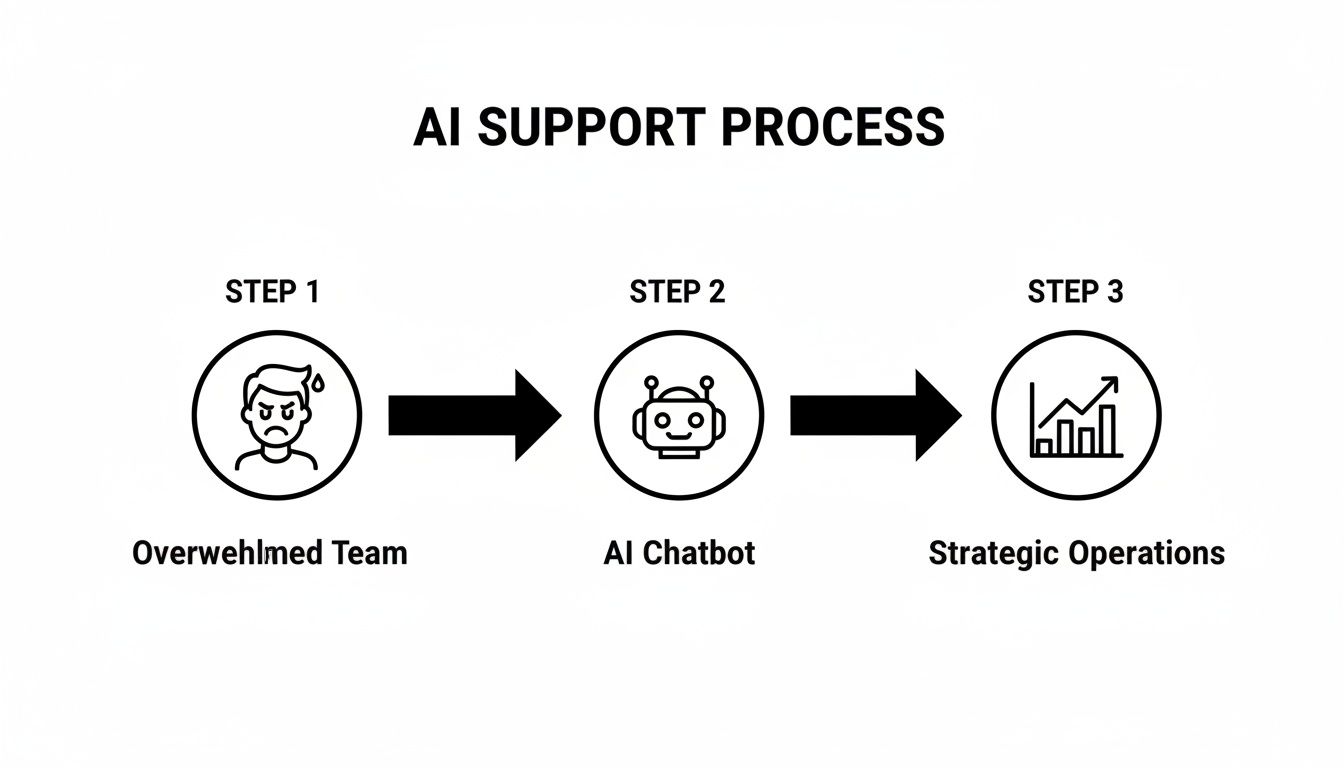
As you can see, the AI chatbot acts as the bridge, turning a reactive, overworked support function into a proactive, efficient operation.
Smart Damage Assessment and Fraud Detection
But the automation doesn’t end there. Using the photos and videos uploaded by the customer, the AI performs a preliminary damage assessment. Its computer vision can identify the location and severity of the damage, cross-reference it with a huge database of past claims, and generate an initial repair cost estimate. This is the heart of modern claims AI reviews.
At the same time, the AI is quietly running fraud detection models in the background. It scrutinizes the claim details, photos, and the customer's history for any red flags or unusual patterns, flagging anything suspicious for a human adjuster to investigate further.
This intelligent triage frees up human adjusters from the grind of paperwork. They can finally focus on what they were hired to do: manage complex, high-stakes claims that demand real expertise and human empathy.
The impact on the business is huge. Insurers see faster cycle times, lower claim processing costs by as much as 30%, and better data accuracy that slashes errors. Most importantly, it creates a customer experience that builds loyalty. Policyholders get instant updates, 24/7 support, and a sense of control over the whole process. You can see a real-world example in this case study on transforming insurance claims with agentic AI.
This is what a modern, customer-first claims experience looks like—transparent, fast, and supportive. It proves that an AI customer support chatbot is far more than a simple Q&A tool; it's a core engine for running a smarter insurance operation.
How AI is Remaking Customer Support in Banking
Just as AI insurance companies are fundamentally changing how claims are processed, the banking world is in the middle of its own AI-powered shift. The goal is simple but powerful: swap out slow, manual customer service for instant, intelligent automation. An ai customer support chatbot in banking becomes a highly knowledgeable, always-compliant, and incredibly efficient assistant, ready to help every customer, 24/7.

This evolution directly addresses a core expectation of modern banking: speed and convenience. Today's customers are not only comfortable with AI, they’re demanding it—a massive 82% expect an immediate response when they have a question. AI chatbots deliver on this promise, providing around-the-clock service that makes phone queues and hold music a thing of the past. It’s this effectiveness that explains why 68% of customers actually prefer a well-performing bot over a human agent for many routine tasks, according to the latest research from Hyperleap.ai on AI chatbot statistics.
Personalized Banking at Scale
The real magic happens when an AI agent is deeply integrated with your core banking systems. By securely connecting to your CRM (like Salesforce) and case management software, the AI gets a full picture of each customer's history and context. This is what elevates it from a simple FAQ bot to a true digital assistant.
Think about a customer asking, "Why was my debit card transaction declined?" A basic bot might offer a generic list of reasons. But an advanced AI agent can securely access that customer's transaction log, pinpoint the specific event, check it against account balances and fraud flags, and deliver a precise, personalized answer in seconds.
This ability to provide context-aware support unlocks a whole new level of service for common banking needs:
24/7 Account Inquiries: Customers can get their balance, look up recent transactions, or ask about a specific fee anytime, day or night.
Instant Transaction Resolution: The AI can immediately investigate and explain a failed payment, an unfamiliar charge, or a transfer delay.
Loan Application Assistance: It can walk applicants through the first steps, ensure all the right documents are uploaded, and answer common questions about rates and terms.
Automating Compliance and Security
In the financial world, every customer interaction is a potential compliance event. AI agents are built for this high-stakes environment. They can run critical Know Your Customer (KYC) and Anti-Money Laundering (AML) checks automatically, ensuring perfect consistency every time.
The process is remarkably smooth. For a new customer, the AI can request an ID, use computer vision to confirm its authenticity, and cross-reference the details with official databases—all without a human needing to step in. Crucially, every single action is logged, creating a clean, comprehensive audit trail for regulators.
This isn't just about cutting operational costs. It's about building a foundation of trust and reliability. When customers get fast, accurate, and secure service every time, their loyalty deepens.
This strategic approach turns customer support from a cost center into a powerful asset. By taking on the high volume of repetitive queries, the AI frees up your human bankers to focus on more complex, high-value work like financial planning or wealth management. The result is a more efficient, secure, and customer-focused bank. You can see how this plays out across the industry in our in-depth article on AI customer service chatbots. This blend of automated efficiency and human expertise is exactly what's needed to compete and win.
Designing a Compliant and Auditable AI Framework
For any financial institution—whether you're a major bank or one of the specialized AI insurance companies—automation is a non-starter unless it's secure, compliant, and completely transparent. An ai customer support chatbot without the right controls isn't an asset; it's a massive liability. That's why building a robust, auditable framework from day one is non-negotiable for risk and compliance leaders who need absolute confidence in their systems.

The architecture for responsible AI starts with strong operational guardrails. Think of these as the digital bumpers that keep the chatbot on the straight and narrow, preventing it from making things up—what the industry calls "hallucination"—or taking actions that wander outside of company policy. These guardrails ensure every interaction, from a simple balance inquiry to the initial steps of a claims AI reviews process, sticks to the rules.
Establishing Ironclad Operational Guardrails
It's helpful to think of guardrails as the AI's built-in compliance officer. They're a set of programmed constraints that govern the chatbot's behavior, making sure it operates strictly within its designated scope. Without them, an AI might try to answer questions it isn't trained for, which could lead to inaccurate or non-compliant advice.
These controls are the bedrock of high-quality AI customer care and typically include:
Scope Limitation: The AI is explicitly blocked from discussing topics outside its purview, like offering investment advice or speculating on market movements.
Policy Adherence: Every answer is cross-referenced against your internal knowledge base of approved Standard Operating Procedures (SOPs), which guarantees consistency.
Data Masking: Sensitive Personally Identifiable Information (PII) such as account or social security numbers is automatically redacted from all logs and transcripts.
While our focus here is on AI, the core principles of regulatory adherence are universal. Building a solid compliance posture is foundational, a concept explored well in this HR Compliance Checklist: The Ultimate Guide for Businesses.
To ensure your chatbot is built on a foundation of compliance from the start, certain features are indispensable. The table below breaks down the essential components that any AI solution for financial services must include to satisfy both internal auditors and external regulators.
Table: Key Compliance Features for Financial Services AI Chatbots
Feature | Description | Impact on Compliance and Audit |
|---|---|---|
Immutable Audit Logs | Every interaction, system change, and data access event is recorded in a tamper-proof log. | Provides a verifiable, chronological record for regulators (e.g., FINRA, FCA) to prove actions and decisions were compliant at the time they occurred. |
Role-Based Access Control (RBAC) | Granular permissions restrict access to AI configurations, conversation data, and analytics based on an employee's job function. | Prevents unauthorized access to sensitive customer data and system settings, a core requirement for SOC 2 and GDPR. Ensures separation of duties. |
PII Redaction & Data Masking | The system automatically identifies and conceals or removes sensitive customer data (e.g., SSN, account numbers) from logs and agent views. | Directly supports data privacy regulations like GDPR and CCPA by minimizing data exposure. Crucial for protecting customer information from internal threats. |
Content and Policy Adherence | AI responses are continuously checked against a curated knowledge base of approved company policies and regulatory guidelines. | Prevents the AI from providing non-compliant advice or outdated information. Creates a consistent, auditable trail of policy enforcement. |
Human Escalation Pathways | Pre-defined triggers (e.g., keywords, sentiment analysis) automatically and seamlessly transfer conversations to a human agent. | Ensures complex or sensitive issues are handled by qualified staff, mitigating risk. The workflow itself can be audited to prove proper handling. |
Version Control & Model Governance | All changes to the AI model, its knowledge base, and its operational rules are tracked and versioned over time. | Allows auditors to reconstruct the AI's state at any point in the past, proving why a specific decision was made based on the rules active at that time. |
These features aren't just "nice-to-haves"—they are the essential building blocks for creating an AI system that earns the trust of your customers, your team, and your regulators.
Designing Seamless Human Escalation Workflows
Let's be realistic: no AI can handle every single situation. That’s why a critical piece of any compliant framework is a seamless, intelligent escalation path to a human agent. This is much more than a simple "transfer to agent" button. It’s a smart workflow designed to preserve context and empower your human experts to resolve issues efficiently.
When the AI detects customer frustration, a sensitive topic, or a query it simply can't handle, it should trigger an escalation. The handoff must include the full conversation transcript and any relevant customer context, so the agent can step in and take over without forcing the customer to repeat everything. This ensures that complex insurance claims or delicate banking matters get the human empathy and deep expertise they demand.
Creating Comprehensive and Immutable Audit Trails
For any regulated industry, the audit trail is arguably the most important element of all. Every single interaction, every decision, and every piece of data the ai customer support chatbot touches must be meticulously logged. This process creates an immutable record that can be pulled up and reviewed by internal auditors or external regulators at a moment's notice.
An auditable AI system provides the ultimate proof of compliance. It demonstrates not just that you have policies, but that your automated systems are enforcing them consistently and verifiably with every single customer interaction.
This level of detailed logging is precisely what allows financial institutions to meet stringent standards like GDPR and SOC 2. It gives you complete visibility into the AI's operations, proving that your automated customer service isn't just efficient, but also fully compliant.
If you'd like to dive deeper into navigating these complex requirements, our guide on regulatory compliance in financial services is a great place to start. Ultimately, this level of control proves that high-performance automation and rigorous compliance can—and must—go hand in hand.
Your Practical Roadmap for AI Chatbot Implementation
Let's get practical and turn strategy into action. For IT and transformation leaders in banking or insurance, rolling out an AI customer support chatbot is far more than just a tech project—it's a fundamental shift in how you operate. A clear, phased roadmap is your best friend here, ensuring you can manage this change, sidestep major disruptions, and start delivering real value from day one. This plan breaks the journey down into four manageable stages, taking you from initial discovery to a full-scale deployment that actively generates value.
Phase 1: Discovery and Use Case Selection
The first move has nothing to do with technology. It’s all about putting on your detective hat and finding the most significant operational pain points. Where are your teams getting bogged down in repetitive work? Which processes create the most friction and frustration for your customers?
For AI insurance companies, this trail often leads directly to the claims intake process. In banking, it’s usually the endless flood of routine account inquiries that overwhelm contact centers. Your job is to map out your current workflows and zero in on those high-volume, repetitive tasks governed by clear rules. These are your prime candidates for automation.
The goal is to pick an initial use case that has a high chance of success and offers a clear, easily measured return on investment. A few solid starting points include:
Automating FNOL: Handling the first notice of loss for insurance claims to speed up initial data collection.
24/7 Policy Inquiries: Answering common questions about coverage, deductibles, and renewal dates, even at 3 AM.
Transaction Queries: Resolving simple banking questions about recent charges or the status of a payment.
Phase 2: Vendor Evaluation and Solution Design
Once you’ve locked in your target use case, the focus shifts to finding the right partner and sketching out the solution. Let's be clear: not all AI platforms are built the same, especially when you're operating in a regulated industry. You absolutely need a vendor who gets the nuances of financial services compliance, data security, and the critical importance of a rock-solid audit trail. As you think through your practical roadmap for AI chatbot implementation, exploring the world of modern AI app builder tools can seriously fast-track your development.
During this phase, you'll want to co-design the solution with potential vendors. This means getting your internal Standard Operating Procedures (SOPs) and knowledge base documents ready for the AI to train on. The chatbot's effectiveness is a direct reflection of the quality of data it learns from, making this a crucial step for accurate and compliant AI customer care. The vendor should be able to clearly demonstrate how their system will securely plug into your core platforms—like Guidewire or Salesforce—using robust APIs.
Phase 3: The Pilot Program and KPI Measurement
Before you even think about a full rollout, a controlled pilot program is non-negotiable. This is your chance to test the AI customer support chatbot in a live but limited environment, gather real-world performance data, and iron out the kinks. Select a small but representative group of users for the pilot—maybe policyholders in a specific state or bank customers with a certain account type.
During the pilot, you must be laser-focused on measuring the right Key Performance Indicators (KPIs). This data is what will prove the chatbot's value and build the business case for expansion.
A successful pilot isn't just about flawless technology; it's about demonstrating tangible business impact. The data you collect here will be your most powerful tool for securing broader organizational buy-in.
Here are the key metrics to track:
Ticket Deflection Rate: What percentage of inbound queries are fully resolved by the AI without a human ever touching them?
First-Contact Resolution (FCR): How often does the chatbot solve the customer's problem on the very first try?
Average Handling Time (AHT): How much agent time is saved per interaction when compared to the old, manual way?
Customer Satisfaction (CSAT): Are users actually happy with the chatbot experience? A simple post-interaction survey can answer this.
Cost Per Interaction: Calculate the hard savings by comparing the operational cost of AI-handled queries to agent-handled ones. Industry research shows each chatbot query in banking saves around 4 minutes of an agent's time.
Phase 4: Scaled Deployment and Continuous Improvement
With a successful pilot under your belt and compelling KPI data in your hands, you’re ready for the main event: a broader rollout. This phase is all about expanding the chatbot’s reach to more use cases, departments, or customer segments. The heavy lifting you did on integrations back in the design phase really pays off here, allowing you to connect the AI to more systems and start automating more complex, multi-step processes.
But implementation is not a "set it and forget it" activity. The most effective claims AI reviews and customer service bots are the ones that are constantly being monitored and refined. You need a process for regularly reviewing conversation logs, pinpointing where the AI struggled, and updating its knowledge base to make it smarter. For teams looking to build and iterate on their own solutions, learning more about what a no-code AI agent builder can do offers a huge advantage in adapting to new challenges on the fly. This iterative loop ensures your AI becomes more valuable over time, driving ongoing efficiency gains and consistently improving the customer experience.
Answering Your Key Questions About AI in Financial Services
Even with a clear roadmap, it's natural for leaders in banking and insurance to have some hard questions before bringing an AI customer support chatbot on board. That’s just smart business. When you're dealing with sensitive financial operations and heavy regulatory scrutiny, you need confidence built on clear, direct answers.
Let's cut through the noise and tackle the most common concerns head-on. My goal here is to clear up any misconceptions about security, integration, and what this technology really means for your teams.
How Can We Guarantee AI Provides Compliant Answers?
This is non-negotiable in financial services, and the answer comes down to three things: a controlled knowledge base, strict operational guardrails, and a complete audit trail.
First off, an AI customer support chatbot is never, ever trained on the open internet. Its entire world consists of your approved internal documents—SOPs, policy manuals, compliance guidelines, you name it. This completely walls it off from inventing information or pulling answers from unvetted sources.
Next, we build in strict guardrails that prevent the AI from speculating. If a question falls outside its designated scope or gets too complex, the system is designed to immediately escalate to a human agent. There's no guesswork, just a clean handoff to ensure a compliant and appropriate response every time.
Every single interaction—from the customer's first question to the AI's final answer—is meticulously logged. This creates a comprehensive, unchangeable audit trail that your compliance teams can pull up at a moment's notice to prove adherence to all relevant financial regulations.
This level of transparency is exactly what auditors and regulators need to see. It demonstrates total control and accountability.
What Is the Integration Process Like?
Modern AI customer care platforms are built to fit into your world, not force you to rebuild it. Think of them as an intelligent layer that sits on top of your existing infrastructure.
Integration with your core systems of record—like Guidewire in insurance or Salesforce in banking—is handled through secure Application Programming Interfaces (APIs). An API is like a secure, managed bridge that lets different software systems talk to each other and exchange specific pieces of information.
The process is always collaborative. The AI vendor works hand-in-glove with your IT department to set up these connections. For example, a simple API call can securely pull a claim status from Guidewire or fetch a customer's transaction history from your core banking system in real-time. This API-first approach adds powerful new capabilities without the headache of a massive "rip and replace" project.
Will AI Replace Our Human Teams?
The goal isn't replacement; it's augmentation. AI is fantastic at handling the high-volume, repetitive questions that come in 24/7. It does this with incredible speed and accuracy, freeing your skilled human agents from the monotonous work of answering the same things over and over again.
This shift allows your people to focus on what they do best: handling high-value, complex, and empathetic conversations that an AI simply can't. Think about managing a distressed policyholder after a major loss or resolving a tricky fraud case. These are the moments that define a customer relationship.
The result is a much smarter, two-tiered support system. It improves efficiency and customer satisfaction by delivering instant answers for routine issues, while also boosting employee engagement by making their work more meaningful.
How Do We Measure the ROI of This Solution?
Measuring the return on an AI customer care investment means looking at both the hard numbers and the softer, but equally important, benefits.
The financial impact is usually the easiest to see.
On the quantitative side, you’ll look at:
Cost Reduction: Track direct savings from ticket deflection, reduced average handle time for agents, and better first-contact resolution rates. For example, each query handled by a chatbot in banking can save $0.50 - $0.70 in operational costs.
Increased Capacity: Measure how many more customer interactions your existing team can manage without needing to hire more staff.
But the story doesn't end there. On the qualitative side, you’ll monitor:
Customer Satisfaction (CSAT): Are customers happy with the speed and quality of the AI's help? Post-interaction surveys will tell you.
Net Promoter Score (NPS): Is this making customers more loyal and likely to recommend your brand?
Employee Satisfaction: Check in with your agents. Has offloading repetitive tasks reduced burnout and improved their job satisfaction?
A successful rollout will show a clear, positive trend across all these areas, proving a powerful return that goes far beyond just cutting costs.
At Nolana, we deploy compliant AI agents trained on your specific procedures to automate high-stakes financial operations. Our platform integrates with your core systems to deliver real-time automation with clear guardrails and seamless human escalation, helping you cut costs and accelerate cycle times without compromising risk standards. Learn how we can transform your operations at https://nolana.com.
Think of an AI customer support chatbot as your smartest, most reliable team member—one that works around the clock to handle customer questions, complete tasks, and offer support without ever needing a break. For AI insurance companies and financial services, these aren't your average FAQ bots. They are sophisticated digital agents built to manage complex, high-stakes work, from automating an insurance claim to securely verifying a customer's identity.
Your New Digital Front Door for Finance and Insurance
What if you could reinvent your customer service department to be faster, more intelligent, and impeccably compliant? This guide is all about that shift—moving away from overloaded support teams and toward strategic, AI-powered operations. We're not talking about chatbots as a simple add-on, but as a core asset that can automate the very workflows that define your business.
This is how we start to solve the problems that keep claims leaders and banking executives up at night: slow processing, ballooning operational costs, and the constant headache of compliance. You’ll see how AI agents, trained specifically on your company's internal procedures, can instantly take on everything from a multi-step insurance claim to a secure KYC verification.
Modernizing with AI Customer Care
Moving to AI customer care isn't just a trend; it's a strategic imperative for staying competitive. In banking and insurance, AI is designed to handle high volumes of repetitive tasks with absolute precision. This frees up your human experts to focus on what they do best: making judgment calls and handling nuanced situations, ultimately making their roles more valuable.
The operational wins are immediate and clear:
Accelerated Processing: An AI agent can process a First Notice of Loss (FNOL) for an insurance claim in a matter of minutes, not days.
Reduced Operational Costs: Automation dramatically reduces the manual hours spent on routine inquiries and document checks.
Enhanced Compliance: Every single action taken by the AI is logged, creating a flawless audit trail and ensuring you meet strict financial regulations.
The momentum behind this technology is undeniable. Projections show that by 2026, AI-powered bots will be behind a massive 95% of all customer service interactions. This adoption is fueled by real-world results: chatbots are already handling up to 80% of routine questions, deflecting 40-70% of support tickets, and cutting down email volumes by 35%.
An AI customer support chatbot effectively becomes your digital front door—an intelligent, compliant, and incredibly efficient first point of contact that completely reshapes the customer experience while reinforcing your operational core.
By automating these foundational processes, you're building a more resilient and scalable service model from the ground up. To dig deeper into the core technology, you might be interested in exploring our detailed guide on what is conversational AI. This kind of strategic automation is what it takes to thrive in today's demanding market.
How AI Can Fix the Insurance Claims Lifecycle
Anyone who's filed an insurance claim knows the drill: long hold times, endless paperwork, and a frustrating lack of updates. For insurers, this old-school, manual process isn’t just a customer experience nightmare—it’s a massive operational headache. An AI customer support chatbot completely flips this script, automating the entire journey and shrinking a multi-day ordeal into a few minutes.
Think about a minor car accident. Instead of dialing a call center, the policyholder just opens the insurer's app and starts chatting with an AI agent. This is the new front door to the claims process, starting with the First Notice of Loss (FNOL).
From First Notice to Fast Resolution
The AI agent isn't just a passive form-filler. It actively walks the policyholder through the FNOL process, asking for the right details at the right time. It prompts them to upload photos of the damage and snap a picture of the police report, giving instant feedback that the files are clear and readable.
This first touchpoint immediately shows what better AI customer care looks like:
Real-Time Document Checks: The AI scans uploaded documents on the spot, ensuring everything is complete and matches the customer's policy information.
Instant Policy Verification: It confirms coverage details right away, letting the policyholder know if the incident falls under their policy terms.
Automated Claim File Creation: With all the information collected, the AI instantly opens a new claim file in the core system—like Guidewire or Duck Creek—no manual data entry required.
The diagram below shows how AI helps support teams shift from being buried in repetitive tasks to focusing on high-value, strategic work.
As you can see, the AI chatbot acts as the bridge, turning a reactive, overworked support function into a proactive, efficient operation.
Smart Damage Assessment and Fraud Detection
But the automation doesn’t end there. Using the photos and videos uploaded by the customer, the AI performs a preliminary damage assessment. Its computer vision can identify the location and severity of the damage, cross-reference it with a huge database of past claims, and generate an initial repair cost estimate. This is the heart of modern claims AI reviews.
At the same time, the AI is quietly running fraud detection models in the background. It scrutinizes the claim details, photos, and the customer's history for any red flags or unusual patterns, flagging anything suspicious for a human adjuster to investigate further.
This intelligent triage frees up human adjusters from the grind of paperwork. They can finally focus on what they were hired to do: manage complex, high-stakes claims that demand real expertise and human empathy.
The impact on the business is huge. Insurers see faster cycle times, lower claim processing costs by as much as 30%, and better data accuracy that slashes errors. Most importantly, it creates a customer experience that builds loyalty. Policyholders get instant updates, 24/7 support, and a sense of control over the whole process. You can see a real-world example in this case study on transforming insurance claims with agentic AI.
This is what a modern, customer-first claims experience looks like—transparent, fast, and supportive. It proves that an AI customer support chatbot is far more than a simple Q&A tool; it's a core engine for running a smarter insurance operation.
How AI is Remaking Customer Support in Banking
Just as AI insurance companies are fundamentally changing how claims are processed, the banking world is in the middle of its own AI-powered shift. The goal is simple but powerful: swap out slow, manual customer service for instant, intelligent automation. An ai customer support chatbot in banking becomes a highly knowledgeable, always-compliant, and incredibly efficient assistant, ready to help every customer, 24/7.
This evolution directly addresses a core expectation of modern banking: speed and convenience. Today's customers are not only comfortable with AI, they’re demanding it—a massive 82% expect an immediate response when they have a question. AI chatbots deliver on this promise, providing around-the-clock service that makes phone queues and hold music a thing of the past. It’s this effectiveness that explains why 68% of customers actually prefer a well-performing bot over a human agent for many routine tasks, according to the latest research from Hyperleap.ai on AI chatbot statistics.
Personalized Banking at Scale
The real magic happens when an AI agent is deeply integrated with your core banking systems. By securely connecting to your CRM (like Salesforce) and case management software, the AI gets a full picture of each customer's history and context. This is what elevates it from a simple FAQ bot to a true digital assistant.
Think about a customer asking, "Why was my debit card transaction declined?" A basic bot might offer a generic list of reasons. But an advanced AI agent can securely access that customer's transaction log, pinpoint the specific event, check it against account balances and fraud flags, and deliver a precise, personalized answer in seconds.
This ability to provide context-aware support unlocks a whole new level of service for common banking needs:
24/7 Account Inquiries: Customers can get their balance, look up recent transactions, or ask about a specific fee anytime, day or night.
Instant Transaction Resolution: The AI can immediately investigate and explain a failed payment, an unfamiliar charge, or a transfer delay.
Loan Application Assistance: It can walk applicants through the first steps, ensure all the right documents are uploaded, and answer common questions about rates and terms.
Automating Compliance and Security
In the financial world, every customer interaction is a potential compliance event. AI agents are built for this high-stakes environment. They can run critical Know Your Customer (KYC) and Anti-Money Laundering (AML) checks automatically, ensuring perfect consistency every time.
The process is remarkably smooth. For a new customer, the AI can request an ID, use computer vision to confirm its authenticity, and cross-reference the details with official databases—all without a human needing to step in. Crucially, every single action is logged, creating a clean, comprehensive audit trail for regulators.
This isn't just about cutting operational costs. It's about building a foundation of trust and reliability. When customers get fast, accurate, and secure service every time, their loyalty deepens.
This strategic approach turns customer support from a cost center into a powerful asset. By taking on the high volume of repetitive queries, the AI frees up your human bankers to focus on more complex, high-value work like financial planning or wealth management. The result is a more efficient, secure, and customer-focused bank. You can see how this plays out across the industry in our in-depth article on AI customer service chatbots. This blend of automated efficiency and human expertise is exactly what's needed to compete and win.
Designing a Compliant and Auditable AI Framework
For any financial institution—whether you're a major bank or one of the specialized AI insurance companies—automation is a non-starter unless it's secure, compliant, and completely transparent. An ai customer support chatbot without the right controls isn't an asset; it's a massive liability. That's why building a robust, auditable framework from day one is non-negotiable for risk and compliance leaders who need absolute confidence in their systems.
The architecture for responsible AI starts with strong operational guardrails. Think of these as the digital bumpers that keep the chatbot on the straight and narrow, preventing it from making things up—what the industry calls "hallucination"—or taking actions that wander outside of company policy. These guardrails ensure every interaction, from a simple balance inquiry to the initial steps of a claims AI reviews process, sticks to the rules.
Establishing Ironclad Operational Guardrails
It's helpful to think of guardrails as the AI's built-in compliance officer. They're a set of programmed constraints that govern the chatbot's behavior, making sure it operates strictly within its designated scope. Without them, an AI might try to answer questions it isn't trained for, which could lead to inaccurate or non-compliant advice.
These controls are the bedrock of high-quality AI customer care and typically include:
Scope Limitation: The AI is explicitly blocked from discussing topics outside its purview, like offering investment advice or speculating on market movements.
Policy Adherence: Every answer is cross-referenced against your internal knowledge base of approved Standard Operating Procedures (SOPs), which guarantees consistency.
Data Masking: Sensitive Personally Identifiable Information (PII) such as account or social security numbers is automatically redacted from all logs and transcripts.
While our focus here is on AI, the core principles of regulatory adherence are universal. Building a solid compliance posture is foundational, a concept explored well in this HR Compliance Checklist: The Ultimate Guide for Businesses.
To ensure your chatbot is built on a foundation of compliance from the start, certain features are indispensable. The table below breaks down the essential components that any AI solution for financial services must include to satisfy both internal auditors and external regulators.
Table: Key Compliance Features for Financial Services AI Chatbots
Feature | Description | Impact on Compliance and Audit |
|---|---|---|
Immutable Audit Logs | Every interaction, system change, and data access event is recorded in a tamper-proof log. | Provides a verifiable, chronological record for regulators (e.g., FINRA, FCA) to prove actions and decisions were compliant at the time they occurred. |
Role-Based Access Control (RBAC) | Granular permissions restrict access to AI configurations, conversation data, and analytics based on an employee's job function. | Prevents unauthorized access to sensitive customer data and system settings, a core requirement for SOC 2 and GDPR. Ensures separation of duties. |
PII Redaction & Data Masking | The system automatically identifies and conceals or removes sensitive customer data (e.g., SSN, account numbers) from logs and agent views. | Directly supports data privacy regulations like GDPR and CCPA by minimizing data exposure. Crucial for protecting customer information from internal threats. |
Content and Policy Adherence | AI responses are continuously checked against a curated knowledge base of approved company policies and regulatory guidelines. | Prevents the AI from providing non-compliant advice or outdated information. Creates a consistent, auditable trail of policy enforcement. |
Human Escalation Pathways | Pre-defined triggers (e.g., keywords, sentiment analysis) automatically and seamlessly transfer conversations to a human agent. | Ensures complex or sensitive issues are handled by qualified staff, mitigating risk. The workflow itself can be audited to prove proper handling. |
Version Control & Model Governance | All changes to the AI model, its knowledge base, and its operational rules are tracked and versioned over time. | Allows auditors to reconstruct the AI's state at any point in the past, proving why a specific decision was made based on the rules active at that time. |
These features aren't just "nice-to-haves"—they are the essential building blocks for creating an AI system that earns the trust of your customers, your team, and your regulators.
Designing Seamless Human Escalation Workflows
Let's be realistic: no AI can handle every single situation. That’s why a critical piece of any compliant framework is a seamless, intelligent escalation path to a human agent. This is much more than a simple "transfer to agent" button. It’s a smart workflow designed to preserve context and empower your human experts to resolve issues efficiently.
When the AI detects customer frustration, a sensitive topic, or a query it simply can't handle, it should trigger an escalation. The handoff must include the full conversation transcript and any relevant customer context, so the agent can step in and take over without forcing the customer to repeat everything. This ensures that complex insurance claims or delicate banking matters get the human empathy and deep expertise they demand.
Creating Comprehensive and Immutable Audit Trails
For any regulated industry, the audit trail is arguably the most important element of all. Every single interaction, every decision, and every piece of data the ai customer support chatbot touches must be meticulously logged. This process creates an immutable record that can be pulled up and reviewed by internal auditors or external regulators at a moment's notice.
An auditable AI system provides the ultimate proof of compliance. It demonstrates not just that you have policies, but that your automated systems are enforcing them consistently and verifiably with every single customer interaction.
This level of detailed logging is precisely what allows financial institutions to meet stringent standards like GDPR and SOC 2. It gives you complete visibility into the AI's operations, proving that your automated customer service isn't just efficient, but also fully compliant.
If you'd like to dive deeper into navigating these complex requirements, our guide on regulatory compliance in financial services is a great place to start. Ultimately, this level of control proves that high-performance automation and rigorous compliance can—and must—go hand in hand.
Your Practical Roadmap for AI Chatbot Implementation
Let's get practical and turn strategy into action. For IT and transformation leaders in banking or insurance, rolling out an AI customer support chatbot is far more than just a tech project—it's a fundamental shift in how you operate. A clear, phased roadmap is your best friend here, ensuring you can manage this change, sidestep major disruptions, and start delivering real value from day one. This plan breaks the journey down into four manageable stages, taking you from initial discovery to a full-scale deployment that actively generates value.
Phase 1: Discovery and Use Case Selection
The first move has nothing to do with technology. It’s all about putting on your detective hat and finding the most significant operational pain points. Where are your teams getting bogged down in repetitive work? Which processes create the most friction and frustration for your customers?
For AI insurance companies, this trail often leads directly to the claims intake process. In banking, it’s usually the endless flood of routine account inquiries that overwhelm contact centers. Your job is to map out your current workflows and zero in on those high-volume, repetitive tasks governed by clear rules. These are your prime candidates for automation.
The goal is to pick an initial use case that has a high chance of success and offers a clear, easily measured return on investment. A few solid starting points include:
Automating FNOL: Handling the first notice of loss for insurance claims to speed up initial data collection.
24/7 Policy Inquiries: Answering common questions about coverage, deductibles, and renewal dates, even at 3 AM.
Transaction Queries: Resolving simple banking questions about recent charges or the status of a payment.
Phase 2: Vendor Evaluation and Solution Design
Once you’ve locked in your target use case, the focus shifts to finding the right partner and sketching out the solution. Let's be clear: not all AI platforms are built the same, especially when you're operating in a regulated industry. You absolutely need a vendor who gets the nuances of financial services compliance, data security, and the critical importance of a rock-solid audit trail. As you think through your practical roadmap for AI chatbot implementation, exploring the world of modern AI app builder tools can seriously fast-track your development.
During this phase, you'll want to co-design the solution with potential vendors. This means getting your internal Standard Operating Procedures (SOPs) and knowledge base documents ready for the AI to train on. The chatbot's effectiveness is a direct reflection of the quality of data it learns from, making this a crucial step for accurate and compliant AI customer care. The vendor should be able to clearly demonstrate how their system will securely plug into your core platforms—like Guidewire or Salesforce—using robust APIs.
Phase 3: The Pilot Program and KPI Measurement
Before you even think about a full rollout, a controlled pilot program is non-negotiable. This is your chance to test the AI customer support chatbot in a live but limited environment, gather real-world performance data, and iron out the kinks. Select a small but representative group of users for the pilot—maybe policyholders in a specific state or bank customers with a certain account type.
During the pilot, you must be laser-focused on measuring the right Key Performance Indicators (KPIs). This data is what will prove the chatbot's value and build the business case for expansion.
A successful pilot isn't just about flawless technology; it's about demonstrating tangible business impact. The data you collect here will be your most powerful tool for securing broader organizational buy-in.
Here are the key metrics to track:
Ticket Deflection Rate: What percentage of inbound queries are fully resolved by the AI without a human ever touching them?
First-Contact Resolution (FCR): How often does the chatbot solve the customer's problem on the very first try?
Average Handling Time (AHT): How much agent time is saved per interaction when compared to the old, manual way?
Customer Satisfaction (CSAT): Are users actually happy with the chatbot experience? A simple post-interaction survey can answer this.
Cost Per Interaction: Calculate the hard savings by comparing the operational cost of AI-handled queries to agent-handled ones. Industry research shows each chatbot query in banking saves around 4 minutes of an agent's time.
Phase 4: Scaled Deployment and Continuous Improvement
With a successful pilot under your belt and compelling KPI data in your hands, you’re ready for the main event: a broader rollout. This phase is all about expanding the chatbot’s reach to more use cases, departments, or customer segments. The heavy lifting you did on integrations back in the design phase really pays off here, allowing you to connect the AI to more systems and start automating more complex, multi-step processes.
But implementation is not a "set it and forget it" activity. The most effective claims AI reviews and customer service bots are the ones that are constantly being monitored and refined. You need a process for regularly reviewing conversation logs, pinpointing where the AI struggled, and updating its knowledge base to make it smarter. For teams looking to build and iterate on their own solutions, learning more about what a no-code AI agent builder can do offers a huge advantage in adapting to new challenges on the fly. This iterative loop ensures your AI becomes more valuable over time, driving ongoing efficiency gains and consistently improving the customer experience.
Answering Your Key Questions About AI in Financial Services
Even with a clear roadmap, it's natural for leaders in banking and insurance to have some hard questions before bringing an AI customer support chatbot on board. That’s just smart business. When you're dealing with sensitive financial operations and heavy regulatory scrutiny, you need confidence built on clear, direct answers.
Let's cut through the noise and tackle the most common concerns head-on. My goal here is to clear up any misconceptions about security, integration, and what this technology really means for your teams.
How Can We Guarantee AI Provides Compliant Answers?
This is non-negotiable in financial services, and the answer comes down to three things: a controlled knowledge base, strict operational guardrails, and a complete audit trail.
First off, an AI customer support chatbot is never, ever trained on the open internet. Its entire world consists of your approved internal documents—SOPs, policy manuals, compliance guidelines, you name it. This completely walls it off from inventing information or pulling answers from unvetted sources.
Next, we build in strict guardrails that prevent the AI from speculating. If a question falls outside its designated scope or gets too complex, the system is designed to immediately escalate to a human agent. There's no guesswork, just a clean handoff to ensure a compliant and appropriate response every time.
Every single interaction—from the customer's first question to the AI's final answer—is meticulously logged. This creates a comprehensive, unchangeable audit trail that your compliance teams can pull up at a moment's notice to prove adherence to all relevant financial regulations.
This level of transparency is exactly what auditors and regulators need to see. It demonstrates total control and accountability.
What Is the Integration Process Like?
Modern AI customer care platforms are built to fit into your world, not force you to rebuild it. Think of them as an intelligent layer that sits on top of your existing infrastructure.
Integration with your core systems of record—like Guidewire in insurance or Salesforce in banking—is handled through secure Application Programming Interfaces (APIs). An API is like a secure, managed bridge that lets different software systems talk to each other and exchange specific pieces of information.
The process is always collaborative. The AI vendor works hand-in-glove with your IT department to set up these connections. For example, a simple API call can securely pull a claim status from Guidewire or fetch a customer's transaction history from your core banking system in real-time. This API-first approach adds powerful new capabilities without the headache of a massive "rip and replace" project.
Will AI Replace Our Human Teams?
The goal isn't replacement; it's augmentation. AI is fantastic at handling the high-volume, repetitive questions that come in 24/7. It does this with incredible speed and accuracy, freeing your skilled human agents from the monotonous work of answering the same things over and over again.
This shift allows your people to focus on what they do best: handling high-value, complex, and empathetic conversations that an AI simply can't. Think about managing a distressed policyholder after a major loss or resolving a tricky fraud case. These are the moments that define a customer relationship.
The result is a much smarter, two-tiered support system. It improves efficiency and customer satisfaction by delivering instant answers for routine issues, while also boosting employee engagement by making their work more meaningful.
How Do We Measure the ROI of This Solution?
Measuring the return on an AI customer care investment means looking at both the hard numbers and the softer, but equally important, benefits.
The financial impact is usually the easiest to see.
On the quantitative side, you’ll look at:
Cost Reduction: Track direct savings from ticket deflection, reduced average handle time for agents, and better first-contact resolution rates. For example, each query handled by a chatbot in banking can save $0.50 - $0.70 in operational costs.
Increased Capacity: Measure how many more customer interactions your existing team can manage without needing to hire more staff.
But the story doesn't end there. On the qualitative side, you’ll monitor:
Customer Satisfaction (CSAT): Are customers happy with the speed and quality of the AI's help? Post-interaction surveys will tell you.
Net Promoter Score (NPS): Is this making customers more loyal and likely to recommend your brand?
Employee Satisfaction: Check in with your agents. Has offloading repetitive tasks reduced burnout and improved their job satisfaction?
A successful rollout will show a clear, positive trend across all these areas, proving a powerful return that goes far beyond just cutting costs.
At Nolana, we deploy compliant AI agents trained on your specific procedures to automate high-stakes financial operations. Our platform integrates with your core systems to deliver real-time automation with clear guardrails and seamless human escalation, helping you cut costs and accelerate cycle times without compromising risk standards. Learn how we can transform your operations at https://nolana.com.
Want early access?
© 2026 Nolana Limited. All rights reserved.
Leroy House, Unit G01, 436 Essex Rd, London N1 3QP
Want early access?
© 2026 Nolana Limited. All rights reserved.
Leroy House, Unit G01, 436 Essex Rd, London N1 3QP
Want early access?
© 2026 Nolana Limited. All rights reserved.
Leroy House, Unit G01, 436 Essex Rd, London N1 3QP
Want early access?
© 2026 Nolana Limited. All rights reserved.
Leroy House, Unit G01, 436 Essex Rd, London N1 3QP