How Sapiens Software Company Is Modernizing Insurance With AI
How Sapiens Software Company Is Modernizing Insurance With AI
Learn how Sapiens uses AI, cloud core systems, and digital engagement tools to help insurers modernize claims, service, and operations.
As a global provider of insurance software, Sapiens helps carriers replace legacy systems with cloud-based core platforms, digital engagement tools, and embedded AI. Its role is not just to digitize a few workflows. It is to give insurers a more unified operating foundation for policy administration, billing, claims, data, and customer interactions.
For insurers under pressure to reduce costs, improve service, and launch products faster, that matters. Sapiens positions its platform as an open, integrated, cloud-native environment with AI and automation built into the insurance lifecycle, especially across claims and customer engagement, according to its official platform materials and AI pages (Sapiens platform, automation and AI).
Understanding The Sapiens Ecosystem
At a high level, Sapiens provides the systems of record and digital tools that insurers use to run daily operations. That includes core administration for property and casualty, life, pensions, workers' compensation, and reinsurance, along with portals, analytics, and workflow automation.
The practical value is straightforward. Instead of managing policy, billing, and claims across fragmented legacy systems, insurers can centralize operations on a modern platform and connect that platform to downstream and upstream tools through APIs.
This shift is showing up in the company’s results. Sapiens reported full-year 2024 revenue of $542.4 million, up 5.4% year over year, and Q4 2024 revenue of $134.0 million, up 2.6% year over year, according to its official financial results (Q4 and full-year 2024 results). In its official second quarter 2025 release, Sapiens reported $141.6 million in revenue for Q2 2025 and noted operations spanning 38 countries (Q2 2025 results).
Core Mission and Capabilities
Sapiens aims to help insurers modernize critical operations without forcing them to stitch together disconnected point solutions. Its product strategy centers on core processing, digital engagement, data intelligence, and AI-assisted workflows.
Sapiens Q3 2024 financial report
Here are the main capabilities that define the platform:
Claims automation: Sapiens offers cloud claims management and AI-assisted workflows for intake, triage, summaries, communication, and task handling. Its official claims and AI content highlights faster resolution, better accuracy, and improved service outcomes (AI for claims).
Policy and billing administration: The platform supports policy lifecycle management, billing operations, product configuration, and compliance across multiple insurance lines.
Digital engagement: Sapiens provides portals, journey orchestration, and role-based experiences for customers, agents, and internal teams, with AI woven into service and engagement flows (Sapiens homepage).
Data and analytics: The platform includes data intelligence capabilities so insurers can work from a clearer operational picture and support better decisions.
Sapiens provides a wide range of solutions tailored to different sectors within the insurance and financial services landscape. The table below offers a high-level summary of its main functional areas.
Sapiens Platform Capabilities At A Glance
Core Area | Key Functionality | Primary Business Impact |
|---|---|---|
P&C Insurance | End-to-end policy, billing, and claims management for personal and commercial lines. | Improves efficiency, speeds product rollout, and supports better agent and policyholder experiences. |
Life, Pensions, and Annuities | Administration for life, pension, savings, and annuity products. | Helps modernize legacy estates and manage complex products and compliance requirements. |
Reinsurance | Lifecycle administration for treaty and facultative business. | Reduces manual reconciliation and creates stronger data consistency across ceded and assumed portfolios. |
Digital Engagement | Customer and agent portals, journey orchestration, and connected service experiences. | Expands self-service, reduces friction, and supports omnichannel engagement. |
Data & Analytics | Data models, reporting, and intelligence capabilities. | Improves visibility, decision-making, and operational control. |
Ultimately, these capabilities work together to create a more agile insurance operation.
For insurers trying to modernize without losing control of compliance and core data, Sapiens can serve as a foundational platform. The value comes from consolidating core operations, then layering automation and AI on top of that foundation.
Choosing a core systems provider like Sapiens is a major strategic decision for any insurer focused on long-term growth and market relevance. For a more detailed breakdown, you can also explore our full guide on the Sapiens software ecosystem.
How Sapiens Uses AI In Insurance Claims
Claims has long been one of the most expensive and operationally complex parts of insurance. Delays often come from manual intake, repetitive documentation work, fragmented systems, and inconsistent handoffs between teams.
Sapiens is trying to change that by embedding AI into the claims lifecycle. In its official materials, the company points to AI use cases such as claim and document summaries, automated communications, and support for faster, more accurate handling (automation and AI). Its ClaimsPro offering is presented as a cloud-native claims solution for end-to-end processing across personal and commercial lines (Claims platform context).
For insurers, the biggest gain is often at first notice of loss. AI can help capture information from digital forms, uploaded documents, and images more efficiently, then route the claim to the right next step.
This diagram shows the basic philosophy Sapiens advocates for bringing insurance operations up to speed.
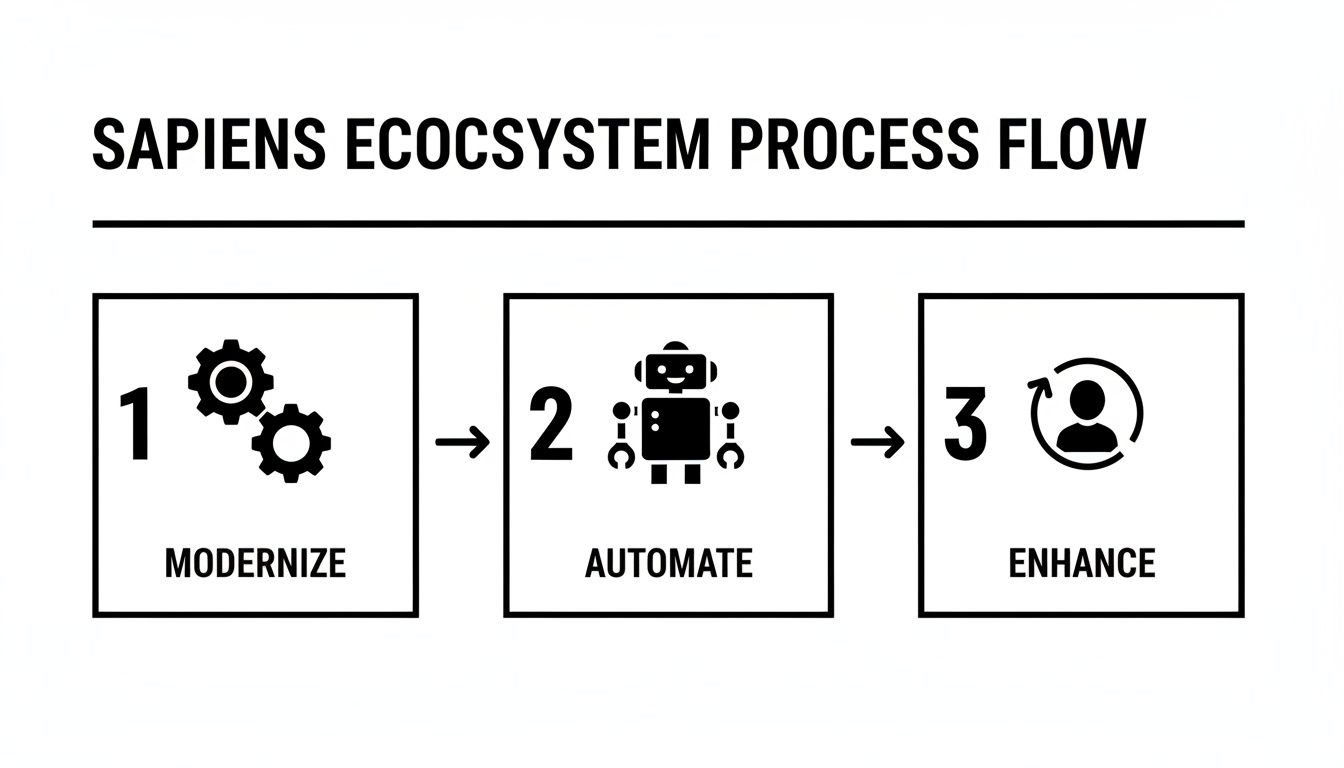
The journey from modernizing core systems to automating key processes and finally enhancing the user experience is a practical roadmap for carriers trying to advance digitally.
From Intake To Faster Adjudication
Once a claim enters the platform, AI can support classification, summarization, validation, and task routing. That does not mean every claim becomes fully automated. It means simpler claims can move faster, while more complex cases reach the right human expert earlier.
Sapiens has also cited broader automation benchmarks in its own thought leadership, including claims operating cost reductions of 36%, average straight-through processing of 59%, and significantly reduced handling time for many manually reviewed claims (Sapiens claims AI blog). These figures are directional rather than universal, but they show why carriers continue to invest in claims automation.
Consider a routine auto claim. In a traditional environment, the process may involve multiple phone calls, repeated data entry, manual review of policy details, and back-and-forth communications with vendors and adjusters. In a modernized workflow, the claimant can upload photos and documents digitally, the system can summarize key facts, verify policy data, and route the claim with fewer delays.
That shift matters because claims speed is not only an efficiency metric. It is a trust metric.
The biggest operational win from AI in claims is not replacing adjusters. It is reducing the low-value work that keeps experienced claims professionals from focusing on complex investigations, customer communication, and exception handling.
The Business Impact Of Smarter Claims Operations
Faster claims handling can lower administrative costs, reduce avoidable errors, and improve policyholder satisfaction during a stressful moment. It can also create cleaner internal workflows because teams spend less time chasing information across disconnected systems.
That push toward modern, AI-enabled insurance operations also aligns with Sapiens' commercial momentum. In addition to its 2024 growth, the company said its 2025 guidance reflected continued focus on SaaS transition, recurring revenue, and operational discipline (Q4 and full-year 2024 results).
transforming insurance claims with agentic AI
If you're exploring what comes after basic workflow automation, you might also look at our case study on transforming insurance claims with agentic AI.
Using AI To Improve Insurance Customer Experience
Claims modernization is only part of the story. Customer experience has become a competitive differentiator across the full insurance lifecycle, from quote and bind to policy servicing and renewals.
Sapiens emphasizes digital engagement as a core part of its platform strategy. Its official messaging highlights personalized, role-based experiences for customers, agents, claim handlers, and other stakeholders, with AI and digital tools helping support more relevant interactions (Sapiens homepage, automation and AI).
The practical outcome is a shift from reactive service to connected self-service and assisted service. Instead of waiting for business hours or relying only on call centers, policyholders can use portals, mobile experiences, and chat-based support to complete common tasks faster.

What Modern Service Looks Like In Practice
Imagine a policyholder who wants to update a driver, download proof of insurance, or check claim status after hours. In a modern Sapiens-enabled environment, that user can access a portal or digital service channel, complete the request, and receive guided support without starting from scratch each time.
That may involve:
Self-service access: Customers can start common requests digitally instead of waiting for an agent.
Context-aware support: AI can help summarize prior interactions or surface relevant account information for the next step.
Better handoffs: If a request needs human review, the case can be routed with the right context attached.
This kind of experience reduces friction for both customers and service teams. For a closer look at the broader shift, you can read more about how AI is reshaping customer care.
AI customer care works best when it removes effort, not when it creates another layer of confusion. The goal is faster answers, fewer repeated steps, and smoother transitions between self-service and human support.
Why It Matters To The Business
Better service does more than lower call volumes. It can improve retention, strengthen digital adoption, and increase confidence in the insurer’s brand. It also helps internal teams by reducing repetitive administrative work and giving service staff more complete context when a customer does need live help.
For insurers, the most important point is this: customer experience and operational efficiency are no longer separate agendas. With modern platforms, they increasingly depend on the same data, workflows, and automation layer.
Integrating Sapiens With Modern AI Platforms
A core platform becomes more valuable when it connects cleanly to the rest of the enterprise stack. Sapiens promotes an open, integrated approach, which is important for insurers that need core administration to exchange data with CRMs, contact center tools, analytics platforms, and specialized automation systems.
That makes Sapiens a potential system of record. Then a separate AI-native platform can act as a system of action, retrieving trusted policy or claims data and executing tasks within secure workflows.

This architecture is attractive because it lets insurers modernize incrementally. They can preserve a compliant core environment while extending automation into areas that once required constant manual effort.
Creating An Intelligent Automation Layer
In practice, an AI layer connected to Sapiens could:
Pull policy or claims data from the core platform.
Cross-check information against external sources or uploaded documents.
summarize the record and identify the next recommended action.
Trigger a payment workflow, service case, approval request, or escalation.
That same pattern works beyond claims. It can support underwriting intake, policy servicing, billing exceptions, and service desk workflows.
A well-governed AI layer does not replace the core system. It extends it. The core platform remains the source of truth, while the AI layer helps coordinate decisions and actions across the surrounding workflow.
The Synergy Of Systems
This model can help insurers avoid a disruptive rip-and-replace project. Instead, they can keep their core Sapiens environment and add intelligent orchestration through APIs and connected services.
For regulated industries, that matters. Auditability, data integrity, and permissions still need to hold up when automation is introduced. A strong integration strategy makes it possible to gain speed without giving up control.
If your team is comparing vendors, our guide to Guidewire Software Inc. offers additional context on another major insurance core platform.
How To Evaluate Sapiens For Your Organization
Selecting a core insurance platform is a long-term architectural decision. The right evaluation process should go beyond product demos and feature checklists.
At minimum, insurers should assess how Sapiens fits their operating model, line-of-business complexity, compliance requirements, integration environment, and long-term AI roadmap.
Key Evaluation Criteria For Decision-Makers
Focus on a few practical criteria:
Scalability and resilience: Can the platform handle growth, peak event volumes, and multi-line complexity without creating bottlenecks?
Security and compliance: What certifications, controls, and governance processes support the platform in regulated insurance environments?
Implementation model: How much effort is required for migration, integration, testing, and change management?
Configurability: Can your products, workflows, and rules be adapted without introducing brittle custom code?
Total cost of ownership: Consider implementation, data migration, integrations, support, ongoing licensing, and future optimization costs, not only subscription price.
Vendor stability also matters. Sapiens’ official financial releases point to continued revenue growth and sustained investment capacity, including full-year 2024 revenue of $542.4 million and Q2 2025 revenue of $141.6 million (Q4 and full-year 2024 results, Q2 2025 results).
intelligent automation in insurance
The best core system is not just the one that solves today’s pain points. It is the one that gives your organization room to automate, integrate, and adapt over time.
For a broader look at where operations are headed, see our guide to intelligent automation in insurance.
Common Questions About Sapiens
Decision-makers evaluating Sapiens usually ask the same practical questions: how hard implementation will be, how flexible the platform is, and whether its AI capabilities are mature enough to support real business outcomes.
How Does Sapiens Use AI In Claims And Customer Service?
Sapiens uses AI across insurance workflows, especially in claims and digital engagement. In claims, its official materials point to support for summaries, communications, and workflow acceleration. In customer-facing journeys, it promotes role-based digital experiences and AI-enabled engagement tools for customers, agents, and internal users (automation and AI, Sapiens homepage).
The value is less about flashy AI features and more about reducing turnaround time, surfacing better context, and helping teams handle routine work more consistently.
What Sets Sapiens Apart From Other Insurance Tech Companies?
Sapiens stands out because it offers a broad insurance platform rather than a narrow point solution. Its footprint spans core administration, claims, digital engagement, and data capabilities across multiple insurance lines.
That matters for insurers that want a more unified architecture and fewer integration gaps between critical functions. It also matters for enterprises that prefer a vendor with scale and international operating experience. According to Sapiens’ official reporting, the company operates across 38 countries (Q2 2025 results).
Is Sapiens A Good Fit For AI-Driven Insurance Operations?
It can be, especially for insurers that want to modernize core operations and then layer in AI across claims, service, and back-office workflows. The strongest fit is usually with organizations that need a stable core platform, open integration options, and a structured path toward automation rather than isolated AI pilots.
The bigger question is not whether Sapiens has AI features. It is whether your organization has the data quality, governance, process discipline, and integration plan to turn those features into measurable outcomes.
Are you ready to see how AI agents can automate your most complex insurance workflows? Nolana deploys a compliant, AI-native operating system that integrates seamlessly with core systems like Sapiens to execute tasks, assist decisions, and deliver end-to-end automation with clear, auditable guardrails. Discover Nolana today.
As a global provider of insurance software, Sapiens helps carriers replace legacy systems with cloud-based core platforms, digital engagement tools, and embedded AI. Its role is not just to digitize a few workflows. It is to give insurers a more unified operating foundation for policy administration, billing, claims, data, and customer interactions.
For insurers under pressure to reduce costs, improve service, and launch products faster, that matters. Sapiens positions its platform as an open, integrated, cloud-native environment with AI and automation built into the insurance lifecycle, especially across claims and customer engagement, according to its official platform materials and AI pages (Sapiens platform, automation and AI).
Understanding The Sapiens Ecosystem
At a high level, Sapiens provides the systems of record and digital tools that insurers use to run daily operations. That includes core administration for property and casualty, life, pensions, workers' compensation, and reinsurance, along with portals, analytics, and workflow automation.
The practical value is straightforward. Instead of managing policy, billing, and claims across fragmented legacy systems, insurers can centralize operations on a modern platform and connect that platform to downstream and upstream tools through APIs.
This shift is showing up in the company’s results. Sapiens reported full-year 2024 revenue of $542.4 million, up 5.4% year over year, and Q4 2024 revenue of $134.0 million, up 2.6% year over year, according to its official financial results (Q4 and full-year 2024 results). In its official second quarter 2025 release, Sapiens reported $141.6 million in revenue for Q2 2025 and noted operations spanning 38 countries (Q2 2025 results).
Core Mission and Capabilities
Sapiens aims to help insurers modernize critical operations without forcing them to stitch together disconnected point solutions. Its product strategy centers on core processing, digital engagement, data intelligence, and AI-assisted workflows.
Sapiens Q3 2024 financial report
Here are the main capabilities that define the platform:
Claims automation: Sapiens offers cloud claims management and AI-assisted workflows for intake, triage, summaries, communication, and task handling. Its official claims and AI content highlights faster resolution, better accuracy, and improved service outcomes (AI for claims).
Policy and billing administration: The platform supports policy lifecycle management, billing operations, product configuration, and compliance across multiple insurance lines.
Digital engagement: Sapiens provides portals, journey orchestration, and role-based experiences for customers, agents, and internal teams, with AI woven into service and engagement flows (Sapiens homepage).
Data and analytics: The platform includes data intelligence capabilities so insurers can work from a clearer operational picture and support better decisions.
Sapiens provides a wide range of solutions tailored to different sectors within the insurance and financial services landscape. The table below offers a high-level summary of its main functional areas.
Sapiens Platform Capabilities At A Glance
Core Area | Key Functionality | Primary Business Impact |
|---|---|---|
P&C Insurance | End-to-end policy, billing, and claims management for personal and commercial lines. | Improves efficiency, speeds product rollout, and supports better agent and policyholder experiences. |
Life, Pensions, and Annuities | Administration for life, pension, savings, and annuity products. | Helps modernize legacy estates and manage complex products and compliance requirements. |
Reinsurance | Lifecycle administration for treaty and facultative business. | Reduces manual reconciliation and creates stronger data consistency across ceded and assumed portfolios. |
Digital Engagement | Customer and agent portals, journey orchestration, and connected service experiences. | Expands self-service, reduces friction, and supports omnichannel engagement. |
Data & Analytics | Data models, reporting, and intelligence capabilities. | Improves visibility, decision-making, and operational control. |
Ultimately, these capabilities work together to create a more agile insurance operation.
For insurers trying to modernize without losing control of compliance and core data, Sapiens can serve as a foundational platform. The value comes from consolidating core operations, then layering automation and AI on top of that foundation.
Choosing a core systems provider like Sapiens is a major strategic decision for any insurer focused on long-term growth and market relevance. For a more detailed breakdown, you can also explore our full guide on the Sapiens software ecosystem.
How Sapiens Uses AI In Insurance Claims
Claims has long been one of the most expensive and operationally complex parts of insurance. Delays often come from manual intake, repetitive documentation work, fragmented systems, and inconsistent handoffs between teams.
Sapiens is trying to change that by embedding AI into the claims lifecycle. In its official materials, the company points to AI use cases such as claim and document summaries, automated communications, and support for faster, more accurate handling (automation and AI). Its ClaimsPro offering is presented as a cloud-native claims solution for end-to-end processing across personal and commercial lines (Claims platform context).
For insurers, the biggest gain is often at first notice of loss. AI can help capture information from digital forms, uploaded documents, and images more efficiently, then route the claim to the right next step.
This diagram shows the basic philosophy Sapiens advocates for bringing insurance operations up to speed.
The journey from modernizing core systems to automating key processes and finally enhancing the user experience is a practical roadmap for carriers trying to advance digitally.
From Intake To Faster Adjudication
Once a claim enters the platform, AI can support classification, summarization, validation, and task routing. That does not mean every claim becomes fully automated. It means simpler claims can move faster, while more complex cases reach the right human expert earlier.
Sapiens has also cited broader automation benchmarks in its own thought leadership, including claims operating cost reductions of 36%, average straight-through processing of 59%, and significantly reduced handling time for many manually reviewed claims (Sapiens claims AI blog). These figures are directional rather than universal, but they show why carriers continue to invest in claims automation.
Consider a routine auto claim. In a traditional environment, the process may involve multiple phone calls, repeated data entry, manual review of policy details, and back-and-forth communications with vendors and adjusters. In a modernized workflow, the claimant can upload photos and documents digitally, the system can summarize key facts, verify policy data, and route the claim with fewer delays.
That shift matters because claims speed is not only an efficiency metric. It is a trust metric.
The biggest operational win from AI in claims is not replacing adjusters. It is reducing the low-value work that keeps experienced claims professionals from focusing on complex investigations, customer communication, and exception handling.
The Business Impact Of Smarter Claims Operations
Faster claims handling can lower administrative costs, reduce avoidable errors, and improve policyholder satisfaction during a stressful moment. It can also create cleaner internal workflows because teams spend less time chasing information across disconnected systems.
That push toward modern, AI-enabled insurance operations also aligns with Sapiens' commercial momentum. In addition to its 2024 growth, the company said its 2025 guidance reflected continued focus on SaaS transition, recurring revenue, and operational discipline (Q4 and full-year 2024 results).
transforming insurance claims with agentic AI
If you're exploring what comes after basic workflow automation, you might also look at our case study on transforming insurance claims with agentic AI.
Using AI To Improve Insurance Customer Experience
Claims modernization is only part of the story. Customer experience has become a competitive differentiator across the full insurance lifecycle, from quote and bind to policy servicing and renewals.
Sapiens emphasizes digital engagement as a core part of its platform strategy. Its official messaging highlights personalized, role-based experiences for customers, agents, claim handlers, and other stakeholders, with AI and digital tools helping support more relevant interactions (Sapiens homepage, automation and AI).
The practical outcome is a shift from reactive service to connected self-service and assisted service. Instead of waiting for business hours or relying only on call centers, policyholders can use portals, mobile experiences, and chat-based support to complete common tasks faster.
What Modern Service Looks Like In Practice
Imagine a policyholder who wants to update a driver, download proof of insurance, or check claim status after hours. In a modern Sapiens-enabled environment, that user can access a portal or digital service channel, complete the request, and receive guided support without starting from scratch each time.
That may involve:
Self-service access: Customers can start common requests digitally instead of waiting for an agent.
Context-aware support: AI can help summarize prior interactions or surface relevant account information for the next step.
Better handoffs: If a request needs human review, the case can be routed with the right context attached.
This kind of experience reduces friction for both customers and service teams. For a closer look at the broader shift, you can read more about how AI is reshaping customer care.
AI customer care works best when it removes effort, not when it creates another layer of confusion. The goal is faster answers, fewer repeated steps, and smoother transitions between self-service and human support.
Why It Matters To The Business
Better service does more than lower call volumes. It can improve retention, strengthen digital adoption, and increase confidence in the insurer’s brand. It also helps internal teams by reducing repetitive administrative work and giving service staff more complete context when a customer does need live help.
For insurers, the most important point is this: customer experience and operational efficiency are no longer separate agendas. With modern platforms, they increasingly depend on the same data, workflows, and automation layer.
Integrating Sapiens With Modern AI Platforms
A core platform becomes more valuable when it connects cleanly to the rest of the enterprise stack. Sapiens promotes an open, integrated approach, which is important for insurers that need core administration to exchange data with CRMs, contact center tools, analytics platforms, and specialized automation systems.
That makes Sapiens a potential system of record. Then a separate AI-native platform can act as a system of action, retrieving trusted policy or claims data and executing tasks within secure workflows.
This architecture is attractive because it lets insurers modernize incrementally. They can preserve a compliant core environment while extending automation into areas that once required constant manual effort.
Creating An Intelligent Automation Layer
In practice, an AI layer connected to Sapiens could:
Pull policy or claims data from the core platform.
Cross-check information against external sources or uploaded documents.
summarize the record and identify the next recommended action.
Trigger a payment workflow, service case, approval request, or escalation.
That same pattern works beyond claims. It can support underwriting intake, policy servicing, billing exceptions, and service desk workflows.
A well-governed AI layer does not replace the core system. It extends it. The core platform remains the source of truth, while the AI layer helps coordinate decisions and actions across the surrounding workflow.
The Synergy Of Systems
This model can help insurers avoid a disruptive rip-and-replace project. Instead, they can keep their core Sapiens environment and add intelligent orchestration through APIs and connected services.
For regulated industries, that matters. Auditability, data integrity, and permissions still need to hold up when automation is introduced. A strong integration strategy makes it possible to gain speed without giving up control.
If your team is comparing vendors, our guide to Guidewire Software Inc. offers additional context on another major insurance core platform.
How To Evaluate Sapiens For Your Organization
Selecting a core insurance platform is a long-term architectural decision. The right evaluation process should go beyond product demos and feature checklists.
At minimum, insurers should assess how Sapiens fits their operating model, line-of-business complexity, compliance requirements, integration environment, and long-term AI roadmap.
Key Evaluation Criteria For Decision-Makers
Focus on a few practical criteria:
Scalability and resilience: Can the platform handle growth, peak event volumes, and multi-line complexity without creating bottlenecks?
Security and compliance: What certifications, controls, and governance processes support the platform in regulated insurance environments?
Implementation model: How much effort is required for migration, integration, testing, and change management?
Configurability: Can your products, workflows, and rules be adapted without introducing brittle custom code?
Total cost of ownership: Consider implementation, data migration, integrations, support, ongoing licensing, and future optimization costs, not only subscription price.
Vendor stability also matters. Sapiens’ official financial releases point to continued revenue growth and sustained investment capacity, including full-year 2024 revenue of $542.4 million and Q2 2025 revenue of $141.6 million (Q4 and full-year 2024 results, Q2 2025 results).
intelligent automation in insurance
The best core system is not just the one that solves today’s pain points. It is the one that gives your organization room to automate, integrate, and adapt over time.
For a broader look at where operations are headed, see our guide to intelligent automation in insurance.
Common Questions About Sapiens
Decision-makers evaluating Sapiens usually ask the same practical questions: how hard implementation will be, how flexible the platform is, and whether its AI capabilities are mature enough to support real business outcomes.
How Does Sapiens Use AI In Claims And Customer Service?
Sapiens uses AI across insurance workflows, especially in claims and digital engagement. In claims, its official materials point to support for summaries, communications, and workflow acceleration. In customer-facing journeys, it promotes role-based digital experiences and AI-enabled engagement tools for customers, agents, and internal users (automation and AI, Sapiens homepage).
The value is less about flashy AI features and more about reducing turnaround time, surfacing better context, and helping teams handle routine work more consistently.
What Sets Sapiens Apart From Other Insurance Tech Companies?
Sapiens stands out because it offers a broad insurance platform rather than a narrow point solution. Its footprint spans core administration, claims, digital engagement, and data capabilities across multiple insurance lines.
That matters for insurers that want a more unified architecture and fewer integration gaps between critical functions. It also matters for enterprises that prefer a vendor with scale and international operating experience. According to Sapiens’ official reporting, the company operates across 38 countries (Q2 2025 results).
Is Sapiens A Good Fit For AI-Driven Insurance Operations?
It can be, especially for insurers that want to modernize core operations and then layer in AI across claims, service, and back-office workflows. The strongest fit is usually with organizations that need a stable core platform, open integration options, and a structured path toward automation rather than isolated AI pilots.
The bigger question is not whether Sapiens has AI features. It is whether your organization has the data quality, governance, process discipline, and integration plan to turn those features into measurable outcomes.
Are you ready to see how AI agents can automate your most complex insurance workflows? Nolana deploys a compliant, AI-native operating system that integrates seamlessly with core systems like Sapiens to execute tasks, assist decisions, and deliver end-to-end automation with clear, auditable guardrails. Discover Nolana today.


All systems operational
1 Lime Street, London EC3M 7HA | 222E 3rd Street, New York 10009
Copyright © 2026, Nolana. All rights reserved
All systems operational
1 Lime Street, London EC3M 7HA | 222E 3rd Street, New York 10009
Copyright © 2026, Nolana. All rights reserved
All systems operational
1 Lime Street, London EC3M 7HA | 222E 3rd Street, New York 10009
Copyright © 2026, Nolana. All rights reserved
All systems operational
1 Lime Street, London EC3M 7HA | 222E 3rd Street, New York 10009
Copyright © 2026, Nolana. All rights reserved