Top 12 AI Insurance Companies to Watch in 2025
Top 12 AI Insurance Companies to Watch in 2025
Discover our curated list of the top ai insurance companies for 2025. Compare providers for claims automation, AI customer care, and risk management.
The insurance industry is undergoing a significant transformation, driven by artificial intelligence. From automating insurance claims with AI to delivering hyper-personalized AI customer care, organizations are adopting new technologies to enhance efficiency and customer satisfaction. This evolution, however, introduces new categories of risk and operational complexity. For financial services leaders, understanding the ecosystem of ai insurance companies is no longer a peripheral task, it's a strategic necessity for deploying AI safely and insuring against its unique liabilities.
This guide serves as a comprehensive directory and analysis of the top 12 providers in this space. We move beyond marketing claims to offer a detailed review of each company's core capabilities, particularly in automating claims and enhancing customer interactions. Our goal is to equip procurement teams, technology leaders, and risk managers with the insights needed to make informed partnership decisions. As AI reshapes operational workflows, it's also crucial to consider its broader implications, such as the impact of AI on jobs and the future of work, which affects long-term strategic planning.
Inside, you will find a curated breakdown of each vendor, complete with screenshots and direct links, focusing on:
Core AI Capabilities: What technology do they actually offer for claims and customer service?
Target Use Cases: Who is their ideal customer and what problems do they solve?
Implementation & Integration: What does it take to get their solution running with your existing systems?
Compliance & Security: How do they address the stringent regulatory demands of the financial services industry?
This resource is designed to help you navigate the crowded market, compare claims ai reviews, and select a partner that aligns with your organization's specific technological and business objectives.
1. Armilla AI
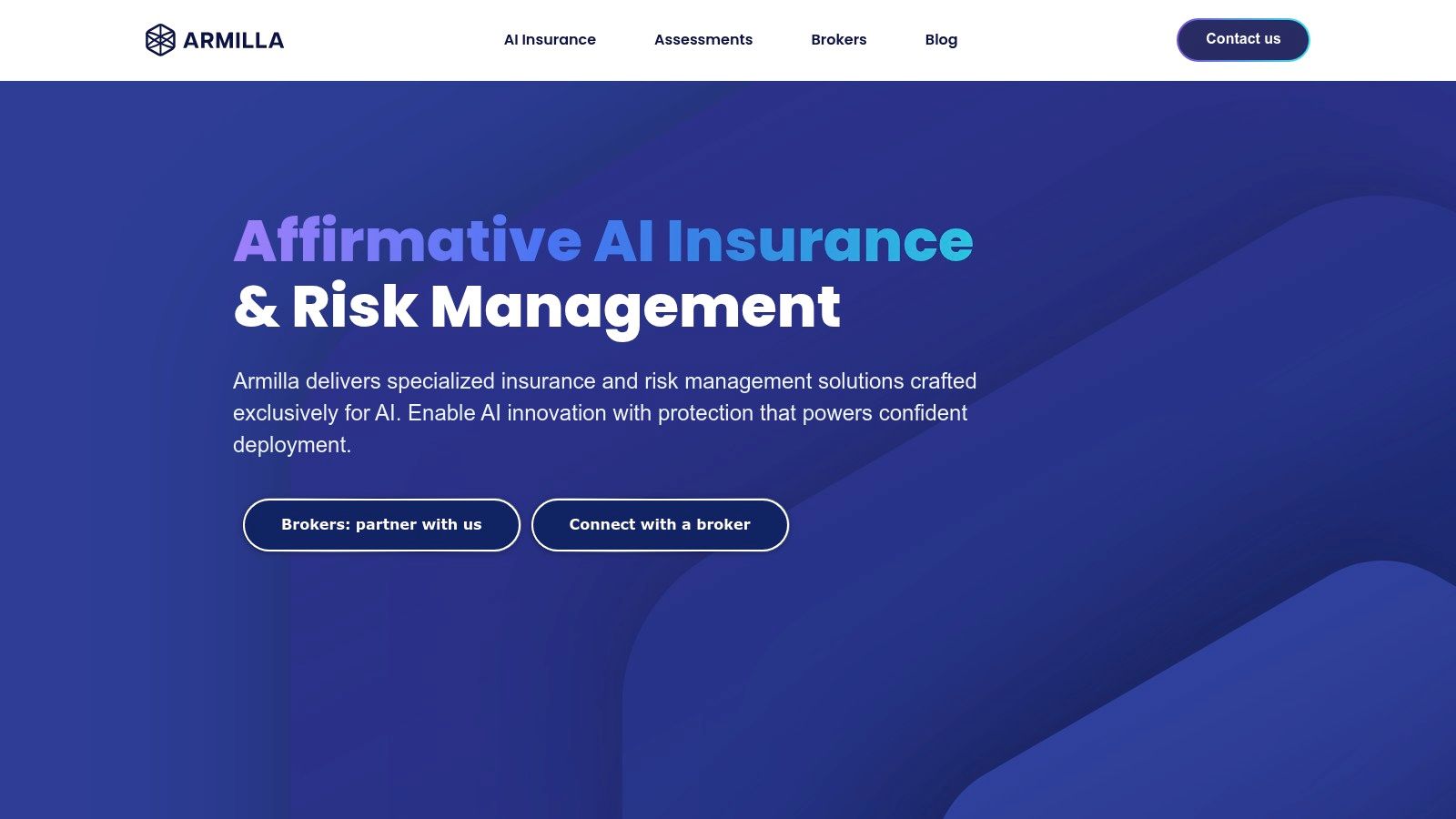
Armilla AI offers a unique and specialized form of protection in the evolving landscape of AI-driven insurance and financial services. Rather than providing AI tools for carriers, Armilla is a specialist Lloyd’s coverholder that insures the performance of AI models themselves. This positions them as a critical partner for AI vendors and the enterprises that procure their technology, ensuring AI solutions deliver on their promised value.
Their core product, the AI Performance Warranty, is an insurance policy that backs a model’s stated Key Performance Indicators (KPIs). For an insurance carrier implementing a new AI for claims processing, this means that if the model fails to meet pre-agreed accuracy or efficiency targets, the Armilla policy can respond, mitigating financial losses from underperformance. This warranty is crucial for de-risking the adoption of new technology and accelerating sales cycles for AI developers.
Core Capabilities & Use Cases
Armilla stands out among ai insurance companies by focusing on AI assurance rather than operational AI. Their independent assessments, bias checks, and ongoing monitoring provide a third-party verification layer that builds trust. This is particularly valuable for automating insurance claims with AI and for high-stakes AI customer care in financial services, where model reliability is paramount. The affirmative policy wordings are specifically designed to cover AI failures, a gap often left by traditional Errors & Omissions (E&O) or cyber policies. As enterprises increasingly rely on advanced data analytics, solutions like Armilla's provide essential financial backstops. For more information, you can explore the role of data analytics in the insurance sector.
Procurement & Implementation Insights
Target Audience: Best suited for AI developers selling into the enterprise or large companies deploying third-party AI for critical functions.
Access: Coverage must be sourced through a licensed surplus lines broker. In the U.S., it is placed on a surplus lines basis and is not available in every state.
Pricing: Premiums are based on the risk profile of the AI model, the limit of liability required, and the outcomes of Armilla’s technical assessment.
Feature | Description |
|---|---|
Product Type | AI Performance Warranty Insurance |
Key Offering | Financial backing for AI model KPIs |
Underwriting | Backed by A-rated insurers at Lloyd's |
Strengths | Purpose-built AI wordings, builds buyer trust |
Limitations | Requires specialist broker, limited U.S. availability |
Website: https://www.armilla.ai/
2. Munich Re (aiSure)
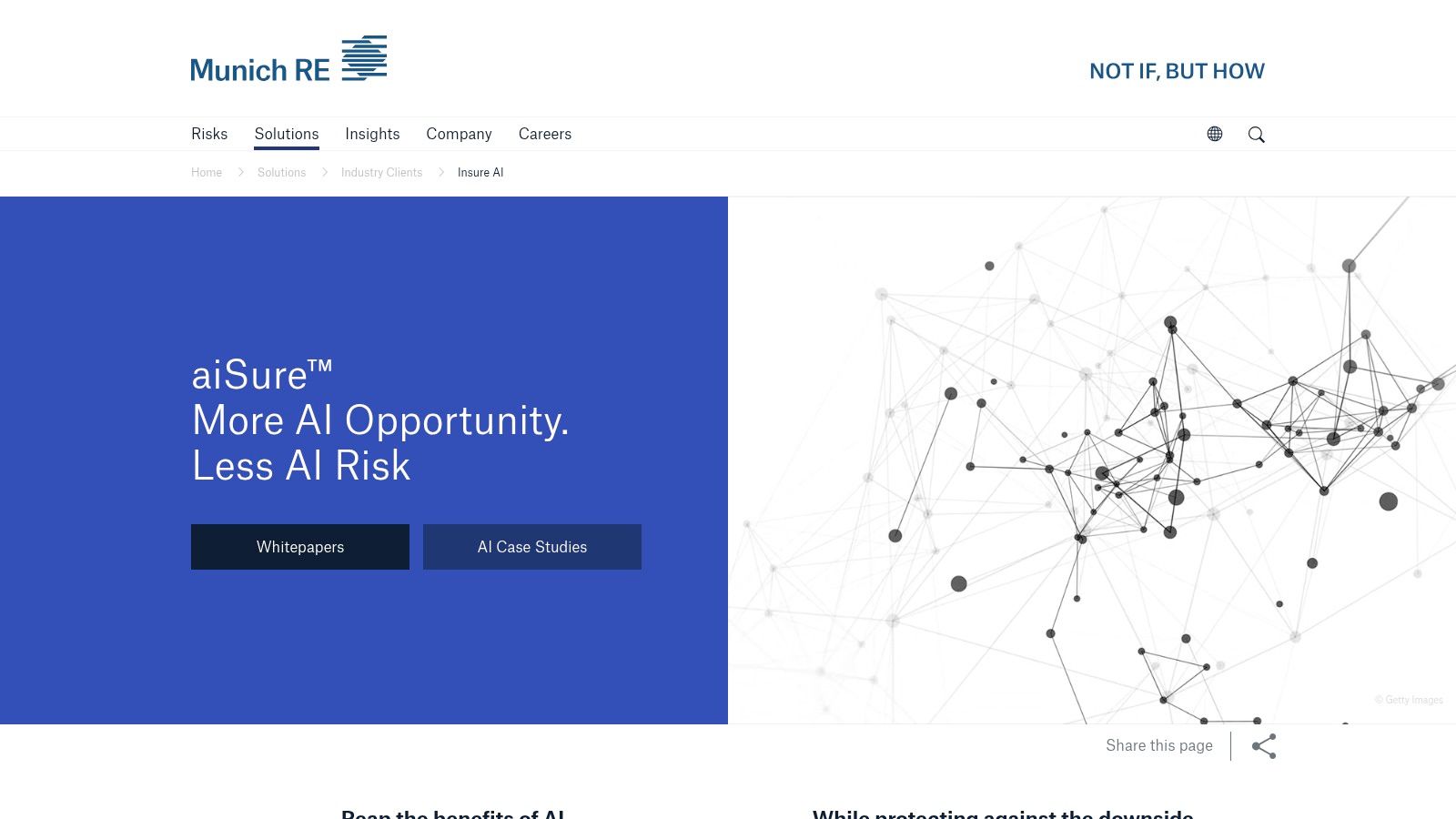
As a global reinsurance giant, Munich Re brings its substantial balance sheet and deep underwriting expertise to the AI risk landscape with its aiSure product suite. Unlike niche providers, aiSure offers a broad spectrum of coverage options designed to address the financial fallout from AI underperformance or failure. This product is engineered for both AI vendors seeking to de-risk their solutions for enterprise buyers and the large corporations deploying these technologies for critical operations.
The core of aiSure is its bespoke nature, covering contractual liabilities, direct financial losses, and third-party damages stemming from AI model errors. For a bank using an AI for fraud detection, an aiSure policy could cover losses if the model fails to perform to its specified accuracy, going beyond what standard tech Errors & Omissions (E&O) policies typically cover. This provides a crucial layer of financial security for companies investing heavily in automation.
Core Capabilities & Use Cases
Munich Re’s strength among ai insurance companies lies in its ability to craft custom wordings for novel and complex AI risks, backed by extensive technical due diligence. This makes it a powerful partner for organizations automating high-stakes processes like insurance claims or financial services. For instance, their coverage can provide a safety net for deploying new claims ai reviews systems, ensuring that model failures do not result in catastrophic financial or reputational damage. This capability is vital for transforming operations, as detailed in case studies on transforming insurance claims with agentic AI. Their embedded expertise allows them to underwrite risks that other carriers may avoid.
Procurement & Implementation Insights
Target Audience: Ideal for established AI technology providers and large enterprises in sectors like finance and insurance that are deploying business-critical AI.
Access: Coverage is not available directly. It must be structured and placed through sophisticated insurance brokers and underwriters who can navigate the bespoke process.
Pricing: Premiums are highly customized, determined after a thorough technical evaluation of the AI model, its intended use, and the desired liability limits.
Feature | Description |
|---|---|
Product Type | Bespoke AI Performance Insurance |
Key Offering | Covers contractual, third-party, and first-party AI-related losses |
Underwriting | Backed by Munich Re's global balance sheet |
Strengths | Custom policy wordings, extensive AI risk expertise |
Limitations | Complex procurement via brokers, requires in-depth technical due diligence |
Website: https://www.munichre.com/en/solutions/for-industry-clients/insure-ai.html
3. Coalition
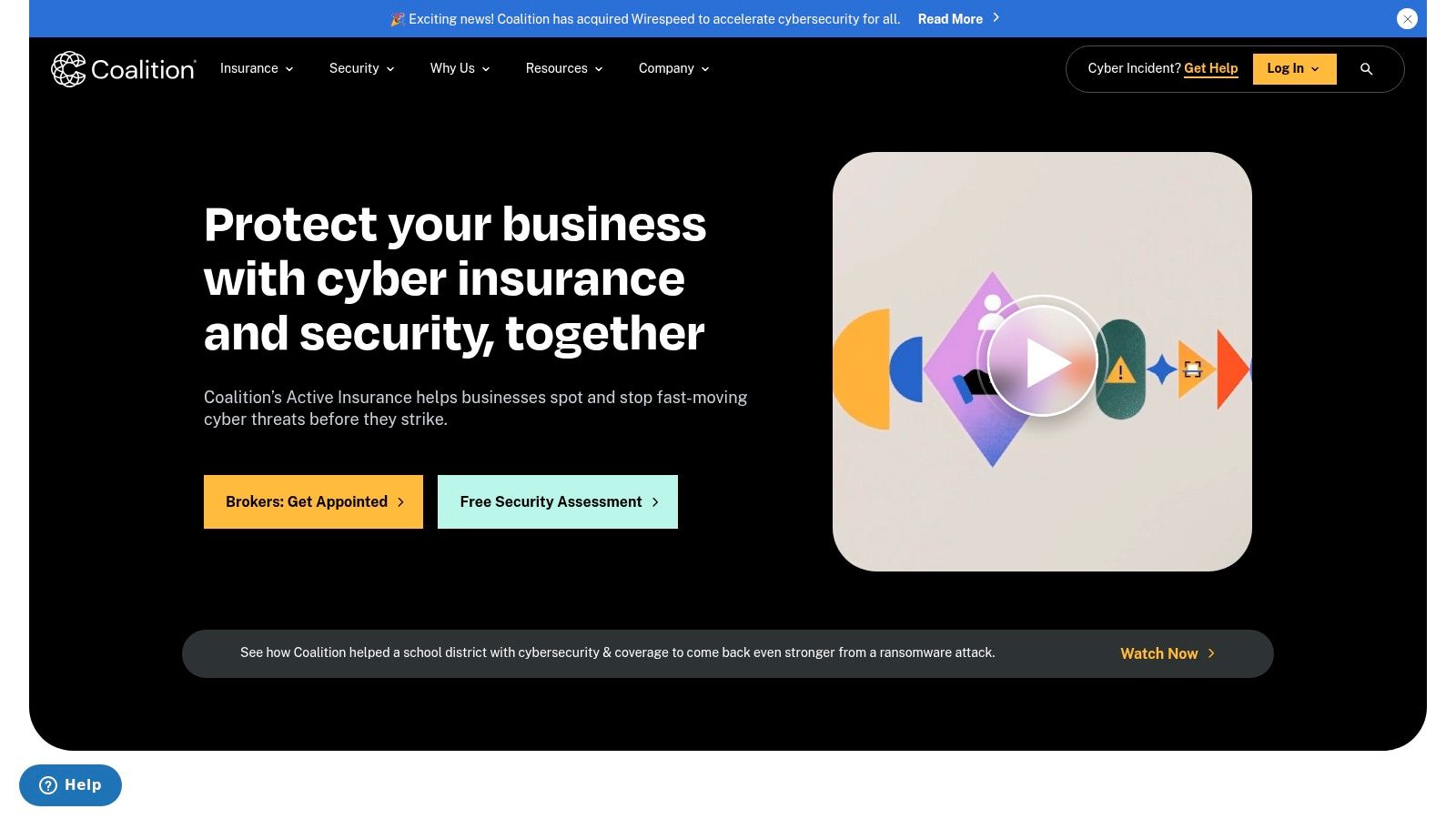
Coalition has adapted its leading cyber insurance platform to address the novel risks introduced by artificial intelligence, particularly for small to mid-market businesses. Rather than insuring AI model performance, Coalition extends its robust cyber coverage to include AI-driven security incidents. This approach makes them a practical choice for companies leveraging AI tools in their daily operations, providing a safety net against AI-enabled cyber threats rather than guaranteeing the AI’s operational output.
Their key innovation is the Affirmative AI Endorsement, which explicitly broadens the definition of a security failure or data breach to include events caused by AI systems. A complementary Deepfake Response Endorsement provides policyholders with crucial technical, legal, and public relations support if they become victims of AI-generated impersonation or fraudulent content, a growing concern for AI customer care and executive security.
Core Capabilities & Use Cases
As one of the pioneering ai insurance companies in the cyber space, Coalition’s strength lies in its integrated risk management platform. Policyholders gain access to active risk monitoring and a dedicated incident response ecosystem, which is now equipped to handle AI-specific threats. For an organization using an AI to help with automating insurance claims with AI, this means that if the AI system is compromised and leads to a data breach, the Coalition policy is designed to respond affirmatively. These endorsements provide clarity in a complex risk environment where traditional policies may be ambiguous. To better understand how AI is being deployed in customer-facing roles, you can explore various AI agent use cases.
Procurement & Implementation Insights
Target Audience: Best for SMEs and mid-market companies using AI tools that need to extend their existing cyber liability coverage.
Access: Coverage is sourced through licensed insurance brokers who partner with Coalition.
Pricing: The endorsements are add-ons to a core cyber policy; their cost depends on the client's risk profile, selected limits, and overall security posture.
Feature | Description |
|---|---|
Product Type | Cyber Insurance with AI Endorsements |
Key Offering | Affirmative coverage for AI-driven cyber events and deepfakes |
Underwriting | Based on active risk scanning and security posture |
Strengths | Clearly defined AI triggers, easy to add for existing policyholders |
Limitations | Does not cover AI model performance or KPI failures |
Website: https://www.coalitioninc.com/
4. Cowbell
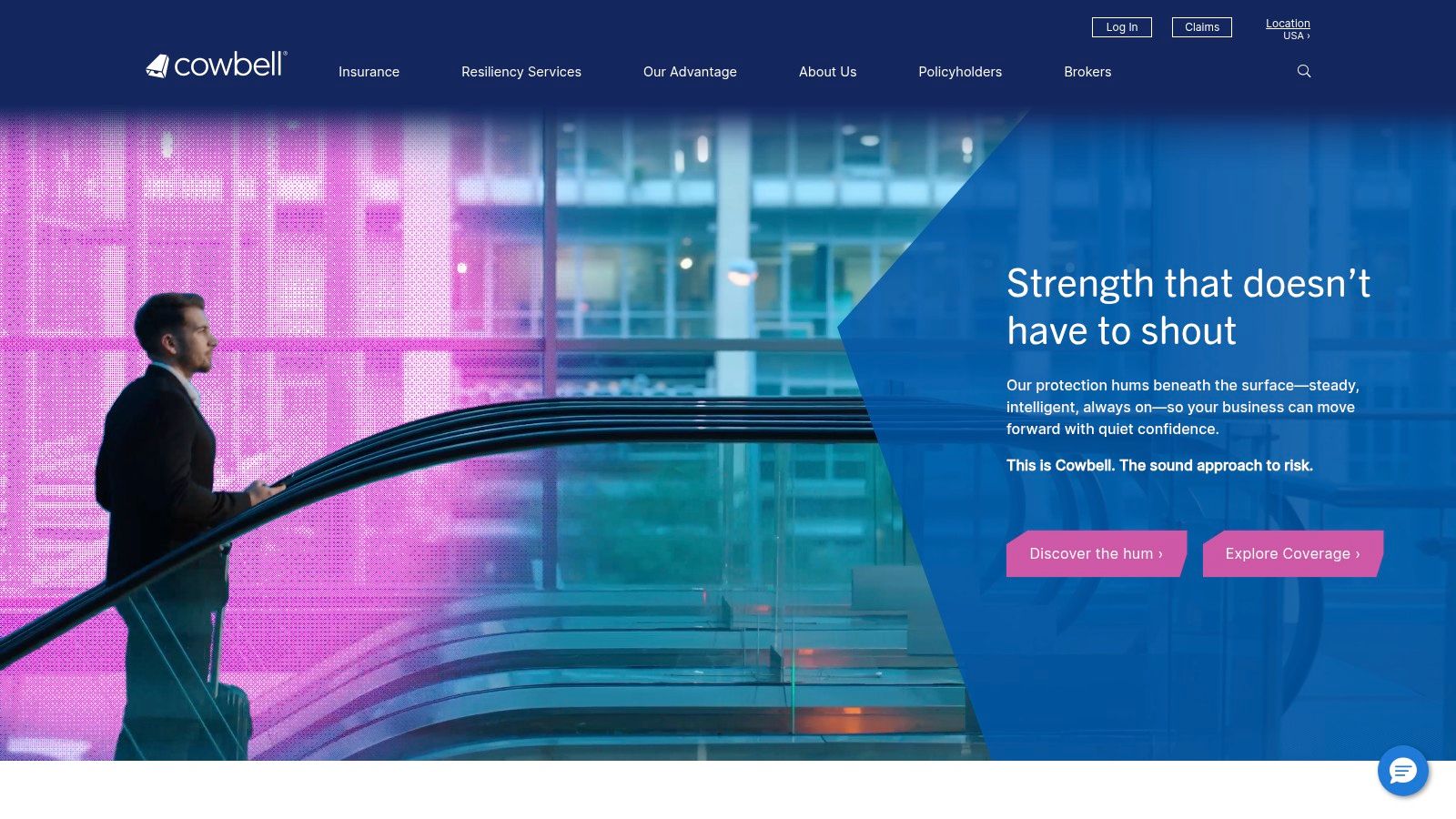
Cowbell offers an adaptive approach to cyber insurance, specifically tailored for small to medium-sized enterprises (SMEs) facing modern, AI-accelerated threats. Rather than focusing on AI model performance, Cowbell provides cyber and technology Errors & Omissions (E&O) coverage with an AI-aware underwriting and risk services framework. This positions them as a key provider for businesses looking to protect their digital operations from sophisticated, AI-driven cyberattacks.
Their core offering is a dynamic cyber insurance policy that evolves with a company’s risk profile, facilitated by AI-powered continuous risk assessment. Cowbell connects this coverage to a proactive ecosystem called Cowbell Resiliency Services (CRS), a marketplace offering discounted access to vital security tools like Managed Detection and Response (MDR), threat intelligence, and employee training. This integrated model helps businesses improve their security posture, which can lead to better insurance terms and faster incident response.
Core Capabilities & Use Cases
Cowbell stands out among ai insurance companies by linking proactive risk management directly to insurance coverage. Their MDR endorsement, for example, can waive deductibles if a company uses an approved MDR vendor, incentivizing stronger defenses. This is crucial for businesses using AI customer care platforms or systems for automating insurance claims with AI, as these tools can be prime targets for cybercriminals. By focusing on mitigating the operational impact of a cyber event, Cowbell provides a practical layer of defense. You can learn more about comprehensive risk management in operations to understand how this approach fits into a broader strategy.
Procurement & Implementation Insights
Target Audience: Best suited for U.S.-based SMEs seeking comprehensive, digitally managed cyber and tech E&O insurance.
Access: Policies and services are procured through a network of appointed insurance brokers and agents.
Pricing: Premiums are determined by the company's real-time risk score, industry, revenue, and the adoption of recommended security controls.
Feature | Description |
|---|---|
Product Type | Adaptive Cyber & Tech E&O Insurance |
Key Offering | AI-powered risk assessment and a resiliency services marketplace |
Underwriting | Continuous underwriting based on evolving risk signals |
Strengths | Incentivizes proactive defense, fast digital policy management |
Limitations | Focuses on cyber exposure, not AI performance warranties; add-ons priced separately |
Website: https://cowbell.insure/
5. Tokio Marine HCC (TechGuard)
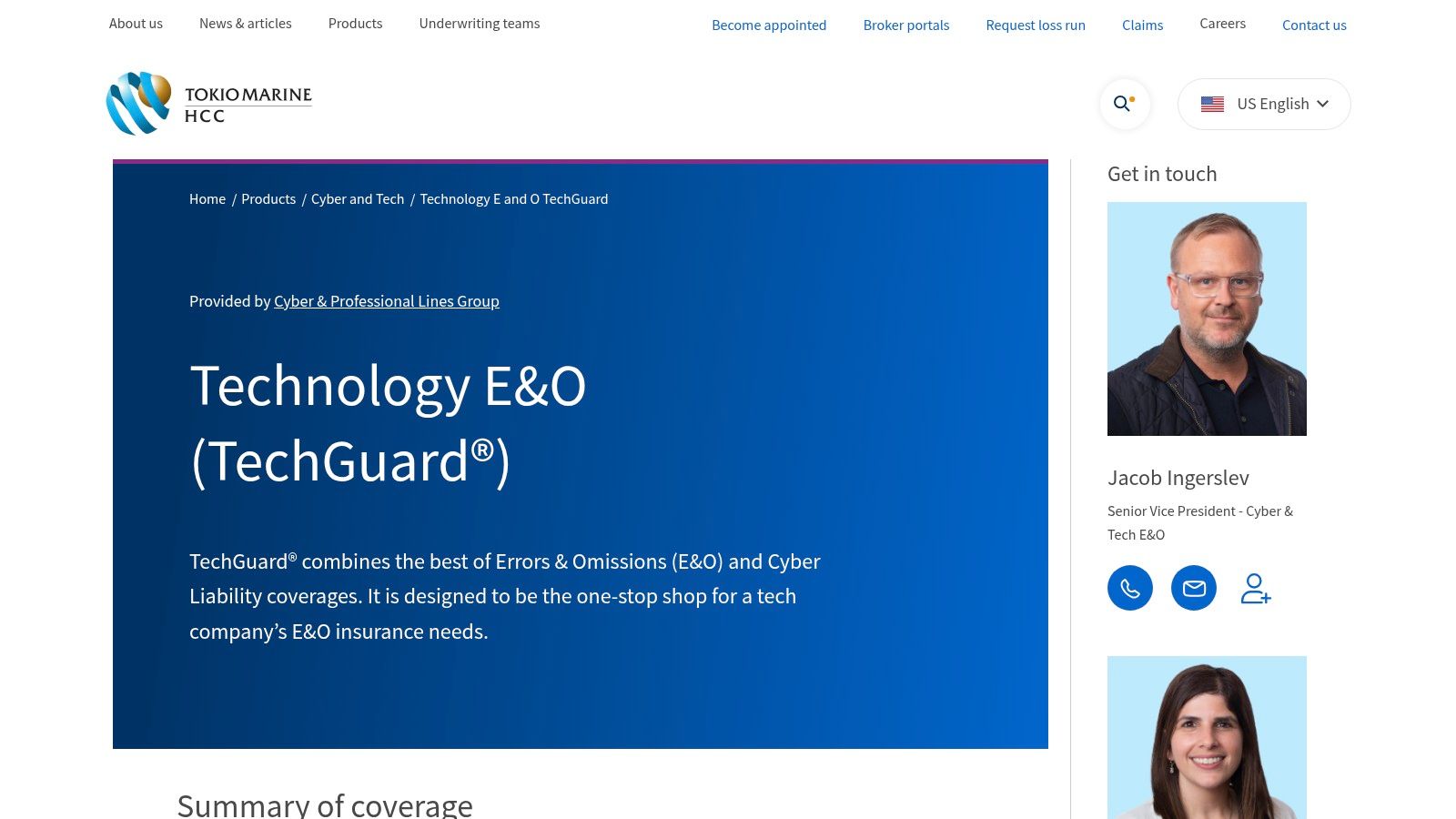
Tokio Marine HCC offers a practical and established insurance solution for technology companies through its TechGuard product. Rather than insuring the performance of AI models, TechGuard provides crucial Technology Errors & Omissions (E&O) and Cyber Liability coverage. This product is designed for the tech firms that build and sell AI solutions, protecting them from liability claims arising from failures in their technology or services, a key consideration for many ai insurance companies and the vendors that supply them.
The policy framework integrates AI and data analytics into its own underwriting and risk monitoring processes, demonstrating a modern approach to assessing tech-related risks. For brokers and their clients, Tokio Marine HCC provides a digital portal to streamline the quoting and binding process, making it an accessible option for technology startups and small-to-midsize businesses (SMBs) that need reliable coverage to operate and grow in the competitive tech landscape.
Core Capabilities & Use Cases
Tokio Marine HCC's strength lies in providing a foundational liability backstop for technology providers, including those developing AI customer care platforms or tools for automating insurance claims with AI. While not a performance warranty, their Tech E&O policy is essential for covering financial losses to a third party caused by a tech product's failure or professional service error. This is a critical risk management tool for AI vendors selling into highly regulated sectors like insurance and finance. As these sectors increasingly adopt AI, understanding the liability implications becomes paramount; you can find more on this by exploring the evolution of AI in insurance claims.
Procurement & Implementation Insights
Target Audience: Best suited for U.S.-based technology companies, from startups to established enterprises, that require E&O and Cyber Liability coverage.
Access: Coverage is sourced through licensed insurance brokers. The digital portal is designed to give brokers quick access to quotes and policy documents.
Pricing: Premiums are determined by traditional underwriting factors like company revenue, services offered, risk management practices, and required coverage limits.
Feature | Description |
|---|---|
Product Type | Technology E&O and Cyber Liability Insurance |
Key Offering | Packaged or standalone liability coverage |
Underwriting | A-rated specialty carrier with a strong U.S. presence |
Strengths | Established carrier, broker portal for efficiency |
Limitations | Standard E&O, not a dedicated AI performance policy |
Website: https://www.tmhcc.com/en-us/products/cyber-and-tech/technology-e-and-o-techguard
6. Zurich North America
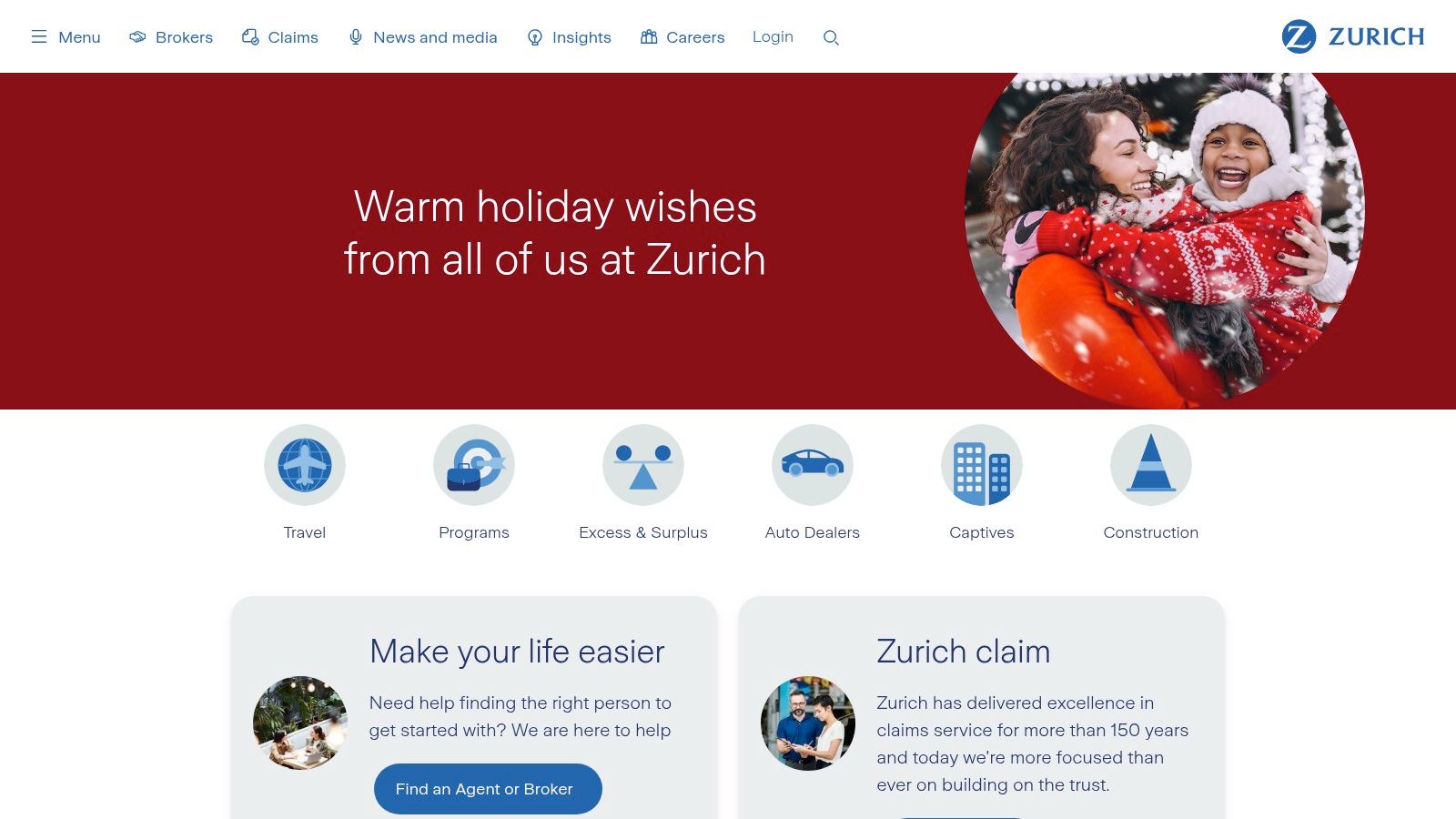
Zurich North America represents a traditional, top-tier commercial insurer that has integrated AI into its core operations, particularly in underwriting and risk assessment for physical assets. Instead of selling AI software, Zurich applies artificial intelligence to enhance its own insurance products, offering sophisticated solutions for complex, modern risks. A prime example is its U.S. builders risk coverage, which has been specifically tailored to address the unique challenges of constructing hyperscale and AI-focused data centers.
This approach demonstrates how established ai insurance companies are evolving by embedding AI into their risk evaluation workflows. By integrating AI-powered property insights, Zurich can more accurately price risk and underwrite policies for technology-heavy infrastructure projects. This makes them a key partner for businesses building the physical backbone of the digital economy, where traditional risk models may fall short.
Core Capabilities & Use Cases
Zurich’s strength lies in applying AI to tangible, physical risks rather than abstract model performance. Their AI-enabled underwriting for property and casualty exposures allows for more precise risk segmentation and pricing, particularly for complex construction. The specialized Builders Risk product is a direct response to the boom in AI data center construction, covering unique perils associated with these high-value, mission-critical facilities. While not focused on AI customer care or claims automation software, Zurich’s use of AI in risk assessment provides a foundational layer of security for the enterprises that rely on these technologies. This innovative application of technology supports the broader AI ecosystem from the ground up.
Procurement & Implementation Insights
Target Audience: Best suited for large commercial enterprises, real estate developers, and construction firms involved in building or operating high-tech facilities like AI data centers.
Access: Policies and pricing are accessed exclusively through Zurich's national network of appointed independent insurance agents and brokers.
Pricing: Premiums are highly customized based on the project's scale, location, risk management protocols, and specific construction or operational exposures.
Feature | Description |
|---|---|
Product Type | Commercial Property & Casualty Insurance |
Key Offering | AI-enabled underwriting and specialized Builders Risk for data centers |
Underwriting | Direct underwriting by Zurich, a global A+ rated carrier |
Strengths | Deep expertise in complex construction risk, financial stability |
Limitations | Does not insure AI model performance; broker access is required |
Website: https://www.zurichna.com/
7. Chubb (Chubb Studio)
Chubb, a global insurance powerhouse, leverages AI not as a product itself, but as the engine for its innovative embedded insurance platform, Chubb Studio. This platform enables digital businesses and platforms to seamlessly integrate and offer Chubb’s diverse insurance products, such as cyber and Errors & Omissions (E&O), directly to their customers at the point of need. It uses AI to optimize the distribution and personalization of these traditional insurance lines, making it a critical enabler for partners serving AI-rich customer bases.
For companies in the technology sector, this means their customers can access relevant coverage through a streamlined digital experience. Chubb Studio's AI capabilities help identify the right product and moment to present an offer, enhancing the customer journey while embedding risk management directly into a partner’s ecosystem. This approach shifts the focus from selling standalone policies to providing integrated protection, powered by intelligent distribution.
Core Capabilities & Use Cases
Chubb stands out among ai insurance companies by using AI to facilitate distribution rather than underwriting a specific AI risk. The platform's AI optimization engine is ideal for digital marketplaces, fintech apps, and e-commerce sites that want to offer value-added insurance services. For instance, a software platform could offer its users cyber liability insurance at signup. While not a direct tool for automating insurance claims with AI, Chubb’s robust, brand-backed claims handling and risk engineering services support the policies distributed through this AI-powered channel, ensuring a high-quality end-to-end customer experience.
Procurement & Implementation Insights
Target Audience: Best suited for digital platforms, fintech companies, and e-commerce businesses looking to embed insurance offerings.
Access: Available through partnership agreements with Chubb. The platform provides APIs for seamless integration into partner websites and applications.
Pricing: The model is typically based on revenue sharing or commission from policies sold through the partner's platform.
Feature | Description |
|---|---|
Product Type | Embedded Insurance Platform |
Key Offering | AI-powered engine (Chubb Studio) for distributing standard insurance lines like cyber and E&O. |
Underwriting | Traditional underwriting for established lines, backed by Chubb's global A+ rated capacity. |
Strengths | Access to a top-tier global carrier, strong claims handling, easy integration for digital partners. |
Limitations | Not a specific AI liability product; coverage depends on the underlying policies offered via the platform. |
Website: https://news.chubb.com/
8. Beazley (US)
Beazley is a specialist insurer with a strong focus on technology-related risks, offering sophisticated cyber and Tech Errors & Omissions (E&O) products. While not an AI platform provider, Beazley leverages AI analytics to enhance its risk assessment and response services, particularly in reputational risk. This makes them a key partner for companies deploying AI, as they understand the complex liability landscape that new technologies create.
Their approach is to provide robust insurance coverage for the consequences of technology failure rather than warranting the technology's performance itself. For an organization implementing new AI for claims processing or customer care, Beazley’s policies can cover liability arising from algorithmic errors, data breaches, or service interruptions. Their AI-augmented reputational risk solution uses tools like Polecat to monitor online sentiment, providing early warnings and crisis management support if an AI-driven issue becomes public.

Core Capabilities & Use Cases
Beazley stands out among ai insurance companies for its deep expertise in underwriting technology risks. Their flexible policy wordings are designed to address the evolving liabilities of digital operations, which is crucial for businesses automating insurance claims with AI or deploying AI customer care systems. Their sector-specific packages, like WellTech for tech-enabled healthcare, demonstrate a nuanced understanding of industry-specific risks where AI is becoming prevalent. The integration of AI-powered analytics into their reputational risk product provides clients with proactive insights to manage crises before they escalate, a critical service for brands relying on public-facing AI.
Procurement & Implementation Insights
Target Audience: Best for technology companies, healthcare providers, and other enterprises deploying AI who need sophisticated liability coverage.
Access: Policies are not available for direct purchase and must be sourced through a licensed insurance broker.
Pricing: Premiums are determined by the company's risk profile, industry, revenue, and the specific limits and coverages required.
Feature | Description |
|---|---|
Product Type | Specialty Insurance (Cyber, Tech E&O, Reputational Risk) |
Key Offering | AI-enhanced risk analytics for reputational harm coverage |
Underwriting | In-house expertise with significant capacity |
Strengths | Deep specialty in tech/cyber, recognized claims handling |
Limitations | Broker-only access, does not offer AI performance warranties |
Website: https://www.beazley.com/en-us
9. Marsh (US)
As the world's largest insurance broker, Marsh offers a fundamentally different value proposition in the AI risk landscape. Instead of providing AI tools, Marsh provides access to the global insurance market to structure and place complex AI-related risks. For enterprises deploying AI in high-stakes environments, Marsh acts as a strategic advisor, helping them navigate new exclusions, negotiate favorable terms, and secure coverage that adequately addresses AI-driven liabilities.
Their role is to design comprehensive risk transfer solutions, which can range from enhanced Tech E&O and cyber policies with specific AI endorsements to creating sophisticated captive insurance programs. A captive is essentially a self-insurance vehicle that can cover unique AI risks when traditional markets are unwilling or too expensive. This approach gives large enterprises greater control over their risk management strategy for critical deployments like automating insurance claims with AI.
Core Capabilities & Use Cases
Marsh stands out among ai insurance companies by leveraging its market-leading position and deep carrier relationships to find coverage for emerging AI risks. They are crucial for organizations seeking high-limit policies or navigating complex regulatory environments where AI model failure could lead to significant financial and reputational damage. Their advisory services are vital for interpreting new policy language and ensuring that coverage for AI customer care and claims automation is not inadvertently excluded. They also provide strong claims advocacy, helping clients recover losses when an insured event occurs.
Procurement & Implementation Insights
Target Audience: Best suited for large enterprises, multinational corporations, and tech companies deploying or developing AI solutions who need specialized risk advisory and placement services.
Access: Services are accessed by engaging Marsh directly as an insurance broker. The process involves detailed risk assessments and collaboration with Marsh's specialist teams.
Pricing: Compensation is typically through brokerage fees, which are a percentage of the premium, or on a fee-for-service basis for advisory and captive management work.
Feature | Description |
|---|---|
Product Type | Insurance Brokerage & Risk Advisory |
Key Offering | Sourcing and structuring AI risk coverage (e.g., Tech E&O, Cyber), captive design. |
Underwriting | N/A - Marsh accesses coverage from the entire global insurance carrier market. |
Strengths | Maximizes market competition, expert negotiation, strong claims advocacy, captive solutions. |
Limitations | Brokerage fees apply; coverage is dependent on carrier appetite and underwriting complexity. |
Website: https://www.marsh.com/us/home.html
10. Aon
Aon, a global professional services firm, is leveraging AI to transform the traditional insurance broking process, particularly for complex technology and AI-related risks. Instead of offering a direct AI tool for carriers to use, Aon utilizes proprietary AI, like its Broker Copilot, to enhance market intelligence and streamline the insurance placement process. This makes them a strategic partner for businesses seeking specialized coverage for cyber, tech E&O, and emerging AI liabilities.
The firm's AI-driven approach provides clients with powerful placement analytics, offering insights into carrier pricing, capacity appetite, and market sentiment. This data-led broking is especially valuable for tech startups and enterprises deploying AI, as it can significantly shorten placement cycles. By integrating risk analytics, Aon helps clients better understand their exposures and secure optimal terms, navigating the tightening capacity in the market for AI-specific risks. This positions them as a key facilitator among ai insurance companies for securing innovative coverage.
Core Capabilities & Use Cases
Aon's strength lies in its global scale and its ability to harness data for complex risk placement. Their tools help aggregate underwriter feedback and market data, which is critical for vendors automating insurance claims with AI who need robust liability coverage. For financial services firms implementing AI customer care solutions, Aon can structure sophisticated policies that address the unique risks of algorithmic decision-making and data privacy. Their integrated Risk Analyzer informs broking strategy, ensuring clients present their risk profiles effectively to underwriters in specialty markets.
Procurement & Implementation Insights
Target Audience: Best for technology companies, AI developers, and large enterprises seeking specialized cyber, E&O, or specific AI liability insurance.
Access: Services are accessed by engaging Aon as a licensed insurance broker for risk placement and advisory.
Pricing: Aon's compensation is typically commission-based, calculated as a percentage of the insurance premium placed.
Feature | Description |
|---|---|
Product Type | AI-Enhanced Insurance Broking & Risk Advisory |
Key Offering | Data-driven placement for cyber, tech E&O, and AI liability |
Underwriting | Access to global carriers and specialty London markets |
Strengths | Strong market leverage, data-led insights shorten placement cycles |
Limitations | Coverage depends on underwriter appetite; still a broker-led process |
Website: https://aon.com/
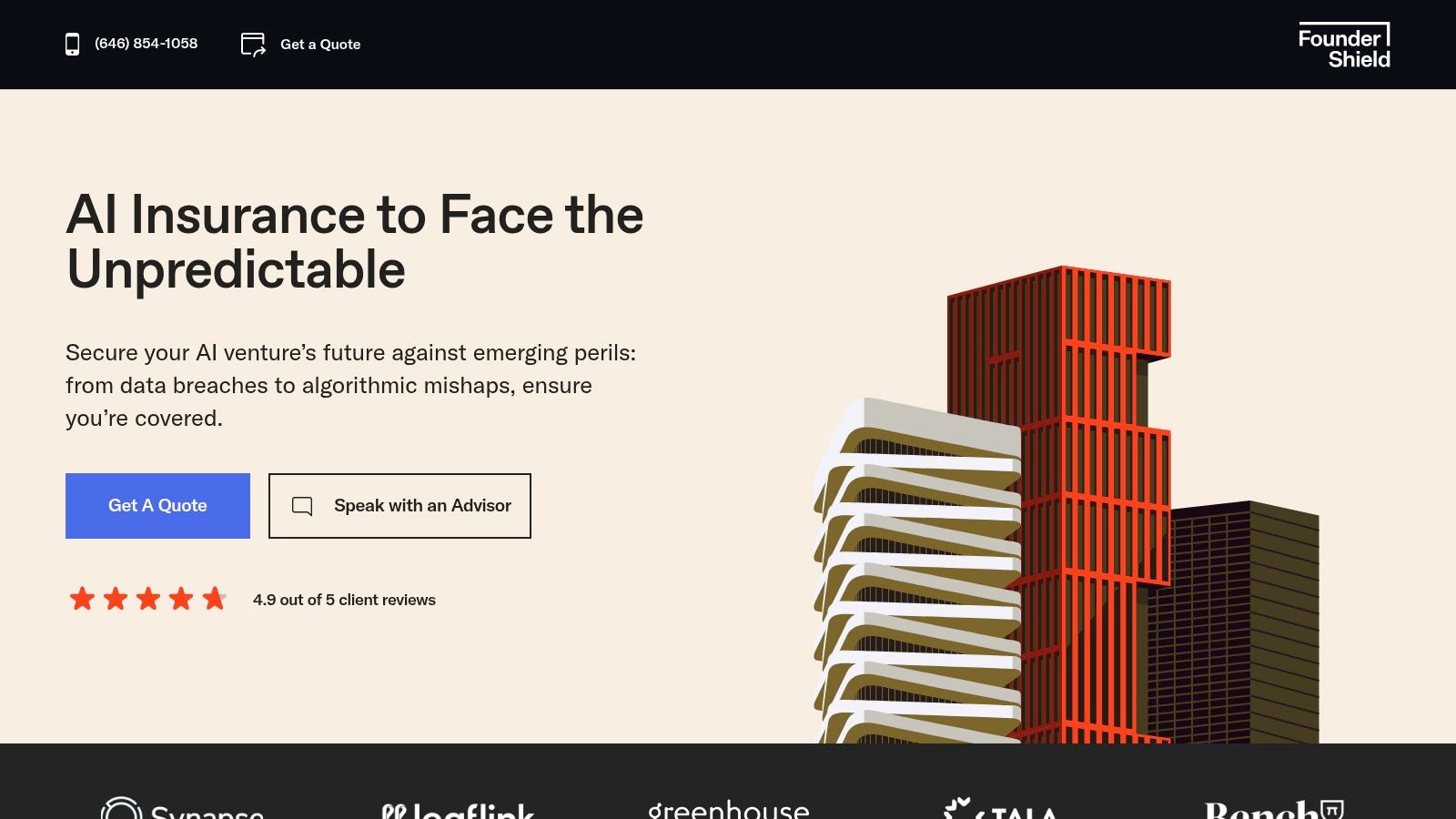
11. Founder Shield
Founder Shield operates as a tech-enabled insurance brokerage with a dedicated focus on the unique risks faced by technology startups, including those developing and deploying AI. Rather than underwriting risk directly, Founder Shield provides a specialized intake and advisory path for AI companies to secure comprehensive coverage. They help startups navigate the complex insurance requirements often imposed by enterprise clients, ensuring their AI products are backed by robust policies.
This brokerage is tailored for AI innovators who need to secure multi-line insurance programs, including Tech Errors & Omissions (E&O), cyber liability, and intellectual property coverage. Their digital application process is specifically designed to capture the nuanced risks of AI, such as model bias, data privacy exposure, and algorithmic performance failures. This approach helps translate a startup's technology into a risk profile that A-rated insurance carriers can underwrite, making Founder Shield a crucial partner for AI companies seeking to win enterprise contracts.
Core Capabilities & Use Cases
Founder Shield’s primary value among ai insurance companies is its role as a specialized intermediary. They provide a streamlined digital experience backed by human expertise, guiding AI developers through the process of obtaining policies that satisfy Master Service Agreements (MSAs). This is critical for companies providing solutions for automating insurance claims with AI or delivering AI customer care in regulated sectors. Their expertise ensures that the final insurance program addresses specific AI risks that generalist brokers might overlook, closing critical coverage gaps.
Procurement & Implementation Insights
Target Audience: Best suited for AI-native startups and scale-ups needing to secure a comprehensive insurance package to meet enterprise customer requirements.
Access: Services are accessed directly through their digital application portal, followed by consultation with their brokerage team.
Pricing: As a broker, they do not set prices. Premiums are determined by partner carriers based on the startup’s revenue, data sensitivity, use case, and risk management posture.
Feature | Description |
|---|---|
Product Type | Insurance Brokerage for AI Companies |
Key Offering | Multi-line coverage placement (Tech E&O, Cyber, IP) |
Underwriting | Access to multiple A-rated carriers |
Strengths | Fast, startup-friendly digital process; expertise in enterprise contract requirements |
Limitations | Coverage is dependent on carrier appetite; pricing and terms vary significantly |
Website: https://foundershield.com/apply/ai-insurance/
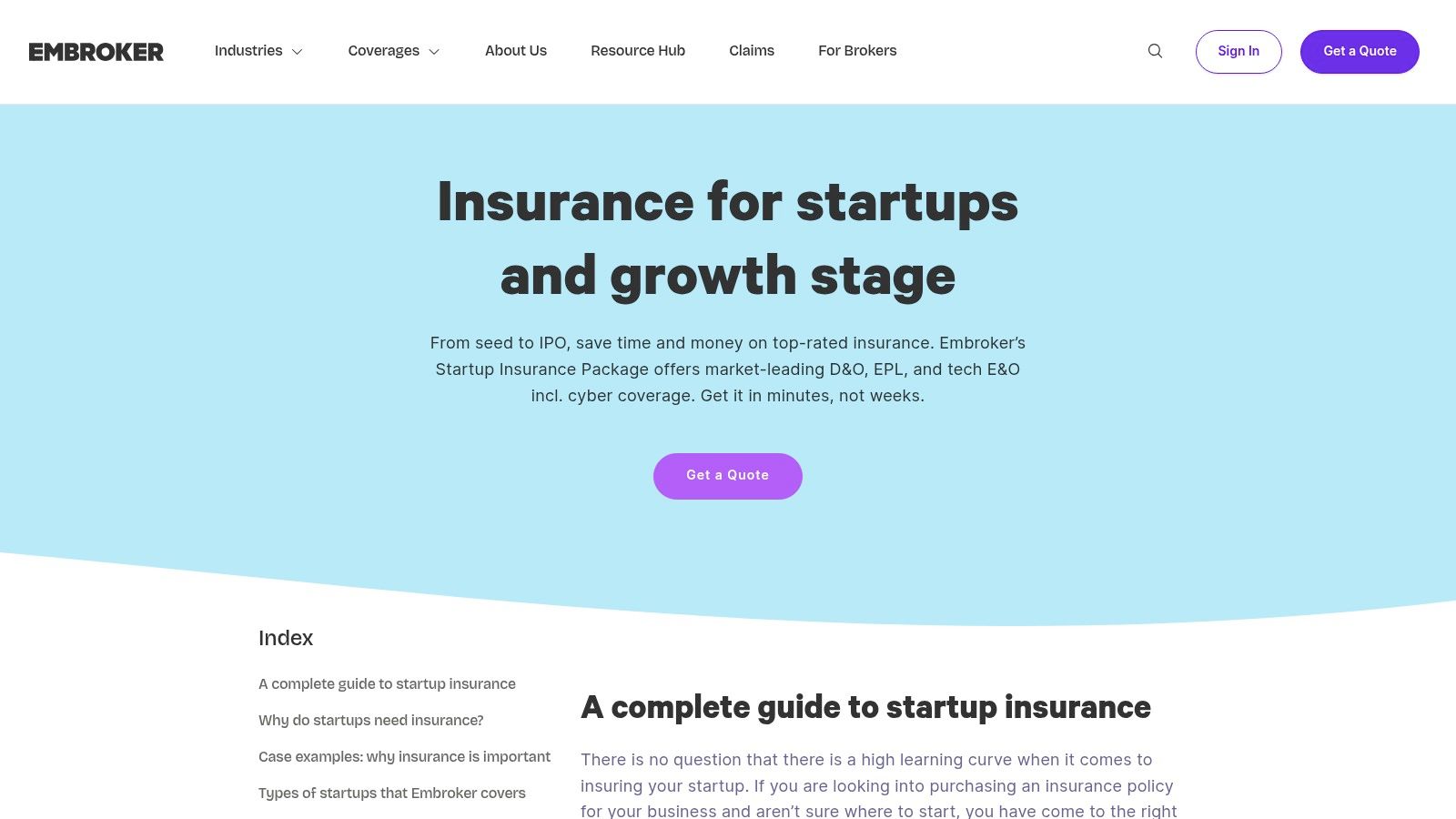
12. Embroker
Embroker operates as a digital-first business insurance brokerage, focusing on providing technology companies, including AI startups, with streamlined access to essential coverage. Instead of offering AI tools for carriers, Embroker serves the other side of the ecosystem: it equips AI vendors with the insurance they need to operate and secure enterprise contracts. This is particularly vital for startups developing solutions for automating insurance claims with AI or for AI customer care, as their enterprise clients will mandate robust liability coverage.
The platform specializes in bundled "startup packages" that include critical policies like Technology Errors & Omissions (Tech E&O), Cyber Liability, and Directors & Officers (D&O). The key value proposition is speed and simplicity. An AI company can go from quote to a certificate of insurance rapidly through a mostly digital process, which is a significant advantage when trying to close deals with large financial institutions or insurance carriers that require proof of coverage before signing.
Core Capabilities & Use Cases
Embroker's strength is its role as an enabler for emerging ai insurance companies and technology vendors. Their platform efficiently assembles the necessary insurance programs that AI developers require to satisfy enterprise procurement and risk management teams. While they do not provide affirmative AI performance guarantees, their Tech E&O and cyber policies are sourced from A-rated carriers and can be tailored to address the risks inherent in developing and deploying AI systems. This gives buyers of AI technology confidence that their vendor has a financial backstop for traditional technology-related liabilities.
Procurement & Implementation Insights
Target Audience: Best suited for venture-backed AI startups and technology companies that need to secure comprehensive business insurance quickly to meet customer contract requirements.
Access: Services are accessed directly through their online platform, which provides instant quotes for many standard coverage lines.
Pricing: Premiums are determined by the startup’s operational details, revenue, funding, risk controls, and the specific limits and deductibles selected.
Feature | Description |
|---|---|
Product Type | Digital Insurance Brokerage for Tech Startups |
Key Offering | Bundled insurance packages (Tech E&O, Cyber, D&O) |
Underwriting | Sourced from a panel of A/A+ rated insurance carriers |
Strengths | Fast, digital quoting and binding process; startup-focused |
Limitations | Policies are standard carrier forms, not specific AI warranties |
Website: https://www.embroker.com/coverage/startup-insurance/
12-Provider AI Insurance Comparison
Provider | Core offering | AI-specific coverage & USP | Target audience | Strengths | Limitations / placement notes |
|---|---|---|---|---|---|
Armilla AI | Lloyd’s coverholder; affirmative AI insurance | Affirmative AI wordings + AI Performance Warranty backing KPIs; independent assessments | AI developers & vendors needing KPI warranties | Purpose-built AI policy; A‑rated Lloyd’s capacity | Surplus lines in US; broker-only; limited state availability |
Munich Re (aiSure) | Reinsurer suite for AI exposures; bespoke programs | Covers contractual, own-loss & third‑party AI errors; custom wordings | Large vendors, enterprises, broker-placed programs | Deep AI underwriting expertise; global balance sheet | Broker/underwriter placements; pricing after technical diligence |
Coalition | Cyber insurance platform with AI enhancements | Affirmative AI Endorsement for AI-driven security events; Deepfake Response | SMEs & mid‑market seeking cyber + AI incident support | Early mainstream AI-trigger definitions; integrated IR ecosystem | Not for AI performance/KPI failure; endorsements affect premium |
Cowbell | Adaptive cyber & tech E&O with risk services | AI-aware risk services; CRS marketplace; MDR endorsement (deductible waivers) | US SMEs focused on proactive cyber defenses | Fast digital policies; proactive defense services | Cyber-focused (not AI performance warranties); add-ons priced separately |
Tokio Marine HCC (TechGuard) | Tech E&O & cyber with broker portal | AI/analytics in underwriting & threat monitoring; rapid quoting portal | Tech firms, startups, SMBs | Specialty carrier with US footprint; practical startup option | AI coverage via Tech E&O constructs; broker placement required |
Zurich North America | Broad commercial carrier with AI-enabled underwriting | AI property insights; builders risk for hyperscale/AI data centers | Enterprises with AI infrastructure/data centers | Tier‑one carrier; specialized data center solutions | Focus on property/construction risks, not AI performance liability |
Chubb (Chubb Studio) | Embedded insurance distribution & engine | AI-powered personalization for distribution (Chubb Studio) | Platforms/partners needing point-of-need insurance | Global capacity; strong claims & risk engineering | Not an AI‑specific liability product; coverage varies by partner lines |
Beazley (US) | Specialty cyber & Tech E&O; reputational products | Cyber & Tech E&O + AI analytics for reputational response (Polecat) | Tech-driven sectors (incl. healthcare) | Deep cyber expertise; AI‑enhanced crisis insights | Broker-placed policies; no AI performance warranties |
Marsh (US) | Global broker & placement/advisory services | Market sourcing for AI risk, captives, structured placements | Enterprises needing complex placements & captives | Broad market access; captive design & claims advocacy | Brokerage fees; placement timelines depend on underwriting |
Aon | Global broker with AI/LLM-enabled tools | AI-driven placement analytics (Broker Copilot), Risk Analyzer | Enterprises seeking data‑led broking at scale | Data-led insight; global reach & carrier leverage | Coverage depends on carrier appetite; requires documentation |
Founder Shield | Startup-focused broker with AI intake path | Dedicated AI application flow; multi-line program assembly | AI startups needing enterprise-ready coverage | Fast, startup-friendly digital experience; multi-line support | Actual coverage depends on carrier forms & appetite |
Embroker | Digital broker for venture-backed startups | Online quoting & bundled startup packages (Tech E&O, cyber, D&O) | Venture-backed startups needing fast certs | Speedy online quoting; enterprise-ready limits | Not AI performance warranty provider; premiums vary by risk |
Integrating AI and Insurance for a Resilient Future
The journey through the landscape of leading ai insurance companies reveals a fundamental shift in risk management for the modern enterprise. As we've detailed, the pioneers in this space, from specialized providers like Coalition and Cowbell to established giants like Munich Re and Chubb, are no longer just insuring against traditional risks. They are creating sophisticated financial safety nets specifically designed for the complexities and vulnerabilities introduced by artificial intelligence, particularly in high-stakes environments like financial services and insurance claims processing.
This evolution is not a niche trend; it is a direct response to the enterprise-wide adoption of AI for mission-critical functions. The core takeaway is clear: as your organization integrates AI to automate insurance claims or enhance AI customer care, your risk management strategy must evolve in parallel. Standard cyber liability or E&O policies often contain significant gaps when it comes to the unique failure modes of AI systems, such as algorithmic bias, data poisoning, or unexpected model drift. The providers profiled in this guide offer the specialized coverage needed to bridge these gaps, transforming AI from a potential liability into a protected, resilient asset.
Key Takeaways for Your AI Insurance Strategy
Selecting the right partner is less about finding a one-size-fits-all policy and more about aligning a provider’s expertise with your specific AI implementation. Reflecting on the claims ai reviews and capabilities discussed:
For Early Adopters & Startups: Companies like Founder Shield or Embroker offer more agile, accessible policies tailored to organizations that are beginning their AI journey or operating at a smaller scale. Their focus on speed and customized packages for tech-forward businesses can be a significant advantage.
For Large-Scale Enterprise Deployments: Global carriers such as Zurich, Tokio Marine HCC, and Aon bring the financial strength and comprehensive risk engineering services necessary for complex, multinational AI systems. Their ability to underwrite significant risks and provide hands-on mitigation support is critical for mature enterprises.
For Cutting-Edge AI Assurance: Providers like Armilla AI and Munich Re with its aiSure product represent the future of this field. They go beyond reactive coverage, offering model validation, performance guarantees, and continuous monitoring to proactively reduce risk, ensuring the technology performs as promised.
Actionable Next Steps: From Evaluation to Implementation
Armed with this information, your next step is to initiate a structured evaluation process. Begin by assembling a cross-functional team comprising leaders from IT, risk, legal, and the specific business units deploying the AI, such as claims operations or customer service.
Map Your AI Risk Surface: Document every AI model and system in production or development. For each, identify potential failure points. What is the financial and reputational impact if your claims automation AI makes a systemic error? What are the consequences of a customer-facing chatbot providing harmful, biased, or non-compliant advice?
Quantify Potential Impact: Work with your finance and operations teams to assign a tangible cost to these risks. This exercise will be crucial for determining the appropriate level of coverage and for making a compelling business case to leadership.
Engage Potential Insurers: Use the evaluation checklist provided earlier in this article to open discussions with a shortlist of the most relevant ai insurance companies. Be prepared to provide detailed documentation about your AI governance framework, model validation processes, and data security protocols. The more transparent and rigorous your internal controls are, the more favorable your terms will be. As AI becomes more integrated into business operations, companies, including those in the insurance sector, increasingly rely on robust AI brand monitoring strategies to protect their reputation and ensure accurate representation across various AI platforms.
Ultimately, integrating AI into your core workflows is a strategic imperative for staying competitive. Whether you are focused on deploying AI customer care solutions to delight clients or automating claims to drive efficiency, the journey requires both bold innovation and prudent protection. By thoughtfully selecting an AI insurance partner, you are not just buying a policy; you are building a foundation of resilience that empowers your organization to innovate with confidence, secure in the knowledge that your most advanced technological assets are comprehensively protected.
Ready to build, manage, and scale your AI workforce with the resilience these insurance policies are designed to protect? Nolana provides the AI-native operating system that enables enterprises to deploy, monitor, and govern AI agents for complex workflows like claims processing and customer service. Secure your AI-driven future by pairing a robust operational platform with the right insurance strategy. Learn more about Nolana.
The insurance industry is undergoing a significant transformation, driven by artificial intelligence. From automating insurance claims with AI to delivering hyper-personalized AI customer care, organizations are adopting new technologies to enhance efficiency and customer satisfaction. This evolution, however, introduces new categories of risk and operational complexity. For financial services leaders, understanding the ecosystem of ai insurance companies is no longer a peripheral task, it's a strategic necessity for deploying AI safely and insuring against its unique liabilities.
This guide serves as a comprehensive directory and analysis of the top 12 providers in this space. We move beyond marketing claims to offer a detailed review of each company's core capabilities, particularly in automating claims and enhancing customer interactions. Our goal is to equip procurement teams, technology leaders, and risk managers with the insights needed to make informed partnership decisions. As AI reshapes operational workflows, it's also crucial to consider its broader implications, such as the impact of AI on jobs and the future of work, which affects long-term strategic planning.
Inside, you will find a curated breakdown of each vendor, complete with screenshots and direct links, focusing on:
Core AI Capabilities: What technology do they actually offer for claims and customer service?
Target Use Cases: Who is their ideal customer and what problems do they solve?
Implementation & Integration: What does it take to get their solution running with your existing systems?
Compliance & Security: How do they address the stringent regulatory demands of the financial services industry?
This resource is designed to help you navigate the crowded market, compare claims ai reviews, and select a partner that aligns with your organization's specific technological and business objectives.
1. Armilla AI
Armilla AI offers a unique and specialized form of protection in the evolving landscape of AI-driven insurance and financial services. Rather than providing AI tools for carriers, Armilla is a specialist Lloyd’s coverholder that insures the performance of AI models themselves. This positions them as a critical partner for AI vendors and the enterprises that procure their technology, ensuring AI solutions deliver on their promised value.
Their core product, the AI Performance Warranty, is an insurance policy that backs a model’s stated Key Performance Indicators (KPIs). For an insurance carrier implementing a new AI for claims processing, this means that if the model fails to meet pre-agreed accuracy or efficiency targets, the Armilla policy can respond, mitigating financial losses from underperformance. This warranty is crucial for de-risking the adoption of new technology and accelerating sales cycles for AI developers.
Core Capabilities & Use Cases
Armilla stands out among ai insurance companies by focusing on AI assurance rather than operational AI. Their independent assessments, bias checks, and ongoing monitoring provide a third-party verification layer that builds trust. This is particularly valuable for automating insurance claims with AI and for high-stakes AI customer care in financial services, where model reliability is paramount. The affirmative policy wordings are specifically designed to cover AI failures, a gap often left by traditional Errors & Omissions (E&O) or cyber policies. As enterprises increasingly rely on advanced data analytics, solutions like Armilla's provide essential financial backstops. For more information, you can explore the role of data analytics in the insurance sector.
Procurement & Implementation Insights
Target Audience: Best suited for AI developers selling into the enterprise or large companies deploying third-party AI for critical functions.
Access: Coverage must be sourced through a licensed surplus lines broker. In the U.S., it is placed on a surplus lines basis and is not available in every state.
Pricing: Premiums are based on the risk profile of the AI model, the limit of liability required, and the outcomes of Armilla’s technical assessment.
Feature | Description |
|---|---|
Product Type | AI Performance Warranty Insurance |
Key Offering | Financial backing for AI model KPIs |
Underwriting | Backed by A-rated insurers at Lloyd's |
Strengths | Purpose-built AI wordings, builds buyer trust |
Limitations | Requires specialist broker, limited U.S. availability |
Website: https://www.armilla.ai/
2. Munich Re (aiSure)
As a global reinsurance giant, Munich Re brings its substantial balance sheet and deep underwriting expertise to the AI risk landscape with its aiSure product suite. Unlike niche providers, aiSure offers a broad spectrum of coverage options designed to address the financial fallout from AI underperformance or failure. This product is engineered for both AI vendors seeking to de-risk their solutions for enterprise buyers and the large corporations deploying these technologies for critical operations.
The core of aiSure is its bespoke nature, covering contractual liabilities, direct financial losses, and third-party damages stemming from AI model errors. For a bank using an AI for fraud detection, an aiSure policy could cover losses if the model fails to perform to its specified accuracy, going beyond what standard tech Errors & Omissions (E&O) policies typically cover. This provides a crucial layer of financial security for companies investing heavily in automation.
Core Capabilities & Use Cases
Munich Re’s strength among ai insurance companies lies in its ability to craft custom wordings for novel and complex AI risks, backed by extensive technical due diligence. This makes it a powerful partner for organizations automating high-stakes processes like insurance claims or financial services. For instance, their coverage can provide a safety net for deploying new claims ai reviews systems, ensuring that model failures do not result in catastrophic financial or reputational damage. This capability is vital for transforming operations, as detailed in case studies on transforming insurance claims with agentic AI. Their embedded expertise allows them to underwrite risks that other carriers may avoid.
Procurement & Implementation Insights
Target Audience: Ideal for established AI technology providers and large enterprises in sectors like finance and insurance that are deploying business-critical AI.
Access: Coverage is not available directly. It must be structured and placed through sophisticated insurance brokers and underwriters who can navigate the bespoke process.
Pricing: Premiums are highly customized, determined after a thorough technical evaluation of the AI model, its intended use, and the desired liability limits.
Feature | Description |
|---|---|
Product Type | Bespoke AI Performance Insurance |
Key Offering | Covers contractual, third-party, and first-party AI-related losses |
Underwriting | Backed by Munich Re's global balance sheet |
Strengths | Custom policy wordings, extensive AI risk expertise |
Limitations | Complex procurement via brokers, requires in-depth technical due diligence |
Website: https://www.munichre.com/en/solutions/for-industry-clients/insure-ai.html
3. Coalition
Coalition has adapted its leading cyber insurance platform to address the novel risks introduced by artificial intelligence, particularly for small to mid-market businesses. Rather than insuring AI model performance, Coalition extends its robust cyber coverage to include AI-driven security incidents. This approach makes them a practical choice for companies leveraging AI tools in their daily operations, providing a safety net against AI-enabled cyber threats rather than guaranteeing the AI’s operational output.
Their key innovation is the Affirmative AI Endorsement, which explicitly broadens the definition of a security failure or data breach to include events caused by AI systems. A complementary Deepfake Response Endorsement provides policyholders with crucial technical, legal, and public relations support if they become victims of AI-generated impersonation or fraudulent content, a growing concern for AI customer care and executive security.
Core Capabilities & Use Cases
As one of the pioneering ai insurance companies in the cyber space, Coalition’s strength lies in its integrated risk management platform. Policyholders gain access to active risk monitoring and a dedicated incident response ecosystem, which is now equipped to handle AI-specific threats. For an organization using an AI to help with automating insurance claims with AI, this means that if the AI system is compromised and leads to a data breach, the Coalition policy is designed to respond affirmatively. These endorsements provide clarity in a complex risk environment where traditional policies may be ambiguous. To better understand how AI is being deployed in customer-facing roles, you can explore various AI agent use cases.
Procurement & Implementation Insights
Target Audience: Best for SMEs and mid-market companies using AI tools that need to extend their existing cyber liability coverage.
Access: Coverage is sourced through licensed insurance brokers who partner with Coalition.
Pricing: The endorsements are add-ons to a core cyber policy; their cost depends on the client's risk profile, selected limits, and overall security posture.
Feature | Description |
|---|---|
Product Type | Cyber Insurance with AI Endorsements |
Key Offering | Affirmative coverage for AI-driven cyber events and deepfakes |
Underwriting | Based on active risk scanning and security posture |
Strengths | Clearly defined AI triggers, easy to add for existing policyholders |
Limitations | Does not cover AI model performance or KPI failures |
Website: https://www.coalitioninc.com/
4. Cowbell
Cowbell offers an adaptive approach to cyber insurance, specifically tailored for small to medium-sized enterprises (SMEs) facing modern, AI-accelerated threats. Rather than focusing on AI model performance, Cowbell provides cyber and technology Errors & Omissions (E&O) coverage with an AI-aware underwriting and risk services framework. This positions them as a key provider for businesses looking to protect their digital operations from sophisticated, AI-driven cyberattacks.
Their core offering is a dynamic cyber insurance policy that evolves with a company’s risk profile, facilitated by AI-powered continuous risk assessment. Cowbell connects this coverage to a proactive ecosystem called Cowbell Resiliency Services (CRS), a marketplace offering discounted access to vital security tools like Managed Detection and Response (MDR), threat intelligence, and employee training. This integrated model helps businesses improve their security posture, which can lead to better insurance terms and faster incident response.
Core Capabilities & Use Cases
Cowbell stands out among ai insurance companies by linking proactive risk management directly to insurance coverage. Their MDR endorsement, for example, can waive deductibles if a company uses an approved MDR vendor, incentivizing stronger defenses. This is crucial for businesses using AI customer care platforms or systems for automating insurance claims with AI, as these tools can be prime targets for cybercriminals. By focusing on mitigating the operational impact of a cyber event, Cowbell provides a practical layer of defense. You can learn more about comprehensive risk management in operations to understand how this approach fits into a broader strategy.
Procurement & Implementation Insights
Target Audience: Best suited for U.S.-based SMEs seeking comprehensive, digitally managed cyber and tech E&O insurance.
Access: Policies and services are procured through a network of appointed insurance brokers and agents.
Pricing: Premiums are determined by the company's real-time risk score, industry, revenue, and the adoption of recommended security controls.
Feature | Description |
|---|---|
Product Type | Adaptive Cyber & Tech E&O Insurance |
Key Offering | AI-powered risk assessment and a resiliency services marketplace |
Underwriting | Continuous underwriting based on evolving risk signals |
Strengths | Incentivizes proactive defense, fast digital policy management |
Limitations | Focuses on cyber exposure, not AI performance warranties; add-ons priced separately |
Website: https://cowbell.insure/
5. Tokio Marine HCC (TechGuard)
Tokio Marine HCC offers a practical and established insurance solution for technology companies through its TechGuard product. Rather than insuring the performance of AI models, TechGuard provides crucial Technology Errors & Omissions (E&O) and Cyber Liability coverage. This product is designed for the tech firms that build and sell AI solutions, protecting them from liability claims arising from failures in their technology or services, a key consideration for many ai insurance companies and the vendors that supply them.
The policy framework integrates AI and data analytics into its own underwriting and risk monitoring processes, demonstrating a modern approach to assessing tech-related risks. For brokers and their clients, Tokio Marine HCC provides a digital portal to streamline the quoting and binding process, making it an accessible option for technology startups and small-to-midsize businesses (SMBs) that need reliable coverage to operate and grow in the competitive tech landscape.
Core Capabilities & Use Cases
Tokio Marine HCC's strength lies in providing a foundational liability backstop for technology providers, including those developing AI customer care platforms or tools for automating insurance claims with AI. While not a performance warranty, their Tech E&O policy is essential for covering financial losses to a third party caused by a tech product's failure or professional service error. This is a critical risk management tool for AI vendors selling into highly regulated sectors like insurance and finance. As these sectors increasingly adopt AI, understanding the liability implications becomes paramount; you can find more on this by exploring the evolution of AI in insurance claims.
Procurement & Implementation Insights
Target Audience: Best suited for U.S.-based technology companies, from startups to established enterprises, that require E&O and Cyber Liability coverage.
Access: Coverage is sourced through licensed insurance brokers. The digital portal is designed to give brokers quick access to quotes and policy documents.
Pricing: Premiums are determined by traditional underwriting factors like company revenue, services offered, risk management practices, and required coverage limits.
Feature | Description |
|---|---|
Product Type | Technology E&O and Cyber Liability Insurance |
Key Offering | Packaged or standalone liability coverage |
Underwriting | A-rated specialty carrier with a strong U.S. presence |
Strengths | Established carrier, broker portal for efficiency |
Limitations | Standard E&O, not a dedicated AI performance policy |
Website: https://www.tmhcc.com/en-us/products/cyber-and-tech/technology-e-and-o-techguard
6. Zurich North America
Zurich North America represents a traditional, top-tier commercial insurer that has integrated AI into its core operations, particularly in underwriting and risk assessment for physical assets. Instead of selling AI software, Zurich applies artificial intelligence to enhance its own insurance products, offering sophisticated solutions for complex, modern risks. A prime example is its U.S. builders risk coverage, which has been specifically tailored to address the unique challenges of constructing hyperscale and AI-focused data centers.
This approach demonstrates how established ai insurance companies are evolving by embedding AI into their risk evaluation workflows. By integrating AI-powered property insights, Zurich can more accurately price risk and underwrite policies for technology-heavy infrastructure projects. This makes them a key partner for businesses building the physical backbone of the digital economy, where traditional risk models may fall short.
Core Capabilities & Use Cases
Zurich’s strength lies in applying AI to tangible, physical risks rather than abstract model performance. Their AI-enabled underwriting for property and casualty exposures allows for more precise risk segmentation and pricing, particularly for complex construction. The specialized Builders Risk product is a direct response to the boom in AI data center construction, covering unique perils associated with these high-value, mission-critical facilities. While not focused on AI customer care or claims automation software, Zurich’s use of AI in risk assessment provides a foundational layer of security for the enterprises that rely on these technologies. This innovative application of technology supports the broader AI ecosystem from the ground up.
Procurement & Implementation Insights
Target Audience: Best suited for large commercial enterprises, real estate developers, and construction firms involved in building or operating high-tech facilities like AI data centers.
Access: Policies and pricing are accessed exclusively through Zurich's national network of appointed independent insurance agents and brokers.
Pricing: Premiums are highly customized based on the project's scale, location, risk management protocols, and specific construction or operational exposures.
Feature | Description |
|---|---|
Product Type | Commercial Property & Casualty Insurance |
Key Offering | AI-enabled underwriting and specialized Builders Risk for data centers |
Underwriting | Direct underwriting by Zurich, a global A+ rated carrier |
Strengths | Deep expertise in complex construction risk, financial stability |
Limitations | Does not insure AI model performance; broker access is required |
Website: https://www.zurichna.com/
7. Chubb (Chubb Studio)
Chubb, a global insurance powerhouse, leverages AI not as a product itself, but as the engine for its innovative embedded insurance platform, Chubb Studio. This platform enables digital businesses and platforms to seamlessly integrate and offer Chubb’s diverse insurance products, such as cyber and Errors & Omissions (E&O), directly to their customers at the point of need. It uses AI to optimize the distribution and personalization of these traditional insurance lines, making it a critical enabler for partners serving AI-rich customer bases.
For companies in the technology sector, this means their customers can access relevant coverage through a streamlined digital experience. Chubb Studio's AI capabilities help identify the right product and moment to present an offer, enhancing the customer journey while embedding risk management directly into a partner’s ecosystem. This approach shifts the focus from selling standalone policies to providing integrated protection, powered by intelligent distribution.
Core Capabilities & Use Cases
Chubb stands out among ai insurance companies by using AI to facilitate distribution rather than underwriting a specific AI risk. The platform's AI optimization engine is ideal for digital marketplaces, fintech apps, and e-commerce sites that want to offer value-added insurance services. For instance, a software platform could offer its users cyber liability insurance at signup. While not a direct tool for automating insurance claims with AI, Chubb’s robust, brand-backed claims handling and risk engineering services support the policies distributed through this AI-powered channel, ensuring a high-quality end-to-end customer experience.
Procurement & Implementation Insights
Target Audience: Best suited for digital platforms, fintech companies, and e-commerce businesses looking to embed insurance offerings.
Access: Available through partnership agreements with Chubb. The platform provides APIs for seamless integration into partner websites and applications.
Pricing: The model is typically based on revenue sharing or commission from policies sold through the partner's platform.
Feature | Description |
|---|---|
Product Type | Embedded Insurance Platform |
Key Offering | AI-powered engine (Chubb Studio) for distributing standard insurance lines like cyber and E&O. |
Underwriting | Traditional underwriting for established lines, backed by Chubb's global A+ rated capacity. |
Strengths | Access to a top-tier global carrier, strong claims handling, easy integration for digital partners. |
Limitations | Not a specific AI liability product; coverage depends on the underlying policies offered via the platform. |
Website: https://news.chubb.com/
8. Beazley (US)
Beazley is a specialist insurer with a strong focus on technology-related risks, offering sophisticated cyber and Tech Errors & Omissions (E&O) products. While not an AI platform provider, Beazley leverages AI analytics to enhance its risk assessment and response services, particularly in reputational risk. This makes them a key partner for companies deploying AI, as they understand the complex liability landscape that new technologies create.
Their approach is to provide robust insurance coverage for the consequences of technology failure rather than warranting the technology's performance itself. For an organization implementing new AI for claims processing or customer care, Beazley’s policies can cover liability arising from algorithmic errors, data breaches, or service interruptions. Their AI-augmented reputational risk solution uses tools like Polecat to monitor online sentiment, providing early warnings and crisis management support if an AI-driven issue becomes public.
Core Capabilities & Use Cases
Beazley stands out among ai insurance companies for its deep expertise in underwriting technology risks. Their flexible policy wordings are designed to address the evolving liabilities of digital operations, which is crucial for businesses automating insurance claims with AI or deploying AI customer care systems. Their sector-specific packages, like WellTech for tech-enabled healthcare, demonstrate a nuanced understanding of industry-specific risks where AI is becoming prevalent. The integration of AI-powered analytics into their reputational risk product provides clients with proactive insights to manage crises before they escalate, a critical service for brands relying on public-facing AI.
Procurement & Implementation Insights
Target Audience: Best for technology companies, healthcare providers, and other enterprises deploying AI who need sophisticated liability coverage.
Access: Policies are not available for direct purchase and must be sourced through a licensed insurance broker.
Pricing: Premiums are determined by the company's risk profile, industry, revenue, and the specific limits and coverages required.
Feature | Description |
|---|---|
Product Type | Specialty Insurance (Cyber, Tech E&O, Reputational Risk) |
Key Offering | AI-enhanced risk analytics for reputational harm coverage |
Underwriting | In-house expertise with significant capacity |
Strengths | Deep specialty in tech/cyber, recognized claims handling |
Limitations | Broker-only access, does not offer AI performance warranties |
Website: https://www.beazley.com/en-us
9. Marsh (US)
As the world's largest insurance broker, Marsh offers a fundamentally different value proposition in the AI risk landscape. Instead of providing AI tools, Marsh provides access to the global insurance market to structure and place complex AI-related risks. For enterprises deploying AI in high-stakes environments, Marsh acts as a strategic advisor, helping them navigate new exclusions, negotiate favorable terms, and secure coverage that adequately addresses AI-driven liabilities.
Their role is to design comprehensive risk transfer solutions, which can range from enhanced Tech E&O and cyber policies with specific AI endorsements to creating sophisticated captive insurance programs. A captive is essentially a self-insurance vehicle that can cover unique AI risks when traditional markets are unwilling or too expensive. This approach gives large enterprises greater control over their risk management strategy for critical deployments like automating insurance claims with AI.
Core Capabilities & Use Cases
Marsh stands out among ai insurance companies by leveraging its market-leading position and deep carrier relationships to find coverage for emerging AI risks. They are crucial for organizations seeking high-limit policies or navigating complex regulatory environments where AI model failure could lead to significant financial and reputational damage. Their advisory services are vital for interpreting new policy language and ensuring that coverage for AI customer care and claims automation is not inadvertently excluded. They also provide strong claims advocacy, helping clients recover losses when an insured event occurs.
Procurement & Implementation Insights
Target Audience: Best suited for large enterprises, multinational corporations, and tech companies deploying or developing AI solutions who need specialized risk advisory and placement services.
Access: Services are accessed by engaging Marsh directly as an insurance broker. The process involves detailed risk assessments and collaboration with Marsh's specialist teams.
Pricing: Compensation is typically through brokerage fees, which are a percentage of the premium, or on a fee-for-service basis for advisory and captive management work.
Feature | Description |
|---|---|
Product Type | Insurance Brokerage & Risk Advisory |
Key Offering | Sourcing and structuring AI risk coverage (e.g., Tech E&O, Cyber), captive design. |
Underwriting | N/A - Marsh accesses coverage from the entire global insurance carrier market. |
Strengths | Maximizes market competition, expert negotiation, strong claims advocacy, captive solutions. |
Limitations | Brokerage fees apply; coverage is dependent on carrier appetite and underwriting complexity. |
Website: https://www.marsh.com/us/home.html
10. Aon
Aon, a global professional services firm, is leveraging AI to transform the traditional insurance broking process, particularly for complex technology and AI-related risks. Instead of offering a direct AI tool for carriers to use, Aon utilizes proprietary AI, like its Broker Copilot, to enhance market intelligence and streamline the insurance placement process. This makes them a strategic partner for businesses seeking specialized coverage for cyber, tech E&O, and emerging AI liabilities.
The firm's AI-driven approach provides clients with powerful placement analytics, offering insights into carrier pricing, capacity appetite, and market sentiment. This data-led broking is especially valuable for tech startups and enterprises deploying AI, as it can significantly shorten placement cycles. By integrating risk analytics, Aon helps clients better understand their exposures and secure optimal terms, navigating the tightening capacity in the market for AI-specific risks. This positions them as a key facilitator among ai insurance companies for securing innovative coverage.
Core Capabilities & Use Cases
Aon's strength lies in its global scale and its ability to harness data for complex risk placement. Their tools help aggregate underwriter feedback and market data, which is critical for vendors automating insurance claims with AI who need robust liability coverage. For financial services firms implementing AI customer care solutions, Aon can structure sophisticated policies that address the unique risks of algorithmic decision-making and data privacy. Their integrated Risk Analyzer informs broking strategy, ensuring clients present their risk profiles effectively to underwriters in specialty markets.
Procurement & Implementation Insights
Target Audience: Best for technology companies, AI developers, and large enterprises seeking specialized cyber, E&O, or specific AI liability insurance.
Access: Services are accessed by engaging Aon as a licensed insurance broker for risk placement and advisory.
Pricing: Aon's compensation is typically commission-based, calculated as a percentage of the insurance premium placed.
Feature | Description |
|---|---|
Product Type | AI-Enhanced Insurance Broking & Risk Advisory |
Key Offering | Data-driven placement for cyber, tech E&O, and AI liability |
Underwriting | Access to global carriers and specialty London markets |
Strengths | Strong market leverage, data-led insights shorten placement cycles |
Limitations | Coverage depends on underwriter appetite; still a broker-led process |
Website: https://aon.com/
11. Founder Shield
Founder Shield operates as a tech-enabled insurance brokerage with a dedicated focus on the unique risks faced by technology startups, including those developing and deploying AI. Rather than underwriting risk directly, Founder Shield provides a specialized intake and advisory path for AI companies to secure comprehensive coverage. They help startups navigate the complex insurance requirements often imposed by enterprise clients, ensuring their AI products are backed by robust policies.
This brokerage is tailored for AI innovators who need to secure multi-line insurance programs, including Tech Errors & Omissions (E&O), cyber liability, and intellectual property coverage. Their digital application process is specifically designed to capture the nuanced risks of AI, such as model bias, data privacy exposure, and algorithmic performance failures. This approach helps translate a startup's technology into a risk profile that A-rated insurance carriers can underwrite, making Founder Shield a crucial partner for AI companies seeking to win enterprise contracts.
Core Capabilities & Use Cases
Founder Shield’s primary value among ai insurance companies is its role as a specialized intermediary. They provide a streamlined digital experience backed by human expertise, guiding AI developers through the process of obtaining policies that satisfy Master Service Agreements (MSAs). This is critical for companies providing solutions for automating insurance claims with AI or delivering AI customer care in regulated sectors. Their expertise ensures that the final insurance program addresses specific AI risks that generalist brokers might overlook, closing critical coverage gaps.
Procurement & Implementation Insights
Target Audience: Best suited for AI-native startups and scale-ups needing to secure a comprehensive insurance package to meet enterprise customer requirements.
Access: Services are accessed directly through their digital application portal, followed by consultation with their brokerage team.
Pricing: As a broker, they do not set prices. Premiums are determined by partner carriers based on the startup’s revenue, data sensitivity, use case, and risk management posture.
Feature | Description |
|---|---|
Product Type | Insurance Brokerage for AI Companies |
Key Offering | Multi-line coverage placement (Tech E&O, Cyber, IP) |
Underwriting | Access to multiple A-rated carriers |
Strengths | Fast, startup-friendly digital process; expertise in enterprise contract requirements |
Limitations | Coverage is dependent on carrier appetite; pricing and terms vary significantly |
Website: https://foundershield.com/apply/ai-insurance/
12. Embroker
Embroker operates as a digital-first business insurance brokerage, focusing on providing technology companies, including AI startups, with streamlined access to essential coverage. Instead of offering AI tools for carriers, Embroker serves the other side of the ecosystem: it equips AI vendors with the insurance they need to operate and secure enterprise contracts. This is particularly vital for startups developing solutions for automating insurance claims with AI or for AI customer care, as their enterprise clients will mandate robust liability coverage.
The platform specializes in bundled "startup packages" that include critical policies like Technology Errors & Omissions (Tech E&O), Cyber Liability, and Directors & Officers (D&O). The key value proposition is speed and simplicity. An AI company can go from quote to a certificate of insurance rapidly through a mostly digital process, which is a significant advantage when trying to close deals with large financial institutions or insurance carriers that require proof of coverage before signing.
Core Capabilities & Use Cases
Embroker's strength is its role as an enabler for emerging ai insurance companies and technology vendors. Their platform efficiently assembles the necessary insurance programs that AI developers require to satisfy enterprise procurement and risk management teams. While they do not provide affirmative AI performance guarantees, their Tech E&O and cyber policies are sourced from A-rated carriers and can be tailored to address the risks inherent in developing and deploying AI systems. This gives buyers of AI technology confidence that their vendor has a financial backstop for traditional technology-related liabilities.
Procurement & Implementation Insights
Target Audience: Best suited for venture-backed AI startups and technology companies that need to secure comprehensive business insurance quickly to meet customer contract requirements.
Access: Services are accessed directly through their online platform, which provides instant quotes for many standard coverage lines.
Pricing: Premiums are determined by the startup’s operational details, revenue, funding, risk controls, and the specific limits and deductibles selected.
Feature | Description |
|---|---|
Product Type | Digital Insurance Brokerage for Tech Startups |
Key Offering | Bundled insurance packages (Tech E&O, Cyber, D&O) |
Underwriting | Sourced from a panel of A/A+ rated insurance carriers |
Strengths | Fast, digital quoting and binding process; startup-focused |
Limitations | Policies are standard carrier forms, not specific AI warranties |
Website: https://www.embroker.com/coverage/startup-insurance/
12-Provider AI Insurance Comparison
Provider | Core offering | AI-specific coverage & USP | Target audience | Strengths | Limitations / placement notes |
|---|---|---|---|---|---|
Armilla AI | Lloyd’s coverholder; affirmative AI insurance | Affirmative AI wordings + AI Performance Warranty backing KPIs; independent assessments | AI developers & vendors needing KPI warranties | Purpose-built AI policy; A‑rated Lloyd’s capacity | Surplus lines in US; broker-only; limited state availability |
Munich Re (aiSure) | Reinsurer suite for AI exposures; bespoke programs | Covers contractual, own-loss & third‑party AI errors; custom wordings | Large vendors, enterprises, broker-placed programs | Deep AI underwriting expertise; global balance sheet | Broker/underwriter placements; pricing after technical diligence |
Coalition | Cyber insurance platform with AI enhancements | Affirmative AI Endorsement for AI-driven security events; Deepfake Response | SMEs & mid‑market seeking cyber + AI incident support | Early mainstream AI-trigger definitions; integrated IR ecosystem | Not for AI performance/KPI failure; endorsements affect premium |
Cowbell | Adaptive cyber & tech E&O with risk services | AI-aware risk services; CRS marketplace; MDR endorsement (deductible waivers) | US SMEs focused on proactive cyber defenses | Fast digital policies; proactive defense services | Cyber-focused (not AI performance warranties); add-ons priced separately |
Tokio Marine HCC (TechGuard) | Tech E&O & cyber with broker portal | AI/analytics in underwriting & threat monitoring; rapid quoting portal | Tech firms, startups, SMBs | Specialty carrier with US footprint; practical startup option | AI coverage via Tech E&O constructs; broker placement required |
Zurich North America | Broad commercial carrier with AI-enabled underwriting | AI property insights; builders risk for hyperscale/AI data centers | Enterprises with AI infrastructure/data centers | Tier‑one carrier; specialized data center solutions | Focus on property/construction risks, not AI performance liability |
Chubb (Chubb Studio) | Embedded insurance distribution & engine | AI-powered personalization for distribution (Chubb Studio) | Platforms/partners needing point-of-need insurance | Global capacity; strong claims & risk engineering | Not an AI‑specific liability product; coverage varies by partner lines |
Beazley (US) | Specialty cyber & Tech E&O; reputational products | Cyber & Tech E&O + AI analytics for reputational response (Polecat) | Tech-driven sectors (incl. healthcare) | Deep cyber expertise; AI‑enhanced crisis insights | Broker-placed policies; no AI performance warranties |
Marsh (US) | Global broker & placement/advisory services | Market sourcing for AI risk, captives, structured placements | Enterprises needing complex placements & captives | Broad market access; captive design & claims advocacy | Brokerage fees; placement timelines depend on underwriting |
Aon | Global broker with AI/LLM-enabled tools | AI-driven placement analytics (Broker Copilot), Risk Analyzer | Enterprises seeking data‑led broking at scale | Data-led insight; global reach & carrier leverage | Coverage depends on carrier appetite; requires documentation |
Founder Shield | Startup-focused broker with AI intake path | Dedicated AI application flow; multi-line program assembly | AI startups needing enterprise-ready coverage | Fast, startup-friendly digital experience; multi-line support | Actual coverage depends on carrier forms & appetite |
Embroker | Digital broker for venture-backed startups | Online quoting & bundled startup packages (Tech E&O, cyber, D&O) | Venture-backed startups needing fast certs | Speedy online quoting; enterprise-ready limits | Not AI performance warranty provider; premiums vary by risk |
Integrating AI and Insurance for a Resilient Future
The journey through the landscape of leading ai insurance companies reveals a fundamental shift in risk management for the modern enterprise. As we've detailed, the pioneers in this space, from specialized providers like Coalition and Cowbell to established giants like Munich Re and Chubb, are no longer just insuring against traditional risks. They are creating sophisticated financial safety nets specifically designed for the complexities and vulnerabilities introduced by artificial intelligence, particularly in high-stakes environments like financial services and insurance claims processing.
This evolution is not a niche trend; it is a direct response to the enterprise-wide adoption of AI for mission-critical functions. The core takeaway is clear: as your organization integrates AI to automate insurance claims or enhance AI customer care, your risk management strategy must evolve in parallel. Standard cyber liability or E&O policies often contain significant gaps when it comes to the unique failure modes of AI systems, such as algorithmic bias, data poisoning, or unexpected model drift. The providers profiled in this guide offer the specialized coverage needed to bridge these gaps, transforming AI from a potential liability into a protected, resilient asset.
Key Takeaways for Your AI Insurance Strategy
Selecting the right partner is less about finding a one-size-fits-all policy and more about aligning a provider’s expertise with your specific AI implementation. Reflecting on the claims ai reviews and capabilities discussed:
For Early Adopters & Startups: Companies like Founder Shield or Embroker offer more agile, accessible policies tailored to organizations that are beginning their AI journey or operating at a smaller scale. Their focus on speed and customized packages for tech-forward businesses can be a significant advantage.
For Large-Scale Enterprise Deployments: Global carriers such as Zurich, Tokio Marine HCC, and Aon bring the financial strength and comprehensive risk engineering services necessary for complex, multinational AI systems. Their ability to underwrite significant risks and provide hands-on mitigation support is critical for mature enterprises.
For Cutting-Edge AI Assurance: Providers like Armilla AI and Munich Re with its aiSure product represent the future of this field. They go beyond reactive coverage, offering model validation, performance guarantees, and continuous monitoring to proactively reduce risk, ensuring the technology performs as promised.
Actionable Next Steps: From Evaluation to Implementation
Armed with this information, your next step is to initiate a structured evaluation process. Begin by assembling a cross-functional team comprising leaders from IT, risk, legal, and the specific business units deploying the AI, such as claims operations or customer service.
Map Your AI Risk Surface: Document every AI model and system in production or development. For each, identify potential failure points. What is the financial and reputational impact if your claims automation AI makes a systemic error? What are the consequences of a customer-facing chatbot providing harmful, biased, or non-compliant advice?
Quantify Potential Impact: Work with your finance and operations teams to assign a tangible cost to these risks. This exercise will be crucial for determining the appropriate level of coverage and for making a compelling business case to leadership.
Engage Potential Insurers: Use the evaluation checklist provided earlier in this article to open discussions with a shortlist of the most relevant ai insurance companies. Be prepared to provide detailed documentation about your AI governance framework, model validation processes, and data security protocols. The more transparent and rigorous your internal controls are, the more favorable your terms will be. As AI becomes more integrated into business operations, companies, including those in the insurance sector, increasingly rely on robust AI brand monitoring strategies to protect their reputation and ensure accurate representation across various AI platforms.
Ultimately, integrating AI into your core workflows is a strategic imperative for staying competitive. Whether you are focused on deploying AI customer care solutions to delight clients or automating claims to drive efficiency, the journey requires both bold innovation and prudent protection. By thoughtfully selecting an AI insurance partner, you are not just buying a policy; you are building a foundation of resilience that empowers your organization to innovate with confidence, secure in the knowledge that your most advanced technological assets are comprehensively protected.
Ready to build, manage, and scale your AI workforce with the resilience these insurance policies are designed to protect? Nolana provides the AI-native operating system that enables enterprises to deploy, monitor, and govern AI agents for complex workflows like claims processing and customer service. Secure your AI-driven future by pairing a robust operational platform with the right insurance strategy. Learn more about Nolana.


All systems operational
1 Lime Street, London EC3M 7HA | 222E 3rd Street, New York 10009
Copyright © 2026, Nolana. All rights reserved
All systems operational
1 Lime Street, London EC3M 7HA | 222E 3rd Street, New York 10009
Copyright © 2026, Nolana. All rights reserved
All systems operational
1 Lime Street, London EC3M 7HA | 222E 3rd Street, New York 10009
Copyright © 2026, Nolana. All rights reserved
All systems operational
1 Lime Street, London EC3M 7HA | 222E 3rd Street, New York 10009
Copyright © 2026, Nolana. All rights reserved