The Real Definition of Risk in Insurance and How AI Is Changing It
The Real Definition of Risk in Insurance and How AI Is Changing It
Discover the true definition of risk in insurance. We'll explore how modern AI is transforming risk management, claims, and customer care for leading insurers.
At its most basic level, risk in insurance is simply the measurable possibility of a financial loss. An insurer takes on that possibility, or "risk," from you in exchange for a premium payment.
The whole point isn't to get rid of uncertainty altogether—that’s impossible. Instead, insurance is a mechanism for transferring the financial consequences of that uncertainty from one person to a much larger group, where the outcomes become far more predictable. Grasping this transfer is the first step to understanding how policies are priced and why claims are paid.
What Makes a Risk Insurable

Insurance companies can't just cover any and every bad thing that might happen. For a risk to be insurable, it has to fit a specific profile. These criteria are what allow an insurer to do the math, calculate the odds of a loss, and charge a fair premium. Without them, the entire model falls apart.
The secret sauce is predictability across a large group, even when an individual event is completely random. Think about it: an insurer has no idea if your specific house will catch fire this year. But, thanks to the law of large numbers, they can predict with incredible accuracy how many houses out of 100,000 will. This statistical principle is the absolute bedrock of the industry.
The Essential Criteria for Insurable Risk
For an insurance policy to cover a potential loss, the risk generally has to tick a few critical boxes. It must be:
Accidental and Unintentional: The event causing the loss needs to be a genuine accident—unforeseen and out of the policyholder's control. You can’t intentionally crash your car and expect a payout. That’s fraud, and it’s a classic example of moral hazard, which policies are designed to prevent.
Definite and Measurable: An insurer has to know for sure that a loss happened and be able to put a clear dollar amount on it. A general feeling of "sadness" isn't insurable, but a $50,000 medical bill from a specific car accident certainly is.
Not Catastrophic: The risk can’t be something so massive that it causes devastating losses to a huge number of policyholders all at once. This is why standard policies exclude things like war or widespread nuclear fallout—no single company could possibly afford to pay all those claims.
An insurable risk is a calculated bet on uncertainty, where an insurer pools premiums from many to pay for the unpredictable losses of a few. It’s a system built on shared responsibility and statistical probability.
This table neatly summarizes the characteristics that make a risk a good fit for insurance.
Key Characteristics of an Insurable Risk
Characteristic | Description | Example |
|---|---|---|
Accidental | The loss must be unforeseen and outside the policyholder's control. | A tree falling on a house during a storm. |
Measurable | The financial impact of the loss can be clearly defined and calculated. | Repair costs of $15,000 for a vehicle after a collision. |
Predictable | The frequency and severity of the loss can be estimated for a large group. | Actuaries predicting the number of auto claims per 10,000 drivers. |
Non-Catastrophic | The risk should not affect a massive number of policyholders at once. | A single-family house fire, as opposed to a widespread earthquake. |
Large Number of Similar Risks | The insurer needs a large pool of similar risks to accurately predict losses. | Insuring thousands of similar homes in a region, not just one unique property. |
Affordable Premium | The cost to insure the risk must be financially feasible for the policyholder. | A reasonable monthly premium for auto insurance. |
Each of these criteria ensures the insurance system remains stable and functional, allowing carriers to confidently cover the unexpected.
This foundational framework is now getting a major upgrade with technology. Modern AI insurance companies are moving beyond old-school risk tables, using live data to make these principles even more precise. For example, AI can instantly cross-reference data when automating insurance claims to help verify that a loss was truly accidental, or it can analyze images to get a much more accurate measurement of the damage.
comprehensive insurance risk management
As we'll explore, things like AI customer care and intelligent automation are making the entire process of managing risk more efficient than ever. To see the bigger picture, you can learn more about comprehensive insurance risk management in our detailed guide.
Tracing the Evolution of Risk Management
The modern concept of insurance risk wasn't born in a sterile boardroom. It was forged on the high seas, where merchants faced the very real and constant threat of losing everything to storms, pirates, and simple misfortune. This journey from gut feeling to data-driven analysis has shaped the industry for centuries.
The earliest glimmers of formal insurance appeared in ancient Greece and Rome with maritime commerce. Merchants created "bottomry contracts," which were essentially loans. If the ship and its cargo were lost at sea, the debt was simply forgiven. The high interest charged on these loans was, in effect, the very first insurance premium, compensating the lender for taking on the risk. You can read more about these ancient insurance practices on Britannica.
This fundamental idea—pooling resources to soften the blow of a potential loss—laid the groundwork for everything that came after.
The Shift from Intuition to Mathematics
For hundreds of years, risk was managed almost entirely by experience and instinct. Underwriters at emerging insurance hubs like Lloyd's of London would evaluate a ship's voyage based on the captain's reputation, the time of year, and the planned route. It was a qualitative process, more art than science.
The real game-changer arrived in the late 17th century with the advent of probability theory. Mathematicians like Blaise Pascal and Pierre de Fermat started building the mathematical frameworks needed to actually quantify uncertainty.
This new thinking had a profound impact. In 1693, astronomer Edmund Halley created the first-ever survival table by analyzing birth and death records. For the first time, human mortality could be measured, providing the actuarial foundation for life insurance. This was a massive leap forward, moving the industry from guessing about risk to measuring it with data.
Modern Risk Management and the AI Revolution
This historical line, from ancient sea contracts to statistical tables, reveals a constant drive for more precision in understanding risk. Today, we're in the middle of the next great leap in this evolution, powered by artificial intelligence.
Just as probability theory enabled early insurers to move beyond pure intuition, AI insurance companies now use sophisticated algorithms to analyze datasets of a scale and complexity that were once unimaginable. This gives them a much more detailed and dynamic picture of risk.
Modern AI customer care systems are a direct product of this long legacy. They help manage the operational risks tied to customer interactions, making sure every inquiry is handled correctly and consistently. This minimizes the chance of errors, disputes, and compliance breaches.
The history of risk management is a story of steadily replacing ambiguity with data. From ancient maritime contracts to AI-driven claims processing, the goal has always been the same: to make the unpredictable more predictable.
This long evolution is what makes today’s automated systems possible. When automating insurance claims with AI, for instance, the system can instantly verify policy details and cross-reference damage reports with historical data—a process that used to take days of manual work. A quick look at claims AI reviews shows this technology isn't just about speed; it's the next logical step in a centuries-long quest to master uncertainty.
insurance industry case studies
To see how these principles work in the real world, check out these insurance industry case studies that showcase modern risk management solutions in action.
How Insurers Actually Measure and Price Risk
Insurers have the difficult job of putting a price on uncertainty. They take the abstract concept of risk and turn it into a concrete financial model, and the magic ingredient that makes this possible is a statistical principle called the law of large numbers.
The idea is simple but powerful. While it's impossible to know if one specific house will burn down, by insuring thousands of similar houses, an insurer can predict with incredible accuracy how many total fire claims they'll see in a year. This ability to forecast collective losses across a large, independent pool of risks is the bedrock of the entire insurance business.
To get these predictions right, actuaries zoom in on two critical components of any risk. These two factors are the fundamental building blocks they use to calculate the expected loss—a figure that directly shapes the premium every policyholder pays.
Frequency and Severity: The Two Sides of Risk
Think of any given risk as having two distinct, measurable dimensions:
Frequency: This is all about how often something bad happens. For example, actuaries dig into historical data to figure out how many car accident claims are likely to be filed per 10,000 drivers in a given year.
Severity: This measures how much a loss costs when it actually occurs. A minor fender-bender might have a low severity of $1,500, but a multi-car pileup on the highway would have an extremely high severity.
An insurer’s financial health hinges on getting the balance between these two right. A risk that happens all the time but doesn't cost much (like a cracked windshield) creates a completely different financial challenge than a risk that rarely happens but is catastrophic when it does (like a massive factory fire).
This journey from simple agreements to complex calculations has been a long one, as the graphic below shows.
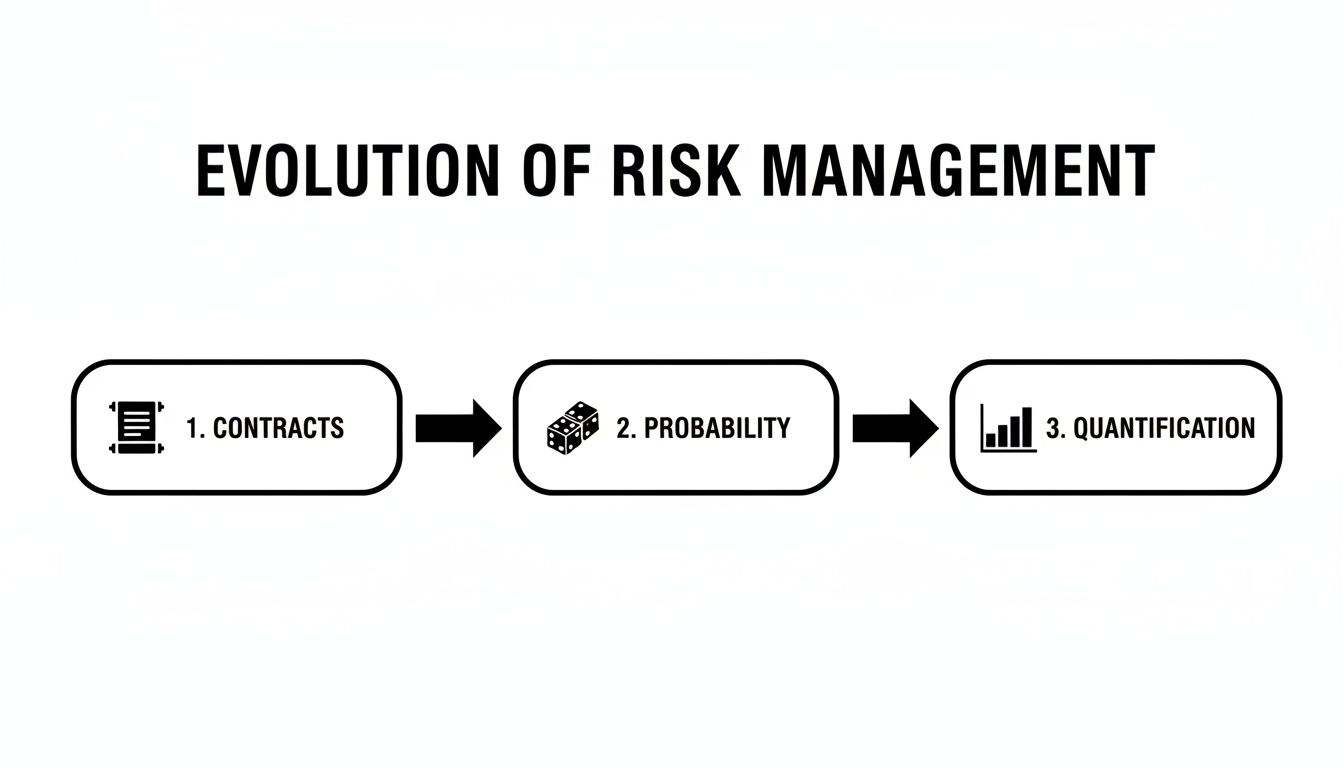
It’s a story of continuously striving to make risk more measurable, moving from basic contracts to probabilistic models and, finally, to the sophisticated quantification we rely on today.
The Power of the Law of Large Numbers
The law of large numbers is the statistical cornerstone of the modern insurance industry. It proves that as an insurer gathers a big enough pool of similar, unrelated risks, the actual losses they experience will get closer and closer to the predicted average. This allows them to smooth out the financial bumps and better match the premiums they collect with the claims they pay out.
By combining the calculated frequency and severity of potential losses across a vast portfolio, insurers can confidently set premiums that cover expected claims, operational costs, and profit margins.
Today, technology has supercharged this entire process. Insurers are increasingly using machine learning to comb through massive datasets, refining their frequency and severity predictions with a precision that was once unimaginable. You can see this in action in claims departments, where AI analyzes photos of vehicle damage to instantly estimate the repair cost (severity) or scans incident reports to spot fraud patterns (frequency).
The insights from these models are invaluable. You can read more about how data analytics in insurance is changing the game in our other guides.
This quantitative mindset even extends to customer service. AI customer care for financial services can analyze the topics of customer inquiries to flag emerging risks, like widespread confusion over a new policy term that could lead to a spike in future claims. By spotting and measuring these operational risks early, insurers can step in and fix problems before they get bigger.
Putting AI to Work in Claims and Customer Care
Theoretical risk models are great on paper, but they only show their true worth when you put them into practice on the front lines. This is where artificial intelligence stops being a buzzword and becomes a powerful tool, completely changing how insurers manage two of their most vital functions: claims processing and customer care.
By having AI handle key tasks in these areas, insurers can directly tackle operational risks, boost accuracy, and provide much faster service. This isn't just about making things more efficient; it's about fundamentally changing how operational risk is handled—moving from a reactive, after-the-fact calculation to something you can proactively manage and control.
Automating Insurance Claims with AI
The claims process is a hotbed of financial and operational risk. One small slip-up—a missed detail, a delayed response, or a fraudulent claim that gets through—can result in huge financial losses and erode customer trust. Automating insurance claims with AI is designed to plug these gaps.
Think about what happens the moment a First Notice of Loss (FNOL) comes in. Instead of it sitting in a queue waiting for a human, an AI agent gets to work instantly.
Data Ingestion and Verification: The AI immediately reads and understands information from any source, whether it’s an email, a web form, or a scanned PDF. It then cross-references those details with the customer's policy to confirm coverage, check for exclusions, and flag any inconsistencies for review.
Fraud Detection: AI algorithms are incredibly good at spotting red flags. They can analyze a new claim against millions of historical data points and known fraud patterns, identifying suspicious connections or behaviors that a human adjuster could easily overlook. This drastically reduces the risk of paying out on fraudulent claims.
Workflow Orchestration: Once the initial checks are done, the AI can automatically order necessary reports, schedule inspections, and assign the case to the right human adjuster—with all the preliminary work already done. This simple step can shrink processing times from days down to just a few minutes.
By standardizing the first steps of every claim, AI builds a consistent, auditable, and incredibly efficient workflow. This minimizes the chance of human error and guarantees that every claim is handled exactly according to company protocols.
Elevating Customer Care with AI for Financial Services
Customer service is another area where operational risks can quietly pile up. Inconsistent answers from different agents, long hold times, and unresolved problems can lead to frustrated customers, regulatory complaints, and a tarnished reputation. AI customer care for financial services is a powerful way to get these risks under control.
An AI agent can provide 24/7 support, handling a huge volume of common questions without any human help. This frees up your human agents to focus on the more complex, emotionally charged situations where they’re needed most. For instance, an AI agent can instantly answer questions about policy coverage, process a payment, or walk a customer through the first steps of filing a claim.
This approach delivers significant risk management benefits. First, it ensures every customer gets a consistent, accurate, and compliant answer drawn from approved scripts and knowledge bases. Second, it creates a perfect, auditable record of every single interaction, which is priceless for compliance checks and resolving disputes. The transparency this provides is a major factor in reducing legal and regulatory exposure.
improve efficiency with AI in insurance claims
By deploying AI in these key areas, modern insurers are doing more than just cutting costs. They are building tougher, data-driven operations that can better manage the risks inherent in the business. To go deeper on this, you can learn how to improve efficiency with AI in insurance claims in our detailed guide.
How AI Helps Mitigate Underwriting and Claims Risks
Artificial intelligence isn't just about making old processes faster; it's giving us powerful new tools to manage the very definition of risk in insurance. In both underwriting and claims, AI is moving well beyond simple task automation. It’s becoming a central pillar of a modern risk governance framework, building a more controlled, consistent, and auditable operation from the ground up.

This shift isn't without precedent. Think back to the 1920s, which many consider the 'birth of underwriting' as a true profession. As business boomed, it became impossible for doctors and actuaries to personally vet every applicant. Insurers had to create new clerical roles to systematize how they assessed risk, turning what was once pure intuition into a formal discipline. You can find more about this professionalization of underwriting on Wiley.com. Today, AI is the next logical step in that evolution, bringing a level of precision and scale to risk management that was previously unimaginable.
Fortifying the Underwriting Process
In underwriting, AI insurance companies are using machine learning to sift through massive datasets, uncovering subtle risk patterns that even the most experienced human teams would likely miss. This immediately translates into more accurate pricing and a sharp reduction in the odds of taking on a bad risk.
Deeper Data Analysis: AI models can digest thousands of data points simultaneously—property records, climate projections, telematics data, you name it—to construct a granular, multi-faceted risk profile for every applicant.
Reduced Adverse Selection: When you price risk more accurately, you naturally avoid adverse selection, which is the classic problem of unintentionally attracting a disproportionate share of high-risk policyholders.
This data-first approach ensures that premiums are set in much closer alignment with the actual risk being covered, which is fundamental to the financial health of any insurance portfolio.
AI transforms underwriting from a static, point-in-time assessment into a dynamic, data-rich process. It equips underwriters with deeper insights, allowing them to make more informed decisions and mitigate potential losses before a policy is even issued.
Creating an Auditable Claims Workflow
When it comes to claims, AI's biggest contribution to risk mitigation is its ability to enforce consistency. Every single claim introduces a mix of operational, financial, and compliance risks. AI-driven systems ensure that every action adheres to approved standard operating procedures, which dramatically cuts down on human error and the chance of a regulatory misstep.
The result is a perfect, auditable trail for every decision made on a claim. From the moment data is first entered to the final payment authorization, the system logs each step. This gives risk and compliance teams a level of visibility and control they’ve never had before. As noted in many claims AI reviews, this auditability is a game-changer for simplifying internal reviews and satisfying regulatory demands.
automated underwriting systems
This kind of automation turns a traditionally manual, and sometimes inconsistent, process into a tightly governed workflow. To see how this applies elsewhere, you can learn more about how automated underwriting systems are raising the bar for risk control. By embedding rules and compliance checks directly into the workflow, AI stops being just an efficiency tool and becomes an essential part of modern risk management.
Common Questions on Risk and AI in Insurance
As technology reshapes the insurance landscape, leaders across operations, IT, and compliance often ask how artificial intelligence fits in with the fundamental concept of risk. Here are some straightforward answers to the most common questions we hear.
What’s the Real Difference Between Pure Risk and Speculative Risk?
Think of it this way: pure risk is a one-way street to potential loss. There's a chance something bad happens (a house fire, a car accident), or a chance nothing happens. There is absolutely no opportunity for gain. This is the bedrock of insurance—it’s the only type of risk that can be insured.
Speculative risk, on the other hand, is a two-way street. You could win, or you could lose. Investing in stocks or launching a new product line are classic examples. Because there's a chance for profit, insurers stay away. Underwriting speculative risk would be more like gambling than indemnifying a policyholder against an unfortunate event. Advanced analytics and AI help carriers make certain they are only taking on pure risks.
How Can AI Customer Care Actually Reduce Operational Risk?
AI customer care systems are a powerful defense against operational risk for a few key reasons. First, they provide consistent and accurate information, slashing the human errors that can easily snowball into customer disputes, costly rework, or even regulatory penalties.
They also tackle a major business continuity risk by managing massive volumes of inquiries 24/7 without a hitch, preventing service bottlenecks during claim surges or catastrophes. But maybe the most crucial benefit is the creation of a complete, auditable log of every interaction. This gives compliance teams a transparent record to prove they're meeting service agreements and consumer protection rules, ultimately strengthening the company's overall risk posture.
An AI-powered customer care platform turns a high-volume, risk-prone function into a well-documented, compliant, and efficient operation. It makes every customer touchpoint a controlled, auditable event that protects the business.
What's the Single Biggest Hurdle When Automating Insurance Claims with AI?
If you look at industry reports and claims AI reviews, one challenge stands out above all others: integration. Many early AI tools were standalone "point solutions" that didn't play well with the legacy systems where all the critical data lives. This created data silos and clunky, disconnected workflows that frustrated everyone.
Thankfully, modern AI platforms are built differently. They come equipped with pre-built connectors and flexible APIs designed to plug directly into existing systems of record. This allows the AI to read and write data, coordinate tasks across multiple applications, and give human adjusters a single, unified view of the claim, ensuring the technology actually helps instead of hinders.
Will AI Ever Completely Replace Human Experts in Complex Decisions?
No, and that’s not the goal. The real power of enterprise AI in insurance is in augmenting human expertise, not replacing it. AI is brilliant at handling the high-volume, repetitive tasks that bog people down—things like checking policy details, verifying information against documents, and running thousands of rules-based checks in seconds.
By automating insurance claims with AI, the system frees up experienced underwriters and claims adjusters to dedicate their time to what people do best: managing complex, gray-area cases that demand critical thinking, empathy, and negotiation. The best platforms are designed for this kind of human-in-the-loop collaboration, automatically escalating exceptions to the right person with all the necessary context. It’s about creating a partnership where technology and human judgment work together to manage risk far more effectively.
Nolana is an AI-native operating system built to automate high‑stakes financial services operations across banking and insurance. By deploying compliant AI agents trained on your unique SOPs, Nolana connects to your existing core systems to automate tasks end‑to‑end within claims, case management, and customer service workflows. Learn more about how to build more resilient and efficient operations.
At its most basic level, risk in insurance is simply the measurable possibility of a financial loss. An insurer takes on that possibility, or "risk," from you in exchange for a premium payment.
The whole point isn't to get rid of uncertainty altogether—that’s impossible. Instead, insurance is a mechanism for transferring the financial consequences of that uncertainty from one person to a much larger group, where the outcomes become far more predictable. Grasping this transfer is the first step to understanding how policies are priced and why claims are paid.
What Makes a Risk Insurable
Insurance companies can't just cover any and every bad thing that might happen. For a risk to be insurable, it has to fit a specific profile. These criteria are what allow an insurer to do the math, calculate the odds of a loss, and charge a fair premium. Without them, the entire model falls apart.
The secret sauce is predictability across a large group, even when an individual event is completely random. Think about it: an insurer has no idea if your specific house will catch fire this year. But, thanks to the law of large numbers, they can predict with incredible accuracy how many houses out of 100,000 will. This statistical principle is the absolute bedrock of the industry.
The Essential Criteria for Insurable Risk
For an insurance policy to cover a potential loss, the risk generally has to tick a few critical boxes. It must be:
Accidental and Unintentional: The event causing the loss needs to be a genuine accident—unforeseen and out of the policyholder's control. You can’t intentionally crash your car and expect a payout. That’s fraud, and it’s a classic example of moral hazard, which policies are designed to prevent.
Definite and Measurable: An insurer has to know for sure that a loss happened and be able to put a clear dollar amount on it. A general feeling of "sadness" isn't insurable, but a $50,000 medical bill from a specific car accident certainly is.
Not Catastrophic: The risk can’t be something so massive that it causes devastating losses to a huge number of policyholders all at once. This is why standard policies exclude things like war or widespread nuclear fallout—no single company could possibly afford to pay all those claims.
An insurable risk is a calculated bet on uncertainty, where an insurer pools premiums from many to pay for the unpredictable losses of a few. It’s a system built on shared responsibility and statistical probability.
This table neatly summarizes the characteristics that make a risk a good fit for insurance.
Key Characteristics of an Insurable Risk
Characteristic | Description | Example |
|---|---|---|
Accidental | The loss must be unforeseen and outside the policyholder's control. | A tree falling on a house during a storm. |
Measurable | The financial impact of the loss can be clearly defined and calculated. | Repair costs of $15,000 for a vehicle after a collision. |
Predictable | The frequency and severity of the loss can be estimated for a large group. | Actuaries predicting the number of auto claims per 10,000 drivers. |
Non-Catastrophic | The risk should not affect a massive number of policyholders at once. | A single-family house fire, as opposed to a widespread earthquake. |
Large Number of Similar Risks | The insurer needs a large pool of similar risks to accurately predict losses. | Insuring thousands of similar homes in a region, not just one unique property. |
Affordable Premium | The cost to insure the risk must be financially feasible for the policyholder. | A reasonable monthly premium for auto insurance. |
Each of these criteria ensures the insurance system remains stable and functional, allowing carriers to confidently cover the unexpected.
This foundational framework is now getting a major upgrade with technology. Modern AI insurance companies are moving beyond old-school risk tables, using live data to make these principles even more precise. For example, AI can instantly cross-reference data when automating insurance claims to help verify that a loss was truly accidental, or it can analyze images to get a much more accurate measurement of the damage.
comprehensive insurance risk management
As we'll explore, things like AI customer care and intelligent automation are making the entire process of managing risk more efficient than ever. To see the bigger picture, you can learn more about comprehensive insurance risk management in our detailed guide.
Tracing the Evolution of Risk Management
The modern concept of insurance risk wasn't born in a sterile boardroom. It was forged on the high seas, where merchants faced the very real and constant threat of losing everything to storms, pirates, and simple misfortune. This journey from gut feeling to data-driven analysis has shaped the industry for centuries.
The earliest glimmers of formal insurance appeared in ancient Greece and Rome with maritime commerce. Merchants created "bottomry contracts," which were essentially loans. If the ship and its cargo were lost at sea, the debt was simply forgiven. The high interest charged on these loans was, in effect, the very first insurance premium, compensating the lender for taking on the risk. You can read more about these ancient insurance practices on Britannica.
This fundamental idea—pooling resources to soften the blow of a potential loss—laid the groundwork for everything that came after.
The Shift from Intuition to Mathematics
For hundreds of years, risk was managed almost entirely by experience and instinct. Underwriters at emerging insurance hubs like Lloyd's of London would evaluate a ship's voyage based on the captain's reputation, the time of year, and the planned route. It was a qualitative process, more art than science.
The real game-changer arrived in the late 17th century with the advent of probability theory. Mathematicians like Blaise Pascal and Pierre de Fermat started building the mathematical frameworks needed to actually quantify uncertainty.
This new thinking had a profound impact. In 1693, astronomer Edmund Halley created the first-ever survival table by analyzing birth and death records. For the first time, human mortality could be measured, providing the actuarial foundation for life insurance. This was a massive leap forward, moving the industry from guessing about risk to measuring it with data.
Modern Risk Management and the AI Revolution
This historical line, from ancient sea contracts to statistical tables, reveals a constant drive for more precision in understanding risk. Today, we're in the middle of the next great leap in this evolution, powered by artificial intelligence.
Just as probability theory enabled early insurers to move beyond pure intuition, AI insurance companies now use sophisticated algorithms to analyze datasets of a scale and complexity that were once unimaginable. This gives them a much more detailed and dynamic picture of risk.
Modern AI customer care systems are a direct product of this long legacy. They help manage the operational risks tied to customer interactions, making sure every inquiry is handled correctly and consistently. This minimizes the chance of errors, disputes, and compliance breaches.
The history of risk management is a story of steadily replacing ambiguity with data. From ancient maritime contracts to AI-driven claims processing, the goal has always been the same: to make the unpredictable more predictable.
This long evolution is what makes today’s automated systems possible. When automating insurance claims with AI, for instance, the system can instantly verify policy details and cross-reference damage reports with historical data—a process that used to take days of manual work. A quick look at claims AI reviews shows this technology isn't just about speed; it's the next logical step in a centuries-long quest to master uncertainty.
insurance industry case studies
To see how these principles work in the real world, check out these insurance industry case studies that showcase modern risk management solutions in action.
How Insurers Actually Measure and Price Risk
Insurers have the difficult job of putting a price on uncertainty. They take the abstract concept of risk and turn it into a concrete financial model, and the magic ingredient that makes this possible is a statistical principle called the law of large numbers.
The idea is simple but powerful. While it's impossible to know if one specific house will burn down, by insuring thousands of similar houses, an insurer can predict with incredible accuracy how many total fire claims they'll see in a year. This ability to forecast collective losses across a large, independent pool of risks is the bedrock of the entire insurance business.
To get these predictions right, actuaries zoom in on two critical components of any risk. These two factors are the fundamental building blocks they use to calculate the expected loss—a figure that directly shapes the premium every policyholder pays.
Frequency and Severity: The Two Sides of Risk
Think of any given risk as having two distinct, measurable dimensions:
Frequency: This is all about how often something bad happens. For example, actuaries dig into historical data to figure out how many car accident claims are likely to be filed per 10,000 drivers in a given year.
Severity: This measures how much a loss costs when it actually occurs. A minor fender-bender might have a low severity of $1,500, but a multi-car pileup on the highway would have an extremely high severity.
An insurer’s financial health hinges on getting the balance between these two right. A risk that happens all the time but doesn't cost much (like a cracked windshield) creates a completely different financial challenge than a risk that rarely happens but is catastrophic when it does (like a massive factory fire).
This journey from simple agreements to complex calculations has been a long one, as the graphic below shows.
It’s a story of continuously striving to make risk more measurable, moving from basic contracts to probabilistic models and, finally, to the sophisticated quantification we rely on today.
The Power of the Law of Large Numbers
The law of large numbers is the statistical cornerstone of the modern insurance industry. It proves that as an insurer gathers a big enough pool of similar, unrelated risks, the actual losses they experience will get closer and closer to the predicted average. This allows them to smooth out the financial bumps and better match the premiums they collect with the claims they pay out.
By combining the calculated frequency and severity of potential losses across a vast portfolio, insurers can confidently set premiums that cover expected claims, operational costs, and profit margins.
Today, technology has supercharged this entire process. Insurers are increasingly using machine learning to comb through massive datasets, refining their frequency and severity predictions with a precision that was once unimaginable. You can see this in action in claims departments, where AI analyzes photos of vehicle damage to instantly estimate the repair cost (severity) or scans incident reports to spot fraud patterns (frequency).
The insights from these models are invaluable. You can read more about how data analytics in insurance is changing the game in our other guides.
This quantitative mindset even extends to customer service. AI customer care for financial services can analyze the topics of customer inquiries to flag emerging risks, like widespread confusion over a new policy term that could lead to a spike in future claims. By spotting and measuring these operational risks early, insurers can step in and fix problems before they get bigger.
Putting AI to Work in Claims and Customer Care
Theoretical risk models are great on paper, but they only show their true worth when you put them into practice on the front lines. This is where artificial intelligence stops being a buzzword and becomes a powerful tool, completely changing how insurers manage two of their most vital functions: claims processing and customer care.
By having AI handle key tasks in these areas, insurers can directly tackle operational risks, boost accuracy, and provide much faster service. This isn't just about making things more efficient; it's about fundamentally changing how operational risk is handled—moving from a reactive, after-the-fact calculation to something you can proactively manage and control.
Automating Insurance Claims with AI
The claims process is a hotbed of financial and operational risk. One small slip-up—a missed detail, a delayed response, or a fraudulent claim that gets through—can result in huge financial losses and erode customer trust. Automating insurance claims with AI is designed to plug these gaps.
Think about what happens the moment a First Notice of Loss (FNOL) comes in. Instead of it sitting in a queue waiting for a human, an AI agent gets to work instantly.
Data Ingestion and Verification: The AI immediately reads and understands information from any source, whether it’s an email, a web form, or a scanned PDF. It then cross-references those details with the customer's policy to confirm coverage, check for exclusions, and flag any inconsistencies for review.
Fraud Detection: AI algorithms are incredibly good at spotting red flags. They can analyze a new claim against millions of historical data points and known fraud patterns, identifying suspicious connections or behaviors that a human adjuster could easily overlook. This drastically reduces the risk of paying out on fraudulent claims.
Workflow Orchestration: Once the initial checks are done, the AI can automatically order necessary reports, schedule inspections, and assign the case to the right human adjuster—with all the preliminary work already done. This simple step can shrink processing times from days down to just a few minutes.
By standardizing the first steps of every claim, AI builds a consistent, auditable, and incredibly efficient workflow. This minimizes the chance of human error and guarantees that every claim is handled exactly according to company protocols.
Elevating Customer Care with AI for Financial Services
Customer service is another area where operational risks can quietly pile up. Inconsistent answers from different agents, long hold times, and unresolved problems can lead to frustrated customers, regulatory complaints, and a tarnished reputation. AI customer care for financial services is a powerful way to get these risks under control.
An AI agent can provide 24/7 support, handling a huge volume of common questions without any human help. This frees up your human agents to focus on the more complex, emotionally charged situations where they’re needed most. For instance, an AI agent can instantly answer questions about policy coverage, process a payment, or walk a customer through the first steps of filing a claim.
This approach delivers significant risk management benefits. First, it ensures every customer gets a consistent, accurate, and compliant answer drawn from approved scripts and knowledge bases. Second, it creates a perfect, auditable record of every single interaction, which is priceless for compliance checks and resolving disputes. The transparency this provides is a major factor in reducing legal and regulatory exposure.
improve efficiency with AI in insurance claims
By deploying AI in these key areas, modern insurers are doing more than just cutting costs. They are building tougher, data-driven operations that can better manage the risks inherent in the business. To go deeper on this, you can learn how to improve efficiency with AI in insurance claims in our detailed guide.
How AI Helps Mitigate Underwriting and Claims Risks
Artificial intelligence isn't just about making old processes faster; it's giving us powerful new tools to manage the very definition of risk in insurance. In both underwriting and claims, AI is moving well beyond simple task automation. It’s becoming a central pillar of a modern risk governance framework, building a more controlled, consistent, and auditable operation from the ground up.
This shift isn't without precedent. Think back to the 1920s, which many consider the 'birth of underwriting' as a true profession. As business boomed, it became impossible for doctors and actuaries to personally vet every applicant. Insurers had to create new clerical roles to systematize how they assessed risk, turning what was once pure intuition into a formal discipline. You can find more about this professionalization of underwriting on Wiley.com. Today, AI is the next logical step in that evolution, bringing a level of precision and scale to risk management that was previously unimaginable.
Fortifying the Underwriting Process
In underwriting, AI insurance companies are using machine learning to sift through massive datasets, uncovering subtle risk patterns that even the most experienced human teams would likely miss. This immediately translates into more accurate pricing and a sharp reduction in the odds of taking on a bad risk.
Deeper Data Analysis: AI models can digest thousands of data points simultaneously—property records, climate projections, telematics data, you name it—to construct a granular, multi-faceted risk profile for every applicant.
Reduced Adverse Selection: When you price risk more accurately, you naturally avoid adverse selection, which is the classic problem of unintentionally attracting a disproportionate share of high-risk policyholders.
This data-first approach ensures that premiums are set in much closer alignment with the actual risk being covered, which is fundamental to the financial health of any insurance portfolio.
AI transforms underwriting from a static, point-in-time assessment into a dynamic, data-rich process. It equips underwriters with deeper insights, allowing them to make more informed decisions and mitigate potential losses before a policy is even issued.
Creating an Auditable Claims Workflow
When it comes to claims, AI's biggest contribution to risk mitigation is its ability to enforce consistency. Every single claim introduces a mix of operational, financial, and compliance risks. AI-driven systems ensure that every action adheres to approved standard operating procedures, which dramatically cuts down on human error and the chance of a regulatory misstep.
The result is a perfect, auditable trail for every decision made on a claim. From the moment data is first entered to the final payment authorization, the system logs each step. This gives risk and compliance teams a level of visibility and control they’ve never had before. As noted in many claims AI reviews, this auditability is a game-changer for simplifying internal reviews and satisfying regulatory demands.
automated underwriting systems
This kind of automation turns a traditionally manual, and sometimes inconsistent, process into a tightly governed workflow. To see how this applies elsewhere, you can learn more about how automated underwriting systems are raising the bar for risk control. By embedding rules and compliance checks directly into the workflow, AI stops being just an efficiency tool and becomes an essential part of modern risk management.
Common Questions on Risk and AI in Insurance
As technology reshapes the insurance landscape, leaders across operations, IT, and compliance often ask how artificial intelligence fits in with the fundamental concept of risk. Here are some straightforward answers to the most common questions we hear.
What’s the Real Difference Between Pure Risk and Speculative Risk?
Think of it this way: pure risk is a one-way street to potential loss. There's a chance something bad happens (a house fire, a car accident), or a chance nothing happens. There is absolutely no opportunity for gain. This is the bedrock of insurance—it’s the only type of risk that can be insured.
Speculative risk, on the other hand, is a two-way street. You could win, or you could lose. Investing in stocks or launching a new product line are classic examples. Because there's a chance for profit, insurers stay away. Underwriting speculative risk would be more like gambling than indemnifying a policyholder against an unfortunate event. Advanced analytics and AI help carriers make certain they are only taking on pure risks.
How Can AI Customer Care Actually Reduce Operational Risk?
AI customer care systems are a powerful defense against operational risk for a few key reasons. First, they provide consistent and accurate information, slashing the human errors that can easily snowball into customer disputes, costly rework, or even regulatory penalties.
They also tackle a major business continuity risk by managing massive volumes of inquiries 24/7 without a hitch, preventing service bottlenecks during claim surges or catastrophes. But maybe the most crucial benefit is the creation of a complete, auditable log of every interaction. This gives compliance teams a transparent record to prove they're meeting service agreements and consumer protection rules, ultimately strengthening the company's overall risk posture.
An AI-powered customer care platform turns a high-volume, risk-prone function into a well-documented, compliant, and efficient operation. It makes every customer touchpoint a controlled, auditable event that protects the business.
What's the Single Biggest Hurdle When Automating Insurance Claims with AI?
If you look at industry reports and claims AI reviews, one challenge stands out above all others: integration. Many early AI tools were standalone "point solutions" that didn't play well with the legacy systems where all the critical data lives. This created data silos and clunky, disconnected workflows that frustrated everyone.
Thankfully, modern AI platforms are built differently. They come equipped with pre-built connectors and flexible APIs designed to plug directly into existing systems of record. This allows the AI to read and write data, coordinate tasks across multiple applications, and give human adjusters a single, unified view of the claim, ensuring the technology actually helps instead of hinders.
Will AI Ever Completely Replace Human Experts in Complex Decisions?
No, and that’s not the goal. The real power of enterprise AI in insurance is in augmenting human expertise, not replacing it. AI is brilliant at handling the high-volume, repetitive tasks that bog people down—things like checking policy details, verifying information against documents, and running thousands of rules-based checks in seconds.
By automating insurance claims with AI, the system frees up experienced underwriters and claims adjusters to dedicate their time to what people do best: managing complex, gray-area cases that demand critical thinking, empathy, and negotiation. The best platforms are designed for this kind of human-in-the-loop collaboration, automatically escalating exceptions to the right person with all the necessary context. It’s about creating a partnership where technology and human judgment work together to manage risk far more effectively.
Nolana is an AI-native operating system built to automate high‑stakes financial services operations across banking and insurance. By deploying compliant AI agents trained on your unique SOPs, Nolana connects to your existing core systems to automate tasks end‑to‑end within claims, case management, and customer service workflows. Learn more about how to build more resilient and efficient operations.


All systems operational
1 Lime Street, London EC3M 7HA | 222E 3rd Street, New York 10009
Copyright © 2026, Nolana. All rights reserved
All systems operational
1 Lime Street, London EC3M 7HA | 222E 3rd Street, New York 10009
Copyright © 2026, Nolana. All rights reserved
All systems operational
1 Lime Street, London EC3M 7HA | 222E 3rd Street, New York 10009
Copyright © 2026, Nolana. All rights reserved
All systems operational
1 Lime Street, London EC3M 7HA | 222E 3rd Street, New York 10009
Copyright © 2026, Nolana. All rights reserved