Automating Insurance Claims Processing with AI for Enhanced Customer Care
Automating Insurance Claims Processing with AI for Enhanced Customer Care
Explore how automating insurance claims processing with AI boosts efficiency, reduces errors, and improves customer satisfaction.
Traditional claims processing is a tough business, often bogged down by manual data entry, endless administrative tasks, and the unavoidable risk of human error. It's a huge operational expense. Shifting to AI-powered claims processing tackles these headaches head-on, creating workflows that are not just faster and more accurate, but also significantly more cost-effective. For AI insurance companies today, this isn't just an upgrade; it's a must-have to stay competitive and deliver superior AI customer care.
The High Cost of Outdated Claims Processing
Most carriers see the claims department as a cost center—it's where the money flows out. While that's technically true, it misses the bigger picture. The claims experience is the single most important interaction you'll have with a customer. A slow, confusing process can destroy years of loyalty in a flash. On the other hand, a quick, transparent resolution driven by smart AI can create a customer for life.
The hidden costs of clinging to old, manual systems go way beyond the operational budget. They hit customer retention, damage your brand's reputation, and ultimately eat into long-term profitability.
Manual workflows are brittle. Adjusters are constantly switching between spreadsheets, emails, and disconnected systems just to piece together the information they need. This constant context-switching creates friction and opens the door to risk at every turn.
Where Manual Processes Break Down
The problems with old-school claims handling aren't just minor irritations; they create a domino effect of issues. Every time a human has to touch a file, it's a chance for delay or a mistake, from the first notice of loss all the way to the final payout. This administrative drag doesn't just hold up payments—it actively degrades the policyholder's experience and hurts AI customer care initiatives.
Think about a standard auto claim. The customer sends in photos, a police report, and their contact info. In a manual world, an adjuster has to:
Key in all that data by hand into the core system.
Dig through policy documents to confirm coverage.
Send emails back and forth to chase down missing details.
Line up an assessment and then wait for the report to come back.
Each one of these steps can add days, sometimes even weeks, to the cycle time. For a customer who's just been through a stressful event, these delays feel like you don't care. This is a prime example of where automation can step in to handle routine communications and provide instant updates, taking the pressure off everyone. You can learn more about the complete journey in our guide to insurance claims processing automation.
The Financial Impact of Inefficiency
The dollar-and-cents impact of these delays is massive. A 2022 survey from the American Hospital Association, for instance, found that healthcare providers were sitting on $6.4 billion in claims that were over six months old and unpaid. That figure is a stark reminder of how administrative bottlenecks translate directly into serious financial strain for financial services organizations.
To give you a clearer picture, let's compare the two approaches side-by-side.
Manual Vs Automated Claims Processing At A Glance
The difference between a traditional, manual workflow and one driven by AI is night and day. The following table breaks down how key performance indicators stack up in each environment.
Metric | Manual Processing | AI-Automated Processing |
|---|---|---|
Cycle Time | Days to weeks | Minutes to hours |
Adjuster Touchpoints | High (5-10+ per claim) | Low (1-2, for exceptions) |
Data Entry Errors | 5-10% average | <1% |
Processing Cost | High | Low (up to 70% reduction) |
Fraud Detection | Manual review, inconsistent | Proactive, pattern-based |
Customer Satisfaction | Low to moderate | High |
As you can see, the improvements aren't just incremental. Automation fundamentally changes the efficiency, accuracy, and cost-effectiveness of the entire claims function.
For forward-thinking insurance carriers, the business case is a no-brainer. Trimming claims processing costs by just a few percentage points can add millions to the bottom line every single year. Automation gets you there by cutting down on manual work, reducing payment errors, and catching fraud far more effectively.
From Cost Center to Competitive Advantage
Ultimately, automating is about changing how you think about the claims department. With AI, carriers can turn this function from a reactive cost center into a powerful engine for customer loyalty and operational excellence.
When your best people are freed from mind-numbing administrative work, they can focus on what they were hired to do: manage complex cases, communicate with empathy, and make the tough judgment calls. This shift doesn't just make you more efficient—it elevates the role of your human experts and builds a more resilient, responsive organization that’s ready for anything.
Building Your AI Automation Roadmap
Shifting from time-tested manual workflows to automating insurance claims processing with AI isn’t something you do overnight. It demands a practical, deliberate plan. A successful rollout is less about flipping a switch and more about building a thoughtful roadmap that connects technology directly to your business goals. It all starts with an honest look at your current operations to find where AI can make the biggest, fastest difference.
The first move is always to take a hard look at your existing claims process. I've seen many carriers start by mapping every single touchpoint, from the first notice of loss all the way to the final payout. This exercise almost always uncovers hidden bottlenecks and the kind of repetitive, low-value tasks that are perfect candidates for automation. You're hunting for the points of greatest friction—the administrative black holes where claims get stuck and your adjusters burn valuable time.
This is what that all-too-familiar manual process looks like. It's slow, riddled with potential errors, and incredibly expensive to maintain.
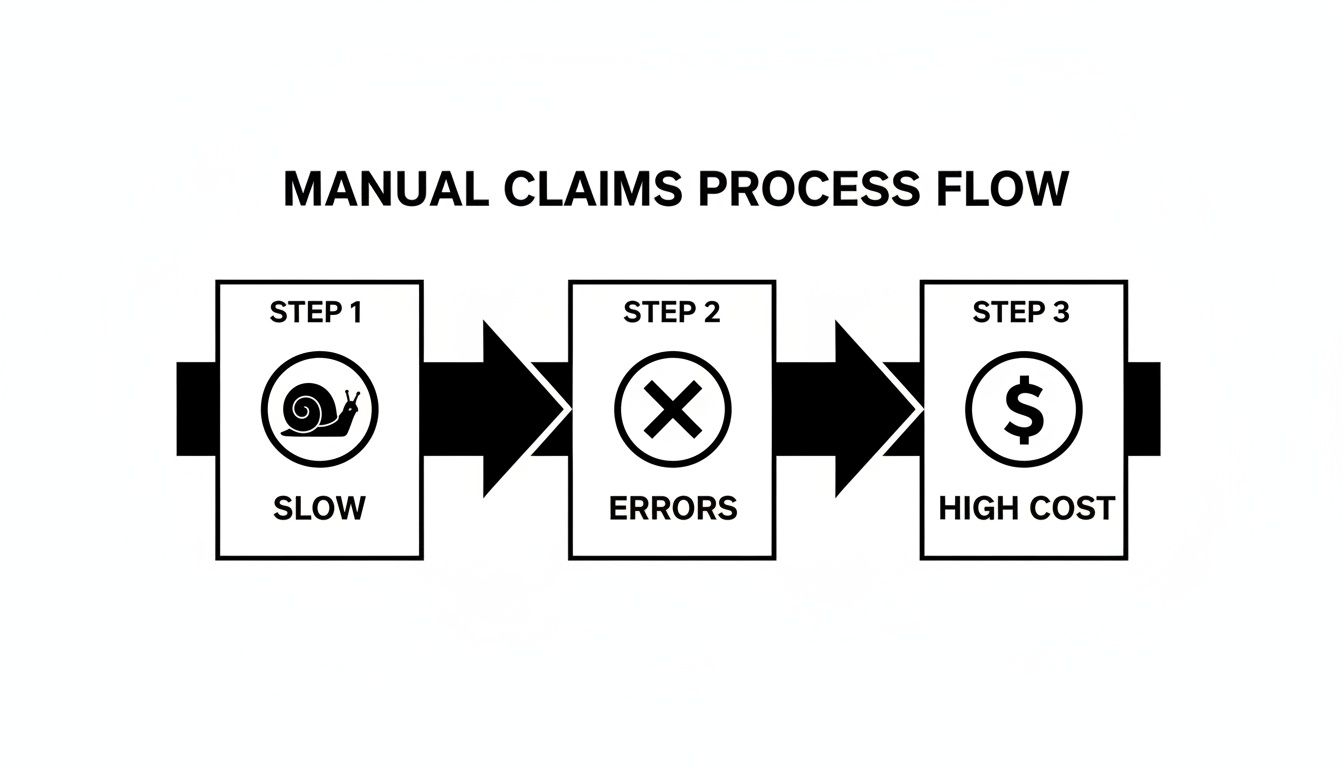
Each of these pain points is an opportunity for AI to inject speed, accuracy, and efficiency, completely changing the game.
Pinpointing Your Automation Starting Point
With a clear map of your current state, you can get tactical about where to begin. The goal isn't to boil the ocean. You want to lock in a few "quick wins" to prove the value early on and build momentum for a wider rollout.
From my experience, these initial targets usually fall into a few key areas:
High-Volume, Low-Complexity Claims: Think simple auto glass claims or minor water damage to a basement. These follow predictable rules and are tailor-made for straight-through processing, where an AI agent can manage the entire claim without a human ever touching it.
Data Intake and Triage: This is a huge one. Automating the extraction and validation of information from forms, emails, and photos right at the start can shave days off the cycle time. It ensures adjusters get complete, accurate files from day one.
Customer Status Updates: You can deploy AI customer care using chatbots or automated notifications to give policyholders 24/7 access to information. This cuts down on inbound "where's my claim?" calls and dramatically improves their experience.
By starting small and staying focused, you can prove the concept, tweak your approach, and get the internal buy-in you'll need to scale.
Defining Clear Goals and Measurable KPIs
Without clear objectives, you're just running a technology experiment. You have to define what success looks like in concrete, measurable terms. These goals should tie directly back to the pain points you found during your process mapping.
A well-designed pilot program should answer a specific business question. For example, "Can we slash the cycle time for low-value auto claims by 50% in the next 90 days?" That gives you a clear target and makes it simple to measure the ROI.
Your Key Performance Indicators (KPIs) will likely include:
Reduction in Claims Cycle Time: The average clock from FNOL to settlement.
Decrease in Cost-Per-Claim: Factoring in reduced labor and administrative costs.
Increase in Straight-Through Processing (STP) Rate: The percentage of claims handled with zero human touches.
Improvement in Customer Satisfaction (CSAT) Scores: A direct pulse on the policyholder experience.
Reduction in Error Rates: Tracking data entry mistakes and payment inaccuracies.
These are the metrics that build a solid business case and will be closely watched by internal stakeholders. To get a better handle on the underlying mechanics, you can learn more about the role of AI in insurance claims and how it drives operational gains.
Launching a Pilot Program to Prove Value
A pilot program is where the rubber meets the road. It lets you deploy the AI in a controlled environment, see how it performs against your KPIs, and get real-world feedback from your claims team. This isn't just a technical test; it's a critical piece of change management.
For instance, a mid-sized carrier might pick a single line of business—say, personal auto—and a specific claim type, like windshield replacements, for their pilot. They'd train the AI agent on their exact procedures and run it in parallel with their human team for a month or two, comparing the results side-by-side.
This approach takes the risk out of the investment and shows real, tangible benefits to everyone from frontline adjusters to the C-suite. A successful pilot gives you the data, the confidence, and the internal champions you need to turn your automation roadmap into reality.
Integrating AI With Core Insurance Systems
An AI agent is a powerful tool, but it's only as good as the systems it can talk to and the data it can access. For AI insurance companies, the real magic happens when you weave automation deep into your existing technology fabric. This isn't about creating a side project; it's about fundamentally upgrading your entire claims operation.
The goal here isn't to rip out and replace your trusted core systems. Far from it. The smart play is to build a seamless bridge between your AI platform and essential infrastructure, whether that's Guidewire, Duck Creek, Sapiens, or even your CRM like Salesforce. Think of the AI as an intelligent orchestration layer sitting on top of everything, fluidly moving tasks and information from one system to the next.

This kind of connectivity is what allows an AI agent to pull policy details from one system, cross-reference them with a damage report in another, and push a payment authorization to a third—all in a matter of seconds, with no one lifting a finger.
Connecting AI to Your Systems of Record
Technically, this all comes down to API (Application Programming Interface) connectivity. Modern AI platforms are built to communicate with other software through these digital handshakes. It's how an AI agent can read a new claim filed in your portal, instantly validate the policyholder's coverage in Guidewire, and spin up a case file in ServiceNow all at once.
But let's be realistic—many carriers still rely on legacy systems that weren't built with modern, RESTful APIs in mind. When you hit this wall, you just need a more creative approach.
API Wrappers: For older systems, your developers can build an "API wrapper." It’s essentially a modern translator that takes a request from the AI and converts it into a format the legacy system can actually understand.
Robotic Process Automation (RPA): Where APIs just aren't an option, RPA can act as a bridge. These bots can be trained to mimic human actions, like logging into a green-screen terminal, copying data from one field, and pasting it into another.
No matter the method, the critical piece is ensuring real-time, two-way data sync. When an AI agent updates a claim's status, that change must reflect immediately in the core system of record, and vice versa. This eliminates the data silos and conflicting information that bog down manual workflows, creating a single, reliable source of truth.
Successful integration isn't just a technical challenge; it's about creating a unified operational environment. The AI needs the right permissions to access and update records—just like a human adjuster, but with the speed and scale only software can provide.
Orchestrating Data for Smarter Decisions
Once everything is connected, your AI agent transforms into a master data aggregator. It can pull unstructured text from a customer email, structured policy info from your core admin system, and even external data from a weather service or public records database. This 360-degree view is what unlocks truly intelligent automation.
Think about a typical property claim:
The AI agent ingests the First Notice of Loss (FNOL) from an email.
Using Natural Language Processing (NLP), it extracts the policy number, date of loss, and other key details.
It then queries Guidewire via an API to confirm the policy is active and check the coverage limits.
Next, it hits an external weather data service to verify a reported hailstorm actually occurred at the insured's location on that specific date.
With everything validated, it can instantly approve a low-value claim for straight-through processing or flag it for human review, attaching a complete, consolidated file for the adjuster.
This ability to fuse data from different sources is what separates AI from simple task-bots. It empowers the system to make context-aware decisions that mirror, and often improve upon, the initial triage done by a human. The architecture behind these platforms can get complex, so understanding how different claims management systems are designed will give you a real head start in your integration strategy.
Augmenting Workflows Without a Complete Overhaul
Perhaps the biggest advantage of this model is that it enhances your current tech stack without forcing a massive, disruptive replacement project. The AI works with your existing systems, making them smarter and more efficient. This approach dramatically reduces business disruption and allows you to roll out the changes in phases, delivering value almost immediately.
This has a direct impact on AI customer care, too. When a policyholder calls, the AI can instantly pull their complete claims history and provide a precise, up-to-the-minute status update. This seamless access to information is what turns a frustrating customer experience into an effortless one—a key differentiator often mentioned in claims AI reviews. The end result is a more agile and responsive claims operation, built right on the foundation you already have.
Keeping Control in a World of Automation
Bringing automation into claims processing is all about speed, but that can't ever come at the cost of control. In an industry as regulated as insurance, every automated touchpoint has to be completely transparent, auditable, and compliant. For your risk and audit teams, the idea of an AI making autonomous decisions can feel like a black box—and that's a non-starter.
But a well-built automation system isn't a black box at all. In fact, it offers more visibility and tighter control than any manual process ever could.
The trick is to build intelligent guardrails directly into your automated workflows. This isn’t about setting an AI loose. It's about giving it a precise, unchangeable playbook to follow. Every decision the AI agent makes is based on the Standard Operating Procedures (SOPs) you've already established, locking in consistency for every single claim.
The Power of an Unbreakable Audit Trail
One of the biggest wins with a dedicated AI platform is the automatic creation of a complete, unchangeable log of every single action. Think of it as the flight data recorder for your entire claims journey. For a compliance officer, it's everything they could ask for.
From the moment a claim hits your system, this trail documents it all:
Where and when: It logs the data source (email, portal, API) and the exact arrival time.
The AI's logic: It records which rule was triggered, the specific data that informed the decision, and a precise timestamp.
System handshakes: Every query to Guidewire, every update in Salesforce, every call to an external data source is logged.
Human handoffs: It tracks exactly when and why a claim was escalated, and which adjuster took over.
You’d be hard-pressed to capture this level of detail with any consistency in a manual environment. It provides an ironclad record for auditors, regulators, and internal reviews, proving that every step followed your established protocols. For sensitive information, this auditable framework must extend to all communications, which is why many carriers rely on tools like secure HIPAA compliant eFax services for transmitting protected documents.
An AI agent doesn't have a bad day. It never forgets a step or gets distracted. It simply executes the rules you give it, flawlessly, which dramatically cuts down on operational risk and makes audits far less painful.
Knowing When to Call in a Human
Automation isn’t here to replace your experts; it’s here to free them up for the work that matters. The smartest systems are designed to recognize their own limitations and escalate the tricky, high-risk, or ambiguous claims to a human at exactly the right moment.
This "human-in-the-loop" design isn't just a safety net—it's a core strategic element of your workflow. You decide what triggers an immediate handoff to a person.
Smart Escalation Triggers We See All the Time:
High-Dollar Claims: Any claim that pops up over a set amount, say $10,000, gets routed straight to a senior adjuster. No exceptions.
Red Flags for Fraud: If the AI’s model spots suspicious patterns, the claim is instantly quarantined for a human investigator to dig into.
Messy or Missing Data: When key information is garbled, unclear, or just not there, the AI agent flags it for an adjuster to sort out.
Customer Tone: By analyzing emails and messages, the system can detect frustration or anger and escalate the case to a specialist who can provide a human touch.
This hybrid model gives you the best of both worlds. You get the incredible speed and efficiency of automation for the 80% of routine work, paired with the sharp, nuanced judgment of your experienced team for the complex 20%. Finding this balance is the cornerstone of effective https://nolana.com/articles/insurance-risk-management.
By building these clear escalation paths, you keep tight control over outcomes while reaping the massive benefits of automation. It’s how you build a claims operation that’s not just fast, but resilient and compliant from the ground up.
Measuring Success and Scaling Your AI Program

Launching your AI pilot for automating insurance claims processing is a huge milestone. But let's be honest—the real work begins now. To get the buy-in you need for a wider rollout, you have to prove its value with hard data. This is where you move past the "it feels faster" stage and into concrete, quantifiable metrics that catch the attention of leadership.
A solid measurement framework does more than just track results; it creates a feedback loop that helps you continuously get better. The analytics pouring out of your AI platform are gold. They'll show you exactly where bottlenecks still exist and how you can fine-tune your automated workflows. This is the difference between a one-off project and a genuine operational shift.
Key Metrics That Define Success
When you're gauging the pilot's performance, you need to zero in on the KPIs that matter most: efficiency, cost, and the customer experience. These are the numbers that will build your business case and show the tangible impact of your work.
Here are the metrics that leading AI insurance companies live and die by:
Claims Cycle Time: How long does it take from First Notice of Loss (FNOL) to final payment? A sharp drop here is your number one proof point for efficiency.
Cost-Per-Claim: This captures every dollar spent to process a single claim, from labor to overhead. Automation should send this number tumbling.
Straight-Through Processing (STP) Rate: What percentage of claims fly through the system without a single human touch? Getting a high STP rate for simple claims is a massive win.
Customer Satisfaction (CSAT) Scores: Are policyholders happier? Use surveys to see how automation is affecting their experience. Faster, clearer communication from your AI customer care should boost these scores significantly.
Tracking these metrics is non-negotiable. They are the hard evidence that proves your AI initiative isn't just a tech project—it's a fundamental improvement to the business.
From Pilot Program to Enterprise-Wide Scale
So, your pilot smashed its KPIs. Fantastic. Now, how do you take that success and scale it across the entire organization? This is about more than just flipping a switch; it requires a thoughtful strategy for change management, training, and governance. A great pilot creates momentum, but a smart scaling plan is what turns that initial victory into a long-term competitive edge.
The sheer volume of modern claims processing demands this kind of strategic thinking. Just look at the 2024 CAQH Index Report—it analyzed 3 billion medical claims and found a direct line between automating revenue cycle tasks and massive cost savings. By blending machine learning with automation, carriers can push simple claims through a straight-through process, freeing up experienced adjusters to handle the really tough cases. This hybrid model is quickly becoming the new standard for financial services.
A Strategic Framework for Scaling
A structured rollout prevents chaos and ensures you get consistent results as you expand automation to new business lines or regions.
Standardize and Document: Take everything you learned from the pilot and build a playbook. Document your optimized workflows, AI agent configurations, and best practices so every team can replicate your success.
Phased Rollout: Don't try to boil the ocean. Scale your program piece by piece, targeting the next line of business or claim type that offers the biggest bang for your buck.
Invest in Training: Your people need to be prepared for a new way of working. Adjusters will need to learn how to collaborate with AI agents, manage escalations, and use the new data and insights now at their fingertips.
Establish a Center of Excellence (CoE): Create a dedicated team to own the AI automation program. This group will handle governance, monitor performance across the board, and constantly hunt for the next big automation opportunity.
As you expand, keeping an eye on the broader market and the best AI search tracker tools can help you monitor performance and refine your approach. It’s also incredibly helpful to see how others have navigated this journey. Our own case study on https://nolana.com/case-studies/transforming-insurance-claims-with-agentic-ai provides a real-world look at what this transformation looks like in practice.
Frequently Asked Questions About AI in Claims Processing
When leaders start exploring claims automation, the same set of practical questions always comes up. It's only natural. You're thinking about how AI works in a heavily regulated industry, what it means for your customers, and what it really takes to get it up and running. These are the conversations we have every day with insurance executives, and here are the honest answers.
Most of the initial concerns boil down to one thing: the customer. How will this technology impact the policyholder experience, especially when they're going through something stressful? The truth is, it makes it dramatically better by delivering two things people crave most in that moment: speed and transparency.
How Does AI Improve Customer Care?
Think about the traditional claims journey. It's often slow, confusing, and leaves the policyholder in the dark. AI customer care flips that script completely. Instead of someone waiting days just to hear that their claim was received, an AI agent can provide instant confirmation and keep them updated 24/7 through a chatbot or self-service portal.
This constant, low-effort communication removes so much of the anxiety and friction from the process. It also has a huge internal benefit: it frees up your human adjusters. They're no longer bogged down by a constant stream of "what's the status of my claim?" calls. Instead, they can focus their expertise and empathy where it truly matters—on the complex cases that demand a human touch.
What Is the Biggest Challenge When Implementing Claims AI?
Surprisingly, the biggest hurdle is rarely the AI technology itself. The real challenge almost always lies in two areas: integrating with legacy core systems and managing the internal, human side of the change. Many AI insurance companies quickly discover their older platforms weren't built for the modern, API-driven world, which can make getting data to flow smoothly a significant undertaking.
A successful project hinges on a rock-solid integration plan to connect the AI platform with your core systems, whether it's Guidewire, Duck Creek, or something else. But the human element is just as critical. You have to train your claims handlers to work with AI agents, redefine their roles to focus on higher-value tasks, and build genuine trust in the automated decisions. Getting that buy-in is what ultimately leads to positive claims AI reviews and a project that delivers real value.
The goal isn't just to install new software. It's to create a truly unified operational environment where your people and your AI work as a single team. That means tackling both technical debt and cultural change from day one.
How Do You Ensure AI Decisions Are Fair and Compliant?
This is the big one, and for good reason—fairness and compliance are absolutely non-negotiable. We ensure this through a combination of transparent design, strict operational guardrails, and continuous, rigorous auditing. Modern AI agents aren't mysterious "black boxes." They are built and trained to execute your specific Standard Operating Procedures (SOPs) and business rules, period.
Every piece of decision logic is explicitly documented and is 100% auditable. The platform must keep an immutable, time-stamped log of every single action an AI agent takes, creating a perfect record for internal reviews or regulatory scrutiny.
On top of that, you need built-in controls:
Bias Monitoring: The system must be actively monitored to identify and prevent any unfair or biased outcomes.
Rule-Based Execution: The AI operates strictly within the business rules and logic you define. It doesn't get creative.
Smart Escalation: Any claim that falls outside the lines—whether it's ambiguous, high-value, or flags a potential fraud indicator—is automatically routed to a human expert for review.
This framework ensures the AI works as an extension of your team, operating within carefully defined, compliant boundaries to enhance human judgment, not replace it.
Nolana provides an AI-native operating system designed to automate high-stakes insurance operations with the precision and control you need. By deploying compliant AI agents trained on your specific procedures, we help you slash costs, accelerate claims cycles, and deliver the kind of customer experience that builds loyalty.
Discover how to transform your claims processing with Nolana
Traditional claims processing is a tough business, often bogged down by manual data entry, endless administrative tasks, and the unavoidable risk of human error. It's a huge operational expense. Shifting to AI-powered claims processing tackles these headaches head-on, creating workflows that are not just faster and more accurate, but also significantly more cost-effective. For AI insurance companies today, this isn't just an upgrade; it's a must-have to stay competitive and deliver superior AI customer care.
The High Cost of Outdated Claims Processing
Most carriers see the claims department as a cost center—it's where the money flows out. While that's technically true, it misses the bigger picture. The claims experience is the single most important interaction you'll have with a customer. A slow, confusing process can destroy years of loyalty in a flash. On the other hand, a quick, transparent resolution driven by smart AI can create a customer for life.
The hidden costs of clinging to old, manual systems go way beyond the operational budget. They hit customer retention, damage your brand's reputation, and ultimately eat into long-term profitability.
Manual workflows are brittle. Adjusters are constantly switching between spreadsheets, emails, and disconnected systems just to piece together the information they need. This constant context-switching creates friction and opens the door to risk at every turn.
Where Manual Processes Break Down
The problems with old-school claims handling aren't just minor irritations; they create a domino effect of issues. Every time a human has to touch a file, it's a chance for delay or a mistake, from the first notice of loss all the way to the final payout. This administrative drag doesn't just hold up payments—it actively degrades the policyholder's experience and hurts AI customer care initiatives.
Think about a standard auto claim. The customer sends in photos, a police report, and their contact info. In a manual world, an adjuster has to:
Key in all that data by hand into the core system.
Dig through policy documents to confirm coverage.
Send emails back and forth to chase down missing details.
Line up an assessment and then wait for the report to come back.
Each one of these steps can add days, sometimes even weeks, to the cycle time. For a customer who's just been through a stressful event, these delays feel like you don't care. This is a prime example of where automation can step in to handle routine communications and provide instant updates, taking the pressure off everyone. You can learn more about the complete journey in our guide to insurance claims processing automation.
The Financial Impact of Inefficiency
The dollar-and-cents impact of these delays is massive. A 2022 survey from the American Hospital Association, for instance, found that healthcare providers were sitting on $6.4 billion in claims that were over six months old and unpaid. That figure is a stark reminder of how administrative bottlenecks translate directly into serious financial strain for financial services organizations.
To give you a clearer picture, let's compare the two approaches side-by-side.
Manual Vs Automated Claims Processing At A Glance
The difference between a traditional, manual workflow and one driven by AI is night and day. The following table breaks down how key performance indicators stack up in each environment.
Metric | Manual Processing | AI-Automated Processing |
|---|---|---|
Cycle Time | Days to weeks | Minutes to hours |
Adjuster Touchpoints | High (5-10+ per claim) | Low (1-2, for exceptions) |
Data Entry Errors | 5-10% average | <1% |
Processing Cost | High | Low (up to 70% reduction) |
Fraud Detection | Manual review, inconsistent | Proactive, pattern-based |
Customer Satisfaction | Low to moderate | High |
As you can see, the improvements aren't just incremental. Automation fundamentally changes the efficiency, accuracy, and cost-effectiveness of the entire claims function.
For forward-thinking insurance carriers, the business case is a no-brainer. Trimming claims processing costs by just a few percentage points can add millions to the bottom line every single year. Automation gets you there by cutting down on manual work, reducing payment errors, and catching fraud far more effectively.
From Cost Center to Competitive Advantage
Ultimately, automating is about changing how you think about the claims department. With AI, carriers can turn this function from a reactive cost center into a powerful engine for customer loyalty and operational excellence.
When your best people are freed from mind-numbing administrative work, they can focus on what they were hired to do: manage complex cases, communicate with empathy, and make the tough judgment calls. This shift doesn't just make you more efficient—it elevates the role of your human experts and builds a more resilient, responsive organization that’s ready for anything.
Building Your AI Automation Roadmap
Shifting from time-tested manual workflows to automating insurance claims processing with AI isn’t something you do overnight. It demands a practical, deliberate plan. A successful rollout is less about flipping a switch and more about building a thoughtful roadmap that connects technology directly to your business goals. It all starts with an honest look at your current operations to find where AI can make the biggest, fastest difference.
The first move is always to take a hard look at your existing claims process. I've seen many carriers start by mapping every single touchpoint, from the first notice of loss all the way to the final payout. This exercise almost always uncovers hidden bottlenecks and the kind of repetitive, low-value tasks that are perfect candidates for automation. You're hunting for the points of greatest friction—the administrative black holes where claims get stuck and your adjusters burn valuable time.
This is what that all-too-familiar manual process looks like. It's slow, riddled with potential errors, and incredibly expensive to maintain.
Each of these pain points is an opportunity for AI to inject speed, accuracy, and efficiency, completely changing the game.
Pinpointing Your Automation Starting Point
With a clear map of your current state, you can get tactical about where to begin. The goal isn't to boil the ocean. You want to lock in a few "quick wins" to prove the value early on and build momentum for a wider rollout.
From my experience, these initial targets usually fall into a few key areas:
High-Volume, Low-Complexity Claims: Think simple auto glass claims or minor water damage to a basement. These follow predictable rules and are tailor-made for straight-through processing, where an AI agent can manage the entire claim without a human ever touching it.
Data Intake and Triage: This is a huge one. Automating the extraction and validation of information from forms, emails, and photos right at the start can shave days off the cycle time. It ensures adjusters get complete, accurate files from day one.
Customer Status Updates: You can deploy AI customer care using chatbots or automated notifications to give policyholders 24/7 access to information. This cuts down on inbound "where's my claim?" calls and dramatically improves their experience.
By starting small and staying focused, you can prove the concept, tweak your approach, and get the internal buy-in you'll need to scale.
Defining Clear Goals and Measurable KPIs
Without clear objectives, you're just running a technology experiment. You have to define what success looks like in concrete, measurable terms. These goals should tie directly back to the pain points you found during your process mapping.
A well-designed pilot program should answer a specific business question. For example, "Can we slash the cycle time for low-value auto claims by 50% in the next 90 days?" That gives you a clear target and makes it simple to measure the ROI.
Your Key Performance Indicators (KPIs) will likely include:
Reduction in Claims Cycle Time: The average clock from FNOL to settlement.
Decrease in Cost-Per-Claim: Factoring in reduced labor and administrative costs.
Increase in Straight-Through Processing (STP) Rate: The percentage of claims handled with zero human touches.
Improvement in Customer Satisfaction (CSAT) Scores: A direct pulse on the policyholder experience.
Reduction in Error Rates: Tracking data entry mistakes and payment inaccuracies.
These are the metrics that build a solid business case and will be closely watched by internal stakeholders. To get a better handle on the underlying mechanics, you can learn more about the role of AI in insurance claims and how it drives operational gains.
Launching a Pilot Program to Prove Value
A pilot program is where the rubber meets the road. It lets you deploy the AI in a controlled environment, see how it performs against your KPIs, and get real-world feedback from your claims team. This isn't just a technical test; it's a critical piece of change management.
For instance, a mid-sized carrier might pick a single line of business—say, personal auto—and a specific claim type, like windshield replacements, for their pilot. They'd train the AI agent on their exact procedures and run it in parallel with their human team for a month or two, comparing the results side-by-side.
This approach takes the risk out of the investment and shows real, tangible benefits to everyone from frontline adjusters to the C-suite. A successful pilot gives you the data, the confidence, and the internal champions you need to turn your automation roadmap into reality.
Integrating AI With Core Insurance Systems
An AI agent is a powerful tool, but it's only as good as the systems it can talk to and the data it can access. For AI insurance companies, the real magic happens when you weave automation deep into your existing technology fabric. This isn't about creating a side project; it's about fundamentally upgrading your entire claims operation.
The goal here isn't to rip out and replace your trusted core systems. Far from it. The smart play is to build a seamless bridge between your AI platform and essential infrastructure, whether that's Guidewire, Duck Creek, Sapiens, or even your CRM like Salesforce. Think of the AI as an intelligent orchestration layer sitting on top of everything, fluidly moving tasks and information from one system to the next.
This kind of connectivity is what allows an AI agent to pull policy details from one system, cross-reference them with a damage report in another, and push a payment authorization to a third—all in a matter of seconds, with no one lifting a finger.
Connecting AI to Your Systems of Record
Technically, this all comes down to API (Application Programming Interface) connectivity. Modern AI platforms are built to communicate with other software through these digital handshakes. It's how an AI agent can read a new claim filed in your portal, instantly validate the policyholder's coverage in Guidewire, and spin up a case file in ServiceNow all at once.
But let's be realistic—many carriers still rely on legacy systems that weren't built with modern, RESTful APIs in mind. When you hit this wall, you just need a more creative approach.
API Wrappers: For older systems, your developers can build an "API wrapper." It’s essentially a modern translator that takes a request from the AI and converts it into a format the legacy system can actually understand.
Robotic Process Automation (RPA): Where APIs just aren't an option, RPA can act as a bridge. These bots can be trained to mimic human actions, like logging into a green-screen terminal, copying data from one field, and pasting it into another.
No matter the method, the critical piece is ensuring real-time, two-way data sync. When an AI agent updates a claim's status, that change must reflect immediately in the core system of record, and vice versa. This eliminates the data silos and conflicting information that bog down manual workflows, creating a single, reliable source of truth.
Successful integration isn't just a technical challenge; it's about creating a unified operational environment. The AI needs the right permissions to access and update records—just like a human adjuster, but with the speed and scale only software can provide.
Orchestrating Data for Smarter Decisions
Once everything is connected, your AI agent transforms into a master data aggregator. It can pull unstructured text from a customer email, structured policy info from your core admin system, and even external data from a weather service or public records database. This 360-degree view is what unlocks truly intelligent automation.
Think about a typical property claim:
The AI agent ingests the First Notice of Loss (FNOL) from an email.
Using Natural Language Processing (NLP), it extracts the policy number, date of loss, and other key details.
It then queries Guidewire via an API to confirm the policy is active and check the coverage limits.
Next, it hits an external weather data service to verify a reported hailstorm actually occurred at the insured's location on that specific date.
With everything validated, it can instantly approve a low-value claim for straight-through processing or flag it for human review, attaching a complete, consolidated file for the adjuster.
This ability to fuse data from different sources is what separates AI from simple task-bots. It empowers the system to make context-aware decisions that mirror, and often improve upon, the initial triage done by a human. The architecture behind these platforms can get complex, so understanding how different claims management systems are designed will give you a real head start in your integration strategy.
Augmenting Workflows Without a Complete Overhaul
Perhaps the biggest advantage of this model is that it enhances your current tech stack without forcing a massive, disruptive replacement project. The AI works with your existing systems, making them smarter and more efficient. This approach dramatically reduces business disruption and allows you to roll out the changes in phases, delivering value almost immediately.
This has a direct impact on AI customer care, too. When a policyholder calls, the AI can instantly pull their complete claims history and provide a precise, up-to-the-minute status update. This seamless access to information is what turns a frustrating customer experience into an effortless one—a key differentiator often mentioned in claims AI reviews. The end result is a more agile and responsive claims operation, built right on the foundation you already have.
Keeping Control in a World of Automation
Bringing automation into claims processing is all about speed, but that can't ever come at the cost of control. In an industry as regulated as insurance, every automated touchpoint has to be completely transparent, auditable, and compliant. For your risk and audit teams, the idea of an AI making autonomous decisions can feel like a black box—and that's a non-starter.
But a well-built automation system isn't a black box at all. In fact, it offers more visibility and tighter control than any manual process ever could.
The trick is to build intelligent guardrails directly into your automated workflows. This isn’t about setting an AI loose. It's about giving it a precise, unchangeable playbook to follow. Every decision the AI agent makes is based on the Standard Operating Procedures (SOPs) you've already established, locking in consistency for every single claim.
The Power of an Unbreakable Audit Trail
One of the biggest wins with a dedicated AI platform is the automatic creation of a complete, unchangeable log of every single action. Think of it as the flight data recorder for your entire claims journey. For a compliance officer, it's everything they could ask for.
From the moment a claim hits your system, this trail documents it all:
Where and when: It logs the data source (email, portal, API) and the exact arrival time.
The AI's logic: It records which rule was triggered, the specific data that informed the decision, and a precise timestamp.
System handshakes: Every query to Guidewire, every update in Salesforce, every call to an external data source is logged.
Human handoffs: It tracks exactly when and why a claim was escalated, and which adjuster took over.
You’d be hard-pressed to capture this level of detail with any consistency in a manual environment. It provides an ironclad record for auditors, regulators, and internal reviews, proving that every step followed your established protocols. For sensitive information, this auditable framework must extend to all communications, which is why many carriers rely on tools like secure HIPAA compliant eFax services for transmitting protected documents.
An AI agent doesn't have a bad day. It never forgets a step or gets distracted. It simply executes the rules you give it, flawlessly, which dramatically cuts down on operational risk and makes audits far less painful.
Knowing When to Call in a Human
Automation isn’t here to replace your experts; it’s here to free them up for the work that matters. The smartest systems are designed to recognize their own limitations and escalate the tricky, high-risk, or ambiguous claims to a human at exactly the right moment.
This "human-in-the-loop" design isn't just a safety net—it's a core strategic element of your workflow. You decide what triggers an immediate handoff to a person.
Smart Escalation Triggers We See All the Time:
High-Dollar Claims: Any claim that pops up over a set amount, say $10,000, gets routed straight to a senior adjuster. No exceptions.
Red Flags for Fraud: If the AI’s model spots suspicious patterns, the claim is instantly quarantined for a human investigator to dig into.
Messy or Missing Data: When key information is garbled, unclear, or just not there, the AI agent flags it for an adjuster to sort out.
Customer Tone: By analyzing emails and messages, the system can detect frustration or anger and escalate the case to a specialist who can provide a human touch.
This hybrid model gives you the best of both worlds. You get the incredible speed and efficiency of automation for the 80% of routine work, paired with the sharp, nuanced judgment of your experienced team for the complex 20%. Finding this balance is the cornerstone of effective https://nolana.com/articles/insurance-risk-management.
By building these clear escalation paths, you keep tight control over outcomes while reaping the massive benefits of automation. It’s how you build a claims operation that’s not just fast, but resilient and compliant from the ground up.
Measuring Success and Scaling Your AI Program
Launching your AI pilot for automating insurance claims processing is a huge milestone. But let's be honest—the real work begins now. To get the buy-in you need for a wider rollout, you have to prove its value with hard data. This is where you move past the "it feels faster" stage and into concrete, quantifiable metrics that catch the attention of leadership.
A solid measurement framework does more than just track results; it creates a feedback loop that helps you continuously get better. The analytics pouring out of your AI platform are gold. They'll show you exactly where bottlenecks still exist and how you can fine-tune your automated workflows. This is the difference between a one-off project and a genuine operational shift.
Key Metrics That Define Success
When you're gauging the pilot's performance, you need to zero in on the KPIs that matter most: efficiency, cost, and the customer experience. These are the numbers that will build your business case and show the tangible impact of your work.
Here are the metrics that leading AI insurance companies live and die by:
Claims Cycle Time: How long does it take from First Notice of Loss (FNOL) to final payment? A sharp drop here is your number one proof point for efficiency.
Cost-Per-Claim: This captures every dollar spent to process a single claim, from labor to overhead. Automation should send this number tumbling.
Straight-Through Processing (STP) Rate: What percentage of claims fly through the system without a single human touch? Getting a high STP rate for simple claims is a massive win.
Customer Satisfaction (CSAT) Scores: Are policyholders happier? Use surveys to see how automation is affecting their experience. Faster, clearer communication from your AI customer care should boost these scores significantly.
Tracking these metrics is non-negotiable. They are the hard evidence that proves your AI initiative isn't just a tech project—it's a fundamental improvement to the business.
From Pilot Program to Enterprise-Wide Scale
So, your pilot smashed its KPIs. Fantastic. Now, how do you take that success and scale it across the entire organization? This is about more than just flipping a switch; it requires a thoughtful strategy for change management, training, and governance. A great pilot creates momentum, but a smart scaling plan is what turns that initial victory into a long-term competitive edge.
The sheer volume of modern claims processing demands this kind of strategic thinking. Just look at the 2024 CAQH Index Report—it analyzed 3 billion medical claims and found a direct line between automating revenue cycle tasks and massive cost savings. By blending machine learning with automation, carriers can push simple claims through a straight-through process, freeing up experienced adjusters to handle the really tough cases. This hybrid model is quickly becoming the new standard for financial services.
A Strategic Framework for Scaling
A structured rollout prevents chaos and ensures you get consistent results as you expand automation to new business lines or regions.
Standardize and Document: Take everything you learned from the pilot and build a playbook. Document your optimized workflows, AI agent configurations, and best practices so every team can replicate your success.
Phased Rollout: Don't try to boil the ocean. Scale your program piece by piece, targeting the next line of business or claim type that offers the biggest bang for your buck.
Invest in Training: Your people need to be prepared for a new way of working. Adjusters will need to learn how to collaborate with AI agents, manage escalations, and use the new data and insights now at their fingertips.
Establish a Center of Excellence (CoE): Create a dedicated team to own the AI automation program. This group will handle governance, monitor performance across the board, and constantly hunt for the next big automation opportunity.
As you expand, keeping an eye on the broader market and the best AI search tracker tools can help you monitor performance and refine your approach. It’s also incredibly helpful to see how others have navigated this journey. Our own case study on https://nolana.com/case-studies/transforming-insurance-claims-with-agentic-ai provides a real-world look at what this transformation looks like in practice.
Frequently Asked Questions About AI in Claims Processing
When leaders start exploring claims automation, the same set of practical questions always comes up. It's only natural. You're thinking about how AI works in a heavily regulated industry, what it means for your customers, and what it really takes to get it up and running. These are the conversations we have every day with insurance executives, and here are the honest answers.
Most of the initial concerns boil down to one thing: the customer. How will this technology impact the policyholder experience, especially when they're going through something stressful? The truth is, it makes it dramatically better by delivering two things people crave most in that moment: speed and transparency.
How Does AI Improve Customer Care?
Think about the traditional claims journey. It's often slow, confusing, and leaves the policyholder in the dark. AI customer care flips that script completely. Instead of someone waiting days just to hear that their claim was received, an AI agent can provide instant confirmation and keep them updated 24/7 through a chatbot or self-service portal.
This constant, low-effort communication removes so much of the anxiety and friction from the process. It also has a huge internal benefit: it frees up your human adjusters. They're no longer bogged down by a constant stream of "what's the status of my claim?" calls. Instead, they can focus their expertise and empathy where it truly matters—on the complex cases that demand a human touch.
What Is the Biggest Challenge When Implementing Claims AI?
Surprisingly, the biggest hurdle is rarely the AI technology itself. The real challenge almost always lies in two areas: integrating with legacy core systems and managing the internal, human side of the change. Many AI insurance companies quickly discover their older platforms weren't built for the modern, API-driven world, which can make getting data to flow smoothly a significant undertaking.
A successful project hinges on a rock-solid integration plan to connect the AI platform with your core systems, whether it's Guidewire, Duck Creek, or something else. But the human element is just as critical. You have to train your claims handlers to work with AI agents, redefine their roles to focus on higher-value tasks, and build genuine trust in the automated decisions. Getting that buy-in is what ultimately leads to positive claims AI reviews and a project that delivers real value.
The goal isn't just to install new software. It's to create a truly unified operational environment where your people and your AI work as a single team. That means tackling both technical debt and cultural change from day one.
How Do You Ensure AI Decisions Are Fair and Compliant?
This is the big one, and for good reason—fairness and compliance are absolutely non-negotiable. We ensure this through a combination of transparent design, strict operational guardrails, and continuous, rigorous auditing. Modern AI agents aren't mysterious "black boxes." They are built and trained to execute your specific Standard Operating Procedures (SOPs) and business rules, period.
Every piece of decision logic is explicitly documented and is 100% auditable. The platform must keep an immutable, time-stamped log of every single action an AI agent takes, creating a perfect record for internal reviews or regulatory scrutiny.
On top of that, you need built-in controls:
Bias Monitoring: The system must be actively monitored to identify and prevent any unfair or biased outcomes.
Rule-Based Execution: The AI operates strictly within the business rules and logic you define. It doesn't get creative.
Smart Escalation: Any claim that falls outside the lines—whether it's ambiguous, high-value, or flags a potential fraud indicator—is automatically routed to a human expert for review.
This framework ensures the AI works as an extension of your team, operating within carefully defined, compliant boundaries to enhance human judgment, not replace it.
Nolana provides an AI-native operating system designed to automate high-stakes insurance operations with the precision and control you need. By deploying compliant AI agents trained on your specific procedures, we help you slash costs, accelerate claims cycles, and deliver the kind of customer experience that builds loyalty.
Discover how to transform your claims processing with Nolana


All systems operational
1 Lime Street, London EC3M 7HA | 222E 3rd Street, New York 10009
Copyright © 2026, Nolana. All rights reserved
All systems operational
1 Lime Street, London EC3M 7HA | 222E 3rd Street, New York 10009
Copyright © 2026, Nolana. All rights reserved
All systems operational
1 Lime Street, London EC3M 7HA | 222E 3rd Street, New York 10009
Copyright © 2026, Nolana. All rights reserved
All systems operational
1 Lime Street, London EC3M 7HA | 222E 3rd Street, New York 10009
Copyright © 2026, Nolana. All rights reserved