Manage Insurance Risk: AI Strategies for Insurance (manage insurance risk)
Manage Insurance Risk: AI Strategies for Insurance (manage insurance risk)
Learn how to manage insurance risk with AI in claims, underwriting, and customer care. A practical guide for financial services.
To truly get a handle on insurance risk, carriers have to move past the old, reactive playbooks. The game has changed, and winning requires embedding AI-driven automation deep into the core of your operations, from claims and underwriting to the day-to-day back-office grind. This isn't about bolting on a new tool, it's about building a smarter, more resilient defense against the risks we face today.
The New Reality of Insurance Risk Management
The insurance world is at a crossroads. We're getting hit from all sides: unpredictable natural disasters, sophisticated cyber-attacks, and volatile economic conditions. The old ways of managing risk just can't keep up. In this new environment, success depends on speed, accuracy, and intelligence, all things that AI-native automation delivers.
This reality calls for a complete overhaul, moving from manual, look-in-the-rearview-mirror processes to an automated, forward-looking operational model. This is precisely where the leading AI insurance companies are pulling away from the pack. They're weaving intelligence directly into the fabric of their most critical workflows, creating a massive competitive advantage.
Navigating Unprecedented Volatility
The sheer pace and intensity of catastrophic events have skyrocketed, putting an incredible strain on claims departments. Just look at the numbers: in 2024, global insured losses from natural catastrophes hit a staggering $140 billion. That's a huge jump from the ten-year average of $94 billion. This isn't a fluke, it's the new normal of climate-driven risk.
2025 outlook on risk management
When events like the January 2025 Los Angeles wildfires hit, with estimated losses between $30-40 billion, insurers are forced to fundamentally question their approach to managing assets and liabilities in such a chaotic market. For more insights, the 2025 outlook on risk management from Risk Strategies is a must-read.
In this kind of environment, manual processing isn't just slow, it's a liability. Human teams simply can't cope with the volume and complexity, which inevitably leads to delays, mistakes, and bigger financial losses.
The core challenge is no longer just predicting risk, but building an operational backbone that can respond to it in real time. An AI-native operating system provides the resilience needed to withstand these shocks without compromising on compliance or customer experience.
AI as a Strategic Imperative
Automating your core functions is no longer a "nice-to-have." It's a strategic imperative for survival and growth. By putting AI to work, carriers can drive real, tangible outcomes:
Automating Insurance Claims with AI: Imagine AI agents handling the entire claims lifecycle, from the first notice of loss all the way through fraud checks and settlement. This dramatically cuts down on manual work and slashes resolution times, a lifesaver after a major event.
Enhanced AI Customer Care for Financial Services: Intelligent agents can manage frontline customer questions, walk policyholders through confusing processes, and even handle the back-office tasks that get triggered during a conversation. This delivers a consistent experience and frees up your human experts for the tough cases.
Proactive Risk Identification: Instead of waiting for a problem to blow up, AI can continuously scan data to spot emerging risk patterns. Think social inflation trends or new fraud schemes, AI can flag them long before they hit your bottom line.
To give a sense of how this works in practice, let's look at some of the most pressing risks carriers face and how an AI-powered approach provides a direct solution.
Modern Insurance Risks vs AI-Powered Solutions
Key Risk Area | Traditional Challenge | AI-Powered Solution (e.g., Nolana) |
|---|---|---|
Catastrophic Events | Manual claims processing gets overwhelmed, causing massive delays and operational bottlenecks. | AI agents scale instantly to manage intake, triage, and processing for thousands of claims simultaneously. |
Sophisticated Fraud | Fraudsters exploit process gaps and human oversight with increasingly complex schemes. | AI continuously analyzes data patterns to detect anomalies and flag suspicious claims for review in real-time. |
Regulatory Compliance | Keeping up with changing regulations across multiple jurisdictions is a constant manual struggle. | AI-native systems embed compliance rules directly into workflows, ensuring auditable, consistent adherence. |
Social Inflation | Rising litigation costs and jury awards are hard to predict and model with historical data alone. | AI models analyze unstructured data (like legal documents) to identify trends and predict loss costs more accurately. |
Cyber Threats | Data breaches and system vulnerabilities pose a constant threat to sensitive customer information. | AI-powered monitoring provides 24/7 oversight, detecting and responding to security threats faster than human teams. |
This table illustrates a fundamental shift: moving from a reactive, manual posture to a proactive, automated one.
intelligent automation in insurance
intelligent automation in insurance
Platforms like Nolana's agentic operating system are built for this new era. They help you build a compliant, proactive, and fully auditable foundation to get ahead of risk instead of just reacting to it. For a much deeper look at how this works, check out our guide to AI for insurers and MGAs. It’s a practical next step for navigating the challenges of today's market.
Weaving AI Into Your Risk Governance Framework
To truly manage insurance risk in an automated world, slapping some new tech on top of old processes just won't cut it. You need a thoughtfully designed governance framework, a central nervous system that dictates exactly how your AI and human teams work together. This isn't about replacing your tried-and-true Standard Operating Procedures (SOPs), it's about translating them into intelligent, automated workflows.
The goal is to map your established protocols directly onto your AI agents. This way, your automation follows the same rules and best practices as your top human performers. For AI insurance companies, getting this right is the key to unlocking efficiency while maintaining unwavering compliance.
Think of it this way: an AI handling a claim can be set to only approve payments up to a certain dollar amount. The moment a claim exceeds that threshold, it automatically gets escalated to a human adjuster for a final look. The AI operates within clear, predefined boundaries.
Defining Roles for Humans and AI Agents
One of the biggest myths out there is that AI is here to replace human expertise. In reality, a well-built governance structure is all about augmenting it. The trick is to clearly define who does what, the AI and the human experts, creating a symbiotic relationship where each plays to their strengths. This clarity is absolutely fundamental for building trust in the system.
Your AI agents are your digital specialists, built to handle the high-volume, repetitive tasks with incredible speed and precision. Their role is to:
Handle Initial Data Intake and Verification: They can instantly capture information from First Notice of Loss (FNOL) forms and cross-reference it with policy details.
Field Routine Customer Inquiries: Through AI customer care channels, they can provide immediate answers to common policyholder questions, freeing up your human agents for the tough stuff.
Run Preliminary Fraud Analysis: They are excellent at scanning claim details against known fraud indicators, flagging anything suspicious for a human to investigate further.
Your human experts, meanwhile, are elevated. They get to focus on the work that requires critical thinking, empathy, and seasoned judgment. Their responsibilities shift to high-value activities that directly impact your bottom line and customer loyalty, like handling complex negotiations, managing sensitive customer escalations, or making the final call on a flagged claim.
"A successful AI integration is less about automation and more about orchestration. The framework must ensure that humans are always in control, able to intervene, override, and audit any decision the AI makes. This human-in-the-loop design is non-negotiable in financial services."
The flowchart below visualizes how AI fits into a modern risk management process, from spotting a risk all the way through to deploying a solution.
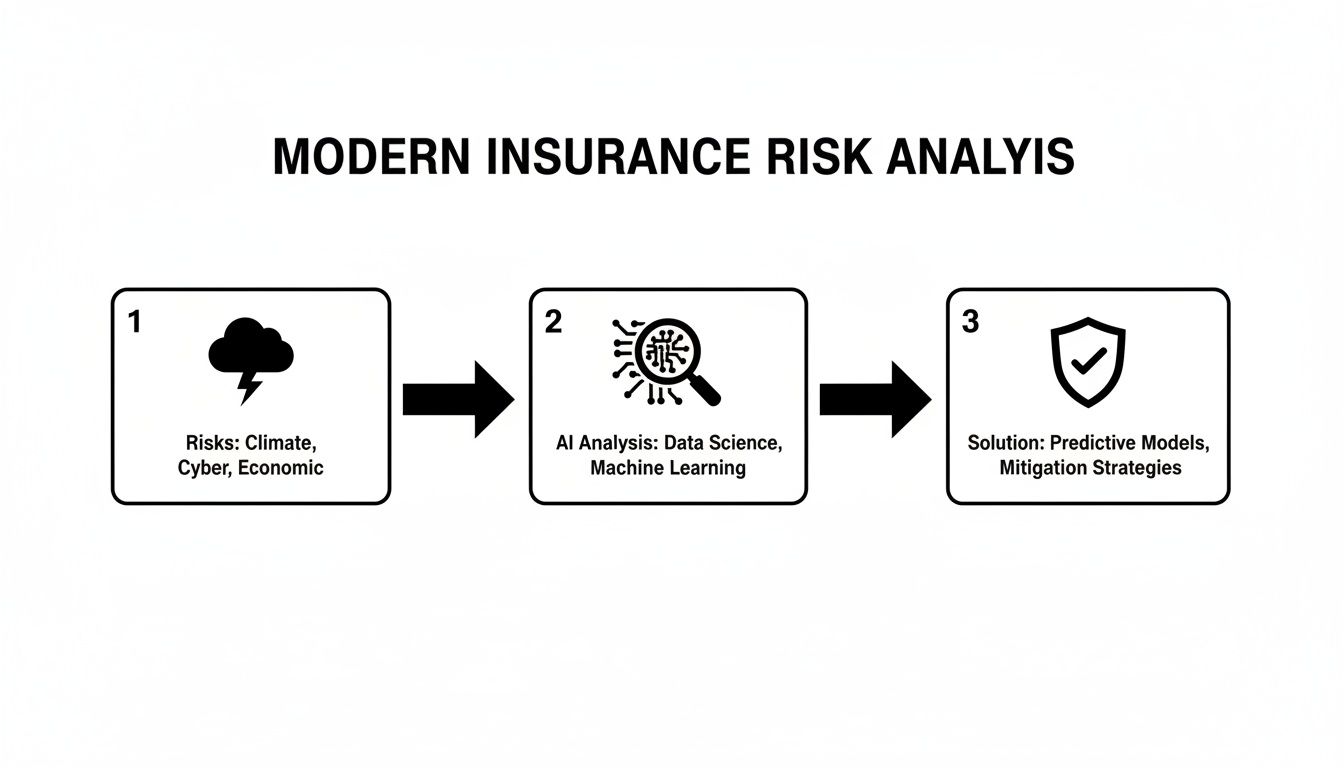
As you can see, AI acts as the analytical engine, processing risks to empower a faster, more accurate human response.
Setting Guardrails and Escalation Paths
Once roles are clear, the next move is to build rock-solid operational guardrails and seamless escalation paths. This is where a platform like Nolana becomes indispensable. It allows you to configure the specific rules that govern AI behavior, making every automated action auditable and compliant. The system provides a transparent log for all claims AI reviews, which is exactly what regulators want to see.
For instance, an AI agent handling AI customer care for financial services can be blocked from accessing certain types of sensitive personal data. If a customer's question requires that information, the conversation is automatically and smoothly handed off to a credentialed human agent who gets the full context.
operational risk management for financial services
This systematic approach is non-negotiable. Sectors like healthcare face similar hurdles with data privacy and compliance, and looking at AI Solutions for Healthcare can offer valuable parallels.
operational risk management for financial services
Ultimately, a strong governance framework transforms AI from just a powerful tool into a trusted, integrated part of your risk management strategy. To see how these principles are applied in practice, you can dive deeper into insurance claims processing with our detailed guide.
Using Automation in Claims to Curb Financial Loss
For any insurer, the claims process is the moment of truth. It’s where theoretical risk becomes a very real financial event. To truly manage insurance risk at this stage, the most forward-thinking AI insurance companies are moving past old-school manual checks and disjointed systems. They're embracing the automation of insurance claims with AI across the entire lifecycle, building a strong defense against both financial leakage and operational drag.

This shift starts the second a claim is filed. Imagine an AI agent handling the First Notice of Loss (FNOL). It can instantly pull details from a web form or a phone call, create a case file, and, most importantly, validate that information in real-time. By plugging directly into core systems like Guidewire or Duck Creek, it confirms policy details and coverage on the spot.
This immediate, accurate data capture is a huge deal. It cuts out the human error and delays that so often bog down the start of a claim, creating a solid foundation for everything that follows.
Catching Fraud and Anomalies in Real-Time
With the claim initiated, the next critical hurdle is figuring out if it's legitimate. The traditional approach of having an adjuster manually sift through files is not just slow, it’s a setup for missing subtle fraud patterns. This is where automating insurance claims with AI really changes the game.
An AI agent can crunch thousands of data points in seconds, cross-referencing a new claim against a vast repository of historical data, known fraud rings, and external databases. This isn't a one-and-done check, it's continuous monitoring that flags red flags a person would almost certainly overlook.
Think about these real-world scenarios:
Surge Events: After a major hurricane, an AI can tear through a tidal wave of incoming claims, instantly spotting duplicate submissions or flagging claims filed from well outside the storm's path.
Hidden Networks: It can connect the dots between seemingly unrelated claims that all use the same auto body shop or medical provider, uncovering signs of organized fraud.
Social Inflation: By scanning unstructured text in legal filings or even social media chatter, AI can detect new litigation tactics that inflate claim costs, giving the insurer a crucial early warning.
This proactive defense transforms claims AI reviews from a reactive, manual chore into an automated, always-on process that directly protects your bottom line.
Speeding Up Settlements and Keeping Customers Happy
Beyond just sniffing out fraud, automation makes the entire path to settlement faster and smoother. For simple, clear-cut claims, an AI agent can gather repair estimates, process the necessary invoices, and cut the check, all within predefined business rules and authority limits. This absolutely slashes cycle times for high-volume, low-complexity claims.
The result? Lower operational costs and a much, much better customer experience. A minor fender-bender, for example, could be fully settled in a matter of hours, not days. The AI orchestrates the whole workflow, from scheduling the vehicle inspection to releasing the payment, while keeping the policyholder updated automatically. That kind of efficiency is a game-changer.
The current economic climate only adds to the pressure. A recent BlackRock survey of insurers found that 63% now see inflation as their number one macroeconomic risk. This, paired with a sharp drop in risk appetite, down to just 12% in 2025 from highs of 60% between 2018-2021, is compelling 73% of insurers to invest seriously in AI for underwriting and security. You can dig into more of these findings in Aon's global insurance market trends report.
By automating routine claim adjudication, you free up your most experienced adjusters to focus on high-value, complex cases where their expertise is most needed. This creates a more strategic and effective claims operation.
This end-to-end automation does more than just move things along quickly. It creates a perfect, auditable record of every single action taken on a claim. For your compliance and audit teams, that transparent trail is gold, proving you have tight control over one of the riskiest parts of the business. To see how this fits into the bigger picture, explore our full guide on modernizing insurance claims processing.
How AI in Customer Care Mitigates Operational Risk
Great customer service isn't just about keeping people happy, it's a critical lever you can pull to manage insurance risk. Think about it: every single conversation with a policyholder is a potential operational slip-up or a compliance miss. By implementing smart AI customer care, leading AI insurance companies are building a more resilient frontline, one that not only serves customers well but also systematically cuts down on manual errors and protects the company's reputation.
The old model, with a human agent jumping between half a dozen screens to help one customer, is riddled with risk. Information gets lost in the shuffle, data is entered incorrectly, and critical regulatory disclosures can be easily forgotten when things get busy. An AI agent, on the other hand, runs the same exact workflow with perfect consistency, every single time. This is especially true for AI customer care for financial services, where compliance is paramount.
Creating a Unified Frontline Experience
Today’s AI agents do a lot more than just field basic questions. They function as a central nervous system, directly linking a customer conversation to the complex back-office work that needs to happen. This connection creates a truly unified experience where tasks are executed perfectly in the background, driven entirely by what the customer needs.
Let's walk through a real-world scenario. A policyholder calls to add their teenage son to their auto policy. Here’s how an AI agent, tied into core systems like Genesys for the call and Salesforce for the CRM, manages the entire flow:
Authenticates the Caller: First, it securely verifies the policyholder’s identity, no questions asked.
Guides the Conversation: The agent then follows a specific, pre-approved script to gather all the necessary details about the new driver.
Provides Disclosures: It makes sure every required regulatory disclosure about premium changes is delivered at precisely the right moment in the conversation.
Updates Core Systems: As the conversation unfolds, the agent is already pushing the new driver's information to the policy administration system in real time.
Confirms the Change: To wrap it all up, it triggers an email confirmation to the policyholder with their updated policy documents attached.
The whole thing is done in a single, smooth interaction. The risk of an agent forgetting a key step or mistyping a VIN number is completely eliminated. What you get is a faster, more accurate process that ultimately builds the customer's confidence in you.
Empowering Human Agents with Real-Time Data
Let me be clear: this isn't about replacing your people with bots. It’s about making your best people even better. When a call requires genuine empathy or a delicate negotiation, the AI can seamlessly escalate the conversation to a human agent.
But here’s the magic, it doesn't just transfer the call. It transfers the entire context.
The human agent gets a complete summary of the conversation so far, including why the customer called, what steps the AI already completed, and relevant policy information pulled from your core systems. This lets your agent pick up right where the AI left off, without forcing the customer to repeat everything. It turns a potentially frustrating handoff into a supportive, helpful experience.
This human-in-the-loop model gives you the best of both worlds: the raw efficiency and consistency of AI combined with the critical thinking and emotional intelligence of your best agents. Automation handles the routine, freeing up your experts to manage the exceptions.
This approach directly shrinks operational risk by arming agents with the right information at the right time, minimizing the chance of them giving bad advice or making a costly mistake.
Ensuring Full Auditability and Compliance
One of the biggest wins I've seen from using an AI-native operating system like Nolana is the creation of a complete, unchangeable audit trail. Every single interaction, whether the AI handled it from start to finish or escalated it to a person, is logged and time-stamped.
This log includes:
Full conversation transcripts
Every action the AI agent took
All data pulled from or sent to core systems
Confirmation that compliance steps were followed
This level of detail is a game-changer for regulatory scrutiny. When an auditor asks for proof that you followed a specific procedure for a policy change made six months ago, you can pull up a digital receipt of the entire event in seconds. Achieving that kind of transparency with purely manual processes is next to impossible and is a cornerstone of modern risk management.
If you're looking to build out these capabilities, a great next step is to explore different strategies for AI customer care and see which models fit your business.
Implementing Continuous Monitoring and Compliance
Thinking you can manage insurance risk with a "set it and forget it" approach is a recipe for disaster. Effective risk management is a living, breathing discipline, not a one-off project. To stay in control in such a dynamic environment, you need a robust, AI-driven system for monitoring and reporting. It's time to move past static reports and embrace real-time oversight of your automated operations.
This continuous loop of monitoring, reporting, and refining is where you truly unlock the power of AI. It gives you the visibility to catch small issues before they snowball into major compliance headaches or eat into your bottom line.

Defining Your Key Indicators
The first move is deciding what to measure. You can't manage what you don't track. For AI insurance companies, this means getting a handle on both Key Performance Indicators (KPIs) and Key Risk Indicators (KRIs).
KPIs show you how well your automated processes are running, while KRIs are your canaries in the coal mine, early warnings that something might be going wrong.
Key Performance Indicators (KPIs): These tell the story of your operational efficiency.
Average Claim Processing Time: How fast are you really moving claims from FNOL to settlement?
First-Contact Resolution Rate: What percentage of customer issues are being fully handled by an AI agent without a human ever getting involved?
Automated Task Success Rate: How often are your AI agents completing workflows from start to finish without any errors?
Key Risk Indicators (KRIs): These are the metrics that keep you up at night.
Escalation Frequency: How often are tasks being kicked over from AI to a human agent? A sudden spike here is a massive red flag that a process is broken.
System Error Rates: Are AI agents constantly hitting a wall when trying to connect to core systems like Guidewire or Salesforce?
Manual Override Percentage: How often are supervisors stepping in to overrule AI-driven decisions? This often points to a mismatch between the AI's logic and your actual business rules.
These metrics aren’t just numbers on a screen, they are the concrete data you need to fine-tune your automation and prove its value.
Gaining Real-Time Visibility
Old-school risk management often leans on monthly or quarterly reports, which are basically historical documents by the time they hit your desk. Modern, AI-native platforms deliver real-time dashboards that give leaders a live, up-to-the-minute view of their operational health. This is a complete game-changer.
Imagine a claims manager seeing a sudden surge in claim escalations in a specific region on their dashboard. They can drill down immediately and discover a new fraud pattern or a system integration bug before it impacts thousands of other claims. To make this happen, you need real-time insights into your IT environment. For a deeper technical perspective on this, the guide on What Is Continuous Monitoring offers some great context for setting up these systems.
This proactive stance is absolutely critical. Insurers' return on equity might be projected to hit 10.7% in 2025, but with softening markets and rising catastrophe losses, every single operational efficiency matters. This is where platforms that automate high-stakes workflows and connect to data streams for inflation monitoring, a top priority for 48% of insurers, become indispensable.
Ensuring Immutable Auditability
When it comes to your risk, compliance, and audit teams, proof is everything. In a heavily regulated industry like insurance, you have to be able to demonstrate, without a doubt, that you have control over your operations. Your audit trail is your most valuable asset here.
In systems built for regulated industries, every single action taken by an AI agent is logged immutably. Every piece of data it touches, every decision it makes, and every task it completes creates an unchangeable, time-stamped record that will satisfy even the toughest regulatory scrutiny.
This is why certifications like SOC 2 Type II and maintaining GDPR compliance are non-negotiable. When an auditor asks how a specific claim was handled six months ago, you need to be able to pull up a complete digital receipt of the entire process in seconds.
Achieving this level of granular, easily accessible evidence is next to impossible with manual processes. It’s the bedrock of a defensible compliance posture. For more on this, our guide on regulatory compliance in financial services gets into the weeds on these critical topics.
Charting Your Course to Resilient Insurance Operations
Let's be honest: truly managing insurance risk today isn't about making small tweaks to old processes. It’s about a fundamental rethink of your entire operational strategy. The most competitive and resilient carriers are making a deliberate shift, moving away from a reactive, "wait-and-see" stance to a proactive, intelligent model. This isn’t just a trend, it's the new standard for building an organization that can weather any storm.
This transition really comes down to embedding smart automation deep within your core business functions, especially in the high-stakes, high-volume worlds of claims and customer service.
The big picture is this: you need a strategy with several moving parts. It all starts with a rock-solid governance framework that clearly spells out who does what and establishes firm boundaries for your operations. Once that's in place, you can start automating the workflows that matter most. We're already seeing leading AI insurance companies demonstrate just how powerful this is, using AI to manage the entire claims lifecycle, from the first notice of loss right through to settlement. This ensures claims AI reviews are not only faster but also more consistent and accurate.
Adopting an AI-Native Operating System
At the same time, you can’t ignore the customer-facing side of the house. Deploying top-tier AI customer care is one of the most effective ways to mitigate both operational and reputational risk. Think about it: when AI can handle frontline inquiries with speed and precision, it frees up your human agents to tackle complex issues with better data at their fingertips. This not only cuts down on errors but also ensures every single interaction stays within compliance guardrails.
When automated claims processing and intelligent customer service work together, they form a powerful, unified operational backbone.
Moving to an AI-native operating system doesn't have to be a painful, rip-and-replace project. It's an evolution. It's about giving your teams a platform where AI agents and human experts can collaborate seamlessly, all while you maintain strict control and have a complete audit trail of every action taken.
Ultimately, the goal is to create an operation that can confidently handle market volatility, drive down costs, and provide a genuinely better customer experience, all without ever cutting corners on risk and compliance.
With the right strategy and the right platform, you're doing more than just managing risk. You're building a future-proof foundation that sets you up for long-term growth and leadership. This proactive approach is what will keep your organization agile, efficient, and ready for whatever comes next.
Answering Your Questions
When we talk about bringing new technology into a highly regulated field like insurance, it’s natural for leaders to have questions. This isn't just about the tech itself, it's about how you weave it into the fabric of your operations. The goal is to build a system where automation supports your experts, giving them better tools without taking away their control.
Here are some of the most common questions we hear from insurance executives who are exploring how AI can help build more resilient and efficient companies.
How Does AI Actually Make Claims Processing More Accurate?
The biggest win for accuracy comes from AI's ability to automate data extraction and validation across different sources. This alone cuts out a huge chunk of the manual entry errors that can creep into the process.
Think of it this way: a machine learning model can analyze an incoming claim against millions of historical data points and your own business rules in a split second. It's trained to flag anything that looks off, inconsistencies, missing information, or even patterns that suggest potential fraud.
For example, an AI agent can instantly check a repair invoice against the policy's coverage limits and cross-reference it with regional repair cost databases. This guarantees the payment is both correct and compliant, preventing the kind of financial leakage that often results from simple human oversight. Better yet, platforms designed for this leave a complete audit trail, making claims AI reviews totally transparent.
What’s the Role of My Team When AI Handles Customer Care?
Human oversight isn't just a feature, it's a non-negotiable part of any AI customer care strategy, especially in financial services. Your AI agents should be there to handle the routine, high-volume inquiries and execute standard processes, but they must operate within clearly defined boundaries.
We always build in escalation paths. If a customer's problem is too complex, becomes emotionally charged, or simply falls outside the AI's training, the conversation is seamlessly handed off to a human agent.
That agent doesn't walk in cold. They get the full context of the AI's interaction, which makes for a much smoother and more effective resolution. It’s a "human-in-the-loop" model that gives you the best of both worlds: the efficiency of AI and the critical thinking and empathy that only your people can provide.
How Can AI Help Us Keep Up with Changing Regulations?
This is one of the most powerful applications. AI makes your compliance workflows far more agile and easier to audit. When a new regulation comes down the pipeline, you can update the business rules directly in the AI's operating system. From that moment on, the AI agents will apply the new logic consistently to every single transaction or interaction.
Let’s say new data privacy laws are passed. You can configure your AI to automatically manage data redaction or handle consent requests based on the new policy. And because every single action is logged, these platforms give you audit-ready proof that you're systematically following the new rules. This dramatically cuts down on compliance risk and the manual effort it usually takes to implement regulatory changes.
Ready to build a more resilient, efficient, and compliant insurance operation? See how Nolana's AI-native operating system can automate your high-stakes workflows with complete control and auditability. Discover Nolana today.
To truly get a handle on insurance risk, carriers have to move past the old, reactive playbooks. The game has changed, and winning requires embedding AI-driven automation deep into the core of your operations, from claims and underwriting to the day-to-day back-office grind. This isn't about bolting on a new tool, it's about building a smarter, more resilient defense against the risks we face today.
The New Reality of Insurance Risk Management
The insurance world is at a crossroads. We're getting hit from all sides: unpredictable natural disasters, sophisticated cyber-attacks, and volatile economic conditions. The old ways of managing risk just can't keep up. In this new environment, success depends on speed, accuracy, and intelligence, all things that AI-native automation delivers.
This reality calls for a complete overhaul, moving from manual, look-in-the-rearview-mirror processes to an automated, forward-looking operational model. This is precisely where the leading AI insurance companies are pulling away from the pack. They're weaving intelligence directly into the fabric of their most critical workflows, creating a massive competitive advantage.
Navigating Unprecedented Volatility
The sheer pace and intensity of catastrophic events have skyrocketed, putting an incredible strain on claims departments. Just look at the numbers: in 2024, global insured losses from natural catastrophes hit a staggering $140 billion. That's a huge jump from the ten-year average of $94 billion. This isn't a fluke, it's the new normal of climate-driven risk.
2025 outlook on risk management
When events like the January 2025 Los Angeles wildfires hit, with estimated losses between $30-40 billion, insurers are forced to fundamentally question their approach to managing assets and liabilities in such a chaotic market. For more insights, the 2025 outlook on risk management from Risk Strategies is a must-read.
In this kind of environment, manual processing isn't just slow, it's a liability. Human teams simply can't cope with the volume and complexity, which inevitably leads to delays, mistakes, and bigger financial losses.
The core challenge is no longer just predicting risk, but building an operational backbone that can respond to it in real time. An AI-native operating system provides the resilience needed to withstand these shocks without compromising on compliance or customer experience.
AI as a Strategic Imperative
Automating your core functions is no longer a "nice-to-have." It's a strategic imperative for survival and growth. By putting AI to work, carriers can drive real, tangible outcomes:
Automating Insurance Claims with AI: Imagine AI agents handling the entire claims lifecycle, from the first notice of loss all the way through fraud checks and settlement. This dramatically cuts down on manual work and slashes resolution times, a lifesaver after a major event.
Enhanced AI Customer Care for Financial Services: Intelligent agents can manage frontline customer questions, walk policyholders through confusing processes, and even handle the back-office tasks that get triggered during a conversation. This delivers a consistent experience and frees up your human experts for the tough cases.
Proactive Risk Identification: Instead of waiting for a problem to blow up, AI can continuously scan data to spot emerging risk patterns. Think social inflation trends or new fraud schemes, AI can flag them long before they hit your bottom line.
To give a sense of how this works in practice, let's look at some of the most pressing risks carriers face and how an AI-powered approach provides a direct solution.
Modern Insurance Risks vs AI-Powered Solutions
Key Risk Area | Traditional Challenge | AI-Powered Solution (e.g., Nolana) |
|---|---|---|
Catastrophic Events | Manual claims processing gets overwhelmed, causing massive delays and operational bottlenecks. | AI agents scale instantly to manage intake, triage, and processing for thousands of claims simultaneously. |
Sophisticated Fraud | Fraudsters exploit process gaps and human oversight with increasingly complex schemes. | AI continuously analyzes data patterns to detect anomalies and flag suspicious claims for review in real-time. |
Regulatory Compliance | Keeping up with changing regulations across multiple jurisdictions is a constant manual struggle. | AI-native systems embed compliance rules directly into workflows, ensuring auditable, consistent adherence. |
Social Inflation | Rising litigation costs and jury awards are hard to predict and model with historical data alone. | AI models analyze unstructured data (like legal documents) to identify trends and predict loss costs more accurately. |
Cyber Threats | Data breaches and system vulnerabilities pose a constant threat to sensitive customer information. | AI-powered monitoring provides 24/7 oversight, detecting and responding to security threats faster than human teams. |
This table illustrates a fundamental shift: moving from a reactive, manual posture to a proactive, automated one.
intelligent automation in insurance
intelligent automation in insurance
Platforms like Nolana's agentic operating system are built for this new era. They help you build a compliant, proactive, and fully auditable foundation to get ahead of risk instead of just reacting to it. For a much deeper look at how this works, check out our guide to AI for insurers and MGAs. It’s a practical next step for navigating the challenges of today's market.
Weaving AI Into Your Risk Governance Framework
To truly manage insurance risk in an automated world, slapping some new tech on top of old processes just won't cut it. You need a thoughtfully designed governance framework, a central nervous system that dictates exactly how your AI and human teams work together. This isn't about replacing your tried-and-true Standard Operating Procedures (SOPs), it's about translating them into intelligent, automated workflows.
The goal is to map your established protocols directly onto your AI agents. This way, your automation follows the same rules and best practices as your top human performers. For AI insurance companies, getting this right is the key to unlocking efficiency while maintaining unwavering compliance.
Think of it this way: an AI handling a claim can be set to only approve payments up to a certain dollar amount. The moment a claim exceeds that threshold, it automatically gets escalated to a human adjuster for a final look. The AI operates within clear, predefined boundaries.
Defining Roles for Humans and AI Agents
One of the biggest myths out there is that AI is here to replace human expertise. In reality, a well-built governance structure is all about augmenting it. The trick is to clearly define who does what, the AI and the human experts, creating a symbiotic relationship where each plays to their strengths. This clarity is absolutely fundamental for building trust in the system.
Your AI agents are your digital specialists, built to handle the high-volume, repetitive tasks with incredible speed and precision. Their role is to:
Handle Initial Data Intake and Verification: They can instantly capture information from First Notice of Loss (FNOL) forms and cross-reference it with policy details.
Field Routine Customer Inquiries: Through AI customer care channels, they can provide immediate answers to common policyholder questions, freeing up your human agents for the tough stuff.
Run Preliminary Fraud Analysis: They are excellent at scanning claim details against known fraud indicators, flagging anything suspicious for a human to investigate further.
Your human experts, meanwhile, are elevated. They get to focus on the work that requires critical thinking, empathy, and seasoned judgment. Their responsibilities shift to high-value activities that directly impact your bottom line and customer loyalty, like handling complex negotiations, managing sensitive customer escalations, or making the final call on a flagged claim.
"A successful AI integration is less about automation and more about orchestration. The framework must ensure that humans are always in control, able to intervene, override, and audit any decision the AI makes. This human-in-the-loop design is non-negotiable in financial services."
The flowchart below visualizes how AI fits into a modern risk management process, from spotting a risk all the way through to deploying a solution.
As you can see, AI acts as the analytical engine, processing risks to empower a faster, more accurate human response.
Setting Guardrails and Escalation Paths
Once roles are clear, the next move is to build rock-solid operational guardrails and seamless escalation paths. This is where a platform like Nolana becomes indispensable. It allows you to configure the specific rules that govern AI behavior, making every automated action auditable and compliant. The system provides a transparent log for all claims AI reviews, which is exactly what regulators want to see.
For instance, an AI agent handling AI customer care for financial services can be blocked from accessing certain types of sensitive personal data. If a customer's question requires that information, the conversation is automatically and smoothly handed off to a credentialed human agent who gets the full context.
operational risk management for financial services
This systematic approach is non-negotiable. Sectors like healthcare face similar hurdles with data privacy and compliance, and looking at AI Solutions for Healthcare can offer valuable parallels.
operational risk management for financial services
Ultimately, a strong governance framework transforms AI from just a powerful tool into a trusted, integrated part of your risk management strategy. To see how these principles are applied in practice, you can dive deeper into insurance claims processing with our detailed guide.
Using Automation in Claims to Curb Financial Loss
For any insurer, the claims process is the moment of truth. It’s where theoretical risk becomes a very real financial event. To truly manage insurance risk at this stage, the most forward-thinking AI insurance companies are moving past old-school manual checks and disjointed systems. They're embracing the automation of insurance claims with AI across the entire lifecycle, building a strong defense against both financial leakage and operational drag.
This shift starts the second a claim is filed. Imagine an AI agent handling the First Notice of Loss (FNOL). It can instantly pull details from a web form or a phone call, create a case file, and, most importantly, validate that information in real-time. By plugging directly into core systems like Guidewire or Duck Creek, it confirms policy details and coverage on the spot.
This immediate, accurate data capture is a huge deal. It cuts out the human error and delays that so often bog down the start of a claim, creating a solid foundation for everything that follows.
Catching Fraud and Anomalies in Real-Time
With the claim initiated, the next critical hurdle is figuring out if it's legitimate. The traditional approach of having an adjuster manually sift through files is not just slow, it’s a setup for missing subtle fraud patterns. This is where automating insurance claims with AI really changes the game.
An AI agent can crunch thousands of data points in seconds, cross-referencing a new claim against a vast repository of historical data, known fraud rings, and external databases. This isn't a one-and-done check, it's continuous monitoring that flags red flags a person would almost certainly overlook.
Think about these real-world scenarios:
Surge Events: After a major hurricane, an AI can tear through a tidal wave of incoming claims, instantly spotting duplicate submissions or flagging claims filed from well outside the storm's path.
Hidden Networks: It can connect the dots between seemingly unrelated claims that all use the same auto body shop or medical provider, uncovering signs of organized fraud.
Social Inflation: By scanning unstructured text in legal filings or even social media chatter, AI can detect new litigation tactics that inflate claim costs, giving the insurer a crucial early warning.
This proactive defense transforms claims AI reviews from a reactive, manual chore into an automated, always-on process that directly protects your bottom line.
Speeding Up Settlements and Keeping Customers Happy
Beyond just sniffing out fraud, automation makes the entire path to settlement faster and smoother. For simple, clear-cut claims, an AI agent can gather repair estimates, process the necessary invoices, and cut the check, all within predefined business rules and authority limits. This absolutely slashes cycle times for high-volume, low-complexity claims.
The result? Lower operational costs and a much, much better customer experience. A minor fender-bender, for example, could be fully settled in a matter of hours, not days. The AI orchestrates the whole workflow, from scheduling the vehicle inspection to releasing the payment, while keeping the policyholder updated automatically. That kind of efficiency is a game-changer.
The current economic climate only adds to the pressure. A recent BlackRock survey of insurers found that 63% now see inflation as their number one macroeconomic risk. This, paired with a sharp drop in risk appetite, down to just 12% in 2025 from highs of 60% between 2018-2021, is compelling 73% of insurers to invest seriously in AI for underwriting and security. You can dig into more of these findings in Aon's global insurance market trends report.
By automating routine claim adjudication, you free up your most experienced adjusters to focus on high-value, complex cases where their expertise is most needed. This creates a more strategic and effective claims operation.
This end-to-end automation does more than just move things along quickly. It creates a perfect, auditable record of every single action taken on a claim. For your compliance and audit teams, that transparent trail is gold, proving you have tight control over one of the riskiest parts of the business. To see how this fits into the bigger picture, explore our full guide on modernizing insurance claims processing.
How AI in Customer Care Mitigates Operational Risk
Great customer service isn't just about keeping people happy, it's a critical lever you can pull to manage insurance risk. Think about it: every single conversation with a policyholder is a potential operational slip-up or a compliance miss. By implementing smart AI customer care, leading AI insurance companies are building a more resilient frontline, one that not only serves customers well but also systematically cuts down on manual errors and protects the company's reputation.
The old model, with a human agent jumping between half a dozen screens to help one customer, is riddled with risk. Information gets lost in the shuffle, data is entered incorrectly, and critical regulatory disclosures can be easily forgotten when things get busy. An AI agent, on the other hand, runs the same exact workflow with perfect consistency, every single time. This is especially true for AI customer care for financial services, where compliance is paramount.
Creating a Unified Frontline Experience
Today’s AI agents do a lot more than just field basic questions. They function as a central nervous system, directly linking a customer conversation to the complex back-office work that needs to happen. This connection creates a truly unified experience where tasks are executed perfectly in the background, driven entirely by what the customer needs.
Let's walk through a real-world scenario. A policyholder calls to add their teenage son to their auto policy. Here’s how an AI agent, tied into core systems like Genesys for the call and Salesforce for the CRM, manages the entire flow:
Authenticates the Caller: First, it securely verifies the policyholder’s identity, no questions asked.
Guides the Conversation: The agent then follows a specific, pre-approved script to gather all the necessary details about the new driver.
Provides Disclosures: It makes sure every required regulatory disclosure about premium changes is delivered at precisely the right moment in the conversation.
Updates Core Systems: As the conversation unfolds, the agent is already pushing the new driver's information to the policy administration system in real time.
Confirms the Change: To wrap it all up, it triggers an email confirmation to the policyholder with their updated policy documents attached.
The whole thing is done in a single, smooth interaction. The risk of an agent forgetting a key step or mistyping a VIN number is completely eliminated. What you get is a faster, more accurate process that ultimately builds the customer's confidence in you.
Empowering Human Agents with Real-Time Data
Let me be clear: this isn't about replacing your people with bots. It’s about making your best people even better. When a call requires genuine empathy or a delicate negotiation, the AI can seamlessly escalate the conversation to a human agent.
But here’s the magic, it doesn't just transfer the call. It transfers the entire context.
The human agent gets a complete summary of the conversation so far, including why the customer called, what steps the AI already completed, and relevant policy information pulled from your core systems. This lets your agent pick up right where the AI left off, without forcing the customer to repeat everything. It turns a potentially frustrating handoff into a supportive, helpful experience.
This human-in-the-loop model gives you the best of both worlds: the raw efficiency and consistency of AI combined with the critical thinking and emotional intelligence of your best agents. Automation handles the routine, freeing up your experts to manage the exceptions.
This approach directly shrinks operational risk by arming agents with the right information at the right time, minimizing the chance of them giving bad advice or making a costly mistake.
Ensuring Full Auditability and Compliance
One of the biggest wins I've seen from using an AI-native operating system like Nolana is the creation of a complete, unchangeable audit trail. Every single interaction, whether the AI handled it from start to finish or escalated it to a person, is logged and time-stamped.
This log includes:
Full conversation transcripts
Every action the AI agent took
All data pulled from or sent to core systems
Confirmation that compliance steps were followed
This level of detail is a game-changer for regulatory scrutiny. When an auditor asks for proof that you followed a specific procedure for a policy change made six months ago, you can pull up a digital receipt of the entire event in seconds. Achieving that kind of transparency with purely manual processes is next to impossible and is a cornerstone of modern risk management.
If you're looking to build out these capabilities, a great next step is to explore different strategies for AI customer care and see which models fit your business.
Implementing Continuous Monitoring and Compliance
Thinking you can manage insurance risk with a "set it and forget it" approach is a recipe for disaster. Effective risk management is a living, breathing discipline, not a one-off project. To stay in control in such a dynamic environment, you need a robust, AI-driven system for monitoring and reporting. It's time to move past static reports and embrace real-time oversight of your automated operations.
This continuous loop of monitoring, reporting, and refining is where you truly unlock the power of AI. It gives you the visibility to catch small issues before they snowball into major compliance headaches or eat into your bottom line.
Defining Your Key Indicators
The first move is deciding what to measure. You can't manage what you don't track. For AI insurance companies, this means getting a handle on both Key Performance Indicators (KPIs) and Key Risk Indicators (KRIs).
KPIs show you how well your automated processes are running, while KRIs are your canaries in the coal mine, early warnings that something might be going wrong.
Key Performance Indicators (KPIs): These tell the story of your operational efficiency.
Average Claim Processing Time: How fast are you really moving claims from FNOL to settlement?
First-Contact Resolution Rate: What percentage of customer issues are being fully handled by an AI agent without a human ever getting involved?
Automated Task Success Rate: How often are your AI agents completing workflows from start to finish without any errors?
Key Risk Indicators (KRIs): These are the metrics that keep you up at night.
Escalation Frequency: How often are tasks being kicked over from AI to a human agent? A sudden spike here is a massive red flag that a process is broken.
System Error Rates: Are AI agents constantly hitting a wall when trying to connect to core systems like Guidewire or Salesforce?
Manual Override Percentage: How often are supervisors stepping in to overrule AI-driven decisions? This often points to a mismatch between the AI's logic and your actual business rules.
These metrics aren’t just numbers on a screen, they are the concrete data you need to fine-tune your automation and prove its value.
Gaining Real-Time Visibility
Old-school risk management often leans on monthly or quarterly reports, which are basically historical documents by the time they hit your desk. Modern, AI-native platforms deliver real-time dashboards that give leaders a live, up-to-the-minute view of their operational health. This is a complete game-changer.
Imagine a claims manager seeing a sudden surge in claim escalations in a specific region on their dashboard. They can drill down immediately and discover a new fraud pattern or a system integration bug before it impacts thousands of other claims. To make this happen, you need real-time insights into your IT environment. For a deeper technical perspective on this, the guide on What Is Continuous Monitoring offers some great context for setting up these systems.
This proactive stance is absolutely critical. Insurers' return on equity might be projected to hit 10.7% in 2025, but with softening markets and rising catastrophe losses, every single operational efficiency matters. This is where platforms that automate high-stakes workflows and connect to data streams for inflation monitoring, a top priority for 48% of insurers, become indispensable.
Ensuring Immutable Auditability
When it comes to your risk, compliance, and audit teams, proof is everything. In a heavily regulated industry like insurance, you have to be able to demonstrate, without a doubt, that you have control over your operations. Your audit trail is your most valuable asset here.
In systems built for regulated industries, every single action taken by an AI agent is logged immutably. Every piece of data it touches, every decision it makes, and every task it completes creates an unchangeable, time-stamped record that will satisfy even the toughest regulatory scrutiny.
This is why certifications like SOC 2 Type II and maintaining GDPR compliance are non-negotiable. When an auditor asks how a specific claim was handled six months ago, you need to be able to pull up a complete digital receipt of the entire process in seconds.
Achieving this level of granular, easily accessible evidence is next to impossible with manual processes. It’s the bedrock of a defensible compliance posture. For more on this, our guide on regulatory compliance in financial services gets into the weeds on these critical topics.
Charting Your Course to Resilient Insurance Operations
Let's be honest: truly managing insurance risk today isn't about making small tweaks to old processes. It’s about a fundamental rethink of your entire operational strategy. The most competitive and resilient carriers are making a deliberate shift, moving away from a reactive, "wait-and-see" stance to a proactive, intelligent model. This isn’t just a trend, it's the new standard for building an organization that can weather any storm.
This transition really comes down to embedding smart automation deep within your core business functions, especially in the high-stakes, high-volume worlds of claims and customer service.
The big picture is this: you need a strategy with several moving parts. It all starts with a rock-solid governance framework that clearly spells out who does what and establishes firm boundaries for your operations. Once that's in place, you can start automating the workflows that matter most. We're already seeing leading AI insurance companies demonstrate just how powerful this is, using AI to manage the entire claims lifecycle, from the first notice of loss right through to settlement. This ensures claims AI reviews are not only faster but also more consistent and accurate.
Adopting an AI-Native Operating System
At the same time, you can’t ignore the customer-facing side of the house. Deploying top-tier AI customer care is one of the most effective ways to mitigate both operational and reputational risk. Think about it: when AI can handle frontline inquiries with speed and precision, it frees up your human agents to tackle complex issues with better data at their fingertips. This not only cuts down on errors but also ensures every single interaction stays within compliance guardrails.
When automated claims processing and intelligent customer service work together, they form a powerful, unified operational backbone.
Moving to an AI-native operating system doesn't have to be a painful, rip-and-replace project. It's an evolution. It's about giving your teams a platform where AI agents and human experts can collaborate seamlessly, all while you maintain strict control and have a complete audit trail of every action taken.
Ultimately, the goal is to create an operation that can confidently handle market volatility, drive down costs, and provide a genuinely better customer experience, all without ever cutting corners on risk and compliance.
With the right strategy and the right platform, you're doing more than just managing risk. You're building a future-proof foundation that sets you up for long-term growth and leadership. This proactive approach is what will keep your organization agile, efficient, and ready for whatever comes next.
Answering Your Questions
When we talk about bringing new technology into a highly regulated field like insurance, it’s natural for leaders to have questions. This isn't just about the tech itself, it's about how you weave it into the fabric of your operations. The goal is to build a system where automation supports your experts, giving them better tools without taking away their control.
Here are some of the most common questions we hear from insurance executives who are exploring how AI can help build more resilient and efficient companies.
How Does AI Actually Make Claims Processing More Accurate?
The biggest win for accuracy comes from AI's ability to automate data extraction and validation across different sources. This alone cuts out a huge chunk of the manual entry errors that can creep into the process.
Think of it this way: a machine learning model can analyze an incoming claim against millions of historical data points and your own business rules in a split second. It's trained to flag anything that looks off, inconsistencies, missing information, or even patterns that suggest potential fraud.
For example, an AI agent can instantly check a repair invoice against the policy's coverage limits and cross-reference it with regional repair cost databases. This guarantees the payment is both correct and compliant, preventing the kind of financial leakage that often results from simple human oversight. Better yet, platforms designed for this leave a complete audit trail, making claims AI reviews totally transparent.
What’s the Role of My Team When AI Handles Customer Care?
Human oversight isn't just a feature, it's a non-negotiable part of any AI customer care strategy, especially in financial services. Your AI agents should be there to handle the routine, high-volume inquiries and execute standard processes, but they must operate within clearly defined boundaries.
We always build in escalation paths. If a customer's problem is too complex, becomes emotionally charged, or simply falls outside the AI's training, the conversation is seamlessly handed off to a human agent.
That agent doesn't walk in cold. They get the full context of the AI's interaction, which makes for a much smoother and more effective resolution. It’s a "human-in-the-loop" model that gives you the best of both worlds: the efficiency of AI and the critical thinking and empathy that only your people can provide.
How Can AI Help Us Keep Up with Changing Regulations?
This is one of the most powerful applications. AI makes your compliance workflows far more agile and easier to audit. When a new regulation comes down the pipeline, you can update the business rules directly in the AI's operating system. From that moment on, the AI agents will apply the new logic consistently to every single transaction or interaction.
Let’s say new data privacy laws are passed. You can configure your AI to automatically manage data redaction or handle consent requests based on the new policy. And because every single action is logged, these platforms give you audit-ready proof that you're systematically following the new rules. This dramatically cuts down on compliance risk and the manual effort it usually takes to implement regulatory changes.
Ready to build a more resilient, efficient, and compliant insurance operation? See how Nolana's AI-native operating system can automate your high-stakes workflows with complete control and auditability. Discover Nolana today.


All systems operational
1 Lime Street, London EC3M 7HA | 222E 3rd Street, New York 10009
Copyright © 2026, Nolana. All rights reserved
All systems operational
1 Lime Street, London EC3M 7HA | 222E 3rd Street, New York 10009
Copyright © 2026, Nolana. All rights reserved
All systems operational
1 Lime Street, London EC3M 7HA | 222E 3rd Street, New York 10009
Copyright © 2026, Nolana. All rights reserved
All systems operational
1 Lime Street, London EC3M 7HA | 222E 3rd Street, New York 10009
Copyright © 2026, Nolana. All rights reserved