
Author
Nolana
Date


What a bordereau is, the three types used in delegated authority business, how Lloyd's standards and Delegated Data Manager work, and why reporting still takes so much manual effort.
A bordereau (plural bordereaux) is the regular schedule of risks, premiums or claims that a coverholder, MGA or claims administrator sends to the insurers it acts for. It is how an insurer sees business it did not write itself, and in 2026 it has become one of the most scrutinised documents in the Lloyd's market.
Delegated business accounts for around 45% of Lloyd's gross written premium, and Lloyd's 2026 Market Oversight Plan makes data adequacy a core focus of its oversight. This guide covers the types of bordereaux and the standards behind them, but spends most of its time on what oversight teams are now expected to do with them.
What Lloyd's expects from delegated data in 2026
Lloyd's 2026 Market Oversight Plan is direct about delegated authority. It notes that the performance of delegated business tends to deteriorate less visibly and is harder to put right, so issues can compound before anyone acts. It calls timely access to risk, premium and claims data critical.
A named overseer. From January 2026, each managing agent has a dedicated DA Oversight Manager at Lloyd's, carrying out structured engagement and reviews across the delegated lifecycle.
More, and more complex, producers. Growth is coming through cross-class broker facilities and consortia, which add volume and variety to the bordereaux a managing agent receives.
A softening market. Lloyd's warns that poorly managed delegated business can make a softening market worse, which is exactly when late or messy data does the most damage.
Claims under the hurdle. Delegated claims handling is a stated focus under the claims management principle, now a hurdle principle.
In practice, the bordereaux process is no longer judged on whether files arrive and get submitted. It is judged on whether the managing agent can see what is happening in its delegated book early enough to act.
The three types of bordereaux
Lloyd's sets out three types in its Coverholder Reporting Standards:
Risk written bordereau. Details of each policy bound: the insured, period of cover, location, sums insured, limits and deductibles.
Premium paid bordereau. The premium collected for each risk, with commission, taxes and the net amount due to insurers.
Claims bordereau. Claims notified and handled under the authority: dates, causes, reserves, payments, recoveries and status.
Some contracts still use a combined risk and premium bordereau. Claims bordereaux are often produced by a separate delegated claims administrator rather than by the coverholder itself.
Lloyd's reporting standards
Since July 2017, Lloyd's has required syndicates to collect delegated authority data in line with its Coverholder Reporting Standards. The current version, 5.2, defines the core regulatory, tax, premium and claims fields a bordereau should contain. Lloyd's does not mandate a single file format. That flexibility is one reason bordereaux still look so different from one coverholder to the next, even when they contain the same information.
How bordereaux move through the market
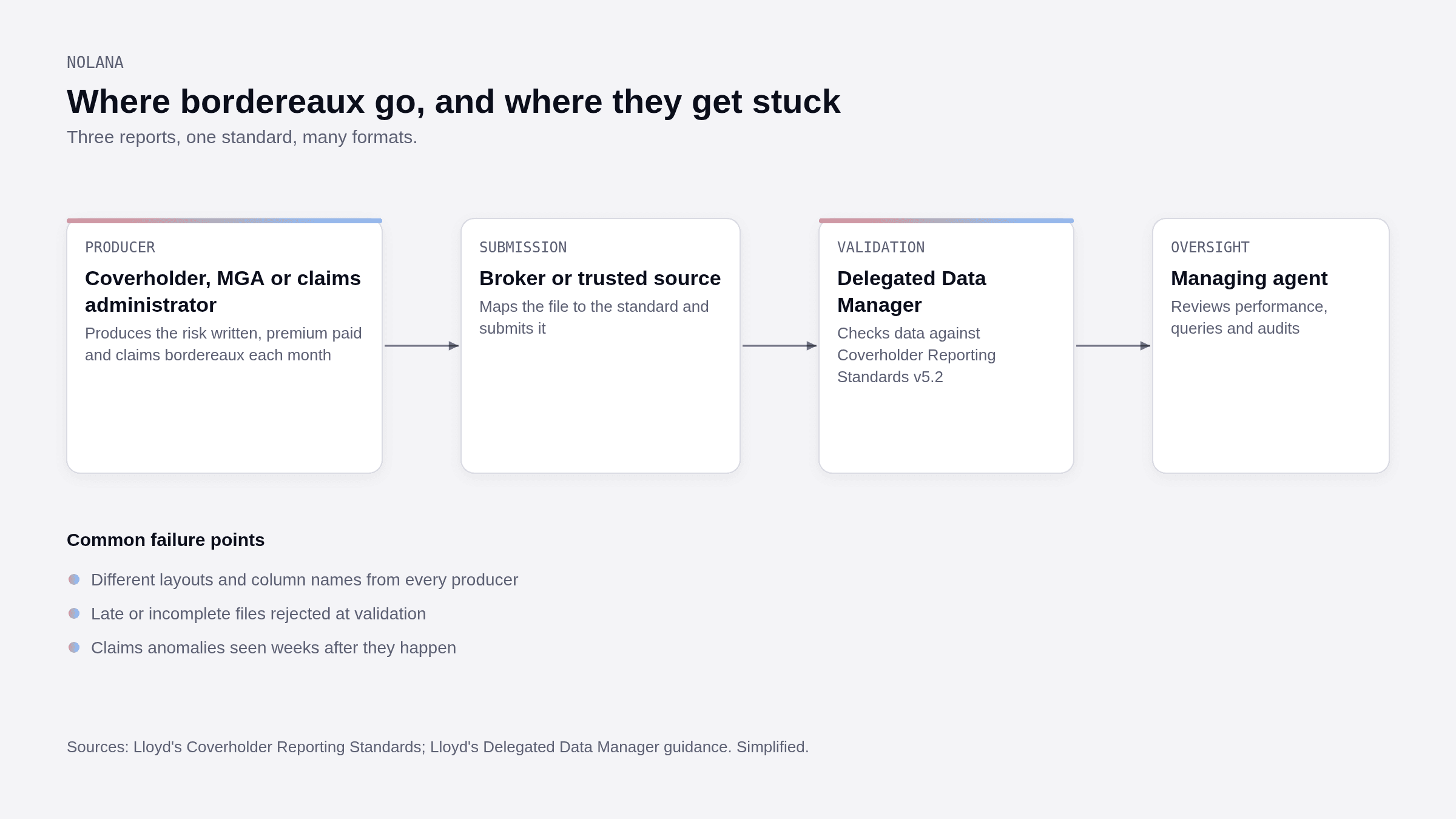
Since 2018, the London market's core service for processing delegated authority bordereaux has been Delegated Data Manager, or DDM, built on Charles Taylor InsureTech's Tide platform. In 2024, LIMOSS made DDM an elective service, so managing agents and brokers can now choose the bordereaux system that suits them. Whichever system is used, each file is mapped to the standard, validated against the Coverholder Reporting Standards, and corrected if it fails.
Premium paid and claims bordereaux that relate to money movements are linked to market accounting and settlement, so errors in those files can hold up payments as well as reporting.
Why bordereaux reporting is hard
Every producer is different. Each coverholder has its own format, column names, codes and conventions.
Spreadsheets everywhere. Data arrives as spreadsheets, often late and sometimes incomplete.
Moving targets. The same risk or claim can appear differently from one month to the next as it is amended or developed.
Manual mapping. Fitting each file to the standard takes skilled work, and some errors only surface at validation.
Cleaning, not reviewing. Oversight teams spend their time cleaning data instead of looking at what it shows.
For a managing agent with dozens or hundreds of binders, that adds up to a large, repetitive workload every month, and a lag between something happening at the coverholder and anyone in London seeing it.

Claims bordereaux and oversight
Claims bordereaux matter most for oversight. They show how a coverholder or claims administrator is handling claims: how quickly they are acknowledged and settled, how reserves develop, whether payments sit within authority, and whether any claims should have been referred. Read well, they are an early warning system.
The questions an oversight team wants answered each month are practical ones:
Which claims have moved outside the claims authority, or should have been referred?
Which reserves have moved sharply, up or down, since last month?
Which open claims have had no movement for months?
Are acknowledgement and settlement times within the agreed service standards?
Do paid amounts reconcile with the premium and claims funds?
When the data arrives late or messy, those questions are answered weeks after the fact, if at all. That is how small problems in a delegated book become audit findings.
What good bordereaux management looks like
The teams that handle bordereaux well tend to do the same things. They agree formats and field definitions with each producer at the start of the contract. They validate files on arrival, not at month end. They keep a single, mapped dataset across all binders, so trends can be compared. And they use the output for oversight decisions, not just for reporting.
How AI can help
The repetitive part of bordereaux work is reading each file, mapping its fields to the standard and finding gaps. That work is well suited to AI. Done well, it means:
Files are read and mapped to the standard whatever their layout, with the mapping shown for review.
Missing, inconsistent or out-of-range fields are flagged before submission, not after rejection.
Claims that look unusual, such as large reserve movements, payments near the authority limit or files with no recent activity, are surfaced for review.
Oversight teams spend their time on decisions rather than data cleaning.
People still make the decisions. AI prepares and checks the data, and the oversight team decides what to query, approve or escalate. This is how Nolana supports bordereaux automation and delegated authority claims for Lloyd's and London market insurers.
Common data problems, and how to spot them
Many bordereaux problems can be caught with a handful of checks before the file goes anywhere:
Duplicates: the same claim reported twice, or under two references, across months.
Figures that do not add up: paid plus outstanding not matching incurred, or negative reserves.
Dates out of sequence: a loss date after the notification date, or outside the period of cover.
Missing references: no unique market reference or binder reference to tie the claim to the contract.
Currency mismatches: amounts in different currencies with no settlement currency given.
Unexplained jumps: claim counts or reserves that change sharply from one month to the next.
Orphaned claims: claims that cannot be matched to a risk because the claims bordereau lacks a policy or certificate reference.
A monthly routine for oversight teams
Check every expected bordereau has arrived, and chase those that have not.
Validate and map each file on arrival, and send errors back to the producer the same week.
Review claims above authority, large reserve movements and files with no movement.
Compare service standards, such as acknowledgement and settlement times, against the contract.
Record what was queried and the response, ready for the next audit.
Sources: Lloyd's 2026 Market Oversight Plan; Lloyd's reporting standards; InsurTech Digital on DDM as an elective service.
Frequently asked questions
What does bordereaux mean in insurance?
A bordereau is a regular schedule of risks, premiums or claims that a coverholder, MGA or claims administrator sends to the insurers it acts for under a delegated authority.
How often are bordereaux submitted?
Most binders require monthly bordereaux, though the frequency is set in the contract.
What is a claims bordereau?
A report listing the claims notified and handled under a delegated authority, with their reserves, payments and status, used by insurers to oversee how the claims are being managed.

Articles


