Claims Management System Guide for Modern Insurers
Claims Management System Guide for Modern Insurers
Explore how a claims management system automates the full claims lifecycle, integrates with existing tools, and helps insurers cut cycle times and loss ratios.

It's Monday morning at a London Market managing agent, and the inbox already looks like a triage board. Broker queries sit next to coverholder notifications, ECF messages, and forwarded PDFs with missing attachments. By the time a handler has checked policy details, chased evidence, and updated the file twice, the work of judgment is already competing with administration.
That's why a claims management system matters. It isn't just a place to store claim numbers, it's the operational spine that keeps intake, validation, tasking, evidence, payment, and audit trail moving from first notice of loss to closure. In a market where delegated authority, broker communication, and regulatory defensibility all matter at once, the difference between a system of record and a system of operation is the difference between logging work and running it.

A helpful way to think about adjacent workflow software is to look at how PI firms use case management software. The legal world faces a similar problem, lots of documents, lots of handoffs, and a need for traceability, but insurance claims add policy rules, reserving, payments, and settlement governance on top.
The market signal is clear. Verdantix estimated the global claims management software market at $4.25 billion in 2024 and projected $8.22 billion by 2030, a near doubling that points to long-term investment in claims infrastructure, not a passing software trend [Verdantix]. For carriers, MGAs, and London Market participants, that scale matters because claims ops is no longer treated as a back-office afterthought, it's a core control point for cost, service, and risk.
The simple test is this. A claims database tells you what happened. A claims management system helps you decide what happens next, who owns it, what evidence is missing, and when the file can close.
For a practical look at claims automation in an insurance workflow, see Nolana's claims processing automation overview.
What a Claims Management System Actually Does
A Monday in the London Market exposes the job of claims software. A marine loss comes in by email, a liability query lands through a broker, a coverholder sends a scanned FNOL form, and someone in the team pastes notes into a spreadsheet because the original file still needs indexing. By lunchtime, the handlers aren't just processing claims, they're reconstructing them.
A real claims management system stops that fragmentation. It captures the incident, validates the information, creates the claim record, assigns tasks, centralizes the evidence, and keeps the audit trail intact through payment and closure [AClaimant]. The point is not digitization. The point is to give every participant, handler, manager, broker, and coverholder a shared operational view of the same claim.
System of record versus system of operation
A lot of vendors can tell you where a claim lives. Fewer can tell you how the claim moves. That's the key distinction buyers should care about.
Practical rule: if the platform only stores documents, you still need people to run the process by hand. If it routes work, validates data, and keeps status synchronized, it's doing operational work.
The operational spine matters because claims work is not linear. Documents arrive out of order, authority levels vary by line, and exceptions need human review without breaking the file. Nolana's approach to insurance claims processing automation fits that reality by sitting on top of existing systems and handling the work around the core record rather than forcing a rip-and-replace migration.
There's also a bigger strategic point. When claims software can manage intake, triage, investigation, reserving, settlement, and closure as one controlled flow, leaders can measure bottlenecks instead of guessing at them. That's what turns claims from a cost centre that reacts slowly into an operating function that can be improved deliberately.
Why the category keeps expanding
The market growth is not happening because insurers love buying more software for its own sake. It's happening because claims teams need faster routing, better auditability, and less manual rekeying across more channels and more counterparties. The same pressure shows up in London Market placements, where the file often moves through several hands before settlement is even possible.
A claim file should never depend on memory, a shared inbox, or who happens to be online that morning.
That's also why the category now touches customer experience and regulatory defensibility as much as cycle time. A system that can show what was received, when it was reviewed, who touched it, and why a decision was made is far more valuable than one that only records a claim number. The market is rewarding systems that behave like operational infrastructure, not digital filing cabinets.
Anatomy of the Modern Claims Lifecycle
The claims lifecycle works like a relay race, and every handoff can either add drag or preserve speed. In a London Market file, FNOL is the first runner, triage is the second, investigation and adjustment are the third, and settlement or denial is the final exchange. If any runner drops the baton, someone on the team spends time rebuilding context that should've travelled with the claim.
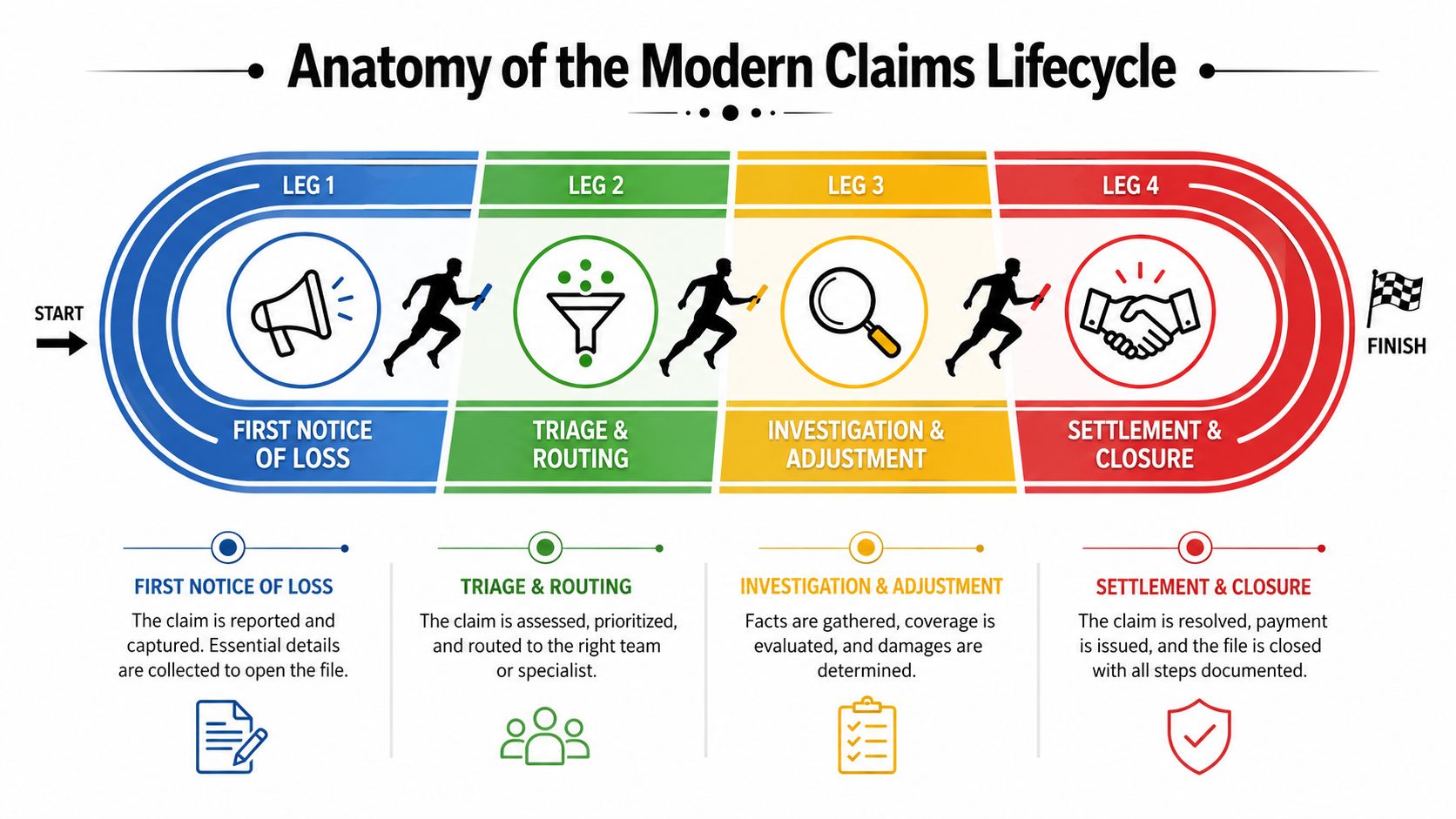
The advantage of event-driven design is that each stage can be handled independently. AWS's reference flow shows FNOL triggering claim-ID generation, document upload, policy matching, and fraud checks before acceptance or rejection, then appraisal and settlement moving downstream as separate events rather than one monolithic transaction [AWS]. That separation matters when different claim types, authority thresholds, and document formats need different handling.
FNOL and triage
FNOL should do more than capture contact details. It should create a stable record, check basic policy fit, and decide whether the file can move straight through or needs specialist review. In practice, that means a simple property damage claim shouldn't wait in the same queue as a complex liability dispute.
The triage layer is where the system earns its keep. A good platform keeps the claim file intact while routing only the exceptions to handlers. That prevents the common London Market problem where updates live in email, evidence sits in attachments, and status notes drift out of sync with the actual record.
Investigation, reserving, settlement, closure
Once the claim is accepted, investigation becomes a structured workflow, not a loose conversation. Evidence is collected, tasks are assigned, and status updates flow to the downstream users who need them. Reserving and settlement are part of that same lifecycle, not an afterthought added once the “real work” is over.
Straight-through processing delivers real value here. Simple claims move quickly because the system checks the rules, confirms the evidence, and keeps the record synchronized without forcing a handler to retype what the claimant already supplied. Complex files still need judgment, and that's fine. The architecture should make that boundary obvious.
For a related look at how claims data supports operational control, see Nolana's insurance data analytics overview.
Core Capabilities That Define a Modern Platform
A credible claims platform is more than a case tracker with a prettier interface. It needs to collect the right data, move the file through the right steps, and let handlers intervene without tearing up the workflow. That sounds simple until you try to manage London Market claims across email, portals, coverholders, and internal workbenches at the same time.
Intake, documents, and routing
The first layer is AI-driven FNOL intake. The platform should adapt to how the policyholder or broker describes the loss, ask for missing information, and request evidence only when it's actually needed. That reduces back-and-forth and keeps the claim from stalling before it's even been opened.
The second layer is intelligent document processing. Google Cloud's insurance reference architecture describes extracting text, parsing fields and tables from PDFs and images, classifying documents, segmenting claims, and using AI to support fraud detection and straight-through processing when claims meet eligibility thresholds [Google Cloud]. The operational point is straightforward, better extraction means less rekeying, fewer corrections, and faster progress through the queue.
Lifecycle control and delegated authority
Claims don't fail only at intake. They fail when they sit dormant, drift across teams, or fall into the wrong authority band. A modern platform should watch the file through its life, flag inactivity, and propose the next best action so handlers spend their time on judgment rather than on housekeeping.
That's especially important in delegated authority environments. A system should check the claim against thresholds, auto-approve the simple ones, reject the out-of-scope ones, and escalate the borderline cases. The value is not just speed, it's consistency. When the system applies the same threshold logic every time, managers can defend the process and handlers can focus on exceptions.
The best automation doesn't remove the handler, it removes the administrative noise around the handler.
Cross-channel support matters just as much. Industry research from Arizent shows claims organisations using texting with policyholders, claimant tracking, and automatic responses to common questions, while the CLM buyer's guide notes that text, chat, and portal collaboration are increasingly folded into claim notes to simplify adjuster workflow [Arizent]. The capability is not five separate channels, it's one synchronized record that keeps everyone aligned.
For a practical lens on independent agency workflows, PIA Southern Alliance's guide for independent agency claims is useful because it shows how workflow discipline and file visibility matter even outside a carrier core.
Platform checklist in practice
A modern platform should include:
Data capture at intake, with guided fields and evidence collection.
Document extraction, so emails and PDFs become structured claim data.
Lifecycle monitoring, so dormant files surface before they go stale.
Authority-aware routing, so claims go to the right person the first time.
Synchronized communication, so file notes stay consistent across channels.
The strongest systems also integrate with existing claims workbenches and policy platforms via APIs, and they support multiple lines, including property, specialty, marine, aviation, energy, construction, liability, motor, reinsurance, and travel claims. That breadth matters in the London Market, where one organisation rarely handles just one kind of claim.
For implementation context, Nolana's agentic AI platform overview shows how these capabilities can sit inside existing operations instead of replacing them.
Integration Approaches and the London Market Reality
Integration usually decides whether a claims platform gets used or avoided. In a London Market environment, the question isn't whether a shiny new platform can demo well, it's whether it can work with the claims workbench, the policy admin system, broker interactions, and delegated authority processes already in place.
There are two basic models. The first is rip-and-replace, where the new vendor becomes the system of record and everyone migrates over. The second is layer-on-top, where agentic AI sits above existing systems through APIs and orchestrates work without forcing the whole market to move at once. For Lloyd's and London Market participants, the second model usually fits better because it preserves the way managing agents, brokers, and coverholders already collaborate.
Why layering beats replacement in practice
Rip-and-replace sounds tidy on a slide deck. In practice, it means data migration, retraining, process redesign, and a lot of change management before the first useful file moves. That's a heavy lift when the organisation already has working systems, even if those systems are imperfect.
Layering reduces disruption because handlers stay in familiar tools while the AI handles intake, routing, and updates in the background. The market already values that kind of continuity. For delegated authority files, especially, you don't want to break broker communication or coverholder reporting just to get automation into the process.
Governance, auditability, and cross-channel control
Enterprise claims operations also need SOC 2-level discipline and audit-ready logging. Nolana describes itself as SOC 2-certified, and that matters because insurers need to know what the system did, when it did it, and why it did it. If the platform is making recommendations, those recommendations have to remain explainable.
Cross-channel orchestration is part of the same control problem. Email, web forms, live chat, voice, and call centre interactions can't create competing versions of the same claim. The system has to keep updates synchronized so AI suggestions and human decisions never collide.
For London Market teams, the practical requirement is simple. The platform should sit on top of what already works, connect cleanly to the surrounding ecosystem, and improve the file without asking every counterparty to change how they operate. That's how automation becomes usable in a delegated authority environment instead of becoming another disconnected tool.
For a related technical view, see Nolana's page on AI for Lloyd's and London Market insurers.
How AI-Native Platforms Like Nolana Differentiate
Once the architecture is clear, the difference between bolt-on AI and an AI-native claims platform becomes easier to see. Nolana is an agentic AI platform that automates claims lifecycle operations for the Lloyd's market, including FNOL intake, claims triage, static claims management, and document processing. The important part is not just that it automates work, it's that it does so while keeping experienced handlers available for the judgment calls that matter.
What changes for handlers
In a broker-heavy or coverholder-heavy file, a lot of the work is administrative before it is analytical. Someone has to pull the email threads together, extract the right details, follow up for missing documents, and keep the claim moving without breaking the audit trail. Nolana's model is to handle that layer of work so handlers spend more time on value-adding tasks and less time on file choreography.
That distinction matters in delegated authority settings. If the platform can extract claim details from inbound messages, check authority thresholds, update core systems, and notify the right counterparties, the handler is freed from repetitive work without losing control of the decision path. The file still has a human owner, but the system does more of the mechanical lifting.
What credible AI looks like
The true test for AI in claims is not how conversational it sounds. It's whether it keeps human-in-the-loop oversight, maintains a full audit trail, and makes explainability available when managers need it. Those are the features that separate enterprise-grade automation from marketing-grade AI language.
Nolana also documents outcome ranges of up to 50x faster cycle times, up to 30% higher handler throughput, and up to 5% lower loss ratio, depending on context, while operating on top of existing claims and policy systems rather than replacing them [Nolana]. Those are ranges, not promises, but they give buyers a realistic frame for evaluating what automation can deliver when it's applied to the right claim segments.
A useful vendor test is simple. Ask where the human stays in control, where the audit trail lives, and what the platform does when evidence is incomplete.
The Lloyd's-specific fit is also part of the story. Nolana is built for managing agents, brokers, and coverholders, which means it's designed around the market's actual workflow rather than a generic insurance template. For a deeper product lens, Nolana's AI agent overview for business operations helps explain how the agentic model works across task execution and oversight.
Choosing Where to Automate First and What to Leave to Handlers
More automation isn't automatically better. A claims team can absolutely automate itself into trouble if it treats every file like a routine file. Arthur D. Little's framing is useful here, low-complexity, high-frequency claims can be fully automated, while higher-complexity cases still benefit from human judgment [Arthur D. Little].
Start with the files that follow rules
The safest early targets are the claims that already behave like predictable workflows. They tend to have clear coverage, limited dispute potential, and a repeatable evidence set. Those files are good candidates for automation because the system can validate inputs, route the work, and move the claim without much ambiguity.
The same logic applies to the stages of the lifecycle. FNOL, intake validation, and document handling usually deliver quick wins because they're repetitive and heavily manual today. From there, teams can expand into more advanced routing and follow-up logic, then gradually widen the scope by claim type or line of business.
Good automation principle: automate the steps that are repetitive, checkable, and easy to reverse. Keep judgment in the hands of the person who can defend the outcome.
Keep judgment where the file needs it
Certain work should stay with experienced handlers. Complex liability questions, fraud investigations that require nuance, and sensitive policyholder communications all benefit from human context. The platform can flag, route, and surface evidence, but the person making the call still has to read the file, weigh the trade-offs, and stand behind the result.
That's the operational reason the best systems separate flagging from deciding. AI can highlight risk signals, compile information, and propose the next action. It shouldn't blur the line on disputed liability or coverage questions where fairness, defensibility, and relationship management matter more than speed.
A staged rollout also avoids over-automation in the wrong place. Start with one claim segment, confirm the control points, and then expand by complexity tier. That gives leaders a cleaner way to measure whether the platform is reducing rework, not just shifting it around.
The pain points are easy to map:
Manual document handling becomes structured extraction and less rekeying.
Dormant claims become visible queues with recommended next actions.
Fragmented communication becomes a single synchronized file.
Slow coverage checks become rule-based intake and triage.
High handling cost becomes a more focused use of handler time.
Measuring ROI and the KPIs That Actually Matter
Claims leaders are right to be skeptical of broad automation claims. The business case gets real when you can point to specific operational metrics and show the movement clearly. In a claims room, that means cycle time, throughput, file quality, and customer responsiveness, not just “innovation” language.
The KPI stack that matters
The first metric is cycle time from FNOL to settlement. If the platform removes rekeying, speeds routing, and keeps the file moving, that should show up in elapsed time. The second is handler throughput, measured by how many claims each handler can close in a given period without losing control of quality.
A third metric is straight-through-processing rate for low-complexity claims. If the system can resolve predictable files without unnecessary manual touches, handlers get more time for exceptions. Then there's document extraction accuracy, because bad extraction just creates new rework under a different label.
Here's a simple comparison framework:
KPI | Operational problem solved | Typical outcome range |
|---|---|---|
Cycle time | Slow handoffs and manual follow-up | Can fall materially where automation removes repetitive work [Talli] |
Handler throughput | Too much time spent on admin | Can rise when routine work is removed from the queue [Nolana] |
Loss ratio | Excess handling cost and slow decisions | Can improve where faster handling and decision support reduce leakage [Nolana] |
Dormant claim aging | Files stalling in queues | Improves when inactivity detection surfaces stuck claims |
STP rate | Too many simple claims needing manual touch | Rises when intake and validation are rule-driven |
Extraction accuracy | Rekeying errors and correction loops | Improves when IDP captures structured data at intake |
Measurement hygiene
Baselining matters more than many teams admit. Without knowing your current cycle time by claim type, or your current rate of dormant files, you can't tell whether a new workflow helped or just changed the mix. The cleanest approach is to measure before rollout, compare by segment, and keep volume complexity visible in the reporting.
That last point matters in London Market operations, where one week's file mix can look nothing like the next. If executives only see averages, they miss where automation is working and where humans still need to intervene. Good reporting makes that distinction visible instead of burying it.
For a related discussion of claims analytics, Nolana's insurance analytics overview is a useful companion read when you're building the measurement framework.
Implementation Checklist and Frequently Asked Questions
A claims system project goes better when the decision criteria are explicit before the demo starts. For a London Market team, that means checking whether the platform fits delegated authority workflows, whether it can sit on top of current systems, and whether it gives managers a clear audit trail without making handlers jump between tools.
Implementation checklist
Lloyd's market fit: Confirm that the platform understands managing agents, brokers, and coverholders, not just generic insurance workflows.
Delegated authority support: Check that authority thresholds, escalation paths, and broker notifications are part of the operating model.
Security posture: Ask how the vendor handles audit logging, access control, and certification requirements.
Integration model: Verify that the platform can layer over existing claims and policy systems through APIs.
Human oversight: Make sure the platform keeps handlers in control of exceptions, approvals, and disputed decisions.
Multi-line coverage: Confirm support for the lines your business writes, not only the line shown in the demo.
Phased rollout: Start with one line of business, then expand by complexity tier before turning on cross-channel orchestration.
FAQ
How long does implementation usually take?
It depends on how customized your current claims stack is and how much process redesign you're willing to do. Layer-on-top deployments usually move faster because they don't require a wholesale system replacement.
What about data residency and compliance in regulated markets?
The right platform should support auditability, controlled access, and clear system logging from day one. That's especially important where claims files cross brokers, coverholders, and internal systems.
What if our existing claims system is heavily customized?
That's exactly where a layered approach helps. You keep the core record where it is, and let the AI platform handle intake, triage, document processing, and task orchestration around it.
How do humans stay in control?
The platform should route exceptions to handlers, show the evidence behind each recommendation, and preserve every action in the audit trail. If the vendor can't explain that clearly, the control model isn't mature enough.
For teams trying to clean up file quality at the source, Total Loss Northwest's auto claim documentation guide is a useful reminder that better documentation discipline still matters even when automation is in the mix.
If you're evaluating how to automate claims without giving up control, Nolana AI is built for exactly that balance. It automates FNOL intake, triage, document processing, and claims lifecycle work while keeping handlers in the loop and the audit trail intact. Visit Nolana AI to see how its agentic claims automation approach fits existing insurance operations.
It's Monday morning at a London Market managing agent, and the inbox already looks like a triage board. Broker queries sit next to coverholder notifications, ECF messages, and forwarded PDFs with missing attachments. By the time a handler has checked policy details, chased evidence, and updated the file twice, the work of judgment is already competing with administration.
That's why a claims management system matters. It isn't just a place to store claim numbers, it's the operational spine that keeps intake, validation, tasking, evidence, payment, and audit trail moving from first notice of loss to closure. In a market where delegated authority, broker communication, and regulatory defensibility all matter at once, the difference between a system of record and a system of operation is the difference between logging work and running it.
A helpful way to think about adjacent workflow software is to look at how PI firms use case management software. The legal world faces a similar problem, lots of documents, lots of handoffs, and a need for traceability, but insurance claims add policy rules, reserving, payments, and settlement governance on top.
The market signal is clear. Verdantix estimated the global claims management software market at $4.25 billion in 2024 and projected $8.22 billion by 2030, a near doubling that points to long-term investment in claims infrastructure, not a passing software trend [Verdantix]. For carriers, MGAs, and London Market participants, that scale matters because claims ops is no longer treated as a back-office afterthought, it's a core control point for cost, service, and risk.
The simple test is this. A claims database tells you what happened. A claims management system helps you decide what happens next, who owns it, what evidence is missing, and when the file can close.
For a practical look at claims automation in an insurance workflow, see Nolana's claims processing automation overview.
What a Claims Management System Actually Does
A Monday in the London Market exposes the job of claims software. A marine loss comes in by email, a liability query lands through a broker, a coverholder sends a scanned FNOL form, and someone in the team pastes notes into a spreadsheet because the original file still needs indexing. By lunchtime, the handlers aren't just processing claims, they're reconstructing them.
A real claims management system stops that fragmentation. It captures the incident, validates the information, creates the claim record, assigns tasks, centralizes the evidence, and keeps the audit trail intact through payment and closure [AClaimant]. The point is not digitization. The point is to give every participant, handler, manager, broker, and coverholder a shared operational view of the same claim.
System of record versus system of operation
A lot of vendors can tell you where a claim lives. Fewer can tell you how the claim moves. That's the key distinction buyers should care about.
Practical rule: if the platform only stores documents, you still need people to run the process by hand. If it routes work, validates data, and keeps status synchronized, it's doing operational work.
The operational spine matters because claims work is not linear. Documents arrive out of order, authority levels vary by line, and exceptions need human review without breaking the file. Nolana's approach to insurance claims processing automation fits that reality by sitting on top of existing systems and handling the work around the core record rather than forcing a rip-and-replace migration.
There's also a bigger strategic point. When claims software can manage intake, triage, investigation, reserving, settlement, and closure as one controlled flow, leaders can measure bottlenecks instead of guessing at them. That's what turns claims from a cost centre that reacts slowly into an operating function that can be improved deliberately.
Why the category keeps expanding
The market growth is not happening because insurers love buying more software for its own sake. It's happening because claims teams need faster routing, better auditability, and less manual rekeying across more channels and more counterparties. The same pressure shows up in London Market placements, where the file often moves through several hands before settlement is even possible.
A claim file should never depend on memory, a shared inbox, or who happens to be online that morning.
That's also why the category now touches customer experience and regulatory defensibility as much as cycle time. A system that can show what was received, when it was reviewed, who touched it, and why a decision was made is far more valuable than one that only records a claim number. The market is rewarding systems that behave like operational infrastructure, not digital filing cabinets.
Anatomy of the Modern Claims Lifecycle
The claims lifecycle works like a relay race, and every handoff can either add drag or preserve speed. In a London Market file, FNOL is the first runner, triage is the second, investigation and adjustment are the third, and settlement or denial is the final exchange. If any runner drops the baton, someone on the team spends time rebuilding context that should've travelled with the claim.
The advantage of event-driven design is that each stage can be handled independently. AWS's reference flow shows FNOL triggering claim-ID generation, document upload, policy matching, and fraud checks before acceptance or rejection, then appraisal and settlement moving downstream as separate events rather than one monolithic transaction [AWS]. That separation matters when different claim types, authority thresholds, and document formats need different handling.
FNOL and triage
FNOL should do more than capture contact details. It should create a stable record, check basic policy fit, and decide whether the file can move straight through or needs specialist review. In practice, that means a simple property damage claim shouldn't wait in the same queue as a complex liability dispute.
The triage layer is where the system earns its keep. A good platform keeps the claim file intact while routing only the exceptions to handlers. That prevents the common London Market problem where updates live in email, evidence sits in attachments, and status notes drift out of sync with the actual record.
Investigation, reserving, settlement, closure
Once the claim is accepted, investigation becomes a structured workflow, not a loose conversation. Evidence is collected, tasks are assigned, and status updates flow to the downstream users who need them. Reserving and settlement are part of that same lifecycle, not an afterthought added once the “real work” is over.
Straight-through processing delivers real value here. Simple claims move quickly because the system checks the rules, confirms the evidence, and keeps the record synchronized without forcing a handler to retype what the claimant already supplied. Complex files still need judgment, and that's fine. The architecture should make that boundary obvious.
For a related look at how claims data supports operational control, see Nolana's insurance data analytics overview.
Core Capabilities That Define a Modern Platform
A credible claims platform is more than a case tracker with a prettier interface. It needs to collect the right data, move the file through the right steps, and let handlers intervene without tearing up the workflow. That sounds simple until you try to manage London Market claims across email, portals, coverholders, and internal workbenches at the same time.
Intake, documents, and routing
The first layer is AI-driven FNOL intake. The platform should adapt to how the policyholder or broker describes the loss, ask for missing information, and request evidence only when it's actually needed. That reduces back-and-forth and keeps the claim from stalling before it's even been opened.
The second layer is intelligent document processing. Google Cloud's insurance reference architecture describes extracting text, parsing fields and tables from PDFs and images, classifying documents, segmenting claims, and using AI to support fraud detection and straight-through processing when claims meet eligibility thresholds [Google Cloud]. The operational point is straightforward, better extraction means less rekeying, fewer corrections, and faster progress through the queue.
Lifecycle control and delegated authority
Claims don't fail only at intake. They fail when they sit dormant, drift across teams, or fall into the wrong authority band. A modern platform should watch the file through its life, flag inactivity, and propose the next best action so handlers spend their time on judgment rather than on housekeeping.
That's especially important in delegated authority environments. A system should check the claim against thresholds, auto-approve the simple ones, reject the out-of-scope ones, and escalate the borderline cases. The value is not just speed, it's consistency. When the system applies the same threshold logic every time, managers can defend the process and handlers can focus on exceptions.
The best automation doesn't remove the handler, it removes the administrative noise around the handler.
Cross-channel support matters just as much. Industry research from Arizent shows claims organisations using texting with policyholders, claimant tracking, and automatic responses to common questions, while the CLM buyer's guide notes that text, chat, and portal collaboration are increasingly folded into claim notes to simplify adjuster workflow [Arizent]. The capability is not five separate channels, it's one synchronized record that keeps everyone aligned.
For a practical lens on independent agency workflows, PIA Southern Alliance's guide for independent agency claims is useful because it shows how workflow discipline and file visibility matter even outside a carrier core.
Platform checklist in practice
A modern platform should include:
Data capture at intake, with guided fields and evidence collection.
Document extraction, so emails and PDFs become structured claim data.
Lifecycle monitoring, so dormant files surface before they go stale.
Authority-aware routing, so claims go to the right person the first time.
Synchronized communication, so file notes stay consistent across channels.
The strongest systems also integrate with existing claims workbenches and policy platforms via APIs, and they support multiple lines, including property, specialty, marine, aviation, energy, construction, liability, motor, reinsurance, and travel claims. That breadth matters in the London Market, where one organisation rarely handles just one kind of claim.
For implementation context, Nolana's agentic AI platform overview shows how these capabilities can sit inside existing operations instead of replacing them.
Integration Approaches and the London Market Reality
Integration usually decides whether a claims platform gets used or avoided. In a London Market environment, the question isn't whether a shiny new platform can demo well, it's whether it can work with the claims workbench, the policy admin system, broker interactions, and delegated authority processes already in place.
There are two basic models. The first is rip-and-replace, where the new vendor becomes the system of record and everyone migrates over. The second is layer-on-top, where agentic AI sits above existing systems through APIs and orchestrates work without forcing the whole market to move at once. For Lloyd's and London Market participants, the second model usually fits better because it preserves the way managing agents, brokers, and coverholders already collaborate.
Why layering beats replacement in practice
Rip-and-replace sounds tidy on a slide deck. In practice, it means data migration, retraining, process redesign, and a lot of change management before the first useful file moves. That's a heavy lift when the organisation already has working systems, even if those systems are imperfect.
Layering reduces disruption because handlers stay in familiar tools while the AI handles intake, routing, and updates in the background. The market already values that kind of continuity. For delegated authority files, especially, you don't want to break broker communication or coverholder reporting just to get automation into the process.
Governance, auditability, and cross-channel control
Enterprise claims operations also need SOC 2-level discipline and audit-ready logging. Nolana describes itself as SOC 2-certified, and that matters because insurers need to know what the system did, when it did it, and why it did it. If the platform is making recommendations, those recommendations have to remain explainable.
Cross-channel orchestration is part of the same control problem. Email, web forms, live chat, voice, and call centre interactions can't create competing versions of the same claim. The system has to keep updates synchronized so AI suggestions and human decisions never collide.
For London Market teams, the practical requirement is simple. The platform should sit on top of what already works, connect cleanly to the surrounding ecosystem, and improve the file without asking every counterparty to change how they operate. That's how automation becomes usable in a delegated authority environment instead of becoming another disconnected tool.
For a related technical view, see Nolana's page on AI for Lloyd's and London Market insurers.
How AI-Native Platforms Like Nolana Differentiate
Once the architecture is clear, the difference between bolt-on AI and an AI-native claims platform becomes easier to see. Nolana is an agentic AI platform that automates claims lifecycle operations for the Lloyd's market, including FNOL intake, claims triage, static claims management, and document processing. The important part is not just that it automates work, it's that it does so while keeping experienced handlers available for the judgment calls that matter.
What changes for handlers
In a broker-heavy or coverholder-heavy file, a lot of the work is administrative before it is analytical. Someone has to pull the email threads together, extract the right details, follow up for missing documents, and keep the claim moving without breaking the audit trail. Nolana's model is to handle that layer of work so handlers spend more time on value-adding tasks and less time on file choreography.
That distinction matters in delegated authority settings. If the platform can extract claim details from inbound messages, check authority thresholds, update core systems, and notify the right counterparties, the handler is freed from repetitive work without losing control of the decision path. The file still has a human owner, but the system does more of the mechanical lifting.
What credible AI looks like
The true test for AI in claims is not how conversational it sounds. It's whether it keeps human-in-the-loop oversight, maintains a full audit trail, and makes explainability available when managers need it. Those are the features that separate enterprise-grade automation from marketing-grade AI language.
Nolana also documents outcome ranges of up to 50x faster cycle times, up to 30% higher handler throughput, and up to 5% lower loss ratio, depending on context, while operating on top of existing claims and policy systems rather than replacing them [Nolana]. Those are ranges, not promises, but they give buyers a realistic frame for evaluating what automation can deliver when it's applied to the right claim segments.
A useful vendor test is simple. Ask where the human stays in control, where the audit trail lives, and what the platform does when evidence is incomplete.
The Lloyd's-specific fit is also part of the story. Nolana is built for managing agents, brokers, and coverholders, which means it's designed around the market's actual workflow rather than a generic insurance template. For a deeper product lens, Nolana's AI agent overview for business operations helps explain how the agentic model works across task execution and oversight.
Choosing Where to Automate First and What to Leave to Handlers
More automation isn't automatically better. A claims team can absolutely automate itself into trouble if it treats every file like a routine file. Arthur D. Little's framing is useful here, low-complexity, high-frequency claims can be fully automated, while higher-complexity cases still benefit from human judgment [Arthur D. Little].
Start with the files that follow rules
The safest early targets are the claims that already behave like predictable workflows. They tend to have clear coverage, limited dispute potential, and a repeatable evidence set. Those files are good candidates for automation because the system can validate inputs, route the work, and move the claim without much ambiguity.
The same logic applies to the stages of the lifecycle. FNOL, intake validation, and document handling usually deliver quick wins because they're repetitive and heavily manual today. From there, teams can expand into more advanced routing and follow-up logic, then gradually widen the scope by claim type or line of business.
Good automation principle: automate the steps that are repetitive, checkable, and easy to reverse. Keep judgment in the hands of the person who can defend the outcome.
Keep judgment where the file needs it
Certain work should stay with experienced handlers. Complex liability questions, fraud investigations that require nuance, and sensitive policyholder communications all benefit from human context. The platform can flag, route, and surface evidence, but the person making the call still has to read the file, weigh the trade-offs, and stand behind the result.
That's the operational reason the best systems separate flagging from deciding. AI can highlight risk signals, compile information, and propose the next action. It shouldn't blur the line on disputed liability or coverage questions where fairness, defensibility, and relationship management matter more than speed.
A staged rollout also avoids over-automation in the wrong place. Start with one claim segment, confirm the control points, and then expand by complexity tier. That gives leaders a cleaner way to measure whether the platform is reducing rework, not just shifting it around.
The pain points are easy to map:
Manual document handling becomes structured extraction and less rekeying.
Dormant claims become visible queues with recommended next actions.
Fragmented communication becomes a single synchronized file.
Slow coverage checks become rule-based intake and triage.
High handling cost becomes a more focused use of handler time.
Measuring ROI and the KPIs That Actually Matter
Claims leaders are right to be skeptical of broad automation claims. The business case gets real when you can point to specific operational metrics and show the movement clearly. In a claims room, that means cycle time, throughput, file quality, and customer responsiveness, not just “innovation” language.
The KPI stack that matters
The first metric is cycle time from FNOL to settlement. If the platform removes rekeying, speeds routing, and keeps the file moving, that should show up in elapsed time. The second is handler throughput, measured by how many claims each handler can close in a given period without losing control of quality.
A third metric is straight-through-processing rate for low-complexity claims. If the system can resolve predictable files without unnecessary manual touches, handlers get more time for exceptions. Then there's document extraction accuracy, because bad extraction just creates new rework under a different label.
Here's a simple comparison framework:
KPI | Operational problem solved | Typical outcome range |
|---|---|---|
Cycle time | Slow handoffs and manual follow-up | Can fall materially where automation removes repetitive work [Talli] |
Handler throughput | Too much time spent on admin | Can rise when routine work is removed from the queue [Nolana] |
Loss ratio | Excess handling cost and slow decisions | Can improve where faster handling and decision support reduce leakage [Nolana] |
Dormant claim aging | Files stalling in queues | Improves when inactivity detection surfaces stuck claims |
STP rate | Too many simple claims needing manual touch | Rises when intake and validation are rule-driven |
Extraction accuracy | Rekeying errors and correction loops | Improves when IDP captures structured data at intake |
Measurement hygiene
Baselining matters more than many teams admit. Without knowing your current cycle time by claim type, or your current rate of dormant files, you can't tell whether a new workflow helped or just changed the mix. The cleanest approach is to measure before rollout, compare by segment, and keep volume complexity visible in the reporting.
That last point matters in London Market operations, where one week's file mix can look nothing like the next. If executives only see averages, they miss where automation is working and where humans still need to intervene. Good reporting makes that distinction visible instead of burying it.
For a related discussion of claims analytics, Nolana's insurance analytics overview is a useful companion read when you're building the measurement framework.
Implementation Checklist and Frequently Asked Questions
A claims system project goes better when the decision criteria are explicit before the demo starts. For a London Market team, that means checking whether the platform fits delegated authority workflows, whether it can sit on top of current systems, and whether it gives managers a clear audit trail without making handlers jump between tools.
Implementation checklist
Lloyd's market fit: Confirm that the platform understands managing agents, brokers, and coverholders, not just generic insurance workflows.
Delegated authority support: Check that authority thresholds, escalation paths, and broker notifications are part of the operating model.
Security posture: Ask how the vendor handles audit logging, access control, and certification requirements.
Integration model: Verify that the platform can layer over existing claims and policy systems through APIs.
Human oversight: Make sure the platform keeps handlers in control of exceptions, approvals, and disputed decisions.
Multi-line coverage: Confirm support for the lines your business writes, not only the line shown in the demo.
Phased rollout: Start with one line of business, then expand by complexity tier before turning on cross-channel orchestration.
FAQ
How long does implementation usually take?
It depends on how customized your current claims stack is and how much process redesign you're willing to do. Layer-on-top deployments usually move faster because they don't require a wholesale system replacement.
What about data residency and compliance in regulated markets?
The right platform should support auditability, controlled access, and clear system logging from day one. That's especially important where claims files cross brokers, coverholders, and internal systems.
What if our existing claims system is heavily customized?
That's exactly where a layered approach helps. You keep the core record where it is, and let the AI platform handle intake, triage, document processing, and task orchestration around it.
How do humans stay in control?
The platform should route exceptions to handlers, show the evidence behind each recommendation, and preserve every action in the audit trail. If the vendor can't explain that clearly, the control model isn't mature enough.
For teams trying to clean up file quality at the source, Total Loss Northwest's auto claim documentation guide is a useful reminder that better documentation discipline still matters even when automation is in the mix.
If you're evaluating how to automate claims without giving up control, Nolana AI is built for exactly that balance. It automates FNOL intake, triage, document processing, and claims lifecycle work while keeping handlers in the loop and the audit trail intact. Visit Nolana AI to see how its agentic claims automation approach fits existing insurance operations.


All systems operational
Lloyd's Lab, One Lime Street, London EC3M 7HA
Copyright © 2026, Nolana. All rights reserved
All systems operational
Lloyd's Lab, One Lime Street, London EC3M 7HA
Copyright © 2026, Nolana. All rights reserved
All systems operational
Lloyd's Lab, One Lime Street, London EC3M 7HA
Copyright © 2026, Nolana. All rights reserved
All systems operational
Lloyd's Lab, One Lime Street, London EC3M 7HA
Copyright © 2026, Nolana. All rights reserved