Claims Payment Processing: A 2026 Guide for Insurers
Claims Payment Processing: A 2026 Guide for Insurers
Master claims payment processing with workflows, automation, compliance, and fraud prevention strategies for modern insurers.

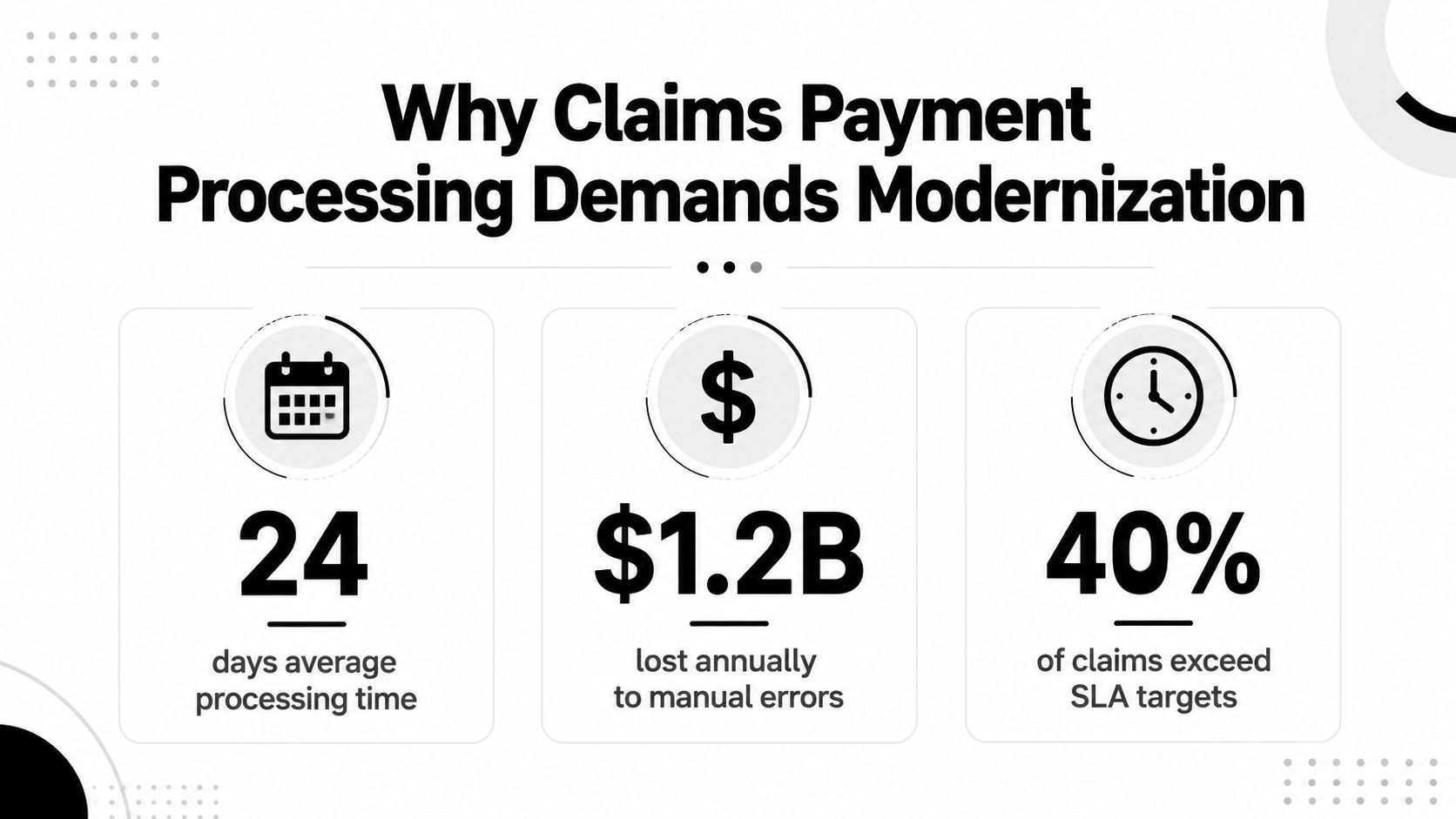
Traditional claims processing still averages 23.9 days from start to settlement, and complex claims can stretch to 34.2 days or more, while paper-based payout timelines can run 30 to 60 days end to end industry compilation. That lag isn't just inconvenient, it's expensive, because manual claims often cost $40 to $60 per claim versus under $20 for automated handling, and only 35% of claims achieve straight-through processing industry compilation. In a market where claimants increasingly expect faster resolution, claims payment processing has become a test of operating discipline, not a back-office afterthought claimant experience statistics.
Why Claims Payment Processing Demands Modernization
The numbers tell the story, but the production reality is even starker. Claims teams don't spend most of their time “paying claims,” they spend it chasing missing references, correcting mismatched records, rekeying payment details, and resolving exceptions that should've been caught earlier. That's why claims payment processing belongs in the same conversation as expense ratios, claimant experience, and settlement quality, because the workflow affects all three.
The real cost of delay
The legacy model was built for checks, batches, and manual review. It still shows up in organizations that treat payment posting as a finance task detached from claims adjudication, which is where cycle time slips. The result is predictable, because if a claim has to move across disconnected systems and then wait for a person to reconcile the payment afterward, the “payment” is really a multi-day workflow with several handoffs.
That gap matters because claimant expectations have moved faster than internal process design. One claims-payment guide says 82% of customers now expect payment within five days, while real-time payments can complete in under 20 seconds settlement claimant experience statistics. When the expectation clock runs in seconds or days and the legacy workflow runs in weeks, modernization stops being a nice-to-have.
Practical rule: If a payment step depends on someone opening a second system to confirm what the first system already knows, that step will become a bottleneck.
Why manual work keeps surviving
Manual claims handling survives because it appears to be the safest option when controls are weak. In practice, it often creates the very risk leaders are trying to avoid, since manual matching increases rework, slows settlement, and makes audit trails harder to maintain. In health insurance alone, insurers adjudicate over three billion medical claims each year, and adjudication costs are estimated at 3% to 6% of practice revenues and premiums, or roughly $150 to $300 billion annually when scaled nationally industry compilation. That scale makes every inefficient handoff visible in aggregate.
The modernization case isn't about replacing judgment. It's about removing repetitive work from skilled handlers so they can focus on exceptions, coverage questions, and recovery decisions. For teams planning that shift, legacy system modernization strategies are only part of the answer, because payment design has to be rebuilt around reconciliation and control, not just speed.
The Complete Claims Payment Workflow
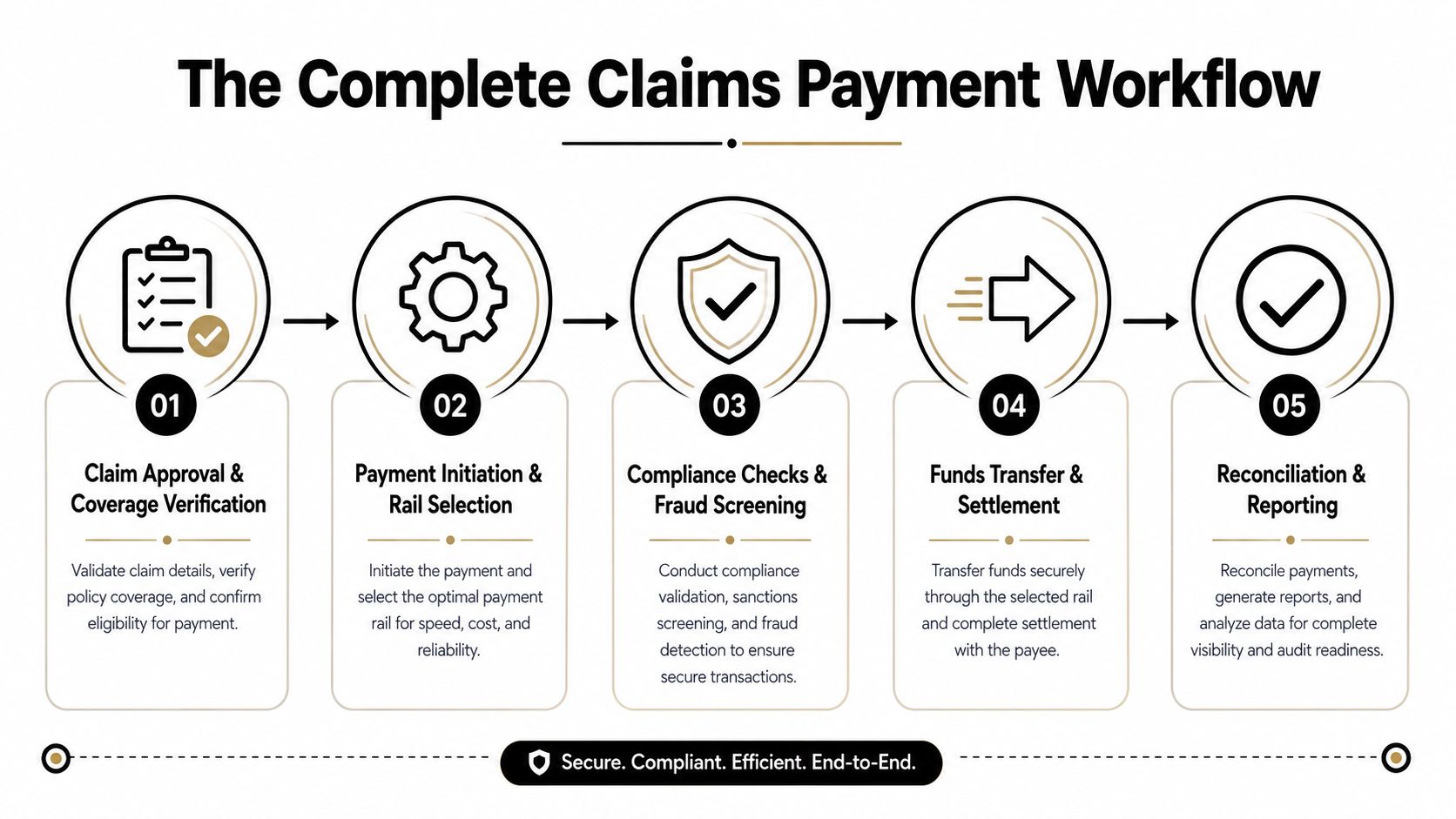
The cleanest payment operations teams I've seen don't think of claims payment processing as a single event. They treat it as a controlled sequence, where each stage has a different owner, different data requirements, and different failure modes. If any one of those stages is vague, the whole workflow gets brittle.
From approval to settlement
The sequence starts with claim approval and coverage verification. That's the point where the handler, adjudication engine, or rules layer confirms that the claim can move forward and that the payment amount is supportable. If the upstream record is incomplete, the payment should not be “rescued” downstream by finance, because that just hides the problem.
Next comes payment initiation and rail selection. The rail should match the claim type, claimant preference, geography, and control requirements. Industry guidance describes the standard order as claim approval, payment initiation, rail selection, settlement, and reconciliation, which is the right model because it forces payment teams to choose the method before money moves, not after insurance payment processing guide.
A payment workflow is only as strong as the metadata that travels with it. If the transaction arrives without a claim reference, you've already created a reconciliation problem.
Settlement is not the finish line
Once funds are transferred, the work isn't done. The technically critical step is automatic reconciliation, which matches the settled payment back to the originating claim, policy, and reserve account using claim metadata insurance payment processing guide. That's what creates the audit trail and closes the loop for back-office control. Without it, the organization can know money left the account, but not whether the right claim was paid, whether the reserve was updated correctly, or whether a duplicate slipped through.
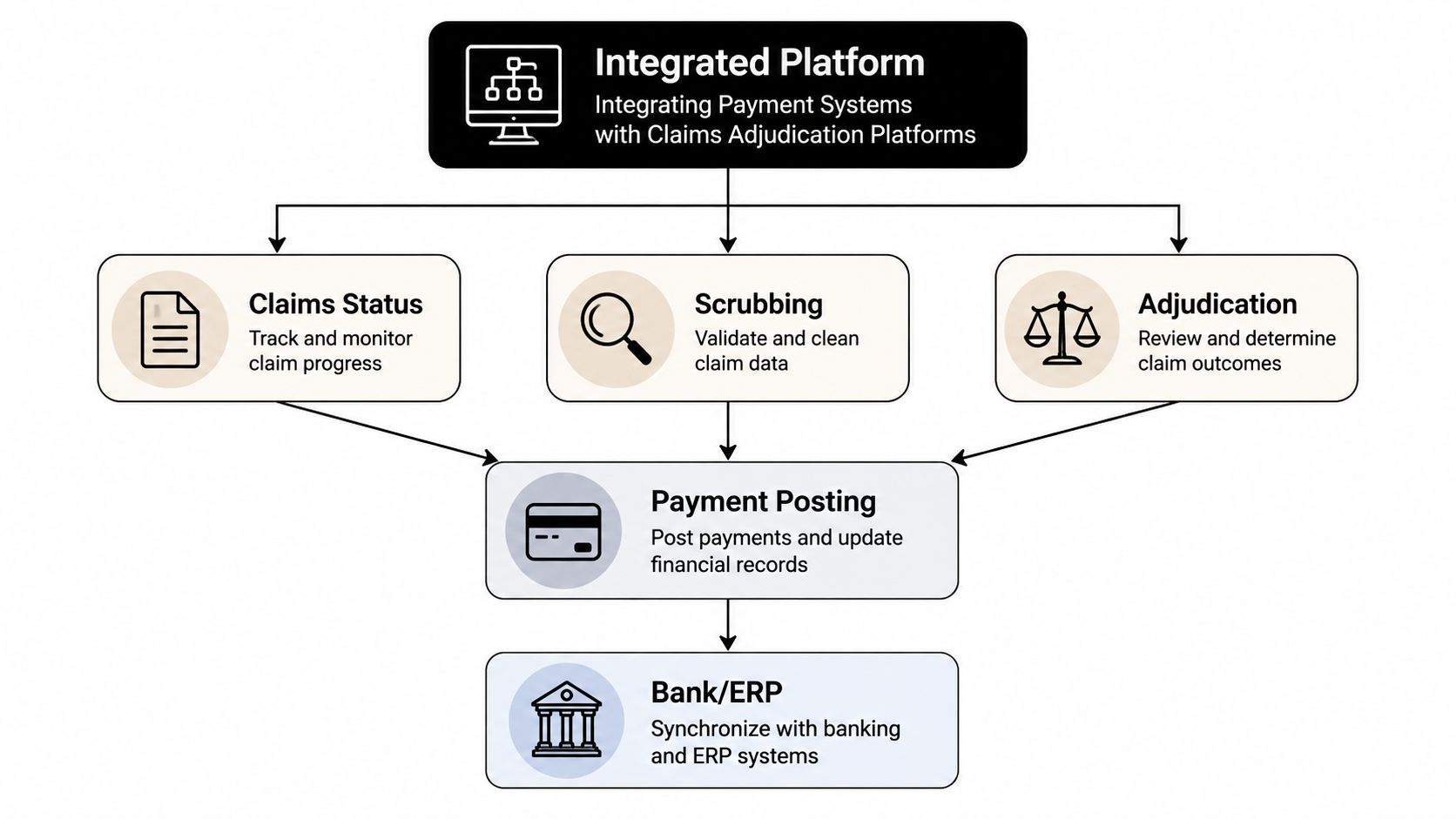
A common production failure is splitting claims adjudication from payment posting. Platforms that combine claims status, scrubbing, adjudication, and automated payment posting in one interface reduce the fragmented handoffs that slow settlement and increase error rates Epic claims platform. That integration doesn't remove human review, it makes review more targeted, because handlers can spend their time on exceptions rather than data hunting.
For teams that want a broader operating model, claims management system guidance is useful only if it's grounded in the same end-to-end record that payment relies on.
A practical sequence looks like this:
Approve the claim against policy and coverage.
Select the payment rail based on claim characteristics.
Send the transaction with complete claim metadata.
Confirm settlement and handle rejects quickly.
Reconcile back to the claim, policy, and reserve.
Choosing the Right Payment Rail for Each Claim Type
There is no universal winner in claims payment processing. The right rail depends on how urgent the settlement is, how much verification the claim needs, how much exception handling the team can absorb, and whether the claimant wants the money delivered that way. Rail selection should be a claims decision first, because the payment method affects service workload, reconciliation quality, and the number of manual touches after the fact.
Compare by claim type, not by habit
Checks still survive in some organizations because they are familiar, but they are expensive and slow to reconcile. Digital methods can reduce processing friction and improve claimant acceptance, with digital payment systems reaching 98% success rates compared with 77% for traditional checks settlement claimant experience statistics. The same source says processing costs can fall from about $4 to $20 per check to $0.26 to $0.50 per digital transaction, which is why the paper default is hard to defend operationally settlement claimant experience statistics.
Payment Rail Comparison by Claim Type | Payment Method | Settlement Speed | Cost per Transaction | Fraud Risk | Best For |
|---|---|---|---|---|---|
Payment Rail Comparison by Claim Type | ACH | Moderate | Lower than checks | Lower than paper if verified | Routine indemnity payments, recurring disbursements |
Payment Rail Comparison by Claim Type | Virtual cards | Fast | Varies by program | Requires strong controls | Supplier-like claim settlements, certain business payments |
Payment Rail Comparison by Claim Type | Digital wallets | Fast | Low relative to paper | Depends on identity checks | Consumer-facing claimants who prefer mobile receipt |
Payment Rail Comparison by Claim Type | Real-time payment networks | Very fast | Low relative to paper | Needs tight verification | Urgent claims, claimant experience priorities |
Payment Rail Comparison by Claim Type | Traditional checks | Slow | Highest operational burden | Higher exception exposure | Edge cases, fallback channels, limited access scenarios |
Let claimant preference shape the final choice
Operational convenience cannot be the only filter. The same industry material says 91% of claimants choose digital payments when offered settlement claimant experience statistics. That matters because a faster internal process that forces the claimant into a slower or more fragile channel still creates avoidable work for service teams.
For a practical walkthrough of bank-transfer mechanics, electronic funds transfer examples are most useful when they are tied to actual exception handling, not generic payment theory. The key decision is whether the claim type needs instant speed, controlled traceability, or broad claimant reach, because different lines of business will value those things differently.
The wrong rail choice usually shows up later as a support ticket, a returned payment, or a broken reconciliation. The best teams ask which method creates the fewest exceptions for this claim population.
Balancing Speed with Payment Integrity and Fraud Controls
Claims payment processing gets harder the moment volume rises and exceptions stop being rare. A fast workflow that cannot reconcile cleanly creates more work later, and the backlog usually lands in operations, finance, and customer service at the same time. I have seen teams move money faster only to spend their next release cycle untangling duplicates, returns, and mismatched references.
Where automation breaks in production
The failure modes are usually mundane, which is part of the problem. A bank account is closed, a payment is returned, two queues touch the same claim and create a duplicate disbursement, or the claim reference does not match the payout record. Once those exceptions stack up, teams end up rebuilding the manual work they tried to remove.
Digital verification and richer payment data should be treated as controls, not optional upgrades. Independent guidance on insurance claims payments emphasizes digital verification, richer payment data, and AI-based fraud screening as insurers expand faster rails and instant payouts. The operational question is whether the payment can be sent safely and reconciled cleanly.
Practical rule: If your exception queue only receives failures after settlement, the process is already too late.
Control Points That Work
The strongest designs catch issues before settlement without turning every claim into a manual review. That means validating account status, checking identity risk, matching claim metadata to the intended payment destination, and screening for suspicious patterns before funds move. It also means routing only true exceptions to people, with enough context to decide whether to retry, escalate, or reverse.
The insurers I have worked with get better results when exception handling is a first-class workflow. Returned payment monitoring, duplicate detection, and post-payment reconciliation all need clear ownership and escalation rules. For teams building that capability, fraud detection in insurance claims matters most when it is tied directly to payment integrity instead of sitting off to the side as a separate program.
One option in this space is autonomous agents in insurance, which can help orchestrate repetitive workflows across claims operations. The value only holds when human review stays in place for edge cases and audit-sensitive decisions, because speed without an audit trail creates its own cleanup work.
Navigating Compliance Requirements and Regulatory Deadlines
Claims payment processing is ruled by deadlines, not moods. The moment you bring in Medicaid, state prompt-pay laws, or CMS documentation rules, the workflow becomes a compliance engine with payment output attached. That changes how systems should be designed, because missing a timer isn't just inefficient, it can create legal and financial exposure.
Deadlines shape the workflow
Under U.S. Medicaid timely-payment rules, a state Medicaid agency must require providers to submit claims no later than 12 months from the date of service, must pay 90% of all clean claims from practitioners in individual or group practice within 30 days of receipt, and must pay 99% within 90 days of receipt 42 CFR 447.45. The same regulation says all other claims must be paid within 12 months of receipt, with limited exceptions for items like retroactive adjustments and certain fraud-related cases 42 CFR 447.45. That's not a loose service target, it's a rule-bound workflow with explicit filing windows and exception categories.
Nevada takes a similarly concrete approach. Insurers and third-party administrators must approve or deny electronically submitted claims within 21 calendar days, or within 30 calendar days for claims submitted by mail or other non-electronic means, and if a claim is approved, payment must be made within the same period after receipt Nevada timely processing requirements. The approval and payment clocks overlap, which is exactly the kind of design constraint that should influence workflow automation and escalation logic.
Compliance has to live inside the system
California Medi-Cal adds another layer of operational pressure. The provider manual says claims must be reimbursed fully or partially within 30 calendar days of receipt, incomplete claims must be noticed no later than 30 calendar days after receipt, and for claims received before January 1, 2026, payers must pay 90% of clean claims within 30 calendar days, 99% within 90 calendar days, and process 95% of all claims within 45 business days California Medi-Cal claims payment requirements. It also specifies late-payment interest of 15% per annum for emergency services in the United States and 15% per annum for all other claims, plus an additional $10 if the interest isn't automatically included in the payment California Medi-Cal claims payment requirements.
CMS documentation rules reinforce the same point. The Medicare Claims Processing Manual requires an Advance Beneficiary Notice before furnishing a requested item when coverage is uncertain, which makes notice and acknowledgement part of the payment workflow rather than a post-denial cleanup step CMS Medicare Claims Processing Manual. In modern claims operations, compliance isn't a checklist outside the system, it is the system.
Integrating Payment Systems with Claims Adjudication Platforms
Integration is where a lot of “automated” claims payment programs fall apart. If the payment platform, adjudication engine, and policy system do not share a common claim identity, the operation ends up with duplicate records, incomplete status updates, and a reconciliation burden that lands back on handlers.
Start with the record, not the rail
The cleanest implementations keep claims status, scrubbing, adjudication, and payment posting in one operational view. That lets handlers see the claim's current state without switching systems and allows payment events to update the same record that drove the decision. It also means the payment system can consume the claim reference, reserve context, and approval outcome without translating between disconnected spreadsheets or email threads.
Guidewire Claim Center is a useful reference point for teams that want the claims record to remain the system of record while payment activity posts back into the same workflow. The integration still has to be strict, because the payment layer needs reliable IDs, timestamps, and status events to preserve the audit trail.
Map the data before you automate the API
The implementation steps are straightforward, but the discipline is not. First, define the canonical claim identifier and make sure it survives from intake through settlement. Second, map all payment fields, including amount, rail, claimant identifier, policy reference, and reserve link, before the first transaction is sent. Third, decide which events push status back to the claims workbench and which ones stay in finance. Finally, test timing conflicts, because payment posting that arrives before adjudication status has been committed is a common source of false exceptions.
Synchronization frequency deserves the same level of attention. Real-time updates reduce stale status, but they also expose race conditions faster, so handlers need exception views that show what is pending and what failed. One common pattern is a claims core like Epic claims platform feeding status to the payment layer while the finance side posts settlement results back into the originating claim record.
A platform such as Nolana AI can sit on top of existing claims and policy systems and automate FNOL intake, claims triage, static claims management, and document processing for Lloyd's market participants while keeping human oversight and auditability intact. That overlay model only works when the integration contract stays strict, because the agentic layer still needs dependable IDs, timestamps, and status events to keep the audit trail intact.
Managing Payment Exceptions and Edge Cases at Scale
Claims payment processing is won or lost in the exception queue. Average payments usually move through the system without much drama, but the cases that fail cause significant operational damage. A closed bank account, a duplicate disbursement, or a payout that no longer matches the claim record can stall settlement, create rework, and expose weak controls. Teams that treat exceptions as a side process usually end up rebuilding the file by hand.
A simple decision tree beats ad hoc judgment
A closed bank account should trigger a defined decision tree, not a thread of emails. The handler needs to know whether the payment can be retried after account verification, whether the claimant needs notification, or whether the transaction must be reversed and reissued through a different rail. The same logic applies to duplicate disbursements, invalid routing numbers, and claim references that do not match payouts. Each failure type calls for a different response, and a generic escalation only adds delay.
Practical rule: Route every exception with the original claim context attached so handlers can decide without rebuilding the file.
That context should include the claim status, payment attempt history, reason codes, and any prior action taken by the payment engine. Without that detail, even a well-run queue turns into manual research. With it, teams can separate simple reversals from cases that need review, and they can keep the audit trail intact when a payment is held, retried, or moved to another rail.
Edge cases need context, not just alerts
The strongest exception queues do more than flag a failure. They show what broke, when it broke, and what the system already tried before the item reached a person. That reduces duplicate work and keeps operators from starting over every time a payment bounces.
It also protects auditability. The organization can show who reviewed the exception, what data they saw, what decision they made, and why the payment was retried, held, or reversed. That record matters when finance, claims, and compliance teams compare notes after a production issue.
AI-based screening helps, but it should stay inside clear controls. It works best alongside deterministic checks for bank validity, duplicate detection, and reference matching, with human review for ambiguous cases. The point is to keep the automation loop tight enough that exceptions do not erase the settlement speed the program was built to gain.
Claims organizations that handle exceptions well do not remove human judgment. They use it where it matters most, and they keep the queue design strict enough that decisions can be made quickly without losing traceability. Nolana AI can sit on top of existing claims and policy systems and support FNOL intake, claims triage, static claims work, and document processing while handlers retain control of final exception decisions.
Traditional claims processing still averages 23.9 days from start to settlement, and complex claims can stretch to 34.2 days or more, while paper-based payout timelines can run 30 to 60 days end to end industry compilation. That lag isn't just inconvenient, it's expensive, because manual claims often cost $40 to $60 per claim versus under $20 for automated handling, and only 35% of claims achieve straight-through processing industry compilation. In a market where claimants increasingly expect faster resolution, claims payment processing has become a test of operating discipline, not a back-office afterthought claimant experience statistics.
Why Claims Payment Processing Demands Modernization
The numbers tell the story, but the production reality is even starker. Claims teams don't spend most of their time “paying claims,” they spend it chasing missing references, correcting mismatched records, rekeying payment details, and resolving exceptions that should've been caught earlier. That's why claims payment processing belongs in the same conversation as expense ratios, claimant experience, and settlement quality, because the workflow affects all three.
The real cost of delay
The legacy model was built for checks, batches, and manual review. It still shows up in organizations that treat payment posting as a finance task detached from claims adjudication, which is where cycle time slips. The result is predictable, because if a claim has to move across disconnected systems and then wait for a person to reconcile the payment afterward, the “payment” is really a multi-day workflow with several handoffs.
That gap matters because claimant expectations have moved faster than internal process design. One claims-payment guide says 82% of customers now expect payment within five days, while real-time payments can complete in under 20 seconds settlement claimant experience statistics. When the expectation clock runs in seconds or days and the legacy workflow runs in weeks, modernization stops being a nice-to-have.
Practical rule: If a payment step depends on someone opening a second system to confirm what the first system already knows, that step will become a bottleneck.
Why manual work keeps surviving
Manual claims handling survives because it appears to be the safest option when controls are weak. In practice, it often creates the very risk leaders are trying to avoid, since manual matching increases rework, slows settlement, and makes audit trails harder to maintain. In health insurance alone, insurers adjudicate over three billion medical claims each year, and adjudication costs are estimated at 3% to 6% of practice revenues and premiums, or roughly $150 to $300 billion annually when scaled nationally industry compilation. That scale makes every inefficient handoff visible in aggregate.
The modernization case isn't about replacing judgment. It's about removing repetitive work from skilled handlers so they can focus on exceptions, coverage questions, and recovery decisions. For teams planning that shift, legacy system modernization strategies are only part of the answer, because payment design has to be rebuilt around reconciliation and control, not just speed.
The Complete Claims Payment Workflow
The cleanest payment operations teams I've seen don't think of claims payment processing as a single event. They treat it as a controlled sequence, where each stage has a different owner, different data requirements, and different failure modes. If any one of those stages is vague, the whole workflow gets brittle.
From approval to settlement
The sequence starts with claim approval and coverage verification. That's the point where the handler, adjudication engine, or rules layer confirms that the claim can move forward and that the payment amount is supportable. If the upstream record is incomplete, the payment should not be “rescued” downstream by finance, because that just hides the problem.
Next comes payment initiation and rail selection. The rail should match the claim type, claimant preference, geography, and control requirements. Industry guidance describes the standard order as claim approval, payment initiation, rail selection, settlement, and reconciliation, which is the right model because it forces payment teams to choose the method before money moves, not after insurance payment processing guide.
A payment workflow is only as strong as the metadata that travels with it. If the transaction arrives without a claim reference, you've already created a reconciliation problem.
Settlement is not the finish line
Once funds are transferred, the work isn't done. The technically critical step is automatic reconciliation, which matches the settled payment back to the originating claim, policy, and reserve account using claim metadata insurance payment processing guide. That's what creates the audit trail and closes the loop for back-office control. Without it, the organization can know money left the account, but not whether the right claim was paid, whether the reserve was updated correctly, or whether a duplicate slipped through.
A common production failure is splitting claims adjudication from payment posting. Platforms that combine claims status, scrubbing, adjudication, and automated payment posting in one interface reduce the fragmented handoffs that slow settlement and increase error rates Epic claims platform. That integration doesn't remove human review, it makes review more targeted, because handlers can spend their time on exceptions rather than data hunting.
For teams that want a broader operating model, claims management system guidance is useful only if it's grounded in the same end-to-end record that payment relies on.
A practical sequence looks like this:
Approve the claim against policy and coverage.
Select the payment rail based on claim characteristics.
Send the transaction with complete claim metadata.
Confirm settlement and handle rejects quickly.
Reconcile back to the claim, policy, and reserve.
Choosing the Right Payment Rail for Each Claim Type
There is no universal winner in claims payment processing. The right rail depends on how urgent the settlement is, how much verification the claim needs, how much exception handling the team can absorb, and whether the claimant wants the money delivered that way. Rail selection should be a claims decision first, because the payment method affects service workload, reconciliation quality, and the number of manual touches after the fact.
Compare by claim type, not by habit
Checks still survive in some organizations because they are familiar, but they are expensive and slow to reconcile. Digital methods can reduce processing friction and improve claimant acceptance, with digital payment systems reaching 98% success rates compared with 77% for traditional checks settlement claimant experience statistics. The same source says processing costs can fall from about $4 to $20 per check to $0.26 to $0.50 per digital transaction, which is why the paper default is hard to defend operationally settlement claimant experience statistics.
Payment Rail Comparison by Claim Type | Payment Method | Settlement Speed | Cost per Transaction | Fraud Risk | Best For |
|---|---|---|---|---|---|
Payment Rail Comparison by Claim Type | ACH | Moderate | Lower than checks | Lower than paper if verified | Routine indemnity payments, recurring disbursements |
Payment Rail Comparison by Claim Type | Virtual cards | Fast | Varies by program | Requires strong controls | Supplier-like claim settlements, certain business payments |
Payment Rail Comparison by Claim Type | Digital wallets | Fast | Low relative to paper | Depends on identity checks | Consumer-facing claimants who prefer mobile receipt |
Payment Rail Comparison by Claim Type | Real-time payment networks | Very fast | Low relative to paper | Needs tight verification | Urgent claims, claimant experience priorities |
Payment Rail Comparison by Claim Type | Traditional checks | Slow | Highest operational burden | Higher exception exposure | Edge cases, fallback channels, limited access scenarios |
Let claimant preference shape the final choice
Operational convenience cannot be the only filter. The same industry material says 91% of claimants choose digital payments when offered settlement claimant experience statistics. That matters because a faster internal process that forces the claimant into a slower or more fragile channel still creates avoidable work for service teams.
For a practical walkthrough of bank-transfer mechanics, electronic funds transfer examples are most useful when they are tied to actual exception handling, not generic payment theory. The key decision is whether the claim type needs instant speed, controlled traceability, or broad claimant reach, because different lines of business will value those things differently.
The wrong rail choice usually shows up later as a support ticket, a returned payment, or a broken reconciliation. The best teams ask which method creates the fewest exceptions for this claim population.
Balancing Speed with Payment Integrity and Fraud Controls
Claims payment processing gets harder the moment volume rises and exceptions stop being rare. A fast workflow that cannot reconcile cleanly creates more work later, and the backlog usually lands in operations, finance, and customer service at the same time. I have seen teams move money faster only to spend their next release cycle untangling duplicates, returns, and mismatched references.
Where automation breaks in production
The failure modes are usually mundane, which is part of the problem. A bank account is closed, a payment is returned, two queues touch the same claim and create a duplicate disbursement, or the claim reference does not match the payout record. Once those exceptions stack up, teams end up rebuilding the manual work they tried to remove.
Digital verification and richer payment data should be treated as controls, not optional upgrades. Independent guidance on insurance claims payments emphasizes digital verification, richer payment data, and AI-based fraud screening as insurers expand faster rails and instant payouts. The operational question is whether the payment can be sent safely and reconciled cleanly.
Practical rule: If your exception queue only receives failures after settlement, the process is already too late.
Control Points That Work
The strongest designs catch issues before settlement without turning every claim into a manual review. That means validating account status, checking identity risk, matching claim metadata to the intended payment destination, and screening for suspicious patterns before funds move. It also means routing only true exceptions to people, with enough context to decide whether to retry, escalate, or reverse.
The insurers I have worked with get better results when exception handling is a first-class workflow. Returned payment monitoring, duplicate detection, and post-payment reconciliation all need clear ownership and escalation rules. For teams building that capability, fraud detection in insurance claims matters most when it is tied directly to payment integrity instead of sitting off to the side as a separate program.
One option in this space is autonomous agents in insurance, which can help orchestrate repetitive workflows across claims operations. The value only holds when human review stays in place for edge cases and audit-sensitive decisions, because speed without an audit trail creates its own cleanup work.
Navigating Compliance Requirements and Regulatory Deadlines
Claims payment processing is ruled by deadlines, not moods. The moment you bring in Medicaid, state prompt-pay laws, or CMS documentation rules, the workflow becomes a compliance engine with payment output attached. That changes how systems should be designed, because missing a timer isn't just inefficient, it can create legal and financial exposure.
Deadlines shape the workflow
Under U.S. Medicaid timely-payment rules, a state Medicaid agency must require providers to submit claims no later than 12 months from the date of service, must pay 90% of all clean claims from practitioners in individual or group practice within 30 days of receipt, and must pay 99% within 90 days of receipt 42 CFR 447.45. The same regulation says all other claims must be paid within 12 months of receipt, with limited exceptions for items like retroactive adjustments and certain fraud-related cases 42 CFR 447.45. That's not a loose service target, it's a rule-bound workflow with explicit filing windows and exception categories.
Nevada takes a similarly concrete approach. Insurers and third-party administrators must approve or deny electronically submitted claims within 21 calendar days, or within 30 calendar days for claims submitted by mail or other non-electronic means, and if a claim is approved, payment must be made within the same period after receipt Nevada timely processing requirements. The approval and payment clocks overlap, which is exactly the kind of design constraint that should influence workflow automation and escalation logic.
Compliance has to live inside the system
California Medi-Cal adds another layer of operational pressure. The provider manual says claims must be reimbursed fully or partially within 30 calendar days of receipt, incomplete claims must be noticed no later than 30 calendar days after receipt, and for claims received before January 1, 2026, payers must pay 90% of clean claims within 30 calendar days, 99% within 90 calendar days, and process 95% of all claims within 45 business days California Medi-Cal claims payment requirements. It also specifies late-payment interest of 15% per annum for emergency services in the United States and 15% per annum for all other claims, plus an additional $10 if the interest isn't automatically included in the payment California Medi-Cal claims payment requirements.
CMS documentation rules reinforce the same point. The Medicare Claims Processing Manual requires an Advance Beneficiary Notice before furnishing a requested item when coverage is uncertain, which makes notice and acknowledgement part of the payment workflow rather than a post-denial cleanup step CMS Medicare Claims Processing Manual. In modern claims operations, compliance isn't a checklist outside the system, it is the system.
Integrating Payment Systems with Claims Adjudication Platforms
Integration is where a lot of “automated” claims payment programs fall apart. If the payment platform, adjudication engine, and policy system do not share a common claim identity, the operation ends up with duplicate records, incomplete status updates, and a reconciliation burden that lands back on handlers.
Start with the record, not the rail
The cleanest implementations keep claims status, scrubbing, adjudication, and payment posting in one operational view. That lets handlers see the claim's current state without switching systems and allows payment events to update the same record that drove the decision. It also means the payment system can consume the claim reference, reserve context, and approval outcome without translating between disconnected spreadsheets or email threads.
Guidewire Claim Center is a useful reference point for teams that want the claims record to remain the system of record while payment activity posts back into the same workflow. The integration still has to be strict, because the payment layer needs reliable IDs, timestamps, and status events to preserve the audit trail.
Map the data before you automate the API
The implementation steps are straightforward, but the discipline is not. First, define the canonical claim identifier and make sure it survives from intake through settlement. Second, map all payment fields, including amount, rail, claimant identifier, policy reference, and reserve link, before the first transaction is sent. Third, decide which events push status back to the claims workbench and which ones stay in finance. Finally, test timing conflicts, because payment posting that arrives before adjudication status has been committed is a common source of false exceptions.
Synchronization frequency deserves the same level of attention. Real-time updates reduce stale status, but they also expose race conditions faster, so handlers need exception views that show what is pending and what failed. One common pattern is a claims core like Epic claims platform feeding status to the payment layer while the finance side posts settlement results back into the originating claim record.
A platform such as Nolana AI can sit on top of existing claims and policy systems and automate FNOL intake, claims triage, static claims management, and document processing for Lloyd's market participants while keeping human oversight and auditability intact. That overlay model only works when the integration contract stays strict, because the agentic layer still needs dependable IDs, timestamps, and status events to keep the audit trail intact.
Managing Payment Exceptions and Edge Cases at Scale
Claims payment processing is won or lost in the exception queue. Average payments usually move through the system without much drama, but the cases that fail cause significant operational damage. A closed bank account, a duplicate disbursement, or a payout that no longer matches the claim record can stall settlement, create rework, and expose weak controls. Teams that treat exceptions as a side process usually end up rebuilding the file by hand.
A simple decision tree beats ad hoc judgment
A closed bank account should trigger a defined decision tree, not a thread of emails. The handler needs to know whether the payment can be retried after account verification, whether the claimant needs notification, or whether the transaction must be reversed and reissued through a different rail. The same logic applies to duplicate disbursements, invalid routing numbers, and claim references that do not match payouts. Each failure type calls for a different response, and a generic escalation only adds delay.
Practical rule: Route every exception with the original claim context attached so handlers can decide without rebuilding the file.
That context should include the claim status, payment attempt history, reason codes, and any prior action taken by the payment engine. Without that detail, even a well-run queue turns into manual research. With it, teams can separate simple reversals from cases that need review, and they can keep the audit trail intact when a payment is held, retried, or moved to another rail.
Edge cases need context, not just alerts
The strongest exception queues do more than flag a failure. They show what broke, when it broke, and what the system already tried before the item reached a person. That reduces duplicate work and keeps operators from starting over every time a payment bounces.
It also protects auditability. The organization can show who reviewed the exception, what data they saw, what decision they made, and why the payment was retried, held, or reversed. That record matters when finance, claims, and compliance teams compare notes after a production issue.
AI-based screening helps, but it should stay inside clear controls. It works best alongside deterministic checks for bank validity, duplicate detection, and reference matching, with human review for ambiguous cases. The point is to keep the automation loop tight enough that exceptions do not erase the settlement speed the program was built to gain.
Claims organizations that handle exceptions well do not remove human judgment. They use it where it matters most, and they keep the queue design strict enough that decisions can be made quickly without losing traceability. Nolana AI can sit on top of existing claims and policy systems and support FNOL intake, claims triage, static claims work, and document processing while handlers retain control of final exception decisions.


All systems operational
1 Lime Street, London EC3M 7HA | 222E 3rd Street, New York 10009
Copyright © 2026, Nolana. All rights reserved
All systems operational
1 Lime Street, London EC3M 7HA | 222E 3rd Street, New York 10009
Copyright © 2026, Nolana. All rights reserved
All systems operational
1 Lime Street, London EC3M 7HA | 222E 3rd Street, New York 10009
Copyright © 2026, Nolana. All rights reserved
All systems operational
1 Lime Street, London EC3M 7HA | 222E 3rd Street, New York 10009
Copyright © 2026, Nolana. All rights reserved