Legacy System Modernization Strategies for 2026
Legacy System Modernization Strategies for 2026
Explore proven legacy system modernization strategies to streamline compliance and reduce costs in regulated enterprises.

Enterprises still spend 60% to 80% of IT budgets maintaining legacy infrastructure, and U.S. federal agencies have been cited at 80% of IT budgets on just ten legacy systems costing $337 million annually to operate, which means modernization is usually a budget reallocation problem, not a pure technology upgrade DreamFactory legacy system modernization statistics. That framing matters because every month spent protecting old code is a month not spent on security, product delivery, or data integration. The core decision is whether to keep funding run cost, or start converting it into capacity.
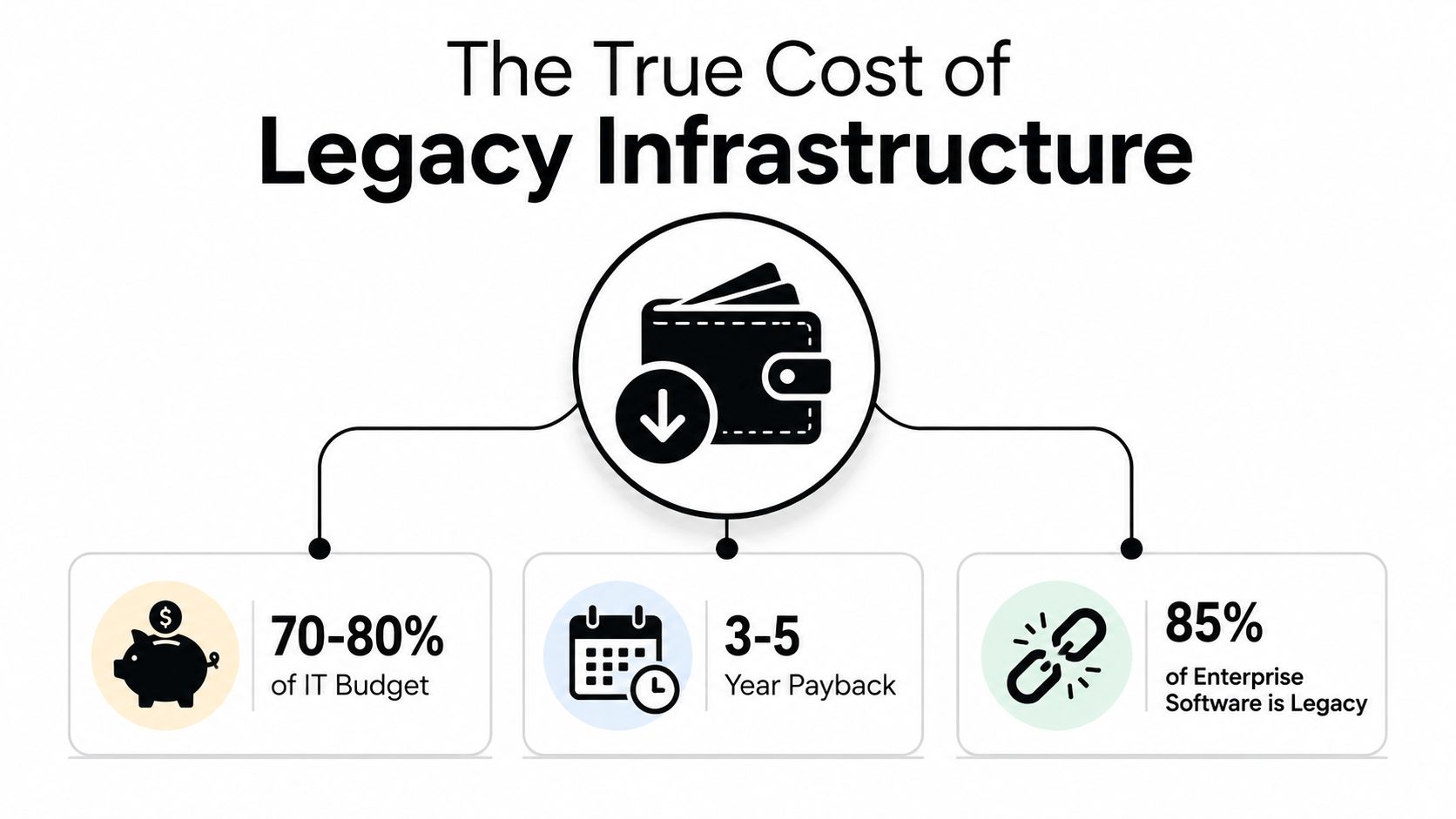
A disciplined modernization program starts with the same question every CFO eventually asks, what's the cost of not changing? Even the market signal is clear, the legacy modernization market was estimated at $24.98 billion in 2025 and projected to reach $56.87 billion by 2030, a 17.92% CAGR projection that tracks with the pressure created by technical debt and aging codebases DreamFactory legacy system modernization statistics. That doesn't mean every system needs a rewrite. It means leaders need a portfolio approach that reduces operational drag first, then targets deeper change where the business case justifies it.
For teams that are also trying to rationalize aging assets, a practical companion is this guide to IT asset lifecycle management, because infrastructure decisions rarely live in isolation. And if the current objective is to lower operating overhead before tackling deep platform work, it's worth aligning modernization with practical ways to reduce operational costs.
The True Cost of Legacy Infrastructure
Legacy infrastructure is expensive in ways that don't always show up in a single budget line. The visible spend is hardware, support contracts, contractors, and maintenance windows. The less visible cost is what the business doesn't ship because the team is busy protecting systems that were never designed for today's pace of change.
Maintenance is the real budget sink
In large organizations, maintenance often dominates IT spend because the legacy estate keeps demanding attention. That doesn't just slow innovation, it creates a recurring trade-off between keeping core services stable and funding anything new. When the estate includes undocumented interfaces and brittle batch jobs, the cost of change rises even further because every modification has to account for unknown dependencies.
A board can usually approve a modernization program once it understands that the question isn't, “Do we want transformation?” It's, “How much of our operating budget do we want to keep trapped in maintenance?” That is why phased modernization, especially rehosting, replatforming, and selective refactoring, is often the most defensible path. Those options attack run cost without demanding a full replacement on day one.
Legacy drag compounds across operations
The problem gets worse when systems age into institutional dependencies. A legacy platform might still work, but it may block security hardening, delay audit responses, or make data integration so difficult that other teams build brittle workarounds around it. Once that happens, the system isn't just old, it's shaping operating behavior across the enterprise.
Practical rule: if a modernization option doesn't reduce either maintenance burden or operational risk, it's probably not the first move.
There's also a sequencing issue. The systems that consume the most attention are often the ones with the most hidden coupling, which is why “big bang” thinking usually fails. SEI/CMU modernization work emphasizes assessment-driven sequencing and incremental transition, not heroic rewrites, because the blast radius of uncertainty is what sinks programs SEI/CMU modernization guidance.
Use the right lens for the cost
For teams trying to estimate whether a legacy estate is worth fixing, focus on three realities, maintenance burden, dependency density, and strategic blockage. If a system is expensive to keep alive and prevents new digital capabilities, it's not just a technical liability, it's a capital allocation problem.
A useful way to think about this is to treat every legacy system as a candidate for one of three outcomes. Some should be stabilized, some should be modernized in place, and some should be retired. That lens keeps leaders from confusing age with urgency and helps them focus on business value instead of nostalgia.
Core Modernization Patterns Explained
The strongest legacy system modernization strategies aren't chosen by fashion, they're chosen by risk tolerance, dependency shape, and how much disruption the business can accept. AWS's 7 Rs framework, rehost, replatform, repurchase, refactor, rearchitect, relocate, retain, and retire, is a useful vocabulary for that decision AWS-aligned modernization pattern framing. IBM's definitions make the practical distinction clear, rehosting moves an application to a new environment with minimal code changes, while refactoring restructures code to improve performance and maintainability without changing core functionality IBM legacy application modernization.
Match the pattern to the system
Rehosting works when the priority is speed and infrastructure relief. It's the classic “lift and shift” move, and it's often the safest first step when the business can't tolerate major behavior changes. Replatforming goes one layer deeper, useful when the underlying architecture still holds up but parts of the runtime or database layer need modernization.
Refactoring is the right call when the code is stable enough to preserve but messy enough to slow delivery. It's slower than rehosting, but it pays off when maintainability matters and the application has a long future ahead. Replace or repurchase fits systems that are generic enough to map to a commercial product, while retain and retire are the correct answers far more often than vendors like to admit.
Strangler patterns reduce blast radius
For large estates, the strangler-style approach is usually safer than a wholesale rewrite. Expose a small, versioned API or service boundary, run legacy and modern components in parallel, compare outputs under controlled conditions, then cut over consumers in groups with rollback capability practical strangler modernization guide. That model preserves continuity and makes it possible to modernize piece by piece instead of betting the business on one cutover weekend.
Don't start with the hardest module. Start with the boundary that gives you the most control over behavior and rollback.
There are also integration techniques that help when the core system can't move yet. A Carnegie Mellon survey catalogues screen scraping, database gateway, XML integration, database replication, CGI integration, object-oriented wrapping, and componentization as concrete options for bridging old and new estates Carnegie Mellon legacy modernization survey. Those aren't elegant, but they can buy time and reduce operational friction while a deeper roadmap is prepared.
Modernization pattern comparison
Pattern | Risk Level | Business Disruption | Best Use Case |
|---|---|---|---|
Rehost | Low | Low | Fast infrastructure relief, minimal code change |
Replatform | Low to medium | Low to medium | Preserve core logic while improving runtime or database layers |
Refactor | Medium | Medium | Improve maintainability without altering core behavior |
Replace | Medium to high | High | Generic capability that a SaaS product can truly cover |
Encapsulate | Low to medium | Low | Expose legacy functions without immediate rewrite |
Strangler approach | Medium | Low to medium | Incremental transition of high-value systems |
If you're aligning these patterns with broader architecture work, the thinking around microservices architecture patterns is useful, but only after you've decided what needs to change. Architecture should serve the migration plan, not dictate it.
Building Your Modernization Decision Framework
The first serious step is portfolio assessment. Classify systems by business criticality, technical debt, and dependency density, because hidden coupling and undocumented interfaces are what turn otherwise manageable programs into failures. If a system touches revenue, compliance, or downstream analytics, it deserves a different level of scrutiny than a low-value internal utility.
Start with dependency mapping
Dependency mapping is not just an inventory exercise. It's the process of finding every downstream report, batch job, interface, and manual workaround that depends on a system, then deciding which of those ties are business-critical. That's how you spot where a “small” change could become an enterprise event.
A good map includes technical dependencies and operational ones. Legacy systems often survive because one team's shortcut has become another team's daily process. The map should show both, or the roadmap will be incomplete.
Rule of thumb: if two teams describe the same system differently, the data model and the operating model probably disagree too.
Score systems before you sequence them
Use a risk score that weighs business value against complexity and fragility. Systems with high criticality and high dependency density but poor maintainability belong near the front of the modernization queue. Systems that are stable, low-value, or redundant belong in the stabilize-or-retire bucket.
This is also where many programs go wrong, because leaders try to modernize based on visible pain instead of portfolio impact. Visible pain may be loud, but it isn't always the right priority. The better approach is to sequence by business consequence, not by whichever team complains the loudest.
The simplest decision model is directional. High-value, high-risk systems get modernized. Low-value, high-cost systems get retired. Stable systems get retained until there's a real reason to move them. That logic is boring, and boring is good in regulated environments.
Build waves, not one giant program
Phased waves are the only realistic way to modernize a complex estate. Group systems by shared dependencies, modernize the least risky components first, and keep every wave independently testable and reversible. That structure lets you prove value early while learning where the hidden coupling really lives.
For teams working on regulated digital services, it helps to tie the roadmap to broader platform goals, which is why digital insurance platform patterns often show up alongside modernization roadmaps. The point isn't to chase a new platform label. It's to ensure the new operating model can support the business once the old one starts to come apart.
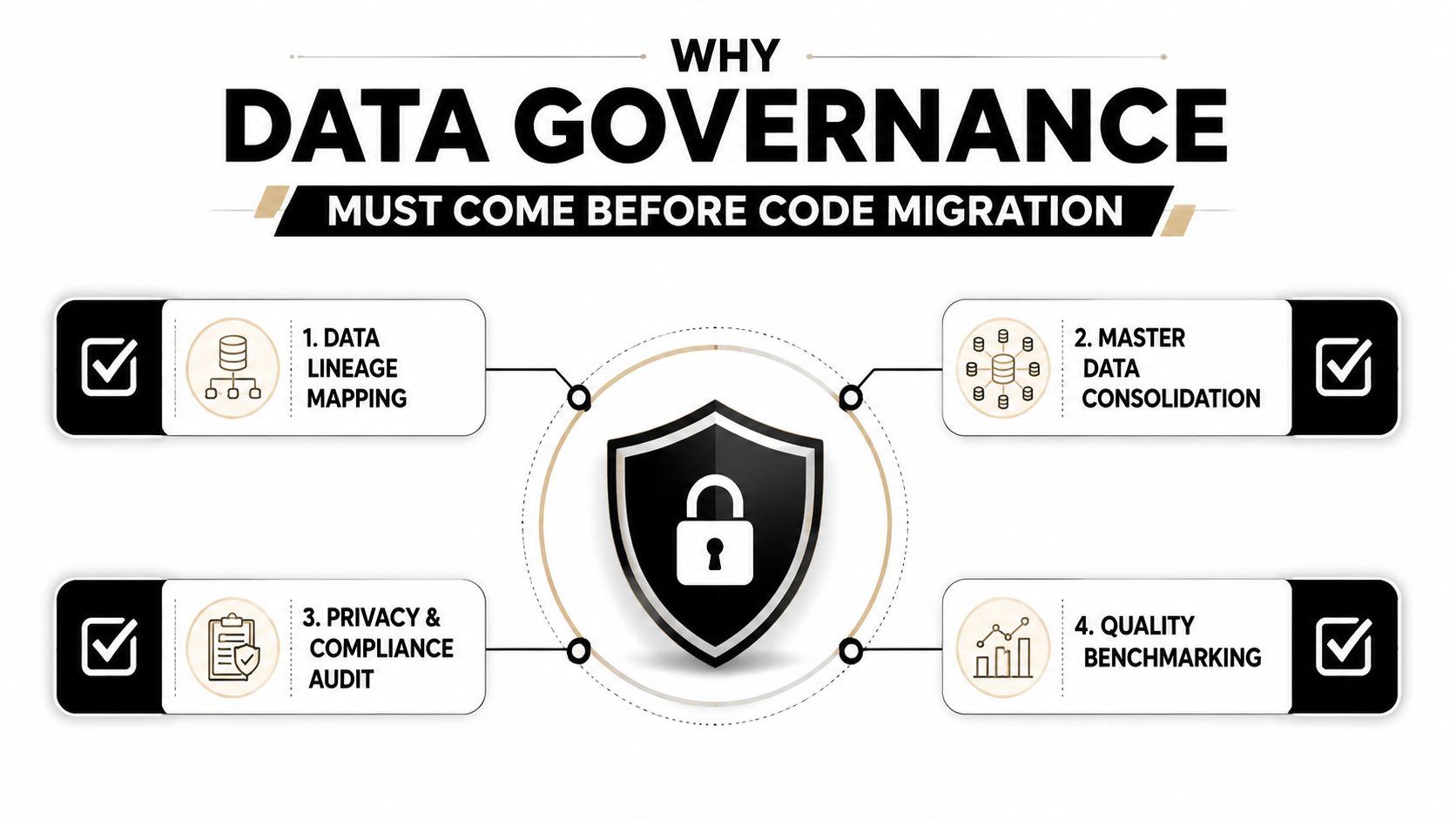
Why Data Governance Must Come Before Code Migration
Modernization fails for a predictable reason, teams treat it like an application problem when the bottleneck is often data governance. If source systems are fragmented, data definitions differ across business units, or ownership is unclear, code migration only moves the confusion into new infrastructure. Industry guidance from firms like Deloitte and EPAM makes the same point, maturity assessment, clear data ownership, and a common data language have to come before large-scale migration work Deloitte legacy system modernization guidance.
Clean the data model before the code moves
Start by inventorying data dependencies, then identify which definitions are authoritative and which are duplicated or local to a specific business unit. If the same field means three different things in three systems, migration will not fix that ambiguity. It will preserve it in a faster stack.
The practical checklist is simple. Map lineage, consolidate master data where it's fragmented, run privacy and compliance checks, and benchmark quality before any migration wave begins. A focused data quality improvement process helps establish the baseline, so the business can trust the target state and avoid expensive rework when downstream reports do not reconcile.
Ownership matters more than tooling
A common mistake is assuming governance will appear once the new platform is live. It won't. Someone has to own the data definitions, someone has to approve exceptions, and someone has to decide what the source of truth is when business units disagree.
That becomes even more important where AI or automation is involved. Trusted automation needs trusted data, and a modern interface does not compensate for contradictory records or unclear lineage. If the source cannot be trusted, the output will not be trusted either.
The best programs separate operational workflows from product innovation early. That gives teams room to stabilize the data foundation while still moving ahead with customer-facing improvements. In regulated environments, that separation also makes audit and control responsibilities much clearer.
How Agentic AI Accelerates Safe Modernization
Agentic AI can act as a modernization layer without replacing the core system underneath it. In insurance operations, that matters because the business still needs the claims platform to stay live while the operating model changes around it. One example is Nolana, an agentic AI platform built for the Lloyd's market that automates claims lifecycle operations, including FNOL intake, claims triage, static claims management, and document processing, while sitting on top of existing claims and policy systems.
The operating layer changes first
That pattern is useful because it reduces the pressure to rip out the core just to improve service quality. Instead of forcing handlers to switch systems, an AI layer can orchestrate work across the channels already in use, email, web forms, live chat, and voice, while synchronizing updates back to the legacy backend through APIs. The business sees faster handling and better consistency, but the core platform stays in place.
Delegated authority triage is a good example of where this pays off. An AI agent can extract claim details from incoming messages, check them against thresholds, auto-approve, reject, or escalate, and update the underlying system with full auditability. That doesn't eliminate the legacy estate, it reduces the amount of manual effort tied to it.
Human oversight keeps the risk bounded
The value of this pattern isn't autonomy for its own sake. It's controlled automation with human oversight, explainability, and audit trails built in from the beginning. In regulated markets, that control is the difference between a useful operational layer and a compliance problem waiting to happen.
Automation is safest when it replaces repetitive handling, not accountability.
Nolana's position in the market is as a platform that works on top of existing systems, which is exactly why it fits modernization programs that can't afford a core replacement before the operating model improves. The point is not to displace every legacy workflow at once. The point is to create a modern execution layer that makes the legacy core less central to day-to-day work.
The broader takeaway is simple. Agentic AI can shorten the path to value when the constraint is operational throughput, document handling, or routing consistency. What agentic AI means in practice becomes easier to understand when it's used as a controlled bridge between old systems and new workflows, not as a replacement fantasy.
Common Modernization Pitfalls and How to Avoid Them
The costliest modernization failures usually start with assumptions, not code quality. Teams assume they have mapped every dependency, assume a lift-and-shift will fix operational pain, or assume change management can wait until after go-live. Those assumptions produce predictable failure modes, and they are expensive to unwind once production is live.

Big rewrites fail for structural reasons
Big-bang rewrites usually run into hidden dependencies that nobody planned for. In older estates, undocumented behavior often lives in database logic, report jobs, batch integrations, or custom routines that have been stable for years because no one has touched them. That is why incremental transition is usually safer than a full replacement when coupling is not fully understood.
The practical response is to modernize in slices. Put a boundary around a small part of the estate, validate the output, and expand only after the team has seen how the system behaves under real load and real exceptions. This takes longer at the start, but it avoids rebuilding the same problems twice.
Lift and shift is not a finish line
Rehosting has a place, but it does not solve the underlying problem by itself. If the original system was brittle, poorly governed, or hard to operate, those weaknesses usually follow it into the new environment. The business may leave old hardware behind, but maintainability and operational risk stay intact.
Treat rehosting as a tactical move. Once the workload is stable in the new environment, the team can decide whether to replatform, refactor, or leave the application in place for longer. That sequence keeps the business steady while preventing the false assumption that a move automatically means modernization.
Change management can't be an afterthought
Technically sound programs still fail when users are not prepared for new workflows, screens, or escalation paths. Over time, people build workarounds around legacy systems, and modernization breaks those habits whether the team planned for it or not. If the rollout changes how work gets done, training needs to happen before cutover, not after the complaints start.
Parallel run periods and rollback criteria need to be defined early. Teams should know how long old and new systems will run together, what conditions trigger a rollback, and who makes that call. Without that discipline, even a small incident can turn into a major outage.
Data governance is part of the migration plan
A lot of modernization pain shows up first as data inconsistency. If source systems disagree on customer records, account status, or transaction history, the migration team cannot treat that as a later cleanup task. The governance model has to define which system is authoritative, how exceptions are handled, and how audit trails are preserved while legacy and modern workflows coexist.
That is where a platform like Nolana fits into incremental modernization. It can sit on top of existing systems, enforce workflow controls, and keep operational continuity intact while the core estate changes in smaller steps. The point is to reduce the amount of manual reconciliation tied to legacy processes, not to pretend the legacy core disappears on day one.
Human oversight keeps the risk bounded
Automation is safest when it handles repetitive processing, not accountability. In regulated environments, the goal is controlled execution with explainability and audit trails built in from the start. That keeps modernization from turning into a compliance problem disguised as efficiency.
The trade-off is clear. If a process affects approvals, exceptions, or regulated records, the team needs human oversight at the point where judgment matters. Agentic AI can help route work, check claims against policy, and update systems with full traceability, but the business still owns the decision rights.
A useful way to avoid the common traps is to compare the pitfall with the operating response before work begins. A comparison chart showing common software modernization pitfalls versus recommended solutions for digital transformation projects. Simple planning mistakes become expensive when they are discovered in production.
Designing Your Migration Roadmap and Governance Model
A good roadmap is less about phases on a slide and more about making every phase reversible. Start with assessment, then planning, incremental execution, validation, and cutover, and place a governance checkpoint at each transition. That gives auditors, business owners, and technical teams a shared view of what “ready” means.
Define the controls up front
Parallel running needs service-level objectives, observability, and data reconciliation rules before it begins. If the legacy and modern systems disagree, the team should already know which one is authoritative, how long discrepancies can exist, and when the issue becomes a rollback event. Those decisions should be made before production pressure enters the room.
Rollback procedures deserve the same treatment. They need to be specific enough that an operations lead can execute them without improvising under pressure. In regulated industries, that clarity is what keeps a difficult migration from becoming a compliance incident.
Governance should decide, not just review
A governance board that only signs papers after the fact isn't governing anything. It should own decision rights around sequencing, risk acceptance, exception handling, and cutover readiness. That keeps product, operations, security, and compliance aligned around one migration calendar instead of four separate priorities.
A useful way to manage cost and risk is to be explicit about where deeper refactoring is worth it and where rehosting is enough. Not every system deserves architectural surgery. Some systems only need a safer runtime, while others need real code change because their long-term cost would stay high otherwise.
Make the roadmap operationally believable
The best roadmap reads like a delivery plan, not an aspiration. It should name the wave boundaries, the validation gates, the rollback triggers, and the sign-off owners for each stage. If those details are missing, the plan isn't ready yet.
When the estate spans several business units, the roadmap also needs stakeholder alignment work baked into it. That means regular review cycles, explicit decision owners, and a standard way to escalate conflicts. Without that, the migration slows down every time priorities collide.
Key Takeaways for Modernization Leaders
The most important shift is mental. Legacy system modernization strategies work best when leaders treat modernization as a budget reallocation and operational continuity problem, not a one-time technical overhaul. Maintenance burden, hidden coupling, and governance gaps shape the outcome as much as architecture does.
A practical decision checklist looks like this.
Classify the portfolio first. Score systems by criticality, debt, and dependency density before touching code.
Choose the least disruptive effective pattern. Rehost, replatform, refactor, replace, encapsulate, or strangler, depending on the system's role.
Put data governance ahead of migration. Clean lineage, ownership, and quality issues before moving workloads.
Modernize in waves. Avoid big-bang rewrites unless the system is isolated and low risk.
Use AI where it reduces operational drag. An orchestration layer can improve continuity without forcing a core replacement.
The leaders who do this well build modernization as an ongoing capability. They keep the legacy estate under active management, not passive hope, and they use each wave to reduce run cost, improve trust in data, and lower the risk of change. That's the difference between modernizing a system and modernizing the organization around it.
If your claims operation still depends on fragile legacy workflows, Nolana AI can help you add a controlled agentic layer on top of what you already run, without forcing a core replacement. It automates claims intake, triage, document handling, and lifecycle work while keeping human oversight and auditability intact. Visit Nolana AI to see how that approach can support safer modernization and stronger operational control.
Enterprises still spend 60% to 80% of IT budgets maintaining legacy infrastructure, and U.S. federal agencies have been cited at 80% of IT budgets on just ten legacy systems costing $337 million annually to operate, which means modernization is usually a budget reallocation problem, not a pure technology upgrade DreamFactory legacy system modernization statistics. That framing matters because every month spent protecting old code is a month not spent on security, product delivery, or data integration. The core decision is whether to keep funding run cost, or start converting it into capacity.
A disciplined modernization program starts with the same question every CFO eventually asks, what's the cost of not changing? Even the market signal is clear, the legacy modernization market was estimated at $24.98 billion in 2025 and projected to reach $56.87 billion by 2030, a 17.92% CAGR projection that tracks with the pressure created by technical debt and aging codebases DreamFactory legacy system modernization statistics. That doesn't mean every system needs a rewrite. It means leaders need a portfolio approach that reduces operational drag first, then targets deeper change where the business case justifies it.
For teams that are also trying to rationalize aging assets, a practical companion is this guide to IT asset lifecycle management, because infrastructure decisions rarely live in isolation. And if the current objective is to lower operating overhead before tackling deep platform work, it's worth aligning modernization with practical ways to reduce operational costs.
The True Cost of Legacy Infrastructure
Legacy infrastructure is expensive in ways that don't always show up in a single budget line. The visible spend is hardware, support contracts, contractors, and maintenance windows. The less visible cost is what the business doesn't ship because the team is busy protecting systems that were never designed for today's pace of change.
Maintenance is the real budget sink
In large organizations, maintenance often dominates IT spend because the legacy estate keeps demanding attention. That doesn't just slow innovation, it creates a recurring trade-off between keeping core services stable and funding anything new. When the estate includes undocumented interfaces and brittle batch jobs, the cost of change rises even further because every modification has to account for unknown dependencies.
A board can usually approve a modernization program once it understands that the question isn't, “Do we want transformation?” It's, “How much of our operating budget do we want to keep trapped in maintenance?” That is why phased modernization, especially rehosting, replatforming, and selective refactoring, is often the most defensible path. Those options attack run cost without demanding a full replacement on day one.
Legacy drag compounds across operations
The problem gets worse when systems age into institutional dependencies. A legacy platform might still work, but it may block security hardening, delay audit responses, or make data integration so difficult that other teams build brittle workarounds around it. Once that happens, the system isn't just old, it's shaping operating behavior across the enterprise.
Practical rule: if a modernization option doesn't reduce either maintenance burden or operational risk, it's probably not the first move.
There's also a sequencing issue. The systems that consume the most attention are often the ones with the most hidden coupling, which is why “big bang” thinking usually fails. SEI/CMU modernization work emphasizes assessment-driven sequencing and incremental transition, not heroic rewrites, because the blast radius of uncertainty is what sinks programs SEI/CMU modernization guidance.
Use the right lens for the cost
For teams trying to estimate whether a legacy estate is worth fixing, focus on three realities, maintenance burden, dependency density, and strategic blockage. If a system is expensive to keep alive and prevents new digital capabilities, it's not just a technical liability, it's a capital allocation problem.
A useful way to think about this is to treat every legacy system as a candidate for one of three outcomes. Some should be stabilized, some should be modernized in place, and some should be retired. That lens keeps leaders from confusing age with urgency and helps them focus on business value instead of nostalgia.
Core Modernization Patterns Explained
The strongest legacy system modernization strategies aren't chosen by fashion, they're chosen by risk tolerance, dependency shape, and how much disruption the business can accept. AWS's 7 Rs framework, rehost, replatform, repurchase, refactor, rearchitect, relocate, retain, and retire, is a useful vocabulary for that decision AWS-aligned modernization pattern framing. IBM's definitions make the practical distinction clear, rehosting moves an application to a new environment with minimal code changes, while refactoring restructures code to improve performance and maintainability without changing core functionality IBM legacy application modernization.
Match the pattern to the system
Rehosting works when the priority is speed and infrastructure relief. It's the classic “lift and shift” move, and it's often the safest first step when the business can't tolerate major behavior changes. Replatforming goes one layer deeper, useful when the underlying architecture still holds up but parts of the runtime or database layer need modernization.
Refactoring is the right call when the code is stable enough to preserve but messy enough to slow delivery. It's slower than rehosting, but it pays off when maintainability matters and the application has a long future ahead. Replace or repurchase fits systems that are generic enough to map to a commercial product, while retain and retire are the correct answers far more often than vendors like to admit.
Strangler patterns reduce blast radius
For large estates, the strangler-style approach is usually safer than a wholesale rewrite. Expose a small, versioned API or service boundary, run legacy and modern components in parallel, compare outputs under controlled conditions, then cut over consumers in groups with rollback capability practical strangler modernization guide. That model preserves continuity and makes it possible to modernize piece by piece instead of betting the business on one cutover weekend.
Don't start with the hardest module. Start with the boundary that gives you the most control over behavior and rollback.
There are also integration techniques that help when the core system can't move yet. A Carnegie Mellon survey catalogues screen scraping, database gateway, XML integration, database replication, CGI integration, object-oriented wrapping, and componentization as concrete options for bridging old and new estates Carnegie Mellon legacy modernization survey. Those aren't elegant, but they can buy time and reduce operational friction while a deeper roadmap is prepared.
Modernization pattern comparison
Pattern | Risk Level | Business Disruption | Best Use Case |
|---|---|---|---|
Rehost | Low | Low | Fast infrastructure relief, minimal code change |
Replatform | Low to medium | Low to medium | Preserve core logic while improving runtime or database layers |
Refactor | Medium | Medium | Improve maintainability without altering core behavior |
Replace | Medium to high | High | Generic capability that a SaaS product can truly cover |
Encapsulate | Low to medium | Low | Expose legacy functions without immediate rewrite |
Strangler approach | Medium | Low to medium | Incremental transition of high-value systems |
If you're aligning these patterns with broader architecture work, the thinking around microservices architecture patterns is useful, but only after you've decided what needs to change. Architecture should serve the migration plan, not dictate it.
Building Your Modernization Decision Framework
The first serious step is portfolio assessment. Classify systems by business criticality, technical debt, and dependency density, because hidden coupling and undocumented interfaces are what turn otherwise manageable programs into failures. If a system touches revenue, compliance, or downstream analytics, it deserves a different level of scrutiny than a low-value internal utility.
Start with dependency mapping
Dependency mapping is not just an inventory exercise. It's the process of finding every downstream report, batch job, interface, and manual workaround that depends on a system, then deciding which of those ties are business-critical. That's how you spot where a “small” change could become an enterprise event.
A good map includes technical dependencies and operational ones. Legacy systems often survive because one team's shortcut has become another team's daily process. The map should show both, or the roadmap will be incomplete.
Rule of thumb: if two teams describe the same system differently, the data model and the operating model probably disagree too.
Score systems before you sequence them
Use a risk score that weighs business value against complexity and fragility. Systems with high criticality and high dependency density but poor maintainability belong near the front of the modernization queue. Systems that are stable, low-value, or redundant belong in the stabilize-or-retire bucket.
This is also where many programs go wrong, because leaders try to modernize based on visible pain instead of portfolio impact. Visible pain may be loud, but it isn't always the right priority. The better approach is to sequence by business consequence, not by whichever team complains the loudest.
The simplest decision model is directional. High-value, high-risk systems get modernized. Low-value, high-cost systems get retired. Stable systems get retained until there's a real reason to move them. That logic is boring, and boring is good in regulated environments.
Build waves, not one giant program
Phased waves are the only realistic way to modernize a complex estate. Group systems by shared dependencies, modernize the least risky components first, and keep every wave independently testable and reversible. That structure lets you prove value early while learning where the hidden coupling really lives.
For teams working on regulated digital services, it helps to tie the roadmap to broader platform goals, which is why digital insurance platform patterns often show up alongside modernization roadmaps. The point isn't to chase a new platform label. It's to ensure the new operating model can support the business once the old one starts to come apart.
Why Data Governance Must Come Before Code Migration
Modernization fails for a predictable reason, teams treat it like an application problem when the bottleneck is often data governance. If source systems are fragmented, data definitions differ across business units, or ownership is unclear, code migration only moves the confusion into new infrastructure. Industry guidance from firms like Deloitte and EPAM makes the same point, maturity assessment, clear data ownership, and a common data language have to come before large-scale migration work Deloitte legacy system modernization guidance.
Clean the data model before the code moves
Start by inventorying data dependencies, then identify which definitions are authoritative and which are duplicated or local to a specific business unit. If the same field means three different things in three systems, migration will not fix that ambiguity. It will preserve it in a faster stack.
The practical checklist is simple. Map lineage, consolidate master data where it's fragmented, run privacy and compliance checks, and benchmark quality before any migration wave begins. A focused data quality improvement process helps establish the baseline, so the business can trust the target state and avoid expensive rework when downstream reports do not reconcile.
Ownership matters more than tooling
A common mistake is assuming governance will appear once the new platform is live. It won't. Someone has to own the data definitions, someone has to approve exceptions, and someone has to decide what the source of truth is when business units disagree.
That becomes even more important where AI or automation is involved. Trusted automation needs trusted data, and a modern interface does not compensate for contradictory records or unclear lineage. If the source cannot be trusted, the output will not be trusted either.
The best programs separate operational workflows from product innovation early. That gives teams room to stabilize the data foundation while still moving ahead with customer-facing improvements. In regulated environments, that separation also makes audit and control responsibilities much clearer.
How Agentic AI Accelerates Safe Modernization
Agentic AI can act as a modernization layer without replacing the core system underneath it. In insurance operations, that matters because the business still needs the claims platform to stay live while the operating model changes around it. One example is Nolana, an agentic AI platform built for the Lloyd's market that automates claims lifecycle operations, including FNOL intake, claims triage, static claims management, and document processing, while sitting on top of existing claims and policy systems.
The operating layer changes first
That pattern is useful because it reduces the pressure to rip out the core just to improve service quality. Instead of forcing handlers to switch systems, an AI layer can orchestrate work across the channels already in use, email, web forms, live chat, and voice, while synchronizing updates back to the legacy backend through APIs. The business sees faster handling and better consistency, but the core platform stays in place.
Delegated authority triage is a good example of where this pays off. An AI agent can extract claim details from incoming messages, check them against thresholds, auto-approve, reject, or escalate, and update the underlying system with full auditability. That doesn't eliminate the legacy estate, it reduces the amount of manual effort tied to it.
Human oversight keeps the risk bounded
The value of this pattern isn't autonomy for its own sake. It's controlled automation with human oversight, explainability, and audit trails built in from the beginning. In regulated markets, that control is the difference between a useful operational layer and a compliance problem waiting to happen.
Automation is safest when it replaces repetitive handling, not accountability.
Nolana's position in the market is as a platform that works on top of existing systems, which is exactly why it fits modernization programs that can't afford a core replacement before the operating model improves. The point is not to displace every legacy workflow at once. The point is to create a modern execution layer that makes the legacy core less central to day-to-day work.
The broader takeaway is simple. Agentic AI can shorten the path to value when the constraint is operational throughput, document handling, or routing consistency. What agentic AI means in practice becomes easier to understand when it's used as a controlled bridge between old systems and new workflows, not as a replacement fantasy.
Common Modernization Pitfalls and How to Avoid Them
The costliest modernization failures usually start with assumptions, not code quality. Teams assume they have mapped every dependency, assume a lift-and-shift will fix operational pain, or assume change management can wait until after go-live. Those assumptions produce predictable failure modes, and they are expensive to unwind once production is live.
Big rewrites fail for structural reasons
Big-bang rewrites usually run into hidden dependencies that nobody planned for. In older estates, undocumented behavior often lives in database logic, report jobs, batch integrations, or custom routines that have been stable for years because no one has touched them. That is why incremental transition is usually safer than a full replacement when coupling is not fully understood.
The practical response is to modernize in slices. Put a boundary around a small part of the estate, validate the output, and expand only after the team has seen how the system behaves under real load and real exceptions. This takes longer at the start, but it avoids rebuilding the same problems twice.
Lift and shift is not a finish line
Rehosting has a place, but it does not solve the underlying problem by itself. If the original system was brittle, poorly governed, or hard to operate, those weaknesses usually follow it into the new environment. The business may leave old hardware behind, but maintainability and operational risk stay intact.
Treat rehosting as a tactical move. Once the workload is stable in the new environment, the team can decide whether to replatform, refactor, or leave the application in place for longer. That sequence keeps the business steady while preventing the false assumption that a move automatically means modernization.
Change management can't be an afterthought
Technically sound programs still fail when users are not prepared for new workflows, screens, or escalation paths. Over time, people build workarounds around legacy systems, and modernization breaks those habits whether the team planned for it or not. If the rollout changes how work gets done, training needs to happen before cutover, not after the complaints start.
Parallel run periods and rollback criteria need to be defined early. Teams should know how long old and new systems will run together, what conditions trigger a rollback, and who makes that call. Without that discipline, even a small incident can turn into a major outage.
Data governance is part of the migration plan
A lot of modernization pain shows up first as data inconsistency. If source systems disagree on customer records, account status, or transaction history, the migration team cannot treat that as a later cleanup task. The governance model has to define which system is authoritative, how exceptions are handled, and how audit trails are preserved while legacy and modern workflows coexist.
That is where a platform like Nolana fits into incremental modernization. It can sit on top of existing systems, enforce workflow controls, and keep operational continuity intact while the core estate changes in smaller steps. The point is to reduce the amount of manual reconciliation tied to legacy processes, not to pretend the legacy core disappears on day one.
Human oversight keeps the risk bounded
Automation is safest when it handles repetitive processing, not accountability. In regulated environments, the goal is controlled execution with explainability and audit trails built in from the start. That keeps modernization from turning into a compliance problem disguised as efficiency.
The trade-off is clear. If a process affects approvals, exceptions, or regulated records, the team needs human oversight at the point where judgment matters. Agentic AI can help route work, check claims against policy, and update systems with full traceability, but the business still owns the decision rights.
A useful way to avoid the common traps is to compare the pitfall with the operating response before work begins. A comparison chart showing common software modernization pitfalls versus recommended solutions for digital transformation projects. Simple planning mistakes become expensive when they are discovered in production.
Designing Your Migration Roadmap and Governance Model
A good roadmap is less about phases on a slide and more about making every phase reversible. Start with assessment, then planning, incremental execution, validation, and cutover, and place a governance checkpoint at each transition. That gives auditors, business owners, and technical teams a shared view of what “ready” means.
Define the controls up front
Parallel running needs service-level objectives, observability, and data reconciliation rules before it begins. If the legacy and modern systems disagree, the team should already know which one is authoritative, how long discrepancies can exist, and when the issue becomes a rollback event. Those decisions should be made before production pressure enters the room.
Rollback procedures deserve the same treatment. They need to be specific enough that an operations lead can execute them without improvising under pressure. In regulated industries, that clarity is what keeps a difficult migration from becoming a compliance incident.
Governance should decide, not just review
A governance board that only signs papers after the fact isn't governing anything. It should own decision rights around sequencing, risk acceptance, exception handling, and cutover readiness. That keeps product, operations, security, and compliance aligned around one migration calendar instead of four separate priorities.
A useful way to manage cost and risk is to be explicit about where deeper refactoring is worth it and where rehosting is enough. Not every system deserves architectural surgery. Some systems only need a safer runtime, while others need real code change because their long-term cost would stay high otherwise.
Make the roadmap operationally believable
The best roadmap reads like a delivery plan, not an aspiration. It should name the wave boundaries, the validation gates, the rollback triggers, and the sign-off owners for each stage. If those details are missing, the plan isn't ready yet.
When the estate spans several business units, the roadmap also needs stakeholder alignment work baked into it. That means regular review cycles, explicit decision owners, and a standard way to escalate conflicts. Without that, the migration slows down every time priorities collide.
Key Takeaways for Modernization Leaders
The most important shift is mental. Legacy system modernization strategies work best when leaders treat modernization as a budget reallocation and operational continuity problem, not a one-time technical overhaul. Maintenance burden, hidden coupling, and governance gaps shape the outcome as much as architecture does.
A practical decision checklist looks like this.
Classify the portfolio first. Score systems by criticality, debt, and dependency density before touching code.
Choose the least disruptive effective pattern. Rehost, replatform, refactor, replace, encapsulate, or strangler, depending on the system's role.
Put data governance ahead of migration. Clean lineage, ownership, and quality issues before moving workloads.
Modernize in waves. Avoid big-bang rewrites unless the system is isolated and low risk.
Use AI where it reduces operational drag. An orchestration layer can improve continuity without forcing a core replacement.
The leaders who do this well build modernization as an ongoing capability. They keep the legacy estate under active management, not passive hope, and they use each wave to reduce run cost, improve trust in data, and lower the risk of change. That's the difference between modernizing a system and modernizing the organization around it.
If your claims operation still depends on fragile legacy workflows, Nolana AI can help you add a controlled agentic layer on top of what you already run, without forcing a core replacement. It automates claims intake, triage, document handling, and lifecycle work while keeping human oversight and auditability intact. Visit Nolana AI to see how that approach can support safer modernization and stronger operational control.


All systems operational
1 Lime Street, London EC3M 7HA | 222E 3rd Street, New York 10009
Copyright © 2026, Nolana. All rights reserved
All systems operational
1 Lime Street, London EC3M 7HA | 222E 3rd Street, New York 10009
Copyright © 2026, Nolana. All rights reserved
All systems operational
1 Lime Street, London EC3M 7HA | 222E 3rd Street, New York 10009
Copyright © 2026, Nolana. All rights reserved
All systems operational
1 Lime Street, London EC3M 7HA | 222E 3rd Street, New York 10009
Copyright © 2026, Nolana. All rights reserved