A Guide To Guidewire AI For Insurance Transformation
A Guide To Guidewire AI For Insurance Transformation
Explore our guide to Guidewire and learn how AI transforms insurance. Discover how top AI insurance companies use it for claims automation and customer care.
Think of Guidewire as the central nervous system for a Property & Casualty (P&C) insurance company. It’s not just another piece of software; it’s the foundational platform that powers the most critical parts of the business, from the moment a customer gets a quote to the final settlement of a complex claim.
Understanding Guidewire And Its Role In Insurance
For years, many of the world's biggest P&C insurance carriers were stuck with clunky, disconnected legacy systems. These old platforms were a nightmare to update and made it nearly impossible to get a clear, single view of a customer or the business as a whole. The result? A lot of manual work, slow service, and missed opportunities.
Guidewire stepped in to fix this mess. It offers a modern, unified software suite designed to replace those fragmented systems with one integrated core platform. This isn't just a simple tech upgrade; it's a strategic overhaul that helps insurers run a tighter ship, cut operational costs, and build a solid base for future innovation. We take a closer look at the company and its offerings in our in-depth article on Guidewire Software Inc.
The screenshot below from Guidewire's own homepage captures their mission perfectly: providing an all-in-one platform for the entire P&C insurance lifecycle.
It’s all about powering every stage of the insurance journey—from underwriting to claims—within a single, connected cloud ecosystem.
The Three Pillars Of The Guidewire Platform
To really get a handle on how Guidewire works, you need to understand its three core components, which together form the Guidewire InsuranceSuite. Each one tackles a distinct, non-negotiable part of the insurance business.
Let's break down these three pillars.
Component | Primary Function | Key Business Value |
|---|---|---|
PolicyCenter | The system of record for all underwriting and policy administration. | Manages new business quotes, renewals, and policy changes, ensuring accuracy and consistency. |
BillingCenter | Handles the entire financial lifecycle of a policy. | Manages invoicing, payment plans, agent commissions, and collections with precision. |
ClaimCenter | The command center for the entire claims management process. | Orchestrates everything from the first notice of loss (FNOL) to investigation, settlement, and payment. |
While each component is powerful on its own, their true strength lies in how they work together. When a claim is filed in ClaimCenter, it automatically pulls the relevant policy details from PolicyCenter to confirm coverage on the spot. This tight integration gets rid of data silos and the need for manual data entry, which means faster, more accurate processes across the board.
Guidewire's grip on the market is firm, and its financials tell the story of its wide-scale adoption. With a projected FY2025 total revenue of $1,202.5 million—a 23% jump—the company’s leadership is clear. It currently holds a 20.6% market share in a P&C insurance software sector that's on track to hit $207.52 billion by 2030. This kind of stability and market presence makes it the ideal foundation for integrating next-generation technologies that automate workflows and elevate the customer experience.
Automating Insurance Claims With Guidewire And AI
Anyone who’s worked in insurance knows the traditional claims lifecycle is riddled with friction. A claim starts with someone manually keying in data from a First Notice of Loss (FNOL). From there, an adjuster has to jump between different systems to verify policy details, pore over documents, and assess the damage. It’s a slow, cumbersome process that drives up operational costs and leaves customers waiting.
Now, imagine pairing that process with artificial intelligence. When you integrate AI with a powerful platform like Guidewire ClaimCenter, it stops being just a system of record and becomes an intelligent, proactive workflow engine for ai insurance companies.
This is more than just a tech upgrade; it’s a complete operational shift. Guidewire becomes the central hub that transforms disconnected legacy systems into a modern, agile, and customer-focused operation.
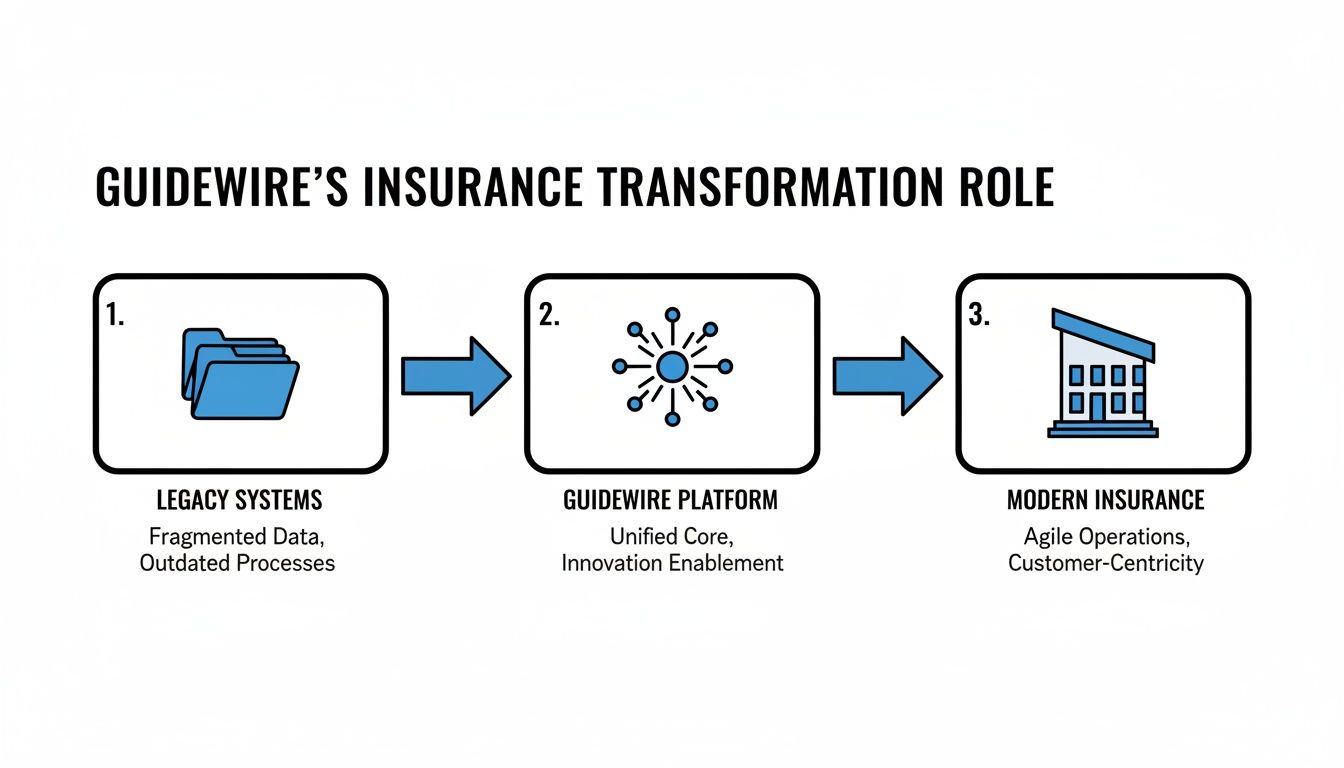
This diagram perfectly illustrates how Guidewire bridges the gap, helping carriers move away from siloed data and toward an intelligent, connected future. It's a fundamental change in the very DNA of claims handling.
From Manual Reviews To Intelligent Automation
The real magic happens right at the beginning of a claim. Instead of an adjuster manually combing through an FNOL report, an AI agent can ingest and understand it in an instant. It’s not just reading the text; it’s grasping the context.
These AI agents conduct automated claims AI reviews with incredible speed and accuracy. Here’s what they can do:
Extract Critical Data: Automatically pull key details from unstructured documents like police reports, medical bills, and repair estimates.
Verify Coverage Instantly: Cross-reference the claim with the policyholder’s information in PolicyCenter to confirm coverage in seconds, not hours.
Analyze Visual Evidence: Use computer vision to assess photos of a damaged car or property, identifying the severity and type of damage.
Flag Potential Fraud: Spot red flags or inconsistencies in the claim data that might point to fraud, automatically routing those cases for a human expert to review.
With this level of automation, straightforward, low-complexity claims can fly through the system with minimal human touch. This frees up your experienced adjusters to focus on the complex, high-stakes cases that require empathy, negotiation, and nuanced judgment. You can dive deeper into this in our guide on insurance claims processing automation.
The Financial Impact Of AI In Claims
The benefits of combining AI with Guidewire aren't just about efficiency—they hit the bottom line, hard. Faster processing directly reduces loss adjustment expenses (LAE), and better fraud detection protects the company’s reserves. This kind of impact is a major reason for Guidewire's strong market performance.
Guidewire Software hit a major milestone in fiscal year 2025, surpassing $1 billion in Annual Recurring Revenue (ARR) for the first time. The company reached $1.03 billion in ARR, a 19% jump from the previous year, highlighting its explosive growth in the P&C insurance software space. This was largely driven by its strategic shift to the cloud. In Q4 alone, Guidewire saw 22% GAAP revenue growth, signing a landmark 10-year deal with a Tier-1 insurer and closing 19 new cloud agreements.
By automating routine tasks, AI-powered Guidewire workflows allow insurers to handle a higher volume of claims with the same or fewer resources. This scalability is critical for managing catastrophic events where claim volumes can spike unexpectedly.
This rapid adoption shows how central AI-powered software development has become in the insurance world. It’s all about building core systems that are more adaptive, intelligent, and responsive to real-world events.
Ultimately, the goal is a claims process that isn't just faster and more accurate but also delivers a far better customer experience. When a policyholder files a claim, they're usually in a stressful situation. By automating the back-end, insurers can provide quicker updates and faster payments, turning a moment of crisis into a chance to build real loyalty and trust through exceptional AI customer care.
Elevating AI Customer Care In Financial Services
While efficient claims processing is a huge internal win for insurance carriers, the true power of AI really comes to life when it touches the customer. The combination of artificial intelligence and Guidewire is completely changing the policyholder experience, ushering in an era of AI customer care that's proactive, intelligent, and immediate.
For decades, customer service in the financial services world has been a reactive game. A policyholder calls with a problem, sits on hold, and crosses their fingers that the agent on the other end has the right answers. That old model is not only expensive for AI insurance companies but also incredibly frustrating for customers who’ve grown accustomed to the instant, on-demand service they get everywhere else.
But when you connect AI to Guidewire's rich data repositories, that entire dynamic flips on its head. Suddenly, financial services firms can deploy intelligent agents that offer 24/7 support, answering common questions and even resolving issues without any human ever needing to get involved.
Creating A Seamless 24/7 Support System
Picture this: it's 10 PM on a Friday, and a policyholder needs to add their newly licensed teenager to their auto policy. Instead of having to wait until Monday morning, they can just open a chat or start a conversation with an AI assistant. This isn't just a chatbot; it's an intelligent agent tied directly into Guidewire PolicyCenter.
This direct connection is the key, allowing the AI to handle the whole process from start to finish:
Verify Identity: It securely confirms who the policyholder is.
Access Policy Details: It pulls up the current policy from Guidewire in a split second.
Process Changes: The AI guides the user through adding the new driver, recalculates the premium, and updates the policy on the spot.
Confirm Completion: It immediately sends a confirmation email with the updated policy documents attached.
We're not talking about a simple FAQ bot here. This is a true end-to-end service agent that gets things done right inside the core insurance platform. The upshot is a dramatically better customer experience and a huge drop in call volume for routine requests. This frees up your human agents to handle the more complex, high-touch interactions where they can really make a difference.
Guiding Customers Through The Claims Journey
The first few hours and days after an accident or property damage are stressful, to say the least. This is where AI-driven customer care, fueled by Guidewire data, can make a massive impact by offering clear, proactive guidance throughout the entire claims process.
Once an FNOL is filed and moves through an automated claims AI reviews workflow, an intelligent agent can reach out to the policyholder. This AI can offer step-by-step instructions, answer frequently asked questions, and provide real-time status updates pulled directly from ClaimCenter.
Imagine an AI agent sending a text that says: "Hi Alex, we've received your claim #12345. An adjuster has been assigned, and you can expect a call within 2 hours. In the meantime, here is a link to schedule a rental car with our preferred partner."
That single, proactive message transforms the experience. It replaces anxious waiting with reassurance and clarity. It shows the insurer is on top of the situation, which is a powerful way to build trust and earn long-term customer loyalty.
The Human-AI Partnership In Service
There's a common fear that AI is coming to replace human service agents. But that's not the goal at all. The real objective is to create a powerful partnership where AI handles the repetitive, high-volume work, freeing up human agents to tackle the sensitive or complex conversations with the full story in hand.
When a customer's issue gets too complicated for an AI agent—say, it involves a dispute or a highly emotional situation—the system can seamlessly escalate the conversation to a person. That human agent instantly gets a full transcript of the AI interaction, along with all the relevant policyholder data from Guidewire. The customer never has to repeat themselves, creating a smooth, efficient handoff.
This collaborative model empowers service teams to perform at a higher level and build stronger relationships. To see how this approach is being used in other industries, you can explore the latest trends in our guide to AI customer care for a deeper look. By automating the routine, insurers empower their people to deliver truly exceptional service when it matters most.
Understanding Guidewire Integration And Architecture
For any technology leader in insurance, it’s crucial to see Guidewire not as a standalone product, but as the central nervous system of a much larger ecosystem. To get the most out of it, Guidewire needs to talk to everything else in your tech stack. It wasn't built to be a closed-off fortress; it was designed as a connected core to power a flexible, future-proof insurance operation.
At its heart, Guidewire is built with an API-first design. Think of these APIs as a set of digital handshakes, allowing the platform to communicate flawlessly with other critical systems. This design is what lets data flow in and out of Guidewire in a controlled, secure, and efficient way.

Whether you're connecting it to your Salesforce CRM, pulling in data from third-party risk assessment tools, or integrating with an AI automation platform, these APIs are the bridges that make a cohesive technology strategy work.
Cloud Versus On-Premise Deployments
One of the first big architectural decisions an insurer faces is where Guidewire will live: in a traditional on-premise setup or on the modern Guidewire Cloud. While on-premise solutions give you a ton of control, they also come with the heavy baggage of maintenance, updates, and scalability challenges.
Guidewire Cloud, on the other hand, is a true SaaS (Software as a Service) offering built for extensibility. It takes the burden of managing infrastructure off your plate, freeing up your IT teams to focus on creating value instead of just keeping the lights on.
A few key advantages of Guidewire Cloud stand out:
Faster Upgrades: Guidewire handles platform updates directly. This means you get the latest features and security patches without having to spin up massive internal projects.
Built-in Scalability: The cloud infrastructure easily scales to meet demand. This is a game-changer during catastrophic events when claim volumes can suddenly spike.
Enhanced Connectivity: Guidewire Cloud is designed from the ground up to integrate with a wider ecosystem of partner applications, which helps you innovate faster.
This strategic pivot to the cloud is a huge reason behind the company's impressive financial performance and why so many top-tier insurers are adopting it.
Common Integration Patterns
To make complex processes run smoothly, insurers rely on proven integration patterns that dictate how Guidewire interacts with other applications. For instance, in claims automation, a common pattern involves Guidewire ClaimCenter acting as the system of record while an AI agent does the heavy lifting of gathering and analyzing external data.
Think about how this plays out for claims AI reviews. When a new claim comes in, Guidewire can fire off an API call to an AI platform. The AI agent then gets to work, pulling unstructured data from police reports or medical records, making sense of it, and pushing a clean, structured summary back into ClaimCenter for the adjuster. This pattern keeps the data where it belongs while automating incredibly tedious manual work.
This orchestrated approach, where Guidewire manages the core workflow and AI handles the intelligent automation layer, is foundational to modernizing insurance operations. It combines the stability of a core system with the agility of AI.
The market’s confidence in this model is easy to see in Guidewire's financial results. In Q3 CY2025, Guidewire Software's revenue shot up 26.5% year-over-year to $332.6 million, blowing past Wall Street's expectations. With a projected 14% revenue growth over the next year, it's clear the industry believes in Guidewire's cloud-first, integration-friendly strategy. You can review more details about these financial trends for deeper insights.
Ultimately, the architecture you build must support your strategic goals. Whether it's improving AI customer care by connecting Guidewire to a communications platform or slashing claims cycle times with AI, a smart integration strategy is what turns your core system into a true engine for growth.
Navigating Implementation Challenges And Best Practices
A Guidewire project isn't just a software installation; it’s a full-blown business transformation. You're fundamentally changing how your core operations run. While the payoff is huge, the journey is packed with hurdles. For many insurers, modernizing their core systems is a path that demands smart planning and flawless execution.
To get a platform like Guidewire deployed successfully, you have to see these obstacles coming and lean on proven best practices right from the get-go.
The Data Migration Dilemma
One of the first and most intimidating challenges is data migration. Most insurers are sitting on decades of policy and claims data trapped in aging, clunky legacy systems. Getting that information into Guidewire without losing or corrupting it is a monumental task.
Let's be honest: the data is never clean. It’s usually scattered across fragmented databases in mismatched formats, so a simple "lift and shift" is out of the question. This phase needs a meticulous strategy for cleaning, validating, and mapping every piece of data to ensure your new system starts on a foundation of truth.
Avoiding The Customization Trap
Another common pitfall is what I call the "customization trap." The temptation to bend Guidewire to mirror every single feature of your old system is strong, but it's a mistake. Heavy customization creates a mountain of technical debt, which makes every future upgrade more difficult, expensive, and time-consuming.
The most successful Guidewire implementations I've seen are the ones that embrace the platform's out-of-the-box features as much as possible. This forces a business to align its processes with industry best practices, rather than clinging to old, inefficient ways of working.
Instead of asking, "How can we make Guidewire do what our old system did?" the question should be, "How can we adapt our processes to what Guidewire does best?" That change in perspective is a game-changer for long-term agility.
Managing Organizational Change
The most overlooked challenge is often the human element. A new core system changes the day-to-day reality for everyone, from underwriters to claims adjusters. If you don't manage that change effectively, you’ll face resistance and low adoption that can kill the project's ROI.
Strong change management comes down to a few key actions:
Secure Executive Buy-In: Leadership needs to be the project's biggest champion, constantly communicating why this move is critical.
Invest in Early Training: Get your teams comfortable and confident with the new platform long before it goes live. No surprises.
Establish Clear Governance: You need a solid framework for making decisions and managing the project's scope. Adhering to ITIL Change Enablement principles can provide a structured, proven approach.
When you manage the transition well, teams are more likely to embrace the new tools. As seen in a Nolana case study, the right strategy has a massive impact, leading to outcomes like a 90% reduction in manual case setup and a 4x increase in claims processing capacity. That's how a successful transformation hits the bottom line.
Measuring The ROI Of Your Guidewire And AI Investment
Putting a platform like Guidewire at the heart of your operations, especially when enhanced with intelligent automation, is a massive commitment. So, how do you prove it was worth it? The real value isn’t just about modernizing your core systems; it’s about the concrete business results you can see and measure.
To truly understand the return on investment (ROI), you have to look past the upfront costs. The focus needs to shift to specific, quantifiable key performance indicators (KPIs). The goal is to show that Guidewire, paired with AI, isn't just a system for storing data—it's an engine driving efficiency, profitability, and a better customer experience.
Key Metrics For Claims Automation
In claims, the impact is often immediate and significant. By taking over manual tasks and speeding up workflows, AI insurance companies can track clear, hard numbers. It all comes down to operational efficiency and keeping costs in check.
You'll want to watch for positive movement in these areas:
Reduced Claims Cycle Times: How long does it take from the First Notice of Loss (FNOL) to the final settlement? For simpler claims, AI-powered claims AI reviews can slash this timeline from weeks down to just a few days.
Lower Loss Adjustment Expenses (LAE): This is the cost of actually handling a claim. Automation cuts down on the manual work needed for each file, which directly lowers your operational overhead.
Improved Fraud Detection Rates: Keep a close eye on the number of fraudulent claims you successfully catch. Every fraudulent payout you prevent is a direct saving that protects your reserves.
Quantifying The Value Of AI Customer Care
When it comes to the customer experience, the ROI is measured in satisfaction, loyalty, and service efficiency. Great AI customer care builds the kind of loyalty that directly impacts your bottom line for years to come.
Here are the key metrics to monitor:
First-Contact Resolution (FCR): A rising FCR rate is a fantastic sign. It means your AI is handling customer questions effectively on the first try, reducing the burden on your human agents and call centers.
Customer Satisfaction (CSAT) Scores: Track your CSAT and Net Promoter Score (NPS) to see how customers feel about their automated interactions. People love fast, 24/7 service, and it usually gives these scores a healthy boost.
Reduced Agent Handle Time: Even when a complex issue gets escalated to a person, AI helps. Measure how much faster your agents can solve problems when they're handed a complete, AI-organized case file from the start.
The ultimate ROI emerges when Guidewire and AI work in concert to create a feedback loop. Faster, data-rich claims processing informs better underwriting, while seamless customer interactions build brand loyalty that drives policy renewals.
This synergy is what turns your core system into a true strategic asset. By tracking these KPIs, you can build a powerful business case that draws a straight line from your technology investment to tangible financial gains. For a deeper dive into using data to make smarter decisions, check out our guide on data analytics in insurance.
Common Questions About Guidewire
Thinking about a core system overhaul with Guidewire brings up a lot of questions, especially when you start layering in advanced AI. Let's tackle some of the most common ones we hear about implementation, the platform's scope, and how intelligent automation can truly amplify your Guidewire investment in both claims and customer care.
How Long Does a Guidewire Implementation Take?
There's no single answer here—it really depends on the insurer's size and complexity. For a mid-sized carrier implementing just one module, say ClaimCenter, you're typically looking at a 12 to 18-month project. But for a large, global insurer undertaking a full-suite transformation, the project could easily stretch over several years, often broken into manageable phases to keep risk in check.
A few key things will dictate your timeline:
The amount of custom work you need.
The headache of migrating data from old, legacy systems.
The number of integrations you have to build.
One shortcut? Opting for Guidewire Cloud and sticking close to its out-of-the-box features can definitely speed things up.
Can Guidewire Be Used Outside Of Insurance?
While Guidewire was purpose-built for the Property & Casualty (P&C) insurance world, the underlying ideas about modernizing a core system apply across the financial services industry. That said, its modules are so deeply tuned for insurance workflows that a bank, for instance, would need a completely different core banking system.
Where things get interesting for broader financial services is when you bring in an AI customer care platform that can talk to both Guidewire and core banking systems. This creates a powerful bridge, allowing you to automate thorny processes like case management and customer service across your entire operation, creating a much more cohesive approach.
What Is The Role Of AI With Guidewire?
Guidewire is fantastic at what it does: managing workflows and enforcing business rules inside its own environment. Its built-in features are designed for the structured, predictable parts of the job. Advanced AI, on the other hand, comes in to handle all the messy, unpredictable, and cross-system work that happens around those core processes.
Think of it this way: an AI agent can read an email, pull data from a PDF, log into a third-party portal to check a status, and make a smart decision based on your standard operating procedures—all before it ever touches Guidewire to update a record. This intelligence acts as the missing link between Guidewire and the rest of your enterprise.
This is a game-changer for tasks like claims AI reviews, where an AI agent can scan unstructured documents and instantly flag potential issues for a human adjuster. For AI insurance companies, this combination is how you achieve true end-to-end automation, massively expanding what you can accomplish.
Ready to get more out of your Guidewire investment? Nolana builds and deploys compliant AI agents that handle high-stakes operations in financial services, from claims processing to complex customer service tasks. See how our agentic AI can plug into your core systems to slash cycle times, reduce costs, and create better customer experiences. Learn more about Nolana.
Think of Guidewire as the central nervous system for a Property & Casualty (P&C) insurance company. It’s not just another piece of software; it’s the foundational platform that powers the most critical parts of the business, from the moment a customer gets a quote to the final settlement of a complex claim.
Understanding Guidewire And Its Role In Insurance
For years, many of the world's biggest P&C insurance carriers were stuck with clunky, disconnected legacy systems. These old platforms were a nightmare to update and made it nearly impossible to get a clear, single view of a customer or the business as a whole. The result? A lot of manual work, slow service, and missed opportunities.
Guidewire stepped in to fix this mess. It offers a modern, unified software suite designed to replace those fragmented systems with one integrated core platform. This isn't just a simple tech upgrade; it's a strategic overhaul that helps insurers run a tighter ship, cut operational costs, and build a solid base for future innovation. We take a closer look at the company and its offerings in our in-depth article on Guidewire Software Inc.
The screenshot below from Guidewire's own homepage captures their mission perfectly: providing an all-in-one platform for the entire P&C insurance lifecycle.
It’s all about powering every stage of the insurance journey—from underwriting to claims—within a single, connected cloud ecosystem.
The Three Pillars Of The Guidewire Platform
To really get a handle on how Guidewire works, you need to understand its three core components, which together form the Guidewire InsuranceSuite. Each one tackles a distinct, non-negotiable part of the insurance business.
Let's break down these three pillars.
Component | Primary Function | Key Business Value |
|---|---|---|
PolicyCenter | The system of record for all underwriting and policy administration. | Manages new business quotes, renewals, and policy changes, ensuring accuracy and consistency. |
BillingCenter | Handles the entire financial lifecycle of a policy. | Manages invoicing, payment plans, agent commissions, and collections with precision. |
ClaimCenter | The command center for the entire claims management process. | Orchestrates everything from the first notice of loss (FNOL) to investigation, settlement, and payment. |
While each component is powerful on its own, their true strength lies in how they work together. When a claim is filed in ClaimCenter, it automatically pulls the relevant policy details from PolicyCenter to confirm coverage on the spot. This tight integration gets rid of data silos and the need for manual data entry, which means faster, more accurate processes across the board.
Guidewire's grip on the market is firm, and its financials tell the story of its wide-scale adoption. With a projected FY2025 total revenue of $1,202.5 million—a 23% jump—the company’s leadership is clear. It currently holds a 20.6% market share in a P&C insurance software sector that's on track to hit $207.52 billion by 2030. This kind of stability and market presence makes it the ideal foundation for integrating next-generation technologies that automate workflows and elevate the customer experience.
Automating Insurance Claims With Guidewire And AI
Anyone who’s worked in insurance knows the traditional claims lifecycle is riddled with friction. A claim starts with someone manually keying in data from a First Notice of Loss (FNOL). From there, an adjuster has to jump between different systems to verify policy details, pore over documents, and assess the damage. It’s a slow, cumbersome process that drives up operational costs and leaves customers waiting.
Now, imagine pairing that process with artificial intelligence. When you integrate AI with a powerful platform like Guidewire ClaimCenter, it stops being just a system of record and becomes an intelligent, proactive workflow engine for ai insurance companies.
This is more than just a tech upgrade; it’s a complete operational shift. Guidewire becomes the central hub that transforms disconnected legacy systems into a modern, agile, and customer-focused operation.
This diagram perfectly illustrates how Guidewire bridges the gap, helping carriers move away from siloed data and toward an intelligent, connected future. It's a fundamental change in the very DNA of claims handling.
From Manual Reviews To Intelligent Automation
The real magic happens right at the beginning of a claim. Instead of an adjuster manually combing through an FNOL report, an AI agent can ingest and understand it in an instant. It’s not just reading the text; it’s grasping the context.
These AI agents conduct automated claims AI reviews with incredible speed and accuracy. Here’s what they can do:
Extract Critical Data: Automatically pull key details from unstructured documents like police reports, medical bills, and repair estimates.
Verify Coverage Instantly: Cross-reference the claim with the policyholder’s information in PolicyCenter to confirm coverage in seconds, not hours.
Analyze Visual Evidence: Use computer vision to assess photos of a damaged car or property, identifying the severity and type of damage.
Flag Potential Fraud: Spot red flags or inconsistencies in the claim data that might point to fraud, automatically routing those cases for a human expert to review.
With this level of automation, straightforward, low-complexity claims can fly through the system with minimal human touch. This frees up your experienced adjusters to focus on the complex, high-stakes cases that require empathy, negotiation, and nuanced judgment. You can dive deeper into this in our guide on insurance claims processing automation.
The Financial Impact Of AI In Claims
The benefits of combining AI with Guidewire aren't just about efficiency—they hit the bottom line, hard. Faster processing directly reduces loss adjustment expenses (LAE), and better fraud detection protects the company’s reserves. This kind of impact is a major reason for Guidewire's strong market performance.
Guidewire Software hit a major milestone in fiscal year 2025, surpassing $1 billion in Annual Recurring Revenue (ARR) for the first time. The company reached $1.03 billion in ARR, a 19% jump from the previous year, highlighting its explosive growth in the P&C insurance software space. This was largely driven by its strategic shift to the cloud. In Q4 alone, Guidewire saw 22% GAAP revenue growth, signing a landmark 10-year deal with a Tier-1 insurer and closing 19 new cloud agreements.
By automating routine tasks, AI-powered Guidewire workflows allow insurers to handle a higher volume of claims with the same or fewer resources. This scalability is critical for managing catastrophic events where claim volumes can spike unexpectedly.
This rapid adoption shows how central AI-powered software development has become in the insurance world. It’s all about building core systems that are more adaptive, intelligent, and responsive to real-world events.
Ultimately, the goal is a claims process that isn't just faster and more accurate but also delivers a far better customer experience. When a policyholder files a claim, they're usually in a stressful situation. By automating the back-end, insurers can provide quicker updates and faster payments, turning a moment of crisis into a chance to build real loyalty and trust through exceptional AI customer care.
Elevating AI Customer Care In Financial Services
While efficient claims processing is a huge internal win for insurance carriers, the true power of AI really comes to life when it touches the customer. The combination of artificial intelligence and Guidewire is completely changing the policyholder experience, ushering in an era of AI customer care that's proactive, intelligent, and immediate.
For decades, customer service in the financial services world has been a reactive game. A policyholder calls with a problem, sits on hold, and crosses their fingers that the agent on the other end has the right answers. That old model is not only expensive for AI insurance companies but also incredibly frustrating for customers who’ve grown accustomed to the instant, on-demand service they get everywhere else.
But when you connect AI to Guidewire's rich data repositories, that entire dynamic flips on its head. Suddenly, financial services firms can deploy intelligent agents that offer 24/7 support, answering common questions and even resolving issues without any human ever needing to get involved.
Creating A Seamless 24/7 Support System
Picture this: it's 10 PM on a Friday, and a policyholder needs to add their newly licensed teenager to their auto policy. Instead of having to wait until Monday morning, they can just open a chat or start a conversation with an AI assistant. This isn't just a chatbot; it's an intelligent agent tied directly into Guidewire PolicyCenter.
This direct connection is the key, allowing the AI to handle the whole process from start to finish:
Verify Identity: It securely confirms who the policyholder is.
Access Policy Details: It pulls up the current policy from Guidewire in a split second.
Process Changes: The AI guides the user through adding the new driver, recalculates the premium, and updates the policy on the spot.
Confirm Completion: It immediately sends a confirmation email with the updated policy documents attached.
We're not talking about a simple FAQ bot here. This is a true end-to-end service agent that gets things done right inside the core insurance platform. The upshot is a dramatically better customer experience and a huge drop in call volume for routine requests. This frees up your human agents to handle the more complex, high-touch interactions where they can really make a difference.
Guiding Customers Through The Claims Journey
The first few hours and days after an accident or property damage are stressful, to say the least. This is where AI-driven customer care, fueled by Guidewire data, can make a massive impact by offering clear, proactive guidance throughout the entire claims process.
Once an FNOL is filed and moves through an automated claims AI reviews workflow, an intelligent agent can reach out to the policyholder. This AI can offer step-by-step instructions, answer frequently asked questions, and provide real-time status updates pulled directly from ClaimCenter.
Imagine an AI agent sending a text that says: "Hi Alex, we've received your claim #12345. An adjuster has been assigned, and you can expect a call within 2 hours. In the meantime, here is a link to schedule a rental car with our preferred partner."
That single, proactive message transforms the experience. It replaces anxious waiting with reassurance and clarity. It shows the insurer is on top of the situation, which is a powerful way to build trust and earn long-term customer loyalty.
The Human-AI Partnership In Service
There's a common fear that AI is coming to replace human service agents. But that's not the goal at all. The real objective is to create a powerful partnership where AI handles the repetitive, high-volume work, freeing up human agents to tackle the sensitive or complex conversations with the full story in hand.
When a customer's issue gets too complicated for an AI agent—say, it involves a dispute or a highly emotional situation—the system can seamlessly escalate the conversation to a person. That human agent instantly gets a full transcript of the AI interaction, along with all the relevant policyholder data from Guidewire. The customer never has to repeat themselves, creating a smooth, efficient handoff.
This collaborative model empowers service teams to perform at a higher level and build stronger relationships. To see how this approach is being used in other industries, you can explore the latest trends in our guide to AI customer care for a deeper look. By automating the routine, insurers empower their people to deliver truly exceptional service when it matters most.
Understanding Guidewire Integration And Architecture
For any technology leader in insurance, it’s crucial to see Guidewire not as a standalone product, but as the central nervous system of a much larger ecosystem. To get the most out of it, Guidewire needs to talk to everything else in your tech stack. It wasn't built to be a closed-off fortress; it was designed as a connected core to power a flexible, future-proof insurance operation.
At its heart, Guidewire is built with an API-first design. Think of these APIs as a set of digital handshakes, allowing the platform to communicate flawlessly with other critical systems. This design is what lets data flow in and out of Guidewire in a controlled, secure, and efficient way.
Whether you're connecting it to your Salesforce CRM, pulling in data from third-party risk assessment tools, or integrating with an AI automation platform, these APIs are the bridges that make a cohesive technology strategy work.
Cloud Versus On-Premise Deployments
One of the first big architectural decisions an insurer faces is where Guidewire will live: in a traditional on-premise setup or on the modern Guidewire Cloud. While on-premise solutions give you a ton of control, they also come with the heavy baggage of maintenance, updates, and scalability challenges.
Guidewire Cloud, on the other hand, is a true SaaS (Software as a Service) offering built for extensibility. It takes the burden of managing infrastructure off your plate, freeing up your IT teams to focus on creating value instead of just keeping the lights on.
A few key advantages of Guidewire Cloud stand out:
Faster Upgrades: Guidewire handles platform updates directly. This means you get the latest features and security patches without having to spin up massive internal projects.
Built-in Scalability: The cloud infrastructure easily scales to meet demand. This is a game-changer during catastrophic events when claim volumes can suddenly spike.
Enhanced Connectivity: Guidewire Cloud is designed from the ground up to integrate with a wider ecosystem of partner applications, which helps you innovate faster.
This strategic pivot to the cloud is a huge reason behind the company's impressive financial performance and why so many top-tier insurers are adopting it.
Common Integration Patterns
To make complex processes run smoothly, insurers rely on proven integration patterns that dictate how Guidewire interacts with other applications. For instance, in claims automation, a common pattern involves Guidewire ClaimCenter acting as the system of record while an AI agent does the heavy lifting of gathering and analyzing external data.
Think about how this plays out for claims AI reviews. When a new claim comes in, Guidewire can fire off an API call to an AI platform. The AI agent then gets to work, pulling unstructured data from police reports or medical records, making sense of it, and pushing a clean, structured summary back into ClaimCenter for the adjuster. This pattern keeps the data where it belongs while automating incredibly tedious manual work.
This orchestrated approach, where Guidewire manages the core workflow and AI handles the intelligent automation layer, is foundational to modernizing insurance operations. It combines the stability of a core system with the agility of AI.
The market’s confidence in this model is easy to see in Guidewire's financial results. In Q3 CY2025, Guidewire Software's revenue shot up 26.5% year-over-year to $332.6 million, blowing past Wall Street's expectations. With a projected 14% revenue growth over the next year, it's clear the industry believes in Guidewire's cloud-first, integration-friendly strategy. You can review more details about these financial trends for deeper insights.
Ultimately, the architecture you build must support your strategic goals. Whether it's improving AI customer care by connecting Guidewire to a communications platform or slashing claims cycle times with AI, a smart integration strategy is what turns your core system into a true engine for growth.
Navigating Implementation Challenges And Best Practices
A Guidewire project isn't just a software installation; it’s a full-blown business transformation. You're fundamentally changing how your core operations run. While the payoff is huge, the journey is packed with hurdles. For many insurers, modernizing their core systems is a path that demands smart planning and flawless execution.
To get a platform like Guidewire deployed successfully, you have to see these obstacles coming and lean on proven best practices right from the get-go.
The Data Migration Dilemma
One of the first and most intimidating challenges is data migration. Most insurers are sitting on decades of policy and claims data trapped in aging, clunky legacy systems. Getting that information into Guidewire without losing or corrupting it is a monumental task.
Let's be honest: the data is never clean. It’s usually scattered across fragmented databases in mismatched formats, so a simple "lift and shift" is out of the question. This phase needs a meticulous strategy for cleaning, validating, and mapping every piece of data to ensure your new system starts on a foundation of truth.
Avoiding The Customization Trap
Another common pitfall is what I call the "customization trap." The temptation to bend Guidewire to mirror every single feature of your old system is strong, but it's a mistake. Heavy customization creates a mountain of technical debt, which makes every future upgrade more difficult, expensive, and time-consuming.
The most successful Guidewire implementations I've seen are the ones that embrace the platform's out-of-the-box features as much as possible. This forces a business to align its processes with industry best practices, rather than clinging to old, inefficient ways of working.
Instead of asking, "How can we make Guidewire do what our old system did?" the question should be, "How can we adapt our processes to what Guidewire does best?" That change in perspective is a game-changer for long-term agility.
Managing Organizational Change
The most overlooked challenge is often the human element. A new core system changes the day-to-day reality for everyone, from underwriters to claims adjusters. If you don't manage that change effectively, you’ll face resistance and low adoption that can kill the project's ROI.
Strong change management comes down to a few key actions:
Secure Executive Buy-In: Leadership needs to be the project's biggest champion, constantly communicating why this move is critical.
Invest in Early Training: Get your teams comfortable and confident with the new platform long before it goes live. No surprises.
Establish Clear Governance: You need a solid framework for making decisions and managing the project's scope. Adhering to ITIL Change Enablement principles can provide a structured, proven approach.
When you manage the transition well, teams are more likely to embrace the new tools. As seen in a Nolana case study, the right strategy has a massive impact, leading to outcomes like a 90% reduction in manual case setup and a 4x increase in claims processing capacity. That's how a successful transformation hits the bottom line.
Measuring The ROI Of Your Guidewire And AI Investment
Putting a platform like Guidewire at the heart of your operations, especially when enhanced with intelligent automation, is a massive commitment. So, how do you prove it was worth it? The real value isn’t just about modernizing your core systems; it’s about the concrete business results you can see and measure.
To truly understand the return on investment (ROI), you have to look past the upfront costs. The focus needs to shift to specific, quantifiable key performance indicators (KPIs). The goal is to show that Guidewire, paired with AI, isn't just a system for storing data—it's an engine driving efficiency, profitability, and a better customer experience.
Key Metrics For Claims Automation
In claims, the impact is often immediate and significant. By taking over manual tasks and speeding up workflows, AI insurance companies can track clear, hard numbers. It all comes down to operational efficiency and keeping costs in check.
You'll want to watch for positive movement in these areas:
Reduced Claims Cycle Times: How long does it take from the First Notice of Loss (FNOL) to the final settlement? For simpler claims, AI-powered claims AI reviews can slash this timeline from weeks down to just a few days.
Lower Loss Adjustment Expenses (LAE): This is the cost of actually handling a claim. Automation cuts down on the manual work needed for each file, which directly lowers your operational overhead.
Improved Fraud Detection Rates: Keep a close eye on the number of fraudulent claims you successfully catch. Every fraudulent payout you prevent is a direct saving that protects your reserves.
Quantifying The Value Of AI Customer Care
When it comes to the customer experience, the ROI is measured in satisfaction, loyalty, and service efficiency. Great AI customer care builds the kind of loyalty that directly impacts your bottom line for years to come.
Here are the key metrics to monitor:
First-Contact Resolution (FCR): A rising FCR rate is a fantastic sign. It means your AI is handling customer questions effectively on the first try, reducing the burden on your human agents and call centers.
Customer Satisfaction (CSAT) Scores: Track your CSAT and Net Promoter Score (NPS) to see how customers feel about their automated interactions. People love fast, 24/7 service, and it usually gives these scores a healthy boost.
Reduced Agent Handle Time: Even when a complex issue gets escalated to a person, AI helps. Measure how much faster your agents can solve problems when they're handed a complete, AI-organized case file from the start.
The ultimate ROI emerges when Guidewire and AI work in concert to create a feedback loop. Faster, data-rich claims processing informs better underwriting, while seamless customer interactions build brand loyalty that drives policy renewals.
This synergy is what turns your core system into a true strategic asset. By tracking these KPIs, you can build a powerful business case that draws a straight line from your technology investment to tangible financial gains. For a deeper dive into using data to make smarter decisions, check out our guide on data analytics in insurance.
Common Questions About Guidewire
Thinking about a core system overhaul with Guidewire brings up a lot of questions, especially when you start layering in advanced AI. Let's tackle some of the most common ones we hear about implementation, the platform's scope, and how intelligent automation can truly amplify your Guidewire investment in both claims and customer care.
How Long Does a Guidewire Implementation Take?
There's no single answer here—it really depends on the insurer's size and complexity. For a mid-sized carrier implementing just one module, say ClaimCenter, you're typically looking at a 12 to 18-month project. But for a large, global insurer undertaking a full-suite transformation, the project could easily stretch over several years, often broken into manageable phases to keep risk in check.
A few key things will dictate your timeline:
The amount of custom work you need.
The headache of migrating data from old, legacy systems.
The number of integrations you have to build.
One shortcut? Opting for Guidewire Cloud and sticking close to its out-of-the-box features can definitely speed things up.
Can Guidewire Be Used Outside Of Insurance?
While Guidewire was purpose-built for the Property & Casualty (P&C) insurance world, the underlying ideas about modernizing a core system apply across the financial services industry. That said, its modules are so deeply tuned for insurance workflows that a bank, for instance, would need a completely different core banking system.
Where things get interesting for broader financial services is when you bring in an AI customer care platform that can talk to both Guidewire and core banking systems. This creates a powerful bridge, allowing you to automate thorny processes like case management and customer service across your entire operation, creating a much more cohesive approach.
What Is The Role Of AI With Guidewire?
Guidewire is fantastic at what it does: managing workflows and enforcing business rules inside its own environment. Its built-in features are designed for the structured, predictable parts of the job. Advanced AI, on the other hand, comes in to handle all the messy, unpredictable, and cross-system work that happens around those core processes.
Think of it this way: an AI agent can read an email, pull data from a PDF, log into a third-party portal to check a status, and make a smart decision based on your standard operating procedures—all before it ever touches Guidewire to update a record. This intelligence acts as the missing link between Guidewire and the rest of your enterprise.
This is a game-changer for tasks like claims AI reviews, where an AI agent can scan unstructured documents and instantly flag potential issues for a human adjuster. For AI insurance companies, this combination is how you achieve true end-to-end automation, massively expanding what you can accomplish.
Ready to get more out of your Guidewire investment? Nolana builds and deploys compliant AI agents that handle high-stakes operations in financial services, from claims processing to complex customer service tasks. See how our agentic AI can plug into your core systems to slash cycle times, reduce costs, and create better customer experiences. Learn more about Nolana.


All systems operational
1 Lime Street, London EC3M 7HA | 222E 3rd Street, New York 10009
Copyright © 2026, Nolana. All rights reserved
All systems operational
1 Lime Street, London EC3M 7HA | 222E 3rd Street, New York 10009
Copyright © 2026, Nolana. All rights reserved
All systems operational
1 Lime Street, London EC3M 7HA | 222E 3rd Street, New York 10009
Copyright © 2026, Nolana. All rights reserved
All systems operational
1 Lime Street, London EC3M 7HA | 222E 3rd Street, New York 10009
Copyright © 2026, Nolana. All rights reserved