Lloyd's Market Insurance Guide: Structure & Automation
Lloyd's Market Insurance Guide: Structure & Automation
Discover Lloyd's market insurance structure, delegated authority workflows, and automation strategies to transform claims operations.

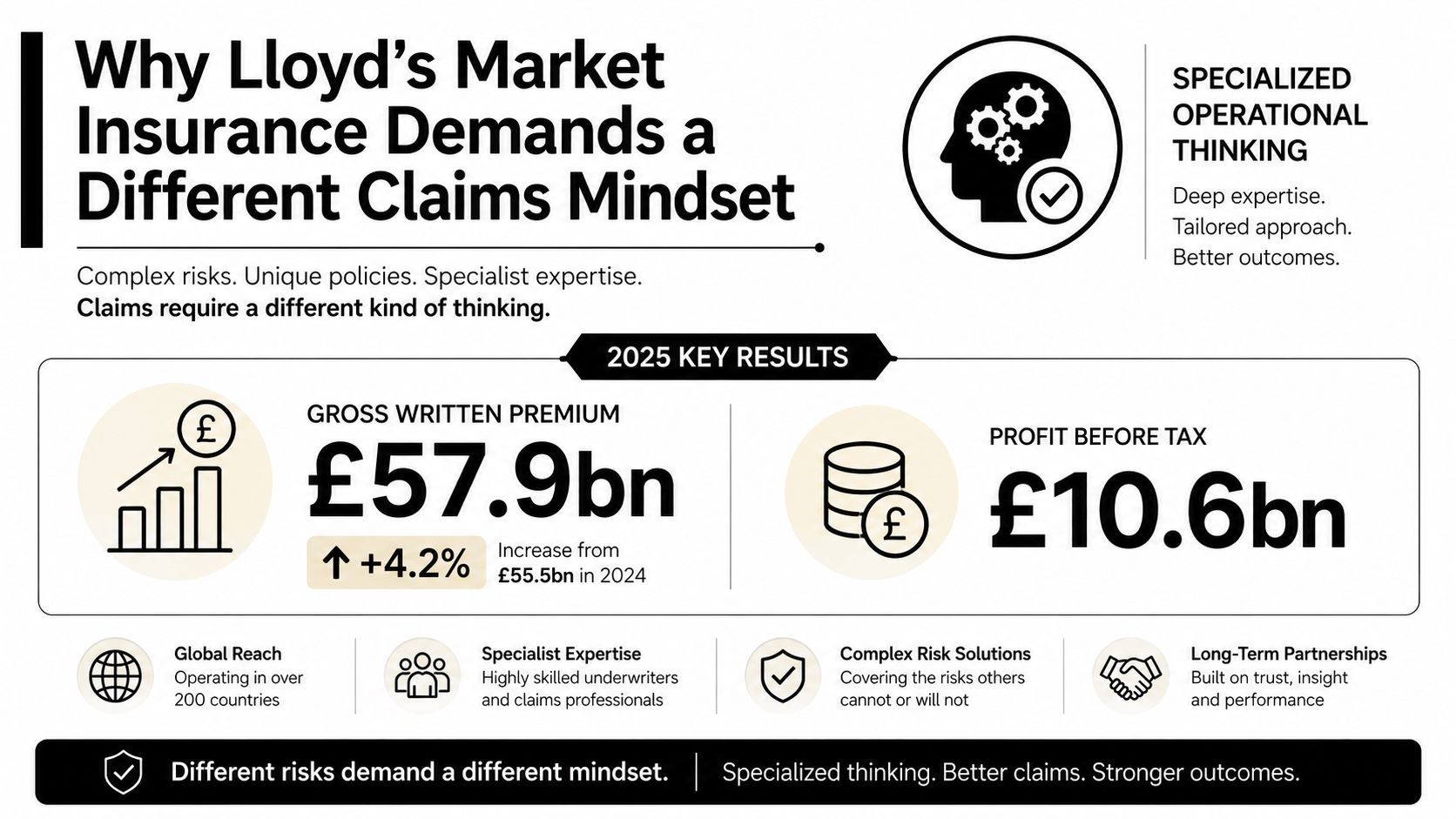
Lloyd's market insurance reached £57.9bn in gross written premium in 2025, up 4.2% from £55.5bn in 2024. That scale makes claims operations a strategic issue, especially when delegated authority drives approximately 45% of market premium while teams still manage fragmented communications, manual workflows, and demanding audit requirements.
Lloyd's has grown from a coffee house with roots dating to 1688 into a globally material specialist insurance market. Its modern scale is impressive, but scale doesn't settle claims. People do. A claims handler still has to interpret a broker email, identify the relevant policy, check authority, request missing evidence, update several systems, and keep the file ready for scrutiny.
That contrast defines Lloyd's market insurance today. The market combines specialist underwriting, brokered placement, syndicates, managing agents, coverholders, delegated claims administrators, and international capital. The structure creates access to expertise and capacity, but it also creates more handoffs than a conventional single-carrier model.
Why Lloyd's Market Insurance Demands a Different Claims Mindset
Claims operations in Lloyd's market insurance must account for authority, ownership, and evidence across organizational boundaries. A claim can begin with a broker notification, pass through a coverholder or delegated claims administrator, and require action from a managing agent or syndicate. Each handoff creates a point where information can be delayed, misrouted, or recorded inconsistently.
That structure is valuable because it brings specialist underwriting knowledge, broker relationships, and flexible capacity to complex risks. It also means the claims handler's working day rarely follows one standardized carrier process. An inbox may contain loss reports, policy documents, medical records, adjuster updates, and payment queries. The handler then rekeys information into a claims workbench, policy system, document repository, or bordereaux file.
A marketplace, not a single insurer
Lloyd's is a marketplace rather than one insurer with a single claims department. Syndicates provide capacity, managing agents operate syndicates, brokers place business, and coverholders act under delegated authority. Claims teams therefore need a clear view of who can make a decision, who must be consulted, and where the final record belongs.
A carrier can often standardize its workflow around its own policy, claims, finance, and reporting systems. Lloyd's participants need processes that remain reliable when external parties use different systems, authority agreements vary, and evidence arrives through email, portals, documents, and spreadsheets.
Operational reality: A fast settlement can still create a governance problem if the file does not show who acted, under which authority, using which information, and with what approval.
Manual coordination becomes expensive when a claim crosses several entities. Email folders and spreadsheets may keep work moving for a time, but they make ownership, deadlines, and decision history harder to monitor. They also force experienced handlers to reconstruct events instead of applying judgment to coverage, liability, quantum, and customer outcomes.
Claims leaders should therefore assess the operating model, not just individual handler productivity. The practical test is whether teams can process files consistently, retain decision context, identify stalled claims, and produce an audit-ready record without searching across scattered messages.
Agentic AI can support that control layer by classifying incoming material, extracting relevant fields, routing tasks according to authority, and preserving an evidence trail for review. The story of Nolana AI's move from fintech into the Lloyd's market illustrates how technology can be adapted to market-specific claims operations while leaving accountable decisions with authorized people.
Understanding the Lloyd's Market Hierarchy and Key Players
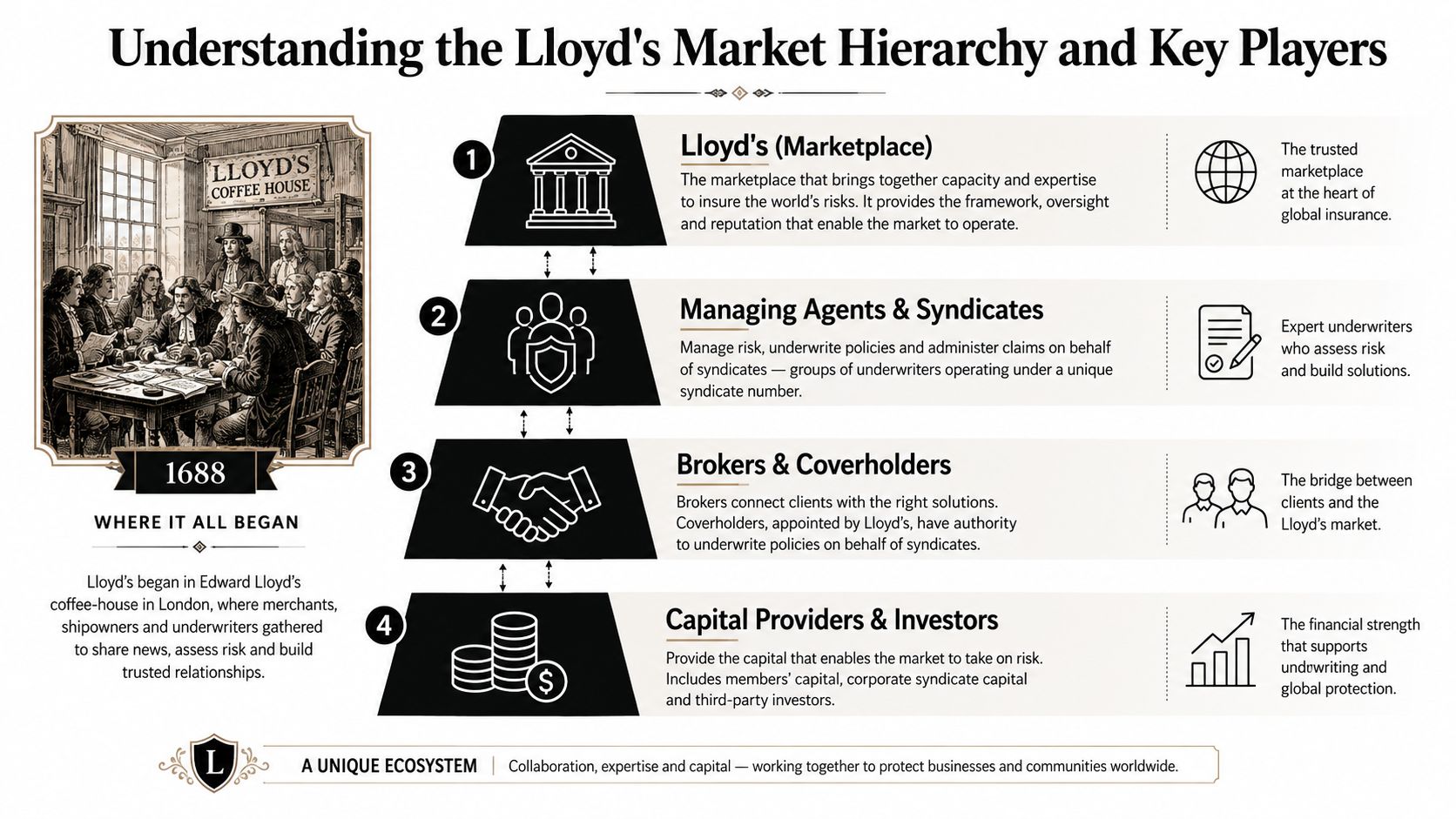
Lloyd's began in a coffee house in 1688 and developed into a specialist insurance market operating through multiple independent participants. That history still shapes claims work. Lloyd's is a marketplace, not a single insurer with one corporate claims department. The Lloyd's market facts provide the broader context, while claims teams must apply the structure to each file.
An orchestra is a useful comparison. Capacity providers supply the instruments, managing agents direct operations, brokers connect the participants, and coverholders perform defined tasks under delegated authority. The operational test is more specific: a claim arrives through a coverholder, but the requested settlement exceeds that entity's authority. The handler must route the decision to the managing agent or another authorized party, preserve the referral, and avoid treating the coverholder's recommendation as approval.
The roles that shape a claim
Lloyd's is the marketplace. It provides the framework for members, syndicates, managing agents, brokers, and other participants. It does not act as the claims handler for every policy.
Syndicates provide underwriting capacity. Each syndicate participates in insurance business and has claims interests that include accurate reserves, controlled settlement, recoveries, and reliable reporting.
Managing agents operate syndicates. They set operational controls, appoint service providers, oversee delegated arrangements, and remain accountable for syndicate governance. If claims authority is delegated, the managing agent still needs visibility into its scope, use, exceptions, and referrals.
Brokers arrange placement and coordinate communication. They connect clients and risks with the market, then often support notifications, document exchange, negotiation, and status updates. Excluding broker communications from the core file can remove context needed for a sound decision.
Coverholders handle business under delegated authority. They may bind risks and manage defined claims activity where their agreement permits. Their work depends on clear instructions, consistent evidence capture, and timely bordereaux.
Capital providers support the market's capacity, while claims operations turn contractual promises into practical service. A controlled workflow should identify who received the notification, which syndicate or syndicates participate, what authority applies, who can approve the action, and where the supporting evidence is stored.
The hierarchy creates specialization, but it also creates routing decisions that generic queues cannot handle reliably. Claims technology should preserve participant roles, authority boundaries, approval records, and evidence links so handlers can act quickly without weakening governance.
How Delegated Authority Shapes Claims Operations at Lloyd's
Delegated authority is one of the clearest examples of Lloyd's operational advantage and operational complexity. It allows business to be handled closer to brokers, policyholders, and local markets, but it also distributes responsibility across coverholders, managing agents, delegated claims administrators, and market infrastructure.
Lloyd's says delegated underwriting accounts for approximately 45% of market premium income, as outlined in its delegated authorities guidance. A large share of risk placement and servicing therefore depends on controls that keep premium, risk, regulatory, tax, policy, and claims data aligned across organizational boundaries.

Speed has to operate inside authority
Delegation exists to avoid sending every routine action back to a central syndicate team. A coverholder or DCA can handle defined activity within an agreement, which can improve responsiveness and local expertise. The trade-off is that every automated or manual action must remain inside the correct authority boundary.
Lloyd's requires all delegated claims administrators to receive approval before a managing agent appoints them to determine claims. Its delegated claims administrator requirements describe delegation as an arrangement in which a managing agent grants authority to a Lloyd's-approved DCA to settle claims on behalf of a syndicate.
That approval gate should be visible in the claims workflow. It shouldn't live only in a contract library or in the memory of a relationship manager. The same applies to authority limits, referral conditions, participating syndicates, and actions that require escalation.
Bordereaux and documentation are part of claims control
Coverholders and DCAs must provide regular premium and claims bordereaux to Velonetic for business placed through it. Lloyd's also says delegated authority agreements incepting on or after 1 July 2025 must identify the Lloyd's lead in policy documentation, according to its letter of authority and mandate guidance.
These requirements create daily operational work. Teams need to connect the claim to the right agreement, preserve the lead identification, validate the data, and make sure the downstream record is complete. The LMA's creation of a specialist Delegated Authority Claims Management Group in 2025 also signals that consistency in DCA claims management remains a live market concern.
A practical workflow should combine authority checks with task routing, document capture, and evidence retention. Nolana's delegated authority claims workflow is one example of an approach that applies structured automation to that operating problem without removing human control.
The Claims Lifecycle and Where Manual Workflows Break Down
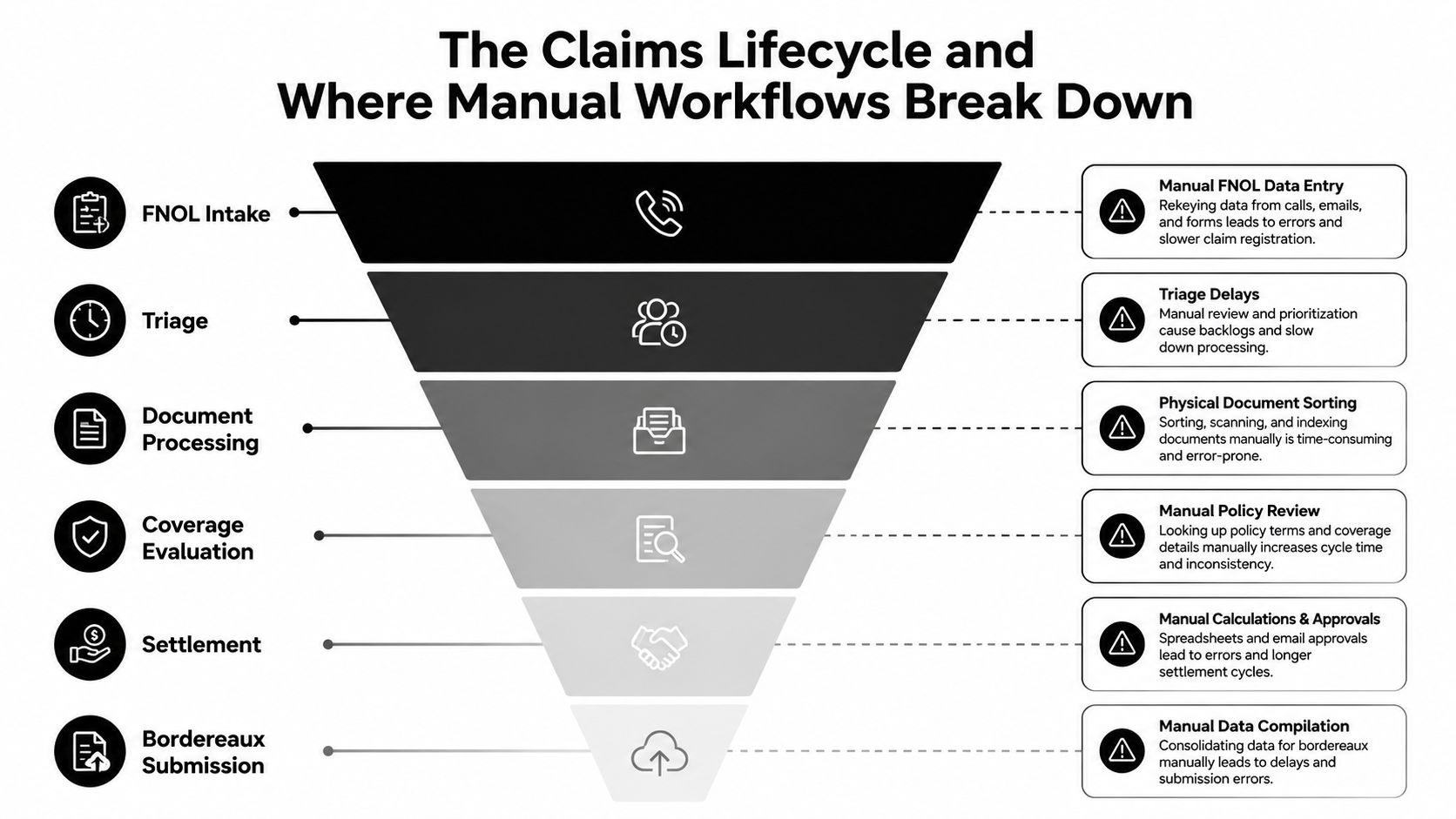
The claims lifecycle looks straightforward on a process map: first notice of loss, triage, document processing, coverage evaluation, settlement, and bordereaux submission. The difficulty appears in the handoffs. Each stage depends on data captured accurately at the previous stage, and a small omission can create work several steps later.
Trade credit claims show why headline performance doesn't remove operational friction. In the 2026 annual trade credit claims survey, payable claims fell to 136 in 2025 from 185 in 2024, but aggregate claim value rose to US$438.5 million. Only three claims were paid after the contractual deadline, with delays attributed to payment processing rather than coverage disputes, according to the LMA trade credit claims survey.
Where the friction starts
At FNOL, teams often extract information from emails, forms, attachments, and calls. Manual rekeying introduces inconsistent descriptions, missing fields, and duplicated records. If the policy number or loss date is wrong at intake, triage may send the claim to the wrong handler or fail to connect it to the correct delegated authority agreement.
Triage then becomes a queue-management exercise. Handlers look for urgency, coverage signals, catastrophe indicators, authority limits, and missing evidence while switching between systems. Claims that lack a clear owner can remain inactive until someone notices that no meaningful action has occurred.
Document processing creates another choke point. A handler may read a loss notice, schedule, invoice, adjuster report, and correspondence, then manually enter selected values into a claims system. That work consumes specialist capacity and makes it harder to prove which source document supported a decision.
The lifecycle tends to fail in a chain rather than at one isolated point:
Intake errors: Incorrect or incomplete data forces later correction.
Triage delays: Files wait for review because routing rules aren't visible or consistently applied.
Document gaps: Missing evidence is discovered late, often after several follow-ups.
Dormant claims: Inactivity remains hidden in large queues.
Bordereaux pressure: Manual compilation makes monthly reporting reactive rather than controlled.
The FNOL workflow perspective is useful because intake quality determines how much downstream effort a claims team must absorb. Automation is therefore not a faster way to perform existing tasks. It's a method for preventing avoidable defects from entering the lifecycle.
The following video provides a visual explanation of how automated claims workflows can support this operating model.
Regulatory and Compliance Requirements for Claims Handling
Lloyd's governance model requires more than a favorable settlement outcome. Claims leaders must be able to show how a file moved, who acted, which authority applied, and what evidence supported the decision.
The market's Claims Reporting Suite tracks 10 KPIs, including reserve accuracy, file management lifecycles and reopenings, static claims, ECF usage, recoveries, catastrophe claims, nil-reserved claims, and lawyer and adjuster monitoring. Lloyd's says the data is updated daily and available 24x7, typically two working days after a bureau transaction, through its performance oversight information.
Manual and automated control models
Control area | Manual operating model | Governed automated model |
|---|---|---|
Intake | A handler reads and rekeys information from incoming messages. | An agent extracts relevant data, records the source, and routes the file for review. |
Triage | Staff search agreements and policy records before assigning work. | Rules and authority context support routing, with exceptions escalated to a person. |
Documents | Evidence sits across inboxes, folders, and attachments. | Structured extraction links documents and data to the claim record. |
Oversight | Managers reconstruct status through sampling and follow-up. | Dashboards flag inactivity, missing evidence, and authority exceptions. |
Automation only improves control if it preserves the information needed for review. Lloyd's delegated underwriting guidance says firms should “maintain transparency and auditability by keeping a clear record of data inputs, rules, assumptions and decisions,” as stated in its delegated underwriting guidance. That expectation applies directly to claims automation design.
The audit process reinforces the point. Coverholders and DCAs respond through the Delegated Audit Manager portal with supporting evidence, while the tool tracks submission and distribution of responses and evidence to managing agents, according to Lloyd's delegated authority guidance. Claims technology should make that evidence easier to retrieve, not create another opaque layer.
Control test: If a system recommends an action, the file should show the input, the rule, the recommendation, the human decision, and the resulting outcome.
That's why discussions about Agentic AI risk control insights are relevant to claims leaders. The risk isn't only inaccurate automation. It's also technical debt that weakens traceability over time. A clear financial services compliance operating model should therefore treat logs, permissions, authority scope, and exception handling as core functionality.
Claims Automation Strategies for the Lloyd's Market
The strongest automation strategy starts with repetitive work that consumes claims expertise without requiring claims judgment. It doesn't begin by replacing the core claims workbench. It begins by connecting to the existing environment and improving the quality, speed, and visibility of work moving through it.
Match the tool to the bottleneck
FNOL intake: In a manual model, handlers sort email, inspect attachments, ask for missing information, and decide where the claim belongs. An agentic workflow can adapt to the policyholder's input, request missing details, evaluate available coverage signals, and route the notification to the appropriate team. A person remains responsible for decisions that require judgment or escalation.
Document processing: Manual rekeying forces staff to copy values from reports and correspondence into structured fields. Document-processing agents can extract data from inbound documents and communications, retain the source, and populate the relevant workflow for validation.
Dormant claim management: Traditional oversight often discovers inactivity through periodic reviews. Lifecycle automation can monitor progress, flag stalled files, identify the reason for delay, and propose the next task for a handler.
Delegated authority triage: A useful workflow checks claim details against authority thresholds, identifies whether the action falls within scope, and routes exceptions to the appropriate person. It should also update core systems and notify the coverholder without obscuring the approval boundary.
Bordereaux preparation: Lloyd's guidance recommends that a DCA submit the BDX as early as possible after the month's activities close, ideally within the first four working days, with timing agreed between the managing agent and DCA, as set out in the delegated authority claims guidance. Automated extraction and validation can make that cadence a controlled process rather than a month-end scramble.
Nolana AI is an agentic AI platform for Lloyd's market claims operations. Its agents handle FNOL intake, claims triage, static claims management, and document processing, while its SOC 2-certified platform integrates with and sits on top of existing claims and policy systems. The platform is designed to maintain human oversight and auditability, which matters when automation touches delegated authority and settlement workflows.
The commercial case should still be tested in the operating context. Nolana documents outcome ranges of up to 50× faster cycle times, up to 30% higher handler throughput, and up to 5% lower loss ratio, depending on context, on its London Market insurance software page. Those are not substitutes for a controlled pilot. They're hypotheses to validate against a defined line of business, baseline process data, exception volume, and governance requirements.
Actionable Recommendations for Claims Operations Leaders
Claims transformation works best when leaders separate immediate control improvements from longer-term technology change. The first task isn't to buy a platform. It's to identify where files lose time, where authority becomes unclear, and where evidence is hardest to reconstruct.
Immediate operational wins
Start with the monthly reporting cycle. Compare actual DCA bordereaux timing with Lloyd's recommended four-working-day window, then identify whether delays originate in data availability, validation, approvals, or transmission. The answer will determine whether the remedy belongs in intake, reconciliation, workflow ownership, or system integration.
Next, create an authority register that connects each delegated agreement to the relevant coverholder, DCA, syndicate, claims scope, approval status, and escalation conditions. Lloyd's approval of a DCA is a governance gate, so claims teams should be able to see that status at the point of action rather than search for it after the fact.
Build a dashboard around the Claims Reporting Suite measures that matter to your operating model. Reserve accuracy, static claims, reopenings, recoveries, catastrophe claims, nil-reserved claims, and handler or adjuster monitoring can reveal different types of leakage. The purpose isn't to create another report. It's to give managers an early view of files that need intervention.
Start with evidence: Choose one workflow where the team can show the current delay, the responsible handoff, and the control needed to prevent recurrence.
Build a controlled transformation roadmap
Pilot agentic AI in one clearly bounded line, such as property or a specialty class, before expanding across multiple products. Select a process with enough volume and document variation to test the technology, but keep the authority model sufficiently clear for reviewers to assess every recommendation.
Evaluate integration before migration. A platform that sits on top of existing claims workbenches and policy administration systems through APIs can reduce change-management exposure and keep handlers in familiar tools. Replacing a core platform may be justified in some environments, but it creates a broader data, training, and governance program than targeted workflow automation.
Use three decision criteria for every candidate:
Human oversight: Can a handler approve, reject, amend, or escalate the system's recommendation?
Audit-ready records: Does the platform capture inputs, rules, assumptions, actions, decisions, and outcomes?
System compatibility: Can it integrate with existing claims, policy, broker, and reporting systems without creating another isolated portal?
Nolana's SOC 2-certified platform is built for managing agents, brokers, and coverholders, with agents for FNOL intake, triage, static claims management, and document processing. Its operating model keeps human handlers in control while maintaining auditability across the lifecycle.
The market's growth creates opportunity, but it also increases the cost of fragmented operations. Leaders who govern automation carefully can give experienced handlers more time for coverage analysis, negotiation, and customer outcomes, while reducing the administrative work that makes claims files difficult to control.
Nolana AI automates claims lifecycle operations for the Lloyd's market, including FNOL intake, triage, document processing, static claims management, and delegated authority workflows while keeping human oversight and auditability in place. Visit Nolana AI to see how its agentic platform can integrate with your existing claims and policy systems and help your team build a more controlled, scalable claims operation.
Lloyd's market insurance reached £57.9bn in gross written premium in 2025, up 4.2% from £55.5bn in 2024. That scale makes claims operations a strategic issue, especially when delegated authority drives approximately 45% of market premium while teams still manage fragmented communications, manual workflows, and demanding audit requirements.
Lloyd's has grown from a coffee house with roots dating to 1688 into a globally material specialist insurance market. Its modern scale is impressive, but scale doesn't settle claims. People do. A claims handler still has to interpret a broker email, identify the relevant policy, check authority, request missing evidence, update several systems, and keep the file ready for scrutiny.
That contrast defines Lloyd's market insurance today. The market combines specialist underwriting, brokered placement, syndicates, managing agents, coverholders, delegated claims administrators, and international capital. The structure creates access to expertise and capacity, but it also creates more handoffs than a conventional single-carrier model.
Why Lloyd's Market Insurance Demands a Different Claims Mindset
Claims operations in Lloyd's market insurance must account for authority, ownership, and evidence across organizational boundaries. A claim can begin with a broker notification, pass through a coverholder or delegated claims administrator, and require action from a managing agent or syndicate. Each handoff creates a point where information can be delayed, misrouted, or recorded inconsistently.
That structure is valuable because it brings specialist underwriting knowledge, broker relationships, and flexible capacity to complex risks. It also means the claims handler's working day rarely follows one standardized carrier process. An inbox may contain loss reports, policy documents, medical records, adjuster updates, and payment queries. The handler then rekeys information into a claims workbench, policy system, document repository, or bordereaux file.
A marketplace, not a single insurer
Lloyd's is a marketplace rather than one insurer with a single claims department. Syndicates provide capacity, managing agents operate syndicates, brokers place business, and coverholders act under delegated authority. Claims teams therefore need a clear view of who can make a decision, who must be consulted, and where the final record belongs.
A carrier can often standardize its workflow around its own policy, claims, finance, and reporting systems. Lloyd's participants need processes that remain reliable when external parties use different systems, authority agreements vary, and evidence arrives through email, portals, documents, and spreadsheets.
Operational reality: A fast settlement can still create a governance problem if the file does not show who acted, under which authority, using which information, and with what approval.
Manual coordination becomes expensive when a claim crosses several entities. Email folders and spreadsheets may keep work moving for a time, but they make ownership, deadlines, and decision history harder to monitor. They also force experienced handlers to reconstruct events instead of applying judgment to coverage, liability, quantum, and customer outcomes.
Claims leaders should therefore assess the operating model, not just individual handler productivity. The practical test is whether teams can process files consistently, retain decision context, identify stalled claims, and produce an audit-ready record without searching across scattered messages.
Agentic AI can support that control layer by classifying incoming material, extracting relevant fields, routing tasks according to authority, and preserving an evidence trail for review. The story of Nolana AI's move from fintech into the Lloyd's market illustrates how technology can be adapted to market-specific claims operations while leaving accountable decisions with authorized people.
Understanding the Lloyd's Market Hierarchy and Key Players
Lloyd's began in a coffee house in 1688 and developed into a specialist insurance market operating through multiple independent participants. That history still shapes claims work. Lloyd's is a marketplace, not a single insurer with one corporate claims department. The Lloyd's market facts provide the broader context, while claims teams must apply the structure to each file.
An orchestra is a useful comparison. Capacity providers supply the instruments, managing agents direct operations, brokers connect the participants, and coverholders perform defined tasks under delegated authority. The operational test is more specific: a claim arrives through a coverholder, but the requested settlement exceeds that entity's authority. The handler must route the decision to the managing agent or another authorized party, preserve the referral, and avoid treating the coverholder's recommendation as approval.
The roles that shape a claim
Lloyd's is the marketplace. It provides the framework for members, syndicates, managing agents, brokers, and other participants. It does not act as the claims handler for every policy.
Syndicates provide underwriting capacity. Each syndicate participates in insurance business and has claims interests that include accurate reserves, controlled settlement, recoveries, and reliable reporting.
Managing agents operate syndicates. They set operational controls, appoint service providers, oversee delegated arrangements, and remain accountable for syndicate governance. If claims authority is delegated, the managing agent still needs visibility into its scope, use, exceptions, and referrals.
Brokers arrange placement and coordinate communication. They connect clients and risks with the market, then often support notifications, document exchange, negotiation, and status updates. Excluding broker communications from the core file can remove context needed for a sound decision.
Coverholders handle business under delegated authority. They may bind risks and manage defined claims activity where their agreement permits. Their work depends on clear instructions, consistent evidence capture, and timely bordereaux.
Capital providers support the market's capacity, while claims operations turn contractual promises into practical service. A controlled workflow should identify who received the notification, which syndicate or syndicates participate, what authority applies, who can approve the action, and where the supporting evidence is stored.
The hierarchy creates specialization, but it also creates routing decisions that generic queues cannot handle reliably. Claims technology should preserve participant roles, authority boundaries, approval records, and evidence links so handlers can act quickly without weakening governance.
How Delegated Authority Shapes Claims Operations at Lloyd's
Delegated authority is one of the clearest examples of Lloyd's operational advantage and operational complexity. It allows business to be handled closer to brokers, policyholders, and local markets, but it also distributes responsibility across coverholders, managing agents, delegated claims administrators, and market infrastructure.
Lloyd's says delegated underwriting accounts for approximately 45% of market premium income, as outlined in its delegated authorities guidance. A large share of risk placement and servicing therefore depends on controls that keep premium, risk, regulatory, tax, policy, and claims data aligned across organizational boundaries.
Speed has to operate inside authority
Delegation exists to avoid sending every routine action back to a central syndicate team. A coverholder or DCA can handle defined activity within an agreement, which can improve responsiveness and local expertise. The trade-off is that every automated or manual action must remain inside the correct authority boundary.
Lloyd's requires all delegated claims administrators to receive approval before a managing agent appoints them to determine claims. Its delegated claims administrator requirements describe delegation as an arrangement in which a managing agent grants authority to a Lloyd's-approved DCA to settle claims on behalf of a syndicate.
That approval gate should be visible in the claims workflow. It shouldn't live only in a contract library or in the memory of a relationship manager. The same applies to authority limits, referral conditions, participating syndicates, and actions that require escalation.
Bordereaux and documentation are part of claims control
Coverholders and DCAs must provide regular premium and claims bordereaux to Velonetic for business placed through it. Lloyd's also says delegated authority agreements incepting on or after 1 July 2025 must identify the Lloyd's lead in policy documentation, according to its letter of authority and mandate guidance.
These requirements create daily operational work. Teams need to connect the claim to the right agreement, preserve the lead identification, validate the data, and make sure the downstream record is complete. The LMA's creation of a specialist Delegated Authority Claims Management Group in 2025 also signals that consistency in DCA claims management remains a live market concern.
A practical workflow should combine authority checks with task routing, document capture, and evidence retention. Nolana's delegated authority claims workflow is one example of an approach that applies structured automation to that operating problem without removing human control.
The Claims Lifecycle and Where Manual Workflows Break Down
The claims lifecycle looks straightforward on a process map: first notice of loss, triage, document processing, coverage evaluation, settlement, and bordereaux submission. The difficulty appears in the handoffs. Each stage depends on data captured accurately at the previous stage, and a small omission can create work several steps later.
Trade credit claims show why headline performance doesn't remove operational friction. In the 2026 annual trade credit claims survey, payable claims fell to 136 in 2025 from 185 in 2024, but aggregate claim value rose to US$438.5 million. Only three claims were paid after the contractual deadline, with delays attributed to payment processing rather than coverage disputes, according to the LMA trade credit claims survey.
Where the friction starts
At FNOL, teams often extract information from emails, forms, attachments, and calls. Manual rekeying introduces inconsistent descriptions, missing fields, and duplicated records. If the policy number or loss date is wrong at intake, triage may send the claim to the wrong handler or fail to connect it to the correct delegated authority agreement.
Triage then becomes a queue-management exercise. Handlers look for urgency, coverage signals, catastrophe indicators, authority limits, and missing evidence while switching between systems. Claims that lack a clear owner can remain inactive until someone notices that no meaningful action has occurred.
Document processing creates another choke point. A handler may read a loss notice, schedule, invoice, adjuster report, and correspondence, then manually enter selected values into a claims system. That work consumes specialist capacity and makes it harder to prove which source document supported a decision.
The lifecycle tends to fail in a chain rather than at one isolated point:
Intake errors: Incorrect or incomplete data forces later correction.
Triage delays: Files wait for review because routing rules aren't visible or consistently applied.
Document gaps: Missing evidence is discovered late, often after several follow-ups.
Dormant claims: Inactivity remains hidden in large queues.
Bordereaux pressure: Manual compilation makes monthly reporting reactive rather than controlled.
The FNOL workflow perspective is useful because intake quality determines how much downstream effort a claims team must absorb. Automation is therefore not a faster way to perform existing tasks. It's a method for preventing avoidable defects from entering the lifecycle.
The following video provides a visual explanation of how automated claims workflows can support this operating model.
Regulatory and Compliance Requirements for Claims Handling
Lloyd's governance model requires more than a favorable settlement outcome. Claims leaders must be able to show how a file moved, who acted, which authority applied, and what evidence supported the decision.
The market's Claims Reporting Suite tracks 10 KPIs, including reserve accuracy, file management lifecycles and reopenings, static claims, ECF usage, recoveries, catastrophe claims, nil-reserved claims, and lawyer and adjuster monitoring. Lloyd's says the data is updated daily and available 24x7, typically two working days after a bureau transaction, through its performance oversight information.
Manual and automated control models
Control area | Manual operating model | Governed automated model |
|---|---|---|
Intake | A handler reads and rekeys information from incoming messages. | An agent extracts relevant data, records the source, and routes the file for review. |
Triage | Staff search agreements and policy records before assigning work. | Rules and authority context support routing, with exceptions escalated to a person. |
Documents | Evidence sits across inboxes, folders, and attachments. | Structured extraction links documents and data to the claim record. |
Oversight | Managers reconstruct status through sampling and follow-up. | Dashboards flag inactivity, missing evidence, and authority exceptions. |
Automation only improves control if it preserves the information needed for review. Lloyd's delegated underwriting guidance says firms should “maintain transparency and auditability by keeping a clear record of data inputs, rules, assumptions and decisions,” as stated in its delegated underwriting guidance. That expectation applies directly to claims automation design.
The audit process reinforces the point. Coverholders and DCAs respond through the Delegated Audit Manager portal with supporting evidence, while the tool tracks submission and distribution of responses and evidence to managing agents, according to Lloyd's delegated authority guidance. Claims technology should make that evidence easier to retrieve, not create another opaque layer.
Control test: If a system recommends an action, the file should show the input, the rule, the recommendation, the human decision, and the resulting outcome.
That's why discussions about Agentic AI risk control insights are relevant to claims leaders. The risk isn't only inaccurate automation. It's also technical debt that weakens traceability over time. A clear financial services compliance operating model should therefore treat logs, permissions, authority scope, and exception handling as core functionality.
Claims Automation Strategies for the Lloyd's Market
The strongest automation strategy starts with repetitive work that consumes claims expertise without requiring claims judgment. It doesn't begin by replacing the core claims workbench. It begins by connecting to the existing environment and improving the quality, speed, and visibility of work moving through it.
Match the tool to the bottleneck
FNOL intake: In a manual model, handlers sort email, inspect attachments, ask for missing information, and decide where the claim belongs. An agentic workflow can adapt to the policyholder's input, request missing details, evaluate available coverage signals, and route the notification to the appropriate team. A person remains responsible for decisions that require judgment or escalation.
Document processing: Manual rekeying forces staff to copy values from reports and correspondence into structured fields. Document-processing agents can extract data from inbound documents and communications, retain the source, and populate the relevant workflow for validation.
Dormant claim management: Traditional oversight often discovers inactivity through periodic reviews. Lifecycle automation can monitor progress, flag stalled files, identify the reason for delay, and propose the next task for a handler.
Delegated authority triage: A useful workflow checks claim details against authority thresholds, identifies whether the action falls within scope, and routes exceptions to the appropriate person. It should also update core systems and notify the coverholder without obscuring the approval boundary.
Bordereaux preparation: Lloyd's guidance recommends that a DCA submit the BDX as early as possible after the month's activities close, ideally within the first four working days, with timing agreed between the managing agent and DCA, as set out in the delegated authority claims guidance. Automated extraction and validation can make that cadence a controlled process rather than a month-end scramble.
Nolana AI is an agentic AI platform for Lloyd's market claims operations. Its agents handle FNOL intake, claims triage, static claims management, and document processing, while its SOC 2-certified platform integrates with and sits on top of existing claims and policy systems. The platform is designed to maintain human oversight and auditability, which matters when automation touches delegated authority and settlement workflows.
The commercial case should still be tested in the operating context. Nolana documents outcome ranges of up to 50× faster cycle times, up to 30% higher handler throughput, and up to 5% lower loss ratio, depending on context, on its London Market insurance software page. Those are not substitutes for a controlled pilot. They're hypotheses to validate against a defined line of business, baseline process data, exception volume, and governance requirements.
Actionable Recommendations for Claims Operations Leaders
Claims transformation works best when leaders separate immediate control improvements from longer-term technology change. The first task isn't to buy a platform. It's to identify where files lose time, where authority becomes unclear, and where evidence is hardest to reconstruct.
Immediate operational wins
Start with the monthly reporting cycle. Compare actual DCA bordereaux timing with Lloyd's recommended four-working-day window, then identify whether delays originate in data availability, validation, approvals, or transmission. The answer will determine whether the remedy belongs in intake, reconciliation, workflow ownership, or system integration.
Next, create an authority register that connects each delegated agreement to the relevant coverholder, DCA, syndicate, claims scope, approval status, and escalation conditions. Lloyd's approval of a DCA is a governance gate, so claims teams should be able to see that status at the point of action rather than search for it after the fact.
Build a dashboard around the Claims Reporting Suite measures that matter to your operating model. Reserve accuracy, static claims, reopenings, recoveries, catastrophe claims, nil-reserved claims, and handler or adjuster monitoring can reveal different types of leakage. The purpose isn't to create another report. It's to give managers an early view of files that need intervention.
Start with evidence: Choose one workflow where the team can show the current delay, the responsible handoff, and the control needed to prevent recurrence.
Build a controlled transformation roadmap
Pilot agentic AI in one clearly bounded line, such as property or a specialty class, before expanding across multiple products. Select a process with enough volume and document variation to test the technology, but keep the authority model sufficiently clear for reviewers to assess every recommendation.
Evaluate integration before migration. A platform that sits on top of existing claims workbenches and policy administration systems through APIs can reduce change-management exposure and keep handlers in familiar tools. Replacing a core platform may be justified in some environments, but it creates a broader data, training, and governance program than targeted workflow automation.
Use three decision criteria for every candidate:
Human oversight: Can a handler approve, reject, amend, or escalate the system's recommendation?
Audit-ready records: Does the platform capture inputs, rules, assumptions, actions, decisions, and outcomes?
System compatibility: Can it integrate with existing claims, policy, broker, and reporting systems without creating another isolated portal?
Nolana's SOC 2-certified platform is built for managing agents, brokers, and coverholders, with agents for FNOL intake, triage, static claims management, and document processing. Its operating model keeps human handlers in control while maintaining auditability across the lifecycle.
The market's growth creates opportunity, but it also increases the cost of fragmented operations. Leaders who govern automation carefully can give experienced handlers more time for coverage analysis, negotiation, and customer outcomes, while reducing the administrative work that makes claims files difficult to control.
Nolana AI automates claims lifecycle operations for the Lloyd's market, including FNOL intake, triage, document processing, static claims management, and delegated authority workflows while keeping human oversight and auditability in place. Visit Nolana AI to see how its agentic platform can integrate with your existing claims and policy systems and help your team build a more controlled, scalable claims operation.


All systems operational
1 Lime Street, London EC3M 7HA | 222E 3rd Street, New York 10009
Copyright © 2026, Nolana. All rights reserved
All systems operational
1 Lime Street, London EC3M 7HA | 222E 3rd Street, New York 10009
Copyright © 2026, Nolana. All rights reserved
All systems operational
1 Lime Street, London EC3M 7HA | 222E 3rd Street, New York 10009
Copyright © 2026, Nolana. All rights reserved
All systems operational
1 Lime Street, London EC3M 7HA | 222E 3rd Street, New York 10009
Copyright © 2026, Nolana. All rights reserved