First Notice of Loss: A Guide to FNOL in Insurance
First Notice of Loss: A Guide to FNOL in Insurance
Learn how first notice of loss drives claims outcomes. Explore the FNOL process, AI automation, and best practices for faster, accurate claims handling.

44 days from FNOL to final payment is now the average U.S. homeowners claim cycle, and that's the longest recorded since the Property Claims Satisfaction Study began in 2008. That makes first notice of loss the start of an end-to-end operational clock, not a clerical intake step, and what happens at that first touch often shapes the rest of the file.
In practice, FNOL is where cycle time, coverage confidence, routing quality, and customer experience either get locked in early or start slipping into rework. Claims teams that treat it as an orchestration point tend to move faster because they capture the right data, route correctly, and keep handlers focused on judgment instead of cleanup.
Why First Notice of Loss Determines Your Claims Outcome
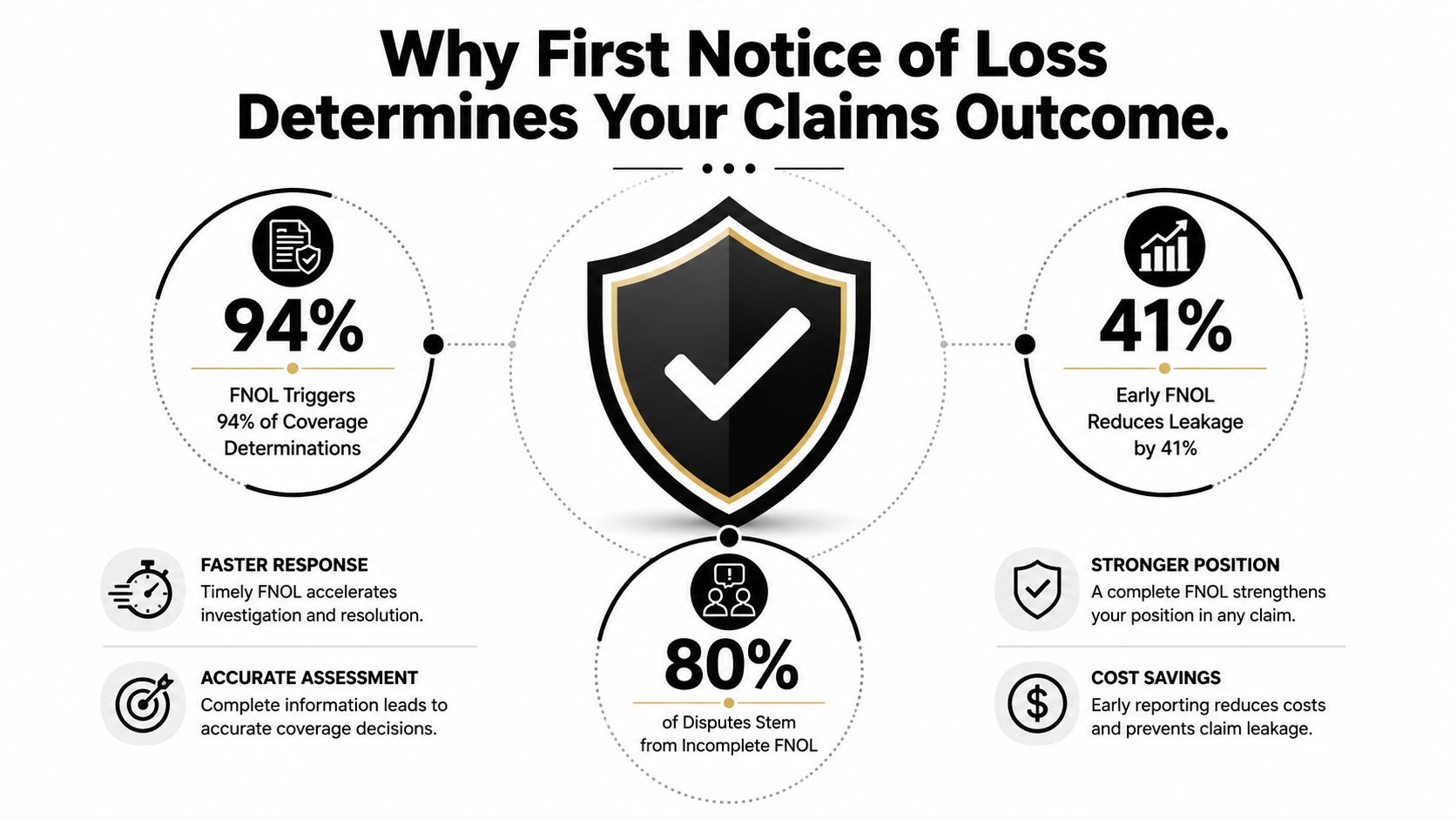
FNOL sets the tone for the claim because it is the first structured record of the loss, the first routing decision, and the first chance to separate a clean file from one that will need cleanup later. If that intake is incomplete or inconsistent, every downstream step has to work around the gaps.
The operational stakes are visible in the cycle time. Industry commentary cited by Five Sigma Labs ties the average U.S. homeowners claim to 44 days from FNOL to final payment, the longest cycle time recorded since 2008 (Five Sigma Labs). That benchmark matters because it shows how early intake decisions can stretch the full settlement path when the first notice is slow, vague, or sent to the wrong handler.
Why intake quality carries disproportionate weight
Strong FNOL gives the handler enough facts to move without guessing. The first notice usually includes the policyholder identity, policy number, date and time of loss, description of damage, and evidence such as photos or police reports (Sentry). If those details are missing, the team has to return to the customer or third party later, and that follow-up creates delay.
Documentation quality also affects leakage, reserving, and how much back-and-forth a claim needs before anyone can make a sound decision. Sentry cites a 2025 ACTEC whitepaper that says documentation accounts for 50% of lost dollars in claims management (Sentry). In practical terms, weak intake does not just slow the file. It increases the chance that the claim is reserved poorly, routed badly, or reopened for avoidable clarification.
Practical rule: if the first notice cannot support coverage verification and routing, it is not ready to become a claim record yet.
What strong FNOL changes in the workflow
High-quality FNOL functions as an orchestration point. Modern insurers use it to run coverage checks, capture missing information, and route the file into the right legal or handling path immediately (Five Sigma Labs). In practice, that means the intake process is doing more than collecting answers. It is starting triage, setting handler priorities, and reducing the amount of manual correction that follows.
A claims operation that wants consistent intake across channels also needs a system layer behind the process. That is where a claims management system matters, because it connects the first notice to routing, tasking, and the rules that keep files moving. Without that structure, even a good FNOL script can produce uneven handling across agents, portals, and partner sources.
The right conversation at intake also matters. A handler who knows what to say on FNOL call can collect the facts needed for coverage checks without turning the exchange into a long interview. That balance is where throughput improves, because the file moves forward with enough structure to support triage and enough discipline to avoid rework.
The FNOL Workflow as a Decision Engine
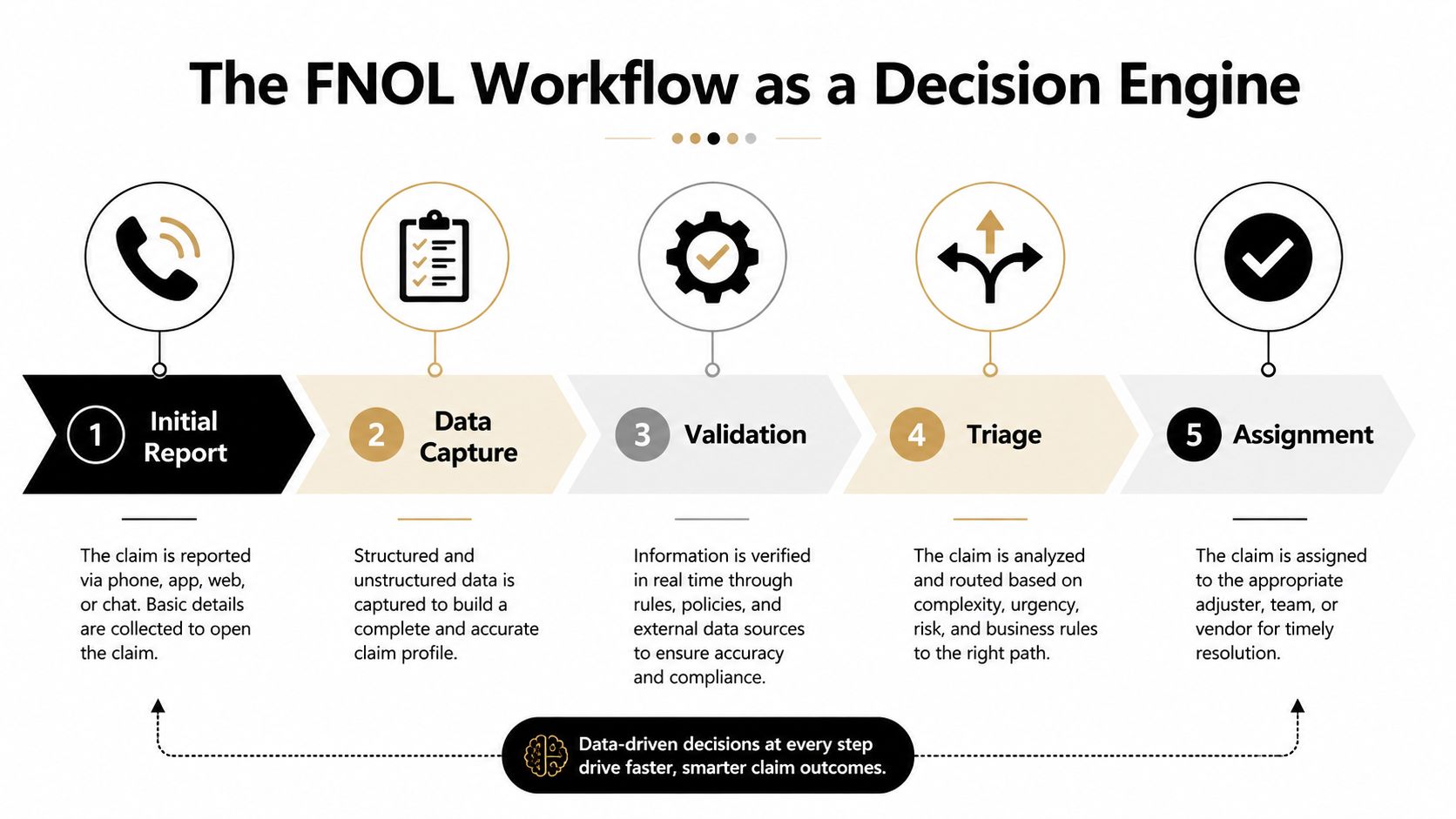
FNOL works best when it follows a sequence, not a scramble. Salesforce Trailhead breaks the process into ordered steps, get policy data, enter basic loss details, verify coverage, add additional loss details, create the claim, and evaluate rules. That order matters because each step depends on the one before it.
The sequence that keeps files moving
Policy lookup comes first because the handler needs to know whether the reporter, coverage, and policy period line up. Basic loss detail entry follows, then coverage verification, then a second pass for additional information, then claim creation, then rule evaluation. If a team skips ahead, it creates problems that show up later as misrouting, weak reserves, or coverage confusion.
That sequence turns FNOL into an early decision engine. It is the point where the system decides what kind of claim this is, who should handle it, and what the next action should be. That is why FNOL is increasingly tied to triage logic rather than a simple intake queue.
Operational insight: the best FNOL teams do not ask, “Did we log the loss?” They ask, “Did we validate enough to route the loss correctly?”
Why sequence discipline beats shortcutting
Compressed intake usually looks efficient at the front end and expensive later. A handler who logs a file quickly but leaves coverage, timing, or loss details incomplete ends up creating follow-up work for themselves or another team. That slows assignment and weakens consistency across the file.
A more disciplined workflow also makes automation possible. The AI insurance claims processing model only works cleanly when the underlying process already has an order to it. AI can accelerate the steps, but it cannot fix a workflow that does not know what it is trying to validate.
The practical test is straightforward. If your FNOL process cannot tell the difference between intake, validation, and assignment, it is not a decision engine yet. It is just a form with a queue attached.
A well-run FNOL flow also makes it easier to separate routine routing from exceptions that need human attention, including cases where teams need claim help from AMPM Restoration Services. That matters because the same intake path has to support straight-through processing for clean files and slower, more careful review for messy ones.
The Minimum Dataset Every FNOL Must Capture
The fastest way to create downstream rework is to accept incomplete notice data. A high-quality FNOL intake should reliably capture the policy number, date and time of loss, location, event description, involved parties, and supporting evidence such as photos, police reports, or medical records. Without those fields, the claim may be opened, but it will not be ready for sound handling.
What belongs in every intake
A practical intake checklist should stay consistent across channels, lines, and teams.
Policy number and effective date. Without these, the handler cannot verify coverage cleanly.
Date and time of loss. This supports coverage timing, sequence, and basic event reconstruction.
Location of loss. Location affects jurisdiction, exposure, and routing.
Claimant and involved party information. This tells the team who to contact and who may be impacted.
Initial damage description and evidence. Photos, police reports, or medical records give the file something structured to work from.
That dataset is more than administrative housekeeping. Each missing field creates another manual check later, and those checks show up in coverage verification, liability triage, and reserve-setting. The cleaner the first notice, the less time handlers spend reconstructing facts that should have been captured once.
A useful external reference for the claimant side of this same problem is claim help from AMPM Restoration Services. Customers often need simple guidance on what evidence to gather before the file reaches the desk.
Why documentation gaps are expensive
Missing documentation slows claims and creates avoidable leakage. When intake does not produce a complete record, handlers spend more time chasing facts, and that delay can push the file into a second round of manual review. The work does not disappear, it moves downstream.
A good FNOL form does not ask for everything. It asks for the fields that let the claim move without guessing.
For teams auditing intake quality, the question is whether every required field is structured, not just whether it exists somewhere in a note. The data quality discipline for FNOL should be treated like a control, because it determines whether the file can support the work that follows.
Manual FNOL vs AI-Driven Intake and Triage
Manual FNOL still works at lower volume and with straightforward claims. It breaks down as intake expands across channels, because handlers end up rekeying facts, making judgment calls from partial records, and stitching together phone calls, emails, and portal notes that do not line up cleanly.
Where manual intake breaks down
Traditional intake depends on a person gathering facts, entering them, and deciding what matters next. That creates friction at every step. If a policy check is delayed, if details arrive in fragments, or if the call transcript does not match the email thread, the handler has to reconcile the file before anything else can move.
That is why manual FNOL creates bottlenecks in cross-channel operations. A claimant may call first, then send photos by email, then answer follow-up questions by text. If those pieces are not merged into one consistent record, the claim can be duplicated, delayed, or sent to the wrong queue.
What AI-driven intake changes
AI-driven FNOL handles the same front-end work differently. It can extract structured data from inbound messages, run policy checks automatically, capture missing details, and route the file to the right team faster. In the publisher's own operating model, that includes FNOL intake, claims triage, document processing, and task orchestration within existing systems, which is where handler throughput tends to improve.
The operational value is not novelty. It is momentum. When the intake layer can validate and route continuously, handlers spend less time cleaning up the front end and more time on claim decisions that require judgment. That is why many teams are shifting from manual note-taking to agentic workflow support.
The difference shows up in triage quality. Manual teams often wait for a full file before acting. AI-driven teams can start the decision path earlier because the workflow has already validated enough of the record to move. For a closer look at routing logic, the internal AI claims triage resource is useful context.
A video walkthrough also helps illustrate the operational shift:
What matters most is not whether the intake is human or automated. It is whether the intake produces a clean, usable record that supports action without rework.
When Early Fraud Detection Helps and When It Hurts
Fraud screening belongs at FNOL, but every screening method does not belong there in the same way. FNOL is the first point where suspicious patterns can surface, and it is also the moment when legitimate claimants are most sensitive to friction. If the screen is too blunt, honest files slow down and trust takes a hit.
The trade-off at intake
An aggressive fraud flag helps when it stops obviously inconsistent claims from advancing. It hurts when it creates false positives that trigger unnecessary escalations. That cost lands early, because the claimant feels the delay before any real claim work has started.
The right question is not whether to screen for fraud. The question is whether the screen is explainable, proportionate, and fast enough to avoid slowing ordinary claims. If a fraud gate is opaque, handlers spend time explaining the flag instead of progressing the file.
What better screening looks like
Strong FNOL risk review uses structured signals, clear thresholds, and a path back to normal handling when the file is not high risk. That matters because severity and staffing decisions are increasingly made at intake, not later in the file.
Practical rule: if the risk model cannot explain why it escalated a clean claim, it is probably creating avoidable friction.
A balanced intake process also protects customer experience. Fraud prevention should reduce bad leakage, not turn every early interaction into an investigation. That distinction matters for teams trying to shorten cycle time without losing control of the file.
The fraud detection discussion from Nolana's own material fits here because the triage logic compares coverage, exposure, and loss context before routing. Used well, early screening helps teams focus attention where it belongs. Used badly, it makes routine claims feel adversarial.
The operating choice is straightforward. Good FNOL risk screening should sharpen judgment, not add drag.
The Cross-Channel FNOL Problem No One Talks About
A claimant rarely stays in one channel anymore. A loss may start with a phone call, continue through email, pick up missing photos via text, and get acknowledged through a portal or messaging app. The operational problem isn't the individual channel, it's keeping the claim record coherent when the same person moves between channels and business hours.
A common failure pattern
A policyholder reports water damage after hours by email, then calls the next morning to ask whether the file was received. The call center opens a second record because the email wasn't linked quickly enough. Later, a photo arrives through a messaging thread, but the handler is working from the original file and never sees it in time.
That's how duplicate claims, lost context, and inconsistent acknowledgments happen. The issue isn't just technology. It's the absence of orchestration across identity capture, policy validation, and follow-up tasks.
What continuous intake has to solve
Cross-channel FNOL needs a shared record that can absorb new facts without losing the original timestamp or ownership. It also needs clear rules for which message is authoritative when the same claimant repeats or corrects details across channels. Without that discipline, handlers spend time reconciling duplicates instead of moving claims forward.
The channel mix matters because insurance isn't a nine-to-five process anymore. Losses come in after hours, from multiple languages, and across different time zones. Teams that still treat FNOL as a single-form event often struggle to keep up with that reality.
A more resilient model treats FNOL as continuous intake. The file keeps evolving, but the record stays anchored. That's what prevents broken handoffs and keeps the first notice from becoming a chain of disconnected contacts.
Building an FNOL Operation That Scales With Human Oversight
The strongest operating model for modern FNOL is human-in-the-loop automation. Full automation sounds efficient until a file needs judgment, auditability, or a defensible exception path. Manual handling, on the other hand, keeps too much routine work in the hands of experienced handlers and slows them down.
Why oversight still matters
Claims leaders need systems that can move quickly without losing control. That means full visibility into who touched the file, what was captured, what was inferred, and what was escalated. It also means handlers can step in when the file is ambiguous, sensitive, or high severity.
That's where agentic AI fits. The publisher's Nolana AI platform is one example of a system that automates FNOL intake, claims triage, static claims management, and document processing while sitting on top of existing claims and policy systems. It's built for managing agents, brokers, and cover holders, and it keeps human oversight and auditability in place throughout.
What to look for in a platform
The platform decision should come down to operating fit, not buzzwords.
Integration with existing systems. If the workflow forces teams into a new swivel-chair process, the gains will disappear fast.
Cross-channel orchestration. The system has to keep email, voice, portal, and messaging activity aligned in one record.
Audit-ready logging. Every action should be traceable for governance and review.
Rules and routing control. Handlers need to understand why a file moved where it did.
Human override. A good system lets experienced people intervene without breaking the workflow.
Practical rule: automation should remove the administrative work around FNOL, not the judgment that makes claims handling safe.
That balance is what scales. Teams that combine structured intake with controlled automation can free handlers from repetitive work while still preserving the oversight required in enterprise claims operations. For buyers evaluating options, the right question is whether the platform strengthens governance as it speeds up intake.
Nolana AI automates FNOL intake, triage, document processing, and task orchestration while keeping handlers in control of the file. If you're modernizing claims operations across complex programs, visit Nolana AI to see how agentic workflows can fit on top of your existing systems without losing auditability or oversight.
44 days from FNOL to final payment is now the average U.S. homeowners claim cycle, and that's the longest recorded since the Property Claims Satisfaction Study began in 2008. That makes first notice of loss the start of an end-to-end operational clock, not a clerical intake step, and what happens at that first touch often shapes the rest of the file.
In practice, FNOL is where cycle time, coverage confidence, routing quality, and customer experience either get locked in early or start slipping into rework. Claims teams that treat it as an orchestration point tend to move faster because they capture the right data, route correctly, and keep handlers focused on judgment instead of cleanup.
Why First Notice of Loss Determines Your Claims Outcome
FNOL sets the tone for the claim because it is the first structured record of the loss, the first routing decision, and the first chance to separate a clean file from one that will need cleanup later. If that intake is incomplete or inconsistent, every downstream step has to work around the gaps.
The operational stakes are visible in the cycle time. Industry commentary cited by Five Sigma Labs ties the average U.S. homeowners claim to 44 days from FNOL to final payment, the longest cycle time recorded since 2008 (Five Sigma Labs). That benchmark matters because it shows how early intake decisions can stretch the full settlement path when the first notice is slow, vague, or sent to the wrong handler.
Why intake quality carries disproportionate weight
Strong FNOL gives the handler enough facts to move without guessing. The first notice usually includes the policyholder identity, policy number, date and time of loss, description of damage, and evidence such as photos or police reports (Sentry). If those details are missing, the team has to return to the customer or third party later, and that follow-up creates delay.
Documentation quality also affects leakage, reserving, and how much back-and-forth a claim needs before anyone can make a sound decision. Sentry cites a 2025 ACTEC whitepaper that says documentation accounts for 50% of lost dollars in claims management (Sentry). In practical terms, weak intake does not just slow the file. It increases the chance that the claim is reserved poorly, routed badly, or reopened for avoidable clarification.
Practical rule: if the first notice cannot support coverage verification and routing, it is not ready to become a claim record yet.
What strong FNOL changes in the workflow
High-quality FNOL functions as an orchestration point. Modern insurers use it to run coverage checks, capture missing information, and route the file into the right legal or handling path immediately (Five Sigma Labs). In practice, that means the intake process is doing more than collecting answers. It is starting triage, setting handler priorities, and reducing the amount of manual correction that follows.
A claims operation that wants consistent intake across channels also needs a system layer behind the process. That is where a claims management system matters, because it connects the first notice to routing, tasking, and the rules that keep files moving. Without that structure, even a good FNOL script can produce uneven handling across agents, portals, and partner sources.
The right conversation at intake also matters. A handler who knows what to say on FNOL call can collect the facts needed for coverage checks without turning the exchange into a long interview. That balance is where throughput improves, because the file moves forward with enough structure to support triage and enough discipline to avoid rework.
The FNOL Workflow as a Decision Engine
FNOL works best when it follows a sequence, not a scramble. Salesforce Trailhead breaks the process into ordered steps, get policy data, enter basic loss details, verify coverage, add additional loss details, create the claim, and evaluate rules. That order matters because each step depends on the one before it.
The sequence that keeps files moving
Policy lookup comes first because the handler needs to know whether the reporter, coverage, and policy period line up. Basic loss detail entry follows, then coverage verification, then a second pass for additional information, then claim creation, then rule evaluation. If a team skips ahead, it creates problems that show up later as misrouting, weak reserves, or coverage confusion.
That sequence turns FNOL into an early decision engine. It is the point where the system decides what kind of claim this is, who should handle it, and what the next action should be. That is why FNOL is increasingly tied to triage logic rather than a simple intake queue.
Operational insight: the best FNOL teams do not ask, “Did we log the loss?” They ask, “Did we validate enough to route the loss correctly?”
Why sequence discipline beats shortcutting
Compressed intake usually looks efficient at the front end and expensive later. A handler who logs a file quickly but leaves coverage, timing, or loss details incomplete ends up creating follow-up work for themselves or another team. That slows assignment and weakens consistency across the file.
A more disciplined workflow also makes automation possible. The AI insurance claims processing model only works cleanly when the underlying process already has an order to it. AI can accelerate the steps, but it cannot fix a workflow that does not know what it is trying to validate.
The practical test is straightforward. If your FNOL process cannot tell the difference between intake, validation, and assignment, it is not a decision engine yet. It is just a form with a queue attached.
A well-run FNOL flow also makes it easier to separate routine routing from exceptions that need human attention, including cases where teams need claim help from AMPM Restoration Services. That matters because the same intake path has to support straight-through processing for clean files and slower, more careful review for messy ones.
The Minimum Dataset Every FNOL Must Capture
The fastest way to create downstream rework is to accept incomplete notice data. A high-quality FNOL intake should reliably capture the policy number, date and time of loss, location, event description, involved parties, and supporting evidence such as photos, police reports, or medical records. Without those fields, the claim may be opened, but it will not be ready for sound handling.
What belongs in every intake
A practical intake checklist should stay consistent across channels, lines, and teams.
Policy number and effective date. Without these, the handler cannot verify coverage cleanly.
Date and time of loss. This supports coverage timing, sequence, and basic event reconstruction.
Location of loss. Location affects jurisdiction, exposure, and routing.
Claimant and involved party information. This tells the team who to contact and who may be impacted.
Initial damage description and evidence. Photos, police reports, or medical records give the file something structured to work from.
That dataset is more than administrative housekeeping. Each missing field creates another manual check later, and those checks show up in coverage verification, liability triage, and reserve-setting. The cleaner the first notice, the less time handlers spend reconstructing facts that should have been captured once.
A useful external reference for the claimant side of this same problem is claim help from AMPM Restoration Services. Customers often need simple guidance on what evidence to gather before the file reaches the desk.
Why documentation gaps are expensive
Missing documentation slows claims and creates avoidable leakage. When intake does not produce a complete record, handlers spend more time chasing facts, and that delay can push the file into a second round of manual review. The work does not disappear, it moves downstream.
A good FNOL form does not ask for everything. It asks for the fields that let the claim move without guessing.
For teams auditing intake quality, the question is whether every required field is structured, not just whether it exists somewhere in a note. The data quality discipline for FNOL should be treated like a control, because it determines whether the file can support the work that follows.
Manual FNOL vs AI-Driven Intake and Triage
Manual FNOL still works at lower volume and with straightforward claims. It breaks down as intake expands across channels, because handlers end up rekeying facts, making judgment calls from partial records, and stitching together phone calls, emails, and portal notes that do not line up cleanly.
Where manual intake breaks down
Traditional intake depends on a person gathering facts, entering them, and deciding what matters next. That creates friction at every step. If a policy check is delayed, if details arrive in fragments, or if the call transcript does not match the email thread, the handler has to reconcile the file before anything else can move.
That is why manual FNOL creates bottlenecks in cross-channel operations. A claimant may call first, then send photos by email, then answer follow-up questions by text. If those pieces are not merged into one consistent record, the claim can be duplicated, delayed, or sent to the wrong queue.
What AI-driven intake changes
AI-driven FNOL handles the same front-end work differently. It can extract structured data from inbound messages, run policy checks automatically, capture missing details, and route the file to the right team faster. In the publisher's own operating model, that includes FNOL intake, claims triage, document processing, and task orchestration within existing systems, which is where handler throughput tends to improve.
The operational value is not novelty. It is momentum. When the intake layer can validate and route continuously, handlers spend less time cleaning up the front end and more time on claim decisions that require judgment. That is why many teams are shifting from manual note-taking to agentic workflow support.
The difference shows up in triage quality. Manual teams often wait for a full file before acting. AI-driven teams can start the decision path earlier because the workflow has already validated enough of the record to move. For a closer look at routing logic, the internal AI claims triage resource is useful context.
A video walkthrough also helps illustrate the operational shift:
What matters most is not whether the intake is human or automated. It is whether the intake produces a clean, usable record that supports action without rework.
When Early Fraud Detection Helps and When It Hurts
Fraud screening belongs at FNOL, but every screening method does not belong there in the same way. FNOL is the first point where suspicious patterns can surface, and it is also the moment when legitimate claimants are most sensitive to friction. If the screen is too blunt, honest files slow down and trust takes a hit.
The trade-off at intake
An aggressive fraud flag helps when it stops obviously inconsistent claims from advancing. It hurts when it creates false positives that trigger unnecessary escalations. That cost lands early, because the claimant feels the delay before any real claim work has started.
The right question is not whether to screen for fraud. The question is whether the screen is explainable, proportionate, and fast enough to avoid slowing ordinary claims. If a fraud gate is opaque, handlers spend time explaining the flag instead of progressing the file.
What better screening looks like
Strong FNOL risk review uses structured signals, clear thresholds, and a path back to normal handling when the file is not high risk. That matters because severity and staffing decisions are increasingly made at intake, not later in the file.
Practical rule: if the risk model cannot explain why it escalated a clean claim, it is probably creating avoidable friction.
A balanced intake process also protects customer experience. Fraud prevention should reduce bad leakage, not turn every early interaction into an investigation. That distinction matters for teams trying to shorten cycle time without losing control of the file.
The fraud detection discussion from Nolana's own material fits here because the triage logic compares coverage, exposure, and loss context before routing. Used well, early screening helps teams focus attention where it belongs. Used badly, it makes routine claims feel adversarial.
The operating choice is straightforward. Good FNOL risk screening should sharpen judgment, not add drag.
The Cross-Channel FNOL Problem No One Talks About
A claimant rarely stays in one channel anymore. A loss may start with a phone call, continue through email, pick up missing photos via text, and get acknowledged through a portal or messaging app. The operational problem isn't the individual channel, it's keeping the claim record coherent when the same person moves between channels and business hours.
A common failure pattern
A policyholder reports water damage after hours by email, then calls the next morning to ask whether the file was received. The call center opens a second record because the email wasn't linked quickly enough. Later, a photo arrives through a messaging thread, but the handler is working from the original file and never sees it in time.
That's how duplicate claims, lost context, and inconsistent acknowledgments happen. The issue isn't just technology. It's the absence of orchestration across identity capture, policy validation, and follow-up tasks.
What continuous intake has to solve
Cross-channel FNOL needs a shared record that can absorb new facts without losing the original timestamp or ownership. It also needs clear rules for which message is authoritative when the same claimant repeats or corrects details across channels. Without that discipline, handlers spend time reconciling duplicates instead of moving claims forward.
The channel mix matters because insurance isn't a nine-to-five process anymore. Losses come in after hours, from multiple languages, and across different time zones. Teams that still treat FNOL as a single-form event often struggle to keep up with that reality.
A more resilient model treats FNOL as continuous intake. The file keeps evolving, but the record stays anchored. That's what prevents broken handoffs and keeps the first notice from becoming a chain of disconnected contacts.
Building an FNOL Operation That Scales With Human Oversight
The strongest operating model for modern FNOL is human-in-the-loop automation. Full automation sounds efficient until a file needs judgment, auditability, or a defensible exception path. Manual handling, on the other hand, keeps too much routine work in the hands of experienced handlers and slows them down.
Why oversight still matters
Claims leaders need systems that can move quickly without losing control. That means full visibility into who touched the file, what was captured, what was inferred, and what was escalated. It also means handlers can step in when the file is ambiguous, sensitive, or high severity.
That's where agentic AI fits. The publisher's Nolana AI platform is one example of a system that automates FNOL intake, claims triage, static claims management, and document processing while sitting on top of existing claims and policy systems. It's built for managing agents, brokers, and cover holders, and it keeps human oversight and auditability in place throughout.
What to look for in a platform
The platform decision should come down to operating fit, not buzzwords.
Integration with existing systems. If the workflow forces teams into a new swivel-chair process, the gains will disappear fast.
Cross-channel orchestration. The system has to keep email, voice, portal, and messaging activity aligned in one record.
Audit-ready logging. Every action should be traceable for governance and review.
Rules and routing control. Handlers need to understand why a file moved where it did.
Human override. A good system lets experienced people intervene without breaking the workflow.
Practical rule: automation should remove the administrative work around FNOL, not the judgment that makes claims handling safe.
That balance is what scales. Teams that combine structured intake with controlled automation can free handlers from repetitive work while still preserving the oversight required in enterprise claims operations. For buyers evaluating options, the right question is whether the platform strengthens governance as it speeds up intake.
Nolana AI automates FNOL intake, triage, document processing, and task orchestration while keeping handlers in control of the file. If you're modernizing claims operations across complex programs, visit Nolana AI to see how agentic workflows can fit on top of your existing systems without losing auditability or oversight.


All systems operational
1 Lime Street, London EC3M 7HA | 222E 3rd Street, New York 10009
Copyright © 2026, Nolana. All rights reserved
All systems operational
1 Lime Street, London EC3M 7HA | 222E 3rd Street, New York 10009
Copyright © 2026, Nolana. All rights reserved
All systems operational
1 Lime Street, London EC3M 7HA | 222E 3rd Street, New York 10009
Copyright © 2026, Nolana. All rights reserved
All systems operational
1 Lime Street, London EC3M 7HA | 222E 3rd Street, New York 10009
Copyright © 2026, Nolana. All rights reserved