What Is Agentic Automation: A 2026 Guide
What Is Agentic Automation: A 2026 Guide
Learn what is agentic automation is and how it transforms enterprise workflows with AI-driven governance and measurable ROI in 2026.

Agentic automation uses AI agents that can perceive, reason, and act across enterprise systems to achieve goals. Gartner forecasts that by 2028, 33% of enterprise software applications will include agentic AI, up from less than 1% in 2024, and agents will autonomously make 15% of day-to-day work decisions. That's the clearest sign yet that this isn't just another automation trend, it's a shift from fixed rules to goal-driven work inside the software your teams already use.
A claims handler buried in intake emails, PDFs, Slack messages, and policy lookups doesn't need another dashboard. They need a digital apprentice that can read the case, decide what's missing, trigger the next step, and escalate only when human judgment is needed. That's the practical answer to what is agentic automation, and it's why operations leaders in regulated industries are paying close attention.
The easiest way to think about it is this, traditional automation is a script, agentic automation is a worker with context. It doesn't just move data from one field to another, it can decide which tool to use, what sequence to follow, and when to ask for help. For a useful primer on adjacent workflow patterns, see Nolana's workflow automation guide, which helps separate fixed-process automation from more adaptive systems.
Introduction From Task Automation to Goal Orchestration
A busy claims team often starts the day with the same problem, work arrives in too many formats and too many channels, and every exception takes time away from judgment-heavy tasks. One file needs a missing attachment, another needs triage, another requires a status update across several systems. Agentic automation is designed for that kind of operational drag because it can move from intake to action without waiting for a person to hand it every next step.
The core idea is simple. An agent sees the situation, understands the goal, chooses a path, executes the work, and learns from the result. Slack describes this as a repeating Sense–Plan–Act–Learn loop, while IBM frames the same cycle as perception, reasoning, goal-setting, decision-making, and execution in which the agent collects data from APIs, databases, or user interactions and then chooses the next action to reach a goal IBM's agentic automation overview and Slack's agentic automation guide.
Why leaders are rethinking automation
Enterprise automation has moved beyond simple if-then logic. McKinsey's guidance on bounded adoption and orchestration shows that buyers are now asking how to keep systems auditable, bounded, and aligned with controls McKinsey on seizing the agentic AI advantage. That is the right question in insurance, banking, and other regulated environments.
Capability | Robotic Process Automation (RPA) | Generative AI | Agentic Automation |
|---|---|---|---|
Main job | Follow predefined rules | Produce text, summaries, or drafts | Pursue a goal and decide next steps |
Input type | Mostly structured data | Structured and unstructured content | Structured and unstructured content |
Adaptability | Low | Medium | High |
Decision-making | Human-designed logic | Suggestive, not action-oriented | Autonomous within guardrails |
Best fit | Repetitive, stable tasks | Content creation and analysis | Variable, cross-system work |
For leaders looking at adjacent enterprise patterns, the AI-driven banking operations guide offers a useful comparison point. The pattern is consistent across sectors, fixed workflows still matter, but goal-oriented orchestration handles the messy middle that breaks traditional automation.
Practical rule: if a process changes often, spans multiple systems, and needs judgment at several points, agentic automation is worth evaluating. If the process is repetitive and tightly structured, keep the simpler tool.
For teams that want a fuller contrast between fixed workflow automation and more adaptive systems, Nolana's workflow automation guide helps separate rule-based process design from goal-driven orchestration.
Deconstructing Agentic Automation The Core Concepts
A claims team gets an email with missing documents, a policy question, and a customer asking for an update. A basic workflow tool can route the message. An agentic automation system goes further. It reads the signals, decides what matters, and takes the next step within the limits it has been given. That is why it behaves more like a digital apprentice than a script runner. It works toward an outcome, but it still needs supervision, clear guardrails, and access to the right systems.
The closest comparison is a calculator versus an operations associate. A calculator gives the same answer every time if the input is the same. An operations associate follows the goal, checks context, and handles the exception that was not written into the original instructions. Agentic systems sit in that middle ground. They are more adaptive than RPA, but they are also expected to stay inside defined controls, especially in regulated work.
The operational loop behind the behavior
The core loop usually follows a sequence of perception, reasoning, goal-setting, decision-making, and execution. IBM's overview of the cycle explains the shape of that loop, but the practical takeaway is simple, the system does not stop at reading information, it uses what it reads to choose an action IBM's agentic automation overview. In an insurance workflow, that might mean opening a claim email, extracting the relevant facts, checking policy data, deciding whether the file is complete, and then moving the case to the right next step.
That loop only works well when the business has defined boundaries. The agent needs to know which sources it can trust, which actions it is allowed to take, and when it must hand the case to a person. For a closer look at the decision side of that process, see how AI agents think and learn. Without that discipline, the system becomes hard to audit, and in regulated operations that is a serious problem.
A practical way to separate the moving parts is to look at what each stage contributes to the workflow:
Perception, gathers context from emails, PDFs, portals, chat, or databases.
Reasoning, interprets the goal and breaks it into sub-steps.
Action, calls APIs, updates systems, or routes work to people.
Memory and learning, retains context and improves the next decision.
The last part is often misunderstood. Memory and learning do not mean the system should freely rewrite business policy. They mean it can preserve relevant context, avoid repeating work, and make better choices inside the control framework the organization sets.
The mistake many teams make is treating the agent like a chat box with broad permissions. It is a workflow participant, so the process design, access rules, and review points matter as much as the model itself.
Agentic automation vs RPA vs standalone GenAI
The easiest way to separate these tools is by asking a simple question. Does the system follow instructions, generate content, or pursue a goal across multiple systems? That difference matters because teams often expect one tool to do all three jobs, then run into brittle behavior.
Capability | Robotic Process Automation (RPA) | Generative AI, standalone | Agentic Automation |
|---|---|---|---|
Decision-making | Rule-based | Suggests or generates content | Chooses actions toward a goal |
Adaptability | Low | Moderate in language tasks | High across changing inputs |
Scope of work | Narrow and repetitive | Drafting, summarizing, analyzing | End-to-end, multi-step workflows |
Tool use | Limited, pre-scripted | Usually no direct execution | Uses APIs and connected tools |
Exception handling | Predefined | Ad hoc text responses | Context-aware escalation or retry |
Best value | Stability | Content generation | Orchestrated execution |
The operational difference becomes clearer when the work spans several systems. RPA can move data through a fixed path. Standalone GenAI can draft a response or summarize a file. Agentic automation can read the situation, decide what is missing, request input, update the case, and route the file to a human when the rules require it. That is why a business-focused guide such as Nolana's AI agent for business guide is useful, it frames agents as operating assets, not novelty features.
The Architecture of an Agentic Automation Platform
At enterprise scale, an agentic system can't live inside a single prompt box. It needs a structure that connects data, reasoning, execution, and control. That's why architecture matters more than the headline feature, especially when work moves through claims systems, policy platforms, document stores, and communications channels.
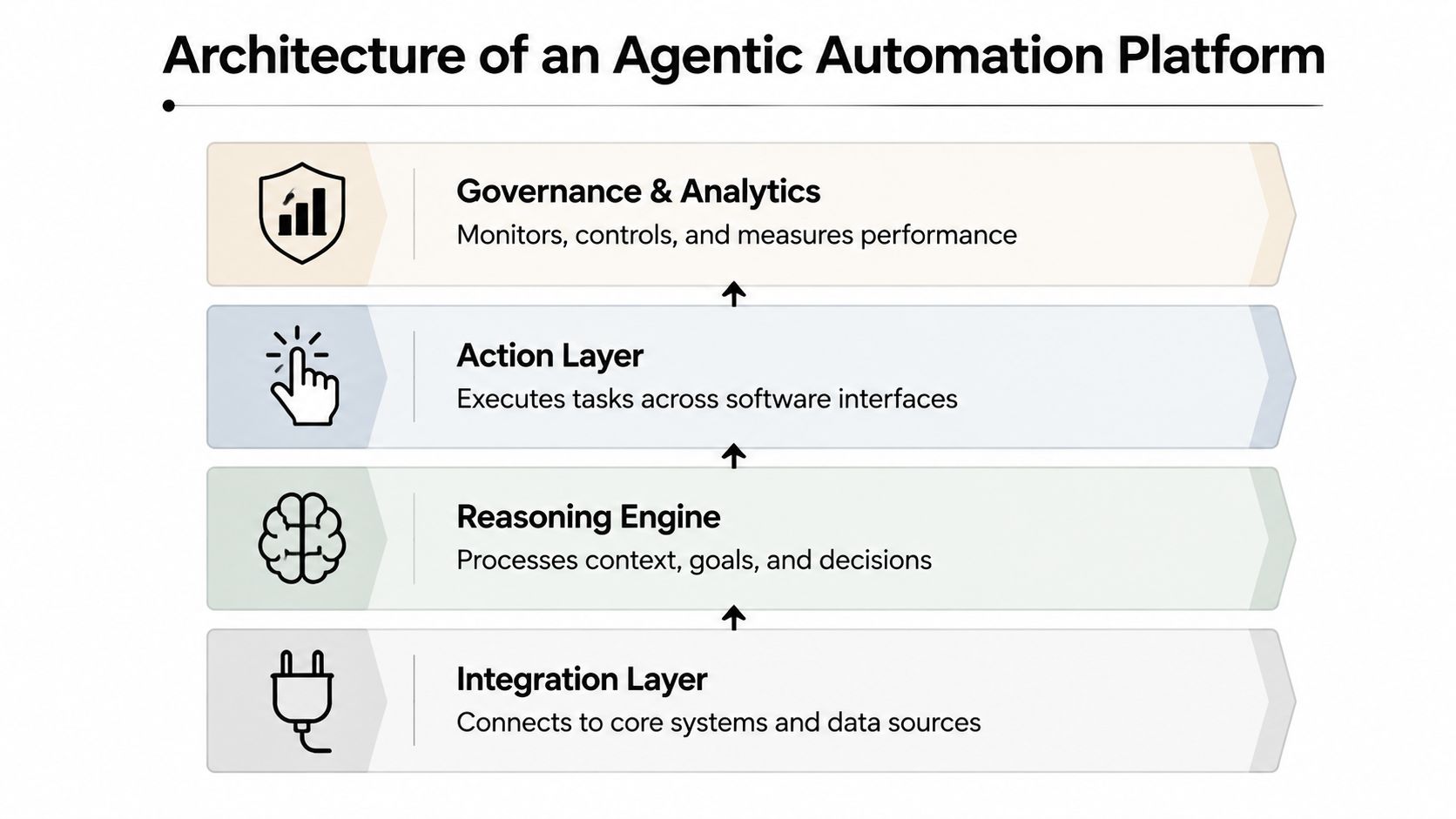
What each layer does in practice
The bottom layer is Integration. The platform connects to core systems and data sources through APIs, message queues, and other interfaces. Stonebranch's architecture guidance is explicit that agentic automation is most useful when work is variable and cross-system, because the architecture has to orchestrate agents, robots, and people around a single goal Stonebranch architecture overview.
Above that sits the Reasoning Engine. It evaluates the case, decides what matters, and chooses which tools to invoke. In claims, that might mean recognizing that an FNOL message is incomplete, checking a policy record, and deciding whether to request more data or route the file immediately.
The Action Layer is where work happens. The agent updates a claims system, sends a request, opens a task, or hands off to another system. This is the point where agentic automation stops being analysis and starts being operations.
Finally, Governance & Analytics watches everything. It tracks what happened, why it happened, and whether the action stayed inside policy. In regulated industries, that layer isn't optional, it's the difference between useful automation and unmanaged autonomy.
How this feels inside real workflows
A KYC team sees the same architecture in a different setting. Before automation, analysts bounce between document review, entity screening, and case notes. After deployment, the agent ingests documents, checks for missing information, routes edge cases for review, and keeps the case moving without forcing a new portal or a new manual process. For an adjacent view into system design, Nolana's microservices architecture patterns article helps explain why modular integration matters when workflows span many applications.
In customer service, the story is similar. The agent can read the issue, classify urgency, gather context from internal systems, and draft a response for a human to approve. The operator keeps control, but the administrative work drops away.
Real-World Use Cases in Insurance and Banking
Insurance is one of the clearest fits for agentic automation because claims work is already a chain of judgments, handoffs, and documents. The Nolana model reflects this well, with AI agents handling FNOL intake, claims triage, static claims management, and document processing while existing handlers stay focused on value-adding decisions. That's a strong fit for a market that lives on accuracy, auditability, and service quality.

Insurance claims from intake to resolution
The simplest way to understand the change is to compare the before and after. Before, a claims handler reads the notice, checks for missing details, rekeys data, and follows up across email and systems. After, the agent captures the notice, extracts the relevant facts, flags missing information, and routes the file to the right queue with the context already assembled.
That's where document-heavy work becomes especially compelling. One 2026 report cited a 3.1x throughput increase for document processing workflows, which is relevant to claims and finance operations because the value isn't just faster capture, it's end-to-end task execution digitalapplied's agentic AI statistics collection. Nolana's AI insurance claims processing page aligns with that use case by focusing on claims lifecycle work rather than isolated automation.
Operational insight: the best claims deployments don't try to automate every judgment. They automate the handoffs, the lookups, the reminders, and the routing that steal time from experienced handlers.
Banking workflows where context matters
Banking teams face similar friction in KYC, onboarding, and exception handling. A standard case may require collecting documents, checking data completeness, verifying against internal records, and escalating unusual situations for review. Agentic automation is valuable there because the work is variable, but still bound by policy and authority.
You can also see the same logic in service teams handling complex customer cases. The agent can gather account context, classify the request, and prepare the next action while the specialist keeps the final call. That's the right balance for regulated work, because it improves speed without removing oversight.
Ensuring Governance Risk and Compliance
A claims handler can move fast and still stay within policy. An agent can do the same only if the operating model is built for control from the start. That is why regulated industries are shifting toward a bounded, hybrid model with human-in-the-loop decisioning and a clear control plane. In insurance claims, where auditability and authority limits matter every day, that difference separates a useful pilot from a system that can run in production.

The controls that have to exist on day one
A safe deployment starts with human oversight. People need approval points for critical actions, not just a review screen after the fact. That matters because some decisions, especially in claims and banking, have to stay within authority thresholds and exception rules.
The second control is auditability. Every meaningful agent decision, tool call, and handoff should be logged so compliance teams can reconstruct what happened. Without that trail, the organization cannot explain outcomes, test process quality, or defend the workflow in a review.
The third is access control. Agents should only operate inside defined roles and permissions. If the platform cannot separate read, propose, and execute rights, it is too risky for regulated use.
A final layer is continuous monitoring. Teams need alerts for anomalous behavior, failed actions, and drift from expected process patterns. That is what turns agentic automation into a managed operating capability instead of a hidden black box.
The control model should also fit the compliance program already in place. For a practical reference point, Nolana's regulatory compliance in financial services guide lays out how automation choices connect to regulatory constraints. That kind of mapping matters because governance is not an add-on after deployment, it is part of the design.
Why the overlay model is safer
The practical implementation pattern is an overlay, not a replacement. The agentic layer sits on top of existing claims and policy systems, communicates through APIs, and orchestrates work without forcing a rip-and-replace project. That reduces change management and keeps the core system of record intact.
Regulated operations already rely on controls embedded in core platforms, approval chains, and case histories. Agentic automation should work like a dispatcher coordinating traffic at a busy junction, not like a contractor tearing up the road and rebuilding it around live operations. The best fit is a layer that uses existing records, respects existing permissions, and leaves a clear trace for auditors and supervisors.
A Practical Approach to Integration and Implementation
The first implementation mistake is trying to automate every part of a workflow at once. McKinsey's guidance is more disciplined, firms should use agents for multi-step decision-making with highly variable inputs, while rule-based automation is better for repetitive, structured work McKinsey on one year of agentic AI lessons. That distinction helps teams avoid placing an expensive agent where a simpler process is the better fit.
Start with the workflow, not the model
The strongest rollouts usually begin with one question, where does the work break today? In claims, that might be document intake or dormant-file follow-up. In banking, it might be KYC exception handling or case preparation. The point is to target a process with enough variability to benefit from agentic reasoning, but enough structure to keep it governable.
A second choice is integration style. Teams get better adoption when the platform sits on top of existing tools and uses APIs to coordinate work across systems. People keep using the systems they know, and the agent handles the administrative layer in the background.
What to look for in the implementation plan
Defined handoffs: each action should have a clear owner, a fallback path, and a human approval point where needed.
System compatibility: the platform should connect to existing claims, policy, CRM, and document systems through standard interfaces.
Exception handling: if a file is incomplete or a system is unavailable, the process should route cleanly to a person instead of stalling.
Operating visibility: teams need dashboards, logs, and traceable outcomes, not just a model output.
For teams comparing build options, Nolana AI provides an AI agent and SOP builder, task execution inside claims workflows, and integrations with existing claims workbenches and policy administration platforms. That kind of overlay approach is usually easier to operationalize than replacing core systems, because it lets the business preserve its current stack while shifting the repetitive work to agents.
Measuring the Business Impact and ROI
ROI for agentic automation shouldn't be framed as a vague promise of efficiency. It should show up in cycle time, throughput, error reduction, and the amount of human capacity freed for higher-value decisions. The market signal is strong too, the global agentic AI market is projected to grow from $5.25 billion in 2024 to $199.05 billion by 2034, a 43.84% CAGR, which reflects the scale of operational value organizations expect Landbase's agentic AI statistics compilation.
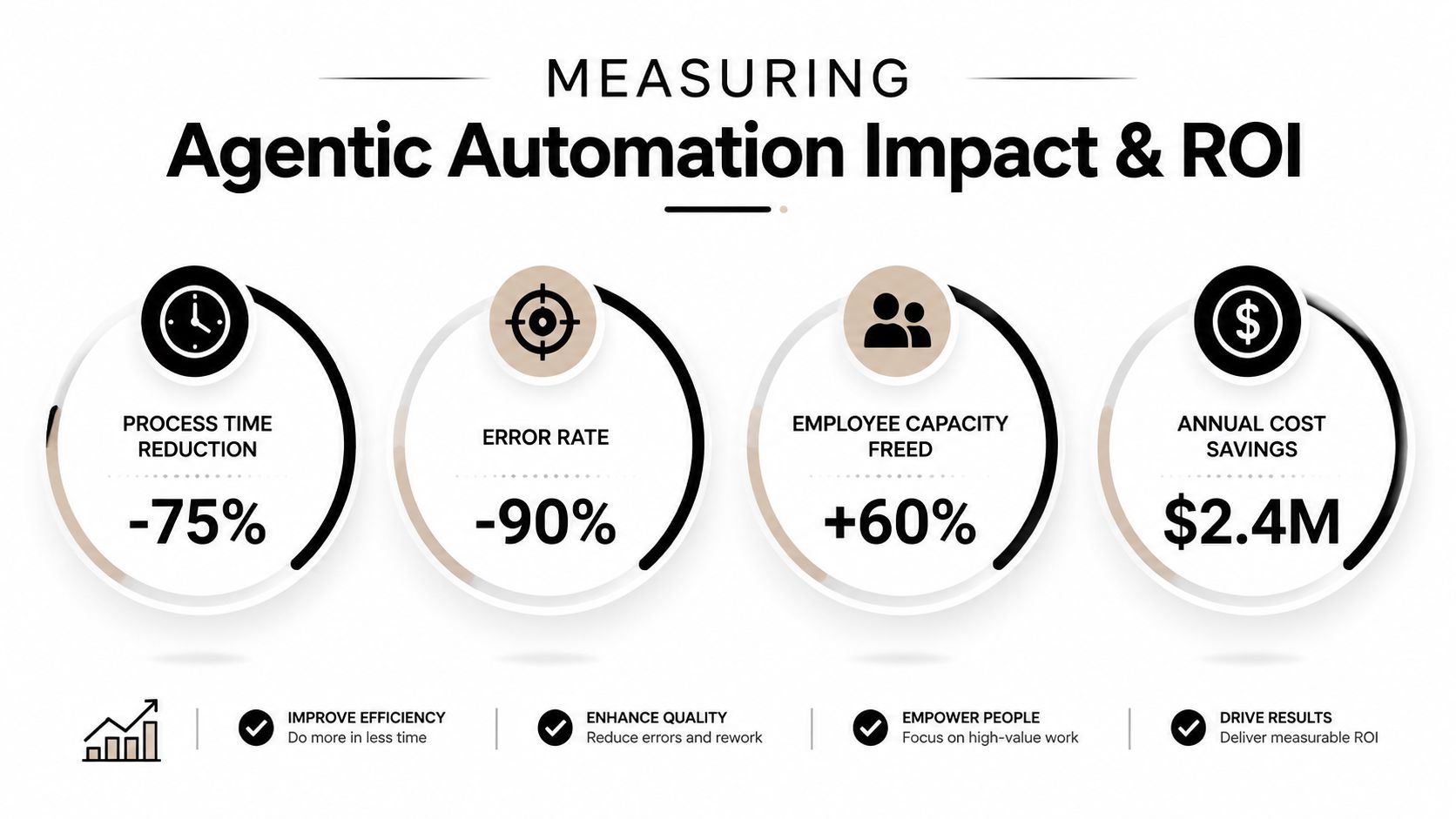
What to measure first
The most useful KPI is usually the one tied closest to a bottleneck. If claims intake is the problem, measure how quickly files move from submission to triage. If document handling is the drag, measure how much manual rekeying disappears. If the issue is handler overload, measure how much capacity is freed for exceptions and judgment-heavy work.
A second layer of measurement should cover quality. That includes fewer missed steps, cleaner audit trails, and more consistent routing decisions. In regulated workflows, consistency matters as much as speed because a fast wrong answer still creates risk.
Building a business case that leadership will trust
Leaders respond to process economics, not buzzwords. Show them where the workflow slows down, where handoffs break, and what a governed agent can take off the team's plate. Then connect that to service quality, employee morale, and customer responsiveness.
Use this standard: if the workflow has a clear start, a known outcome, and repeatable exceptions, it's a candidate for measured agentic automation. If it's mostly policy-driven and stable, simpler automation will usually win.
The business case gets stronger when you pair that measurement discipline with a realistic deployment model. The market is growing fast, but adoption is still early-stage, and that's exactly why the winners will be the teams that combine orchestration, governance, and practical integration rather than chasing autonomy for its own sake.
If you're comparing options for claims operations, visit Nolana AI to see how agentic automation can fit into your existing systems while keeping human oversight, auditability, and control at the center of the workflow.
Agentic automation uses AI agents that can perceive, reason, and act across enterprise systems to achieve goals. Gartner forecasts that by 2028, 33% of enterprise software applications will include agentic AI, up from less than 1% in 2024, and agents will autonomously make 15% of day-to-day work decisions. That's the clearest sign yet that this isn't just another automation trend, it's a shift from fixed rules to goal-driven work inside the software your teams already use.
A claims handler buried in intake emails, PDFs, Slack messages, and policy lookups doesn't need another dashboard. They need a digital apprentice that can read the case, decide what's missing, trigger the next step, and escalate only when human judgment is needed. That's the practical answer to what is agentic automation, and it's why operations leaders in regulated industries are paying close attention.
The easiest way to think about it is this, traditional automation is a script, agentic automation is a worker with context. It doesn't just move data from one field to another, it can decide which tool to use, what sequence to follow, and when to ask for help. For a useful primer on adjacent workflow patterns, see Nolana's workflow automation guide, which helps separate fixed-process automation from more adaptive systems.
Introduction From Task Automation to Goal Orchestration
A busy claims team often starts the day with the same problem, work arrives in too many formats and too many channels, and every exception takes time away from judgment-heavy tasks. One file needs a missing attachment, another needs triage, another requires a status update across several systems. Agentic automation is designed for that kind of operational drag because it can move from intake to action without waiting for a person to hand it every next step.
The core idea is simple. An agent sees the situation, understands the goal, chooses a path, executes the work, and learns from the result. Slack describes this as a repeating Sense–Plan–Act–Learn loop, while IBM frames the same cycle as perception, reasoning, goal-setting, decision-making, and execution in which the agent collects data from APIs, databases, or user interactions and then chooses the next action to reach a goal IBM's agentic automation overview and Slack's agentic automation guide.
Why leaders are rethinking automation
Enterprise automation has moved beyond simple if-then logic. McKinsey's guidance on bounded adoption and orchestration shows that buyers are now asking how to keep systems auditable, bounded, and aligned with controls McKinsey on seizing the agentic AI advantage. That is the right question in insurance, banking, and other regulated environments.
Capability | Robotic Process Automation (RPA) | Generative AI | Agentic Automation |
|---|---|---|---|
Main job | Follow predefined rules | Produce text, summaries, or drafts | Pursue a goal and decide next steps |
Input type | Mostly structured data | Structured and unstructured content | Structured and unstructured content |
Adaptability | Low | Medium | High |
Decision-making | Human-designed logic | Suggestive, not action-oriented | Autonomous within guardrails |
Best fit | Repetitive, stable tasks | Content creation and analysis | Variable, cross-system work |
For leaders looking at adjacent enterprise patterns, the AI-driven banking operations guide offers a useful comparison point. The pattern is consistent across sectors, fixed workflows still matter, but goal-oriented orchestration handles the messy middle that breaks traditional automation.
Practical rule: if a process changes often, spans multiple systems, and needs judgment at several points, agentic automation is worth evaluating. If the process is repetitive and tightly structured, keep the simpler tool.
For teams that want a fuller contrast between fixed workflow automation and more adaptive systems, Nolana's workflow automation guide helps separate rule-based process design from goal-driven orchestration.
Deconstructing Agentic Automation The Core Concepts
A claims team gets an email with missing documents, a policy question, and a customer asking for an update. A basic workflow tool can route the message. An agentic automation system goes further. It reads the signals, decides what matters, and takes the next step within the limits it has been given. That is why it behaves more like a digital apprentice than a script runner. It works toward an outcome, but it still needs supervision, clear guardrails, and access to the right systems.
The closest comparison is a calculator versus an operations associate. A calculator gives the same answer every time if the input is the same. An operations associate follows the goal, checks context, and handles the exception that was not written into the original instructions. Agentic systems sit in that middle ground. They are more adaptive than RPA, but they are also expected to stay inside defined controls, especially in regulated work.
The operational loop behind the behavior
The core loop usually follows a sequence of perception, reasoning, goal-setting, decision-making, and execution. IBM's overview of the cycle explains the shape of that loop, but the practical takeaway is simple, the system does not stop at reading information, it uses what it reads to choose an action IBM's agentic automation overview. In an insurance workflow, that might mean opening a claim email, extracting the relevant facts, checking policy data, deciding whether the file is complete, and then moving the case to the right next step.
That loop only works well when the business has defined boundaries. The agent needs to know which sources it can trust, which actions it is allowed to take, and when it must hand the case to a person. For a closer look at the decision side of that process, see how AI agents think and learn. Without that discipline, the system becomes hard to audit, and in regulated operations that is a serious problem.
A practical way to separate the moving parts is to look at what each stage contributes to the workflow:
Perception, gathers context from emails, PDFs, portals, chat, or databases.
Reasoning, interprets the goal and breaks it into sub-steps.
Action, calls APIs, updates systems, or routes work to people.
Memory and learning, retains context and improves the next decision.
The last part is often misunderstood. Memory and learning do not mean the system should freely rewrite business policy. They mean it can preserve relevant context, avoid repeating work, and make better choices inside the control framework the organization sets.
The mistake many teams make is treating the agent like a chat box with broad permissions. It is a workflow participant, so the process design, access rules, and review points matter as much as the model itself.
Agentic automation vs RPA vs standalone GenAI
The easiest way to separate these tools is by asking a simple question. Does the system follow instructions, generate content, or pursue a goal across multiple systems? That difference matters because teams often expect one tool to do all three jobs, then run into brittle behavior.
Capability | Robotic Process Automation (RPA) | Generative AI, standalone | Agentic Automation |
|---|---|---|---|
Decision-making | Rule-based | Suggests or generates content | Chooses actions toward a goal |
Adaptability | Low | Moderate in language tasks | High across changing inputs |
Scope of work | Narrow and repetitive | Drafting, summarizing, analyzing | End-to-end, multi-step workflows |
Tool use | Limited, pre-scripted | Usually no direct execution | Uses APIs and connected tools |
Exception handling | Predefined | Ad hoc text responses | Context-aware escalation or retry |
Best value | Stability | Content generation | Orchestrated execution |
The operational difference becomes clearer when the work spans several systems. RPA can move data through a fixed path. Standalone GenAI can draft a response or summarize a file. Agentic automation can read the situation, decide what is missing, request input, update the case, and route the file to a human when the rules require it. That is why a business-focused guide such as Nolana's AI agent for business guide is useful, it frames agents as operating assets, not novelty features.
The Architecture of an Agentic Automation Platform
At enterprise scale, an agentic system can't live inside a single prompt box. It needs a structure that connects data, reasoning, execution, and control. That's why architecture matters more than the headline feature, especially when work moves through claims systems, policy platforms, document stores, and communications channels.
What each layer does in practice
The bottom layer is Integration. The platform connects to core systems and data sources through APIs, message queues, and other interfaces. Stonebranch's architecture guidance is explicit that agentic automation is most useful when work is variable and cross-system, because the architecture has to orchestrate agents, robots, and people around a single goal Stonebranch architecture overview.
Above that sits the Reasoning Engine. It evaluates the case, decides what matters, and chooses which tools to invoke. In claims, that might mean recognizing that an FNOL message is incomplete, checking a policy record, and deciding whether to request more data or route the file immediately.
The Action Layer is where work happens. The agent updates a claims system, sends a request, opens a task, or hands off to another system. This is the point where agentic automation stops being analysis and starts being operations.
Finally, Governance & Analytics watches everything. It tracks what happened, why it happened, and whether the action stayed inside policy. In regulated industries, that layer isn't optional, it's the difference between useful automation and unmanaged autonomy.
How this feels inside real workflows
A KYC team sees the same architecture in a different setting. Before automation, analysts bounce between document review, entity screening, and case notes. After deployment, the agent ingests documents, checks for missing information, routes edge cases for review, and keeps the case moving without forcing a new portal or a new manual process. For an adjacent view into system design, Nolana's microservices architecture patterns article helps explain why modular integration matters when workflows span many applications.
In customer service, the story is similar. The agent can read the issue, classify urgency, gather context from internal systems, and draft a response for a human to approve. The operator keeps control, but the administrative work drops away.
Real-World Use Cases in Insurance and Banking
Insurance is one of the clearest fits for agentic automation because claims work is already a chain of judgments, handoffs, and documents. The Nolana model reflects this well, with AI agents handling FNOL intake, claims triage, static claims management, and document processing while existing handlers stay focused on value-adding decisions. That's a strong fit for a market that lives on accuracy, auditability, and service quality.
Insurance claims from intake to resolution
The simplest way to understand the change is to compare the before and after. Before, a claims handler reads the notice, checks for missing details, rekeys data, and follows up across email and systems. After, the agent captures the notice, extracts the relevant facts, flags missing information, and routes the file to the right queue with the context already assembled.
That's where document-heavy work becomes especially compelling. One 2026 report cited a 3.1x throughput increase for document processing workflows, which is relevant to claims and finance operations because the value isn't just faster capture, it's end-to-end task execution digitalapplied's agentic AI statistics collection. Nolana's AI insurance claims processing page aligns with that use case by focusing on claims lifecycle work rather than isolated automation.
Operational insight: the best claims deployments don't try to automate every judgment. They automate the handoffs, the lookups, the reminders, and the routing that steal time from experienced handlers.
Banking workflows where context matters
Banking teams face similar friction in KYC, onboarding, and exception handling. A standard case may require collecting documents, checking data completeness, verifying against internal records, and escalating unusual situations for review. Agentic automation is valuable there because the work is variable, but still bound by policy and authority.
You can also see the same logic in service teams handling complex customer cases. The agent can gather account context, classify the request, and prepare the next action while the specialist keeps the final call. That's the right balance for regulated work, because it improves speed without removing oversight.
Ensuring Governance Risk and Compliance
A claims handler can move fast and still stay within policy. An agent can do the same only if the operating model is built for control from the start. That is why regulated industries are shifting toward a bounded, hybrid model with human-in-the-loop decisioning and a clear control plane. In insurance claims, where auditability and authority limits matter every day, that difference separates a useful pilot from a system that can run in production.
The controls that have to exist on day one
A safe deployment starts with human oversight. People need approval points for critical actions, not just a review screen after the fact. That matters because some decisions, especially in claims and banking, have to stay within authority thresholds and exception rules.
The second control is auditability. Every meaningful agent decision, tool call, and handoff should be logged so compliance teams can reconstruct what happened. Without that trail, the organization cannot explain outcomes, test process quality, or defend the workflow in a review.
The third is access control. Agents should only operate inside defined roles and permissions. If the platform cannot separate read, propose, and execute rights, it is too risky for regulated use.
A final layer is continuous monitoring. Teams need alerts for anomalous behavior, failed actions, and drift from expected process patterns. That is what turns agentic automation into a managed operating capability instead of a hidden black box.
The control model should also fit the compliance program already in place. For a practical reference point, Nolana's regulatory compliance in financial services guide lays out how automation choices connect to regulatory constraints. That kind of mapping matters because governance is not an add-on after deployment, it is part of the design.
Why the overlay model is safer
The practical implementation pattern is an overlay, not a replacement. The agentic layer sits on top of existing claims and policy systems, communicates through APIs, and orchestrates work without forcing a rip-and-replace project. That reduces change management and keeps the core system of record intact.
Regulated operations already rely on controls embedded in core platforms, approval chains, and case histories. Agentic automation should work like a dispatcher coordinating traffic at a busy junction, not like a contractor tearing up the road and rebuilding it around live operations. The best fit is a layer that uses existing records, respects existing permissions, and leaves a clear trace for auditors and supervisors.
A Practical Approach to Integration and Implementation
The first implementation mistake is trying to automate every part of a workflow at once. McKinsey's guidance is more disciplined, firms should use agents for multi-step decision-making with highly variable inputs, while rule-based automation is better for repetitive, structured work McKinsey on one year of agentic AI lessons. That distinction helps teams avoid placing an expensive agent where a simpler process is the better fit.
Start with the workflow, not the model
The strongest rollouts usually begin with one question, where does the work break today? In claims, that might be document intake or dormant-file follow-up. In banking, it might be KYC exception handling or case preparation. The point is to target a process with enough variability to benefit from agentic reasoning, but enough structure to keep it governable.
A second choice is integration style. Teams get better adoption when the platform sits on top of existing tools and uses APIs to coordinate work across systems. People keep using the systems they know, and the agent handles the administrative layer in the background.
What to look for in the implementation plan
Defined handoffs: each action should have a clear owner, a fallback path, and a human approval point where needed.
System compatibility: the platform should connect to existing claims, policy, CRM, and document systems through standard interfaces.
Exception handling: if a file is incomplete or a system is unavailable, the process should route cleanly to a person instead of stalling.
Operating visibility: teams need dashboards, logs, and traceable outcomes, not just a model output.
For teams comparing build options, Nolana AI provides an AI agent and SOP builder, task execution inside claims workflows, and integrations with existing claims workbenches and policy administration platforms. That kind of overlay approach is usually easier to operationalize than replacing core systems, because it lets the business preserve its current stack while shifting the repetitive work to agents.
Measuring the Business Impact and ROI
ROI for agentic automation shouldn't be framed as a vague promise of efficiency. It should show up in cycle time, throughput, error reduction, and the amount of human capacity freed for higher-value decisions. The market signal is strong too, the global agentic AI market is projected to grow from $5.25 billion in 2024 to $199.05 billion by 2034, a 43.84% CAGR, which reflects the scale of operational value organizations expect Landbase's agentic AI statistics compilation.
What to measure first
The most useful KPI is usually the one tied closest to a bottleneck. If claims intake is the problem, measure how quickly files move from submission to triage. If document handling is the drag, measure how much manual rekeying disappears. If the issue is handler overload, measure how much capacity is freed for exceptions and judgment-heavy work.
A second layer of measurement should cover quality. That includes fewer missed steps, cleaner audit trails, and more consistent routing decisions. In regulated workflows, consistency matters as much as speed because a fast wrong answer still creates risk.
Building a business case that leadership will trust
Leaders respond to process economics, not buzzwords. Show them where the workflow slows down, where handoffs break, and what a governed agent can take off the team's plate. Then connect that to service quality, employee morale, and customer responsiveness.
Use this standard: if the workflow has a clear start, a known outcome, and repeatable exceptions, it's a candidate for measured agentic automation. If it's mostly policy-driven and stable, simpler automation will usually win.
The business case gets stronger when you pair that measurement discipline with a realistic deployment model. The market is growing fast, but adoption is still early-stage, and that's exactly why the winners will be the teams that combine orchestration, governance, and practical integration rather than chasing autonomy for its own sake.
If you're comparing options for claims operations, visit Nolana AI to see how agentic automation can fit into your existing systems while keeping human oversight, auditability, and control at the center of the workflow.


All systems operational
1 Lime Street, London EC3M 7HA | 222E 3rd Street, New York 10009
Copyright © 2026, Nolana. All rights reserved
All systems operational
1 Lime Street, London EC3M 7HA | 222E 3rd Street, New York 10009
Copyright © 2026, Nolana. All rights reserved
All systems operational
1 Lime Street, London EC3M 7HA | 222E 3rd Street, New York 10009
Copyright © 2026, Nolana. All rights reserved
All systems operational
1 Lime Street, London EC3M 7HA | 222E 3rd Street, New York 10009
Copyright © 2026, Nolana. All rights reserved