
Author
Nolana
Date


How managing general agents get their authority, how they differ from coverholders and brokers, and what MGA claims operations look like from the inside.
A managing general agent, or MGA, underwrites on behalf of insurers using their capacity, under a written grant of authority. That definition has not changed. What has changed is how much of the market now runs through MGAs and similar delegated structures, and how closely capacity providers are watching what happens to the claims.
Moody's reported that premiums written through MGAs more than doubled between 2020 and 2024. At Lloyd's, delegated business accounts for around 45% of gross written premium, and Lloyd's describes it as a key driver of market performance. This guide covers how the model works and how MGAs differ from coverholders and brokers, then focuses on what it takes to run MGA claims well when the people providing your capacity are under pressure to prove they are overseeing you.
How an MGA works
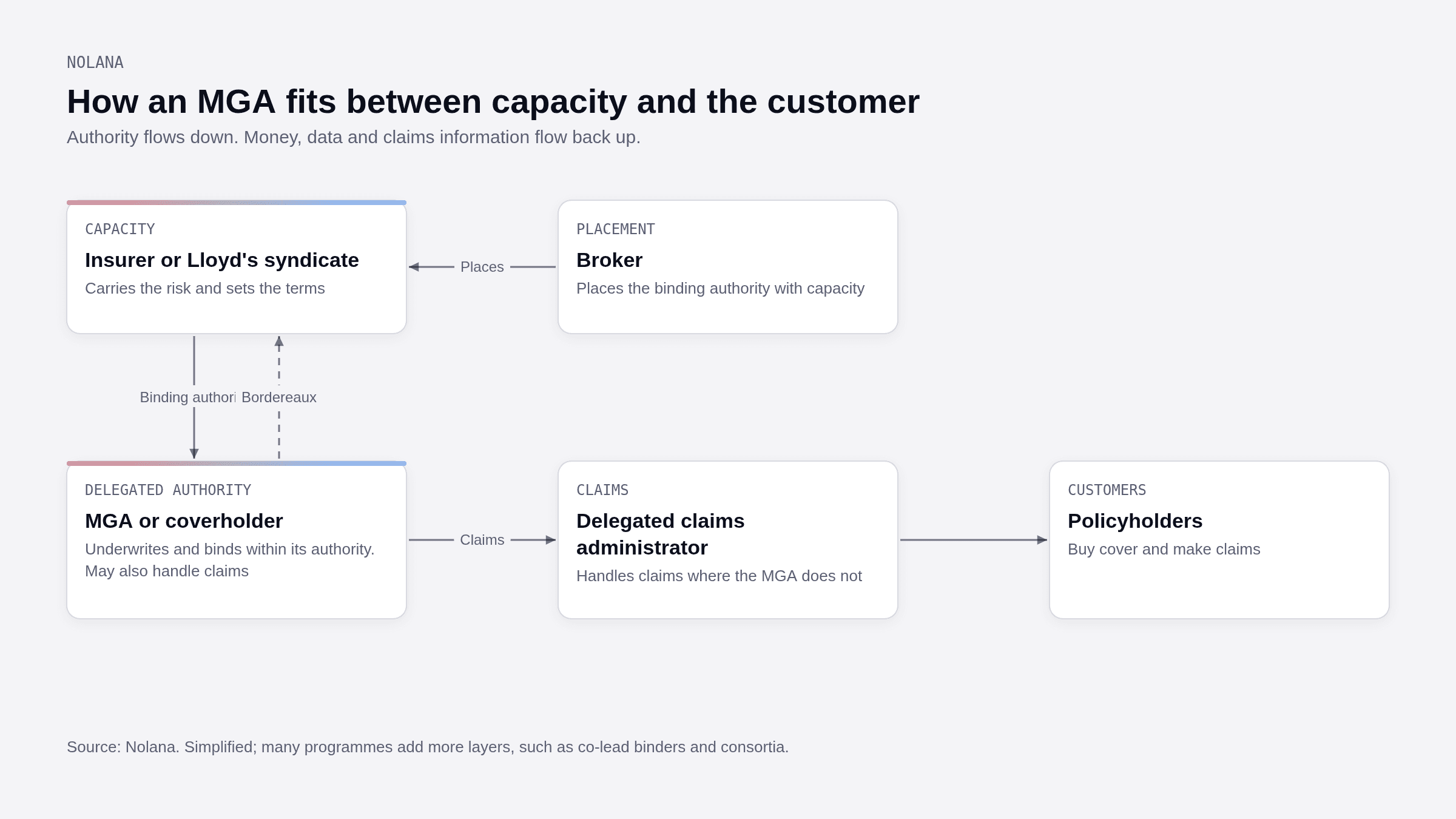
The relationship rests on a binding authority agreement, often called a binder. It sets out what the MGA may write: classes of business, territories, limits, rates, policy wordings and, where agreed, the authority to handle claims. Everything outside those limits has to be referred back to the insurer.
In return, the MGA reports what it has done. Every month, it sends bordereaux to its capacity providers listing the risks written, premiums collected and claims handled. Those reports, and regular audits, are how the insurer oversees business it did not underwrite itself.
Capacity can come from a single insurer, from several insurers sharing the risk, or from a Lloyd's consortium. Panels often change from one year to the next, which matters a great deal for claims, as we will see.
MGA, coverholder, broker: what is the difference?
The terms overlap, which causes confusion. In practice:
MGA. A business model: an underwriting firm that writes on behalf of insurers under delegated authority. The term is used widely in the US and increasingly in the UK and Europe.
Coverholder. The Lloyd's term for a firm granted a binding authority by a Lloyd's syndicate. Coverholders are approved by Lloyd's and registered in its delegated authority systems. Many MGAs are Lloyd's coverholders, and some hold capacity from both Lloyd's and company markets.
Broker. Acts for the client, not the insurer. A broker places risk and may run a facility, but its primary duty is to the person buying the insurance. Lloyd's brokers also place binding authorities with syndicates on behalf of MGAs.
Delegated claims administrator. A firm, sometimes called a third-party administrator or TPA, given authority to handle claims under a binder when the MGA does not handle them itself.
In the US, most states regulate MGAs under laws based on the NAIC's Managing General Agents Model Act. At Lloyd's, the managing agent remains responsible for oversight of every coverholder and claims administrator it appoints.
Why MGA claims are under the spotlight in 2026
Lloyd's has been explicit. Its 2026 Market Oversight Plan says the performance of delegated business tends to deteriorate less visibly and is harder to fix once it does, so problems can build before anyone acts. It calls timely access to risk, premium and claims data critical, and makes data adequacy a core focus of oversight.
From January 2026, every managing agent has a dedicated DA Oversight Manager at Lloyd's, carrying out structured engagement and reviews across the delegated lifecycle.
Lloyd's has a continued focus on delegated claims handling, to make sure oversight frameworks are in place and performance is monitored.
Growth is increasingly coming through cross-class broker facilities and consortia, which Lloyd's says need tighter control.
Claims management became a hurdle principle on 1 January 2026, so the managing agents behind an MGA's capacity are judged on claims outcomes, delegated ones included.
That pressure flows straight to the MGA. Expect more data requests, closer reading of claims bordereaux, more scrutiny of referrals and more audits. MGAs that can show clean data and well-evidenced claims decisions will find capacity easier to keep, especially as rates soften.
How MGA claims are handled
There are three common models, and many MGAs run more than one at the same time across different programmes:
Claims retained by the insurer. The MGA notifies claims, but the insurer's own claims team handles them.
Claims authority with the MGA. The MGA handles claims up to an agreed limit and refers anything larger, or anything outside its authority, to the insurer.
Claims with a delegated claims administrator. A specialist firm handles claims under a separate claims agreement.
Whichever model applies, the insurer expects regular claims bordereaux, timely referrals above authority, and files that stand up to audit.

What makes MGA claims hard
From the inside, MGA claims operations face a particular set of pressures:
Several masters. Each capacity provider can have its own reporting requirements, referral limits and audit expectations.
Changing panels. When capacity moves between years of account, claims from earlier years still need handling and reporting to the original insurers.
Small teams. Many MGAs run lean claims teams that cover a wide range of claims.
Reporting load. Producing accurate claims bordereaux every month, in each insurer's preferred format, takes real time.
Scattered information. Claims data often lives across email, document folders, a claims system and spreadsheets.
Quiet files. Long-tail claims, especially those from programmes that have since moved, are easy to lose sight of.
None of these is a reason not to run claims. Insurers value MGAs that handle claims well, and it often decides whether capacity is renewed.
What good looks like
The MGAs that handle claims best tend to share a few habits. They keep a clear authority matrix, so every handler knows what they can agree and what must be referred. They run one intake process, whatever the programme. They review open files regularly, not just before an audit. They produce bordereaux from their claims system, not by hand. And every decision on file has its reasoning recorded.
Where AI helps MGA claims teams
AI is well suited to the repetitive work that weighs on lean MGA teams:
Reading first notices from email and documents, matching them to the right programme and capacity, and preparing the file.
Checking each claim against the authority limits for that programme and flagging referrals early.
Drafting updates and chasers for handlers to approve.
Producing claims bordereaux data and flagging gaps before submission.
Reviewing the open book for files that have gone quiet, with a recommended next step.
The decisions stay with the handler, and every step is recorded for audit. See how Nolana supports MGA claims teams, or read our guide to bordereaux.
Year of account, run-off and changing capacity
Capacity is usually granted by year of account. When an MGA moves a programme to new capacity, claims on policies written in earlier years still belong to the original insurers, under the original binder's terms and claims authority. A single claims team can therefore be handling claims for several sets of insurers at once, each with different limits, referral rules and reporting formats.
That has practical consequences. Every handler needs to know, for every claim, which binder applies, which insurers are on it and what authority they hold. Claims bordereaux for run-off years must keep going to the right insurers until every claim is closed. And claims from programmes that have moved are the ones most likely to go quiet, because no one is renewing the relationship around them.
What capacity providers look for in a claims audit
Most insurers audit their delegated claims at least once a year. The questions tend to be the same:
Were claims acknowledged and reserved within the agreed timescales?
Are reserves reviewed regularly, with the reasoning recorded on file?
Were payments made within authority, and properly approved?
Were referrals made on time, with complete information?
Are fraud, sanctions and complaints checks recorded where required?
Do the claims bordereaux reconcile with the files and the claims fund?
Most findings come from two places: files that went quiet, and decisions that were made but never written down. Both are easier to fix all year round than in the week before an audit.
Sources: Insurance Business on Moody's MGA research; Lloyd's 2026 Market Oversight Plan.
Frequently asked questions
Is an MGA an insurer?
No. An MGA underwrites on behalf of insurers but does not carry the risk itself. The insurers that provide its capacity pay claims and hold the capital.
Is an MGA the same as a coverholder?
Not exactly. "Coverholder" is the Lloyd's term for a firm with a binding authority from a Lloyd's syndicate. Many MGAs are coverholders, but an MGA that only works with company markets is not.
Who pays MGA claims?
The insurers behind the binding authority pay the claims, in line with their share. The MGA or a delegated claims administrator may handle the claim and make payments from a claims fund, but the money and the liability belong to the insurers.

Articles


