Claims Automation Software: A Practical Enterprise Guide
Claims Automation Software: A Practical Enterprise Guide
Explore claims automation software for insurers and the Lloyd's market. Learn core capabilities, ROI, integration tips, governance, and a rollout roadmap.

Monday morning on a Lloyd's claims desk rarely starts with claims handling. It starts with 200 unread broker emails, two FNOL queues split between portals and inboxes, a delegated-authority referral that's been dormant for nine days, and a senior handler rekeying the same facts into several systems instead of negotiating a difficult loss.
That pattern is why claims automation software has moved onto executive agendas. The problem isn't a shortage of experienced adjusters. It's the administrative drag around them, document sorting, data entry, status chasing, routing, validation, and follow-up. A well-designed platform removes that drag while keeping consequential decisions under human control.
The global claims automation software market was valued at $6.1 billion in 2025 and is projected to reach $37.2 billion by 2034, with a projected compound annual growth rate of 22.3% from 2026 through 2034, according to market data on claims automation software. Those figures signal investment, but they don't tell a chief claims officer which architecture will survive contact with legacy systems, delegated authority, governance requirements, and real handler behaviour.
The Day Claims Automation Is Built to Fix
By mid-morning, the senior handler has opened the same claim in an email client, a policy system, and a claims workbench. One document contains the policy reference, another contains the loss narrative, and a third includes a repair estimate. Someone has already copied parts of the information into a spreadsheet, but no one can confirm whether the latest version reached the core system.
The handler's real work is waiting. A broker needs a coverage position. A complex liability claim requires negotiation. A coverholder needs an answer on authority. Instead, the handler is sorting attachments, checking whether a file has moved, and searching for a missing piece of information that may already be buried in an inbox.
Administrative work creates operational risk
Manual rekeying introduces inconsistency. Dormant files allow delays to continue without a visible owner. Fragmented channels make it difficult to give brokers and policyholders a reliable status update. Coverage decisions can vary when handlers work from incomplete records or different interpretations of the same correspondence.
The cost is not limited to staff frustration. Slow handling can delay indemnity decisions, strain broker relationships, and push skilled people toward clerical work. Hiring more handlers may increase capacity, but it won't fix a workflow that repeatedly asks people to move information between disconnected systems.
The strategic problem: Claims leaders don't need software that replaces judgement. They need software that protects judgement from being buried under administration.
Claims automation should therefore begin with the work nobody wants experienced handlers spending their day on. The platform should capture inbound information, extract relevant facts, request missing details, apply routing logic, update existing systems, and surface the next action. The handler should receive a cleaner file and more time for the decisions that involve ambiguity, negotiation, empathy, and accountability.
That distinction matters throughout vendor selection. “AI-powered” is not a buying criterion by itself. The useful question is whether the product removes handoffs without creating a new control problem.
What Claims Automation Software Actually Is
Claims automation software is an orchestration layer for claims operations. It receives information from channels such as email, web forms, voice, chat, and portals, interprets documents and messages, applies workflow and coverage logic, and writes approved outcomes back into the claims and policy systems already used by the organisation.
Think of it as air-traffic control for claims. The aircraft are incoming FNOLs, broker emails, documents, referrals, status requests, and follow-ups. The controller doesn't replace the airports or pilots. It identifies each signal, determines priority, assigns the correct route, monitors progress, and escalates problems before they become collisions.
The three automation shapes
Robotic process automation follows prescribed steps. It can copy a field from one application to another or trigger a repetitive action, but it usually struggles when the input changes shape.
Rules engines apply explicit logic. They're valuable for authority thresholds, routing conditions, and repeatable coverage checks, provided the underlying data is structured and the rule is clear.
Agentic AI handles less structured work. An AI agent can interpret an email with several attachments, identify the claim context, extract relevant facts, request missing information, complete a sequence of actions, and escalate when confidence or authority is insufficient.
A serious enterprise platform combines these approaches rather than treating them as competing technologies. Document intelligence supplies structured information. Rules provide controlled decision logic. Agents coordinate multi-step work. APIs connect the orchestration layer to policy administration, claims workbenches, and internal applications.
The best mental model is overlay, not replacement. An insurer shouldn't have to pause operations, migrate every historic file, or force handlers into another portal before automation can create value. The orchestration layer should sit above existing systems, use APIs where available, and preserve the current workbench as the system of record.
That approach reflects a wider principle in the benefits of DevOps automation, where repeatable work is coordinated across existing tools rather than isolated in a single manual step. For a claims-specific view, see AI claims automation.
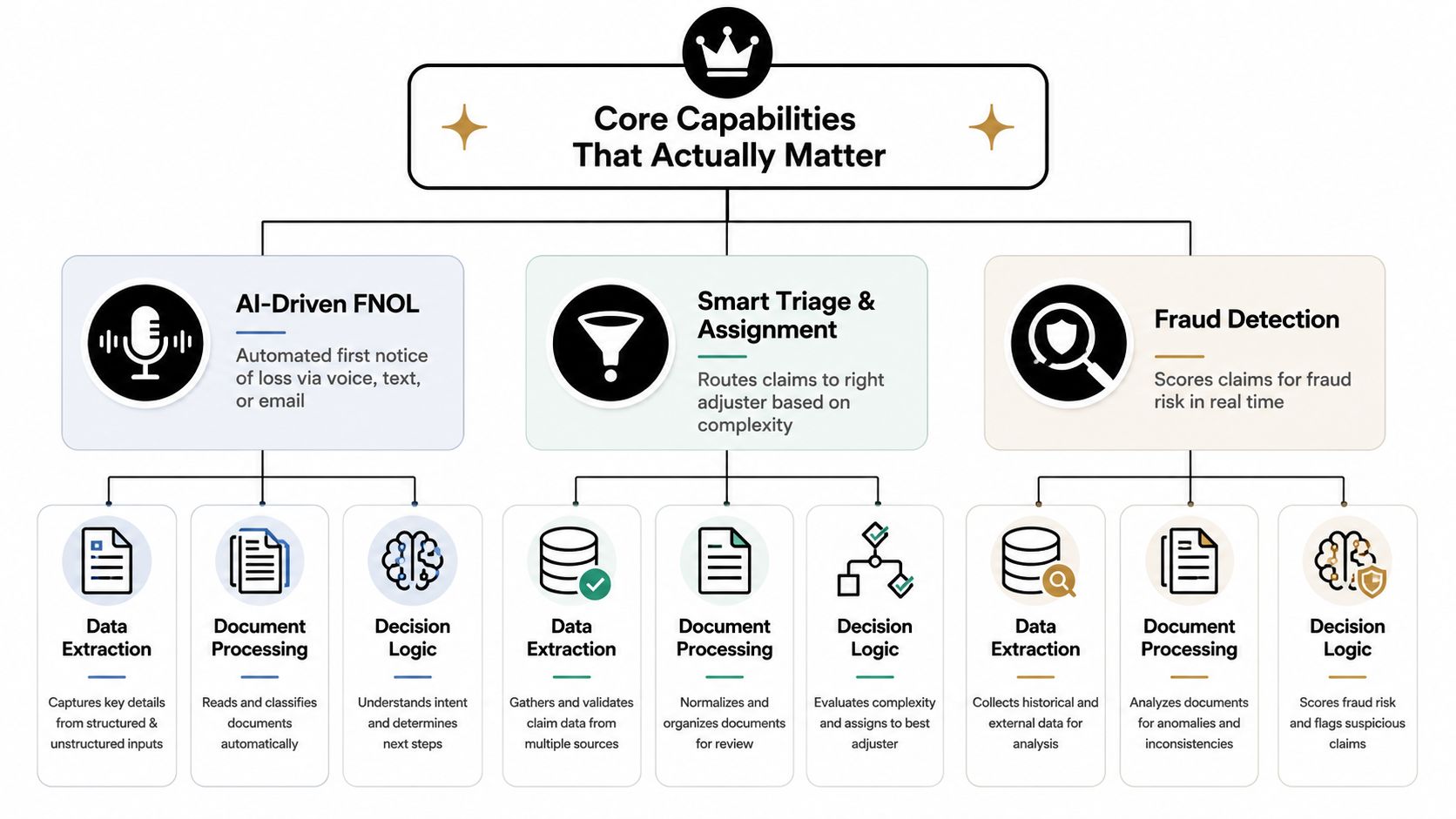
Core Capabilities That Actually Matter
Features matter only when they remove a recognisable operational failure. A vendor that lists AI, OCR, workflow, and analytics without tying them to claims work is selling components, not an operating model.
Intake and triage should improve the file before a handler opens it
AI-driven FNOL intake should accept policyholder information through relevant channels, adapt to the answers provided, identify gaps, request missing details, and route the claim according to complexity and coverage context. The outcome isn't merely a faster submission. It's a more complete first record and fewer avoidable exchanges.
Document processing is equally important. A platform should classify inbound correspondence, extract structured data from documents and attachments, and place that information where handlers can use it. The published claims-process automation case study from Datamatics reported a 76% reduction in claims turnaround time using OCR and AI extraction alongside RPA validation and routing. The important lesson is the mechanism. The gain came from removing manual rekeying and handoffs, not from digitising intake alone.
Lifecycle management must find work before the customer does
A claims lifecycle capability should monitor inactivity, flag dormant files, identify the reason for delay, and propose the next action. That matters because a file can remain technically open while operationally abandoned. A handler needs an actionable exception, not another dashboard that requires manual interpretation.
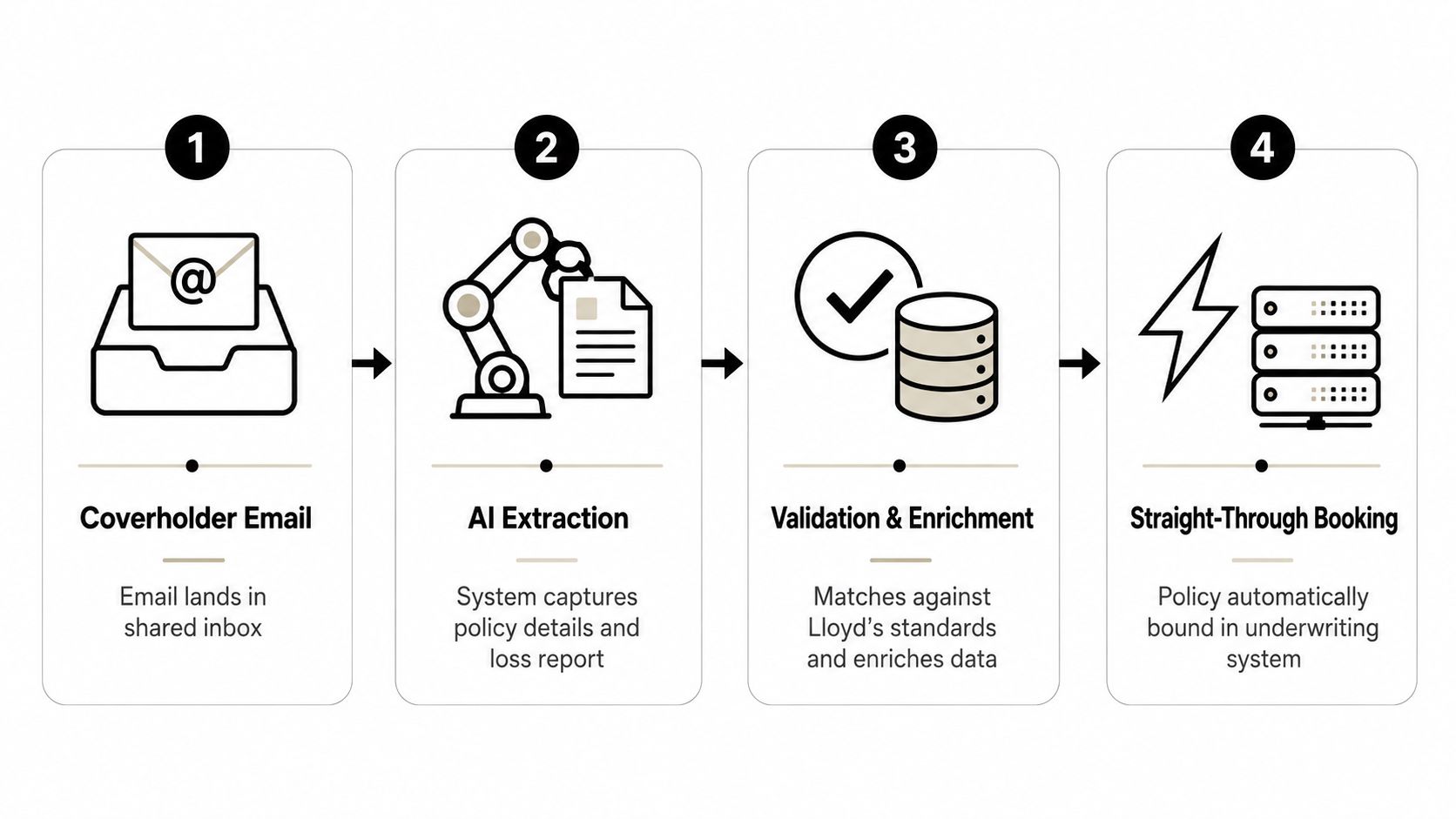
Delegated-authority triage deserves its own test. The platform should extract claim details from coverholder emails, compare them with authority thresholds, and support an approve, reject, or escalate path. It should update the relevant system and notify the appropriate party, while retaining a record of what happened and why.
Cross-channel support prevents the operation from creating separate automation islands. Email, web, chat, AI voice, and call-centre interactions should produce synchronised records rather than competing versions of the claim.
Integration and configuration decide whether the capability survives
Look for API integrations with existing claims workbenches, policy administration platforms, and internal applications. A custom agent builder can help an operations team configure task execution, analysis, and decisioning, but only if every action is logged in an audit-ready way.
custom automation from AY Automate offers a useful comparison point. The buyer should focus less on the label and more on whether configuration can reflect actual processes without creating an unmaintainable collection of custom scripts.
Multi-line support is also more meaningful than a single successful product demo. Property, specialty lines such as marine, aviation, energy, and construction, liability, motor, reinsurance, and travel all produce different workflows. A platform doesn't need identical rules across every line. It does need a common control layer, common integration approach, and consistent auditability. More detail on the operating system around these workflows is available in this claims management system guide.
Where Claims Automation Pays Off in Real Operations
The value becomes clearer when the workflow is specific.
In the Lloyd's and London market, a coverholder email arrives in a shared inbox with loss details and supporting documents. An agent can extract the claim information, check the relevant delegated-authority thresholds, route an exception, update the bureau or claims system, and notify the coverholder. The handler gets involved where authority is unclear, the exposure is unusual, or the claim requires judgement.
For an MGA, the pressure may arrive as a sudden volume spike after a weather event. Intake automation captures claims from the available channels, document processing extracts information from reports and estimates, and triage separates straightforward files from cases needing specialist attention. The objective isn't to make every claim automatic. It's to stop the backlog from forcing senior staff into basic sorting work.
Brokers have a different operational problem. They often need status visibility across multiple carriers and managing agents, and their teams spend time chasing updates that should already be available. Automated status handling can identify the latest claim position, trigger consistent communications, and leave handlers to address genuine blockers instead of repeated “any update?” requests.
Contact centres need a controlled first touch. AI voice and chat can handle routine policyholder questions, capture initial loss information, and request documents. A complex call involving vulnerability, disputed coverage, serious injury, or an uncertain liability position should move to a person with the context already attached.
One control layer, different line-specific workflows
The platform should support different rules for property, specialty, liability, motor, reinsurance, and travel without forcing the business into separate integrations for every line. Specialty claims may require different evidence and referral paths from motor claims. That variation is normal. The technology should manage it through configuration, permissions, and controlled agents rather than disconnected point solutions.
FNOL is often the most practical starting point because it touches volume, service, data quality, and routing at once. A focused FNOL automation workflow can expose integration and governance issues before the organisation expands into deeper lifecycle decisioning.
The ROI Case a CFO Will Actually Accept
A CFO won't approve claims automation because a vendor says the platform is intelligent. The case needs to connect operational change to financial consequences.
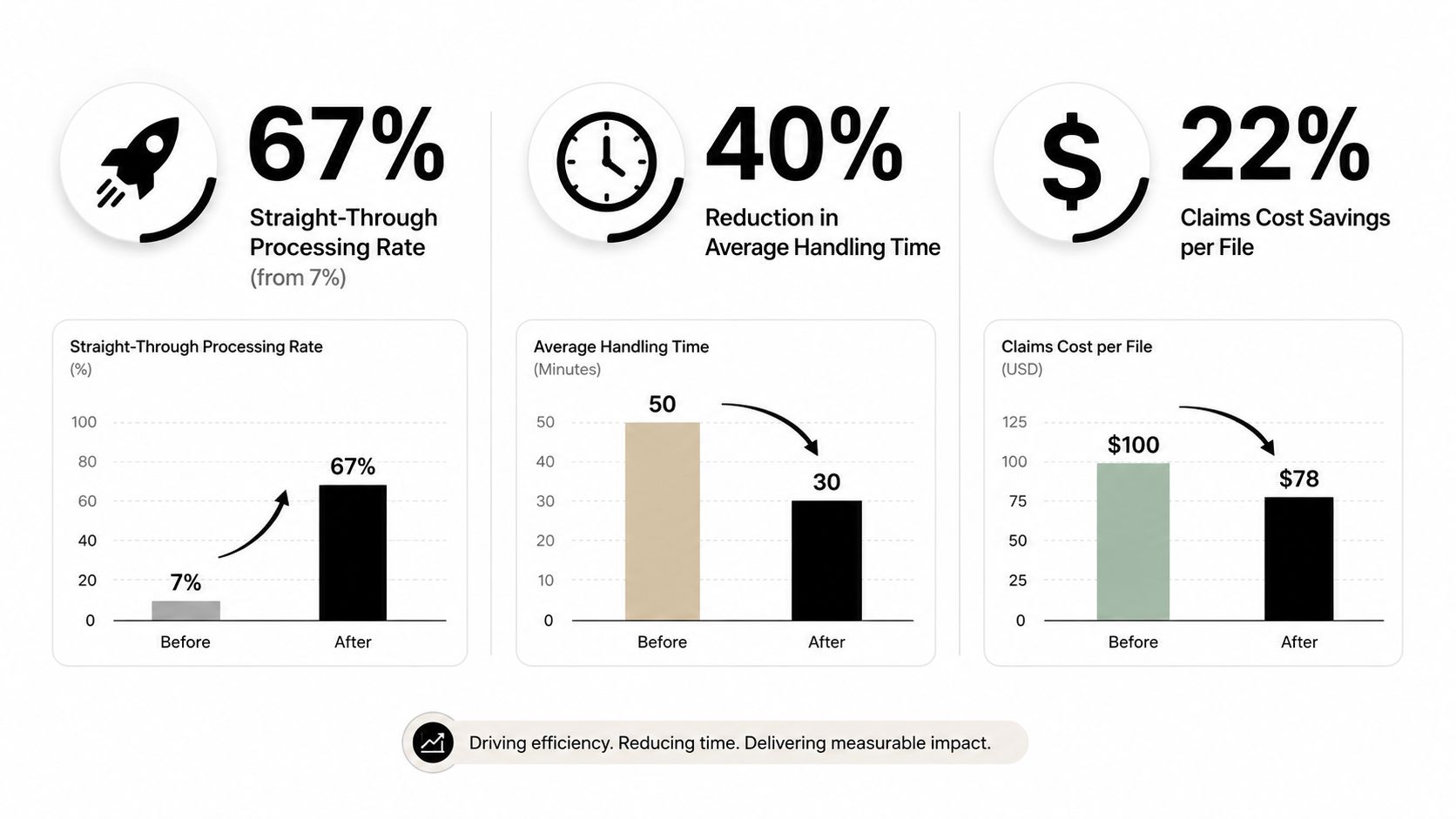
Independent industry evidence reports straight-through processing for simple claims rising from a 7% baseline to 70% to 90% in advanced automation environments, while average claim cycle time falls from about 30 days to under 8 days and cost per claim drops 20% to 40%, as summarised by AI in insurance claims statistics. The same source links broader AI claims automation to a projected 25% to 30% reduction in loss adjustment expenses, and nearly $80 billion to $160 billion in fraudulent-claims savings by 2032. These are market-level ranges and projections, not promises for an individual implementation.
Nolana's published outcome bands describe up to 50 times faster cycle times, up to 30% higher handler throughput, and up to 5% lower loss ratio, depending on context. Treat those figures as vendor-reported ranges to validate, not as the business case itself. The business case should come from your own baseline, file mix, staffing model, and control requirements.
Build the case across three value pools
Service and cycle time are the easiest outcomes to see. Faster acknowledgement, fewer missing-document loops, and clearer routing can improve policyholder and broker experience.
Capacity and throughput determine whether the operation can absorb growth without adding headcount at the same pace. Independent research reports up to a 50% reduction in settlement time for standard claims and up to a 30% reduction in adjuster workload after automated claim handling in an enterprise claims platform, according to this automated claims processing study.
Loss performance requires more discipline. Faster, more consistent coverage decisions, earlier escalation, and fraud-risk signals may influence loss adjustment expense and indemnity outcomes, but finance should separate measured savings from anticipated benefits.
CFO test: Put hard savings, deferred hiring, service improvements, and risk reduction in separate columns. Don't let soft productivity assumptions carry the entire payback case.
Use a baseline that includes cycle time, cost per claim, dormant-file volume, rework, and handler capacity. Guidance on structuring those measures is available in how to measure operational efficiency.
Integration, Security, and Human-in-the-Loop Oversight
Most pilots don't stall because the model can't read a document. They stall because the platform can't operate inside the insurer's technology, control, and accountability environment.
A 2026 survey of European insurers identified legacy IT integration complexity as the top blocker at 53%, followed by unclear ROI or high implementation cost at 48%, and data quality or structural issues at 48%, according to the State of Claims Automation survey. Skills gaps affected 38% of respondents, while resistance to change and regulatory concerns each affected 30%. Those figures point to the buying question: can the software perform useful work without requiring a replacement programme or a data-cleanup project first?
Enterprise fit begins with the architecture
An overlay architecture should connect through APIs to claims workbenches, policy administration platforms, and internal applications. It should preserve the existing system of record and make each write-back visible. A replacement pitch may sound cleaner, but it brings migration, training, historical data, and operational continuity into the same risk envelope.
Security review should cover certification, access controls, data handling, incident response, and evidence available through a Trust Center. Nolana is described as a SOC 2-certified platform that integrates with and sits on top of existing claims and policy systems. Its security posture and certification details are available in this enterprise security and compliance update.
Human control needs to be operational, not cosmetic
The system should show what it read, which rule or agent action it applied, what data it changed, and who approved or overrode the result. A human-in-the-loop control should allow handlers to approve, reject, correct, or escalate before a consequential decision is finalised.
The human role shifts toward complex and high-stakes claims. A claims trends discussion referencing McKinsey and KPMG describes technology handling routine processing while skilled professionals remain essential for difficult work and require upskilling. That is the right operating model. Automate predictable administration. Keep judgement, empathy, negotiation, and accountability with people.
A vendor that says “we're explainable” without showing the audit record for a real decision hasn't answered the question.
A Vendor Evaluation Checklist You Can Take Into the Room
Use the RFP to force vendors out of presentation mode. Require a live demonstration with your own claim documents, delegated-authority rules, and exception scenarios. A polished slide deck proves little. The workflow, write-back, and escalation behaviour matter.
Evaluation block | Key question to ask | What a strong answer looks like |
|---|---|---|
Architecture | Does the platform sit on top of existing systems, and which APIs can it use? | A clear integration map, defined write-back behaviour, and no requirement to replace the core workbench |
Capabilities | Can it handle FNOL, documents, triage, dormant files, delegated authority, and multiple lines? | One controlled workflow across relevant channels, with line-specific rules and visible exceptions |
Governance and security | Can you show every agent action and human intervention? | A searchable audit trail showing inputs, reasoning or rule path, changes, approvals, overrides, and escalation |
Lloyd's and London market fit | How does it handle coverholder, broker, bureau, and authority workflows? | A demonstration using a delegated-authority email, threshold check, escalation, system update, and notification |
Commercial outcomes | What evidence supports the expected value, and how is pricing calculated? | Customer evidence, transparent usage or outcome pricing, baseline requirements, and a credible path to first value |
Operational change | Can claims teams configure workflows without constant custom development? | Controlled configuration, agent governance, training, support ownership, and an exit plan for failed automations |
Ask vendors to identify the work they will not automate. Routine intake, document handling, and system updates are suitable targets for administrative automation. Coverage judgement, negotiation, empathy, and accountability remain with adjusters. The platform should remove drag from those tasks, not pretend every claim follows the same path.
Test the exception path as hard as the happy path. Submit incomplete documents, conflicting authority details, unclear coverage, and a claim above the agreed threshold. Require the system to pause, explain the next action, route the file, and preserve the handler's ability to correct it.
Disqualify vendors that require a new portal for every participant, cannot demonstrate a real audit event, or answer integration questions with a generic partnership slide. Reject any business case that treats every claim as equally automatable. The strongest platforms fit over existing systems, prove value in a contained workflow, and stop when human judgement is required.
A Phased Rollout Roadmap and the KPIs to Track
A pilot should begin with one line of business and one channel. Delegated-authority motor email intake is a practical choice because it tests document extraction, authority rules, routing, system updates, notifications, and human review within one contained workflow. Keep the platform on top of existing systems, and make the adjuster's decision the control point for exceptions.
Four phases keep the risk visible
Phase one, prove the workflow. The claims operations owner selects the process, records a baseline, defines escalation rules, and sets an exit criterion. The pilot must handle routine cases safely, explain exceptions, and preserve a clear handoff to a human.
Phase two, add channels. Introduce voice and web only after email, or the initial channel, is stable. The service owner must verify that every interaction updates the same claim record and that handlers can see the full history.
Phase three, deepen the file. Add document processing, dormant-file detection, follow-ups, and next-best-action recommendations. The claims transformation lead should track whether handlers use those recommendations and whether they improve decisions rather than add review work.
Phase four, expand by line. Extend the workflow to property, specialty, liability, motor, reinsurance, and travel according to readiness. Each line owner must validate its rules, authority limits, controls, and exception paths before release.
Track three KPI groups from the first pilot:
Cycle and service: claim cycle time, FNOL acknowledgement, and straight-through processing rate.
Operational capacity: handler throughput, dormant-file count, and broker or coverholder NPS.
Financial performance: cost per claim, loss adjustment expense ratio, and indemnity spend trend.
Use external benchmarks as context, not as a business case. Research reports up to a 50% reduction in settlement time for standard claims and up to a 30% reduction in adjuster workload after automated claim handling, as reported in the enterprise claims processing research. Your baseline, workflow, and line of business determine whether those results apply.
A rollout succeeds when handlers trust the workflow, use it, and spend more time on claims that require human judgement.
Nolana AI provides an agentic platform for Lloyd's market claims operations, covering FNOL intake, triage, document processing, lifecycle management, and delegated-authority workflows on top of existing systems with human oversight and auditability. Visit Nolana AI to assess its fit with your claims architecture, governance model, and rollout priorities.
Monday morning on a Lloyd's claims desk rarely starts with claims handling. It starts with 200 unread broker emails, two FNOL queues split between portals and inboxes, a delegated-authority referral that's been dormant for nine days, and a senior handler rekeying the same facts into several systems instead of negotiating a difficult loss.
That pattern is why claims automation software has moved onto executive agendas. The problem isn't a shortage of experienced adjusters. It's the administrative drag around them, document sorting, data entry, status chasing, routing, validation, and follow-up. A well-designed platform removes that drag while keeping consequential decisions under human control.
The global claims automation software market was valued at $6.1 billion in 2025 and is projected to reach $37.2 billion by 2034, with a projected compound annual growth rate of 22.3% from 2026 through 2034, according to market data on claims automation software. Those figures signal investment, but they don't tell a chief claims officer which architecture will survive contact with legacy systems, delegated authority, governance requirements, and real handler behaviour.
The Day Claims Automation Is Built to Fix
By mid-morning, the senior handler has opened the same claim in an email client, a policy system, and a claims workbench. One document contains the policy reference, another contains the loss narrative, and a third includes a repair estimate. Someone has already copied parts of the information into a spreadsheet, but no one can confirm whether the latest version reached the core system.
The handler's real work is waiting. A broker needs a coverage position. A complex liability claim requires negotiation. A coverholder needs an answer on authority. Instead, the handler is sorting attachments, checking whether a file has moved, and searching for a missing piece of information that may already be buried in an inbox.
Administrative work creates operational risk
Manual rekeying introduces inconsistency. Dormant files allow delays to continue without a visible owner. Fragmented channels make it difficult to give brokers and policyholders a reliable status update. Coverage decisions can vary when handlers work from incomplete records or different interpretations of the same correspondence.
The cost is not limited to staff frustration. Slow handling can delay indemnity decisions, strain broker relationships, and push skilled people toward clerical work. Hiring more handlers may increase capacity, but it won't fix a workflow that repeatedly asks people to move information between disconnected systems.
The strategic problem: Claims leaders don't need software that replaces judgement. They need software that protects judgement from being buried under administration.
Claims automation should therefore begin with the work nobody wants experienced handlers spending their day on. The platform should capture inbound information, extract relevant facts, request missing details, apply routing logic, update existing systems, and surface the next action. The handler should receive a cleaner file and more time for the decisions that involve ambiguity, negotiation, empathy, and accountability.
That distinction matters throughout vendor selection. “AI-powered” is not a buying criterion by itself. The useful question is whether the product removes handoffs without creating a new control problem.
What Claims Automation Software Actually Is
Claims automation software is an orchestration layer for claims operations. It receives information from channels such as email, web forms, voice, chat, and portals, interprets documents and messages, applies workflow and coverage logic, and writes approved outcomes back into the claims and policy systems already used by the organisation.
Think of it as air-traffic control for claims. The aircraft are incoming FNOLs, broker emails, documents, referrals, status requests, and follow-ups. The controller doesn't replace the airports or pilots. It identifies each signal, determines priority, assigns the correct route, monitors progress, and escalates problems before they become collisions.
The three automation shapes
Robotic process automation follows prescribed steps. It can copy a field from one application to another or trigger a repetitive action, but it usually struggles when the input changes shape.
Rules engines apply explicit logic. They're valuable for authority thresholds, routing conditions, and repeatable coverage checks, provided the underlying data is structured and the rule is clear.
Agentic AI handles less structured work. An AI agent can interpret an email with several attachments, identify the claim context, extract relevant facts, request missing information, complete a sequence of actions, and escalate when confidence or authority is insufficient.
A serious enterprise platform combines these approaches rather than treating them as competing technologies. Document intelligence supplies structured information. Rules provide controlled decision logic. Agents coordinate multi-step work. APIs connect the orchestration layer to policy administration, claims workbenches, and internal applications.
The best mental model is overlay, not replacement. An insurer shouldn't have to pause operations, migrate every historic file, or force handlers into another portal before automation can create value. The orchestration layer should sit above existing systems, use APIs where available, and preserve the current workbench as the system of record.
That approach reflects a wider principle in the benefits of DevOps automation, where repeatable work is coordinated across existing tools rather than isolated in a single manual step. For a claims-specific view, see AI claims automation.
Core Capabilities That Actually Matter
Features matter only when they remove a recognisable operational failure. A vendor that lists AI, OCR, workflow, and analytics without tying them to claims work is selling components, not an operating model.
Intake and triage should improve the file before a handler opens it
AI-driven FNOL intake should accept policyholder information through relevant channels, adapt to the answers provided, identify gaps, request missing details, and route the claim according to complexity and coverage context. The outcome isn't merely a faster submission. It's a more complete first record and fewer avoidable exchanges.
Document processing is equally important. A platform should classify inbound correspondence, extract structured data from documents and attachments, and place that information where handlers can use it. The published claims-process automation case study from Datamatics reported a 76% reduction in claims turnaround time using OCR and AI extraction alongside RPA validation and routing. The important lesson is the mechanism. The gain came from removing manual rekeying and handoffs, not from digitising intake alone.
Lifecycle management must find work before the customer does
A claims lifecycle capability should monitor inactivity, flag dormant files, identify the reason for delay, and propose the next action. That matters because a file can remain technically open while operationally abandoned. A handler needs an actionable exception, not another dashboard that requires manual interpretation.
Delegated-authority triage deserves its own test. The platform should extract claim details from coverholder emails, compare them with authority thresholds, and support an approve, reject, or escalate path. It should update the relevant system and notify the appropriate party, while retaining a record of what happened and why.
Cross-channel support prevents the operation from creating separate automation islands. Email, web, chat, AI voice, and call-centre interactions should produce synchronised records rather than competing versions of the claim.
Integration and configuration decide whether the capability survives
Look for API integrations with existing claims workbenches, policy administration platforms, and internal applications. A custom agent builder can help an operations team configure task execution, analysis, and decisioning, but only if every action is logged in an audit-ready way.
custom automation from AY Automate offers a useful comparison point. The buyer should focus less on the label and more on whether configuration can reflect actual processes without creating an unmaintainable collection of custom scripts.
Multi-line support is also more meaningful than a single successful product demo. Property, specialty lines such as marine, aviation, energy, and construction, liability, motor, reinsurance, and travel all produce different workflows. A platform doesn't need identical rules across every line. It does need a common control layer, common integration approach, and consistent auditability. More detail on the operating system around these workflows is available in this claims management system guide.
Where Claims Automation Pays Off in Real Operations
The value becomes clearer when the workflow is specific.
In the Lloyd's and London market, a coverholder email arrives in a shared inbox with loss details and supporting documents. An agent can extract the claim information, check the relevant delegated-authority thresholds, route an exception, update the bureau or claims system, and notify the coverholder. The handler gets involved where authority is unclear, the exposure is unusual, or the claim requires judgement.
For an MGA, the pressure may arrive as a sudden volume spike after a weather event. Intake automation captures claims from the available channels, document processing extracts information from reports and estimates, and triage separates straightforward files from cases needing specialist attention. The objective isn't to make every claim automatic. It's to stop the backlog from forcing senior staff into basic sorting work.
Brokers have a different operational problem. They often need status visibility across multiple carriers and managing agents, and their teams spend time chasing updates that should already be available. Automated status handling can identify the latest claim position, trigger consistent communications, and leave handlers to address genuine blockers instead of repeated “any update?” requests.
Contact centres need a controlled first touch. AI voice and chat can handle routine policyholder questions, capture initial loss information, and request documents. A complex call involving vulnerability, disputed coverage, serious injury, or an uncertain liability position should move to a person with the context already attached.
One control layer, different line-specific workflows
The platform should support different rules for property, specialty, liability, motor, reinsurance, and travel without forcing the business into separate integrations for every line. Specialty claims may require different evidence and referral paths from motor claims. That variation is normal. The technology should manage it through configuration, permissions, and controlled agents rather than disconnected point solutions.
FNOL is often the most practical starting point because it touches volume, service, data quality, and routing at once. A focused FNOL automation workflow can expose integration and governance issues before the organisation expands into deeper lifecycle decisioning.
The ROI Case a CFO Will Actually Accept
A CFO won't approve claims automation because a vendor says the platform is intelligent. The case needs to connect operational change to financial consequences.
Independent industry evidence reports straight-through processing for simple claims rising from a 7% baseline to 70% to 90% in advanced automation environments, while average claim cycle time falls from about 30 days to under 8 days and cost per claim drops 20% to 40%, as summarised by AI in insurance claims statistics. The same source links broader AI claims automation to a projected 25% to 30% reduction in loss adjustment expenses, and nearly $80 billion to $160 billion in fraudulent-claims savings by 2032. These are market-level ranges and projections, not promises for an individual implementation.
Nolana's published outcome bands describe up to 50 times faster cycle times, up to 30% higher handler throughput, and up to 5% lower loss ratio, depending on context. Treat those figures as vendor-reported ranges to validate, not as the business case itself. The business case should come from your own baseline, file mix, staffing model, and control requirements.
Build the case across three value pools
Service and cycle time are the easiest outcomes to see. Faster acknowledgement, fewer missing-document loops, and clearer routing can improve policyholder and broker experience.
Capacity and throughput determine whether the operation can absorb growth without adding headcount at the same pace. Independent research reports up to a 50% reduction in settlement time for standard claims and up to a 30% reduction in adjuster workload after automated claim handling in an enterprise claims platform, according to this automated claims processing study.
Loss performance requires more discipline. Faster, more consistent coverage decisions, earlier escalation, and fraud-risk signals may influence loss adjustment expense and indemnity outcomes, but finance should separate measured savings from anticipated benefits.
CFO test: Put hard savings, deferred hiring, service improvements, and risk reduction in separate columns. Don't let soft productivity assumptions carry the entire payback case.
Use a baseline that includes cycle time, cost per claim, dormant-file volume, rework, and handler capacity. Guidance on structuring those measures is available in how to measure operational efficiency.
Integration, Security, and Human-in-the-Loop Oversight
Most pilots don't stall because the model can't read a document. They stall because the platform can't operate inside the insurer's technology, control, and accountability environment.
A 2026 survey of European insurers identified legacy IT integration complexity as the top blocker at 53%, followed by unclear ROI or high implementation cost at 48%, and data quality or structural issues at 48%, according to the State of Claims Automation survey. Skills gaps affected 38% of respondents, while resistance to change and regulatory concerns each affected 30%. Those figures point to the buying question: can the software perform useful work without requiring a replacement programme or a data-cleanup project first?
Enterprise fit begins with the architecture
An overlay architecture should connect through APIs to claims workbenches, policy administration platforms, and internal applications. It should preserve the existing system of record and make each write-back visible. A replacement pitch may sound cleaner, but it brings migration, training, historical data, and operational continuity into the same risk envelope.
Security review should cover certification, access controls, data handling, incident response, and evidence available through a Trust Center. Nolana is described as a SOC 2-certified platform that integrates with and sits on top of existing claims and policy systems. Its security posture and certification details are available in this enterprise security and compliance update.
Human control needs to be operational, not cosmetic
The system should show what it read, which rule or agent action it applied, what data it changed, and who approved or overrode the result. A human-in-the-loop control should allow handlers to approve, reject, correct, or escalate before a consequential decision is finalised.
The human role shifts toward complex and high-stakes claims. A claims trends discussion referencing McKinsey and KPMG describes technology handling routine processing while skilled professionals remain essential for difficult work and require upskilling. That is the right operating model. Automate predictable administration. Keep judgement, empathy, negotiation, and accountability with people.
A vendor that says “we're explainable” without showing the audit record for a real decision hasn't answered the question.
A Vendor Evaluation Checklist You Can Take Into the Room
Use the RFP to force vendors out of presentation mode. Require a live demonstration with your own claim documents, delegated-authority rules, and exception scenarios. A polished slide deck proves little. The workflow, write-back, and escalation behaviour matter.
Evaluation block | Key question to ask | What a strong answer looks like |
|---|---|---|
Architecture | Does the platform sit on top of existing systems, and which APIs can it use? | A clear integration map, defined write-back behaviour, and no requirement to replace the core workbench |
Capabilities | Can it handle FNOL, documents, triage, dormant files, delegated authority, and multiple lines? | One controlled workflow across relevant channels, with line-specific rules and visible exceptions |
Governance and security | Can you show every agent action and human intervention? | A searchable audit trail showing inputs, reasoning or rule path, changes, approvals, overrides, and escalation |
Lloyd's and London market fit | How does it handle coverholder, broker, bureau, and authority workflows? | A demonstration using a delegated-authority email, threshold check, escalation, system update, and notification |
Commercial outcomes | What evidence supports the expected value, and how is pricing calculated? | Customer evidence, transparent usage or outcome pricing, baseline requirements, and a credible path to first value |
Operational change | Can claims teams configure workflows without constant custom development? | Controlled configuration, agent governance, training, support ownership, and an exit plan for failed automations |
Ask vendors to identify the work they will not automate. Routine intake, document handling, and system updates are suitable targets for administrative automation. Coverage judgement, negotiation, empathy, and accountability remain with adjusters. The platform should remove drag from those tasks, not pretend every claim follows the same path.
Test the exception path as hard as the happy path. Submit incomplete documents, conflicting authority details, unclear coverage, and a claim above the agreed threshold. Require the system to pause, explain the next action, route the file, and preserve the handler's ability to correct it.
Disqualify vendors that require a new portal for every participant, cannot demonstrate a real audit event, or answer integration questions with a generic partnership slide. Reject any business case that treats every claim as equally automatable. The strongest platforms fit over existing systems, prove value in a contained workflow, and stop when human judgement is required.
A Phased Rollout Roadmap and the KPIs to Track
A pilot should begin with one line of business and one channel. Delegated-authority motor email intake is a practical choice because it tests document extraction, authority rules, routing, system updates, notifications, and human review within one contained workflow. Keep the platform on top of existing systems, and make the adjuster's decision the control point for exceptions.
Four phases keep the risk visible
Phase one, prove the workflow. The claims operations owner selects the process, records a baseline, defines escalation rules, and sets an exit criterion. The pilot must handle routine cases safely, explain exceptions, and preserve a clear handoff to a human.
Phase two, add channels. Introduce voice and web only after email, or the initial channel, is stable. The service owner must verify that every interaction updates the same claim record and that handlers can see the full history.
Phase three, deepen the file. Add document processing, dormant-file detection, follow-ups, and next-best-action recommendations. The claims transformation lead should track whether handlers use those recommendations and whether they improve decisions rather than add review work.
Phase four, expand by line. Extend the workflow to property, specialty, liability, motor, reinsurance, and travel according to readiness. Each line owner must validate its rules, authority limits, controls, and exception paths before release.
Track three KPI groups from the first pilot:
Cycle and service: claim cycle time, FNOL acknowledgement, and straight-through processing rate.
Operational capacity: handler throughput, dormant-file count, and broker or coverholder NPS.
Financial performance: cost per claim, loss adjustment expense ratio, and indemnity spend trend.
Use external benchmarks as context, not as a business case. Research reports up to a 50% reduction in settlement time for standard claims and up to a 30% reduction in adjuster workload after automated claim handling, as reported in the enterprise claims processing research. Your baseline, workflow, and line of business determine whether those results apply.
A rollout succeeds when handlers trust the workflow, use it, and spend more time on claims that require human judgement.
Nolana AI provides an agentic platform for Lloyd's market claims operations, covering FNOL intake, triage, document processing, lifecycle management, and delegated-authority workflows on top of existing systems with human oversight and auditability. Visit Nolana AI to assess its fit with your claims architecture, governance model, and rollout priorities.


All systems operational
1 Lime Street, London EC3M 7HA | 222E 3rd Street, New York 10009
Copyright © 2026, Nolana. All rights reserved
All systems operational
1 Lime Street, London EC3M 7HA | 222E 3rd Street, New York 10009
Copyright © 2026, Nolana. All rights reserved
All systems operational
1 Lime Street, London EC3M 7HA | 222E 3rd Street, New York 10009
Copyright © 2026, Nolana. All rights reserved
All systems operational
1 Lime Street, London EC3M 7HA | 222E 3rd Street, New York 10009
Copyright © 2026, Nolana. All rights reserved