Travel Insurance Claims: Streamlined Guide for 2026
Travel Insurance Claims: Streamlined Guide for 2026
Master travel insurance claims with a clear breakdown of the lifecycle, common denial reasons, and how AI cuts cycle times.

574,000 travel insurance claims were processed in the UK in 2023, and insurers paid out £511 million in total, according to ABI figures reported by Insurance Business. That is not the profile of a niche add-on. It is a high-volume, high-severity claims line where medical losses alone accounted for £291 million and the average medical claim reached £1,724 (Insurance Business).
That scale changes how the work should be managed. A claims operation that treats travel as a simple reimbursement flow misses the point, because the file is usually built from policy wording, trip proof, receipts, incident reports, and medical records, all of which have to line up before payment is even possible (Emergency Assistance Plus). The tail is also ugly. A 2025 industry roundup cited a claim costing about $900,000, which is exactly why small intake errors and sloppy document handling create expensive rework (Condor Ferries).
For operations leaders, the conclusion is blunt. Travel insurance claims are document-heavy, timing-sensitive, and severity-skewed, so lifecycle design has a real effect on cost and service quality. Nolana's claims automation stack is built for that exact friction, from intake through settlement, while keeping human oversight in place across existing claims systems (Nolana AI).

What Travel Insurance Claims Actually Look Like in 2026
Travel insurance doesn't behave like a low-touch retail product once the loss happens. It behaves like a document test. The claimant has to show what happened, when it happened, what was covered, what was prepaid, and what costs were unavoidable, and the handler has to reconcile all of that against policy wording and notification rules.
The scale is the point
The UK figures matter because they reveal the operational shape of the book, not just the size of it. 574,000 claims and £511 million in payouts mean the line produces both frequent files and expensive ones, which is why throughput and judgment matter at the same time (Insurance Business). The average medical claim of £1,724 also shows why medical cases deserve separate handling discipline instead of being lumped together with baggage or delay claims (Insurance Business).
Age makes the concentration sharper. Claims from travelers aged 71-75 averaged £1,830, versus £518 for ages 36-40 (Insurance Business). That gap tells you the process isn't just about admin speed. It's about handling the right evidence, in the right sequence, for the right risk profile.
Practical rule: In travel claims, the fastest file is usually the one with the cleanest evidence chain, not the most detailed narrative.
The tail risk reinforces the same point. When a single claim can reach the upper end of severity discussed in industry commentary, the claims team can't rely on manual memory or loose email chains (Condor Ferries). Files need structured inputs, consistent timestamps, and proof that matches the policy trigger.
The operational takeaway is simple. Claim quality comes from evidence consistency, not from how persuasive the claimant sounds. That's why intake, triage, and document normalization do most of the heavy lifting before adjudication even starts.
Why lifecycle design pays off
A travel claim is never just one decision. It is a chain of decisions, and each handoff creates either momentum or drag. When the workflow captures the right fields early, the handler spends less time chasing basics and more time assessing coverage and settlement.
The broader claims lesson is that administrative friction multiplies quickly in a high-volume line. A small reduction in back-and-forth can translate into better service for the claimant and lower cost for the insurer, which is why lifecycle design matters more here than in many people expect.
The Main Claim Types and the Evidence Each One Demands
Travel insurance claims are not interchangeable. A medical file, a baggage file, and a cancellation file may all begin with the same claim form, but they do not end there. The evidence package changes with the loss type, and intake errors usually start when the file is classified too late or by the wrong trigger.
Classification drives the evidence list
Medical claims usually need a treating physician's statement, an accident report, medical records, itemized bills, and proof that any primary insurer has already responded (Squaremouth checklist). Baggage loss claims are more likely to need a supplier baggage claim form, an incident report from authorities, and an itemized list of the claimed items with cash values. Cancellation and interruption claims depend on proof of cancelled flights, unused prepaid expenses, and additional expense records (Meyer and Associates).
The operational problem is usually simple. A file arrives before the loss type has been pinned down, then the team spends the next several touches discovering that the documents do not match the category. That creates rework, and in travel claims it is often the first sign the file will stall.
Documentation Requirements by Travel Claim Type | Core Documents | Verification Evidence | Common Pitfalls |
|---|---|---|---|
Cancellation or interruption | Claim form, proof of cancelled flights, unused prepaid expenses, additional expense records | Booking confirmations, refund details, travel itinerary | Filing under the wrong reason code, incomplete cost breakdown |
Emergency medical | Claim form, treating physician's statement, medical records, itemized bills | Accident report, proof of denial from primary insurer | Missing facility records, inconsistent dates across documents |
Baggage loss or delay | Claim form, supplier baggage claim form, itemized item list with cash values | Incident report from authorities, travel proof | Valuation gaps, no authority report, unclear ownership |
Delay or missed connection | Claim form, carrier evidence, receipts for covered extra expenses | Travel proof, timing evidence, itinerary match | Mismatched timestamps, missing carrier confirmation |
The structured package matters because insurers commonly need aligned dates, locations, policy numbers, itemized receipts, medical records, proof of travel, and incident reports to validate eligibility (Emergency Assistance Plus). If those fields do not match, the handler has to slow down and investigate, even when the claimant believes the file is complete.
Operational note: A complete submission is not the same thing as a payable submission. The documents have to fit the loss type and the policy trigger.
For claims teams, early classification is the highest-yield control point. Once the loss type is right, the document chase becomes focused instead of sprawling. That is the difference between a file that moves and a file that sits while someone sorts out what the evidence is proving.
The intake step is also where automation changes the process most cleanly. A structured FNOL flow can catch missing fields, route the file to the right queue, and reduce avoidable follow-up, as shown in this FNOL intake automation case study. In practice, that matters because the claim does not usually fail on the final coverage review first. It fails earlier, when the record is too incomplete to support a confident classification.
Inside the Claims Lifecycle From FNOL to Settlement
A travel claim often enters the operation through first notice of loss, or FNOL, and that first touchpoint shapes the rest of the file. The claimant may submit through a web form, email, or a call center, and the intake team has to capture enough detail to route the case correctly without turning the first exchange into a long interrogation.
The file moves through distinct hands
Once FNOL arrives, the handler or triage team checks the policy, identifies the loss type, and decides whether the file belongs with standard claims, medical review, or a specialist queue. If the case involves treatment, a medical assessor may enter the loop. The claims system of record should hold the canonical version of the file, because when the same fact sits in multiple inboxes, the work slows down and the record starts to fragment. A claims management system is what keeps those handoffs tied to one version of the truth.
After triage, the case shifts into evidence collection and document processing. Receipts, itineraries, medical records, and incident reports are matched against the claim narrative. A good handler is not just reading PDFs, they are checking whether the file's dates, names, and locations line up well enough to support coverage. That consistency check is where many files either stay on track or drift into rework.
Practical rule: Momentum usually breaks at the same four points, missing documents, waiting on medical records, coverage ambiguity, and dormant files.
The next step is adjudication. The handler reviews policy wording, checks exclusions, confirms benefit limits, and decides whether the loss fits the contract. If the file passes, settlement follows. If it doesn't, the claimant gets a denial or a partial payment with reasons tied to the policy.
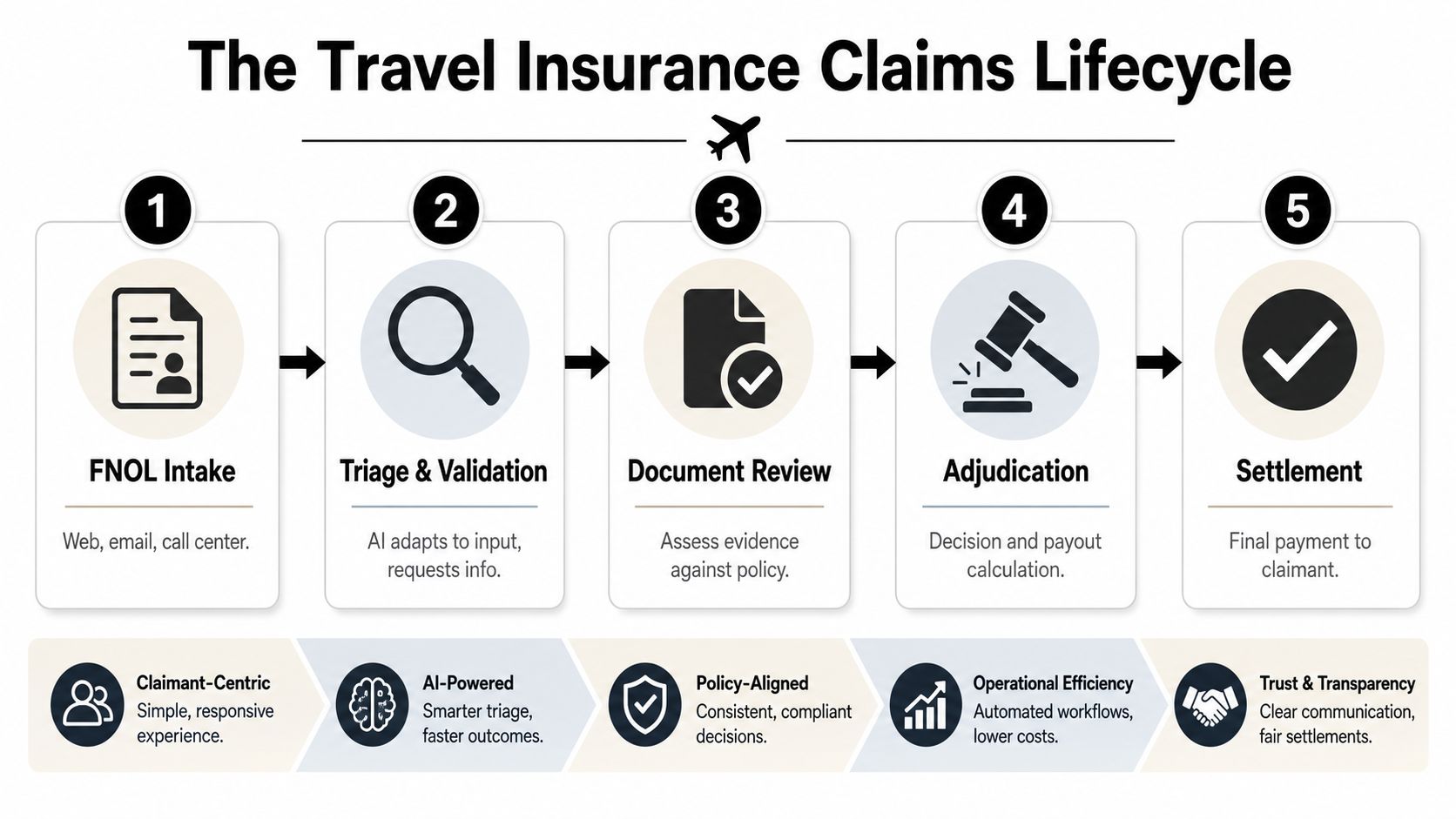
The difference between a smooth file and a stalled one is rarely one dramatic event. It is usually a handoff that lost context. A call center captures the right story, but the document team never sees the full picture. A handler requests more evidence, but the claimant does not understand what still matters. Then the file goes quiet, and the queue absorbs the delay.
The operational point is that travel insurance claims are multi-stage workflows, not single transactions. Each stage needs a different kind of attention, and automation only helps when it reduces the gaps between those stages instead of adding another portal to the pile.
Why Travel Claims Are Denied Even When Documents Look Complete
A claim file can look complete and still fail if the policy logic does not support payment. That is the part many claimants do not see. The denial usually comes from a mismatch between the loss event, the contract wording, and the facts captured at intake, not from a single missing form.
The denial logic is usually upstream
Common denial drivers include inaccurate trip details, late reporting beyond the usual filing window, missing original bills, pre-existing-condition disclosure failures, and known events like strikes or disasters that were public before purchase (Citizens Advice; InsureMyTrip). Those problems are usually baked in before the handler ever starts adjudication. Sending more documents later does not fix a trip that was misreported, a condition that was not disclosed, or a disruption that the policy already excluded.
The operational failure is often upstream data quality. If the claimant enters the trip details incorrectly, leaves out a medical history issue, or describes a disruption without the context the policy needs, the file can look tidy while still being unsupportable. Improving intake discipline, and using a process like how to improve data quality, reduces the chance that a case reaches review with the wrong facts already embedded.
Denials also reflect timing and process, not just evidence. Consumer-rights guidance in the UK shows that disputes usually move through the insurer's internal complaints process first, and the case can reach the Financial Ombudsman Service only after waiting up to 8 weeks (Citizens Advice). That matters because a claim can be rejected on coverage grounds, then later challenged on process grounds, and those are not the same problem.
The practical takeaway is simple. A strong intake flow screens for exclusion risk early, documents the reason for any likely denial, and prevents handlers from spending time on files that cannot survive the policy logic. That is also where the worst insurance data failures become visible, because a clean-looking file is not useful if the underlying facts were never captured correctly in the first place.
How Long a Travel Claim Should Realistically Take
The phrase “file promptly and follow up” hides too much. In practice, travel claims run on separate clocks, and each clock has a different cause of delay and a different escalation path.
Different clocks, different bottlenecks
For serious incidents, guidance commonly recommends notifying the insurer as soon as possible, often within the first 24 hours if you can (InsureMyTrip). Many policies also use a filing deadline that lands around 90 days (InsureMyTrip). A major help center says straightforward claims are typically processed in 4 to 6 weeks, with some paid in 7 to 10 days when the file is clean (Squaremouth). By contrast, complaint handling in the UK can stretch to 8 weeks before ombudsman escalation becomes available (Citizens Advice).
That means “slow” can describe three different things. The first is missing information, where the handler is waiting on proof. The second is coverage review, where the insurer is checking exclusions or benefit triggers. The third is complaint handling, where the file has already moved out of standard processing and into a formal dispute path.
Disruption volumes make the bottleneck worse. A 2025 roundup cited around 1.7 million flights delayed or cancelled in 2024, which helps explain why travel claims teams get hit by the same operational pressure points at the same time (Condor Ferries). When disruptions rise, the same inboxes, evidence requests, and review queues get crowded.
For policyholders, the useful question is not “how long does a claim take?” It's “which clock is mine on?” Once a handler can answer that, they can set a realistic expectation and route the file correctly instead of letting it drift.
Operational insight: The fastest way to calm a claimant is not a vague promise. It's a clear explanation of whether the file is waiting on documents, coverage review, or complaint handling.
For a broader lens on how bad data quality can magnify operational pain, the collection on worst insurance data failures is a useful reminder that bad inputs don't just slow a process, they distort it.
Where Automation Actually Changes the Claims Equation
Automation helps in travel claims only when it cuts a specific kind of friction. Generic digitization doesn't do much if the operation still asks handlers to copy data, chase missing fields, and manually move files between queues.
The first lift comes at intake
AI-driven FNOL intake and triage can adapt to policyholder input, request missing information, evaluate coverage, and route the file to the right team. That matters because the earliest questions in a travel file are often the most consequential. If the intake layer identifies the claim type correctly and checks for obvious coverage issues, handlers stop wasting time on misrouted work.
Document processing does a different job. It extracts structured data from receipts, emails, medical records, and supporting forms so the handler doesn't have to rekey the same facts into multiple systems. In a travel context, that means less time spent transcribing dates, names, costs, and policy details, and more time spent on judgment calls.
Claims lifecycle management is the third lever. It monitors progress, flags dormant cases, automates follow-ups, and suggests next best actions. That's the piece that keeps files from going quiet after one incomplete request. It also helps supervisors see where momentum is getting lost across the book.
For delegated authority workflows, the value is even more targeted. The system can extract claim details from email, compare them to authority thresholds, auto-approve or escalate as needed, and notify coverholders. That is especially relevant in brokered or delegated environments where speed has to coexist with control.
The gains depend on the friction you remove
Nolana describes site-level outcome ranges of up to 50x faster cycle times, up to 30% higher handler throughput, and up to 5% lower loss ratio, depending on context. Those figures make sense when automation is pointed at the actual bottlenecks, not bolted on as a generic front end.
The right mental model is stack-based. Intake handles the first decision. Document processing handles the evidence burden. Lifecycle management keeps files moving. Delegated authority automation protects speed without giving up control. Each layer solves a different failure mode, which is why one tool never fixes the whole claim.
For teams already wrestling with fragmented handling, the clearest reference point is a system that sits on top of existing platforms rather than forcing a rip-and-replace. Nolana's claims automation approach is built around that operating model, including claims workflows and document handling across the existing stack (Nolana AI).
Governance, Oversight, and the Path From Filing to Resolution
Enterprise claims teams don't buy automation to remove judgment. They buy it to protect judgment for the files that need it most. That's why governance has to sit inside the workflow, not outside it.
Human control still matters
Nolana's model is built on human-in-the-loop oversight, with auditability preserved across the chain of actions and outcomes. The practical effect is that handlers stay in control of the hard calls while the system handles repetitive intake, extraction, routing, and follow-up. That matters in travel claims because denials, partial payments, and exceptions all need explainable decisions.
The architecture also matters. A platform that sits on top of existing claims and policy systems reduces change-management pressure, because teams keep working in the tools they already know. Cross-channel synchronization across email, web, chat, AI voice, and call center keeps the file coherent even when the claimant uses different touchpoints.
Audit-ready logging is the other critical component. Every automated action has to be reviewable, because a fast decision that can't be explained is a governance problem waiting to happen. A SOC 2-certified posture signals that the platform is designed with enterprise controls in mind, which is exactly what claims leaders ask about before they trust automation with live files.
The same logic shows up in other regulated workflows, including the careful use of AI contract drafting tools for lawyers, where speed only matters if control, traceability, and review are preserved.
Travel claims are a good test case for this approach because they combine urgency, documentation, and policy friction. If the system can route a clean file faster, flag a broken file earlier, and keep a disputed file auditable, it's doing useful work. If it can't, it's just adding another layer of noise.
That's why the goal is not to automate away handlers. It's to keep them focused on the judgment calls that change outcomes while the routine work disappears into the background.
If your team is wrestling with FNOL intake, document bottlenecks, or dormant travel files, Nolana AI can automate the claims steps that slow handlers down while keeping human oversight intact. Visit Nolana AI to see how its agentic claims platform fits into existing insurance operations and supports faster, more auditable resolution.
574,000 travel insurance claims were processed in the UK in 2023, and insurers paid out £511 million in total, according to ABI figures reported by Insurance Business. That is not the profile of a niche add-on. It is a high-volume, high-severity claims line where medical losses alone accounted for £291 million and the average medical claim reached £1,724 (Insurance Business).
That scale changes how the work should be managed. A claims operation that treats travel as a simple reimbursement flow misses the point, because the file is usually built from policy wording, trip proof, receipts, incident reports, and medical records, all of which have to line up before payment is even possible (Emergency Assistance Plus). The tail is also ugly. A 2025 industry roundup cited a claim costing about $900,000, which is exactly why small intake errors and sloppy document handling create expensive rework (Condor Ferries).
For operations leaders, the conclusion is blunt. Travel insurance claims are document-heavy, timing-sensitive, and severity-skewed, so lifecycle design has a real effect on cost and service quality. Nolana's claims automation stack is built for that exact friction, from intake through settlement, while keeping human oversight in place across existing claims systems (Nolana AI).
What Travel Insurance Claims Actually Look Like in 2026
Travel insurance doesn't behave like a low-touch retail product once the loss happens. It behaves like a document test. The claimant has to show what happened, when it happened, what was covered, what was prepaid, and what costs were unavoidable, and the handler has to reconcile all of that against policy wording and notification rules.
The scale is the point
The UK figures matter because they reveal the operational shape of the book, not just the size of it. 574,000 claims and £511 million in payouts mean the line produces both frequent files and expensive ones, which is why throughput and judgment matter at the same time (Insurance Business). The average medical claim of £1,724 also shows why medical cases deserve separate handling discipline instead of being lumped together with baggage or delay claims (Insurance Business).
Age makes the concentration sharper. Claims from travelers aged 71-75 averaged £1,830, versus £518 for ages 36-40 (Insurance Business). That gap tells you the process isn't just about admin speed. It's about handling the right evidence, in the right sequence, for the right risk profile.
Practical rule: In travel claims, the fastest file is usually the one with the cleanest evidence chain, not the most detailed narrative.
The tail risk reinforces the same point. When a single claim can reach the upper end of severity discussed in industry commentary, the claims team can't rely on manual memory or loose email chains (Condor Ferries). Files need structured inputs, consistent timestamps, and proof that matches the policy trigger.
The operational takeaway is simple. Claim quality comes from evidence consistency, not from how persuasive the claimant sounds. That's why intake, triage, and document normalization do most of the heavy lifting before adjudication even starts.
Why lifecycle design pays off
A travel claim is never just one decision. It is a chain of decisions, and each handoff creates either momentum or drag. When the workflow captures the right fields early, the handler spends less time chasing basics and more time assessing coverage and settlement.
The broader claims lesson is that administrative friction multiplies quickly in a high-volume line. A small reduction in back-and-forth can translate into better service for the claimant and lower cost for the insurer, which is why lifecycle design matters more here than in many people expect.
The Main Claim Types and the Evidence Each One Demands
Travel insurance claims are not interchangeable. A medical file, a baggage file, and a cancellation file may all begin with the same claim form, but they do not end there. The evidence package changes with the loss type, and intake errors usually start when the file is classified too late or by the wrong trigger.
Classification drives the evidence list
Medical claims usually need a treating physician's statement, an accident report, medical records, itemized bills, and proof that any primary insurer has already responded (Squaremouth checklist). Baggage loss claims are more likely to need a supplier baggage claim form, an incident report from authorities, and an itemized list of the claimed items with cash values. Cancellation and interruption claims depend on proof of cancelled flights, unused prepaid expenses, and additional expense records (Meyer and Associates).
The operational problem is usually simple. A file arrives before the loss type has been pinned down, then the team spends the next several touches discovering that the documents do not match the category. That creates rework, and in travel claims it is often the first sign the file will stall.
Documentation Requirements by Travel Claim Type | Core Documents | Verification Evidence | Common Pitfalls |
|---|---|---|---|
Cancellation or interruption | Claim form, proof of cancelled flights, unused prepaid expenses, additional expense records | Booking confirmations, refund details, travel itinerary | Filing under the wrong reason code, incomplete cost breakdown |
Emergency medical | Claim form, treating physician's statement, medical records, itemized bills | Accident report, proof of denial from primary insurer | Missing facility records, inconsistent dates across documents |
Baggage loss or delay | Claim form, supplier baggage claim form, itemized item list with cash values | Incident report from authorities, travel proof | Valuation gaps, no authority report, unclear ownership |
Delay or missed connection | Claim form, carrier evidence, receipts for covered extra expenses | Travel proof, timing evidence, itinerary match | Mismatched timestamps, missing carrier confirmation |
The structured package matters because insurers commonly need aligned dates, locations, policy numbers, itemized receipts, medical records, proof of travel, and incident reports to validate eligibility (Emergency Assistance Plus). If those fields do not match, the handler has to slow down and investigate, even when the claimant believes the file is complete.
Operational note: A complete submission is not the same thing as a payable submission. The documents have to fit the loss type and the policy trigger.
For claims teams, early classification is the highest-yield control point. Once the loss type is right, the document chase becomes focused instead of sprawling. That is the difference between a file that moves and a file that sits while someone sorts out what the evidence is proving.
The intake step is also where automation changes the process most cleanly. A structured FNOL flow can catch missing fields, route the file to the right queue, and reduce avoidable follow-up, as shown in this FNOL intake automation case study. In practice, that matters because the claim does not usually fail on the final coverage review first. It fails earlier, when the record is too incomplete to support a confident classification.
Inside the Claims Lifecycle From FNOL to Settlement
A travel claim often enters the operation through first notice of loss, or FNOL, and that first touchpoint shapes the rest of the file. The claimant may submit through a web form, email, or a call center, and the intake team has to capture enough detail to route the case correctly without turning the first exchange into a long interrogation.
The file moves through distinct hands
Once FNOL arrives, the handler or triage team checks the policy, identifies the loss type, and decides whether the file belongs with standard claims, medical review, or a specialist queue. If the case involves treatment, a medical assessor may enter the loop. The claims system of record should hold the canonical version of the file, because when the same fact sits in multiple inboxes, the work slows down and the record starts to fragment. A claims management system is what keeps those handoffs tied to one version of the truth.
After triage, the case shifts into evidence collection and document processing. Receipts, itineraries, medical records, and incident reports are matched against the claim narrative. A good handler is not just reading PDFs, they are checking whether the file's dates, names, and locations line up well enough to support coverage. That consistency check is where many files either stay on track or drift into rework.
Practical rule: Momentum usually breaks at the same four points, missing documents, waiting on medical records, coverage ambiguity, and dormant files.
The next step is adjudication. The handler reviews policy wording, checks exclusions, confirms benefit limits, and decides whether the loss fits the contract. If the file passes, settlement follows. If it doesn't, the claimant gets a denial or a partial payment with reasons tied to the policy.
The difference between a smooth file and a stalled one is rarely one dramatic event. It is usually a handoff that lost context. A call center captures the right story, but the document team never sees the full picture. A handler requests more evidence, but the claimant does not understand what still matters. Then the file goes quiet, and the queue absorbs the delay.
The operational point is that travel insurance claims are multi-stage workflows, not single transactions. Each stage needs a different kind of attention, and automation only helps when it reduces the gaps between those stages instead of adding another portal to the pile.
Why Travel Claims Are Denied Even When Documents Look Complete
A claim file can look complete and still fail if the policy logic does not support payment. That is the part many claimants do not see. The denial usually comes from a mismatch between the loss event, the contract wording, and the facts captured at intake, not from a single missing form.
The denial logic is usually upstream
Common denial drivers include inaccurate trip details, late reporting beyond the usual filing window, missing original bills, pre-existing-condition disclosure failures, and known events like strikes or disasters that were public before purchase (Citizens Advice; InsureMyTrip). Those problems are usually baked in before the handler ever starts adjudication. Sending more documents later does not fix a trip that was misreported, a condition that was not disclosed, or a disruption that the policy already excluded.
The operational failure is often upstream data quality. If the claimant enters the trip details incorrectly, leaves out a medical history issue, or describes a disruption without the context the policy needs, the file can look tidy while still being unsupportable. Improving intake discipline, and using a process like how to improve data quality, reduces the chance that a case reaches review with the wrong facts already embedded.
Denials also reflect timing and process, not just evidence. Consumer-rights guidance in the UK shows that disputes usually move through the insurer's internal complaints process first, and the case can reach the Financial Ombudsman Service only after waiting up to 8 weeks (Citizens Advice). That matters because a claim can be rejected on coverage grounds, then later challenged on process grounds, and those are not the same problem.
The practical takeaway is simple. A strong intake flow screens for exclusion risk early, documents the reason for any likely denial, and prevents handlers from spending time on files that cannot survive the policy logic. That is also where the worst insurance data failures become visible, because a clean-looking file is not useful if the underlying facts were never captured correctly in the first place.
How Long a Travel Claim Should Realistically Take
The phrase “file promptly and follow up” hides too much. In practice, travel claims run on separate clocks, and each clock has a different cause of delay and a different escalation path.
Different clocks, different bottlenecks
For serious incidents, guidance commonly recommends notifying the insurer as soon as possible, often within the first 24 hours if you can (InsureMyTrip). Many policies also use a filing deadline that lands around 90 days (InsureMyTrip). A major help center says straightforward claims are typically processed in 4 to 6 weeks, with some paid in 7 to 10 days when the file is clean (Squaremouth). By contrast, complaint handling in the UK can stretch to 8 weeks before ombudsman escalation becomes available (Citizens Advice).
That means “slow” can describe three different things. The first is missing information, where the handler is waiting on proof. The second is coverage review, where the insurer is checking exclusions or benefit triggers. The third is complaint handling, where the file has already moved out of standard processing and into a formal dispute path.
Disruption volumes make the bottleneck worse. A 2025 roundup cited around 1.7 million flights delayed or cancelled in 2024, which helps explain why travel claims teams get hit by the same operational pressure points at the same time (Condor Ferries). When disruptions rise, the same inboxes, evidence requests, and review queues get crowded.
For policyholders, the useful question is not “how long does a claim take?” It's “which clock is mine on?” Once a handler can answer that, they can set a realistic expectation and route the file correctly instead of letting it drift.
Operational insight: The fastest way to calm a claimant is not a vague promise. It's a clear explanation of whether the file is waiting on documents, coverage review, or complaint handling.
For a broader lens on how bad data quality can magnify operational pain, the collection on worst insurance data failures is a useful reminder that bad inputs don't just slow a process, they distort it.
Where Automation Actually Changes the Claims Equation
Automation helps in travel claims only when it cuts a specific kind of friction. Generic digitization doesn't do much if the operation still asks handlers to copy data, chase missing fields, and manually move files between queues.
The first lift comes at intake
AI-driven FNOL intake and triage can adapt to policyholder input, request missing information, evaluate coverage, and route the file to the right team. That matters because the earliest questions in a travel file are often the most consequential. If the intake layer identifies the claim type correctly and checks for obvious coverage issues, handlers stop wasting time on misrouted work.
Document processing does a different job. It extracts structured data from receipts, emails, medical records, and supporting forms so the handler doesn't have to rekey the same facts into multiple systems. In a travel context, that means less time spent transcribing dates, names, costs, and policy details, and more time spent on judgment calls.
Claims lifecycle management is the third lever. It monitors progress, flags dormant cases, automates follow-ups, and suggests next best actions. That's the piece that keeps files from going quiet after one incomplete request. It also helps supervisors see where momentum is getting lost across the book.
For delegated authority workflows, the value is even more targeted. The system can extract claim details from email, compare them to authority thresholds, auto-approve or escalate as needed, and notify coverholders. That is especially relevant in brokered or delegated environments where speed has to coexist with control.
The gains depend on the friction you remove
Nolana describes site-level outcome ranges of up to 50x faster cycle times, up to 30% higher handler throughput, and up to 5% lower loss ratio, depending on context. Those figures make sense when automation is pointed at the actual bottlenecks, not bolted on as a generic front end.
The right mental model is stack-based. Intake handles the first decision. Document processing handles the evidence burden. Lifecycle management keeps files moving. Delegated authority automation protects speed without giving up control. Each layer solves a different failure mode, which is why one tool never fixes the whole claim.
For teams already wrestling with fragmented handling, the clearest reference point is a system that sits on top of existing platforms rather than forcing a rip-and-replace. Nolana's claims automation approach is built around that operating model, including claims workflows and document handling across the existing stack (Nolana AI).
Governance, Oversight, and the Path From Filing to Resolution
Enterprise claims teams don't buy automation to remove judgment. They buy it to protect judgment for the files that need it most. That's why governance has to sit inside the workflow, not outside it.
Human control still matters
Nolana's model is built on human-in-the-loop oversight, with auditability preserved across the chain of actions and outcomes. The practical effect is that handlers stay in control of the hard calls while the system handles repetitive intake, extraction, routing, and follow-up. That matters in travel claims because denials, partial payments, and exceptions all need explainable decisions.
The architecture also matters. A platform that sits on top of existing claims and policy systems reduces change-management pressure, because teams keep working in the tools they already know. Cross-channel synchronization across email, web, chat, AI voice, and call center keeps the file coherent even when the claimant uses different touchpoints.
Audit-ready logging is the other critical component. Every automated action has to be reviewable, because a fast decision that can't be explained is a governance problem waiting to happen. A SOC 2-certified posture signals that the platform is designed with enterprise controls in mind, which is exactly what claims leaders ask about before they trust automation with live files.
The same logic shows up in other regulated workflows, including the careful use of AI contract drafting tools for lawyers, where speed only matters if control, traceability, and review are preserved.
Travel claims are a good test case for this approach because they combine urgency, documentation, and policy friction. If the system can route a clean file faster, flag a broken file earlier, and keep a disputed file auditable, it's doing useful work. If it can't, it's just adding another layer of noise.
That's why the goal is not to automate away handlers. It's to keep them focused on the judgment calls that change outcomes while the routine work disappears into the background.
If your team is wrestling with FNOL intake, document bottlenecks, or dormant travel files, Nolana AI can automate the claims steps that slow handlers down while keeping human oversight intact. Visit Nolana AI to see how its agentic claims platform fits into existing insurance operations and supports faster, more auditable resolution.


All systems operational
Lloyd's Lab, One Lime Street, London EC3M 7HA
Copyright © 2026, Nolana. All rights reserved
All systems operational
Lloyd's Lab, One Lime Street, London EC3M 7HA
Copyright © 2026, Nolana. All rights reserved
All systems operational
Lloyd's Lab, One Lime Street, London EC3M 7HA
Copyright © 2026, Nolana. All rights reserved
All systems operational
Lloyd's Lab, One Lime Street, London EC3M 7HA
Copyright © 2026, Nolana. All rights reserved