Insurance Technology Trends Shaping Claims in 2026
Insurance Technology Trends Shaping Claims in 2026
Explore the insurance technology trends driving claims automation in 2026, from AI-powered FNOL to document processing, with KPIs, ROI, and adoption guidance.

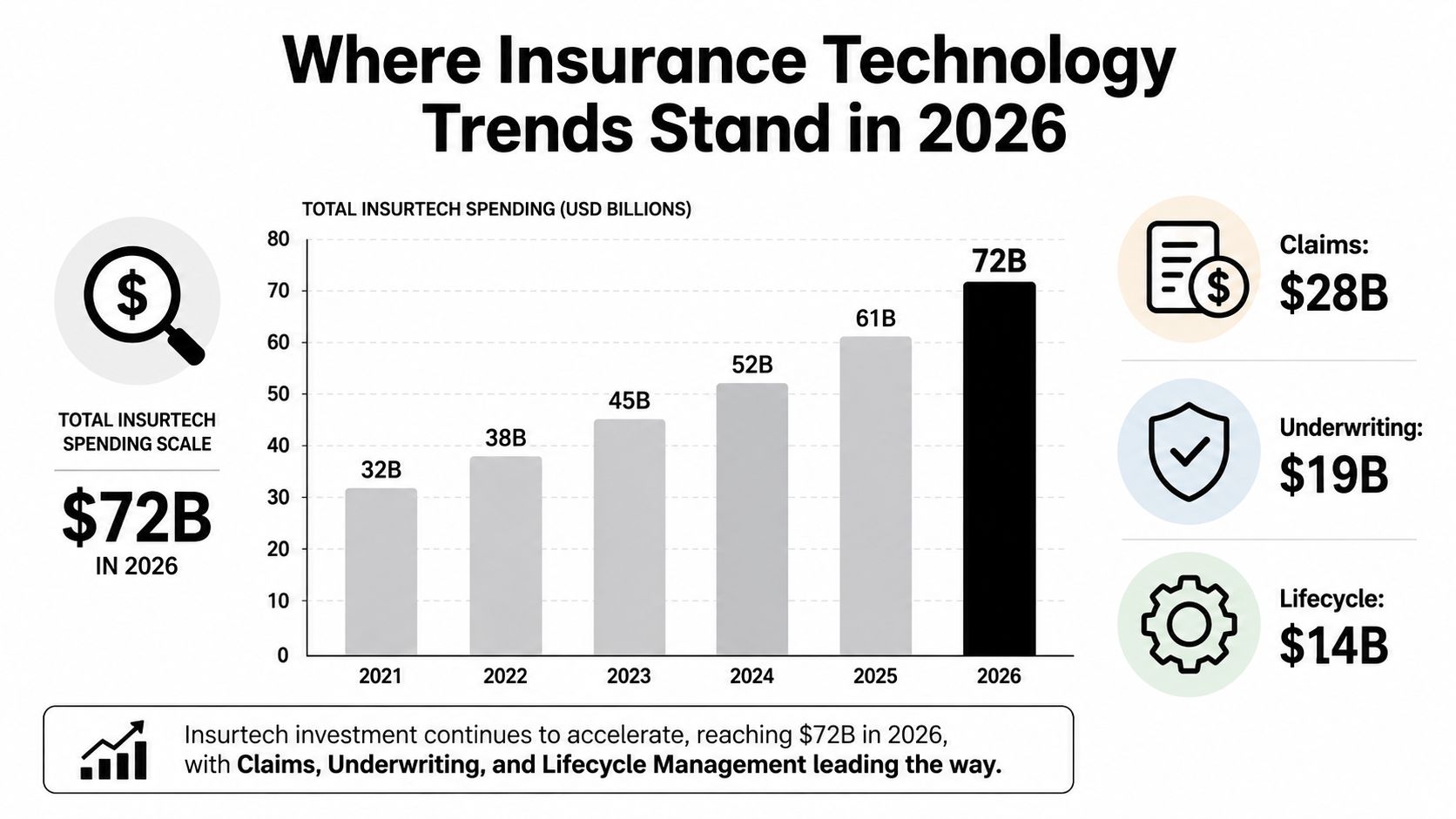
$173 billion is the projected size of U.S. insurance technology spending in 2026, a 7.8% increase year over year, and insurance will make up 6% of total U.S. tech spending. That scale matters because it tells claims leaders this isn't a side bet anymore, it's where budgets are moving, and the biggest gains are flowing into claims operations, not just front-end digital polish.
The signal is clear in the spending mix, too. Insurers are using technology to compress cycle time, automate intake, orchestrate work, and cut the administrative drag that keeps handlers from focusing on judgment calls.
Where Insurance Technology Trends Stand in 2026
The most useful way to read insurance technology trends in 2026 is to stop treating them as a single category. Industry spend is rising, but a key question is where that spend lands, and the answer is increasingly in claims, underwriting, and workflow modernization rather than consumer-facing apps. Forrester's 2026 forecast shows the industry moving from digital adoption to intelligence, with insurers treating tech as a strategic operating lever instead of a back-office expense (Forrester).
Read the budget signal, not the buzz
A claim technology budget tells you more than a product roadmap does. When insurers invest at this scale, they usually avoid one-off tools that sit outside core operations. They prefer software that can sit on top of existing claims and policy systems, support governance, and reduce the amount of manual handling on every file.
That's why claims gets such a large share of attention. It's a throughput-constrained workflow, which means every minute spent rekeying, routing, checking coverage, or chasing missing information creates visible friction. A useful partner-selection checklist for that environment is laid out in insurance technology partner selection tips, especially if your team is comparing build-versus-buy options around claims infrastructure.
The wrong conclusion from 2026 spending data is that all digitization is equally valuable. The better read is that insurers are funding operational modernization where the bottlenecks live. That's why claims, not generic customer experience, is the clearest test case for whether an insurtech investment changes the business.
Practical rule: If a vendor can't show how it reduces touchpoints in FNOL, document handling, or triage, it's probably selling activity, not throughput.
For a broader view of how those systems fit together, the operating model in this overview of digital insurance platforms helps frame where claims automation sits inside the stack.
The Agentic AI Layer Behind Modern Claims Operations
The phrase agentic AI gets used loosely, but in claims operations it has a specific meaning. It's not a chatbot sitting on the side of the workbench. It's the orchestration layer that connects intake, extraction, classification, routing, and human approval checkpoints across a claim's lifecycle.
The 2026 trend line becomes operational instead of conceptual at this point. McKinsey highlights applied AI and next-level automation as key forces reshaping insurance, while Forrester points to agentic AI and workflow orchestration for complex multistep tasks like first notice of loss and underwriting data extraction within governed operating models (McKinsey). For claims teams, that means the value is in the handoff logic, not just in generating text.
What agentic claims looks like in practice
A specialty loss in the Lloyd's market rarely arrives as a neat form. It comes through broker emails, attached PDFs, photos, partial details, and follow-up messages from coverholders. An agentic layer can pull the intake into one record, extract the relevant fields, flag missing evidence, and route the file based on thresholds and authority rules, while a handler signs off where judgment is required.
The important distinction is control. The system can classify a message, draft a response, or recommend the next action, but it pauses where the file needs human review. That's the production pattern enterprise buyers care about, because it preserves auditability while removing the administrative work that slows experienced handlers down.
A useful guide to this operating model is SupportGPT's 2026 workflow guide, especially if your team is trying to separate genuine orchestration from simple automation wrappers.
The earlier wave of insurance automation relied on rules engines and RPA to move data around. Agentic AI goes further by handling the messy middle, where the system has to retrieve context, decide what matters, and coordinate the next step. For a deeper technical definition, see what is agentic AI.
The production test isn't whether AI can answer a question. It's whether it can move a claim forward without breaking governance.
Automated FNOL Intake and Document Processing in Practice
FNOL automation is the first place claims teams feel the difference between surface-level AI and actual workflow improvement. The core task is simple to describe and hard to do well, because the intake arrives through web forms, email, voice, and chat, often with missing or inconsistent details. AI can request what's missing, pull out relevant information, and route the file to the right queue before a handler has touched it.
Document processing is the second half of that same motion. Loss descriptions, photos, repair estimates, correspondence, and first reports all carry structured information that claims systems need, but they usually arrive in unstructured form. If the platform extracts fields cleanly, validates them, and posts them into the claim record, the file starts with momentum instead of admin debt.
Where the cycle time actually changes
The improvement comes from removing rekeying and file chasing at the front of the journey. That's the work that creates a backlog before adjudication even starts, and it's why AI claims tooling has become one of the most studied areas in insurance, especially for auto damage detection and claims automation (peer-reviewed review of AI in insurance).
A strong FNOL workflow doesn't just collect information. It checks whether the submission is complete, determines whether the claim belongs in a specialist or general queue, and passes a cleaner file into the workbench. If the system only moves the bottleneck downstream, the team hasn't gained much. If it reduces the number of files that need manual touch before triage, it changes day-one readiness.
For operational teams, the key question is whether the AI creates a better claim record or merely a faster inbox. The former changes throughput. The latter just changes how fast the inbox fills.
This is the right place to evaluate FNOL workflow design because the intake sequence determines whether the rest of the claim starts with clean data or cleanup work.
Cross-Channel Orchestration and Delegated Authority Triage
Claims teams don't operate in one channel, and neither should their automation. Email, phone, portal, live chat, and broker correspondence all feed the same operational queue, but they do so with different levels of structure and urgency. Cross-channel orchestration keeps those inputs synchronized so handlers aren't reconciling five versions of the same case.
That matters even more in delegated authority workflows. In the Lloyd's market, authority thresholds and broker or coverholder communications create a governance layer that generic claims automation often misses. A file that's simple from a processing standpoint can still be risky if the system mishandles authority, escalations, or notifications.
Two workflows that look similar but behave differently
A portal submission usually arrives with more structure. An email from a broker may include partial context, attachments, and an ask that needs extraction before routing. The AI layer has to normalize both into the same claim record, then decide whether the case can be auto-adjudicated, needs human review, or should be rejected under a threshold rule.
Delegated authority triage is where governance and speed meet. The system can pull claim details from broker or coverholder emails, compare them with authority limits, and update the core system with the result. When that works, it reduces cycle time and lowers the risk of authority mistakes that create E&O exposure.
Industry analysis from Gallagher says AI and RPA can improve claim triaging, and it highlights text analytics, image recognition, and large language models as relevant tools for insurance operations (Gallagher Global InsurTech Report). That's useful, but the important operational takeaway is narrower, automation has to respect thresholds, because delegated authority is not just a workflow problem, it's a control problem.
If you're evaluating a market-specific deployment, delegated authority claims is the right lens for separating a nice interface from a governed operating process.
KPIs and ROI Scenarios That Justify Claims Automation Investment
Claims leaders don't buy automation because it sounds modern. They buy it when it improves the handful of metrics that the operation lives on: cycle time, cost per claim, and handler attention. The best-supported industry ranges show why the interest is so strong, with claims automation linked to materially faster settlement and lower processing cost in the source set above.
The practical move is to map capabilities to outcomes. FNOL intake affects file readiness. Document processing affects rekeying. Triage affects routing speed. Lifecycle orchestration affects dormant-file recovery and follow-up discipline. Once you connect those dots, the ROI conversation gets much less abstract.
A simple comparison frame
Metric | Human-Only Baseline | AI-Augmented Scenario |
|---|---|---|
Cycle time | Slower because intake, routing, and follow-up depend on manual handling | Faster because structured intake and triage reduce waiting time |
Cost per claim | Higher because handlers spend time on admin and rework | Lower because repetitive work shifts into automation |
Handler attention | Spent on rekeying, chasing documents, and queue management | Shifted toward exceptions, settlements, and judgment calls |
That table is deliberately qualitative, because the baseline should come from your own operation. Set the baseline before the pilot, not after it. Measure how long claims sit before a first action, how many touches each file receives, and how much of the handler day goes to non-decision work.
A useful operating benchmark from the publisher's own product documentation is that Nolana AI automates FNOL intake, document processing, lifecycle management, and delegated authority triage on top of existing systems. In practice, that kind of layered deployment is what lets a claims team improve throughput without replacing the core workbench.
Decision rule: If the pilot can't show faster routing and less manual rekeying, don't expand it yet.
For a clean metric setup, the framework in how to measure operational efficiency helps claims teams avoid vanity metrics and focus on work that affects throughput.
Human-in-the-Loop Controls, Explainability, and Audit Posture
The strongest 2026 claims systems are not fully autonomous, and that's a feature, not a flaw. The market is still uneven on end-to-end autonomy, while triage-level automation is much closer to production reality. That's why the buyer question is less “Can AI do the whole claim?” and more “What happens when it's uncertain?”
In regulated environments, especially the Lloyd's and London Market, handlers and managers need to know why the system recommended a route, what evidence it used, and who approved the final action. Human-in-the-loop control keeps that chain intact. Auditability matters just as much as speed, because a fast workflow that can't explain itself creates a governance problem.
What control looks like in a live operation
Authority thresholds define where automation can act and where it must stop. Escalation rules define what happens when confidence is low or the file crosses a risk boundary. Logging captures the recommendation, the human override, and the final outcome. Those three elements are what make AI usable in production rather than just impressive in demos.
The European insurance sector's digitalisation survey shows AI adoption already in production across both non-life and life markets, with more firms planning adoption within three years (EIOPA digitalisation report). That matters because it confirms the direction of travel, but the control posture still determines whether adoption is sustainable.
If a vendor presents AI as a draft-maker rather than a decision dictator, you're closer to a usable system. If it can't show model governance, threshold handling, and a clean audit trail, it belongs in pilot territory, not core operations.
A Practical Adoption Sequence for Claims Operations Leaders
The fastest path into claims automation is to start with a narrow workflow that hurts every day, then prove it before expanding. That's the opposite of the old transformation model, where teams tried to rebuild the whole stack at once. In insurance, large deployments increase risk when the org is still learning how the new operating model behaves.
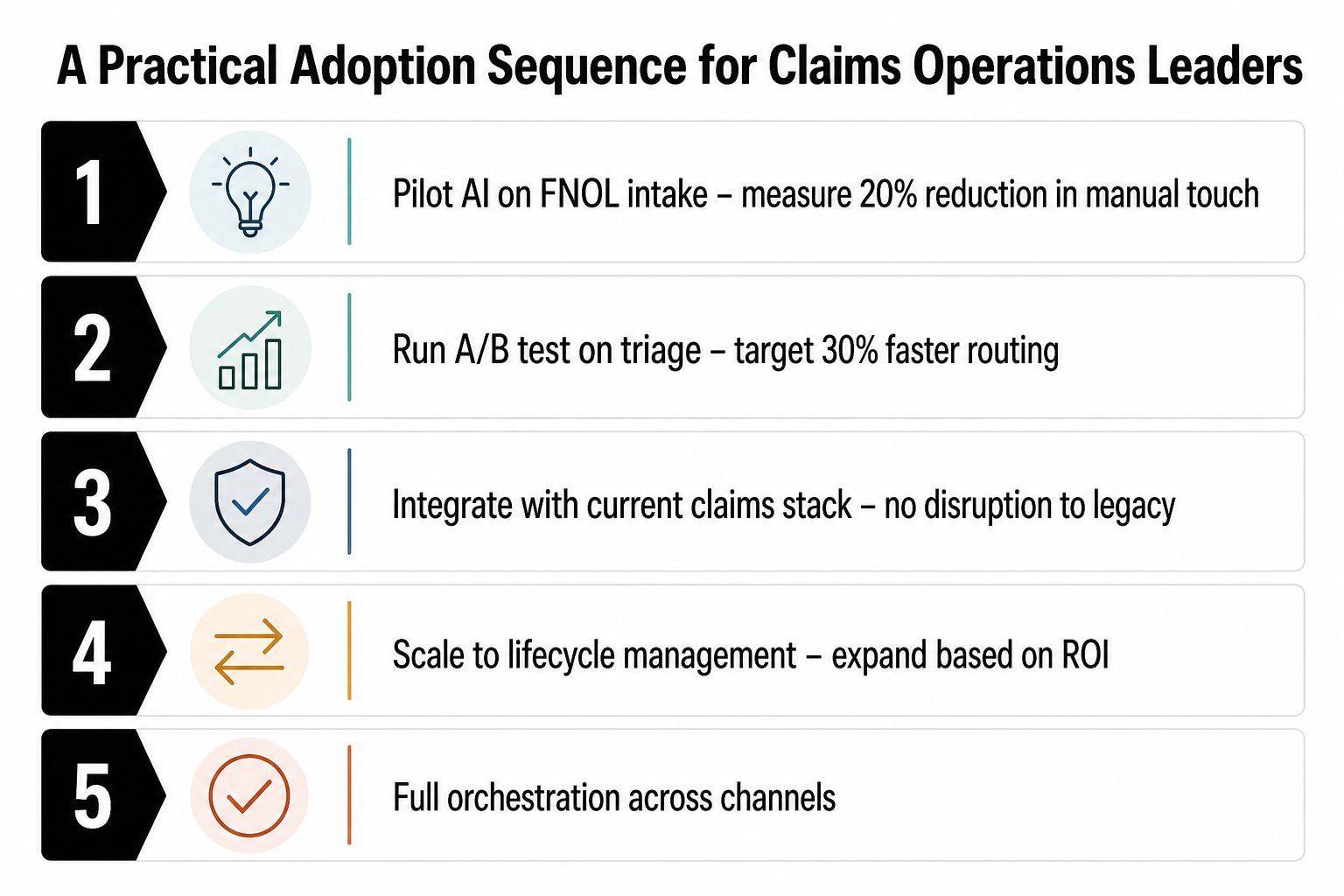
The better sequence is pilot, measure, expand. Begin with a high-friction intake or triage queue, keep the current claims workbench in place, and layer the automation on top via APIs or controlled integrations. That reduces replacement risk and gives claims leaders a cleaner read on whether the tool is changing throughput.
A sequenced rollout that fits existing operations
Pilot AI on FNOL intake. Start where the file first gets stuck, then measure how much manual touch disappears.
Run an A/B test on triage. Compare routing speed and queue quality against the current process.
Integrate with the current claims stack. Keep the core systems in place so the team doesn't lose operational continuity.
Expand into lifecycle management. Add dormant-file detection and next-action recommendations once the first use case is stable.
Scale orchestration across channels. Bring email, portal, voice, and broker communications into one claim record.
That sequence also fits the way insurers buy technology now, with working value expected before broad commitment. If your vendor offers a custom agent builder, use it to mirror your own workflow rather than forcing the operation into a generic template.
Nolana AI fits this pattern because it sits on top of existing claims and policy systems, supports FNOL, document processing, delegated authority triage, and lifecycle management, and keeps human handlers in control. That architecture matches the operating reality of claims teams that need improvement without a platform replacement.
If your claims team is trying to turn insurance technology trends into measurable operational gains, start by mapping one bottleneck, one baseline, and one workflow that can be automated without disturbing the core stack. Visit Nolana AI to see how an agentic claims layer can support FNOL intake, document processing, triage, and lifecycle management while keeping human oversight and auditability intact.
$173 billion is the projected size of U.S. insurance technology spending in 2026, a 7.8% increase year over year, and insurance will make up 6% of total U.S. tech spending. That scale matters because it tells claims leaders this isn't a side bet anymore, it's where budgets are moving, and the biggest gains are flowing into claims operations, not just front-end digital polish.
The signal is clear in the spending mix, too. Insurers are using technology to compress cycle time, automate intake, orchestrate work, and cut the administrative drag that keeps handlers from focusing on judgment calls.
Where Insurance Technology Trends Stand in 2026
The most useful way to read insurance technology trends in 2026 is to stop treating them as a single category. Industry spend is rising, but a key question is where that spend lands, and the answer is increasingly in claims, underwriting, and workflow modernization rather than consumer-facing apps. Forrester's 2026 forecast shows the industry moving from digital adoption to intelligence, with insurers treating tech as a strategic operating lever instead of a back-office expense (Forrester).
Read the budget signal, not the buzz
A claim technology budget tells you more than a product roadmap does. When insurers invest at this scale, they usually avoid one-off tools that sit outside core operations. They prefer software that can sit on top of existing claims and policy systems, support governance, and reduce the amount of manual handling on every file.
That's why claims gets such a large share of attention. It's a throughput-constrained workflow, which means every minute spent rekeying, routing, checking coverage, or chasing missing information creates visible friction. A useful partner-selection checklist for that environment is laid out in insurance technology partner selection tips, especially if your team is comparing build-versus-buy options around claims infrastructure.
The wrong conclusion from 2026 spending data is that all digitization is equally valuable. The better read is that insurers are funding operational modernization where the bottlenecks live. That's why claims, not generic customer experience, is the clearest test case for whether an insurtech investment changes the business.
Practical rule: If a vendor can't show how it reduces touchpoints in FNOL, document handling, or triage, it's probably selling activity, not throughput.
For a broader view of how those systems fit together, the operating model in this overview of digital insurance platforms helps frame where claims automation sits inside the stack.
The Agentic AI Layer Behind Modern Claims Operations
The phrase agentic AI gets used loosely, but in claims operations it has a specific meaning. It's not a chatbot sitting on the side of the workbench. It's the orchestration layer that connects intake, extraction, classification, routing, and human approval checkpoints across a claim's lifecycle.
The 2026 trend line becomes operational instead of conceptual at this point. McKinsey highlights applied AI and next-level automation as key forces reshaping insurance, while Forrester points to agentic AI and workflow orchestration for complex multistep tasks like first notice of loss and underwriting data extraction within governed operating models (McKinsey). For claims teams, that means the value is in the handoff logic, not just in generating text.
What agentic claims looks like in practice
A specialty loss in the Lloyd's market rarely arrives as a neat form. It comes through broker emails, attached PDFs, photos, partial details, and follow-up messages from coverholders. An agentic layer can pull the intake into one record, extract the relevant fields, flag missing evidence, and route the file based on thresholds and authority rules, while a handler signs off where judgment is required.
The important distinction is control. The system can classify a message, draft a response, or recommend the next action, but it pauses where the file needs human review. That's the production pattern enterprise buyers care about, because it preserves auditability while removing the administrative work that slows experienced handlers down.
A useful guide to this operating model is SupportGPT's 2026 workflow guide, especially if your team is trying to separate genuine orchestration from simple automation wrappers.
The earlier wave of insurance automation relied on rules engines and RPA to move data around. Agentic AI goes further by handling the messy middle, where the system has to retrieve context, decide what matters, and coordinate the next step. For a deeper technical definition, see what is agentic AI.
The production test isn't whether AI can answer a question. It's whether it can move a claim forward without breaking governance.
Automated FNOL Intake and Document Processing in Practice
FNOL automation is the first place claims teams feel the difference between surface-level AI and actual workflow improvement. The core task is simple to describe and hard to do well, because the intake arrives through web forms, email, voice, and chat, often with missing or inconsistent details. AI can request what's missing, pull out relevant information, and route the file to the right queue before a handler has touched it.
Document processing is the second half of that same motion. Loss descriptions, photos, repair estimates, correspondence, and first reports all carry structured information that claims systems need, but they usually arrive in unstructured form. If the platform extracts fields cleanly, validates them, and posts them into the claim record, the file starts with momentum instead of admin debt.
Where the cycle time actually changes
The improvement comes from removing rekeying and file chasing at the front of the journey. That's the work that creates a backlog before adjudication even starts, and it's why AI claims tooling has become one of the most studied areas in insurance, especially for auto damage detection and claims automation (peer-reviewed review of AI in insurance).
A strong FNOL workflow doesn't just collect information. It checks whether the submission is complete, determines whether the claim belongs in a specialist or general queue, and passes a cleaner file into the workbench. If the system only moves the bottleneck downstream, the team hasn't gained much. If it reduces the number of files that need manual touch before triage, it changes day-one readiness.
For operational teams, the key question is whether the AI creates a better claim record or merely a faster inbox. The former changes throughput. The latter just changes how fast the inbox fills.
This is the right place to evaluate FNOL workflow design because the intake sequence determines whether the rest of the claim starts with clean data or cleanup work.
Cross-Channel Orchestration and Delegated Authority Triage
Claims teams don't operate in one channel, and neither should their automation. Email, phone, portal, live chat, and broker correspondence all feed the same operational queue, but they do so with different levels of structure and urgency. Cross-channel orchestration keeps those inputs synchronized so handlers aren't reconciling five versions of the same case.
That matters even more in delegated authority workflows. In the Lloyd's market, authority thresholds and broker or coverholder communications create a governance layer that generic claims automation often misses. A file that's simple from a processing standpoint can still be risky if the system mishandles authority, escalations, or notifications.
Two workflows that look similar but behave differently
A portal submission usually arrives with more structure. An email from a broker may include partial context, attachments, and an ask that needs extraction before routing. The AI layer has to normalize both into the same claim record, then decide whether the case can be auto-adjudicated, needs human review, or should be rejected under a threshold rule.
Delegated authority triage is where governance and speed meet. The system can pull claim details from broker or coverholder emails, compare them with authority limits, and update the core system with the result. When that works, it reduces cycle time and lowers the risk of authority mistakes that create E&O exposure.
Industry analysis from Gallagher says AI and RPA can improve claim triaging, and it highlights text analytics, image recognition, and large language models as relevant tools for insurance operations (Gallagher Global InsurTech Report). That's useful, but the important operational takeaway is narrower, automation has to respect thresholds, because delegated authority is not just a workflow problem, it's a control problem.
If you're evaluating a market-specific deployment, delegated authority claims is the right lens for separating a nice interface from a governed operating process.
KPIs and ROI Scenarios That Justify Claims Automation Investment
Claims leaders don't buy automation because it sounds modern. They buy it when it improves the handful of metrics that the operation lives on: cycle time, cost per claim, and handler attention. The best-supported industry ranges show why the interest is so strong, with claims automation linked to materially faster settlement and lower processing cost in the source set above.
The practical move is to map capabilities to outcomes. FNOL intake affects file readiness. Document processing affects rekeying. Triage affects routing speed. Lifecycle orchestration affects dormant-file recovery and follow-up discipline. Once you connect those dots, the ROI conversation gets much less abstract.
A simple comparison frame
Metric | Human-Only Baseline | AI-Augmented Scenario |
|---|---|---|
Cycle time | Slower because intake, routing, and follow-up depend on manual handling | Faster because structured intake and triage reduce waiting time |
Cost per claim | Higher because handlers spend time on admin and rework | Lower because repetitive work shifts into automation |
Handler attention | Spent on rekeying, chasing documents, and queue management | Shifted toward exceptions, settlements, and judgment calls |
That table is deliberately qualitative, because the baseline should come from your own operation. Set the baseline before the pilot, not after it. Measure how long claims sit before a first action, how many touches each file receives, and how much of the handler day goes to non-decision work.
A useful operating benchmark from the publisher's own product documentation is that Nolana AI automates FNOL intake, document processing, lifecycle management, and delegated authority triage on top of existing systems. In practice, that kind of layered deployment is what lets a claims team improve throughput without replacing the core workbench.
Decision rule: If the pilot can't show faster routing and less manual rekeying, don't expand it yet.
For a clean metric setup, the framework in how to measure operational efficiency helps claims teams avoid vanity metrics and focus on work that affects throughput.
Human-in-the-Loop Controls, Explainability, and Audit Posture
The strongest 2026 claims systems are not fully autonomous, and that's a feature, not a flaw. The market is still uneven on end-to-end autonomy, while triage-level automation is much closer to production reality. That's why the buyer question is less “Can AI do the whole claim?” and more “What happens when it's uncertain?”
In regulated environments, especially the Lloyd's and London Market, handlers and managers need to know why the system recommended a route, what evidence it used, and who approved the final action. Human-in-the-loop control keeps that chain intact. Auditability matters just as much as speed, because a fast workflow that can't explain itself creates a governance problem.
What control looks like in a live operation
Authority thresholds define where automation can act and where it must stop. Escalation rules define what happens when confidence is low or the file crosses a risk boundary. Logging captures the recommendation, the human override, and the final outcome. Those three elements are what make AI usable in production rather than just impressive in demos.
The European insurance sector's digitalisation survey shows AI adoption already in production across both non-life and life markets, with more firms planning adoption within three years (EIOPA digitalisation report). That matters because it confirms the direction of travel, but the control posture still determines whether adoption is sustainable.
If a vendor presents AI as a draft-maker rather than a decision dictator, you're closer to a usable system. If it can't show model governance, threshold handling, and a clean audit trail, it belongs in pilot territory, not core operations.
A Practical Adoption Sequence for Claims Operations Leaders
The fastest path into claims automation is to start with a narrow workflow that hurts every day, then prove it before expanding. That's the opposite of the old transformation model, where teams tried to rebuild the whole stack at once. In insurance, large deployments increase risk when the org is still learning how the new operating model behaves.
The better sequence is pilot, measure, expand. Begin with a high-friction intake or triage queue, keep the current claims workbench in place, and layer the automation on top via APIs or controlled integrations. That reduces replacement risk and gives claims leaders a cleaner read on whether the tool is changing throughput.
A sequenced rollout that fits existing operations
Pilot AI on FNOL intake. Start where the file first gets stuck, then measure how much manual touch disappears.
Run an A/B test on triage. Compare routing speed and queue quality against the current process.
Integrate with the current claims stack. Keep the core systems in place so the team doesn't lose operational continuity.
Expand into lifecycle management. Add dormant-file detection and next-action recommendations once the first use case is stable.
Scale orchestration across channels. Bring email, portal, voice, and broker communications into one claim record.
That sequence also fits the way insurers buy technology now, with working value expected before broad commitment. If your vendor offers a custom agent builder, use it to mirror your own workflow rather than forcing the operation into a generic template.
Nolana AI fits this pattern because it sits on top of existing claims and policy systems, supports FNOL, document processing, delegated authority triage, and lifecycle management, and keeps human handlers in control. That architecture matches the operating reality of claims teams that need improvement without a platform replacement.
If your claims team is trying to turn insurance technology trends into measurable operational gains, start by mapping one bottleneck, one baseline, and one workflow that can be automated without disturbing the core stack. Visit Nolana AI to see how an agentic claims layer can support FNOL intake, document processing, triage, and lifecycle management while keeping human oversight and auditability intact.


All systems operational
1 Lime Street, London EC3M 7HA | 222E 3rd Street, New York 10009
Copyright © 2026, Nolana. All rights reserved
All systems operational
1 Lime Street, London EC3M 7HA | 222E 3rd Street, New York 10009
Copyright © 2026, Nolana. All rights reserved
All systems operational
1 Lime Street, London EC3M 7HA | 222E 3rd Street, New York 10009
Copyright © 2026, Nolana. All rights reserved
All systems operational
1 Lime Street, London EC3M 7HA | 222E 3rd Street, New York 10009
Copyright © 2026, Nolana. All rights reserved