What Is Agentic AI? Enterprise Operations Guide
What Is Agentic AI? Enterprise Operations Guide
Learn what is Agentic AI, how it differs from traditional automation, and why regulated enterprises use it to scale claims, governance, and operations safely.

Agentic AI is a goal-directed control system that combines planning, tool use, memory, and orchestration so an LLM can break work into subtasks, call external systems, observe outcomes, and keep iterating until the objective is met. It's already scaling like a platform shift, with one industry summary projecting the market will grow from $5.25 billion in 2024 to $199.05 billion by 2034, a 43.84% CAGR, while 79% of organizations report some AI agent adoption.
That definition matters because most explanations of what is Agentic AI still undersell the operational difference. A chatbot answers. An agent works. Once you connect reasoning to claims systems, policy data, document flows, and communication channels, you're no longer buying a smarter interface. You're introducing a software control layer that can move work forward inside the business.
In regulated operations, that distinction changes the conversation. The core issue isn't whether an AI system can produce text. It's whether it can handle a bounded business objective, stay within policy, leave an audit trail, and hand control back to humans when the risk profile changes.
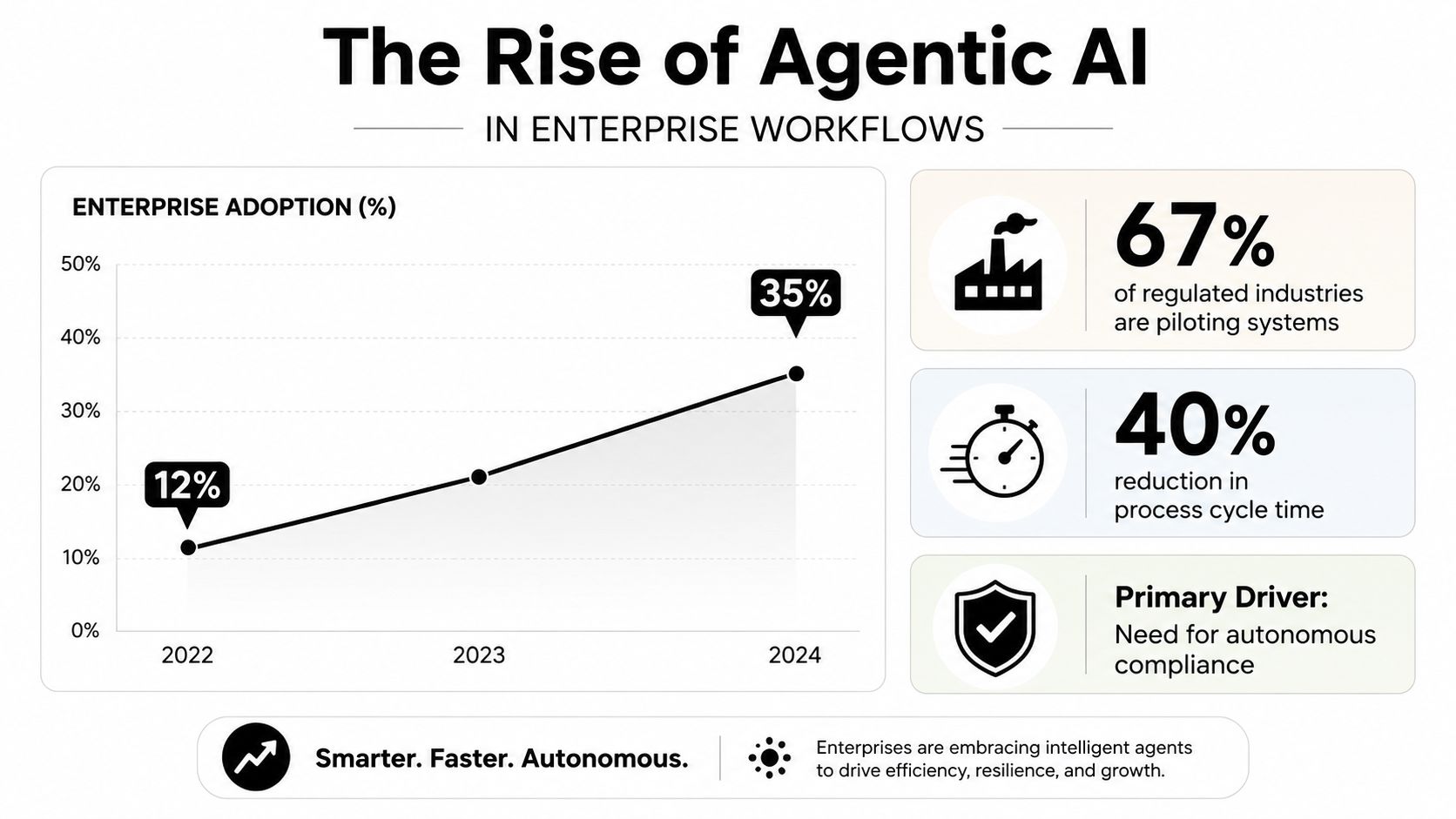
The Rise of Agentic AI in Enterprise Workflows
The speed of adoption tells you this isn't another experimental AI label. One market summary projects the global agentic AI market will expand from $5.25 billion in 2024 to $199.05 billion by 2034, with a 43.84% CAGR, and says 79% of organizations already have some AI agent adoption while 96% plan to expand in 2025 (Landbase agentic AI statistics). Enterprise buyers usually don't move that quickly unless they see this as core infrastructure.
What the term actually means
AWS gives the cleanest practitioner definition. Agentic AI is a system where an LLM can plan, use tools, retain context, and orchestrate actions across systems until it completes a goal, rather than stopping at a single response (AWS Prescriptive Guidance on agentic AI frameworks).
That sounds abstract until you compare it to a claims operation. A handler doesn't just answer one question. They receive a notice, identify what's missing, check relevant records, route the file, request documents, track inactivity, and decide what should happen next. If an AI system only drafts text, it helps at the margins. If it can coordinate those steps, it starts to change throughput and service quality.
Why enterprises care now
The shift happened when AI moved from content generation to workflow execution. In production, the highest-value use cases tend to share a few traits:
Multi-step work: A task can't be finished in one turn.
Cross-system action: The process depends on APIs, claims platforms, inboxes, and document stores.
Variable inputs: Customers, brokers, and coverholders don't submit information in a clean, uniform way.
Human checkpoints: The operation needs review, escalation, or override at defined moments.
That combination is common in insurance, banking, and other controlled environments. It's also why “just use a chatbot” usually fails once a team tries to operationalize it.
Agentic systems earn their keep when the work has branches, exceptions, and follow-up loops. If every step is fixed, standard automation is simpler.
A lot of enterprise teams are now mapping specific workflows to agent patterns instead of broad AI ambitions. That's the practical starting point. Not “where can we use AI,” but “where do we have high-volume operational work that requires judgment, tool use, and repeatable controls.” For teams evaluating real workflows, this list of AI agent use cases in operations is a more useful lens than generic AI trend coverage.
Why regulated sectors moved from curiosity to deployment
Regulated industries were initially cautious, for good reason. But they also have some of the strongest conditions for successful adoption. Their processes are documented. Their controls are explicit. Their work often lives across fragmented systems that create drag for experienced staff.
That creates a narrow but valuable opening for agentic AI. You don't give the system unconstrained freedom. You give it a bounded objective, approved tool access, escalation rules, and full observability. Done well, that's not “autonomy replacing operators.” It's a controlled execution layer supporting them.
How Agentic AI Differs from Traditional and Autonomous Systems
The biggest confusion around what is Agentic AI comes from treating all automation as the same thing. It isn't. There's a wide gap between a rules engine, a generative copilot, and a system that can plan and act across multiple tools.
MIT Sloan notes there's no universally agreed definition of agentic AI, which is one reason the category gets blurred so easily (MIT Sloan on agentic AI explained). In practice, the useful question isn't “is this AI agentic or not.” It's “what level of autonomy is safe and useful for this process.”
Automation Spectrum Comparison
Dimension | Traditional Automation | Generative AI Copilot | Agentic AI |
|---|---|---|---|
Primary role | Executes predefined rules | Assists a human with content or suggestions | Pursues a goal across multiple steps |
Decision path | Fixed and scripted | Human-led | Dynamic within approved boundaries |
Memory | Usually limited to workflow state | Often session-based | Maintains task context across steps |
Tool use | Preconfigured system actions | Usually indirect or manual | Selects and calls tools or systems as part of execution |
Exception handling | Brittle when inputs vary | Defers to user | Adapts, retries, escalates, or changes path |
Human involvement | Heavy at exceptions | Heavy throughout | Targeted at checkpoints and high-risk actions |
Best fit | Stable, repeatable tasks | Drafting, summarizing, answering | Multi-step operations with changing context |
Where each model works
Traditional automation still has a place. If a workflow is stable, deterministic, and low-variance, rule-based automation is cheaper to govern and easier to test. A payment reconciliation rule or a simple status-triggered notification doesn't need an agent.
Generative AI copilots also have a place. They're useful when a person remains the central actor and needs faster drafting, summarization, retrieval, or explanation. Think policy wording assistance, correspondence suggestions, or note summaries for handlers.
Agentic AI sits in the middle ground that many regulated teams need. It can act across APIs and software environments, but it still operates under human supervision and policy constraints. That's the operational sweet spot.
The autonomy question that matters
McKinsey distinguishes between rule-based automation, predictive analytics, generative AI, and agents based on the structure of the task and the variability of context (McKinsey on when machines don't just chat but act). That distinction matters more than the label.
A practical way to think about autonomy is this:
Assistive autonomy
The system recommends, drafts, or summarizes. A human still decides and acts.Conditional autonomy
The system can execute low-risk steps when predefined criteria are met, then escalate exceptions.Supervised execution
The system runs multi-step workflows, updates systems, and manages follow-up while exposing checkpoints, logs, and override controls.Fully autonomous operation
The system acts end to end with minimal supervision. In regulated claims work, this level is rarely appropriate.
Practical rule: Don't buy agentic AI for a process until you can name the exact decisions the system may take alone, the exact decisions it may only recommend, and the exact conditions that force escalation.
That's why many “autonomous AI employee” pitches don't survive implementation. They skip over permissions, exception rates, and accountability. In production, nobody cares whether the demo looked autonomous. They care whether the operating model is defensible.
Core Architectures and Capabilities of Agentic Systems
Agentic AI works because of architecture, not branding. The model is only one component. What determines whether the system is useful in production is the loop around it, the tools it can call, the memory it can retain, and the controls wrapped around each action.
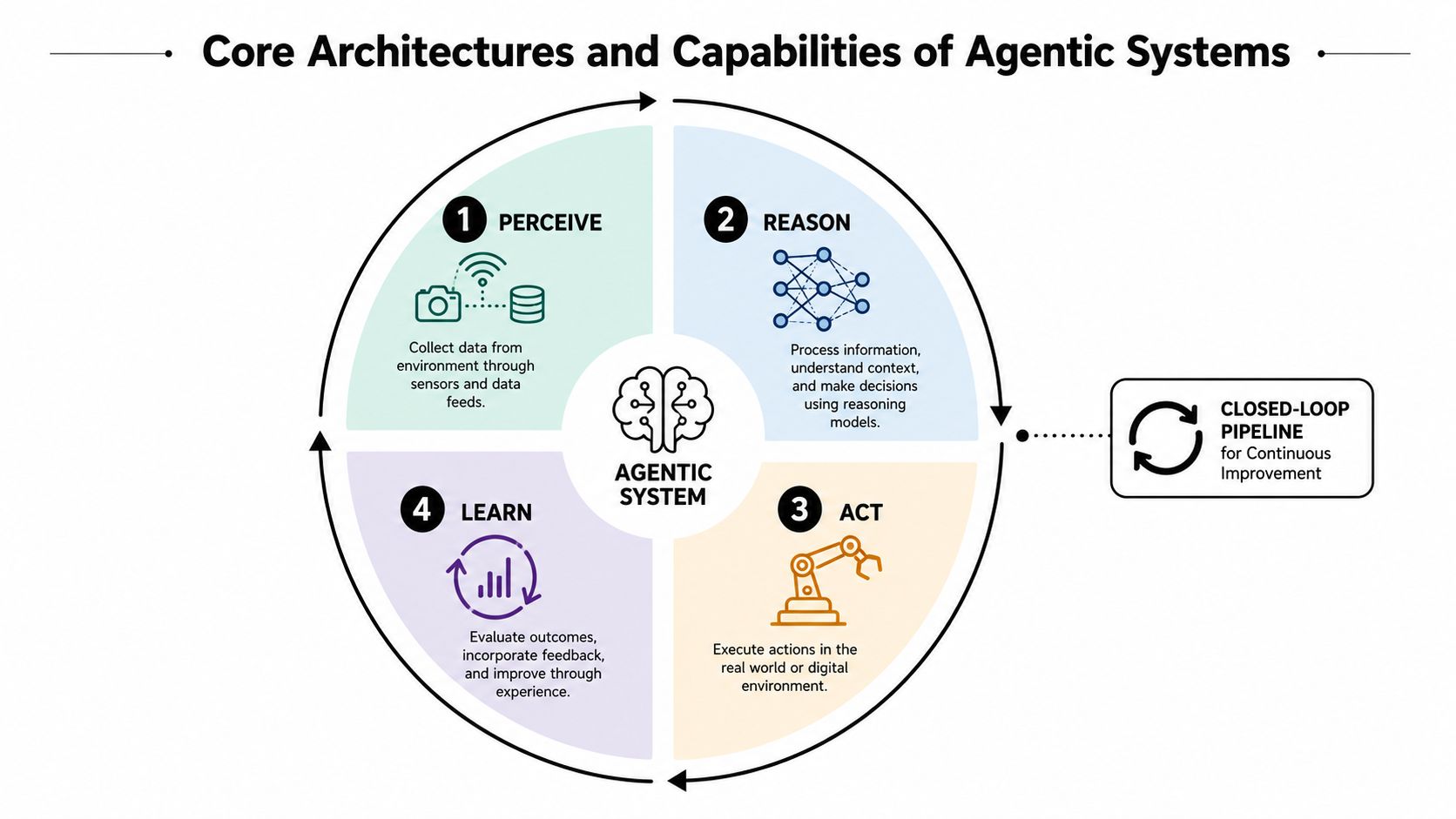
AWS describes agentic systems as closed-loop pipelines with stages such as perceive, reason, act, learn. AWS also recommends typed and versioned tool interfaces, structured tracing, short-lived credentials, policy gates, and budget caps for enterprise hardening (AWS overview of agentic AI architecture).
The closed loop that makes agents useful
A strong agentic system usually follows a loop like this:
Perceive: It ingests signals from emails, forms, documents, claims systems, event feeds, or user prompts.
Reason: It interprets the objective, identifies constraints, and decides the next best action.
Act: It calls tools, updates records, sends communications, or triggers downstream workflows.
Learn: It observes the result, logs the outcome, and adjusts the next step.
That last stage is the one people often miss. Standard workflow automation moves linearly. Agentic systems are built to react when the environment changes. A missing document arrives. A claimant goes silent. A coverage question changes routing. A follow-up fails. The system can detect that change and continue.
Four capabilities that matter in production
Planning
Planning is the ability to decompose a goal into steps. “Triage this claim” sounds like one action, but in practice it may involve reading inbound text, checking policy details, identifying missing data, deciding whether authority thresholds are met, and routing the file.
Without planning, the system becomes a prompt wrapper. With planning, it becomes an execution engine.
Tool use
Tool use is where the agent stops being interesting and starts being operational. This is the capability to call APIs, update records, create tasks, retrieve policy information, or send messages through approved channels.
If the only output is text on a screen, a human still has to do the work. If the system can write back to the claims workbench, trigger follow-ups, and synchronize updates, handoffs drop sharply.
Memory
Memory keeps a process coherent across steps. A claim file develops over time. New attachments arrive. Prior correspondence matters. The last status matters. Escalation history matters.
Short-lived session answers don't carry enough context for that. Operational agentic systems need controlled memory so they can maintain continuity without losing track of prior actions or business rules.
Orchestration
Complex workflows rarely belong to one agent. One component may classify intake, another extract data from documents, another check thresholds, and another handle communications or tasking. The value comes from orchestration.
For teams thinking in modern application terms, the agent layer works best when it sits on modular services rather than brittle monoliths. This is one reason microservices architecture patterns are often relevant to serious agent deployments.
If your tools aren't versioned and your workflows aren't observable, the agent isn't the risky part. Your surrounding architecture is.
Why hardening matters more than clever prompting
Most failures in production don't come from the concept of planning itself. They come from loose system design. Common problems include overbroad permissions, unclear tool contracts, weak tracing, and no spending or action limits.
The controls that help are concrete:
Typed interfaces: The agent should interact with systems through defined inputs and outputs.
Versioning: Tool behavior changes. Interfaces need to be tracked.
Structured traces: Teams need to see what the agent attempted, what happened, and why.
Short-lived credentials: Persistent broad access is a bad idea.
Policy gates: Certain actions should require rule checks or human sign-off.
Budget caps: Runtime and tool-call limits keep errors from compounding.
When those pieces are absent, organizations blame “AI unreliability” for what is usually an engineering and governance problem.
High-Value Use Cases in Banking and Insurance Operations
The fastest way to understand what is Agentic AI is to watch it handle a process that routinely stalls humans. Claims operations are full of these moments. Intake arrives incomplete. Documents come in across channels. Authority thresholds vary. Some files need immediate routing, others need patient follow-up. None of that fits a single prompt.
McKinsey notes that agentic systems can perform complex tasks independently, trigger workflows autonomously, and collaborate with other agents. The same source set, along with AWS's feedback-loop model, supports why these systems fit claims operations that need iterative workflow control rather than one-off extraction (McKinsey on agentic systems and multi-step work).
FNOL intake and triage
First notice of loss is a good example because the surface problem looks simple and the actual process isn't. The incoming notice may arrive by email, web form, voice, or broker message. The details may be partial, unstructured, or inconsistent with policy records.
An agentic workflow can:
Read the submission: Pull out claimant details, loss descriptions, dates, locations, and referenced policy information.
Identify gaps: Ask for missing information instead of waiting for a handler to notice it later.
Check context: Compare the incoming report against available policy or claim data.
Route the file: Send the case to the right team based on claim type, urgency, and business rules.
That isn't just document extraction. It's controlled progression of the claim at the first operational touchpoint.
Document processing that keeps files moving
Insurance teams don't suffer from lack of information. They suffer from fragmented information arriving in awkward formats. PDFs, scanned reports, adjuster notes, emails, and attachments all have to become usable operational data.
The valuable use case isn't “AI reads documents.” It's that the system reads them, extracts the needed fields, updates the right records, and triggers the next task without waiting for manual rekeying.
In production, that matters because manual re-entry creates hidden delays. It also creates quality problems when the claim moves between teams.
Dormant claims and follow-up loops
Static claims management is where an agentic model often proves its worth. Many claims don't fail because they're complex. They fail because nobody notices early enough that the file has gone quiet, a request is outstanding, or the next action was never taken.
A good agentic workflow monitors inactivity, checks the current state, identifies why momentum stalled, and recommends or initiates the next action. That might mean contacting a broker, requesting supporting material, or routing the file for review.
Dormant files are rarely “hard AI” problems. They're workflow control problems. Agentic systems fit because they can keep checking state and taking the next bounded action.
For insurance teams evaluating claims-specific workflows, this overview of AI claims operations aligns closely with where agents can reduce administrative burden while keeping handlers in control.
Delegated authority and threshold-based decisions
Delegated authority triage is one of the clearest examples of useful constrained autonomy. An inbound email arrives from a coverholder. The system extracts the relevant claim details, checks them against authority thresholds, and decides whether it can auto-approve, reject, or escalate.
That kind of process is well suited to supervised execution because the decision logic is structured, but the inbound information isn't. The work requires judgment within limits, not unrestricted autonomy.
What this looks like in the Lloyd's market
Nolana is an agentic AI platform that automates claims lifecycle operations for the Lloyd's market. Its AI agents handle FNOL intake, claims triage, static claims management and document processing, reducing the administrative work that keeps experienced handlers from focusing on higher-value tasks. Built for managing agents, brokers and cover holders, the SOC 2-certified platform integrates with and sits on top of existing claims and policy systems, while maintaining human oversight and auditability throughout.
That operating model matters more than the label. In Lloyd's and London Market environments, workflows cross multiple participants, channels, and authority structures. A useful system has to work inside that reality, not simplify it away for the demo.
Governance, Compliance, and Risk Controls for Regulated Enterprises
The weak point in most agentic AI discussions isn't capability. It's control. Teams spend time on reasoning quality and too little on what happens when an agent has credentials, can call tools, and can trigger actions at speed.
Security-focused coverage has warned that agentic AI expands the attack surface because autonomous systems can use tools, access external systems, and initiate actions without step-by-step prompts. The same analysis argues that governance hasn't kept pace with deployment speed (HS Today on agentic AI and governance risk).

Why autonomy without controls fails
A claims operation doesn't need a system that can “do anything.” It needs one that can do specific things, in specific ways, with traceability. The more autonomy an agent gets, the more important it becomes to define what it may read, what it may write, when it must pause, and who can override it.
The practical risk categories are familiar:
Permission risk: The agent has broader access than the task requires.
Execution risk: It updates the wrong record, takes an action out of sequence, or follows a flawed plan too far.
Compliance risk: The system acts in ways that aren't aligned with internal controls or regulatory expectations.
Operational opacity: Nobody can reconstruct why a decision happened.
Controls that hold up in production
The strongest deployments usually share the same safeguards.
Human-in-the-loop oversight
Not every action needs approval, but critical actions need human checkpoints. Coverage-sensitive decisions, authority exceptions, unusual communications, or out-of-pattern recommendations should stop for review.
Full audit trails
Every action should be logged in a way an operations lead, auditor, or compliance team can use. That means recording the input context, the tools called, the decision path, the action taken, and the result.
Policy gates
Agents should encounter machine-enforced control points before sensitive actions. If a step exceeds authority, touches restricted data, or falls outside expected patterns, the system shouldn't “reason through” the restriction. It should stop.
Rollback and override
Supervision isn't real unless the organization can intervene. Operators need the ability to halt, reverse, or reroute the workflow when circumstances change.
Governance isn't a wrapper you add after deployment. It's the operating boundary that determines whether the deployment is acceptable in the first place.
For regulated firms, broader compliance design also matters at the platform layer. The policy, audit, and control expectations described in regulatory compliance for financial services operations are directly relevant to agent deployments.
The trade-off leaders need to accept
There's always tension between speed and control. Teams want fewer manual touches, faster cycle times, and better service. Security and compliance teams want bounded permissions, reviewability, and clear accountability. Both sides are right.
The mistake is treating this as a philosophical conflict. It's really a workflow design problem. Give the agent too little autonomy and you automate very little. Give it too much and you create operational risk that humans can't supervise effectively. The job is to match autonomy level to process risk, then instrument the system so people can see and control what it's doing.
How to Evaluate and Implement an Agentic AI Platform
Most enterprise evaluations fail because they start with model quality and end with procurement language. That's backwards. The first question should be operational fit. Can the platform execute real work inside your environment without forcing a replacement of core systems or a new portal your teams won't use?
A second practical signal is implementation posture. If the platform can only work in a clean sandbox, it probably won't survive real claims operations.
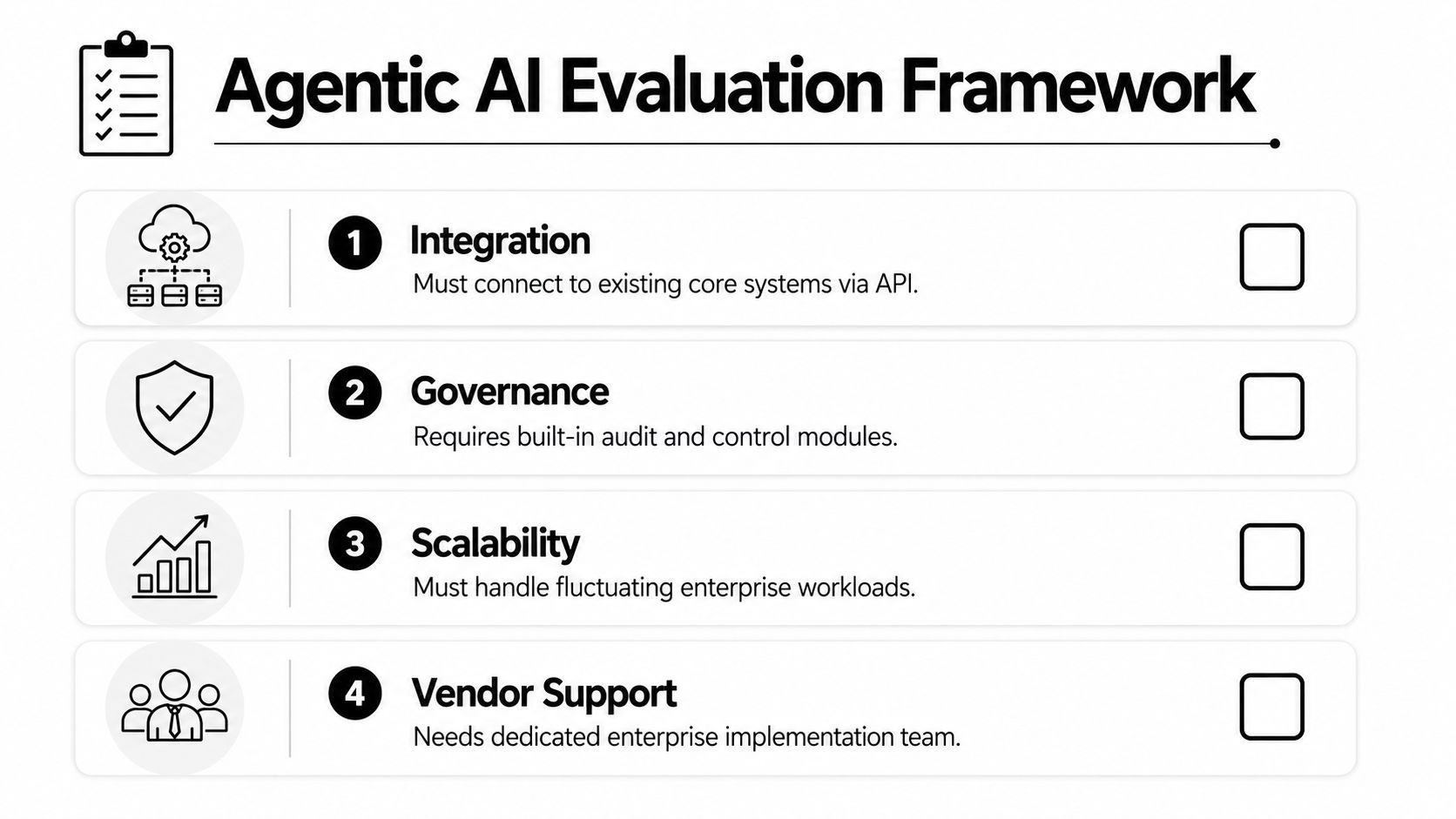
Four evaluation tests that matter
Integration with current systems
The platform should sit on top of existing claims workbenches, policy administration systems, inboxes, and internal applications through APIs. Replacing core platforms to deploy agents is usually a sign the architecture is too intrusive.Auditability of every action
Ask to see the logs, not the slide. You want action histories, decision records, tool traces, escalation points, and outcomes that a handler or auditor can follow.Control over autonomy
The right platform lets you define where the agent may recommend, where it may execute, and where it must stop. If those boundaries are vague, they'll become incidents later.Workflow breadth, not just model output
Check whether the system can orchestrate across email, web, chat, voice, and call center flows while keeping system updates synchronized.
This explainer gives a useful view of what intelligent process automation solutions should look like when they're built for operational environments rather than isolated demos.
Questions worth asking in procurement
Use questions that force concrete answers:
How does the platform handle missing or contradictory input data?
What happens when an action fails midway through a workflow?
Can operators override, reroute, or roll back work in progress?
How are permissions scoped for each tool connection?
How are channels synchronized when communications happen outside the core claims system?
Can the same framework support multiple lines of business without rebuilding from scratch?
A serious vendor should be able to answer these at workflow level, not just with generic security claims.
Here's a practical product walkthrough to keep that checklist grounded in reality.
What good implementation looks like
The best rollouts usually start with bounded processes that have clear pain points and measurable operational drag. FNOL intake, document ingestion, delegated authority triage, and dormant-file follow-up are all strong candidates because they combine volume, repetition, exceptions, and cross-system dependencies.
Outcome expectations also need to be evidence-based. Some platforms document ranges such as up to 50× faster cycle times, up to 30% higher handler throughput, and up to 5% lower loss ratio, depending on context. Those are useful evaluation benchmarks when they're tied to actual workflow conditions, not treated as universal promises.
The Future of Agentic AI in Enterprise Operations
The market has already moved past the “interesting experiment” stage. One 2026 compilation reports that enterprise AI-agent deployments rose 466.7% year over year, and 80% of organizations said their AI agent investments had already delivered measurable financial impact. The same source says directive AI conversations, where users hand off complete tasks, increased from 27% to 39% over eight months. It also cites a forecast that 40% of enterprise applications will feature task-specific AI agents by the end of 2026, up from less than 5% in 2025 (Conversational Geek agentic AI statistics for 2026).
What that means operationally
The center of gravity is shifting from augmentation to delegation. Teams still want answers, but they increasingly want systems that can carry work through completion inside approved boundaries.
That change has real consequences for enterprise operations leaders:
Process design matters more than prompting
Permissions matter as much as model quality
Auditability becomes part of service delivery
Human roles shift toward review, exception handling, and control
The organizations that get value from agentic AI won't be the ones with the loudest autonomy story. They'll be the ones that pair workflow execution with governance discipline.
Where claims operations are heading
In insurance, the long-term pattern is clear. Agentic systems will take on more of the repetitive coordination work that slows handlers down, especially where files move across channels, organizations, and authority models. But the successful operating model won't remove people from the process entirely. It will keep humans focused on judgment, negotiation, and exception management while agents handle progression, follow-up, extraction, and routine decision support.
That's the right frame for what is Agentic AI in enterprise operations. It's not a chatbot with better marketing. It's a governed execution layer for multi-step work.
Nolana AI offers an agentic AI platform for insurance claims operations that automates work from first notice of loss through settlement while keeping handlers in control. For Lloyd's and London Market teams that need workflow execution with auditability, cross-channel orchestration, and integration into existing systems, that's the practical application of agentic AI discussed here. Visit Nolana AI to see how that operating model fits real claims environments.
Agentic AI is a goal-directed control system that combines planning, tool use, memory, and orchestration so an LLM can break work into subtasks, call external systems, observe outcomes, and keep iterating until the objective is met. It's already scaling like a platform shift, with one industry summary projecting the market will grow from $5.25 billion in 2024 to $199.05 billion by 2034, a 43.84% CAGR, while 79% of organizations report some AI agent adoption.
That definition matters because most explanations of what is Agentic AI still undersell the operational difference. A chatbot answers. An agent works. Once you connect reasoning to claims systems, policy data, document flows, and communication channels, you're no longer buying a smarter interface. You're introducing a software control layer that can move work forward inside the business.
In regulated operations, that distinction changes the conversation. The core issue isn't whether an AI system can produce text. It's whether it can handle a bounded business objective, stay within policy, leave an audit trail, and hand control back to humans when the risk profile changes.
The Rise of Agentic AI in Enterprise Workflows
The speed of adoption tells you this isn't another experimental AI label. One market summary projects the global agentic AI market will expand from $5.25 billion in 2024 to $199.05 billion by 2034, with a 43.84% CAGR, and says 79% of organizations already have some AI agent adoption while 96% plan to expand in 2025 (Landbase agentic AI statistics). Enterprise buyers usually don't move that quickly unless they see this as core infrastructure.
What the term actually means
AWS gives the cleanest practitioner definition. Agentic AI is a system where an LLM can plan, use tools, retain context, and orchestrate actions across systems until it completes a goal, rather than stopping at a single response (AWS Prescriptive Guidance on agentic AI frameworks).
That sounds abstract until you compare it to a claims operation. A handler doesn't just answer one question. They receive a notice, identify what's missing, check relevant records, route the file, request documents, track inactivity, and decide what should happen next. If an AI system only drafts text, it helps at the margins. If it can coordinate those steps, it starts to change throughput and service quality.
Why enterprises care now
The shift happened when AI moved from content generation to workflow execution. In production, the highest-value use cases tend to share a few traits:
Multi-step work: A task can't be finished in one turn.
Cross-system action: The process depends on APIs, claims platforms, inboxes, and document stores.
Variable inputs: Customers, brokers, and coverholders don't submit information in a clean, uniform way.
Human checkpoints: The operation needs review, escalation, or override at defined moments.
That combination is common in insurance, banking, and other controlled environments. It's also why “just use a chatbot” usually fails once a team tries to operationalize it.
Agentic systems earn their keep when the work has branches, exceptions, and follow-up loops. If every step is fixed, standard automation is simpler.
A lot of enterprise teams are now mapping specific workflows to agent patterns instead of broad AI ambitions. That's the practical starting point. Not “where can we use AI,” but “where do we have high-volume operational work that requires judgment, tool use, and repeatable controls.” For teams evaluating real workflows, this list of AI agent use cases in operations is a more useful lens than generic AI trend coverage.
Why regulated sectors moved from curiosity to deployment
Regulated industries were initially cautious, for good reason. But they also have some of the strongest conditions for successful adoption. Their processes are documented. Their controls are explicit. Their work often lives across fragmented systems that create drag for experienced staff.
That creates a narrow but valuable opening for agentic AI. You don't give the system unconstrained freedom. You give it a bounded objective, approved tool access, escalation rules, and full observability. Done well, that's not “autonomy replacing operators.” It's a controlled execution layer supporting them.
How Agentic AI Differs from Traditional and Autonomous Systems
The biggest confusion around what is Agentic AI comes from treating all automation as the same thing. It isn't. There's a wide gap between a rules engine, a generative copilot, and a system that can plan and act across multiple tools.
MIT Sloan notes there's no universally agreed definition of agentic AI, which is one reason the category gets blurred so easily (MIT Sloan on agentic AI explained). In practice, the useful question isn't “is this AI agentic or not.” It's “what level of autonomy is safe and useful for this process.”
Automation Spectrum Comparison
Dimension | Traditional Automation | Generative AI Copilot | Agentic AI |
|---|---|---|---|
Primary role | Executes predefined rules | Assists a human with content or suggestions | Pursues a goal across multiple steps |
Decision path | Fixed and scripted | Human-led | Dynamic within approved boundaries |
Memory | Usually limited to workflow state | Often session-based | Maintains task context across steps |
Tool use | Preconfigured system actions | Usually indirect or manual | Selects and calls tools or systems as part of execution |
Exception handling | Brittle when inputs vary | Defers to user | Adapts, retries, escalates, or changes path |
Human involvement | Heavy at exceptions | Heavy throughout | Targeted at checkpoints and high-risk actions |
Best fit | Stable, repeatable tasks | Drafting, summarizing, answering | Multi-step operations with changing context |
Where each model works
Traditional automation still has a place. If a workflow is stable, deterministic, and low-variance, rule-based automation is cheaper to govern and easier to test. A payment reconciliation rule or a simple status-triggered notification doesn't need an agent.
Generative AI copilots also have a place. They're useful when a person remains the central actor and needs faster drafting, summarization, retrieval, or explanation. Think policy wording assistance, correspondence suggestions, or note summaries for handlers.
Agentic AI sits in the middle ground that many regulated teams need. It can act across APIs and software environments, but it still operates under human supervision and policy constraints. That's the operational sweet spot.
The autonomy question that matters
McKinsey distinguishes between rule-based automation, predictive analytics, generative AI, and agents based on the structure of the task and the variability of context (McKinsey on when machines don't just chat but act). That distinction matters more than the label.
A practical way to think about autonomy is this:
Assistive autonomy
The system recommends, drafts, or summarizes. A human still decides and acts.Conditional autonomy
The system can execute low-risk steps when predefined criteria are met, then escalate exceptions.Supervised execution
The system runs multi-step workflows, updates systems, and manages follow-up while exposing checkpoints, logs, and override controls.Fully autonomous operation
The system acts end to end with minimal supervision. In regulated claims work, this level is rarely appropriate.
Practical rule: Don't buy agentic AI for a process until you can name the exact decisions the system may take alone, the exact decisions it may only recommend, and the exact conditions that force escalation.
That's why many “autonomous AI employee” pitches don't survive implementation. They skip over permissions, exception rates, and accountability. In production, nobody cares whether the demo looked autonomous. They care whether the operating model is defensible.
Core Architectures and Capabilities of Agentic Systems
Agentic AI works because of architecture, not branding. The model is only one component. What determines whether the system is useful in production is the loop around it, the tools it can call, the memory it can retain, and the controls wrapped around each action.
AWS describes agentic systems as closed-loop pipelines with stages such as perceive, reason, act, learn. AWS also recommends typed and versioned tool interfaces, structured tracing, short-lived credentials, policy gates, and budget caps for enterprise hardening (AWS overview of agentic AI architecture).
The closed loop that makes agents useful
A strong agentic system usually follows a loop like this:
Perceive: It ingests signals from emails, forms, documents, claims systems, event feeds, or user prompts.
Reason: It interprets the objective, identifies constraints, and decides the next best action.
Act: It calls tools, updates records, sends communications, or triggers downstream workflows.
Learn: It observes the result, logs the outcome, and adjusts the next step.
That last stage is the one people often miss. Standard workflow automation moves linearly. Agentic systems are built to react when the environment changes. A missing document arrives. A claimant goes silent. A coverage question changes routing. A follow-up fails. The system can detect that change and continue.
Four capabilities that matter in production
Planning
Planning is the ability to decompose a goal into steps. “Triage this claim” sounds like one action, but in practice it may involve reading inbound text, checking policy details, identifying missing data, deciding whether authority thresholds are met, and routing the file.
Without planning, the system becomes a prompt wrapper. With planning, it becomes an execution engine.
Tool use
Tool use is where the agent stops being interesting and starts being operational. This is the capability to call APIs, update records, create tasks, retrieve policy information, or send messages through approved channels.
If the only output is text on a screen, a human still has to do the work. If the system can write back to the claims workbench, trigger follow-ups, and synchronize updates, handoffs drop sharply.
Memory
Memory keeps a process coherent across steps. A claim file develops over time. New attachments arrive. Prior correspondence matters. The last status matters. Escalation history matters.
Short-lived session answers don't carry enough context for that. Operational agentic systems need controlled memory so they can maintain continuity without losing track of prior actions or business rules.
Orchestration
Complex workflows rarely belong to one agent. One component may classify intake, another extract data from documents, another check thresholds, and another handle communications or tasking. The value comes from orchestration.
For teams thinking in modern application terms, the agent layer works best when it sits on modular services rather than brittle monoliths. This is one reason microservices architecture patterns are often relevant to serious agent deployments.
If your tools aren't versioned and your workflows aren't observable, the agent isn't the risky part. Your surrounding architecture is.
Why hardening matters more than clever prompting
Most failures in production don't come from the concept of planning itself. They come from loose system design. Common problems include overbroad permissions, unclear tool contracts, weak tracing, and no spending or action limits.
The controls that help are concrete:
Typed interfaces: The agent should interact with systems through defined inputs and outputs.
Versioning: Tool behavior changes. Interfaces need to be tracked.
Structured traces: Teams need to see what the agent attempted, what happened, and why.
Short-lived credentials: Persistent broad access is a bad idea.
Policy gates: Certain actions should require rule checks or human sign-off.
Budget caps: Runtime and tool-call limits keep errors from compounding.
When those pieces are absent, organizations blame “AI unreliability” for what is usually an engineering and governance problem.
High-Value Use Cases in Banking and Insurance Operations
The fastest way to understand what is Agentic AI is to watch it handle a process that routinely stalls humans. Claims operations are full of these moments. Intake arrives incomplete. Documents come in across channels. Authority thresholds vary. Some files need immediate routing, others need patient follow-up. None of that fits a single prompt.
McKinsey notes that agentic systems can perform complex tasks independently, trigger workflows autonomously, and collaborate with other agents. The same source set, along with AWS's feedback-loop model, supports why these systems fit claims operations that need iterative workflow control rather than one-off extraction (McKinsey on agentic systems and multi-step work).
FNOL intake and triage
First notice of loss is a good example because the surface problem looks simple and the actual process isn't. The incoming notice may arrive by email, web form, voice, or broker message. The details may be partial, unstructured, or inconsistent with policy records.
An agentic workflow can:
Read the submission: Pull out claimant details, loss descriptions, dates, locations, and referenced policy information.
Identify gaps: Ask for missing information instead of waiting for a handler to notice it later.
Check context: Compare the incoming report against available policy or claim data.
Route the file: Send the case to the right team based on claim type, urgency, and business rules.
That isn't just document extraction. It's controlled progression of the claim at the first operational touchpoint.
Document processing that keeps files moving
Insurance teams don't suffer from lack of information. They suffer from fragmented information arriving in awkward formats. PDFs, scanned reports, adjuster notes, emails, and attachments all have to become usable operational data.
The valuable use case isn't “AI reads documents.” It's that the system reads them, extracts the needed fields, updates the right records, and triggers the next task without waiting for manual rekeying.
In production, that matters because manual re-entry creates hidden delays. It also creates quality problems when the claim moves between teams.
Dormant claims and follow-up loops
Static claims management is where an agentic model often proves its worth. Many claims don't fail because they're complex. They fail because nobody notices early enough that the file has gone quiet, a request is outstanding, or the next action was never taken.
A good agentic workflow monitors inactivity, checks the current state, identifies why momentum stalled, and recommends or initiates the next action. That might mean contacting a broker, requesting supporting material, or routing the file for review.
Dormant files are rarely “hard AI” problems. They're workflow control problems. Agentic systems fit because they can keep checking state and taking the next bounded action.
For insurance teams evaluating claims-specific workflows, this overview of AI claims operations aligns closely with where agents can reduce administrative burden while keeping handlers in control.
Delegated authority and threshold-based decisions
Delegated authority triage is one of the clearest examples of useful constrained autonomy. An inbound email arrives from a coverholder. The system extracts the relevant claim details, checks them against authority thresholds, and decides whether it can auto-approve, reject, or escalate.
That kind of process is well suited to supervised execution because the decision logic is structured, but the inbound information isn't. The work requires judgment within limits, not unrestricted autonomy.
What this looks like in the Lloyd's market
Nolana is an agentic AI platform that automates claims lifecycle operations for the Lloyd's market. Its AI agents handle FNOL intake, claims triage, static claims management and document processing, reducing the administrative work that keeps experienced handlers from focusing on higher-value tasks. Built for managing agents, brokers and cover holders, the SOC 2-certified platform integrates with and sits on top of existing claims and policy systems, while maintaining human oversight and auditability throughout.
That operating model matters more than the label. In Lloyd's and London Market environments, workflows cross multiple participants, channels, and authority structures. A useful system has to work inside that reality, not simplify it away for the demo.
Governance, Compliance, and Risk Controls for Regulated Enterprises
The weak point in most agentic AI discussions isn't capability. It's control. Teams spend time on reasoning quality and too little on what happens when an agent has credentials, can call tools, and can trigger actions at speed.
Security-focused coverage has warned that agentic AI expands the attack surface because autonomous systems can use tools, access external systems, and initiate actions without step-by-step prompts. The same analysis argues that governance hasn't kept pace with deployment speed (HS Today on agentic AI and governance risk).
Why autonomy without controls fails
A claims operation doesn't need a system that can “do anything.” It needs one that can do specific things, in specific ways, with traceability. The more autonomy an agent gets, the more important it becomes to define what it may read, what it may write, when it must pause, and who can override it.
The practical risk categories are familiar:
Permission risk: The agent has broader access than the task requires.
Execution risk: It updates the wrong record, takes an action out of sequence, or follows a flawed plan too far.
Compliance risk: The system acts in ways that aren't aligned with internal controls or regulatory expectations.
Operational opacity: Nobody can reconstruct why a decision happened.
Controls that hold up in production
The strongest deployments usually share the same safeguards.
Human-in-the-loop oversight
Not every action needs approval, but critical actions need human checkpoints. Coverage-sensitive decisions, authority exceptions, unusual communications, or out-of-pattern recommendations should stop for review.
Full audit trails
Every action should be logged in a way an operations lead, auditor, or compliance team can use. That means recording the input context, the tools called, the decision path, the action taken, and the result.
Policy gates
Agents should encounter machine-enforced control points before sensitive actions. If a step exceeds authority, touches restricted data, or falls outside expected patterns, the system shouldn't “reason through” the restriction. It should stop.
Rollback and override
Supervision isn't real unless the organization can intervene. Operators need the ability to halt, reverse, or reroute the workflow when circumstances change.
Governance isn't a wrapper you add after deployment. It's the operating boundary that determines whether the deployment is acceptable in the first place.
For regulated firms, broader compliance design also matters at the platform layer. The policy, audit, and control expectations described in regulatory compliance for financial services operations are directly relevant to agent deployments.
The trade-off leaders need to accept
There's always tension between speed and control. Teams want fewer manual touches, faster cycle times, and better service. Security and compliance teams want bounded permissions, reviewability, and clear accountability. Both sides are right.
The mistake is treating this as a philosophical conflict. It's really a workflow design problem. Give the agent too little autonomy and you automate very little. Give it too much and you create operational risk that humans can't supervise effectively. The job is to match autonomy level to process risk, then instrument the system so people can see and control what it's doing.
How to Evaluate and Implement an Agentic AI Platform
Most enterprise evaluations fail because they start with model quality and end with procurement language. That's backwards. The first question should be operational fit. Can the platform execute real work inside your environment without forcing a replacement of core systems or a new portal your teams won't use?
A second practical signal is implementation posture. If the platform can only work in a clean sandbox, it probably won't survive real claims operations.
Four evaluation tests that matter
Integration with current systems
The platform should sit on top of existing claims workbenches, policy administration systems, inboxes, and internal applications through APIs. Replacing core platforms to deploy agents is usually a sign the architecture is too intrusive.Auditability of every action
Ask to see the logs, not the slide. You want action histories, decision records, tool traces, escalation points, and outcomes that a handler or auditor can follow.Control over autonomy
The right platform lets you define where the agent may recommend, where it may execute, and where it must stop. If those boundaries are vague, they'll become incidents later.Workflow breadth, not just model output
Check whether the system can orchestrate across email, web, chat, voice, and call center flows while keeping system updates synchronized.
This explainer gives a useful view of what intelligent process automation solutions should look like when they're built for operational environments rather than isolated demos.
Questions worth asking in procurement
Use questions that force concrete answers:
How does the platform handle missing or contradictory input data?
What happens when an action fails midway through a workflow?
Can operators override, reroute, or roll back work in progress?
How are permissions scoped for each tool connection?
How are channels synchronized when communications happen outside the core claims system?
Can the same framework support multiple lines of business without rebuilding from scratch?
A serious vendor should be able to answer these at workflow level, not just with generic security claims.
Here's a practical product walkthrough to keep that checklist grounded in reality.
What good implementation looks like
The best rollouts usually start with bounded processes that have clear pain points and measurable operational drag. FNOL intake, document ingestion, delegated authority triage, and dormant-file follow-up are all strong candidates because they combine volume, repetition, exceptions, and cross-system dependencies.
Outcome expectations also need to be evidence-based. Some platforms document ranges such as up to 50× faster cycle times, up to 30% higher handler throughput, and up to 5% lower loss ratio, depending on context. Those are useful evaluation benchmarks when they're tied to actual workflow conditions, not treated as universal promises.
The Future of Agentic AI in Enterprise Operations
The market has already moved past the “interesting experiment” stage. One 2026 compilation reports that enterprise AI-agent deployments rose 466.7% year over year, and 80% of organizations said their AI agent investments had already delivered measurable financial impact. The same source says directive AI conversations, where users hand off complete tasks, increased from 27% to 39% over eight months. It also cites a forecast that 40% of enterprise applications will feature task-specific AI agents by the end of 2026, up from less than 5% in 2025 (Conversational Geek agentic AI statistics for 2026).
What that means operationally
The center of gravity is shifting from augmentation to delegation. Teams still want answers, but they increasingly want systems that can carry work through completion inside approved boundaries.
That change has real consequences for enterprise operations leaders:
Process design matters more than prompting
Permissions matter as much as model quality
Auditability becomes part of service delivery
Human roles shift toward review, exception handling, and control
The organizations that get value from agentic AI won't be the ones with the loudest autonomy story. They'll be the ones that pair workflow execution with governance discipline.
Where claims operations are heading
In insurance, the long-term pattern is clear. Agentic systems will take on more of the repetitive coordination work that slows handlers down, especially where files move across channels, organizations, and authority models. But the successful operating model won't remove people from the process entirely. It will keep humans focused on judgment, negotiation, and exception management while agents handle progression, follow-up, extraction, and routine decision support.
That's the right frame for what is Agentic AI in enterprise operations. It's not a chatbot with better marketing. It's a governed execution layer for multi-step work.
Nolana AI offers an agentic AI platform for insurance claims operations that automates work from first notice of loss through settlement while keeping handlers in control. For Lloyd's and London Market teams that need workflow execution with auditability, cross-channel orchestration, and integration into existing systems, that's the practical application of agentic AI discussed here. Visit Nolana AI to see how that operating model fits real claims environments.


All systems operational
1 Lime Street, London EC3M 7HA | 222E 3rd Street, New York 10009
Copyright © 2026, Nolana. All rights reserved
All systems operational
1 Lime Street, London EC3M 7HA | 222E 3rd Street, New York 10009
Copyright © 2026, Nolana. All rights reserved
All systems operational
1 Lime Street, London EC3M 7HA | 222E 3rd Street, New York 10009
Copyright © 2026, Nolana. All rights reserved
All systems operational
1 Lime Street, London EC3M 7HA | 222E 3rd Street, New York 10009
Copyright © 2026, Nolana. All rights reserved