Choosing Digital Insurance Platforms in 2026
Choosing Digital Insurance Platforms in 2026
Explore digital insurance platforms: market, capabilities, and selection. Leverage AI automation for strategic advantage.

The digital insurance platform market was estimated at USD 148.15 billion in 2025 and is projected to reach USD 255.43 billion by 2030 at an 11.51% CAGR (market estimate). That scale matters because this is no longer a back-office software conversation, it's a strategic operating model shift for insurers that still depend on manual claims handling, fragmented policy data, and disconnected channels.
For a Chief Claims Officer, the key question isn't whether digital change is coming. It's whether the organization will use it to remove administrative drag without losing control, auditability, or fairness. The strongest platforms do that by combining process automation with governed human oversight, and by fitting into the broader insurance ecosystem instead of forcing another rip-and-replace program.
A useful way to think about the market is simple. The winners won't be the firms with the slickest front end, but the ones that can orchestrate FNOL, triage, documents, settlement, and exception handling across existing systems. If you want a practical lens on the business case, the framework for quantifying digital transformation ROI is a good external reference point, and Nolana's overview of financial services digital transformation helps connect that logic to regulated operations.
The Inevitable Shift to Digital Insurance Platforms
The market signal is clear. Analysts tracking the category show sustained growth, and the broader insurance technology market is expanding fast enough to push platform decisions into board-level discussion. For claims leaders, that means the question is no longer whether to modernize. It is how to modernize without creating new control gaps.
The pressure underneath that growth is operational. Claims teams still lose time to rekeying, document chasing, legacy workbenches, and channel fragmentation. A platform changes the operating question from “How do we process this file faster?” to “How do we keep every file moving, with controls, across every channel and every participant?”
This growth signals that platform investment is now a core operational priority, not a discretionary IT project.
Why this matters for claims leaders
For a claims executive, the strategic value is not just lower handling friction. It is the ability to standardize intake, route exceptions intelligently, and keep a clear audit trail while handlers focus on judgment-heavy work. That is why digital insurance platforms are increasingly tied to governance as much as speed.
The insurance industry has already learned that digital business priorities rise quickly when service pressure increases. A Forrester-commissioned report published by OneSpan found that the share of firms rating accelerating digital business as a high or critical priority rose from 22% before the pandemic to 27% by April and May 2020 (OneSpan report). That urgency never really went away.
Practical rule: If a platform only improves the customer-facing screen, it has not solved the claims problem. The operating model still leaks time in the middle.
The insurers that get this right are using platforms to modernize the whole claims path, not just the intake form. They are replacing manual handoffs with orchestrated workflows, and they are doing it in a way that can still satisfy regulators, auditors, brokers, and cover holders. That shift is what separates a digital feature from a digital operating advantage. For a useful frame on how regulated firms translate transformation into business value, see quantifying digital transformation ROI, and the logic carries directly into broader financial services digital transformation as well.
What Are Digital Insurance Platforms Really
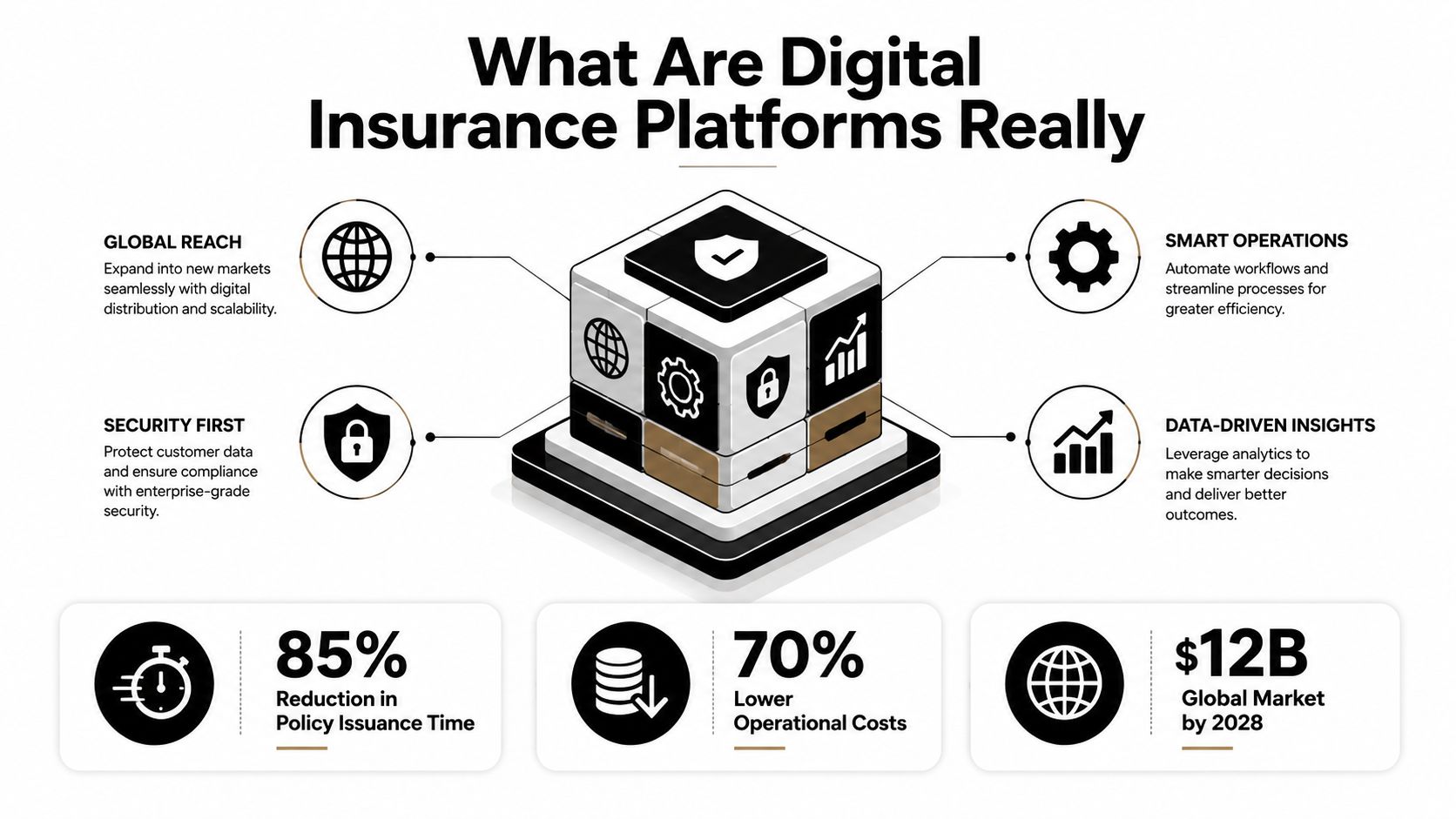
A digital insurance platform is a coordinated operating layer, not a single app or portal. It brings together policy administration, claims management, CRM, and analytics so insurers can design, manage, and refine products through digital channels (market definition). The breadth of that scope means the platform must handle regulated workflows, auditability, and operational controls, which favors vendors with deep insurance domain expertise.
The strategic point is stronger than the technology stack itself. These platforms replace siloed legacy systems with a more connected and data-driven operating model. That lets insurers link underwriting decisions, policy changes, claims status, and customer communications without forcing each function to rely on a different source of truth.
The practical definition
Start with three questions.
Does the platform manage core insurance work?
If it only handles customer messaging, it is a front-end tool. A true platform reaches operational processes such as claims, billing, and servicing, where exceptions, approvals, and record keeping matter.Does it unify data across the journey?
Claims, documents, and communications need a common operational model. Without that, automation breaks at the handoff and teams revert to manual intervention.Can it scale without replatforming everything?
Architecture decides this. A real platform lets insurers modernize one capability at a time, which reduces disruption while preserving control over change.
The market signal supports why insurers are treating this as a core operating decision. The category is projected to add more than USD 100 billion in annual value versus the 2025 base by 2030, according to the market data above (market estimate). That points to a structural change in how insurance operations are organized and governed.
For claims leaders, the practical test is clear. If the current environment cannot support structured data, cross-channel visibility, or controlled automation, each file carries avoidable delay. A platform changes more than the experience layer, it changes how work is governed, and it should be judged against that standard. If you want a reference point for operational scope, see claims management system design.
The Core Capabilities of a Modern Platform Stack
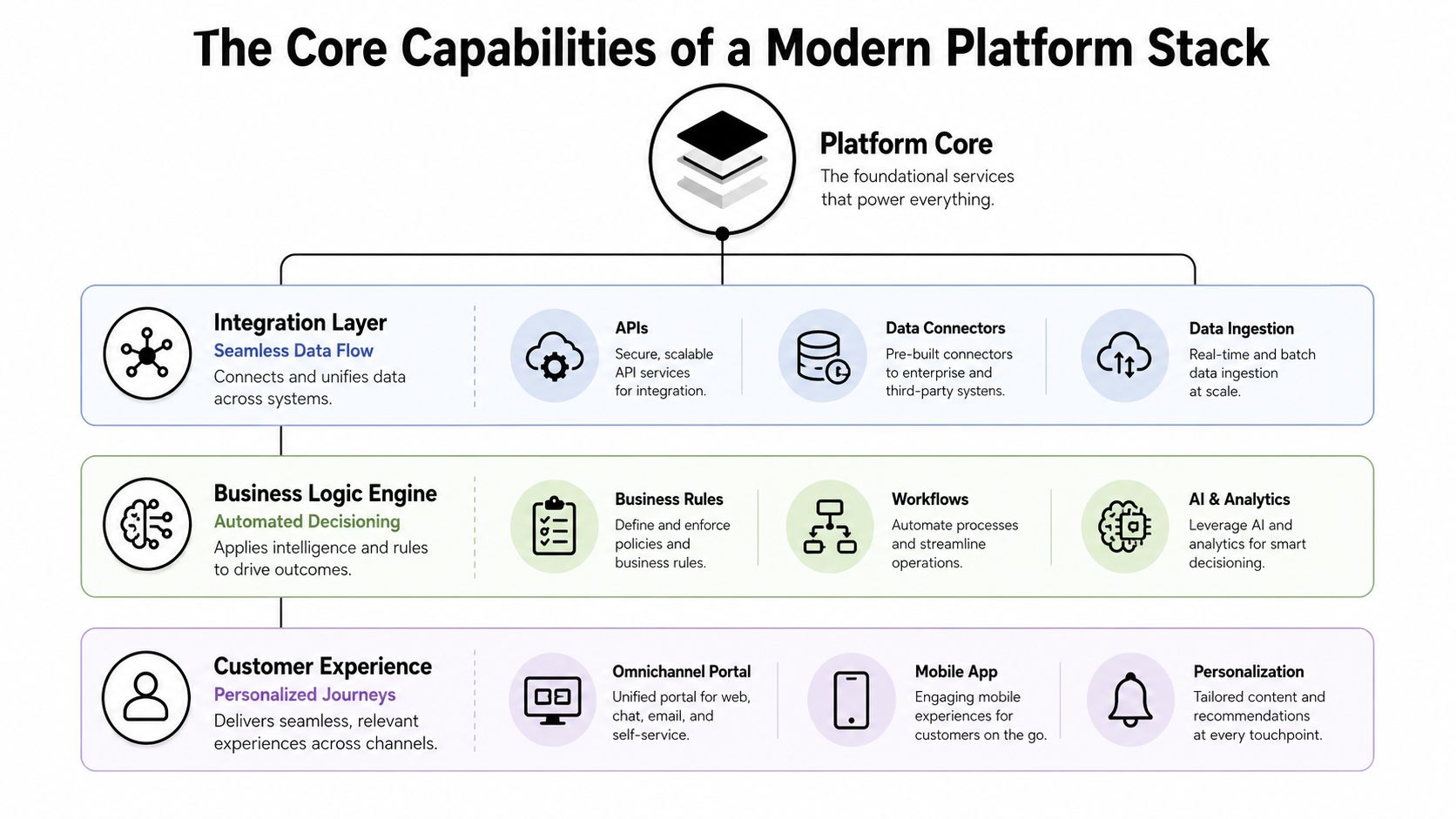
Modern digital insurance platforms are usually built as an API-first, microservices-based stack where policy administration, billing, rating, and claims are exposed as independently deployable services (architecture guide). That matters because it separates business capability from the user interface. You can scale, replace, or improve one service without tearing down the entire core.
Why architecture is a business decision
Legacy monoliths force insurers into broad change cycles. A composable stack gives them narrower, safer change paths. If claims triage needs new logic, you can update that service without waiting on a full policy-system overhaul. If billing needs a different integration pattern, you can adjust it independently.
That flexibility is what chief claims teams are really buying. They're not buying microservices for the sake of elegance. They're buying speed of change with lower operational risk.
The platform stack also changes how digital channels work. A user interface becomes the surface layer, while business logic sits in services behind it. That means a broker portal, a claims app, and an internal handler console can all use the same underlying rules and data models without duplicating work.
Decision point: If a vendor can't explain how its claims service upgrades without breaking the rest of the stack, it's still behaving like a monolith, even if the brochure says otherwise.
For claims operations, the internal link matters. Nolana's overview of a claims management system is relevant because it shows how claims workbenches, policy systems, and orchestration layers should fit together rather than compete for control.
The takeaway is straightforward. Modern platform design isn't mainly about technology fashion. It's about limiting blast radius when business rules, regulations, or market demands change. In insurance, that limitation is worth a lot.
Moving Beyond Portals to Platform Ecosystems
The portal model assumes the customer comes to the insurer. Platform ecosystems start from the opposite premise, insurance is increasingly encountered inside another party's digital journey. The Geneva Association defines a digital insurance platform ecosystem through three parts, a digital-technology-enabled platform, a multi-supplier ecosystem, and insurance transactions among participants on that platform (Geneva Association summary). It also identifies the insurer roles as orchestrator, partner, or co-developer.
That changes how distribution works. Insurers stop relying on a single destination and instead place services where the customer, broker, or partner is already transacting. The result is better fit for embedded insurance, wider reach, and more relevant product placement in the journey itself.
What the ecosystem model changes
The Geneva Association summary says customers gain more convenient access, one-stop shopping, and more customized products, while insurers gain access to new customers, increased market reach, improved engagement, and better use of data (Geneva Association summary). These gains translate directly into lower customer acquisition costs and higher lifetime value through embedded touchpoints. They also improve servicing efficiency because the insurer is meeting customers inside workflows that already exist.
The report goes further and says successful platforms need value beyond insurance itself, because insurance alone rarely sustains repeated interaction (Geneva Association report). Adjacent services, such as medical or risk-prevention services, make the platform more useful and keep the relationship active. That is the difference between a transaction point and a working ecosystem.
The strategic shift is from owning a destination to being present inside the journeys that already matter.
For claims leaders, that shift changes the operating model as much as the commercial model. If the insurer is embedded in a broker workflow, a cover holder workflow, or a partner platform, claims service has to stay consistent across participants who do not control the same systems. The claims function becomes part of the ecosystem's credibility, and any inconsistency shows up as a trust problem, not just a service issue.
A practical reference point is Guidewire software Inc, which helps frame how core platform choices affect ecosystem participation and control. This means claims operations must be designed for multi-party visibility and consistent service levels across all ecosystem participants.
A Deep Dive into Automated Claims Operations
A modern claims file begins at FNOL intake, and that entry point is where many traditional workflows lose control of the data. In a governed platform, the claim can enter through chat, voice, web, email, or a cover holder workflow, then be normalized into a single shared data model that spans intake, investigation, settlement, document generation, and distribution channels (claims architecture). That shared model matters because it keeps each channel from creating its own version of the truth, which is a common source of rework, inconsistent authority, and weak audit trails.
How the file moves
The first step is triage. AI can classify standard claims, identify missing details, and route exceptions to the right handler. The case for this approach is described in how AI transforms claims, where machine assistance is applied to repetitive intake and review steps while human review remains available for edge cases.
Then comes evidence handling. Documents and images can be converted into structured data, which removes rekeying and shortens the time between notification and decision. For standard risks, automation can support underwriting-style checks and routing, while more complex cases move into human review with the supporting documents already organized.
Modern implementations also add ML-based risk scoring, automated underwriting for standard risks, AI claims triage, and fraud detection (claims architecture). This combination allows insurers to process routine claims through governed rules and model-based decisioning, while exceptions are escalated with context intact instead of being reassembled by hand.
Where the value shows up
The business result is not just faster handling. It is a better use of expert time. Straight-through handling absorbs routine files, while experienced handlers spend more time on complex settlement, authority decisions, and customer-sensitive exceptions. For a claims leader, that changes the productivity mix, because judgment is concentrated where it has the highest impact.
Nolana's article on automating insurance claims processing is useful if you want to compare this operating model with older workflow automation. The difference matters. Basic automation moves tasks. Governed automation moves tasks, while keeping routing logic, overrides, and decision control visible to operations and audit teams.
The broader claims trend is already visible in industry reporting. Coverage from 2024 to 2025 has emphasized image-based assessment, remote video verification, and WhatsApp or IVR-based tracking, while still stressing that human agents remain necessary for complex settlement decisions. The highest-performing claims platforms show a measurable effect on operations, with pilot deployments reporting shorter claim cycle times and higher handler productivity because teams spend less time on manual routing and more time on decisions that need judgment.
How to Choose the Right Digital Insurance Platform
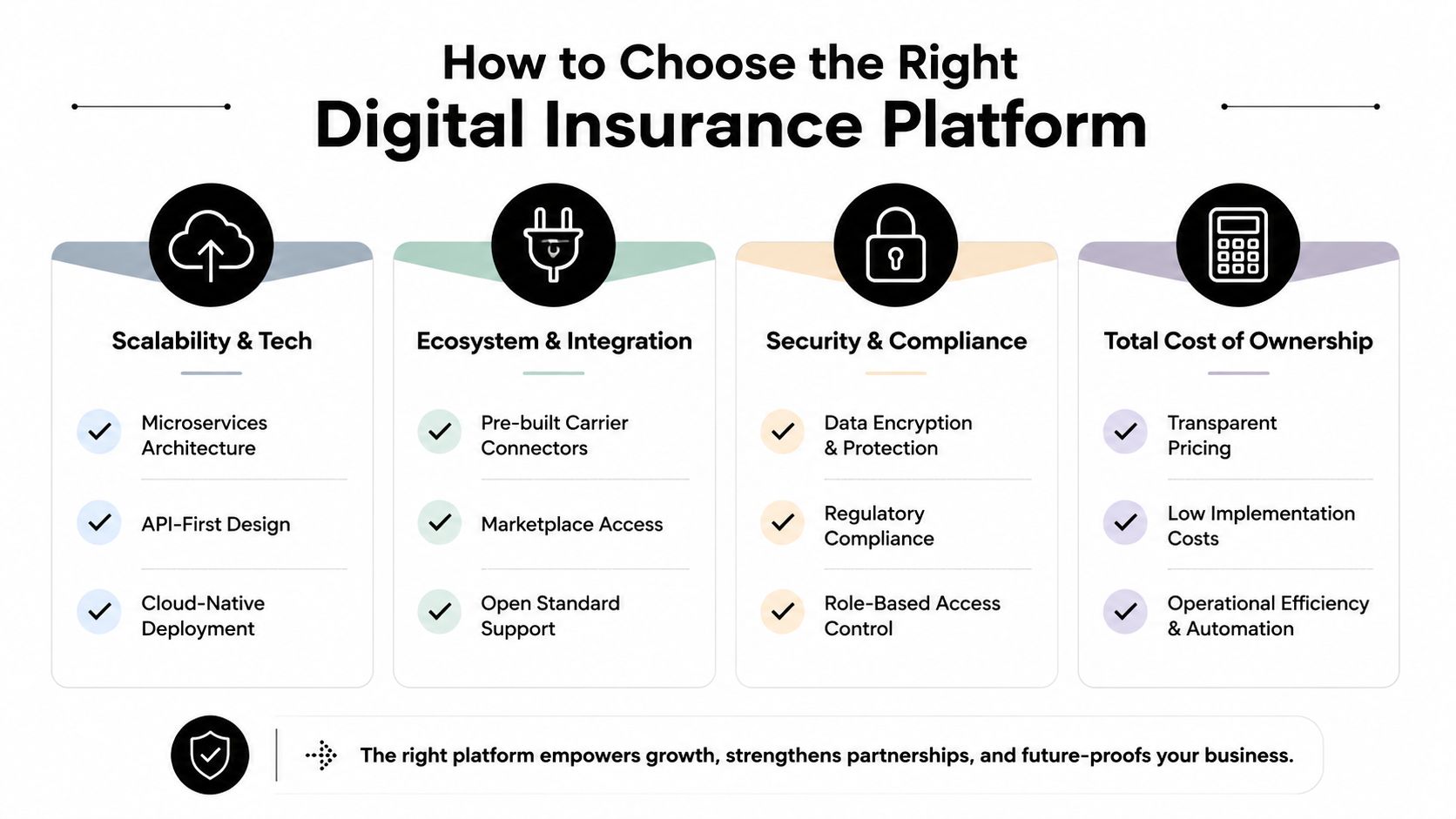
A platform should be judged on how safely it can change your operating model, not how many features it lists. If a vendor cannot fit into your claims, policy, and broker environment, strong automation just creates another silo. The selection process should start with integration, governance, and deployment reality, not demo polish.
Four questions that matter
How well does it integrate with current systems?
The platform should sit on top of existing claims and policy systems, not force a replacement program. If it cannot connect cleanly to workbenches, email, and core systems, handlers will keep duplicating work and control will fragment across systems.Can we audit every automated step?
In regulated claims operations, auditability is not optional. You need traceable routing, explainable decisions, and a clear view of when a human overrode automation.Does it fit our deployment model?
Sapiens advises insurers to favor cloud-native, API-driven platforms and to start with a digital maturity assessment before prioritizing use cases such as automated claims intake or AI-assisted policy servicing (Sapiens guide). Cloud-native, API-driven platforms allow phased rollouts, which reduces the risk of a failed full-system migration.Does the vendor understand our market structure?
Lloyd's and London Market workflows are not the same as standard personal lines. Delegated authority, broker interactions, and cover holder processes require vendor fluency, not generic insurance language.
The governance test
The strongest evaluation lens is simple. Ask whether the platform can improve claims speed without weakening fairness or control. That means looking for fairness audits, transparent model documentation, and clear exception handling from the start, not as a later add-on.
If you are comparing options, Nolana's article on vetting claims AI reviews is a useful companion for the procurement stage. It helps surface the difference between real operational fit and generic automation claims. For operational resilience questions, the DataLunix operational resilience guide is a practical reference point for understanding how platform choices affect continuity and testing discipline.
Buyer's filter: A platform that cannot explain its audit trail is not ready for a claims environment, no matter how good the demo looks.
The best choice is the one that shows a clear audit trail for automated decisions and fits into your existing claims workbench without requiring a full system replacement.
The Future Is Governed Automation Not Just Speed
The future of digital insurance platforms isn't a contest to remove humans. It's a test of whether insurers can automate administrative work while keeping decision-making explainable, auditable, and fair. That's what I mean by governed automation, a model where AI handles the repetitive flow and people stay in control of exceptions, settlements, and accountability.
That balance matters more in complex markets than in simple ones. Lloyd's and other specialty environments depend on broker interaction, delegated authority, and cross-channel claims coordination, which means speed without control becomes a liability. The best platforms preserve human oversight while making that oversight more focused and more effective.
The operational standard is changing
McKinsey's digital insurance paper argues that data is becoming one of the most valuable assets in the organization, and it frames digital transformation around value at stake, insurtech partnerships, and major investment bets (McKinsey paper). In claims, that translates into a different operating discipline. Files have to become structured decisions, not just digital documents.
That's also why resilience matters. If automation sits on top of fragile controls, it won't survive operational stress. A useful external reference for that broader control mindset is DataLunix operational resilience guide, especially for teams thinking about continuity, testing, and governed change.
The strongest conclusion for claims leaders is straightforward. The platform that wins won't just be the fastest one. It will be the one that can prove what happened, why it happened, and who stayed accountable at every step.
If you're evaluating how to modernize claims operations without sacrificing governance, visit Nolana AI to see how agentic AI can automate FNOL, triage, document processing, and claims workflow orchestration while keeping human handlers in control. Nolana's approach is built for insurers that need faster operations, clearer auditability, and better service quality across complex claims environments.
The digital insurance platform market was estimated at USD 148.15 billion in 2025 and is projected to reach USD 255.43 billion by 2030 at an 11.51% CAGR (market estimate). That scale matters because this is no longer a back-office software conversation, it's a strategic operating model shift for insurers that still depend on manual claims handling, fragmented policy data, and disconnected channels.
For a Chief Claims Officer, the key question isn't whether digital change is coming. It's whether the organization will use it to remove administrative drag without losing control, auditability, or fairness. The strongest platforms do that by combining process automation with governed human oversight, and by fitting into the broader insurance ecosystem instead of forcing another rip-and-replace program.
A useful way to think about the market is simple. The winners won't be the firms with the slickest front end, but the ones that can orchestrate FNOL, triage, documents, settlement, and exception handling across existing systems. If you want a practical lens on the business case, the framework for quantifying digital transformation ROI is a good external reference point, and Nolana's overview of financial services digital transformation helps connect that logic to regulated operations.
The Inevitable Shift to Digital Insurance Platforms
The market signal is clear. Analysts tracking the category show sustained growth, and the broader insurance technology market is expanding fast enough to push platform decisions into board-level discussion. For claims leaders, that means the question is no longer whether to modernize. It is how to modernize without creating new control gaps.
The pressure underneath that growth is operational. Claims teams still lose time to rekeying, document chasing, legacy workbenches, and channel fragmentation. A platform changes the operating question from “How do we process this file faster?” to “How do we keep every file moving, with controls, across every channel and every participant?”
This growth signals that platform investment is now a core operational priority, not a discretionary IT project.
Why this matters for claims leaders
For a claims executive, the strategic value is not just lower handling friction. It is the ability to standardize intake, route exceptions intelligently, and keep a clear audit trail while handlers focus on judgment-heavy work. That is why digital insurance platforms are increasingly tied to governance as much as speed.
The insurance industry has already learned that digital business priorities rise quickly when service pressure increases. A Forrester-commissioned report published by OneSpan found that the share of firms rating accelerating digital business as a high or critical priority rose from 22% before the pandemic to 27% by April and May 2020 (OneSpan report). That urgency never really went away.
Practical rule: If a platform only improves the customer-facing screen, it has not solved the claims problem. The operating model still leaks time in the middle.
The insurers that get this right are using platforms to modernize the whole claims path, not just the intake form. They are replacing manual handoffs with orchestrated workflows, and they are doing it in a way that can still satisfy regulators, auditors, brokers, and cover holders. That shift is what separates a digital feature from a digital operating advantage. For a useful frame on how regulated firms translate transformation into business value, see quantifying digital transformation ROI, and the logic carries directly into broader financial services digital transformation as well.
What Are Digital Insurance Platforms Really
A digital insurance platform is a coordinated operating layer, not a single app or portal. It brings together policy administration, claims management, CRM, and analytics so insurers can design, manage, and refine products through digital channels (market definition). The breadth of that scope means the platform must handle regulated workflows, auditability, and operational controls, which favors vendors with deep insurance domain expertise.
The strategic point is stronger than the technology stack itself. These platforms replace siloed legacy systems with a more connected and data-driven operating model. That lets insurers link underwriting decisions, policy changes, claims status, and customer communications without forcing each function to rely on a different source of truth.
The practical definition
Start with three questions.
Does the platform manage core insurance work?
If it only handles customer messaging, it is a front-end tool. A true platform reaches operational processes such as claims, billing, and servicing, where exceptions, approvals, and record keeping matter.Does it unify data across the journey?
Claims, documents, and communications need a common operational model. Without that, automation breaks at the handoff and teams revert to manual intervention.Can it scale without replatforming everything?
Architecture decides this. A real platform lets insurers modernize one capability at a time, which reduces disruption while preserving control over change.
The market signal supports why insurers are treating this as a core operating decision. The category is projected to add more than USD 100 billion in annual value versus the 2025 base by 2030, according to the market data above (market estimate). That points to a structural change in how insurance operations are organized and governed.
For claims leaders, the practical test is clear. If the current environment cannot support structured data, cross-channel visibility, or controlled automation, each file carries avoidable delay. A platform changes more than the experience layer, it changes how work is governed, and it should be judged against that standard. If you want a reference point for operational scope, see claims management system design.
The Core Capabilities of a Modern Platform Stack
Modern digital insurance platforms are usually built as an API-first, microservices-based stack where policy administration, billing, rating, and claims are exposed as independently deployable services (architecture guide). That matters because it separates business capability from the user interface. You can scale, replace, or improve one service without tearing down the entire core.
Why architecture is a business decision
Legacy monoliths force insurers into broad change cycles. A composable stack gives them narrower, safer change paths. If claims triage needs new logic, you can update that service without waiting on a full policy-system overhaul. If billing needs a different integration pattern, you can adjust it independently.
That flexibility is what chief claims teams are really buying. They're not buying microservices for the sake of elegance. They're buying speed of change with lower operational risk.
The platform stack also changes how digital channels work. A user interface becomes the surface layer, while business logic sits in services behind it. That means a broker portal, a claims app, and an internal handler console can all use the same underlying rules and data models without duplicating work.
Decision point: If a vendor can't explain how its claims service upgrades without breaking the rest of the stack, it's still behaving like a monolith, even if the brochure says otherwise.
For claims operations, the internal link matters. Nolana's overview of a claims management system is relevant because it shows how claims workbenches, policy systems, and orchestration layers should fit together rather than compete for control.
The takeaway is straightforward. Modern platform design isn't mainly about technology fashion. It's about limiting blast radius when business rules, regulations, or market demands change. In insurance, that limitation is worth a lot.
Moving Beyond Portals to Platform Ecosystems
The portal model assumes the customer comes to the insurer. Platform ecosystems start from the opposite premise, insurance is increasingly encountered inside another party's digital journey. The Geneva Association defines a digital insurance platform ecosystem through three parts, a digital-technology-enabled platform, a multi-supplier ecosystem, and insurance transactions among participants on that platform (Geneva Association summary). It also identifies the insurer roles as orchestrator, partner, or co-developer.
That changes how distribution works. Insurers stop relying on a single destination and instead place services where the customer, broker, or partner is already transacting. The result is better fit for embedded insurance, wider reach, and more relevant product placement in the journey itself.
What the ecosystem model changes
The Geneva Association summary says customers gain more convenient access, one-stop shopping, and more customized products, while insurers gain access to new customers, increased market reach, improved engagement, and better use of data (Geneva Association summary). These gains translate directly into lower customer acquisition costs and higher lifetime value through embedded touchpoints. They also improve servicing efficiency because the insurer is meeting customers inside workflows that already exist.
The report goes further and says successful platforms need value beyond insurance itself, because insurance alone rarely sustains repeated interaction (Geneva Association report). Adjacent services, such as medical or risk-prevention services, make the platform more useful and keep the relationship active. That is the difference between a transaction point and a working ecosystem.
The strategic shift is from owning a destination to being present inside the journeys that already matter.
For claims leaders, that shift changes the operating model as much as the commercial model. If the insurer is embedded in a broker workflow, a cover holder workflow, or a partner platform, claims service has to stay consistent across participants who do not control the same systems. The claims function becomes part of the ecosystem's credibility, and any inconsistency shows up as a trust problem, not just a service issue.
A practical reference point is Guidewire software Inc, which helps frame how core platform choices affect ecosystem participation and control. This means claims operations must be designed for multi-party visibility and consistent service levels across all ecosystem participants.
A Deep Dive into Automated Claims Operations
A modern claims file begins at FNOL intake, and that entry point is where many traditional workflows lose control of the data. In a governed platform, the claim can enter through chat, voice, web, email, or a cover holder workflow, then be normalized into a single shared data model that spans intake, investigation, settlement, document generation, and distribution channels (claims architecture). That shared model matters because it keeps each channel from creating its own version of the truth, which is a common source of rework, inconsistent authority, and weak audit trails.
How the file moves
The first step is triage. AI can classify standard claims, identify missing details, and route exceptions to the right handler. The case for this approach is described in how AI transforms claims, where machine assistance is applied to repetitive intake and review steps while human review remains available for edge cases.
Then comes evidence handling. Documents and images can be converted into structured data, which removes rekeying and shortens the time between notification and decision. For standard risks, automation can support underwriting-style checks and routing, while more complex cases move into human review with the supporting documents already organized.
Modern implementations also add ML-based risk scoring, automated underwriting for standard risks, AI claims triage, and fraud detection (claims architecture). This combination allows insurers to process routine claims through governed rules and model-based decisioning, while exceptions are escalated with context intact instead of being reassembled by hand.
Where the value shows up
The business result is not just faster handling. It is a better use of expert time. Straight-through handling absorbs routine files, while experienced handlers spend more time on complex settlement, authority decisions, and customer-sensitive exceptions. For a claims leader, that changes the productivity mix, because judgment is concentrated where it has the highest impact.
Nolana's article on automating insurance claims processing is useful if you want to compare this operating model with older workflow automation. The difference matters. Basic automation moves tasks. Governed automation moves tasks, while keeping routing logic, overrides, and decision control visible to operations and audit teams.
The broader claims trend is already visible in industry reporting. Coverage from 2024 to 2025 has emphasized image-based assessment, remote video verification, and WhatsApp or IVR-based tracking, while still stressing that human agents remain necessary for complex settlement decisions. The highest-performing claims platforms show a measurable effect on operations, with pilot deployments reporting shorter claim cycle times and higher handler productivity because teams spend less time on manual routing and more time on decisions that need judgment.
How to Choose the Right Digital Insurance Platform
A platform should be judged on how safely it can change your operating model, not how many features it lists. If a vendor cannot fit into your claims, policy, and broker environment, strong automation just creates another silo. The selection process should start with integration, governance, and deployment reality, not demo polish.
Four questions that matter
How well does it integrate with current systems?
The platform should sit on top of existing claims and policy systems, not force a replacement program. If it cannot connect cleanly to workbenches, email, and core systems, handlers will keep duplicating work and control will fragment across systems.Can we audit every automated step?
In regulated claims operations, auditability is not optional. You need traceable routing, explainable decisions, and a clear view of when a human overrode automation.Does it fit our deployment model?
Sapiens advises insurers to favor cloud-native, API-driven platforms and to start with a digital maturity assessment before prioritizing use cases such as automated claims intake or AI-assisted policy servicing (Sapiens guide). Cloud-native, API-driven platforms allow phased rollouts, which reduces the risk of a failed full-system migration.Does the vendor understand our market structure?
Lloyd's and London Market workflows are not the same as standard personal lines. Delegated authority, broker interactions, and cover holder processes require vendor fluency, not generic insurance language.
The governance test
The strongest evaluation lens is simple. Ask whether the platform can improve claims speed without weakening fairness or control. That means looking for fairness audits, transparent model documentation, and clear exception handling from the start, not as a later add-on.
If you are comparing options, Nolana's article on vetting claims AI reviews is a useful companion for the procurement stage. It helps surface the difference between real operational fit and generic automation claims. For operational resilience questions, the DataLunix operational resilience guide is a practical reference point for understanding how platform choices affect continuity and testing discipline.
Buyer's filter: A platform that cannot explain its audit trail is not ready for a claims environment, no matter how good the demo looks.
The best choice is the one that shows a clear audit trail for automated decisions and fits into your existing claims workbench without requiring a full system replacement.
The Future Is Governed Automation Not Just Speed
The future of digital insurance platforms isn't a contest to remove humans. It's a test of whether insurers can automate administrative work while keeping decision-making explainable, auditable, and fair. That's what I mean by governed automation, a model where AI handles the repetitive flow and people stay in control of exceptions, settlements, and accountability.
That balance matters more in complex markets than in simple ones. Lloyd's and other specialty environments depend on broker interaction, delegated authority, and cross-channel claims coordination, which means speed without control becomes a liability. The best platforms preserve human oversight while making that oversight more focused and more effective.
The operational standard is changing
McKinsey's digital insurance paper argues that data is becoming one of the most valuable assets in the organization, and it frames digital transformation around value at stake, insurtech partnerships, and major investment bets (McKinsey paper). In claims, that translates into a different operating discipline. Files have to become structured decisions, not just digital documents.
That's also why resilience matters. If automation sits on top of fragile controls, it won't survive operational stress. A useful external reference for that broader control mindset is DataLunix operational resilience guide, especially for teams thinking about continuity, testing, and governed change.
The strongest conclusion for claims leaders is straightforward. The platform that wins won't just be the fastest one. It will be the one that can prove what happened, why it happened, and who stayed accountable at every step.
If you're evaluating how to modernize claims operations without sacrificing governance, visit Nolana AI to see how agentic AI can automate FNOL, triage, document processing, and claims workflow orchestration while keeping human handlers in control. Nolana's approach is built for insurers that need faster operations, clearer auditability, and better service quality across complex claims environments.


All systems operational
Lloyd's Lab, One Lime Street, London EC3M 7HA
Copyright © 2026, Nolana. All rights reserved
All systems operational
Lloyd's Lab, One Lime Street, London EC3M 7HA
Copyright © 2026, Nolana. All rights reserved
All systems operational
Lloyd's Lab, One Lime Street, London EC3M 7HA
Copyright © 2026, Nolana. All rights reserved
All systems operational
Lloyd's Lab, One Lime Street, London EC3M 7HA
Copyright © 2026, Nolana. All rights reserved