Specialty Insurance Claims: Lifecycle, Pain Points &
Specialty Insurance Claims: Lifecycle, Pain Points &
Learn how specialty insurance claims move from FNOL to settlement, where operations break down, and how automation sharpens cycle times.

At 8:15 a.m., a specialty claims handler can already be behind. New ECF submissions sit beside broker chase emails, dormant files need review, and a marine cargo loss is waiting for surveyor instructions. The desk isn't short of expertise. It's short of uninterrupted time to apply it.
That pressure is becoming harder to absorb. Specialty submissions remain active while pricing softens, and severity, legal complexity, geopolitical exposure, and reserving uncertainty continue to test claims performance. Lloyd's reported major claims of £3,169 million in 2024, compared with £1,283 million in 2023, a sharp reminder that large-loss events and reserving outcomes can move specialty results materially from one year to the next. Lloyd's 2024 Annual Report
The practical answer isn't generic digitization. Claims leaders need to remove rekeying, route delegated-authority decisions correctly, extract evidence before files stall, and orchestrate dormant claims without taking judgment away from experienced handlers.
A Day in a Specialty Claims Operation
The first task isn't deciding liability. It's establishing which files deserve attention before the day gets consumed by administration.
An experienced handler opens an inbox containing broker emails, ECF notifications, surveyor correspondence, policy documents, and requests for updates. Three brokers are chasing acknowledgements. Two dormant files have reached review points. A marine cargo loss needs a local surveyor instructed, but the available information is spread across attachments and earlier messages.
Every file carries context that matters. The handler may need to reconcile a Lloyd's market slip, a coverholder reference, a market reform contract, applicable treaty conditions, and the authority granted to the party handling the claim. A misplaced reference or incomplete document request can delay the coverage decision, confuse the following markets, or create an avoidable audit question.
A working claims system should make the following sequence visible:
Capture the loss: Collect the FNOL, broker submission, policy reference, and supporting communication in one claim record.
Establish ownership: Identify the coverholder, MGA, managing agent, broker, lead market, and following markets involved.
Triage authority and complexity: Decide whether the file can remain with the delegated handler or needs referral.
Build the evidence set: Request and classify the documents needed for coverage, quantum, recovery, and reserve decisions.
Control dependencies: Track surveyor instructions, adjuster reports, reinsurance input, payments, and outstanding actions.
Close with discipline: Confirm settlement authority, coding, bordereau treatment, and the audit trail before closure.
The important distinction is between work that requires judgment and work that merely requires persistence. A handler should assess wording, causation, aggregation, recovery prospects, and materiality. The system should not make that person search five inboxes for a bill of lading or remember to chase an adjuster.
A claims management system can provide the operational record, but the value depends on how well it connects intake, documents, authority, tasks, and closure. Specialty claims operations improve when the file moves as a controlled workflow rather than as a chain of disconnected messages.
What Counts as a Specialty Insurance Claim
A specialty insurance claim usually involves an exposure that is difficult to standardize because the loss is infrequent, severe, technically complex, or dependent on bespoke wording. Marine cargo, energy, aviation, specie, political risk, cyber, fine art, complex liability, and reinsurance all fit that operating environment.
These claims may be written through Lloyd's syndicates, MGAs, coverholders, or other specialty markets. The distribution model changes the workflow. A broker may notify a coverholder, the coverholder may have limited claims authority, and the managing agent may need to approve a decision or payment. The file can involve multiple markets, jurisdictions, experts, and forms of evidence before anyone can reach a defensible outcome.
Personal lines operations often optimize for consistent, high-volume processing. Specialty insurance claims require a different balance. Speed matters, but speed without wording discipline creates leakage. A fast payment made under the wrong authority, with incomplete recovery evidence, or without a clear coverage rationale may create more work later.
Practical rule: Treat every document as part of the decision record, not as an attachment that can be filed after the decision.
A marine loss may turn on the bill of lading, packing records, survey findings, transit dates, cargo condition, and the relevant Institute Clauses. An energy claim may require engineering evidence, outage information, contractual analysis, and a careful separation between physical damage and business interruption. A liability file can involve evolving allegations, privilege concerns, defense strategy, and uncertain aggregation.
That complexity gives three disciplines unusual financial weight:
Coverage precision: Handlers must apply the actual wording, endorsements, conditions, exclusions, and notification requirements rather than rely on a broad class assumption.
Documentation control: Missing or poorly indexed evidence slows decisions and weakens the audit trail.
Recovery preservation: Subrogation against carriers, contractors, manufacturers, or other responsible parties can depend on timely notices, inspections, and evidence preservation.
The financial context is volatile. Lloyd's describes specialty lines as operating at a large scale while facing low-frequency, high-severity losses, a very different pattern from the more predictable experience of many personal lines. That makes cycle time, leakage control, and auditability more useful measures than settlement speed alone. A file closed quickly but coded incorrectly, paid outside authority, or left without recovery action isn't operational success.
For a practical view of why claims processing carries so much weight in marine operations, this analysis of AI in marine insurance provides useful context. The core principle applies across specialty classes: automate the administrative path, but keep technical judgment visible and accountable.
How a Specialty Claim Moves From FNOL to Settlement
Consider a marine cargo loss involving damaged goods discovered after arrival. The broker sends the first notification by email or portal, usually with a policy reference, shipment details, an initial description of the damage, and whatever evidence the insured has available.
The first operational test is whether the notification becomes a claim record without manual reconstruction. The broker submits the claim through ECF, the electronic route used to move claim information through the Lloyd's market. Lloyd's broker guidance says claims should be submitted as soon as possible using ECF. Lloyd's claims journey guidance
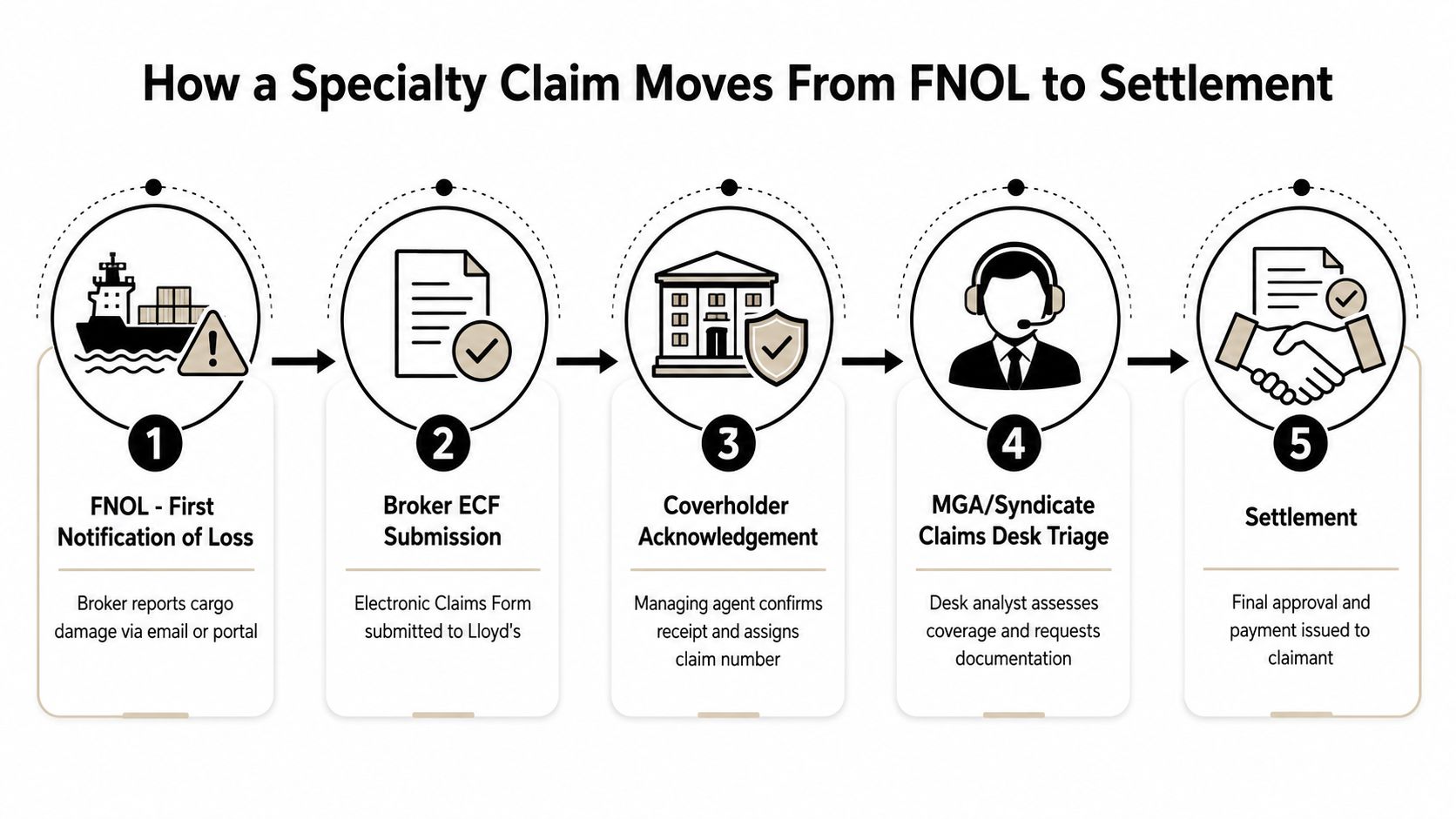
The first handoffs
The coverholder or relevant claims team acknowledges receipt, assigns or confirms a claim number, and checks that the policy, risk, and authority records align. The MGA or syndicate desk then reviews the class, apparent severity, wording, and referral requirements. The slip leader and following markets may need to be identified, particularly where the decision or payment must be coordinated across participants.
For a delegated claim, the handler checks the coverholder's authority before treating the file as routine. Lloyd's states that claims-handling authority under a binding authority is discretionary, and that coverholders will very rarely have authority to decline a claim without referring it to the managing agent. Lloyd's delegated claims-handling guidance
The desk may instruct a local surveyor to inspect the cargo, establish cause and extent of damage, and advise on mitigation. It requests the bill of lading, commercial invoice, packing list, delivery records, photographs, survey report, carrier correspondence, and any notice issued to preserve recovery rights. Each request creates a dependency. If the request isn't recorded, assigned, and chased, the file can become dormant without anyone making an active decision.
The FNOL workflow guidance is relevant here because a complete first notification reduces the number of later clarification loops. For teams assessing intake controls, streamlineInsuranceClaimsProcessing offers another useful reference point for how inbound claims information can be structured before it reaches the handling desk.
Coverage, recovery, and settlement
The handler applies the policy wording and Institute Clauses to the facts, considers exclusions and conditions, tests causation, and decides whether further expert input is required. No automation should replace that analysis. A model can identify a clause, highlight a missing document, or compare the facts with an authority rule, but the accountable handler must own the coverage position.
Once quantum is supported, the desk considers recovery against the carrier or another responsible party. It then obtains the required settlement authority, coordinates the market decision, records the payment, and ensures the file is reflected correctly in delegated-authority bordereau reporting. Administrative drag accumulates between each handoff, especially when the same data is typed into an email, ECF record, claims platform, finance system, and spreadsheet.
Where Specialty Claims Operations Break Down
Most specialty claims problems don't begin with a dramatic coverage error. They begin with an uncompleted next action.
Dormant files
A claim becomes dormant after an initial reserve, acknowledgement, or investigation step when the next document or decision doesn't arrive. The missing item may be an adjuster sign-off, survey report, recovery response, reinsurance input, or insured confirmation.
Dormancy distorts management information because an apparently stable file may still carry unresolved coverage, quantum, or reserve uncertainty. It also consumes experienced handler time through repeated manual chasing. The operational fix is not another static report. It is a dependency engine that identifies why a file has stopped, assigns the next action, sets an appropriate follow-up, and escalates when the dependency remains unresolved.
Manual document handling
Specialty desks still receive surveyor reports, invoices, bills of lading, adjuster estimates, EDI messages, and broker correspondence in formats that don't map cleanly into core systems. Handlers read the material, locate relevant figures, and rekey them into the bureau, policy administration, or finance environment.
That work creates delay and transcription risk. It also makes quality control expensive because a supervisor must compare the source document with several downstream records. The right use of extraction technology is targeted: identify entities, dates, amounts, references, clauses, and missing evidence, then show the handler the source and confidence behind each proposed field.
Fragmented channels
A broker portal, shared inbox, ECF note, coverholder submission, and telephone update can all describe the same claim. Without a unified record, the handler triangulates facts manually and may respond from an outdated version of the file.
This fragmentation affects service first, then financial control. Brokers receive inconsistent updates, claimants wait for requests that have already been answered, and recovery opportunities can be missed while people search for the latest evidence. A synchronized claim record should preserve the communication history and update connected systems without asking the handler to re-enter the same information.
Delegated-authority gaps
Authority errors are particularly damaging because they expose both the individual claim and the control framework. A coverholder may refer too late, settle beyond the permitted limit, decline without proper approval, or submit incomplete bordereau coding.
Lloyd's broker guidance describes many claims as less than £250,000 in value to Lloyd's insurers, with the threshold increased to £500,000 for Energy and Property Treaty classes. Lloyd's claims Q&A for brokers Those thresholds aren't a substitute for reading the binding authority. They are a reminder that routing logic must reflect class-specific authority, not a generic low-value rule.
Audit findings, rework, payment delays, and complaints often reveal the same root cause: the workflow doesn't enforce the decision rights clearly enough. Legacy system modernization strategies should therefore be evaluated against control outcomes, not only interface convenience.
How Agentic Automation Reshapes the Claims Workflow
A portal gives a handler somewhere to enter information. A rules engine applies predetermined conditions. Agentic orchestration manages a sequence of tasks, evaluates context, and keeps the claim moving while reserving decisions for the right human.
The distinction matters on specialty desks because exceptions are normal. A simple macro may route marine cargo claims to a team, but it won't reliably interpret an unusual survey report, identify a missing carrier notice, or recognize that a delegated-authority threshold requires referral. An agent can read the inbound email and ECF attachments, identify the class and parties, extract relevant fields, and present a suggested route with supporting evidence.
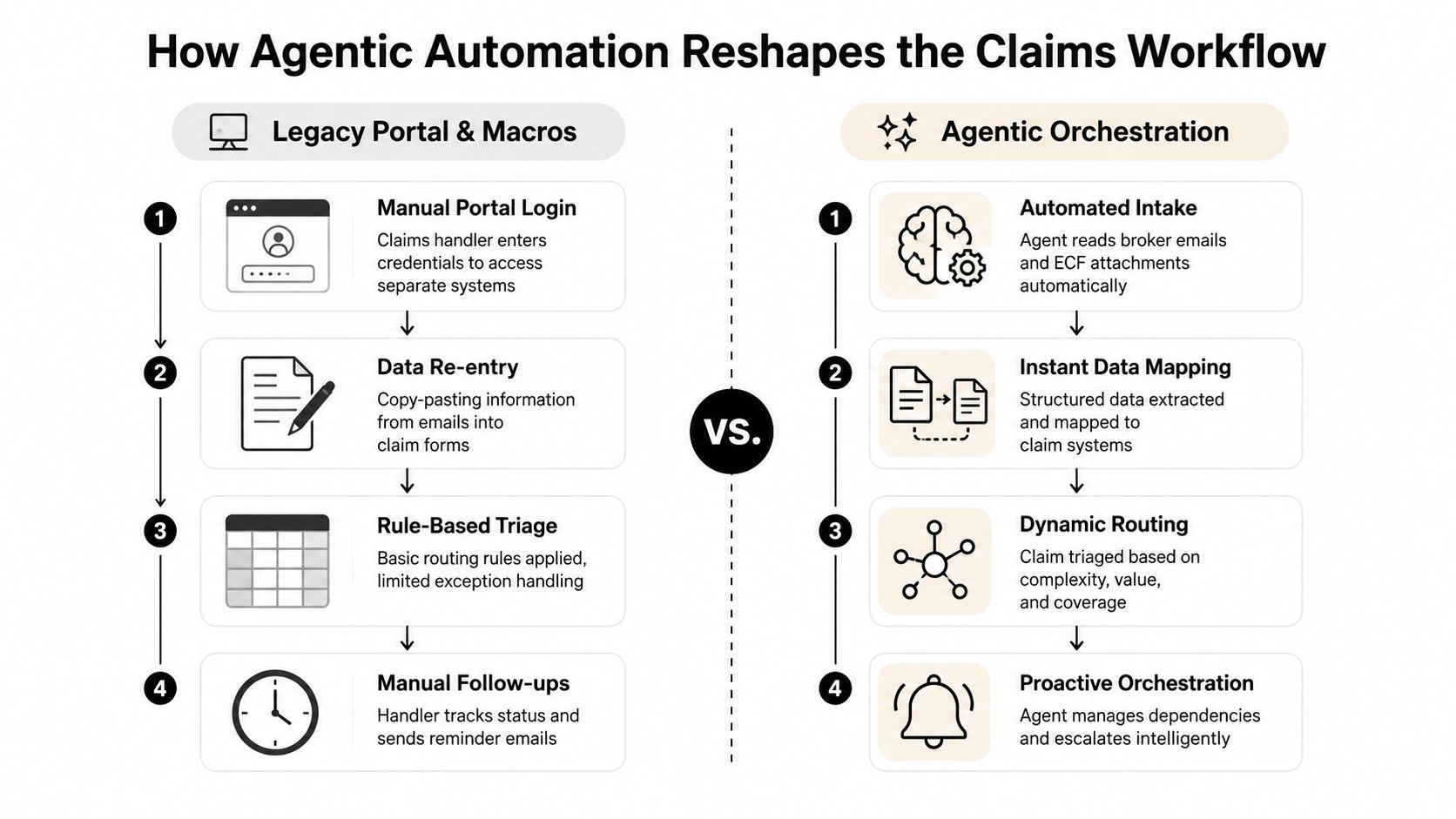
Four practical differences
Workflow point | Legacy portal and macros | Agentic orchestration |
|---|---|---|
Intake | Handler logs into separate systems and transcribes the notification | An intake agent reads broker communications and attachments, then creates or updates the record |
Documents | Staff open files individually and rekey facts | Extraction identifies structured data, references, missing items, and source locations |
Triage | Basic rules handle common routes and struggle with exceptions | Contextual routing considers class, complexity, value, coverage triggers, and authority |
Follow-up | Handlers maintain reminders and chase emails | The workflow tracks dependencies, proposes next actions, and escalates stalled work |
Document processing is valuable when it remains transparent. A model can extract figures from surveyor reports, bills of lading, invoices, and loss adjuster estimates, but the handler should see the proposed value, source page or passage, and confidence signal before accepting it.
Human checkpoints must be explicit:
Reserve recommendations: The system may identify comparable facts or summarize evidence, but the handler signs off the reserve.
Coverage triggers: The workflow can flag relevant clauses and missing conditions, while the accountable claims professional makes the coverage decision.
Authority escalation: Claims outside delegated limits route to the managing agent or designated authority holder.
Settlement payment: Payment remains behind the required approval and dual-control process.
Audit record: Every automated action, human override, and outcome remains available for review.
The integration layer matters as much as the model. ECF, Class Dolphin, policy administration, finance, and internal claims workbenches need to share the same claim identity and status. That removes spreadsheet bridges and reduces the chance that a settlement decision sits in one system while the authority record remains in another.
For a deeper explanation of the operating model, what agentic automation means for claims is a useful starting point.
The technology should disappear into the handler's existing workbench. If staff must open another portal, copy the result into a core system, and maintain a separate exception log, the organization has added another layer rather than removed operational drag.
Implementing Claims Automation in Insurers, MGAs, and the London Market
Successful implementation starts with the claim, not the vendor demonstration. Map how a notification travels across the broker, coverholder, MGA, managing agent, bureau, finance team, and reinsurer. Record where data is captured, where it is rekeyed, where authority is checked, and where files wait.
A phased rollout
Discovery and mapping should produce a touchpoint inventory by class of business. Separate marine, aviation, energy, construction, liability, and reinsurance workflows where their evidence, authority, and escalation logic differ. Identify the highest-volume administrative constraint, which may be dormant-file follow-up, FNOL acknowledgement, bordereau ingestion, or document extraction.
A narrow pilot should automate high-confidence actions first. Suitable candidates include acknowledgement messages, structured ingestion of bordereau data, document classification, missing-information requests, and dormant-file reminders. Keep an exception queue visible so handlers can see what the system couldn't resolve and why.
Supervised triage can follow once the intake record is reliable. The agent can pre-classify complexity, identify possible coverage triggers, check authority conditions, and recommend routing. The handler approves the recommendation, corrects it when needed, and supplies feedback that improves workflow logic without turning production files into an uncontrolled experiment.
Market integration connects ECF, Class Dolphin, claims workbenches, policy administration, accounting, and finance. The objective is one orchestrated record, not a replacement of every existing platform. Nolana is an agentic AI platform for Lloyd's claims lifecycle operations that supports FNOL intake, triage, static claims management, and document processing on top of existing claims and policy systems, with human oversight and auditability.
Governance needs to be designed before scale. Lloyd's delegated-authority guidance promotes high standards and consistency in the audit of coverholders and Delegated Claims Administrators, with best-practice guidance intended to support consistent audits and FCA and PRA expectations. Lloyd's delegated-authority guidance
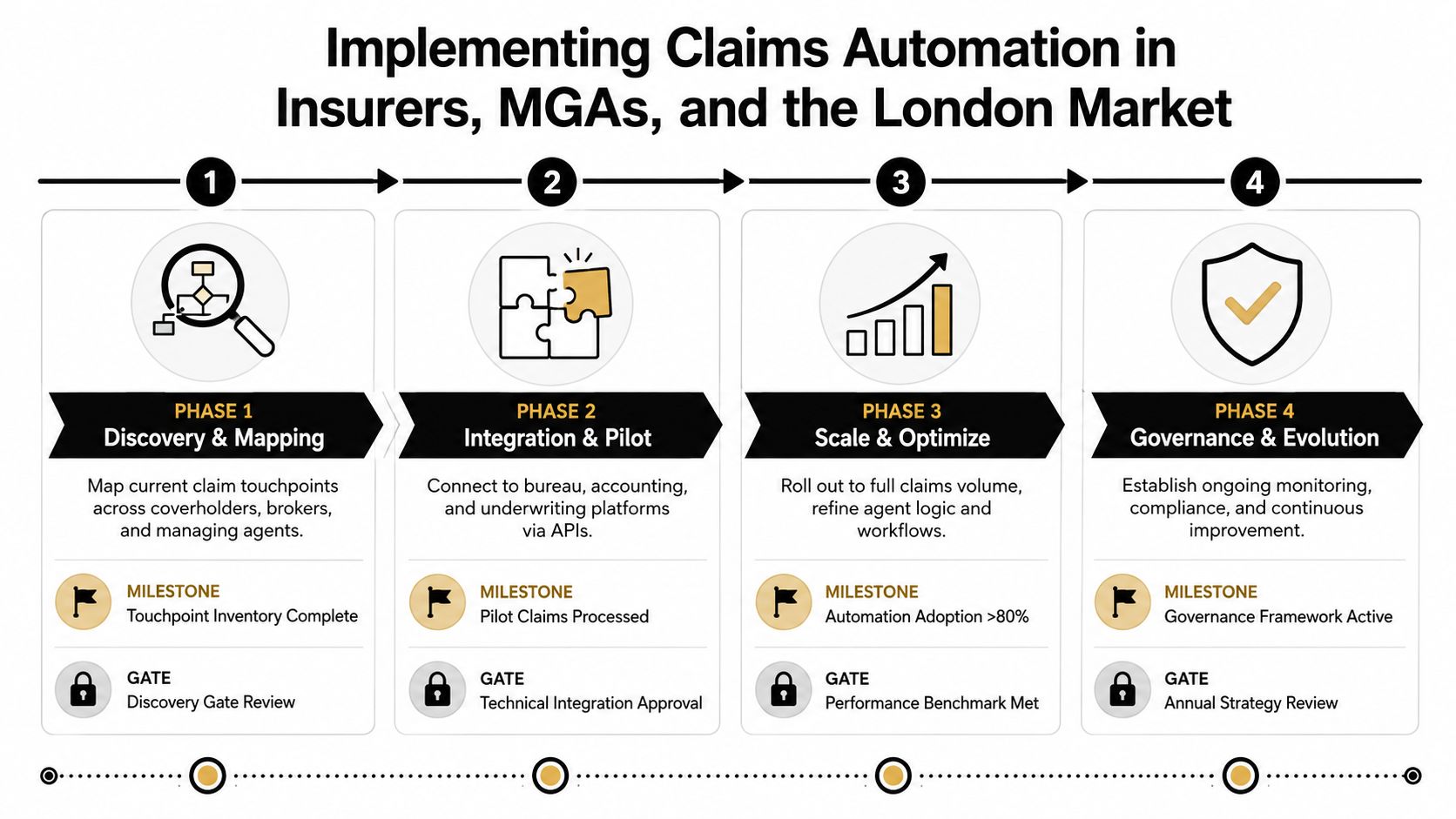
Before production rollout, confirm:
Model accountability: Define who owns model-risk documentation, testing, approval, monitoring, and change control.
Auditability: Log prompts, extracted fields, routing decisions, overrides, approvals, and downstream system updates.
Data controls: Check residency, retention, access rights, privilege handling, and segregation between clients or markets.
Integration resilience: Establish failure handling when ECF, Class Dolphin, finance, or policy systems are unavailable.
Change management: Train handlers on accepting, rejecting, and correcting recommendations. Automation fails when staff don't trust its evidence or don't understand escalation rules.
Vendor dependence: Clarify export rights, interface ownership, service continuity, and the process for changing providers.
The implementation decision is operational. If a phase doesn't remove a queue, reduce duplicate entry, or improve control visibility, pause and redesign it.
Measuring Success With the Right Claims KPIs
A specialty claims automation program needs measures that connect desk activity to underwriting and financial outcomes. Counting logins or automated tasks can show adoption, but it won't tell a claims committee whether the operation is controlling severity, expense, leakage, or authority risk.
Cycle time and capacity
Start with timestamps already available in ECF, claims workbenches, policy administration, and finance systems:
FNOL to first action: Time from receipt to the first documented review, acknowledgement, assignment, or request.
FNOL to acknowledgement: Time until the broker, coverholder, or claimant receives confirmation and a clear next step.
Indemnity cycle: Time from notification to approved indemnity payment, split by class and complexity.
Expense cycle: Time from invoice receipt to approval and payment.
Dormant-file age: Time since the last substantive action, categorized by the missing dependency.
Handler throughput should be paired with idle time. Measure the number of active files per handler, completed substantive actions, time spent on document search and rekeying, and the proportion of the day consumed by follow-up work. A higher file count isn't a gain if unresolved dependencies and reopened claims rise with it.
Loss and control outcomes
Loss-ratio analysis should distinguish operational improvement from portfolio mix. Track attritional loss ratio, severity-adjusted loss ratio, and loss adjustment expense ratio by class, underwriting year, delegated source, and claims route. Compare these against reserve development and recovery performance so faster processing isn't mistaken for better claims economics.
Current specialty conditions make leading indicators particularly valuable. WTW reported aggregate specialty rates down 5% gross of claims trend and 8% net of claims trend, after adjusting for claims-cost inflation beyond simple price changes. WTW specialty market update In a softer pricing environment, claims teams need early visibility into severity inflation, dormant-file aging, adjuster-to-claim ratios, referral volumes, and reserve changes before the loss ratio catches up.
Compliance measures belong on the same dashboard:
ECF timeliness: Track submission and acknowledgement timing against internal service standards.
Audit findings: Categorize findings by missing evidence, authority breach, coding error, payment control, and governance failure.
Delegated-authority breaches: Count and trend cases routed or settled outside documented authority.
Documentation completeness: Test whether the required coverage, quantum, recovery, and approval records exist before closure.
Complaint signals: Link complaints to communication gaps, delayed actions, coverage explanations, and payment handling.
Use weekly operational dashboards for queues and dormant files, monthly underwriting and claims reviews for emerging severity and routing patterns, and quarterly loss-ratio reconciliations that connect operational changes to portfolio results. Lloyd's major claims movement from £1,283 million in 2023 to £3,169 million in 2024 shows why specialty leaders need that discipline rather than relying on a single annual outcome. Lloyd's 2024 Annual Report
The right question isn't how many tasks AI completed. It's whether handlers reach judgment-critical work sooner, whether dormant files return to motion, whether authority decisions are visible, and whether the claims organization can absorb complexity without allowing control quality to deteriorate.
Nolana AI automates specialty claims intake, document processing, delegated-authority triage, and dormant-file follow-up while keeping human handlers in control and maintaining an audit trail across existing systems. Visit Nolana AI to see how its claims lifecycle platform can help your insurer, MGA, broker, or coverholder reduce administrative drag and keep specialty files moving from FNOL through settlement.
At 8:15 a.m., a specialty claims handler can already be behind. New ECF submissions sit beside broker chase emails, dormant files need review, and a marine cargo loss is waiting for surveyor instructions. The desk isn't short of expertise. It's short of uninterrupted time to apply it.
That pressure is becoming harder to absorb. Specialty submissions remain active while pricing softens, and severity, legal complexity, geopolitical exposure, and reserving uncertainty continue to test claims performance. Lloyd's reported major claims of £3,169 million in 2024, compared with £1,283 million in 2023, a sharp reminder that large-loss events and reserving outcomes can move specialty results materially from one year to the next. Lloyd's 2024 Annual Report
The practical answer isn't generic digitization. Claims leaders need to remove rekeying, route delegated-authority decisions correctly, extract evidence before files stall, and orchestrate dormant claims without taking judgment away from experienced handlers.
A Day in a Specialty Claims Operation
The first task isn't deciding liability. It's establishing which files deserve attention before the day gets consumed by administration.
An experienced handler opens an inbox containing broker emails, ECF notifications, surveyor correspondence, policy documents, and requests for updates. Three brokers are chasing acknowledgements. Two dormant files have reached review points. A marine cargo loss needs a local surveyor instructed, but the available information is spread across attachments and earlier messages.
Every file carries context that matters. The handler may need to reconcile a Lloyd's market slip, a coverholder reference, a market reform contract, applicable treaty conditions, and the authority granted to the party handling the claim. A misplaced reference or incomplete document request can delay the coverage decision, confuse the following markets, or create an avoidable audit question.
A working claims system should make the following sequence visible:
Capture the loss: Collect the FNOL, broker submission, policy reference, and supporting communication in one claim record.
Establish ownership: Identify the coverholder, MGA, managing agent, broker, lead market, and following markets involved.
Triage authority and complexity: Decide whether the file can remain with the delegated handler or needs referral.
Build the evidence set: Request and classify the documents needed for coverage, quantum, recovery, and reserve decisions.
Control dependencies: Track surveyor instructions, adjuster reports, reinsurance input, payments, and outstanding actions.
Close with discipline: Confirm settlement authority, coding, bordereau treatment, and the audit trail before closure.
The important distinction is between work that requires judgment and work that merely requires persistence. A handler should assess wording, causation, aggregation, recovery prospects, and materiality. The system should not make that person search five inboxes for a bill of lading or remember to chase an adjuster.
A claims management system can provide the operational record, but the value depends on how well it connects intake, documents, authority, tasks, and closure. Specialty claims operations improve when the file moves as a controlled workflow rather than as a chain of disconnected messages.
What Counts as a Specialty Insurance Claim
A specialty insurance claim usually involves an exposure that is difficult to standardize because the loss is infrequent, severe, technically complex, or dependent on bespoke wording. Marine cargo, energy, aviation, specie, political risk, cyber, fine art, complex liability, and reinsurance all fit that operating environment.
These claims may be written through Lloyd's syndicates, MGAs, coverholders, or other specialty markets. The distribution model changes the workflow. A broker may notify a coverholder, the coverholder may have limited claims authority, and the managing agent may need to approve a decision or payment. The file can involve multiple markets, jurisdictions, experts, and forms of evidence before anyone can reach a defensible outcome.
Personal lines operations often optimize for consistent, high-volume processing. Specialty insurance claims require a different balance. Speed matters, but speed without wording discipline creates leakage. A fast payment made under the wrong authority, with incomplete recovery evidence, or without a clear coverage rationale may create more work later.
Practical rule: Treat every document as part of the decision record, not as an attachment that can be filed after the decision.
A marine loss may turn on the bill of lading, packing records, survey findings, transit dates, cargo condition, and the relevant Institute Clauses. An energy claim may require engineering evidence, outage information, contractual analysis, and a careful separation between physical damage and business interruption. A liability file can involve evolving allegations, privilege concerns, defense strategy, and uncertain aggregation.
That complexity gives three disciplines unusual financial weight:
Coverage precision: Handlers must apply the actual wording, endorsements, conditions, exclusions, and notification requirements rather than rely on a broad class assumption.
Documentation control: Missing or poorly indexed evidence slows decisions and weakens the audit trail.
Recovery preservation: Subrogation against carriers, contractors, manufacturers, or other responsible parties can depend on timely notices, inspections, and evidence preservation.
The financial context is volatile. Lloyd's describes specialty lines as operating at a large scale while facing low-frequency, high-severity losses, a very different pattern from the more predictable experience of many personal lines. That makes cycle time, leakage control, and auditability more useful measures than settlement speed alone. A file closed quickly but coded incorrectly, paid outside authority, or left without recovery action isn't operational success.
For a practical view of why claims processing carries so much weight in marine operations, this analysis of AI in marine insurance provides useful context. The core principle applies across specialty classes: automate the administrative path, but keep technical judgment visible and accountable.
How a Specialty Claim Moves From FNOL to Settlement
Consider a marine cargo loss involving damaged goods discovered after arrival. The broker sends the first notification by email or portal, usually with a policy reference, shipment details, an initial description of the damage, and whatever evidence the insured has available.
The first operational test is whether the notification becomes a claim record without manual reconstruction. The broker submits the claim through ECF, the electronic route used to move claim information through the Lloyd's market. Lloyd's broker guidance says claims should be submitted as soon as possible using ECF. Lloyd's claims journey guidance
The first handoffs
The coverholder or relevant claims team acknowledges receipt, assigns or confirms a claim number, and checks that the policy, risk, and authority records align. The MGA or syndicate desk then reviews the class, apparent severity, wording, and referral requirements. The slip leader and following markets may need to be identified, particularly where the decision or payment must be coordinated across participants.
For a delegated claim, the handler checks the coverholder's authority before treating the file as routine. Lloyd's states that claims-handling authority under a binding authority is discretionary, and that coverholders will very rarely have authority to decline a claim without referring it to the managing agent. Lloyd's delegated claims-handling guidance
The desk may instruct a local surveyor to inspect the cargo, establish cause and extent of damage, and advise on mitigation. It requests the bill of lading, commercial invoice, packing list, delivery records, photographs, survey report, carrier correspondence, and any notice issued to preserve recovery rights. Each request creates a dependency. If the request isn't recorded, assigned, and chased, the file can become dormant without anyone making an active decision.
The FNOL workflow guidance is relevant here because a complete first notification reduces the number of later clarification loops. For teams assessing intake controls, streamlineInsuranceClaimsProcessing offers another useful reference point for how inbound claims information can be structured before it reaches the handling desk.
Coverage, recovery, and settlement
The handler applies the policy wording and Institute Clauses to the facts, considers exclusions and conditions, tests causation, and decides whether further expert input is required. No automation should replace that analysis. A model can identify a clause, highlight a missing document, or compare the facts with an authority rule, but the accountable handler must own the coverage position.
Once quantum is supported, the desk considers recovery against the carrier or another responsible party. It then obtains the required settlement authority, coordinates the market decision, records the payment, and ensures the file is reflected correctly in delegated-authority bordereau reporting. Administrative drag accumulates between each handoff, especially when the same data is typed into an email, ECF record, claims platform, finance system, and spreadsheet.
Where Specialty Claims Operations Break Down
Most specialty claims problems don't begin with a dramatic coverage error. They begin with an uncompleted next action.
Dormant files
A claim becomes dormant after an initial reserve, acknowledgement, or investigation step when the next document or decision doesn't arrive. The missing item may be an adjuster sign-off, survey report, recovery response, reinsurance input, or insured confirmation.
Dormancy distorts management information because an apparently stable file may still carry unresolved coverage, quantum, or reserve uncertainty. It also consumes experienced handler time through repeated manual chasing. The operational fix is not another static report. It is a dependency engine that identifies why a file has stopped, assigns the next action, sets an appropriate follow-up, and escalates when the dependency remains unresolved.
Manual document handling
Specialty desks still receive surveyor reports, invoices, bills of lading, adjuster estimates, EDI messages, and broker correspondence in formats that don't map cleanly into core systems. Handlers read the material, locate relevant figures, and rekey them into the bureau, policy administration, or finance environment.
That work creates delay and transcription risk. It also makes quality control expensive because a supervisor must compare the source document with several downstream records. The right use of extraction technology is targeted: identify entities, dates, amounts, references, clauses, and missing evidence, then show the handler the source and confidence behind each proposed field.
Fragmented channels
A broker portal, shared inbox, ECF note, coverholder submission, and telephone update can all describe the same claim. Without a unified record, the handler triangulates facts manually and may respond from an outdated version of the file.
This fragmentation affects service first, then financial control. Brokers receive inconsistent updates, claimants wait for requests that have already been answered, and recovery opportunities can be missed while people search for the latest evidence. A synchronized claim record should preserve the communication history and update connected systems without asking the handler to re-enter the same information.
Delegated-authority gaps
Authority errors are particularly damaging because they expose both the individual claim and the control framework. A coverholder may refer too late, settle beyond the permitted limit, decline without proper approval, or submit incomplete bordereau coding.
Lloyd's broker guidance describes many claims as less than £250,000 in value to Lloyd's insurers, with the threshold increased to £500,000 for Energy and Property Treaty classes. Lloyd's claims Q&A for brokers Those thresholds aren't a substitute for reading the binding authority. They are a reminder that routing logic must reflect class-specific authority, not a generic low-value rule.
Audit findings, rework, payment delays, and complaints often reveal the same root cause: the workflow doesn't enforce the decision rights clearly enough. Legacy system modernization strategies should therefore be evaluated against control outcomes, not only interface convenience.
How Agentic Automation Reshapes the Claims Workflow
A portal gives a handler somewhere to enter information. A rules engine applies predetermined conditions. Agentic orchestration manages a sequence of tasks, evaluates context, and keeps the claim moving while reserving decisions for the right human.
The distinction matters on specialty desks because exceptions are normal. A simple macro may route marine cargo claims to a team, but it won't reliably interpret an unusual survey report, identify a missing carrier notice, or recognize that a delegated-authority threshold requires referral. An agent can read the inbound email and ECF attachments, identify the class and parties, extract relevant fields, and present a suggested route with supporting evidence.
Four practical differences
Workflow point | Legacy portal and macros | Agentic orchestration |
|---|---|---|
Intake | Handler logs into separate systems and transcribes the notification | An intake agent reads broker communications and attachments, then creates or updates the record |
Documents | Staff open files individually and rekey facts | Extraction identifies structured data, references, missing items, and source locations |
Triage | Basic rules handle common routes and struggle with exceptions | Contextual routing considers class, complexity, value, coverage triggers, and authority |
Follow-up | Handlers maintain reminders and chase emails | The workflow tracks dependencies, proposes next actions, and escalates stalled work |
Document processing is valuable when it remains transparent. A model can extract figures from surveyor reports, bills of lading, invoices, and loss adjuster estimates, but the handler should see the proposed value, source page or passage, and confidence signal before accepting it.
Human checkpoints must be explicit:
Reserve recommendations: The system may identify comparable facts or summarize evidence, but the handler signs off the reserve.
Coverage triggers: The workflow can flag relevant clauses and missing conditions, while the accountable claims professional makes the coverage decision.
Authority escalation: Claims outside delegated limits route to the managing agent or designated authority holder.
Settlement payment: Payment remains behind the required approval and dual-control process.
Audit record: Every automated action, human override, and outcome remains available for review.
The integration layer matters as much as the model. ECF, Class Dolphin, policy administration, finance, and internal claims workbenches need to share the same claim identity and status. That removes spreadsheet bridges and reduces the chance that a settlement decision sits in one system while the authority record remains in another.
For a deeper explanation of the operating model, what agentic automation means for claims is a useful starting point.
The technology should disappear into the handler's existing workbench. If staff must open another portal, copy the result into a core system, and maintain a separate exception log, the organization has added another layer rather than removed operational drag.
Implementing Claims Automation in Insurers, MGAs, and the London Market
Successful implementation starts with the claim, not the vendor demonstration. Map how a notification travels across the broker, coverholder, MGA, managing agent, bureau, finance team, and reinsurer. Record where data is captured, where it is rekeyed, where authority is checked, and where files wait.
A phased rollout
Discovery and mapping should produce a touchpoint inventory by class of business. Separate marine, aviation, energy, construction, liability, and reinsurance workflows where their evidence, authority, and escalation logic differ. Identify the highest-volume administrative constraint, which may be dormant-file follow-up, FNOL acknowledgement, bordereau ingestion, or document extraction.
A narrow pilot should automate high-confidence actions first. Suitable candidates include acknowledgement messages, structured ingestion of bordereau data, document classification, missing-information requests, and dormant-file reminders. Keep an exception queue visible so handlers can see what the system couldn't resolve and why.
Supervised triage can follow once the intake record is reliable. The agent can pre-classify complexity, identify possible coverage triggers, check authority conditions, and recommend routing. The handler approves the recommendation, corrects it when needed, and supplies feedback that improves workflow logic without turning production files into an uncontrolled experiment.
Market integration connects ECF, Class Dolphin, claims workbenches, policy administration, accounting, and finance. The objective is one orchestrated record, not a replacement of every existing platform. Nolana is an agentic AI platform for Lloyd's claims lifecycle operations that supports FNOL intake, triage, static claims management, and document processing on top of existing claims and policy systems, with human oversight and auditability.
Governance needs to be designed before scale. Lloyd's delegated-authority guidance promotes high standards and consistency in the audit of coverholders and Delegated Claims Administrators, with best-practice guidance intended to support consistent audits and FCA and PRA expectations. Lloyd's delegated-authority guidance
Before production rollout, confirm:
Model accountability: Define who owns model-risk documentation, testing, approval, monitoring, and change control.
Auditability: Log prompts, extracted fields, routing decisions, overrides, approvals, and downstream system updates.
Data controls: Check residency, retention, access rights, privilege handling, and segregation between clients or markets.
Integration resilience: Establish failure handling when ECF, Class Dolphin, finance, or policy systems are unavailable.
Change management: Train handlers on accepting, rejecting, and correcting recommendations. Automation fails when staff don't trust its evidence or don't understand escalation rules.
Vendor dependence: Clarify export rights, interface ownership, service continuity, and the process for changing providers.
The implementation decision is operational. If a phase doesn't remove a queue, reduce duplicate entry, or improve control visibility, pause and redesign it.
Measuring Success With the Right Claims KPIs
A specialty claims automation program needs measures that connect desk activity to underwriting and financial outcomes. Counting logins or automated tasks can show adoption, but it won't tell a claims committee whether the operation is controlling severity, expense, leakage, or authority risk.
Cycle time and capacity
Start with timestamps already available in ECF, claims workbenches, policy administration, and finance systems:
FNOL to first action: Time from receipt to the first documented review, acknowledgement, assignment, or request.
FNOL to acknowledgement: Time until the broker, coverholder, or claimant receives confirmation and a clear next step.
Indemnity cycle: Time from notification to approved indemnity payment, split by class and complexity.
Expense cycle: Time from invoice receipt to approval and payment.
Dormant-file age: Time since the last substantive action, categorized by the missing dependency.
Handler throughput should be paired with idle time. Measure the number of active files per handler, completed substantive actions, time spent on document search and rekeying, and the proportion of the day consumed by follow-up work. A higher file count isn't a gain if unresolved dependencies and reopened claims rise with it.
Loss and control outcomes
Loss-ratio analysis should distinguish operational improvement from portfolio mix. Track attritional loss ratio, severity-adjusted loss ratio, and loss adjustment expense ratio by class, underwriting year, delegated source, and claims route. Compare these against reserve development and recovery performance so faster processing isn't mistaken for better claims economics.
Current specialty conditions make leading indicators particularly valuable. WTW reported aggregate specialty rates down 5% gross of claims trend and 8% net of claims trend, after adjusting for claims-cost inflation beyond simple price changes. WTW specialty market update In a softer pricing environment, claims teams need early visibility into severity inflation, dormant-file aging, adjuster-to-claim ratios, referral volumes, and reserve changes before the loss ratio catches up.
Compliance measures belong on the same dashboard:
ECF timeliness: Track submission and acknowledgement timing against internal service standards.
Audit findings: Categorize findings by missing evidence, authority breach, coding error, payment control, and governance failure.
Delegated-authority breaches: Count and trend cases routed or settled outside documented authority.
Documentation completeness: Test whether the required coverage, quantum, recovery, and approval records exist before closure.
Complaint signals: Link complaints to communication gaps, delayed actions, coverage explanations, and payment handling.
Use weekly operational dashboards for queues and dormant files, monthly underwriting and claims reviews for emerging severity and routing patterns, and quarterly loss-ratio reconciliations that connect operational changes to portfolio results. Lloyd's major claims movement from £1,283 million in 2023 to £3,169 million in 2024 shows why specialty leaders need that discipline rather than relying on a single annual outcome. Lloyd's 2024 Annual Report
The right question isn't how many tasks AI completed. It's whether handlers reach judgment-critical work sooner, whether dormant files return to motion, whether authority decisions are visible, and whether the claims organization can absorb complexity without allowing control quality to deteriorate.
Nolana AI automates specialty claims intake, document processing, delegated-authority triage, and dormant-file follow-up while keeping human handlers in control and maintaining an audit trail across existing systems. Visit Nolana AI to see how its claims lifecycle platform can help your insurer, MGA, broker, or coverholder reduce administrative drag and keep specialty files moving from FNOL through settlement.


All systems operational
1 Lime Street, London EC3M 7HA | 222E 3rd Street, New York 10009
Copyright © 2026, Nolana. All rights reserved
All systems operational
1 Lime Street, London EC3M 7HA | 222E 3rd Street, New York 10009
Copyright © 2026, Nolana. All rights reserved
All systems operational
1 Lime Street, London EC3M 7HA | 222E 3rd Street, New York 10009
Copyright © 2026, Nolana. All rights reserved
All systems operational
1 Lime Street, London EC3M 7HA | 222E 3rd Street, New York 10009
Copyright © 2026, Nolana. All rights reserved