Verisk Insurance Solutions: Buyer's Guide to Claims
Verisk Insurance Solutions: Buyer's Guide to Claims
Explore a comprehensive guide to Verisk insurance solutions, covering claims operations, key features, and benefits to help you make an informed choice.

Verisk sits on a claims-data engine that spans more than five decades, 30 petabytes, 39 billion premium and loss records, and 1.9 billion+ claims records. That's not just scale for scale's sake, it's the reason the company can act as infrastructure for property and casualty decision-making instead of merely another software vendor. For claims leaders, the core question isn't whether Verisk is large, it's where that data gravity still compounds value and where automation expectations run ahead of the underlying data structure.
What Verisk Sells and Why Scale Matters
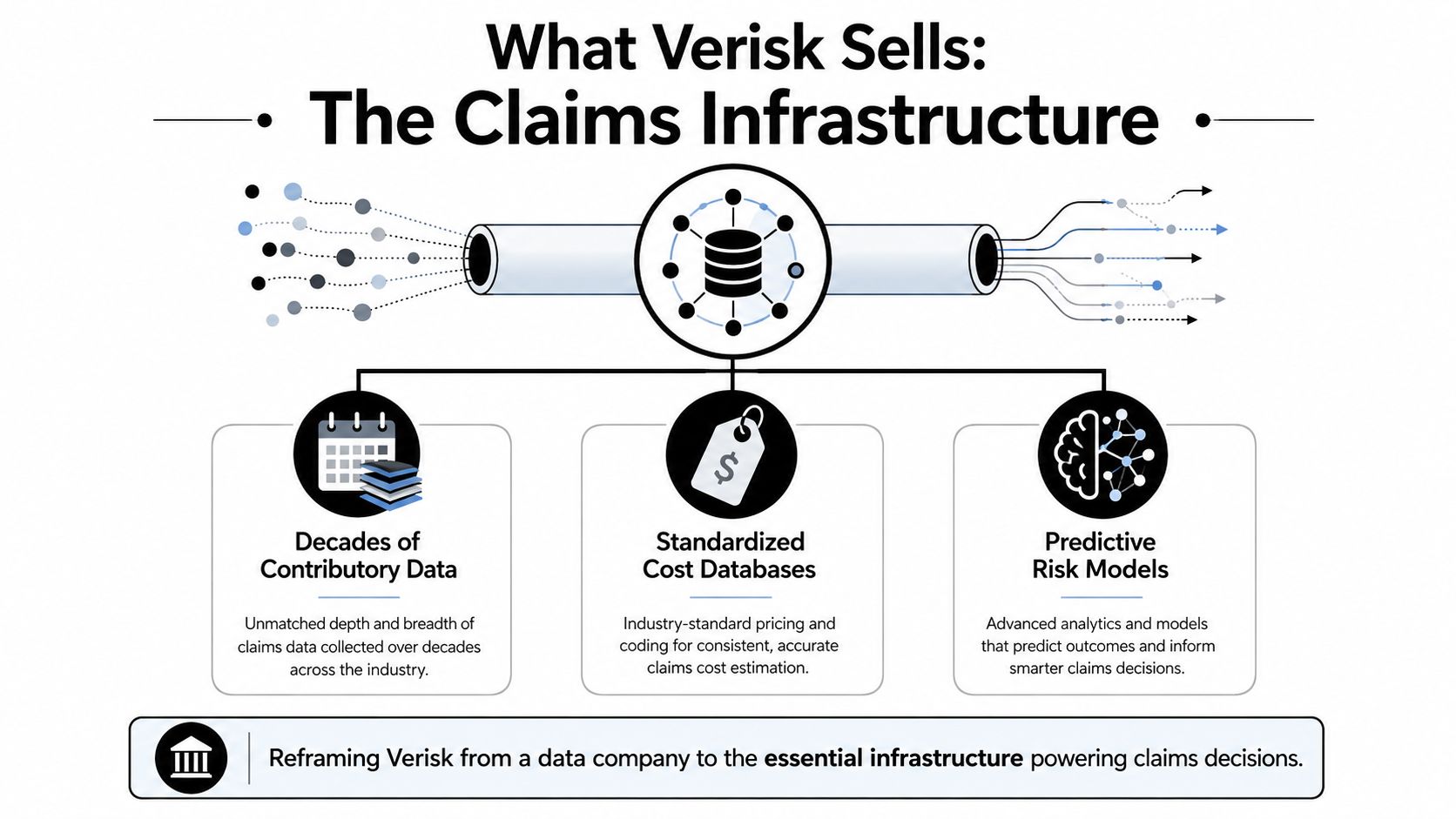
Verisk's core product story starts with accumulation. The company reports 2.3 billion+ yearly transactions and 187,000+ new claims daily across its ecosystem, and it says its claims data system contains more than 1.5 billion claims, described as the world's largest database of P&C claims information for claims processing and investigations Verisk about page. That combination matters because claims analytics becomes more useful when it can compare a file against a deep historical baseline, not just a narrow sample.
Scale changes the quality of the benchmark
A vendor with broad contributory data can help adjusters answer questions that are hard to solve from one carrier's book alone. That is especially true in standardized property and high-volume casualty workflows, where repair patterns, loss histories, and fraud signals repeat often enough to create meaningful comparisons. Verisk's historical advantage is therefore not one product, it is the cumulative data gravity behind underwriting support, claims handling, fraud detection, and catastrophe modeling Verisk about page.
That distinction matters because it reframes the platform choice. If you are evaluating Verisk, you are not buying a generic workflow layer, you are buying access to a benchmark-rich environment where past claims become a reference point for current decisions. That tends to be more valuable when the line of business has high standardization and less valuable when each file is dominated by bespoke judgment.
Practical rule: ask whether the workflow depends on comparables or on deep case-specific judgment. Verisk's edge is strongest when comparables exist in volume.
The company's recent financial history supports the idea that this is a durable infrastructure business, not a one-cycle story. In 2025, Verisk reported $3.0727 billion in revenue, up from $2.8817 billion in 2024, with 6.6% organic constant-currency revenue growth, 8.5% adjusted EBITDA growth, and 56.2% adjusted EBITDA margin Verisk 2025 annual report. That same filing also showed diluted adjusted EPS of $7.16, up 7.8% year over year, and return on invested capital of about 27%.
The revenue signal matters for buyers too
The longer horizon matters as much as the latest year. Verisk disclosed in its SEC filing that for the five-year period ended December 31, 2021, consolidated revenue grew at an 8.7% CAGR and net income grew at 4.7% CAGR, with 2021 revenue of $2.9986 billion and net income of $666.3 million Verisk 2025 annual report. In a market where claims platforms often get judged on implementation speed alone, that kind of profitability profile suggests the company has kept buyers paying for embedded decision infrastructure over multiple cycles.
For claims operations leaders, that means Verisk should be evaluated as a decision support layer with historical depth. It is not storing claims records, it is monetizing the ability to compare, classify, and benchmark at scale. That is why the company often feels indispensable in benchmark-heavy lines and only partially persuasive in fragmented ones.
Digital insurance platform architecture in claims operations is a useful lens here because the value comes from orchestration, not from a single interface. Verisk is strongest when its data layer can sit underneath existing claims workbenches and improve the decision quality of the people already doing the work.
Core Products and Modules for Claims Operations
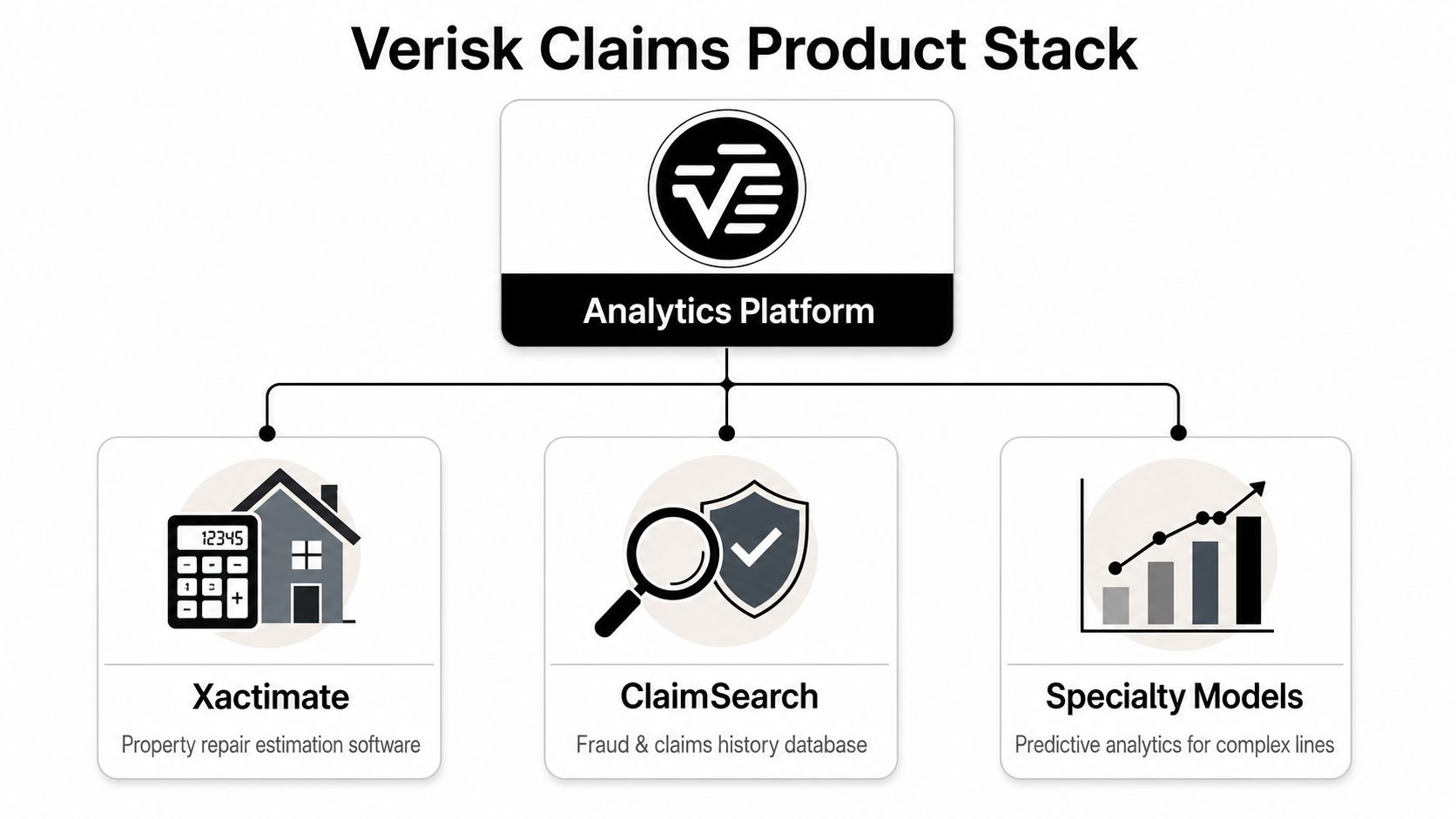
Verisk's claims stack is easier to judge if you separate estimation, history, and analytics. Xactimate sits closest to adjuster workflow, ClaimSearch anchors claims and fraud history, and Verisk's broader models extend that base into pattern recognition and decision support. That framing matters because Verisk's economics are strongest where the same claims facts can be reused across multiple decisions, rather than where a single workflow task needs to be automated in isolation.
Xactimate is the part most claims operations leaders will see first. It supports estimating work that still depends on local endpoint performance, which tells you the software is doing more than simple form entry. Estimate rendering, image handling, and line-item assembly can place real demand on the desktop even when the wider claims environment is already using cloud services.
Xactimate is the desktop-heavy workhorse
Verisk's Xactimate field software is built for claims estimation environments that still depend on local endpoint performance. Verisk recommends a quad-core x64 CPU, 16 GB RAM or more, a 30 GB SSD, an OpenGL 4.1-compatible GPU with 4 GB VRAM, and 1920×1080 resolution for best results, and it requires x64 architecture rather than ARM-based processors such as Surface Pro X Xactimate system requirements. That profile signals a practical constraint, estimate rendering, image handling, and line-item assembly can become compute-bound at the desktop even if the broader claims stack is cloud-enabled.
The operational takeaway is straightforward. Under-provisioned adjuster devices can slow field productivity before the claims platform itself becomes the bottleneck. Buyers should test the software and the endpoint environment together, because poor device fit can make a strong estimation tool look weaker than it is.
ClaimSearch and analytics sit on the same data backbone
ClaimSearch is usually described as a fraud and claims-history capability, but the more useful interpretation is that it sits on the same contributory data engine that supports estimation and benchmarking. That shared base is what gives the stack coherence. When historical records feed fraud review, estimate comparison, and model output, each module has more context than it would on its own.
Buying insight: in a demo, ask how a claim moves from first estimate to fraud review to analytics output without duplicate data entry. The value is in the handoff.
The boundary condition matters too. Verisk's strongest modules are tied to benchmark-rich claims environments, where the company has enough historical depth to make cross-file comparisons meaningful. Specialty lines and delegated authority programs can still benefit from parts of the stack, but the economics are less compelling when the underlying data is sparse, inconsistent, or too fragmented to support strong benchmarking.
For teams comparing claims platforms, claims management system design choices often determine whether a vendor improves handler throughput or adds another screen. Verisk's modules tend to work best when they sit inside an existing workbench and improve decision quality, rather than trying to replace the full claims operating model.
Typical Claims Use Cases and Realistic Outcomes
Verisk tends to appear in claims workflows that are repetitive enough to benefit from standardization, but still messy enough to require human review. That usually includes first notice of loss intake, triage, document-heavy handling, dormant-case monitoring, and some delegated authority workflows. The pattern is not full automation, it is better routing and faster assembly of information.
FNOL and document handling are the most obvious entry points
Manual claims intake can take 5 to 10 days from document receipt to human review, while automated intake can reduce that to 2 to 4 hours, according to independent insurance automation material Floowed. The same source says automation can eliminate 80 to 90% of manual data entry, cut routine claims processing time by 60 to 80%, and produce fully documented compliance audit trails.
Those ranges are useful, but they are not universal promises. They describe what is possible when the input format is predictable and the decision rules are stable. In a claims operation with inconsistent documentation, older policy records, or heavy exception handling, the gains are usually smaller.
For claims operations leaders, the practical question is not whether a system can read documents. It is whether the platform reduces rekeying, keeps the file moving, and still leaves enough control for edge cases.
Lifecycle monitoring and routing need governance, not just speed
The strongest operational use case is often file progression. A system that flags dormant claims, surfaces missing documents, and routes cases to the right handler can remove friction without pretending that every decision should be machine-made. That matters for teams that want better service quality but still need human oversight at the claim level.
Operational test: if a tool cannot explain why a file was routed, it may speed up handling but weaken auditability.
Where delegated authority is involved, auditability matters even more. Lloyd's guidance for delegated authorities replaces the older Code of Practice and formalizes oversight for coverholders and delegated claims administrators, so claims tooling needs to fit a market that already expects control and traceability Lloyd's delegated authority guidance. That does not make automation impossible, it changes the proof standard.
AI insurance claims processing workflows are most useful when they preserve the handler's ability to intervene. That is the benchmark for claims operations leaders, not whether a vendor can claim end-to-end automation in a slide deck.
Strengths and Boundary Conditions for Claims Teams
Verisk's strongest claims value shows up where claim data is repeatable, benchmarkable, and tied to familiar repair or loss patterns. The company is less persuasive where the file depends on local nuance, bespoke wording, or highly variable interpretation across jurisdictions. That split matters for buyers because it shapes where the platform reduces friction and where it adds another layer of analysis.
Where the company excels
Property remains the clearest fit because estimate writing, damage patterns, and repair benchmarking all benefit from large reference sets. Certain casualty and fraud workflows can also benefit from dense history and repeated pattern recognition, especially when the same signal can be reused across many claims. In those settings, Verisk's accumulated data functions as decision support, not just storage.
The company has also made a visible move toward AI risk and emerging-issues positioning. Verisk's Emerging Issues hub features AI among its popular topics, and Insurance Journal reported that “AI Risks” was voted the top concern in Verisk's Emerging Issues survey in June 2025 Verisk Emerging Issues hub. The practical reading is straightforward, Verisk wants to sit where insurers interpret emerging risk signals, not where they archive them.
Where expectations can outrun the data structure
Specialty lines are a different case. Marine, aviation, energy, and construction claims often carry more bespoke facts, more negotiation, and less historical uniformity than standard property claims. The same is true for many delegated authority and cross-border scenarios, where governance, documentation standards, and local rules can vary materially.
Contrarian read: the same platform can look transformative in one line and only incremental in another, because the data shape changes the economics of automation.
That boundary condition matters because it affects ROI. Buyers who assume automation benefits transfer evenly across every claims book usually overestimate the upside in complex lines and underestimate the setup required to get disciplined value from benchmarkable ones. A better question is whether the line has enough repeatability for Verisk's scale to compound rather than merely support manual review.
Claims operations also depend on how structured the work is. A platform such as Guidewire ClaimCenter can organize the file, but Verisk's value is strongest when the claim already has enough consistent inputs for benchmarking, validation, and pattern comparison. That is closer to a well-governed intake desk than to a bespoke negotiation room.
Integration and Deployment Patterns
Verisk usually sits beside existing claims systems as an analytical layer, not as a replacement for the core workbench. That matters because claims leaders generally want faster decisions, cleaner routing, and less rekeying, while keeping the file, notes, and approvals in the system their teams already use.
The stack is layered, not all-or-nothing
A practical rollout usually begins with API connections into the current claims workbench and policy systems, then routes Verisk services into analysis or enrichment. That approach avoids forcing handlers into a new primary interface just to reach benchmark data or estimation logic. It also lets IT keep ownership of the system of record while adding decision support where the claim needs it.
Verisk's recent product direction points the same way. The company has said its insurance analytics are available in Claude through standardized Verisk Model Context Protocol connectors Verisk homepage. For insurers, that kind of interoperability reduces custom integration work and makes it easier to place analytics inside AI-assisted workflows without rebuilding the data pipeline from the ground up.
Endpoint readiness still affects the user experience
The desktop requirement profile for Xactimate is easy to ignore, but it still matters. If adjuster laptops or field devices cannot handle the rendering and graphics workload, the deployment feels slower than it should, even when the central platform is well designed. Cloud delivery does not remove endpoint constraints.
Deployment planning should therefore include device testing, browser behavior, document rendering, and network latency. If those pieces are weak, handlers may blame the vendor when the bottleneck is sitting on the user's desk.
Deployment rule: budget for workflow friction at the edge, not just integration effort in the middle.
For teams comparing rollout options, Guidewire ClaimCenter integration patterns offer a useful reference for how claims platforms fit inside broader operating models. Verisk tends to complement that architecture by enriching decisions rather than replacing the system of record, which is often the right fit for benchmark-rich property lines and a weaker fit where the file is highly bespoke or heavily delegated.
Evaluating AI Risk Insights and Emerging Issues
Verisk's AI-risk messaging deserves scrutiny because surfacing a trend is not the same as changing an operating decision. A vendor can identify a developing issue without proving that the issue has been translated into underwriting rules, claims handling logic, or portfolio actions that teams use. Buyers should separate insight publication from operational adoption.
The key test is whether the signal changes a decision
If an insurer reads a risk brief and updates a guideline, that is useful. If the brief only improves internal awareness without changing a workflow, it is closer to thought leadership. Verisk's Emerging Issues hub positions the company around market interpretation, but the harder question is whether those signals are embedded into decisions at the file, book, or portfolio level Verisk Emerging Issues hub.
That distinction matters more as AI governance becomes a board-level issue in major insurance markets. Leaders do not just need a view of emerging risks, they need evidence that the signal can be turned into a controlled operational response. Without that, the output remains interesting but not decision-changing.
A useful lens is claims triage and reserving discipline
A claims triage rule works only when the input maps to an action. The same standard applies to Verisk's AI-risk claims. If an insight changes reserving review, escalation thresholds, or referral logic, it has operational weight. If it only adds another dashboard, the value is limited.
That is also why buyers should compare the output to their own controls, not to marketing language. Ask where the insight lands, who acts on it, and what exception path exists when the model is wrong. A practical pilot should test whether the signal can sit inside a claims review workflow, which is why a close look at vetting claims AI reviews is more useful than a generic feature tour.
For teams that still want to anchor the discussion in a familiar control concept, the analogy is closer to reserving benchmarks than to how mortgage underwriting works. In both cases, the signal matters only if it feeds a rule that a reviewer can defend. If the answer is vague, the feature is probably more strategic positioning than operational utility.
Buyer Evaluation Checklist and Success Criteria
A Verisk buyer should evaluate the platform as claims infrastructure with control requirements, not as a generic AI layer. The right questions are whether it improves decision quality, keeps file history defensible, and fits existing claims governance without pushing handlers into a separate way of working.
Questions to ask in the vendor review
Audit trail depth: Can handlers and reviewers see every recommendation, action, and override in a way that supports file-level auditability?
Human oversight: Where does the system require explicit approval, and how are exceptions routed back into the claims workflow?
Delegated authority controls: How does the workflow support coverholders and delegated claims administrators, with traceable controls aligned to market guidance as noted earlier?
System layering: Does the platform connect to existing claims systems through APIs, or does it require users to work in a separate portal?
Security evidence: Can the vendor provide SOC 2 Type II evidence covering the five trust principles, security, availability, processing integrity, confidentiality, and privacy SOC 2 overview?
Pilot scope: Which line of business has the most standardized files, and where will benchmark data be most useful?
Review discipline: Can the team define who validates model output, and what happens when the system disagrees with the handler?
Change control: Does the vendor show how updates are tested, documented, and rolled into production without breaking review standards?
Success signal: the pilot should reduce handoffs without weakening traceability. If handlers lose context, the implementation is not ready.
A useful pattern is to compare claims vendors the way compliance teams compare automation platforms, using concrete case evidence rather than feature lists. For that, case studies for compliance-focused firms can help teams think about control design, proof of value, and change management. The same mindset applies to vetting claims AI reviews, where the test is whether the output can survive review, exception handling, and audit scrutiny.
Verisk Evaluation Criteria for Claims Operations
Evaluation Area | Key Question to Ask | Success Signal |
|---|---|---|
Auditability | Can every recommendation, override, and data call be traced? | Clear review history and defensible file notes |
Human oversight | Where does the handler stay in the loop? | Exceptions are visible, not hidden |
Integration depth | Does it sit on top of current systems? | Minimal duplicate entry and stable handoffs |
Governance | How does it support delegated authority controls? | Alignment with oversight expectations |
Deployment readiness | Are endpoints and user devices sized properly? | Fast rendering and consistent user experience |
Pilot fit | Which line has the most structured data? | Noticeable improvement in that line first |
If you want a claims platform that automates intake, processes documents, routes work, and preserves human control, Nolana AI is built for that operating model. It fits especially well where claims teams need AI to sit on top of existing systems rather than replace them, including delegated authority workflows and audit-ready operations. Visit Nolana AI to see how that approach compares with your current claims stack.
Verisk sits on a claims-data engine that spans more than five decades, 30 petabytes, 39 billion premium and loss records, and 1.9 billion+ claims records. That's not just scale for scale's sake, it's the reason the company can act as infrastructure for property and casualty decision-making instead of merely another software vendor. For claims leaders, the core question isn't whether Verisk is large, it's where that data gravity still compounds value and where automation expectations run ahead of the underlying data structure.
What Verisk Sells and Why Scale Matters
Verisk's core product story starts with accumulation. The company reports 2.3 billion+ yearly transactions and 187,000+ new claims daily across its ecosystem, and it says its claims data system contains more than 1.5 billion claims, described as the world's largest database of P&C claims information for claims processing and investigations Verisk about page. That combination matters because claims analytics becomes more useful when it can compare a file against a deep historical baseline, not just a narrow sample.
Scale changes the quality of the benchmark
A vendor with broad contributory data can help adjusters answer questions that are hard to solve from one carrier's book alone. That is especially true in standardized property and high-volume casualty workflows, where repair patterns, loss histories, and fraud signals repeat often enough to create meaningful comparisons. Verisk's historical advantage is therefore not one product, it is the cumulative data gravity behind underwriting support, claims handling, fraud detection, and catastrophe modeling Verisk about page.
That distinction matters because it reframes the platform choice. If you are evaluating Verisk, you are not buying a generic workflow layer, you are buying access to a benchmark-rich environment where past claims become a reference point for current decisions. That tends to be more valuable when the line of business has high standardization and less valuable when each file is dominated by bespoke judgment.
Practical rule: ask whether the workflow depends on comparables or on deep case-specific judgment. Verisk's edge is strongest when comparables exist in volume.
The company's recent financial history supports the idea that this is a durable infrastructure business, not a one-cycle story. In 2025, Verisk reported $3.0727 billion in revenue, up from $2.8817 billion in 2024, with 6.6% organic constant-currency revenue growth, 8.5% adjusted EBITDA growth, and 56.2% adjusted EBITDA margin Verisk 2025 annual report. That same filing also showed diluted adjusted EPS of $7.16, up 7.8% year over year, and return on invested capital of about 27%.
The revenue signal matters for buyers too
The longer horizon matters as much as the latest year. Verisk disclosed in its SEC filing that for the five-year period ended December 31, 2021, consolidated revenue grew at an 8.7% CAGR and net income grew at 4.7% CAGR, with 2021 revenue of $2.9986 billion and net income of $666.3 million Verisk 2025 annual report. In a market where claims platforms often get judged on implementation speed alone, that kind of profitability profile suggests the company has kept buyers paying for embedded decision infrastructure over multiple cycles.
For claims operations leaders, that means Verisk should be evaluated as a decision support layer with historical depth. It is not storing claims records, it is monetizing the ability to compare, classify, and benchmark at scale. That is why the company often feels indispensable in benchmark-heavy lines and only partially persuasive in fragmented ones.
Digital insurance platform architecture in claims operations is a useful lens here because the value comes from orchestration, not from a single interface. Verisk is strongest when its data layer can sit underneath existing claims workbenches and improve the decision quality of the people already doing the work.
Core Products and Modules for Claims Operations
Verisk's claims stack is easier to judge if you separate estimation, history, and analytics. Xactimate sits closest to adjuster workflow, ClaimSearch anchors claims and fraud history, and Verisk's broader models extend that base into pattern recognition and decision support. That framing matters because Verisk's economics are strongest where the same claims facts can be reused across multiple decisions, rather than where a single workflow task needs to be automated in isolation.
Xactimate is the part most claims operations leaders will see first. It supports estimating work that still depends on local endpoint performance, which tells you the software is doing more than simple form entry. Estimate rendering, image handling, and line-item assembly can place real demand on the desktop even when the wider claims environment is already using cloud services.
Xactimate is the desktop-heavy workhorse
Verisk's Xactimate field software is built for claims estimation environments that still depend on local endpoint performance. Verisk recommends a quad-core x64 CPU, 16 GB RAM or more, a 30 GB SSD, an OpenGL 4.1-compatible GPU with 4 GB VRAM, and 1920×1080 resolution for best results, and it requires x64 architecture rather than ARM-based processors such as Surface Pro X Xactimate system requirements. That profile signals a practical constraint, estimate rendering, image handling, and line-item assembly can become compute-bound at the desktop even if the broader claims stack is cloud-enabled.
The operational takeaway is straightforward. Under-provisioned adjuster devices can slow field productivity before the claims platform itself becomes the bottleneck. Buyers should test the software and the endpoint environment together, because poor device fit can make a strong estimation tool look weaker than it is.
ClaimSearch and analytics sit on the same data backbone
ClaimSearch is usually described as a fraud and claims-history capability, but the more useful interpretation is that it sits on the same contributory data engine that supports estimation and benchmarking. That shared base is what gives the stack coherence. When historical records feed fraud review, estimate comparison, and model output, each module has more context than it would on its own.
Buying insight: in a demo, ask how a claim moves from first estimate to fraud review to analytics output without duplicate data entry. The value is in the handoff.
The boundary condition matters too. Verisk's strongest modules are tied to benchmark-rich claims environments, where the company has enough historical depth to make cross-file comparisons meaningful. Specialty lines and delegated authority programs can still benefit from parts of the stack, but the economics are less compelling when the underlying data is sparse, inconsistent, or too fragmented to support strong benchmarking.
For teams comparing claims platforms, claims management system design choices often determine whether a vendor improves handler throughput or adds another screen. Verisk's modules tend to work best when they sit inside an existing workbench and improve decision quality, rather than trying to replace the full claims operating model.
Typical Claims Use Cases and Realistic Outcomes
Verisk tends to appear in claims workflows that are repetitive enough to benefit from standardization, but still messy enough to require human review. That usually includes first notice of loss intake, triage, document-heavy handling, dormant-case monitoring, and some delegated authority workflows. The pattern is not full automation, it is better routing and faster assembly of information.
FNOL and document handling are the most obvious entry points
Manual claims intake can take 5 to 10 days from document receipt to human review, while automated intake can reduce that to 2 to 4 hours, according to independent insurance automation material Floowed. The same source says automation can eliminate 80 to 90% of manual data entry, cut routine claims processing time by 60 to 80%, and produce fully documented compliance audit trails.
Those ranges are useful, but they are not universal promises. They describe what is possible when the input format is predictable and the decision rules are stable. In a claims operation with inconsistent documentation, older policy records, or heavy exception handling, the gains are usually smaller.
For claims operations leaders, the practical question is not whether a system can read documents. It is whether the platform reduces rekeying, keeps the file moving, and still leaves enough control for edge cases.
Lifecycle monitoring and routing need governance, not just speed
The strongest operational use case is often file progression. A system that flags dormant claims, surfaces missing documents, and routes cases to the right handler can remove friction without pretending that every decision should be machine-made. That matters for teams that want better service quality but still need human oversight at the claim level.
Operational test: if a tool cannot explain why a file was routed, it may speed up handling but weaken auditability.
Where delegated authority is involved, auditability matters even more. Lloyd's guidance for delegated authorities replaces the older Code of Practice and formalizes oversight for coverholders and delegated claims administrators, so claims tooling needs to fit a market that already expects control and traceability Lloyd's delegated authority guidance. That does not make automation impossible, it changes the proof standard.
AI insurance claims processing workflows are most useful when they preserve the handler's ability to intervene. That is the benchmark for claims operations leaders, not whether a vendor can claim end-to-end automation in a slide deck.
Strengths and Boundary Conditions for Claims Teams
Verisk's strongest claims value shows up where claim data is repeatable, benchmarkable, and tied to familiar repair or loss patterns. The company is less persuasive where the file depends on local nuance, bespoke wording, or highly variable interpretation across jurisdictions. That split matters for buyers because it shapes where the platform reduces friction and where it adds another layer of analysis.
Where the company excels
Property remains the clearest fit because estimate writing, damage patterns, and repair benchmarking all benefit from large reference sets. Certain casualty and fraud workflows can also benefit from dense history and repeated pattern recognition, especially when the same signal can be reused across many claims. In those settings, Verisk's accumulated data functions as decision support, not just storage.
The company has also made a visible move toward AI risk and emerging-issues positioning. Verisk's Emerging Issues hub features AI among its popular topics, and Insurance Journal reported that “AI Risks” was voted the top concern in Verisk's Emerging Issues survey in June 2025 Verisk Emerging Issues hub. The practical reading is straightforward, Verisk wants to sit where insurers interpret emerging risk signals, not where they archive them.
Where expectations can outrun the data structure
Specialty lines are a different case. Marine, aviation, energy, and construction claims often carry more bespoke facts, more negotiation, and less historical uniformity than standard property claims. The same is true for many delegated authority and cross-border scenarios, where governance, documentation standards, and local rules can vary materially.
Contrarian read: the same platform can look transformative in one line and only incremental in another, because the data shape changes the economics of automation.
That boundary condition matters because it affects ROI. Buyers who assume automation benefits transfer evenly across every claims book usually overestimate the upside in complex lines and underestimate the setup required to get disciplined value from benchmarkable ones. A better question is whether the line has enough repeatability for Verisk's scale to compound rather than merely support manual review.
Claims operations also depend on how structured the work is. A platform such as Guidewire ClaimCenter can organize the file, but Verisk's value is strongest when the claim already has enough consistent inputs for benchmarking, validation, and pattern comparison. That is closer to a well-governed intake desk than to a bespoke negotiation room.
Integration and Deployment Patterns
Verisk usually sits beside existing claims systems as an analytical layer, not as a replacement for the core workbench. That matters because claims leaders generally want faster decisions, cleaner routing, and less rekeying, while keeping the file, notes, and approvals in the system their teams already use.
The stack is layered, not all-or-nothing
A practical rollout usually begins with API connections into the current claims workbench and policy systems, then routes Verisk services into analysis or enrichment. That approach avoids forcing handlers into a new primary interface just to reach benchmark data or estimation logic. It also lets IT keep ownership of the system of record while adding decision support where the claim needs it.
Verisk's recent product direction points the same way. The company has said its insurance analytics are available in Claude through standardized Verisk Model Context Protocol connectors Verisk homepage. For insurers, that kind of interoperability reduces custom integration work and makes it easier to place analytics inside AI-assisted workflows without rebuilding the data pipeline from the ground up.
Endpoint readiness still affects the user experience
The desktop requirement profile for Xactimate is easy to ignore, but it still matters. If adjuster laptops or field devices cannot handle the rendering and graphics workload, the deployment feels slower than it should, even when the central platform is well designed. Cloud delivery does not remove endpoint constraints.
Deployment planning should therefore include device testing, browser behavior, document rendering, and network latency. If those pieces are weak, handlers may blame the vendor when the bottleneck is sitting on the user's desk.
Deployment rule: budget for workflow friction at the edge, not just integration effort in the middle.
For teams comparing rollout options, Guidewire ClaimCenter integration patterns offer a useful reference for how claims platforms fit inside broader operating models. Verisk tends to complement that architecture by enriching decisions rather than replacing the system of record, which is often the right fit for benchmark-rich property lines and a weaker fit where the file is highly bespoke or heavily delegated.
Evaluating AI Risk Insights and Emerging Issues
Verisk's AI-risk messaging deserves scrutiny because surfacing a trend is not the same as changing an operating decision. A vendor can identify a developing issue without proving that the issue has been translated into underwriting rules, claims handling logic, or portfolio actions that teams use. Buyers should separate insight publication from operational adoption.
The key test is whether the signal changes a decision
If an insurer reads a risk brief and updates a guideline, that is useful. If the brief only improves internal awareness without changing a workflow, it is closer to thought leadership. Verisk's Emerging Issues hub positions the company around market interpretation, but the harder question is whether those signals are embedded into decisions at the file, book, or portfolio level Verisk Emerging Issues hub.
That distinction matters more as AI governance becomes a board-level issue in major insurance markets. Leaders do not just need a view of emerging risks, they need evidence that the signal can be turned into a controlled operational response. Without that, the output remains interesting but not decision-changing.
A useful lens is claims triage and reserving discipline
A claims triage rule works only when the input maps to an action. The same standard applies to Verisk's AI-risk claims. If an insight changes reserving review, escalation thresholds, or referral logic, it has operational weight. If it only adds another dashboard, the value is limited.
That is also why buyers should compare the output to their own controls, not to marketing language. Ask where the insight lands, who acts on it, and what exception path exists when the model is wrong. A practical pilot should test whether the signal can sit inside a claims review workflow, which is why a close look at vetting claims AI reviews is more useful than a generic feature tour.
For teams that still want to anchor the discussion in a familiar control concept, the analogy is closer to reserving benchmarks than to how mortgage underwriting works. In both cases, the signal matters only if it feeds a rule that a reviewer can defend. If the answer is vague, the feature is probably more strategic positioning than operational utility.
Buyer Evaluation Checklist and Success Criteria
A Verisk buyer should evaluate the platform as claims infrastructure with control requirements, not as a generic AI layer. The right questions are whether it improves decision quality, keeps file history defensible, and fits existing claims governance without pushing handlers into a separate way of working.
Questions to ask in the vendor review
Audit trail depth: Can handlers and reviewers see every recommendation, action, and override in a way that supports file-level auditability?
Human oversight: Where does the system require explicit approval, and how are exceptions routed back into the claims workflow?
Delegated authority controls: How does the workflow support coverholders and delegated claims administrators, with traceable controls aligned to market guidance as noted earlier?
System layering: Does the platform connect to existing claims systems through APIs, or does it require users to work in a separate portal?
Security evidence: Can the vendor provide SOC 2 Type II evidence covering the five trust principles, security, availability, processing integrity, confidentiality, and privacy SOC 2 overview?
Pilot scope: Which line of business has the most standardized files, and where will benchmark data be most useful?
Review discipline: Can the team define who validates model output, and what happens when the system disagrees with the handler?
Change control: Does the vendor show how updates are tested, documented, and rolled into production without breaking review standards?
Success signal: the pilot should reduce handoffs without weakening traceability. If handlers lose context, the implementation is not ready.
A useful pattern is to compare claims vendors the way compliance teams compare automation platforms, using concrete case evidence rather than feature lists. For that, case studies for compliance-focused firms can help teams think about control design, proof of value, and change management. The same mindset applies to vetting claims AI reviews, where the test is whether the output can survive review, exception handling, and audit scrutiny.
Verisk Evaluation Criteria for Claims Operations
Evaluation Area | Key Question to Ask | Success Signal |
|---|---|---|
Auditability | Can every recommendation, override, and data call be traced? | Clear review history and defensible file notes |
Human oversight | Where does the handler stay in the loop? | Exceptions are visible, not hidden |
Integration depth | Does it sit on top of current systems? | Minimal duplicate entry and stable handoffs |
Governance | How does it support delegated authority controls? | Alignment with oversight expectations |
Deployment readiness | Are endpoints and user devices sized properly? | Fast rendering and consistent user experience |
Pilot fit | Which line has the most structured data? | Noticeable improvement in that line first |
If you want a claims platform that automates intake, processes documents, routes work, and preserves human control, Nolana AI is built for that operating model. It fits especially well where claims teams need AI to sit on top of existing systems rather than replace them, including delegated authority workflows and audit-ready operations. Visit Nolana AI to see how that approach compares with your current claims stack.


All systems operational
1 Lime Street, London EC3M 7HA | 222E 3rd Street, New York 10009
Copyright © 2026, Nolana. All rights reserved
All systems operational
1 Lime Street, London EC3M 7HA | 222E 3rd Street, New York 10009
Copyright © 2026, Nolana. All rights reserved
All systems operational
1 Lime Street, London EC3M 7HA | 222E 3rd Street, New York 10009
Copyright © 2026, Nolana. All rights reserved
All systems operational
1 Lime Street, London EC3M 7HA | 222E 3rd Street, New York 10009
Copyright © 2026, Nolana. All rights reserved