Guidewire Claim Center: Workflows & Automation
Guidewire Claim Center: Workflows & Automation
Discover Guidewire Claim Center architecture, workflows, and automation. See how AI enhances claims decisioning.

If you're staring at a claims backlog that keeps spilling across teams, you already know the problem isn't just volume. The harder issue is orchestration, who owns the file, which system tells the truth, and how much of the work still depends on a handler manually stitching together emails, policy data, documents, and reserve decisions.
That's where Guidewire ClaimCenter keeps coming up in serious claims conversations. It isn't treated as a niche tool because it's been in market since 2003, and a North America P&C insurance vendor analysis lists the current release as Innsbruck 2023.3 with a release date of December 2024 in the market for more than two decades. That longevity matters because claims leaders don't bet their operating model on software that can't survive regulatory change, product evolution, and shifting customer expectations.
Why Guidewire ClaimCenter Remains the Industry Standard
A claims executive I worked with had the same question many teams ask before a platform review, why keep investing in a system this large when the market keeps promising lighter, faster alternatives? The answer wasn't sentiment, it was control. ClaimCenter sits where claims operations live, between intake, triage, handling, financial movement, and recovery, and that's why it tends to become the system leaders organize around rather than around.
The historical case is straightforward. Guidewire was founded in 2001, had 685 employees and $144.7 million in revenue in 2010, and served a client base of 103 with global coverage according to Guidewire's own analysis. More important than the vintage of those numbers is the pattern they show, a platform built early, adopted broadly, and then continuously extended instead of being replaced by point solutions.
Why that still matters in claims operations
Claims teams don't just need a place to store a file. They need a place where routing rules, reserve handling, recovery, correspondence, and supervision can work off the same claim record. Guidewire's own claims materials frame ClaimCenter as an end-to-end system for all lines of business, from new loss entry through investigation, settlement, and recovery, with supervisors seeing real-time visibility into operations and specific claims flagged for extra attention as described in Guidewire's claims excellence paper.
That's why many carriers treat ClaimCenter like a core operating layer, not a feature module. The platform's value isn't that it does one task well, it's that it gives claims leaders a common operational spine. The harder question is what happens around that spine, because the platform only creates value when the surrounding ecosystem, policy, billing, vendors, analytics, and communications, is wired into it cleanly.
Practical rule: A claims core system earns its keep when handlers can work one file without constantly leaving it to ask other systems for basic facts.
For insurers evaluating their broader stack, a useful context piece is this overview of Guidewire software and the ecosystem around it. The platform's staying power comes from being embedded in operating reality, not from being fashionable.
Understanding the Architecture and Data Model
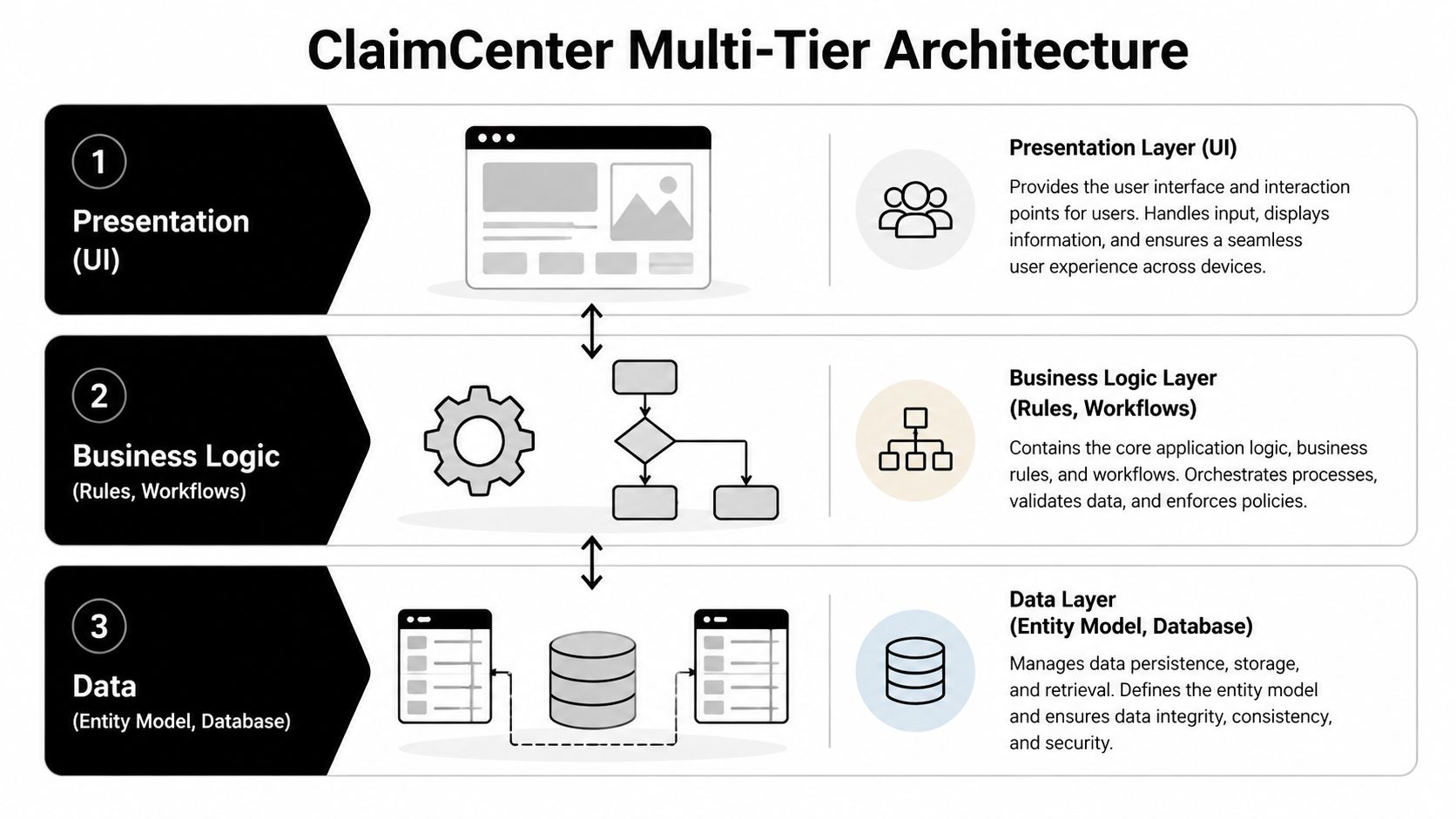
ClaimCenter is built like a layered operating system for claims. The interface sits on top, the workflow and rules engine sit in the middle, and the data, transaction handling, and integration services sit underneath. Guidewire ClaimCenter uses a multi-tier architecture that separates presentation, business logic, persistence, database, integration, messaging, security, and reporting concerns, so teams can change one layer without forcing a rebuild of the others as documented in the architecture guide.
That structure matters in day-to-day claims operations. A carrier can change routing rules, intake prompts, or approval thresholds without asking the technology team to redesign the front end every time the process changes. The Gosu business rules layer is where claim intake, adjudication, and workflow logic can be adjusted while the user experience stays stable. REST and SOAP services, plus asynchronous messaging, let ClaimCenter exchange data with policy, billing, and vendor platforms without stitching every dependency directly into the core. For teams that want a broader view of how a claims platform sits inside the larger technology stack, this overview of claims management systems and how they fit into the broader stack is a useful reference.
Why the data model matters to handlers, not just architects
The data model affects handlers every day, even if they never look at an architecture diagram. ClaimCenter centers the file around a single top-level claim entity with related exposures and payments, and training material describes the full claim record as processed and saved as a single transaction in the claim entity in this Guidewire training video. That reduces the chance of half-updated facts, reserve changes that do not align with the rest of the file, or payment activity that lives in a separate corner of the system.
For operations leaders, that transaction model has two clear benefits. It supports a cleaner audit trail because the claim history stays tied to one operational record. It also makes downstream settlement, reserve management, and reporting easier to trust because the platform is not asking different parts of the file to behave like separate systems.
A claims core should make it easier to answer three questions fast, what happened, who touched it, and what changed financially.
The model also affects how you handle complicated files. When a claim moves into dispute, total loss review, or a difficult settlement path, the system still has to keep exposure data, financials, and diary activity aligned while handlers make judgment calls. That is where a rules engine and a clean transaction model help, but they do not replace judgment. A handler still needs to interpret exceptions, and in cases like a fair settlement for a totaled vehicle, the platform has to support the workflow without pretending the decision is fully automated. Agentic AI layers can sit on top of that record to surface missing facts, suggest next steps, and reduce duplicate handling, which is the practical gap between a strong core system and an operating model that can keep up with complex claims.
Core Claims Workflows from Intake to Closure
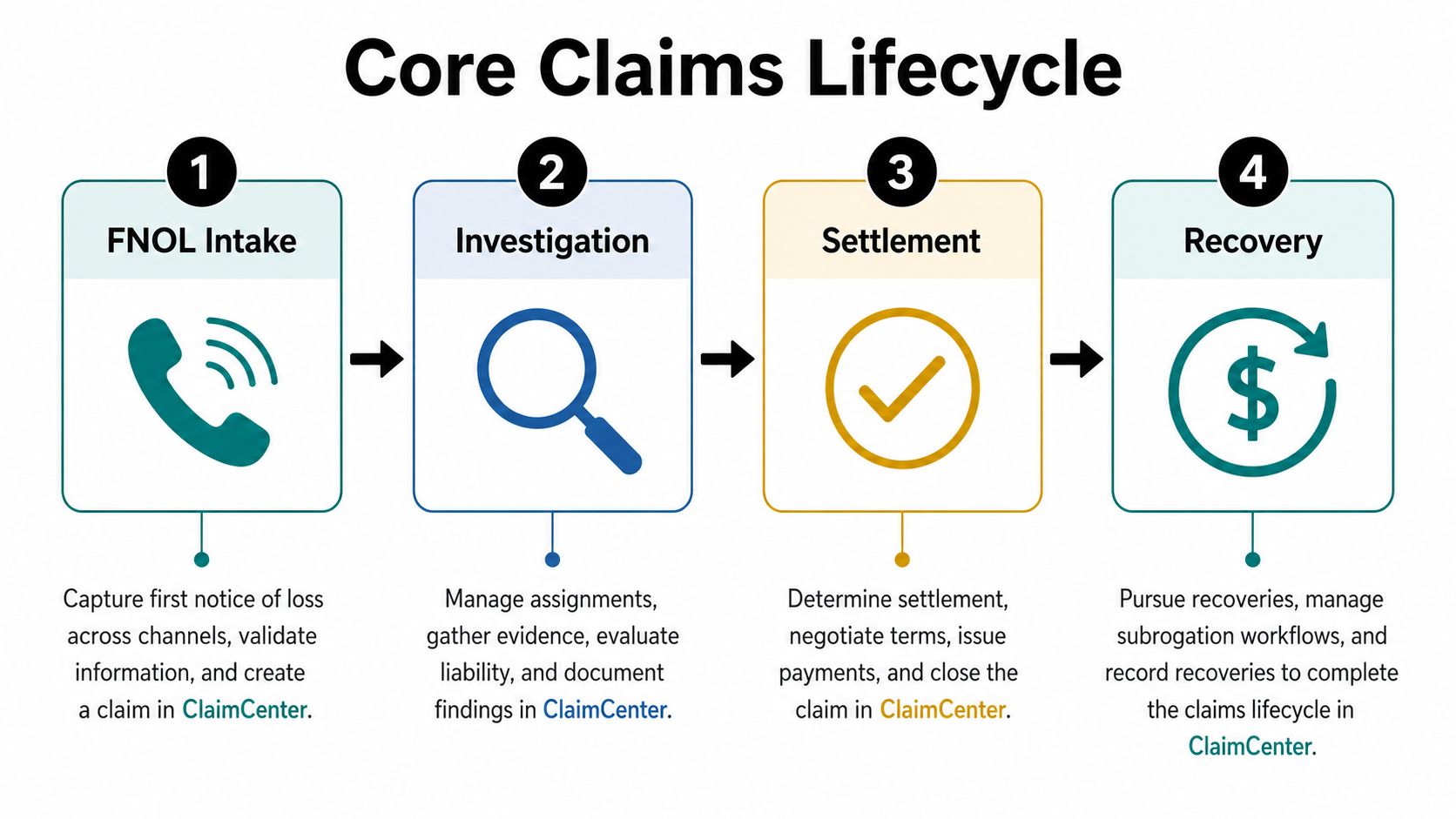
A serious FNOL process is where claims platforms either create discipline or create rework. Guidewire says ClaimCenter supports the full claims lifecycle from claim intake to closure, and its digital intake uses wizard-based, dynamic, response-driven questions integrated with policy search and retrieval, with real-time guidance inside the workflow on the product page. That matters because the handler is not just entering data. They are making first-pass triage decisions while the system is still collecting facts.
FNOL intake that guides, not just records
The best FNOL screens do not ask for everything, they ask for the next right thing. In ClaimCenter, the intake flow can steer users through policy lookups and response-based questions so the handler does not need to jump between systems just to establish basic coverage context. That is a real difference from generic case management tools, where intake often becomes a long form with no operational intelligence behind it.
The same logic carries through the rest of the file. Guidewire's brochure says ClaimCenter supports all lines of personal, commercial, and workers' compensation insurance, and can be deployed as a stand-alone solution or as part of InsuranceSuite, with features like embedded analytics, automated triggers and escalations, visual catastrophe claim mapping, integrated fraud detection, and real-time claims performance monitoring in the brochure. That combination turns intake into a controlled handoff into the rest of the workflow.
Assignment, monitoring, and closure
The Japanese brochure is unusually direct about the operating model. It describes a rules-based workflow where claims are segmented and assigned to one or more claim professionals, then monitored so all appropriate steps are taken before closure, with best practices automatically encompassed in the workplan and continuously monitored, including litigated matters and negotiation details from Guidewire's Japanese overview.
That model works well for the files that fit a defined path. It starts to strain when a claim needs outside valuation support, negotiation back-and-forth, or specialist judgment before the file can close. A fair settlement for a totaled vehicle often requires more than a standard task queue, because the appraisal logic, documentation, and settlement discussion all have to stay aligned while the handler still owns the file.
ClaimCenter is strongest as an orchestration layer. It routes work, monitors progress, and keeps the core record coherent while handlers make judgment calls inside the workflow. For a broader view of how that operating model works in practice, see claims management systems in practice.
Where Automation Gains Meet Implementation Reality
Automation sounds clean on paper because it gets described in the abstract. Claims leaders know the mess lives in the exceptions, the legacy integrations, and the files that don't fit a standard path. A 2025 academic-style review of automated claims processing in Guidewire ClaimCenter reports up to 50% faster settlement time and up to 30% lower adjuster workload, but it also flags integration complexity, workforce adaptation, AI limitations, and difficulty handling complex claims as major challenges in the review. Those two facts belong together.
The issue isn't whether the platform can automate. It can. The key question is which claims benefit most, and which ones need a human decision layer no matter how good the workflow design is. Severity escalation, subrogation detection, and litigation risk detection are exactly the sort of use cases where automation adds value, because the system can surface signals, prioritize the right files, and reduce the amount of time handlers spend hunting for the next action.
The operating-model friction most teams underestimate
A claims core only works as promised when data definitions are stable and the surrounding integrations are reliable. If policy data is inconsistent, if document sources are messy, or if the vendor ecosystem is fragmented, the automation layer starts to slow down instead of speed up. That's why a lot of implementation pain shows up in the middle of the project, after the demo wins are already sold.
Practical warning: If your exceptions live outside the workflow design, the automation will look good in steering meetings and weak in production.
The best way to think about this is not full straight-through processing for every claim. It's targeted automation where the business rules are dependable and the exceptions can be escalated quickly. That's especially true in complex or multi-party claims, where the file needs context, judgment, and human accountability more than another routing rule.
For teams evaluating the broader automation options, the lesson from workflow automation in other industries is still useful. Software can remove administrative friction, but only if the underlying process is structured enough to absorb the change. ClaimCenter gives insurers the rails. It does not eliminate the need for operating discipline.
Augmenting ClaimCenter with Agentic AI Platforms
What many insurers really need is not a replacement for ClaimCenter, it's a layer that handles the repetitive work surrounding it. That's where agentic AI platforms fit. Nolana is built to automate claims lifecycle operations for the Lloyd's market, handling FNOL intake, claims triage, static claims management, and document processing while keeping human oversight and auditability in place. It sits on top of existing claims and policy systems, which matters because most carriers and market participants can't afford a rip-and-replace project.
The operating-model shift is simple to describe and hard to execute well. ClaimCenter remains the system of record and orchestration backbone, while an AI layer absorbs the intake churn, document extraction, follow-up work, and routine status checks that consume handler time. That's a more realistic answer than pretending every file should become touchless.
Where an AI layer actually helps
The value shows up in the edges of the workflow. A platform like Nolana can process inbound documents, extract structured data, monitor claim progress to flag dormant cases, and recommend next best actions directly inside existing workflows. It also supports delegated authority triage for Lloyd's and London market scenarios, where coverholders, brokers, and managing agents need fast routing with clear audit trails. Its cross-channel model spans email, web, chat, voice, and call center, which reduces the gap between where a claim arrives and where the core system records it.
That matters because the claims burden isn't just decision-making. It's copying details, reconciling versions, chasing missing information, and making sure the right person sees the right file at the right time. Agentic AI is useful when it removes that administrative drag without hiding the decision path.
For readers comparing AI operating models, the agentic AI overview is a helpful companion. The core point is that augmentation works best when the AI layer delegates, routes, extracts, and follows up while the human handler keeps authority over complex or sensitive decisions.
The governance advantage
Nolana's enterprise posture is built around audit-ready logging, explainability, and API integration with existing tools, so teams keep working in the systems they already know. That's a key change-management win. When the AI layer sits on top of current workflows instead of forcing a new portal, adoption is usually less disruptive and oversight is easier to preserve.
The best augmentation doesn't ask handlers to learn a new universe. It gives them a cleaner queue, better context, and fewer chores.
That's also why this topic keeps coming back to operating model instead of feature lists. ClaimCenter provides control and consistency. An agentic layer adds reach, especially where service quality drops because staff are overloaded by routine work. In the Lloyd's market, that combination can strengthen governance while scaling claim operations without loosening oversight.
Deployment Options and Implementation Considerations
A ClaimCenter deployment decision changes more than infrastructure. It shapes how claims work, how quickly the business can absorb change, and how much control operations keeps over the file. Guidewire notes that ClaimCenter can run as a stand-alone solution or as part of Guidewire InsuranceSuite, and that distinction matters because it affects how policy, billing, and claims are coordinated across the enterprise in the brochure.
A stand-alone deployment often fits a claims organization that needs to modernize before the rest of the stack is ready. InsuranceSuite fits better when the enterprise wants tighter alignment across core systems and can support a broader program. Either path still requires integration work, because ClaimCenter needs to exchange data with policy administration, billing, and external vendor systems through services and messaging patterns as described in the architecture reference.
What usually creates friction
The hard part is usually the operating model, not the software. Handlers need training, supervisors need new control points, and operations leaders have to decide which fields stay mandatory, which become standardized, and which remain exception-based. If those choices are left too late, go-live stops being a software deployment and becomes a process redesign under pressure.
Data quality is the other recurring issue. Claims platforms do not correct inconsistent source data on their own. They surface it faster, so a messy policy record, incomplete party data, or an unclear vendor master file shows up early in the rollout. That can be uncomfortable, but it is better than discovering those gaps after the organization is already live and dependent on the new workflow.
For a broader view of platform selection and integration posture, this overview of digital insurance platforms helps frame the trade-offs. The core question is not cloud versus on-premise in isolation. It is whether the operating model can support the amount of change the target architecture asks for.
Implementation reality from the handler's seat
The best implementations spend time on the queue, not just the diagram. If the handler workflow is unclear, the system gets blamed for an operating design problem. Early work should focus on standardized data definitions, clear exception handling, and supervisor visibility into where files stall.
Once those pieces are in place, ClaimCenter can serve as a stable core with broad reach. When they are missing, the platform still functions, but teams begin improvising around it. That is where value leaks, and where implementation teams usually learn that orchestration capability only works when the handler workflow is designed to match it.
Measuring Success with Claims KPIs and Business Value
A claims platform can look weaker than it is if the KPI stack is badly chosen. Speed matters, but it cannot be the only measure. Guidewire's benchmark claims outcomes show customers paying their typical claim in 18 days versus an industry average of 21 days, and it cited one Amica homeowner claim paid in 11 days; Guidewire framed that as about 14% faster than the industry on its benchmark metric. Those figures are useful, but a claims leader should treat them as one part of the picture, not the whole business case.
The better test is whether the operation is becoming more controlled as it gets faster. If cycle time improves while exceptions become harder to audit, the team has traded one problem for another. Supervisors need real-time visibility into file flow, because that is how they see where work is moving cleanly and where handlers are starting to improvise around the system.

The KPIs that deserve board attention
A useful scorecard starts with a baseline before implementation, then tracks change through rollout. I would track a mix of operational, financial, and governance measures, because throughput alone hides too much.
Cycle time by claim type: Separate simple, moderate, and complex files so the fastest claims do not mask the slow ones.
Exception handling efficiency: Measure how quickly atypical files reach the right expert and return to the normal path.
Auditability and reserve discipline: Check whether the file history supports clean reviews, stable financial tracking, and defensible decisions.
Customer-facing responsiveness: Track whether policyholders get consistent updates instead of repeating the same information across channels.
That mix is where business value shows up. Speed without control is faster confusion. Control without speed becomes a backlog with better documentation.
Why embedded analytics matter
ClaimCenter's embedded analytics and real-time monitoring help supervisors intervene before a file goes stale as listed in Guidewire's brochure. That matters even more when the platform sits beside automation layers that surface dormant cases or suggest the next action. The strongest ROI case usually comes from fewer handoffs, cleaner reserves, better recovery activity, and more reliable handling quality.
For teams building an internal business case, this guide on measuring operational efficiency in claims operations is a practical reference. Claims automation should be judged on governance as much as throughput, because the value is cleaner decisions, not just faster file closure.
Making the Strategic Case for ClaimCenter with AI Augmentation
ClaimCenter is strongest when it stays what it already is, a foundational claims core with serious orchestration depth. The platform's real limitation isn't that it lacks process control. It's that handlers still spend too much time on administrative work, cross-system lookups, and low-value follow-up. That's where an AI layer earns its place.
The strategic case is simple. Use ClaimCenter as the operational backbone, then add agentic AI where the work is repetitive, distributed, and audit-sensitive. That combination preserves human oversight while reducing the work that keeps experienced handlers from focusing on the files that need judgment. For claims leaders, the next move is to identify where the workflow is broken by friction, not by policy, and then decide whether the fix belongs in the core system or in an augmentation layer.
If you're evaluating your current claims operation, start with three questions. Where do handlers lose the most time. Which exceptions repeatedly fall outside the standard workflow. And what can be automated without weakening governance. The answers usually point toward a hybrid model, not a wholesale replacement.
Nolana AI fits that hybrid model by automating FNOL intake, claims triage, document processing, and claim monitoring on top of existing systems. If you're ready to see how that approach could support your claims operation, visit Nolana AI and review how its platform fits into your current claims stack.
If you're staring at a claims backlog that keeps spilling across teams, you already know the problem isn't just volume. The harder issue is orchestration, who owns the file, which system tells the truth, and how much of the work still depends on a handler manually stitching together emails, policy data, documents, and reserve decisions.
That's where Guidewire ClaimCenter keeps coming up in serious claims conversations. It isn't treated as a niche tool because it's been in market since 2003, and a North America P&C insurance vendor analysis lists the current release as Innsbruck 2023.3 with a release date of December 2024 in the market for more than two decades. That longevity matters because claims leaders don't bet their operating model on software that can't survive regulatory change, product evolution, and shifting customer expectations.
Why Guidewire ClaimCenter Remains the Industry Standard
A claims executive I worked with had the same question many teams ask before a platform review, why keep investing in a system this large when the market keeps promising lighter, faster alternatives? The answer wasn't sentiment, it was control. ClaimCenter sits where claims operations live, between intake, triage, handling, financial movement, and recovery, and that's why it tends to become the system leaders organize around rather than around.
The historical case is straightforward. Guidewire was founded in 2001, had 685 employees and $144.7 million in revenue in 2010, and served a client base of 103 with global coverage according to Guidewire's own analysis. More important than the vintage of those numbers is the pattern they show, a platform built early, adopted broadly, and then continuously extended instead of being replaced by point solutions.
Why that still matters in claims operations
Claims teams don't just need a place to store a file. They need a place where routing rules, reserve handling, recovery, correspondence, and supervision can work off the same claim record. Guidewire's own claims materials frame ClaimCenter as an end-to-end system for all lines of business, from new loss entry through investigation, settlement, and recovery, with supervisors seeing real-time visibility into operations and specific claims flagged for extra attention as described in Guidewire's claims excellence paper.
That's why many carriers treat ClaimCenter like a core operating layer, not a feature module. The platform's value isn't that it does one task well, it's that it gives claims leaders a common operational spine. The harder question is what happens around that spine, because the platform only creates value when the surrounding ecosystem, policy, billing, vendors, analytics, and communications, is wired into it cleanly.
Practical rule: A claims core system earns its keep when handlers can work one file without constantly leaving it to ask other systems for basic facts.
For insurers evaluating their broader stack, a useful context piece is this overview of Guidewire software and the ecosystem around it. The platform's staying power comes from being embedded in operating reality, not from being fashionable.
Understanding the Architecture and Data Model
ClaimCenter is built like a layered operating system for claims. The interface sits on top, the workflow and rules engine sit in the middle, and the data, transaction handling, and integration services sit underneath. Guidewire ClaimCenter uses a multi-tier architecture that separates presentation, business logic, persistence, database, integration, messaging, security, and reporting concerns, so teams can change one layer without forcing a rebuild of the others as documented in the architecture guide.
That structure matters in day-to-day claims operations. A carrier can change routing rules, intake prompts, or approval thresholds without asking the technology team to redesign the front end every time the process changes. The Gosu business rules layer is where claim intake, adjudication, and workflow logic can be adjusted while the user experience stays stable. REST and SOAP services, plus asynchronous messaging, let ClaimCenter exchange data with policy, billing, and vendor platforms without stitching every dependency directly into the core. For teams that want a broader view of how a claims platform sits inside the larger technology stack, this overview of claims management systems and how they fit into the broader stack is a useful reference.
Why the data model matters to handlers, not just architects
The data model affects handlers every day, even if they never look at an architecture diagram. ClaimCenter centers the file around a single top-level claim entity with related exposures and payments, and training material describes the full claim record as processed and saved as a single transaction in the claim entity in this Guidewire training video. That reduces the chance of half-updated facts, reserve changes that do not align with the rest of the file, or payment activity that lives in a separate corner of the system.
For operations leaders, that transaction model has two clear benefits. It supports a cleaner audit trail because the claim history stays tied to one operational record. It also makes downstream settlement, reserve management, and reporting easier to trust because the platform is not asking different parts of the file to behave like separate systems.
A claims core should make it easier to answer three questions fast, what happened, who touched it, and what changed financially.
The model also affects how you handle complicated files. When a claim moves into dispute, total loss review, or a difficult settlement path, the system still has to keep exposure data, financials, and diary activity aligned while handlers make judgment calls. That is where a rules engine and a clean transaction model help, but they do not replace judgment. A handler still needs to interpret exceptions, and in cases like a fair settlement for a totaled vehicle, the platform has to support the workflow without pretending the decision is fully automated. Agentic AI layers can sit on top of that record to surface missing facts, suggest next steps, and reduce duplicate handling, which is the practical gap between a strong core system and an operating model that can keep up with complex claims.
Core Claims Workflows from Intake to Closure
A serious FNOL process is where claims platforms either create discipline or create rework. Guidewire says ClaimCenter supports the full claims lifecycle from claim intake to closure, and its digital intake uses wizard-based, dynamic, response-driven questions integrated with policy search and retrieval, with real-time guidance inside the workflow on the product page. That matters because the handler is not just entering data. They are making first-pass triage decisions while the system is still collecting facts.
FNOL intake that guides, not just records
The best FNOL screens do not ask for everything, they ask for the next right thing. In ClaimCenter, the intake flow can steer users through policy lookups and response-based questions so the handler does not need to jump between systems just to establish basic coverage context. That is a real difference from generic case management tools, where intake often becomes a long form with no operational intelligence behind it.
The same logic carries through the rest of the file. Guidewire's brochure says ClaimCenter supports all lines of personal, commercial, and workers' compensation insurance, and can be deployed as a stand-alone solution or as part of InsuranceSuite, with features like embedded analytics, automated triggers and escalations, visual catastrophe claim mapping, integrated fraud detection, and real-time claims performance monitoring in the brochure. That combination turns intake into a controlled handoff into the rest of the workflow.
Assignment, monitoring, and closure
The Japanese brochure is unusually direct about the operating model. It describes a rules-based workflow where claims are segmented and assigned to one or more claim professionals, then monitored so all appropriate steps are taken before closure, with best practices automatically encompassed in the workplan and continuously monitored, including litigated matters and negotiation details from Guidewire's Japanese overview.
That model works well for the files that fit a defined path. It starts to strain when a claim needs outside valuation support, negotiation back-and-forth, or specialist judgment before the file can close. A fair settlement for a totaled vehicle often requires more than a standard task queue, because the appraisal logic, documentation, and settlement discussion all have to stay aligned while the handler still owns the file.
ClaimCenter is strongest as an orchestration layer. It routes work, monitors progress, and keeps the core record coherent while handlers make judgment calls inside the workflow. For a broader view of how that operating model works in practice, see claims management systems in practice.
Where Automation Gains Meet Implementation Reality
Automation sounds clean on paper because it gets described in the abstract. Claims leaders know the mess lives in the exceptions, the legacy integrations, and the files that don't fit a standard path. A 2025 academic-style review of automated claims processing in Guidewire ClaimCenter reports up to 50% faster settlement time and up to 30% lower adjuster workload, but it also flags integration complexity, workforce adaptation, AI limitations, and difficulty handling complex claims as major challenges in the review. Those two facts belong together.
The issue isn't whether the platform can automate. It can. The key question is which claims benefit most, and which ones need a human decision layer no matter how good the workflow design is. Severity escalation, subrogation detection, and litigation risk detection are exactly the sort of use cases where automation adds value, because the system can surface signals, prioritize the right files, and reduce the amount of time handlers spend hunting for the next action.
The operating-model friction most teams underestimate
A claims core only works as promised when data definitions are stable and the surrounding integrations are reliable. If policy data is inconsistent, if document sources are messy, or if the vendor ecosystem is fragmented, the automation layer starts to slow down instead of speed up. That's why a lot of implementation pain shows up in the middle of the project, after the demo wins are already sold.
Practical warning: If your exceptions live outside the workflow design, the automation will look good in steering meetings and weak in production.
The best way to think about this is not full straight-through processing for every claim. It's targeted automation where the business rules are dependable and the exceptions can be escalated quickly. That's especially true in complex or multi-party claims, where the file needs context, judgment, and human accountability more than another routing rule.
For teams evaluating the broader automation options, the lesson from workflow automation in other industries is still useful. Software can remove administrative friction, but only if the underlying process is structured enough to absorb the change. ClaimCenter gives insurers the rails. It does not eliminate the need for operating discipline.
Augmenting ClaimCenter with Agentic AI Platforms
What many insurers really need is not a replacement for ClaimCenter, it's a layer that handles the repetitive work surrounding it. That's where agentic AI platforms fit. Nolana is built to automate claims lifecycle operations for the Lloyd's market, handling FNOL intake, claims triage, static claims management, and document processing while keeping human oversight and auditability in place. It sits on top of existing claims and policy systems, which matters because most carriers and market participants can't afford a rip-and-replace project.
The operating-model shift is simple to describe and hard to execute well. ClaimCenter remains the system of record and orchestration backbone, while an AI layer absorbs the intake churn, document extraction, follow-up work, and routine status checks that consume handler time. That's a more realistic answer than pretending every file should become touchless.
Where an AI layer actually helps
The value shows up in the edges of the workflow. A platform like Nolana can process inbound documents, extract structured data, monitor claim progress to flag dormant cases, and recommend next best actions directly inside existing workflows. It also supports delegated authority triage for Lloyd's and London market scenarios, where coverholders, brokers, and managing agents need fast routing with clear audit trails. Its cross-channel model spans email, web, chat, voice, and call center, which reduces the gap between where a claim arrives and where the core system records it.
That matters because the claims burden isn't just decision-making. It's copying details, reconciling versions, chasing missing information, and making sure the right person sees the right file at the right time. Agentic AI is useful when it removes that administrative drag without hiding the decision path.
For readers comparing AI operating models, the agentic AI overview is a helpful companion. The core point is that augmentation works best when the AI layer delegates, routes, extracts, and follows up while the human handler keeps authority over complex or sensitive decisions.
The governance advantage
Nolana's enterprise posture is built around audit-ready logging, explainability, and API integration with existing tools, so teams keep working in the systems they already know. That's a key change-management win. When the AI layer sits on top of current workflows instead of forcing a new portal, adoption is usually less disruptive and oversight is easier to preserve.
The best augmentation doesn't ask handlers to learn a new universe. It gives them a cleaner queue, better context, and fewer chores.
That's also why this topic keeps coming back to operating model instead of feature lists. ClaimCenter provides control and consistency. An agentic layer adds reach, especially where service quality drops because staff are overloaded by routine work. In the Lloyd's market, that combination can strengthen governance while scaling claim operations without loosening oversight.
Deployment Options and Implementation Considerations
A ClaimCenter deployment decision changes more than infrastructure. It shapes how claims work, how quickly the business can absorb change, and how much control operations keeps over the file. Guidewire notes that ClaimCenter can run as a stand-alone solution or as part of Guidewire InsuranceSuite, and that distinction matters because it affects how policy, billing, and claims are coordinated across the enterprise in the brochure.
A stand-alone deployment often fits a claims organization that needs to modernize before the rest of the stack is ready. InsuranceSuite fits better when the enterprise wants tighter alignment across core systems and can support a broader program. Either path still requires integration work, because ClaimCenter needs to exchange data with policy administration, billing, and external vendor systems through services and messaging patterns as described in the architecture reference.
What usually creates friction
The hard part is usually the operating model, not the software. Handlers need training, supervisors need new control points, and operations leaders have to decide which fields stay mandatory, which become standardized, and which remain exception-based. If those choices are left too late, go-live stops being a software deployment and becomes a process redesign under pressure.
Data quality is the other recurring issue. Claims platforms do not correct inconsistent source data on their own. They surface it faster, so a messy policy record, incomplete party data, or an unclear vendor master file shows up early in the rollout. That can be uncomfortable, but it is better than discovering those gaps after the organization is already live and dependent on the new workflow.
For a broader view of platform selection and integration posture, this overview of digital insurance platforms helps frame the trade-offs. The core question is not cloud versus on-premise in isolation. It is whether the operating model can support the amount of change the target architecture asks for.
Implementation reality from the handler's seat
The best implementations spend time on the queue, not just the diagram. If the handler workflow is unclear, the system gets blamed for an operating design problem. Early work should focus on standardized data definitions, clear exception handling, and supervisor visibility into where files stall.
Once those pieces are in place, ClaimCenter can serve as a stable core with broad reach. When they are missing, the platform still functions, but teams begin improvising around it. That is where value leaks, and where implementation teams usually learn that orchestration capability only works when the handler workflow is designed to match it.
Measuring Success with Claims KPIs and Business Value
A claims platform can look weaker than it is if the KPI stack is badly chosen. Speed matters, but it cannot be the only measure. Guidewire's benchmark claims outcomes show customers paying their typical claim in 18 days versus an industry average of 21 days, and it cited one Amica homeowner claim paid in 11 days; Guidewire framed that as about 14% faster than the industry on its benchmark metric. Those figures are useful, but a claims leader should treat them as one part of the picture, not the whole business case.
The better test is whether the operation is becoming more controlled as it gets faster. If cycle time improves while exceptions become harder to audit, the team has traded one problem for another. Supervisors need real-time visibility into file flow, because that is how they see where work is moving cleanly and where handlers are starting to improvise around the system.
The KPIs that deserve board attention
A useful scorecard starts with a baseline before implementation, then tracks change through rollout. I would track a mix of operational, financial, and governance measures, because throughput alone hides too much.
Cycle time by claim type: Separate simple, moderate, and complex files so the fastest claims do not mask the slow ones.
Exception handling efficiency: Measure how quickly atypical files reach the right expert and return to the normal path.
Auditability and reserve discipline: Check whether the file history supports clean reviews, stable financial tracking, and defensible decisions.
Customer-facing responsiveness: Track whether policyholders get consistent updates instead of repeating the same information across channels.
That mix is where business value shows up. Speed without control is faster confusion. Control without speed becomes a backlog with better documentation.
Why embedded analytics matter
ClaimCenter's embedded analytics and real-time monitoring help supervisors intervene before a file goes stale as listed in Guidewire's brochure. That matters even more when the platform sits beside automation layers that surface dormant cases or suggest the next action. The strongest ROI case usually comes from fewer handoffs, cleaner reserves, better recovery activity, and more reliable handling quality.
For teams building an internal business case, this guide on measuring operational efficiency in claims operations is a practical reference. Claims automation should be judged on governance as much as throughput, because the value is cleaner decisions, not just faster file closure.
Making the Strategic Case for ClaimCenter with AI Augmentation
ClaimCenter is strongest when it stays what it already is, a foundational claims core with serious orchestration depth. The platform's real limitation isn't that it lacks process control. It's that handlers still spend too much time on administrative work, cross-system lookups, and low-value follow-up. That's where an AI layer earns its place.
The strategic case is simple. Use ClaimCenter as the operational backbone, then add agentic AI where the work is repetitive, distributed, and audit-sensitive. That combination preserves human oversight while reducing the work that keeps experienced handlers from focusing on the files that need judgment. For claims leaders, the next move is to identify where the workflow is broken by friction, not by policy, and then decide whether the fix belongs in the core system or in an augmentation layer.
If you're evaluating your current claims operation, start with three questions. Where do handlers lose the most time. Which exceptions repeatedly fall outside the standard workflow. And what can be automated without weakening governance. The answers usually point toward a hybrid model, not a wholesale replacement.
Nolana AI fits that hybrid model by automating FNOL intake, claims triage, document processing, and claim monitoring on top of existing systems. If you're ready to see how that approach could support your claims operation, visit Nolana AI and review how its platform fits into your current claims stack.


All systems operational
1 Lime Street, London EC3M 7HA | 222E 3rd Street, New York 10009
Copyright © 2026, Nolana. All rights reserved
All systems operational
1 Lime Street, London EC3M 7HA | 222E 3rd Street, New York 10009
Copyright © 2026, Nolana. All rights reserved
All systems operational
1 Lime Street, London EC3M 7HA | 222E 3rd Street, New York 10009
Copyright © 2026, Nolana. All rights reserved
All systems operational
1 Lime Street, London EC3M 7HA | 222E 3rd Street, New York 10009
Copyright © 2026, Nolana. All rights reserved