What Is Case Management Software: A 2026 Guide
What Is Case Management Software: A 2026 Guide
Learn what is case management software and how it supports regulated banking and insurance workflows before you buy in 2026.

Case management software is a rules-driven orchestration layer that sits on top of existing claims and policy systems, coordinating each case from intake through closure. In the Lloyd's market, that can mean receiving a delegated claim by email, checking authority and documentation, routing the file, recording every action, and keeping a human handler responsible for the final judgment.
A claims COO may recognize the situation immediately. A claim arrives in a shared inbox, a broker follows up in another thread, a document sits in a folder, and a handler updates a spreadsheet because the core claims system doesn't capture every operational step. The file is technically present, but nobody has a dependable view of what's missing, who owns the next action, or whether the case has gone dormant.
That's the problem this category addresses. Case management software creates one controlled record for the work around a case, then applies workflow rules, permissions, integrations, and reporting so people can move the file forward without losing context or governance.
The market reflects that shift. One recent estimate places the global case management software market at USD 9.70 billion in 2025 and USD 11.13 billion in 2026, with a projection of USD 26.82 billion by 2032 at a 15.62% CAGR. Another estimate puts the market at USD 7.32 billion in 2023 and forecasts USD 15.00 billion by 2030. These estimates differ in scope and methodology, but both describe a multi-billion-dollar category with strong projected growth as organizations digitize workflow-heavy operations (360iResearch's case management software market estimate).
What Case Management Software Really Does
A delegated authority claim often starts as an ordinary message. The email includes a loss description and perhaps an attachment, but the authority information may be stored in a policy platform, the supporting documents may arrive later, and the next step may depend on a threshold or coverage condition. Without a structured process, a handler has to interpret the message, create or update a record, request missing information, and remember every follow-up manually.
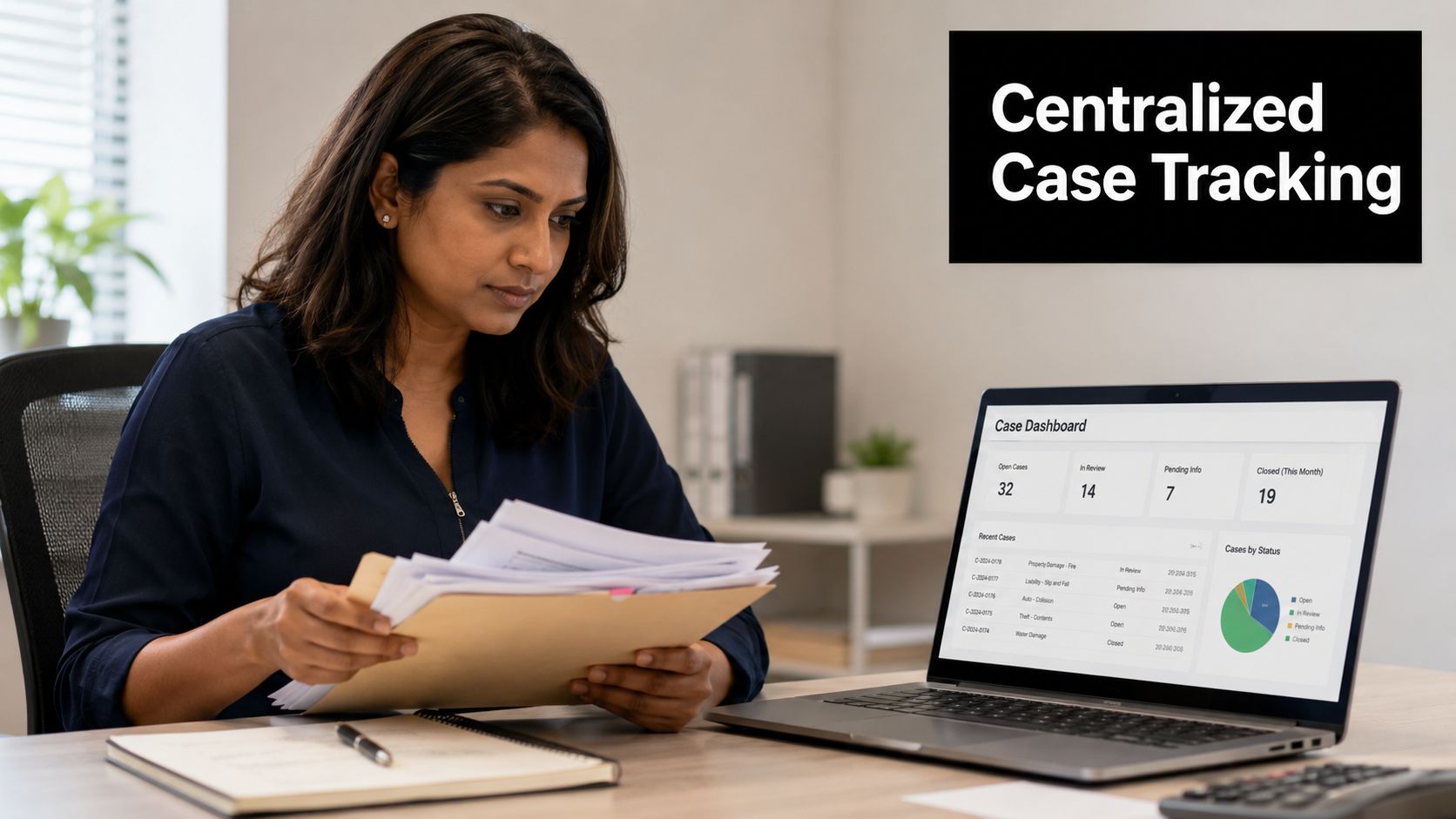
Case management software turns that loose sequence into a managed lifecycle. It captures intake, creates a structured case record, stores and relates documents, assigns tasks, applies routing rules, supports collaboration, produces reports, and preserves an audit trail through closure. The software doesn't merely tell a handler where a file is. It shows what happened, what must happen next, who is accountable, and which decisions need review.
A practical mental model
Think of the platform as a control tower for casework, not as another filing cabinet. The case is the unit of work. Emails, forms, call notes, policy details, documents, tasks, approvals, escalations, and status changes attach to that unit.
That distinction matters for insurance and banking because the work rarely follows a short, predictable transaction. A claim can involve several actors, multiple document exchanges, changing information, delegated authority, financial reporting, and a final decision that someone may need to defend later. A CRM can record a relationship, while a generic workflow tool can move a task from one queue to another. Case management software connects the entire operational history to the matter being resolved.
The category also answers a common operational question: what's blocking this case right now? A mature platform can identify missing documents, overdue actions, stalled approvals, or dormant files and surface them to the right person. That gives the handler a next action rather than another inbox search.
Practical rule: If the work has a long-lived record, several participants, sensitive evidence, and decisions that need to be explained later, treat the case as the primary object.
Modern platforms have moved beyond basic document storage into workflow orchestration and decision support. The evolution is especially relevant to claims teams evaluating a claims management system, because the operational layer must work with existing policy and claims technology rather than assume that one replacement application can solve every problem.
How the Category Evolved from Paper Files to Cloud Platforms
A paper-bound claims team might receive a delegated claim by post, fax, or email and print the material into a physical file. A handler checks a cover sheet, searches a cabinet for policy information, writes a request for missing evidence, and sends the file to another desk for review. If someone asks for an update, the answer depends on which folder has the latest note.
That operating model explains why the first case management systems emerged in the late 20th century. Organizations in legal services, social services, business operations, and early claims environments faced growing volumes of cases, documents, and manual tracking. Early platforms were primarily on-premises systems focused on document management and basic workflow, and many teams adopted them gradually while paper processes remained in place (the evolution of case management software).
From a digital file to a connected process
The early digital version of the delegated claim solved one immediate problem. The team no longer had to search a cabinet for the latest document. But a record that only stores files still leaves important questions unanswered. Who owns the next task? Has the authority been checked? Which document is missing? Did the reviewer approve the recommendation, and can the team show how that decision was made?
The category changed in the 21st century as vendors added collaboration, analytics, and cloud delivery. Cloud platforms improved accessibility, scalability, and cost-effectiveness, while integrations made it possible to connect casework with email, customer systems, enterprise content management, policy platforms, and service operations.
A modern equivalent of the paper-bound file can therefore arrive through several channels, become a structured record, receive automated classification, and move through controlled queues while authorized users work from the same current information. The software can preserve the original message, relate attachments to the case, request missing details, and show management where work is accumulating.
Earlier model | Modern model |
|---|---|
Physical folders and manual notes | Structured digital case records |
One desk or inbox as the source of truth | Shared visibility with role-based access |
Handoffs communicated informally | Configurable routing and task ownership |
Status discovered by searching | Reporting on active, overdue, and dormant work |
Separate documents and systems | Integrated records and synchronized updates |
Why history matters to today's buyer
This history explains why “case management” shouldn't mean simple storage. The category has shifted from record handling to workflow orchestration. Teams now expect controlled collaboration, auditability, real-time status, and integration with systems that already hold policy, customer, or financial data.
That makes legacy system modernization strategies relevant to case management decisions. A team doesn't necessarily need to replace the core system that underpins claims or banking operations. It may need an orchestration layer that coordinates the work around that system and reduces the manual effort created by disconnected tools.
Core Architecture and How the Pieces Fit Together
A case management platform has four connected layers: data, rules, integrations, and oversight. Understanding those layers helps an operations leader distinguish a real orchestration platform from a database with task fields.
The data layer creates the central case record. It typically holds the case identity, parties, policy or account context, documents, communications, activities, decisions, financial information, and current status. The record should preserve relationships between those elements, so a handler can see not just an attachment but why it matters to the case.
The core modules
Most enterprise platforms provide a common set of modules:
Case tracking: Maintains the lifecycle from intake through closure, including ownership, status, priority, and history.
Document management: Captures, classifies, stores, and relates documents and communications to the correct case.
Task assignment: Creates work items, sets owners and due dates, and records completion or reassignment.
Reporting: Shows workload, status, overdue actions, dormant cases, outcomes, and operational trends.
Role-based access control: Limits sensitive information according to a user's role, team, assignment, or approval authority.
Those modules are necessary, but they aren't the feature that makes the platform valuable. The value comes from how the system applies configurable logic to the record and coordinates activity across people and applications. Enterprise case management generally centralizes data, applies workflow logic, and integrates with email, CRM, ECM, and service operations platforms so tasks, documents, and status updates stay synchronized (Salesforce's overview of case management software).
One claim moving through the architecture
Consider a claim arriving through a broker email.
Intake creates the case and preserves the original message. Document processing extracts relevant details from the email and attachments, while the integration layer checks policy or authority information in the connected system.
Triage applies rules to classify the matter, identify missing information, and route it to the appropriate team. A straightforward file may proceed to a handler. A file outside a delegated threshold may require escalation. The platform records the reason for the route rather than moving the item between queues.
Active handling creates tasks for evidence requests, coverage review, approvals, and communications. A timer or service-level rule can identify an overdue action. If the case becomes inactive, the system can surface it for intervention instead of waiting for a handler to notice it.
Decision and closure preserve the recommendation, human approval, documents, communications, settlement information, and final status. Reporting can then show how the case moved through the process and where delays occurred.

The orchestration layer
Rules can route cases, enforce approvals, trigger escalations, and expose overdue or dormant work. Integrations can synchronize the result with the claims workbench, policy administration platform, CRM, ECM, email service, or internal application.
This is why a true platform behaves more like an orchestration layer than a database. A database answers what information exists. An orchestration layer coordinates what happens next, which system receives the update, which person must approve it, and what evidence remains available for review.
Teams assessing the integration boundary should also understand how services communicate, how failures are handled, and where ownership sits between applications. A practical introduction to microservices architecture patterns can help technical and operations leaders ask better questions about APIs, service dependencies, and resilience during vendor demonstrations.
Supporting Regulated Banking and Insurance Workflows
Regulated casework demands more than faster routing. It requires the organization to show who acted, what information they used, which rule applied, who approved the outcome, and what happened afterward.
Lloyd's delegated claims rules make that requirement concrete. A managing agent needs prior approval before appointing a Delegated Claims Administrator, or DCA, to determine claims. Under Lloyd's definition, “determine” includes accepting or denying a claim in whole or in part, agreeing the amount payable, or finally resolving an open matter through agreement or dispute resolution (Lloyd's guidance on delegated claims administrators).
Delegated authority needs controlled judgment
A platform supporting this workflow should record the DCA appointment, authority scope, review activity, referrals, approvals, and final decision. Automation can extract claim details, compare them against configured authority conditions, and identify files that need escalation. It shouldn't automatically turn a recommendation into an unreviewable decision.
Lloyd's guidance also requires managing agents to conduct consistent, thorough due diligence when onboarding a DCA and maintain ongoing oversight. That creates a direct design requirement: the case record must support both operational processing and governance evidence.
Lloyd's delegated authority guidance promotes high standards and consistency in auditing coverholders and DCAs. In 2025, the Lloyd's Market Association created a Delegated Authority Claims Management Group because the market identified a need for greater focus on governance and operational matters in delegated claims management (Lloyd's delegated authority guidance).
Bordereaux are part of the operating model
Claims software also needs to support structured exchange beyond the internal file. Lloyd's guidance states that regular and timely premium and claim bordereaux are required when business is placed through Velonetic. Those bordereaux include paid claims, outstanding claims, and expenses (Lloyd's guidance on delegated authority placement methods).
That means the platform must keep claim status and financial information synchronized across participants. A system that manages an internal task list but can't support reliable reporting artifacts leaves a critical part of the process outside the case record.
Banking teams face a similar pattern in complaint handling, KYC investigations, transaction monitoring follow-up, and suspicious activity report workflows. The subject matter differs, but the control needs remain familiar:
Restricted access: Only authorized users should see sensitive case information.
Decision history: The record should retain reasoning, evidence, approvals, and changes.
Exception handling: The workflow should escalate cases that fall outside defined conditions.
Timely reporting: Management needs visibility into open, overdue, and unresolved work.
Human accountability: Automation should support decisions without obscuring responsibility.
Security evidence matters during procurement. Nolana is described as a SOC 2-certified platform, and its model places AI agents on top of existing claims and policy systems while maintaining human oversight and auditability. Leaders comparing vendors can also use this overview of regtech for advisory firms to frame broader questions about compliance technology and operational controls.
For a financial services team, regulatory compliance in financial services shouldn't be treated as a separate reporting exercise. The controls belong inside the workflow, where people make decisions and systems record evidence.
Concrete Use Cases and the ROI They Unlock
The strongest business cases start with a specific operational bottleneck, not a general promise to “digitize claims.” A delegated authority inbox, a dormant file queue, or a document-heavy FNOL process gives leaders something they can measure and improve.
The delegated authority inbox
A broker sends a claim by email with a narrative, policy reference, and several attachments. An AI-assisted intake process can extract the claim details, identify missing information, check the file against configured authority thresholds, and route the matter for approval or escalation.
The human handler still owns the judgment. The platform removes repetitive reading, rekeying, and notification work, while retaining the original communication and the reasoning behind the route.
Nolana's published outcome ranges include up to 50× faster cycle times, up to 30% higher handler throughput, and up to 5% lower loss ratio, depending on context (Nolana's AI FNOL intake automation case study). Those are documented outcome ranges, not universal results. A COO should treat them as hypotheses to validate against the organization's own baseline, case mix, controls, and adoption quality.
The stalled file
A claims team may have a file that isn't formally closed but has stopped moving. The delay could come from a missing report, an unanswered broker request, an unresolved approval, or a task assigned to someone who has changed roles.
Lifecycle monitoring can detect inactivity, identify the likely blocker, and route the file with a recommended next action. The handler doesn't need to search every open claim manually. Management can also distinguish genuine complexity from avoidable administrative delay.
The cross-channel claim
A policyholder may begin through a web form, add information by email, and speak with a contact center later. If each channel creates a separate fragment, the handler reconstructs the story by hand and the policyholder may repeat information.
Cross-channel orchestration creates one case record and synchronizes updates across email, web, chat, voice, and call center interactions. That supports consistent communication while keeping the operational history available to the handler.
Measure the queue before measuring the tool. Track where work waits, how often people re-enter data, which files become dormant, and how many decisions require avoidable follow-up.
The ROI case usually combines several effects: less manual document handling, fewer missed handoffs, quicker identification of stalled work, more consistent routing, and better visibility into handling costs. A multi-line insurer may also use one operating model across property, specialty lines such as marine and aviation, liability, car, reinsurance, and travel claims, while configuring the rules and documents for each line.
The important discipline is to separate capacity gains from decision authority. Faster extraction or routing can create capacity. It doesn't remove the need for a qualified handler to review coverage, exceptions, settlement recommendations, or delegated authority decisions.
When Case Management Software Is the Right Choice
The decision rule is straightforward: choose case management software when work is high volume, document heavy, regulated, long lived, and handled by multiple actors who need a defensible record.
That description fits many insurance and banking workflows. A claim can remain active while evidence arrives, authority is checked, coverage is assessed, and financial reporting is prepared. A complaint or KYC matter can move across teams while access must remain restricted and every action needs a clear history.
A CRM is usually a better fit when the primary object is a customer or prospect relationship. It can record interactions, opportunities, and service activity, but it may not provide the detailed evidence management, exception routing, approval controls, or case-specific lifecycle needed for regulated operations.
A generic workflow tool may be sufficient for a short, predictable process with limited documentation and little judgment. It can assign a task, notify a user, and mark an item complete. It may become strained when one case contains several related tasks, documents, communications, escalations, decisions, and participants over time.
Choose case management when | Consider a CRM or lighter workflow tool when |
|---|---|
The case remains active through investigation or resolution | The interaction is short and transactional |
Documents and communications must stay connected | The record mainly tracks a relationship or request |
Several teams or external parties participate | One team owns the work from start to finish |
Exceptions and approvals shape the outcome | The process follows a simple fixed path |
Auditability and restricted access are essential | A basic activity history is sufficient |
Management needs case-level reporting | Team-level task reporting meets the need |
A policy administration platform also isn't the same thing. It may hold policy terms, coverage, and related transactions, while the case management layer coordinates the human and automated work around a claim.
The value of sitting on top
Replacing a core claims platform can introduce migration risk, operational disruption, and resistance from handlers who already know their workbench. An orchestration layer offers another path. It can integrate with claims workbenches, policy administration platforms, and internal applications through APIs, allowing teams to keep the systems that hold authoritative data while improving the process around them.
This model is particularly relevant for an agentic claims platform. AI agents can capture FNOL information, process documents, request missing details, recommend next actions, and synchronize updates without forcing every participant into another portal.
Use this sentence to defend the category internally: “We need case management because our work consists of long-lived, evidence-heavy cases with multiple decision points, external participants, and audit obligations, not just customer interactions or isolated tasks.”
A Selection and Implementation Checklist for Operations Leaders
A steering committee can turn vendor evaluation into a controlled conversation by asking questions in a fixed order. The answers should be demonstrated against real claims or banking scenarios, not presented only through polished feature slides.
Start with security and evidence
Can the vendor provide security evidence? Ask for SOC 2 materials, Trust Center information, data residency options, access controls, retention policies, and incident processes.
Can the platform prove what happened? Inspect the audit log. Confirm that it records actions, changes, approvals, system events, and the identity of the actor.
Can permissions follow the case? Test access for handlers, managers, brokers, coverholders, auditors, and external reviewers.
Test integration before configuration
Does it sit on top of existing systems? Verify integrations with claims workbenches, policy administration platforms, email, document repositories, CRM tools, and internal applications.
Are APIs operational or theoretical? Ask the vendor to demonstrate data exchange, failure handling, retries, reconciliation, and ownership when a connected system is unavailable.
Can the organization avoid a rip and replace? Confirm which authoritative records remain in current systems and which activities the case platform will coordinate.
Examine governance and decision controls
Where must a human approve? Configure thresholds for coverage recommendations, delegated authority decisions, settlement actions, escalations, and exceptions.
Can the team explain an AI recommendation? Require the system to show the source documents, extracted facts, applied rules, confidence signals where available, and human changes.
Can leaders change rules without losing control? Look for versioning, approval of workflow changes, testing environments, and a record of who changed configuration.
Evaluate operational coverage
A credible demonstration should include FNOL intake, triage, document processing, lifecycle monitoring, dormant-claim detection, delegated authority handling, cross-channel communication, and multi-line support. It should show what happens when the file is incomplete, contradictory, outside authority, or escalated.
Ask whether the vendor offers a custom agent builder. An organization may want to define agents for document classification, next-action recommendations, authority checks, or specialized line-of-business analysis while controlling which tasks agents can execute.
Design the implementation around learning
Can the team run a bounded pilot? Select one workflow with a clear baseline, representative documents, and named human reviewers.
What will success mean? Measure manual touchpoints, queue age, document rekeying, dormant cases, response quality, and handler adoption.
How will change be managed? Include handlers in design sessions, publish escalation rules, train supervisors, and create a feedback path for incorrect recommendations.
What happens if the pilot fails? Put data export, exit terms, support responsibilities, and implementation deliverables into the commercial agreement.
A vendor should leave the committee with fewer unanswered control questions, not merely a longer feature list. The best test is a realistic file that crosses systems, requires human judgment, and produces an audit-ready outcome.
Common Pitfalls and Quick Answers for Skeptical Leaders
Automation can improve claims operations, but careless automation can create a faster route to an unexplained decision. The main risks are operational and governance risks, not just technical defects.
Five mistakes to challenge
Over-automating judgment: Don't let a model accept, deny, settle, or escalate a sensitive matter without defined human controls. Start with extraction, classification, reminders, and recommendations, then expand execution only where approval rules are clear.
Treating the audit trail as an afterthought: A timestamp alone isn't enough. Preserve source documents, applied rules, recommendations, human edits, approvals, and final outcomes.
Accepting a closed integration: A connector that only exports a status isn't true orchestration. Test bidirectional updates, error handling, reconciliation, and data ownership.
Underestimating change management: Handlers won't adopt a system that creates another queue or portal. Design the workflow around the tools they already use and remove repetitive work visibly.
Replacing the core system unnecessarily: Case management should coordinate claims, policy, document, and communication systems where possible. Replacement may be justified in some environments, but it shouldn't be the default assumption.
Governance test: Ask the vendor to reconstruct one completed case from intake to closure, including every automated action and every human intervention.
Questions a skeptical COO may ask
How long does implementation take?
There isn't a reliable universal duration. It depends on workflow complexity, data quality, integration scope, security review, pilot boundaries, and the organization's change capacity. A bounded pilot with one well-understood process provides a more useful estimate than a generic implementation promise.
Can the platform run on top of legacy claims systems?
Yes, that's a central use case for an orchestration layer. Confirm the API design, supported integrations, synchronization behavior, and which system remains authoritative for each data element.
What governance evidence will reviewers request?
Expect questions about access, approvals, delegated authority, audit history, data handling, exception management, reporting, and human accountability. For Lloyd's workflows, the platform also needs to support DCA oversight and structured bordereaux reporting.
How should ROI be measured in the first year?
Start with operational baselines. Compare manual handling effort, document rekeying, queue age, dormant claims, handler capacity, response consistency, and escalation quality. Treat published outcome ranges as context, not as a substitute for measurement in your own portfolio.
Nolana AI offers agentic claims operations for Lloyd's and London Market participants, including FNOL intake, claims triage, document processing, dormant-claim follow-up, delegated authority workflows, and API integration with existing claims and policy systems while keeping human oversight and auditability in place. To evaluate how that model could fit your claims operation, visit Nolana AI and bring a representative workflow to the conversation.
Case management software is a rules-driven orchestration layer that sits on top of existing claims and policy systems, coordinating each case from intake through closure. In the Lloyd's market, that can mean receiving a delegated claim by email, checking authority and documentation, routing the file, recording every action, and keeping a human handler responsible for the final judgment.
A claims COO may recognize the situation immediately. A claim arrives in a shared inbox, a broker follows up in another thread, a document sits in a folder, and a handler updates a spreadsheet because the core claims system doesn't capture every operational step. The file is technically present, but nobody has a dependable view of what's missing, who owns the next action, or whether the case has gone dormant.
That's the problem this category addresses. Case management software creates one controlled record for the work around a case, then applies workflow rules, permissions, integrations, and reporting so people can move the file forward without losing context or governance.
The market reflects that shift. One recent estimate places the global case management software market at USD 9.70 billion in 2025 and USD 11.13 billion in 2026, with a projection of USD 26.82 billion by 2032 at a 15.62% CAGR. Another estimate puts the market at USD 7.32 billion in 2023 and forecasts USD 15.00 billion by 2030. These estimates differ in scope and methodology, but both describe a multi-billion-dollar category with strong projected growth as organizations digitize workflow-heavy operations (360iResearch's case management software market estimate).
What Case Management Software Really Does
A delegated authority claim often starts as an ordinary message. The email includes a loss description and perhaps an attachment, but the authority information may be stored in a policy platform, the supporting documents may arrive later, and the next step may depend on a threshold or coverage condition. Without a structured process, a handler has to interpret the message, create or update a record, request missing information, and remember every follow-up manually.
Case management software turns that loose sequence into a managed lifecycle. It captures intake, creates a structured case record, stores and relates documents, assigns tasks, applies routing rules, supports collaboration, produces reports, and preserves an audit trail through closure. The software doesn't merely tell a handler where a file is. It shows what happened, what must happen next, who is accountable, and which decisions need review.
A practical mental model
Think of the platform as a control tower for casework, not as another filing cabinet. The case is the unit of work. Emails, forms, call notes, policy details, documents, tasks, approvals, escalations, and status changes attach to that unit.
That distinction matters for insurance and banking because the work rarely follows a short, predictable transaction. A claim can involve several actors, multiple document exchanges, changing information, delegated authority, financial reporting, and a final decision that someone may need to defend later. A CRM can record a relationship, while a generic workflow tool can move a task from one queue to another. Case management software connects the entire operational history to the matter being resolved.
The category also answers a common operational question: what's blocking this case right now? A mature platform can identify missing documents, overdue actions, stalled approvals, or dormant files and surface them to the right person. That gives the handler a next action rather than another inbox search.
Practical rule: If the work has a long-lived record, several participants, sensitive evidence, and decisions that need to be explained later, treat the case as the primary object.
Modern platforms have moved beyond basic document storage into workflow orchestration and decision support. The evolution is especially relevant to claims teams evaluating a claims management system, because the operational layer must work with existing policy and claims technology rather than assume that one replacement application can solve every problem.
How the Category Evolved from Paper Files to Cloud Platforms
A paper-bound claims team might receive a delegated claim by post, fax, or email and print the material into a physical file. A handler checks a cover sheet, searches a cabinet for policy information, writes a request for missing evidence, and sends the file to another desk for review. If someone asks for an update, the answer depends on which folder has the latest note.
That operating model explains why the first case management systems emerged in the late 20th century. Organizations in legal services, social services, business operations, and early claims environments faced growing volumes of cases, documents, and manual tracking. Early platforms were primarily on-premises systems focused on document management and basic workflow, and many teams adopted them gradually while paper processes remained in place (the evolution of case management software).
From a digital file to a connected process
The early digital version of the delegated claim solved one immediate problem. The team no longer had to search a cabinet for the latest document. But a record that only stores files still leaves important questions unanswered. Who owns the next task? Has the authority been checked? Which document is missing? Did the reviewer approve the recommendation, and can the team show how that decision was made?
The category changed in the 21st century as vendors added collaboration, analytics, and cloud delivery. Cloud platforms improved accessibility, scalability, and cost-effectiveness, while integrations made it possible to connect casework with email, customer systems, enterprise content management, policy platforms, and service operations.
A modern equivalent of the paper-bound file can therefore arrive through several channels, become a structured record, receive automated classification, and move through controlled queues while authorized users work from the same current information. The software can preserve the original message, relate attachments to the case, request missing details, and show management where work is accumulating.
Earlier model | Modern model |
|---|---|
Physical folders and manual notes | Structured digital case records |
One desk or inbox as the source of truth | Shared visibility with role-based access |
Handoffs communicated informally | Configurable routing and task ownership |
Status discovered by searching | Reporting on active, overdue, and dormant work |
Separate documents and systems | Integrated records and synchronized updates |
Why history matters to today's buyer
This history explains why “case management” shouldn't mean simple storage. The category has shifted from record handling to workflow orchestration. Teams now expect controlled collaboration, auditability, real-time status, and integration with systems that already hold policy, customer, or financial data.
That makes legacy system modernization strategies relevant to case management decisions. A team doesn't necessarily need to replace the core system that underpins claims or banking operations. It may need an orchestration layer that coordinates the work around that system and reduces the manual effort created by disconnected tools.
Core Architecture and How the Pieces Fit Together
A case management platform has four connected layers: data, rules, integrations, and oversight. Understanding those layers helps an operations leader distinguish a real orchestration platform from a database with task fields.
The data layer creates the central case record. It typically holds the case identity, parties, policy or account context, documents, communications, activities, decisions, financial information, and current status. The record should preserve relationships between those elements, so a handler can see not just an attachment but why it matters to the case.
The core modules
Most enterprise platforms provide a common set of modules:
Case tracking: Maintains the lifecycle from intake through closure, including ownership, status, priority, and history.
Document management: Captures, classifies, stores, and relates documents and communications to the correct case.
Task assignment: Creates work items, sets owners and due dates, and records completion or reassignment.
Reporting: Shows workload, status, overdue actions, dormant cases, outcomes, and operational trends.
Role-based access control: Limits sensitive information according to a user's role, team, assignment, or approval authority.
Those modules are necessary, but they aren't the feature that makes the platform valuable. The value comes from how the system applies configurable logic to the record and coordinates activity across people and applications. Enterprise case management generally centralizes data, applies workflow logic, and integrates with email, CRM, ECM, and service operations platforms so tasks, documents, and status updates stay synchronized (Salesforce's overview of case management software).
One claim moving through the architecture
Consider a claim arriving through a broker email.
Intake creates the case and preserves the original message. Document processing extracts relevant details from the email and attachments, while the integration layer checks policy or authority information in the connected system.
Triage applies rules to classify the matter, identify missing information, and route it to the appropriate team. A straightforward file may proceed to a handler. A file outside a delegated threshold may require escalation. The platform records the reason for the route rather than moving the item between queues.
Active handling creates tasks for evidence requests, coverage review, approvals, and communications. A timer or service-level rule can identify an overdue action. If the case becomes inactive, the system can surface it for intervention instead of waiting for a handler to notice it.
Decision and closure preserve the recommendation, human approval, documents, communications, settlement information, and final status. Reporting can then show how the case moved through the process and where delays occurred.
The orchestration layer
Rules can route cases, enforce approvals, trigger escalations, and expose overdue or dormant work. Integrations can synchronize the result with the claims workbench, policy administration platform, CRM, ECM, email service, or internal application.
This is why a true platform behaves more like an orchestration layer than a database. A database answers what information exists. An orchestration layer coordinates what happens next, which system receives the update, which person must approve it, and what evidence remains available for review.
Teams assessing the integration boundary should also understand how services communicate, how failures are handled, and where ownership sits between applications. A practical introduction to microservices architecture patterns can help technical and operations leaders ask better questions about APIs, service dependencies, and resilience during vendor demonstrations.
Supporting Regulated Banking and Insurance Workflows
Regulated casework demands more than faster routing. It requires the organization to show who acted, what information they used, which rule applied, who approved the outcome, and what happened afterward.
Lloyd's delegated claims rules make that requirement concrete. A managing agent needs prior approval before appointing a Delegated Claims Administrator, or DCA, to determine claims. Under Lloyd's definition, “determine” includes accepting or denying a claim in whole or in part, agreeing the amount payable, or finally resolving an open matter through agreement or dispute resolution (Lloyd's guidance on delegated claims administrators).
Delegated authority needs controlled judgment
A platform supporting this workflow should record the DCA appointment, authority scope, review activity, referrals, approvals, and final decision. Automation can extract claim details, compare them against configured authority conditions, and identify files that need escalation. It shouldn't automatically turn a recommendation into an unreviewable decision.
Lloyd's guidance also requires managing agents to conduct consistent, thorough due diligence when onboarding a DCA and maintain ongoing oversight. That creates a direct design requirement: the case record must support both operational processing and governance evidence.
Lloyd's delegated authority guidance promotes high standards and consistency in auditing coverholders and DCAs. In 2025, the Lloyd's Market Association created a Delegated Authority Claims Management Group because the market identified a need for greater focus on governance and operational matters in delegated claims management (Lloyd's delegated authority guidance).
Bordereaux are part of the operating model
Claims software also needs to support structured exchange beyond the internal file. Lloyd's guidance states that regular and timely premium and claim bordereaux are required when business is placed through Velonetic. Those bordereaux include paid claims, outstanding claims, and expenses (Lloyd's guidance on delegated authority placement methods).
That means the platform must keep claim status and financial information synchronized across participants. A system that manages an internal task list but can't support reliable reporting artifacts leaves a critical part of the process outside the case record.
Banking teams face a similar pattern in complaint handling, KYC investigations, transaction monitoring follow-up, and suspicious activity report workflows. The subject matter differs, but the control needs remain familiar:
Restricted access: Only authorized users should see sensitive case information.
Decision history: The record should retain reasoning, evidence, approvals, and changes.
Exception handling: The workflow should escalate cases that fall outside defined conditions.
Timely reporting: Management needs visibility into open, overdue, and unresolved work.
Human accountability: Automation should support decisions without obscuring responsibility.
Security evidence matters during procurement. Nolana is described as a SOC 2-certified platform, and its model places AI agents on top of existing claims and policy systems while maintaining human oversight and auditability. Leaders comparing vendors can also use this overview of regtech for advisory firms to frame broader questions about compliance technology and operational controls.
For a financial services team, regulatory compliance in financial services shouldn't be treated as a separate reporting exercise. The controls belong inside the workflow, where people make decisions and systems record evidence.
Concrete Use Cases and the ROI They Unlock
The strongest business cases start with a specific operational bottleneck, not a general promise to “digitize claims.” A delegated authority inbox, a dormant file queue, or a document-heavy FNOL process gives leaders something they can measure and improve.
The delegated authority inbox
A broker sends a claim by email with a narrative, policy reference, and several attachments. An AI-assisted intake process can extract the claim details, identify missing information, check the file against configured authority thresholds, and route the matter for approval or escalation.
The human handler still owns the judgment. The platform removes repetitive reading, rekeying, and notification work, while retaining the original communication and the reasoning behind the route.
Nolana's published outcome ranges include up to 50× faster cycle times, up to 30% higher handler throughput, and up to 5% lower loss ratio, depending on context (Nolana's AI FNOL intake automation case study). Those are documented outcome ranges, not universal results. A COO should treat them as hypotheses to validate against the organization's own baseline, case mix, controls, and adoption quality.
The stalled file
A claims team may have a file that isn't formally closed but has stopped moving. The delay could come from a missing report, an unanswered broker request, an unresolved approval, or a task assigned to someone who has changed roles.
Lifecycle monitoring can detect inactivity, identify the likely blocker, and route the file with a recommended next action. The handler doesn't need to search every open claim manually. Management can also distinguish genuine complexity from avoidable administrative delay.
The cross-channel claim
A policyholder may begin through a web form, add information by email, and speak with a contact center later. If each channel creates a separate fragment, the handler reconstructs the story by hand and the policyholder may repeat information.
Cross-channel orchestration creates one case record and synchronizes updates across email, web, chat, voice, and call center interactions. That supports consistent communication while keeping the operational history available to the handler.
Measure the queue before measuring the tool. Track where work waits, how often people re-enter data, which files become dormant, and how many decisions require avoidable follow-up.
The ROI case usually combines several effects: less manual document handling, fewer missed handoffs, quicker identification of stalled work, more consistent routing, and better visibility into handling costs. A multi-line insurer may also use one operating model across property, specialty lines such as marine and aviation, liability, car, reinsurance, and travel claims, while configuring the rules and documents for each line.
The important discipline is to separate capacity gains from decision authority. Faster extraction or routing can create capacity. It doesn't remove the need for a qualified handler to review coverage, exceptions, settlement recommendations, or delegated authority decisions.
When Case Management Software Is the Right Choice
The decision rule is straightforward: choose case management software when work is high volume, document heavy, regulated, long lived, and handled by multiple actors who need a defensible record.
That description fits many insurance and banking workflows. A claim can remain active while evidence arrives, authority is checked, coverage is assessed, and financial reporting is prepared. A complaint or KYC matter can move across teams while access must remain restricted and every action needs a clear history.
A CRM is usually a better fit when the primary object is a customer or prospect relationship. It can record interactions, opportunities, and service activity, but it may not provide the detailed evidence management, exception routing, approval controls, or case-specific lifecycle needed for regulated operations.
A generic workflow tool may be sufficient for a short, predictable process with limited documentation and little judgment. It can assign a task, notify a user, and mark an item complete. It may become strained when one case contains several related tasks, documents, communications, escalations, decisions, and participants over time.
Choose case management when | Consider a CRM or lighter workflow tool when |
|---|---|
The case remains active through investigation or resolution | The interaction is short and transactional |
Documents and communications must stay connected | The record mainly tracks a relationship or request |
Several teams or external parties participate | One team owns the work from start to finish |
Exceptions and approvals shape the outcome | The process follows a simple fixed path |
Auditability and restricted access are essential | A basic activity history is sufficient |
Management needs case-level reporting | Team-level task reporting meets the need |
A policy administration platform also isn't the same thing. It may hold policy terms, coverage, and related transactions, while the case management layer coordinates the human and automated work around a claim.
The value of sitting on top
Replacing a core claims platform can introduce migration risk, operational disruption, and resistance from handlers who already know their workbench. An orchestration layer offers another path. It can integrate with claims workbenches, policy administration platforms, and internal applications through APIs, allowing teams to keep the systems that hold authoritative data while improving the process around them.
This model is particularly relevant for an agentic claims platform. AI agents can capture FNOL information, process documents, request missing details, recommend next actions, and synchronize updates without forcing every participant into another portal.
Use this sentence to defend the category internally: “We need case management because our work consists of long-lived, evidence-heavy cases with multiple decision points, external participants, and audit obligations, not just customer interactions or isolated tasks.”
A Selection and Implementation Checklist for Operations Leaders
A steering committee can turn vendor evaluation into a controlled conversation by asking questions in a fixed order. The answers should be demonstrated against real claims or banking scenarios, not presented only through polished feature slides.
Start with security and evidence
Can the vendor provide security evidence? Ask for SOC 2 materials, Trust Center information, data residency options, access controls, retention policies, and incident processes.
Can the platform prove what happened? Inspect the audit log. Confirm that it records actions, changes, approvals, system events, and the identity of the actor.
Can permissions follow the case? Test access for handlers, managers, brokers, coverholders, auditors, and external reviewers.
Test integration before configuration
Does it sit on top of existing systems? Verify integrations with claims workbenches, policy administration platforms, email, document repositories, CRM tools, and internal applications.
Are APIs operational or theoretical? Ask the vendor to demonstrate data exchange, failure handling, retries, reconciliation, and ownership when a connected system is unavailable.
Can the organization avoid a rip and replace? Confirm which authoritative records remain in current systems and which activities the case platform will coordinate.
Examine governance and decision controls
Where must a human approve? Configure thresholds for coverage recommendations, delegated authority decisions, settlement actions, escalations, and exceptions.
Can the team explain an AI recommendation? Require the system to show the source documents, extracted facts, applied rules, confidence signals where available, and human changes.
Can leaders change rules without losing control? Look for versioning, approval of workflow changes, testing environments, and a record of who changed configuration.
Evaluate operational coverage
A credible demonstration should include FNOL intake, triage, document processing, lifecycle monitoring, dormant-claim detection, delegated authority handling, cross-channel communication, and multi-line support. It should show what happens when the file is incomplete, contradictory, outside authority, or escalated.
Ask whether the vendor offers a custom agent builder. An organization may want to define agents for document classification, next-action recommendations, authority checks, or specialized line-of-business analysis while controlling which tasks agents can execute.
Design the implementation around learning
Can the team run a bounded pilot? Select one workflow with a clear baseline, representative documents, and named human reviewers.
What will success mean? Measure manual touchpoints, queue age, document rekeying, dormant cases, response quality, and handler adoption.
How will change be managed? Include handlers in design sessions, publish escalation rules, train supervisors, and create a feedback path for incorrect recommendations.
What happens if the pilot fails? Put data export, exit terms, support responsibilities, and implementation deliverables into the commercial agreement.
A vendor should leave the committee with fewer unanswered control questions, not merely a longer feature list. The best test is a realistic file that crosses systems, requires human judgment, and produces an audit-ready outcome.
Common Pitfalls and Quick Answers for Skeptical Leaders
Automation can improve claims operations, but careless automation can create a faster route to an unexplained decision. The main risks are operational and governance risks, not just technical defects.
Five mistakes to challenge
Over-automating judgment: Don't let a model accept, deny, settle, or escalate a sensitive matter without defined human controls. Start with extraction, classification, reminders, and recommendations, then expand execution only where approval rules are clear.
Treating the audit trail as an afterthought: A timestamp alone isn't enough. Preserve source documents, applied rules, recommendations, human edits, approvals, and final outcomes.
Accepting a closed integration: A connector that only exports a status isn't true orchestration. Test bidirectional updates, error handling, reconciliation, and data ownership.
Underestimating change management: Handlers won't adopt a system that creates another queue or portal. Design the workflow around the tools they already use and remove repetitive work visibly.
Replacing the core system unnecessarily: Case management should coordinate claims, policy, document, and communication systems where possible. Replacement may be justified in some environments, but it shouldn't be the default assumption.
Governance test: Ask the vendor to reconstruct one completed case from intake to closure, including every automated action and every human intervention.
Questions a skeptical COO may ask
How long does implementation take?
There isn't a reliable universal duration. It depends on workflow complexity, data quality, integration scope, security review, pilot boundaries, and the organization's change capacity. A bounded pilot with one well-understood process provides a more useful estimate than a generic implementation promise.
Can the platform run on top of legacy claims systems?
Yes, that's a central use case for an orchestration layer. Confirm the API design, supported integrations, synchronization behavior, and which system remains authoritative for each data element.
What governance evidence will reviewers request?
Expect questions about access, approvals, delegated authority, audit history, data handling, exception management, reporting, and human accountability. For Lloyd's workflows, the platform also needs to support DCA oversight and structured bordereaux reporting.
How should ROI be measured in the first year?
Start with operational baselines. Compare manual handling effort, document rekeying, queue age, dormant claims, handler capacity, response consistency, and escalation quality. Treat published outcome ranges as context, not as a substitute for measurement in your own portfolio.
Nolana AI offers agentic claims operations for Lloyd's and London Market participants, including FNOL intake, claims triage, document processing, dormant-claim follow-up, delegated authority workflows, and API integration with existing claims and policy systems while keeping human oversight and auditability in place. To evaluate how that model could fit your claims operation, visit Nolana AI and bring a representative workflow to the conversation.


All systems operational
1 Lime Street, London EC3M 7HA | 222E 3rd Street, New York 10009
Copyright © 2026, Nolana. All rights reserved
All systems operational
1 Lime Street, London EC3M 7HA | 222E 3rd Street, New York 10009
Copyright © 2026, Nolana. All rights reserved
All systems operational
1 Lime Street, London EC3M 7HA | 222E 3rd Street, New York 10009
Copyright © 2026, Nolana. All rights reserved
All systems operational
1 Lime Street, London EC3M 7HA | 222E 3rd Street, New York 10009
Copyright © 2026, Nolana. All rights reserved