10 Key Claims Management Resources for 2026
10 Key Claims Management Resources for 2026
Explore the top claims management resources for enterprise teams. Our 2026 guide covers software, AI platforms, and tools to streamline your operations.

You're probably living with the same tension most claims leaders feel right now. The backlog is real, experienced handlers are overloaded, and every manual touchpoint, from FNOL intake to document processing to routine triage, pulls your best people away from the cases that need judgment. The answer isn't another abstract digital transformation slogan, it's a practical stack of claims management resources that lets you keep what already works, add what's missing, and modernize without blowing up the operating model.
That's why this list starts with the core systems that anchor claims work, then moves into specialist platforms, workflow layers, and AI overlays that sit on top of existing environments. The market is still expanding quickly, with independent estimates putting claims-management software at USD 5.79 billion in 2025 and USD 17.09 billion by 2034 in one source, while another projects USD 5.8 billion in 2025 growing to USD 12.4 billion by 2034 (Fortune Business Insights). In practice, that growth is being driven less by rip-and-replace projects and more by layered capability, especially as cloud deployment becomes the default delivery model and claims teams look for API-first integration rather than new silos (Market Intelo).
If you're trying to compare tools by what improves operations, not by brochure language, this is the right place to start. For a real-world example of how claims process discipline can matter in the field, see the work of Class A RV Repairs specialists.
1. Nolana AI

A claims team can have a solid core system and still lose time on the work around it. Handlers rekey intake details, chase missing documents, sort through email threads, and move routine tasks by hand while the cases that need judgment wait. Nolana fits that gap as an agentic AI overlay, so it adds orchestration and automation on top of the systems you already run instead of asking for a full replacement.
That positioning matters in real operations. Nolana is built for the Lloyd's market, including managing agents, brokers, and cover holders, and it is aimed at automating FNOL intake, triage, static claims management, and document processing while keeping human oversight intact. For a closer look at how it is positioned against core claims environments, see Nolana's Guidewire overview.
The practical value shows up in the queue. Nolana is designed to capture claims across email, web, chat, voice, and call centers, extract data from communications and documents, orchestrate tasks, and recommend next-best actions inside existing systems. Its public materials also describe the platform as SOC 2-certified, with full auditability and explainability, and it is presented as something that can be deployed in weeks rather than through a long replacement program. For leaders balancing throughput, control, and governance, that trade-off is the point.
Why it stands out for enterprise claims leaders
Nolana is useful because it addresses the space most platforms leave open, the handoff between automation and skilled judgment. Claims organizations still need people for empathy, negotiation, and exception handling, while AI is better suited to high-frequency, low-complexity work such as damage-photo capture, visual processing, repair-cost estimation, initial assessment drafting, and anomaly flagging. That is a better fit for an overlay than for a core rebuild, because it lets routine work move away from handlers without pretending the human role disappears.
The choice is not just about speed. It is about where the tool sits in the stack. If your adjusters are still rekeying intake details and manually chasing missing information, the first improvement is orchestration across your current systems, not another portal that adds one more place to work.
Nolana fits teams that want to modernize on top of what they already trust. The trade-off is that it is still an enterprise platform with custom implementation, not a self-serve tool with published pricing, so buyers should expect procurement, security review, and integration work. For partners who need a field-ready example of disciplined claims response, the Miami hurricane roof inspection image is a useful reference point for how structured intake and documentation reduce back-and-forth once the case lands in the queue.
2. Guidewire ClaimCenter
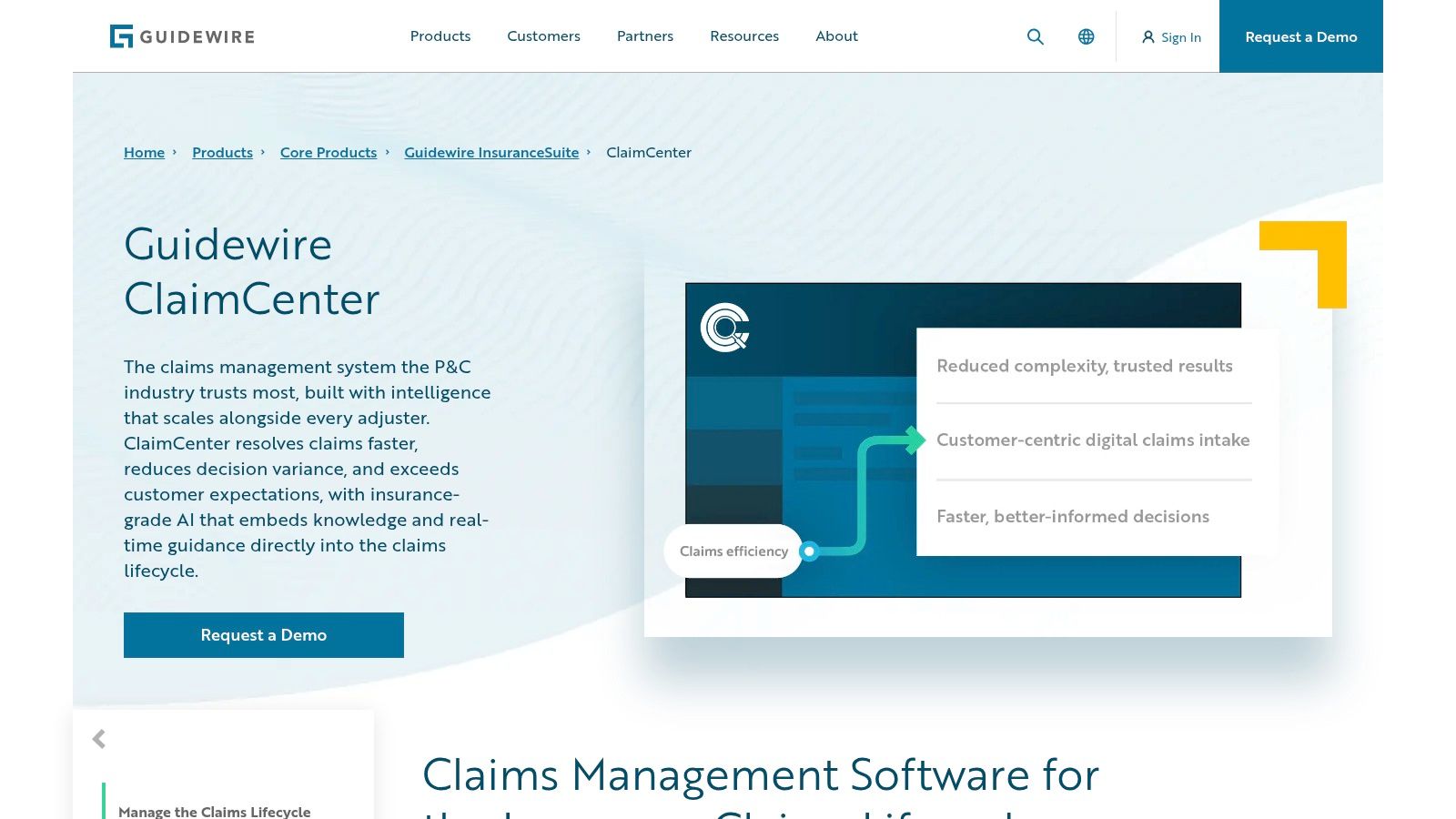
A carrier with a complex P&C core claims system often lands on Guidewire ClaimCenter because it is built to handle high-volume claims work without forcing teams into a patchwork of disconnected tools. The platform is strongest as a core operating layer, not as a narrow fix for a single workflow. It also fits naturally with the broader Guidewire suite, especially PolicyCenter and BillingCenter, which matters for carriers that want one data model and consistent process logic across underwriting, billing, and claims.
ClaimCenter also sits in the same modernization conversation as the AI overlay approach covered in the Guidewire software coverage. That contrast is useful for enterprise leaders because the core system still matters, but many teams now layer new capabilities on top instead of replacing the whole stack at once.
Where it fits best
ClaimCenter works well for carriers that need configurable rules, authority handling, referral paths, and SIU support inside a mature core. That level of control is useful in large environments where claims operations cannot rely on ad hoc workflows or disconnected point solutions. The trade-off is real. More depth usually means more implementation effort, more change management, and a longer path to visible value.
A few practical fit points matter here.
Best for complex P&C operations: It gives claims teams a system of record for difficult line mixes and multi-step handling.
Best when paired with the suite: Its strongest operating model comes from working with the rest of InsuranceSuite.
Less attractive for quick wins: If the business needs a fast efficiency layer, a core replacement project can feel heavy.
The market context explains why carriers still invest in this kind of platform. Market Growth Reports points to strong enterprise adoption and broad use of automated triage, which shows that larger insurers still value process control while reducing manual rekeying where they can. For claims leaders, that is the practical balance to watch. Core systems handle the record, the rules, and the controls. Layered automation handles the repetitive work that slows adjusters down.
For teams comparing a core platform with a field-oriented response model, the Miami hurricane roof inspection image is a useful reminder of why structured intake and documentation matter once a claim enters the queue.
3. Duck Creek Claims
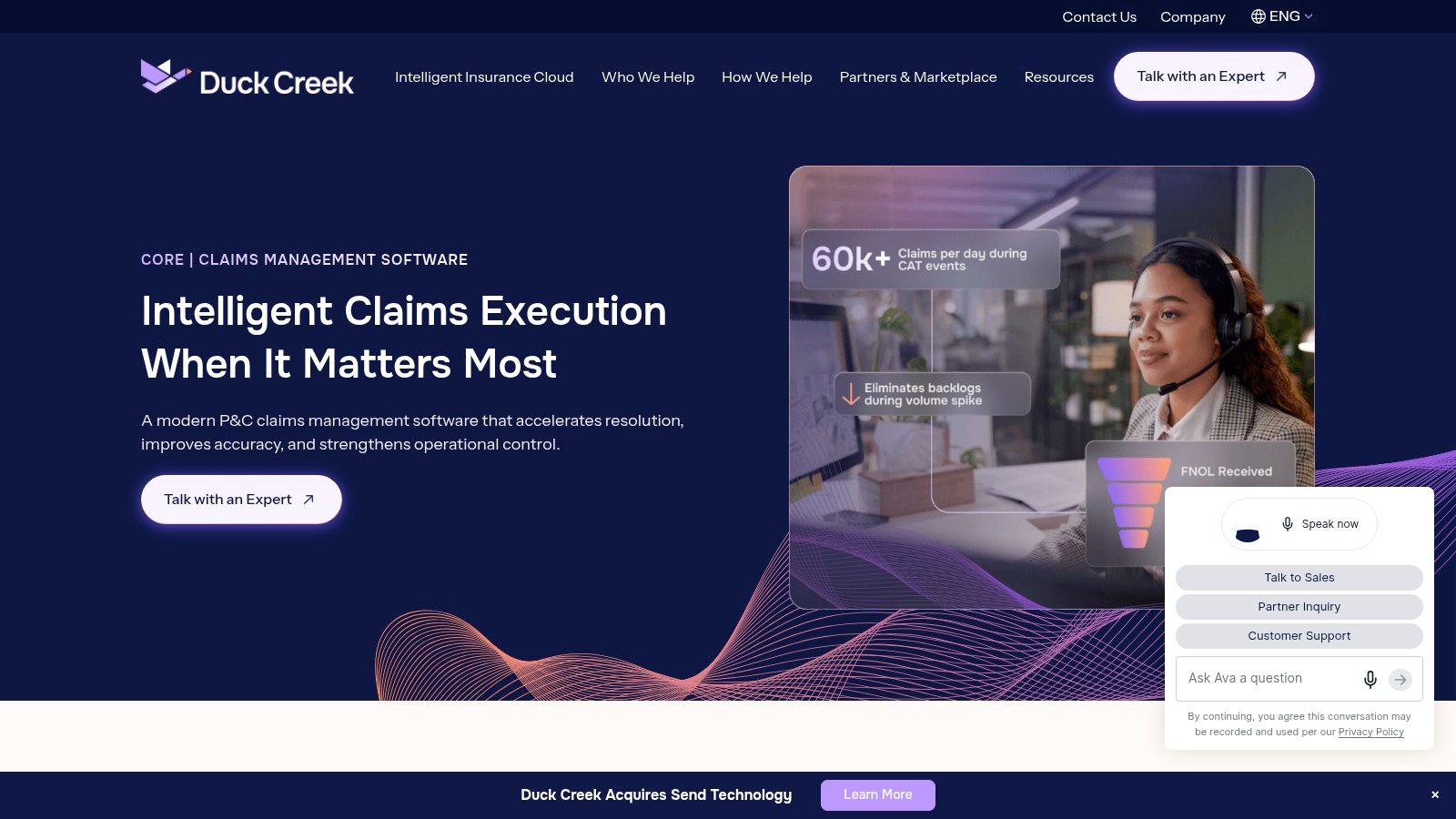
A carrier that is already running on a cloud-first core often reaches Duck Creek Claims for a specific reason, it wants configurable claims control without carrying the day-to-day burden of an on-premise platform. The value is not just deployment style. It is the way Duck Creek lets claims teams adjust workflows, absorb product or regulatory changes, and keep the operation moving without constant internal release work. For leaders trying to reduce disruption while improving claims discipline, that combination matters.
What makes it practical
Duck Creek Claims fits operations where leakage control and cycle-time management are under pressure. Those two issues show up in executive reporting because they affect indemnity spend, staffing efficiency, and the customer's view of the claim. The platform's cloud delivery also helps when volume is unpredictable. Catastrophe-heavy carriers need a claims system that can handle spikes without forcing the organization to build excess permanent capacity.
The trade-off is ecosystem fit. Duck Creek Claims makes the most sense when it sits inside the broader Duck Creek stack, because the suite approach reduces integration friction and keeps data flow cleaner across policy, billing, and claims. Mixed environments are still workable, but they require more deliberate planning around coexistence, downstream reporting, and the handoff to legacy tools. That is the implementation question. How much complexity are you willing to carry outside the core platform?
For claims organizations that are modernizing the operating model, not just refreshing the user interface, that question is often the deciding factor. The cloud delivery model is also part of the broader direction of the market, as Market Growth Reports points to continued enterprise adoption of automated triage and other workflow controls. Those tools do not replace claims discipline. They change where the rules, data, and decision support sit in the stack.
An internal perspective on Duck Creek's market position is available here, which is useful if you are comparing suite-led modernization with an AI overlay strategy.
4. Sapiens ClaimsPro
Sapiens ClaimsPro fits carriers that need rules-driven claims processing and a platform that can support both personal and commercial lines without forcing every file through the same manual path. Its practical value sits in routing, assignment, supervisory visibility, and straight-through processing where the claim profile allows it. For operations leaders, that matters because it reduces ad hoc routing decisions while still leaving room for exceptions that require human judgment.
The operational sweet spot
Sapiens ClaimsPro works best in a claims operation that already has discipline but still spends too much time on manual handoffs. If adjusters are deciding where a claim should go, who should own it next, or when it needs escalation, a rules-driven core can tighten that flow and reduce avoidable friction. For complex files and catastrophe-related claims, the case management structure also helps keep multi-party work organized without scattering the file across side systems.
The trade-off is straightforward. Deep configuration takes time, and the value appears only when the organization is ready to align workflows, authority rules, and supervisory standards. Sapiens ClaimsPro is not a shortcut around process design, it works best when the business is prepared to define the process clearly and then enforce it consistently.
The strongest claims systems do more than move files faster. They make the right next action easier to take and the wrong one harder to repeat.
That matters more as claims work becomes more data-driven. A close look at Sapiens' claims position in the broader insurance stack is available in this internal resource on Sapiens insurance, which is useful if you are comparing core-system modernization with an AI overlay strategy. For teams that want to layer agentic AI on top of a stable claims core, the question is how much process control stays inside the system and how much is handed to adjacent automation tools.
5. Majesco Claims within Majesco P&C Intelligent Core Suite
Majesco's claims capability belongs to a broader cloud core suite, so it's usually evaluated as part of a larger digital transformation agenda rather than as a standalone claims-only purchase. That can be a strength if your organization wants consistency across underwriting, policy, billing, and claims. It can also be a drawback if your immediate pain point is narrow and you don't want to commit to a suite-wide change program.
Why buyers shortlist it
The practical draw is that it aligns with the move toward cloud-based delivery and configurable operating models. Claims leaders who need a platform that can support both personal and commercial lines, while also fitting into a broader digitization roadmap, often look at Majesco because it promises continuity across functions. The presence of GenAI references across the platform also signals that the vendor is trying to align with the next generation of workflow automation.
The trade-off is vendor packaging. Documentation and demos are often gated, so comparison work can take longer than buyers expect. Full value is also easier to realize when the claims module is extended with other Majesco products, which means the platform can be more of a program decision than a point tool.
For market context, healthcare shows how sector demand can pull claims platforms toward deeper digitization. One forecast values the global healthcare claims management solutions market at US$27.4 billion in 2024 and US$54.9 billion by 2034, with North America at 38.2% share and providers making up 65.2% of end users (Market.us). Even though that's healthcare, the lesson travels, buyers want tools that can ingest documents, normalize data, and route exceptions without forcing everyone into new portals.
For a broader view of how Majesco fits into insurance core modernization, use this internal overview.
6. Snapsheet Claims Platform
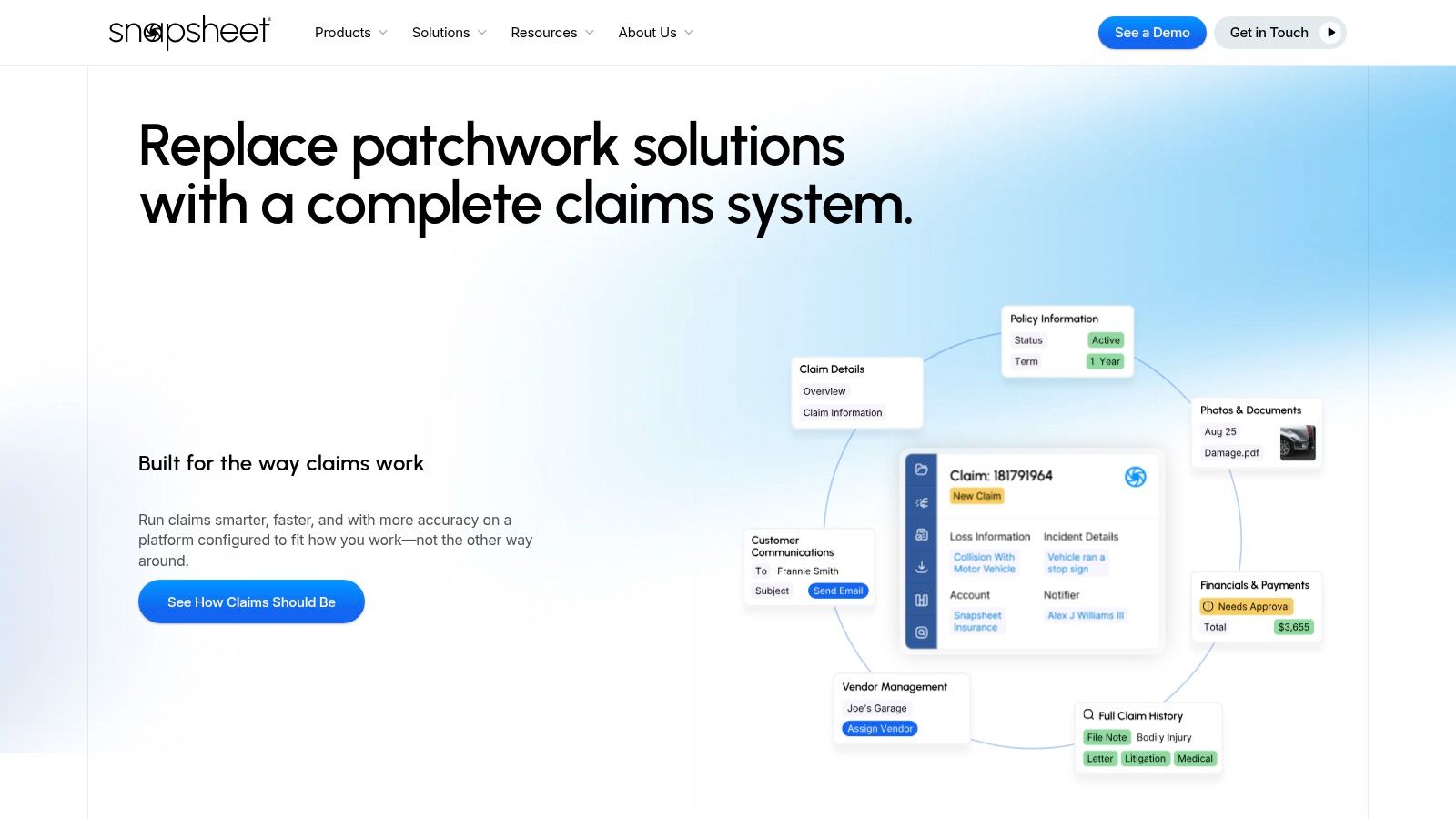
A claims team staring at too many manual handoffs usually starts looking at Snapsheet for a reason. The platform is built for speed-to-value and for improving the claimant experience without forcing a full core replacement. Its appeal sits in virtual appraisal workflows, a single claim view, and digital engagement that gives adjusters and policyholders a clearer path through the process.
Where it earns its keep
Snapsheet fits best in auto and small commercial operations that need orchestration more than a full claims system rebuild. The platform's digital communications and self-service tools help cut friction for claimants, while its workflow structure gives operations leaders a cleaner way to manage tasks, handoffs, and exceptions. CAT readiness matters here too, because volume spikes expose weak coordination quickly.
The trade-off is breadth. A platform designed around fast deployment and digital interaction will not always cover the same ground as a full core suite, especially in specialty-heavy or highly customized claims environments. Enterprise buyers need to decide whether they are solving for claims execution, or for the system of record that sits underneath it.
That distinction is getting sharper as cloud-based claims resources become a more common starting point for new programs. One industry report linked cloud adoption to faster deployment and easier coexistence with existing systems, which is the buying logic here, not just platform novelty (Market Intelo). The point is not that every cloud tool is interchangeable. It is that leaders increasingly want a platform that can sit on top of the stack, connect cleanly, and improve workflow without a rip-and-replace program.
For a closer look at how the vendor is positioned in Chicago, see this Snapsheet Chicago overview. For a practical comparison point on repair economics, see compare Class 4 shingle costs.
7. CCC Intelligent Solutions for Auto and Casualty
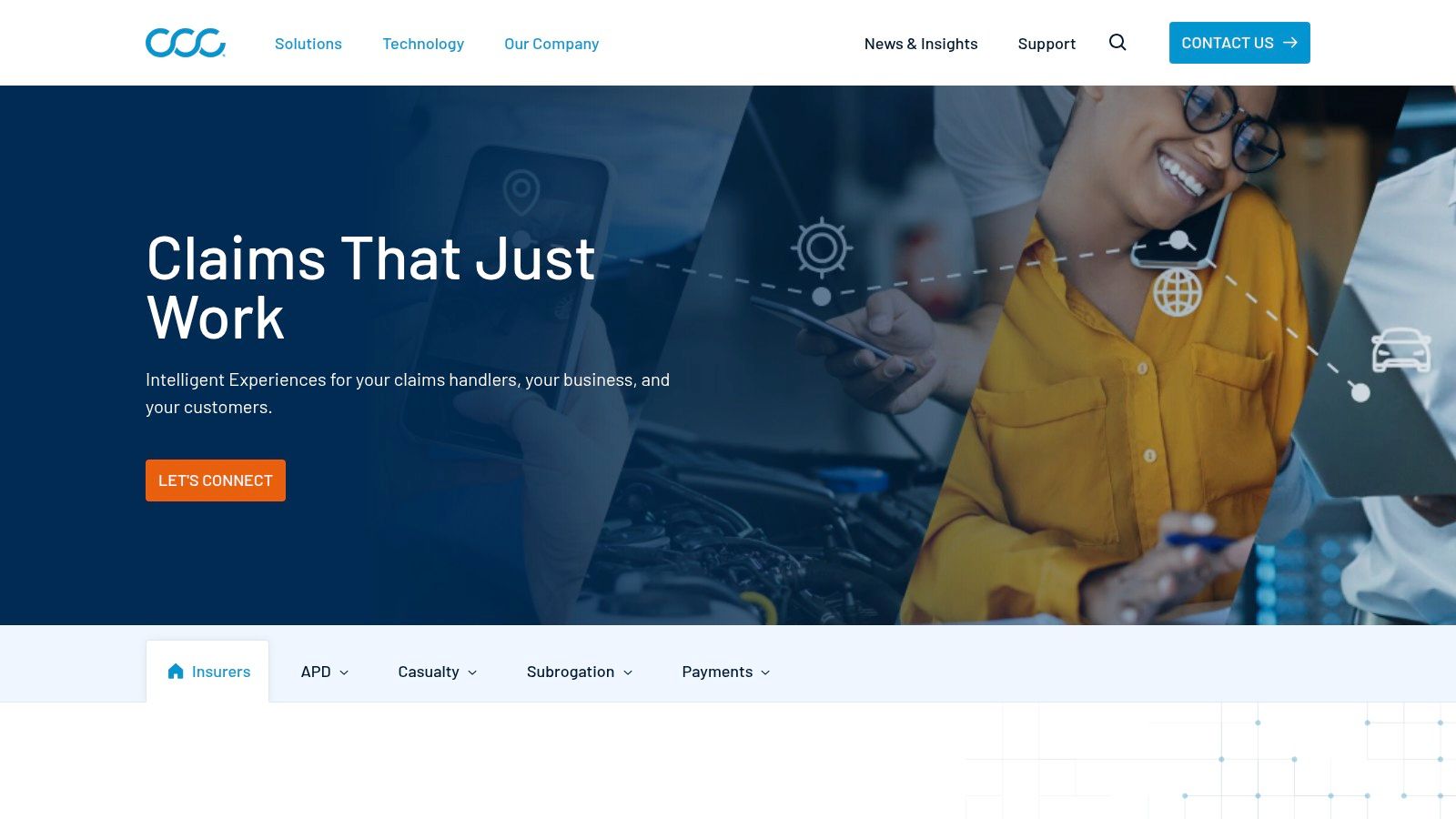
CCC is one of the most recognizable names in auto claims and repair ecosystem technology because it goes narrower and deeper than a general claims suite. For carriers that live in auto and casualty workflows, it brings estimating, APD automation, subrogation support, digital payments, and network connectivity into the same operating flow. That matters in a stack where carriers, repairers, and policyholders all need to stay aligned without forcing a full replacement of the core claims system underneath.
Why auto teams choose it
CCC's main value is the way it reduces friction between the estimate, repair, and payment stages. Those handoffs are where auto claims often slow down, because each gap can create rework, customer follow-up, or inconsistent repair decisions. A platform built around repair-network integration helps claims leaders keep service quality steadier in a high-volume line, especially when the operation depends on repeatable decisions and clear status visibility.
The trade-off is scope. CCC is centered on auto, so it is not a natural fit for carriers with broad specialty portfolios or London Market requirements. Enterprise licensing and limited public pricing visibility can also make early evaluation less straightforward than buyers may want. That does not make the platform weaker, it just means the buying case has to be tied to auto execution, repair control, and partner connectivity rather than broad claims administration.
It still earns attention where the problem is service quality inside auto claims. The key question is whether the platform strengthens the specific workflow gaps a carrier already has, or whether a broader claims layer should sit above it. For many teams, the answer is to keep the core claims system in place and use CCC as a specialized execution layer that improves estimation, assignment, and repair coordination without a rip-and-replace program.
For more context on the company's insurance focus, use CCC's carrier page.
8. Mitchell WorkCenter by Enlyte

Mitchell WorkCenter is a fit for carriers and claims teams that need modular claims support instead of a single, all-purpose platform. Its value comes from how it connects appraisal, audit, repair management, reporting, and casualty-related workflows through separate components that plug into specific process gaps. For enterprise leaders, that matters because the strongest claims stack is often the one that preserves the core system while adding targeted execution layers where the workflow is weak.
Where it fits in a stack
The modular model works because claims operations do not improve in the same way. Some teams need better triage. Others need tighter repair coordination or clearer analytics. Mitchell's ecosystem also draws on deep industry data, which is useful in auto-heavy operations where parts sourcing, repair accuracy, and return-to-work workflows affect day-to-day performance.
The trade-off is integration effort. Modular tools can solve narrow problems well, but they depend on disciplined ownership, clear handoffs, and a defined role in the stack. Without that structure, the result can be a set of connected modules that still feel fragmented to handlers and managers.
That is why modular resources usually work best alongside a strong orchestration layer. In practice, the goal is not to accumulate tools, it is to keep the process coherent from intake through resolution. Workforce design matters for the same reason. Automation should free experienced handlers to focus on higher-touch claims, while repetitive work is handled elsewhere in the stack. As noted earlier, Deloitte's broader point about judgment becoming more valuable is even more relevant in a modular environment.
If you want the vendor's casualty claims positioning, start with Enlyte's claims page.
9. Pega Claims for Insurance
A claims team feels the strain when work moves across too many systems, too many roles, and too many approval paths. Pega is a strong fit for that kind of environment because it focuses on complex cross-system workflow management. Its claims offering centers on case management, rules-based next-best actions, robotic desktop automation, and low-code development. That combination matters most in enterprises where a file has to pass through multiple checkpoints before anyone can close it with confidence.
Why it's different
Pega is not a narrow claims engine. It is designed to orchestrate decisions and workflows across the enterprise, which gives it value in claims operations that have outgrown rigid, single-purpose tools. If handlers are spending too much time moving between screens, triggering actions by hand, or chasing exceptions across systems, Pega can reduce that friction and make the process easier to control.
Low-code changes the pace of process work. Claims leaders often need policy or workflow changes faster than traditional IT release cycles allow, and low-code tools let business teams shape parts of that process more directly. The trade-off is governance. If the organization does not set clear controls, low-code environments can fill up with custom logic that becomes harder to maintain over time.
Pega and an agentic overlay like Nolana serve different layers of the stack. Pega structures and automates workflow logic. Nolana helps with repetitive intake, document processing, and handler support on top of the current environment. That layered approach is more realistic for enterprise claims teams than expecting one platform to replace every function at once.
The implementation choice is also strategic. Pega works best when leadership wants orchestration around an existing core, not a full rip and replace. It can sit above claims administration systems, routing work and decisions while the underlying system of record stays in place. That reduces replacement risk, but it also means the buyer has to be clear about what Pega owns and what it does not.
For Pega's insurance positioning, use its industry page.
10. Origami Risk
A claims team that sits inside a broader risk, safety, or self-insurance operation will often look at Origami Risk before it looks at a pure carrier core. The reason is simple. Origami Risk gives TPAs, risk pools, corporates, and insurers a configurable way to run claims administration and RMIS work without forcing an immediate core replacement. That makes it a practical fit for organizations that need workflow control, self-service portals, analytics, and integration support while keeping the rest of the stack intact.
Why operations teams shortlist it
Origami Risk works well when claims leadership needs a system that can adapt to different operating models. Multi-entity programs, shared service structures, and organizations with several stakeholder groups need claims data, reporting, and user access to behave consistently across teams. In that setting, configurability matters because the platform has to support both operational control and day-to-day usability. Its API and developer hub also matter, since modern claims environments usually sit alongside policy, document, finance, and communication tools rather than replacing them.
The implementation trade-off is clear. If you want Origami Risk to serve as the system of record at scale, you should expect integration work and process design work, not just a quick configuration exercise. Public pricing is not listed, and packaging can vary, so early commercial comparison takes time. That is normal in this part of the market, but buyers still need to validate fit, ownership boundaries, and support requirements before assuming rollout will be fast.
Cloud-native claims platforms continue to draw interest because they reduce upgrade overhead and fit organizations that want a more flexible delivery model. Industry reporting from Market Intelo points in that direction, and Origami Risk fits the broader shift toward configurable administration without a full rip and replace. For teams that want to layer new capability onto an existing stack, that is the core appeal. It gives them room to modernize claims operations while preserving the core systems they already rely on.
For the vendor's own positioning, see Origami Risk.
Top 10 Claims Management Platforms Comparison
Product | Core capabilities | Target audience | Unique selling points | Price & deployment |
|---|---|---|---|---|
Nolana AI (Recommended) | Agentic AI FNOL intake & triage; document extraction; lifecycle orchestration; delegated authority; cross-channel sync; audit logging | Claims operations leaders, insurers, MGAs, Lloyd's/London Market carriers & brokers | Human‑in‑the‑loop + explainability; overlays existing systems; Lloyd's/delegated authority support; documented outcome improvements (up to 50× cycle time, 30% throughput, 5% loss ratio) | Custom enterprise pricing; fast deployments (“weeks”); SOC 2, SSO, AI observability |
Guidewire ClaimCenter | End‑to‑end claims core; AI guidance; shared InsuranceSuite data model; configurable rules & authority | Tier‑1/Tier‑2 carriers seeking full core replacement or suite integration | Deep P&C functionality; large ecosystem & implementation partners; proven at scale | Enterprise licensing; long, resource‑intensive implementations; cloud delivery with frequent upgrades |
Duck Creek Claims | Claims intake to settlement with rules & automation; SaaS delivery; elastic CAT scaling; prebuilt Duck Creek integrations | Carriers prioritizing SaaS, CAT readiness and suite consistency | Modern SaaS, auto updates, elastic scaling for volume surges | SaaS pricing (typically suite‑aligned); automatic updates; limited public price transparency |
Sapiens ClaimsPro (P&C) | Rules‑driven workflows; case management; supervisory dashboards; straight‑through processing | Carriers needing flexible P&C core for personal & commercial lines | Flexible config for diverse portfolios; focus on automation & STP | Enterprise pricing (not public); implementation effort for deep configuration |
Majesco Claims | Configurable claims intake to adjudication; cloud delivery; analytics & GenAI‑enabled features | Carriers pursuing suite‑led digital transformation | Modern cloud stack; integrated analytics; fits Majesco core initiatives | Suite pricing (often gated); value when extended with other Majesco modules |
Snapsheet Claims Platform | Centralized single claim view; digital communications & self‑service; configurable workflows; CAT support | Insurers seeking fast time‑to‑value for auto & small commercial | Quick deployment; strong digital engagement & virtual appraisals | Faster deployment vs core replacements; pricing varies; often auto‑focused |
CCC Intelligent Solutions | AI estimating & APD automation; casualty/subrogation tools; digital payments; repair network | U.S. carriers focused on auto and casualty claims | Deep auto domain expertise; large data & repair network | Enterprise licensing; limited public pricing; auto‑centric scope |
Mitchell WorkCenter (Enlyte) | Modular triage, appraisal, repair, audit, reporting; open integrations | Carriers and TPAs needing modular auto/casualty workflow tools | Mature modular ecosystem; strong repair & parts data | Module‑based pricing; careful integration planning required |
Pega Claims for Insurance | Case management; rules & next‑best‑action decisioning; robotic/desktop automation; low‑code | Enterprises with complex cross‑system workflows and governance teams | Low‑code for rapid change; strong rules/decisioning; enterprise scale | Module/user‑based pricing; governance needed to avoid sprawl |
Origami Risk (Claims Admin) | End‑to‑end claim lifecycle; self‑service portals; analytics; API/dev hub | Carriers, TPAs, risk pools, corporates needing configurable RMIS/claims admin | Fast to stand up vs full core; API extensibility for integrations | Cloud pricing varies by package; generally faster implementation than full cores |
Building Your Future-Ready Claims Tech Stack
Modernizing claims isn't about picking the single “best” tool. It's about deciding which layer of the stack should own which job, then making sure each layer integrates cleanly with the others. The strongest programs usually combine a dependable core system, specialized workflow tools, and an automation layer that removes repetitive handling without taking control away from experienced adjusters.
That layered model is the strategic shift most enterprise teams need. Core systems like Guidewire ClaimCenter, Duck Creek Claims, Sapiens ClaimsPro, Majesco, Origami Risk, and Pega can anchor process, data, and governance. Specialist platforms like CCC, Mitchell WorkCenter, and Snapsheet solve narrower execution problems in auto, casualty, repair, and digital engagement. Then an agentic AI layer like Nolana sits on top of existing systems, handles FNOL intake, claims triage, static claims management, and document processing, and keeps humans in control while reducing administrative drag.
That last point matters more than it gets credit for. Claims leaders are under pressure not just to automate, but to redesign capacity. The core question isn't whether a task can be automated, it's whether the workflow gets better when humans spend less time on repetitive admin and more time on exception handling, customer communication, and decision quality. Industry analysis also points to a gap in coverage around workforce design, which is exactly why a platform that preserves auditability and human oversight deserves attention (Deloitte).
The best implementation path is usually incremental. Start with the bottleneck that's causing the most rework, then layer in the resource that fixes that specific pain point. If your teams need better intake discipline, document extraction, and delegated authority routing without replacing the core, an overlay platform is often the smarter first move. If your problem is broader system fragmentation, a suite-led core may still make sense, but it should be paired with automation that protects capacity from day one.
The market is clearly moving in that direction. Cloud is gaining share, digital intake is mainstreaming, and claims automation is no longer experimental in larger carriers (Fortune Business Insights, Market Growth Reports). The winning stack will be the one that improves throughput, protects governance, and lets your best people focus on the claims that need them.
If you're ready to reduce manual claims work without ripping out your existing systems, Nolana AI is built for exactly that layer of the stack. It automates FNOL intake, claims triage, static claims management, and document processing while preserving human oversight, auditability, and control. Visit Nolana AI to see how an agentic overlay can help your team scale claims operations more intelligently.
You're probably living with the same tension most claims leaders feel right now. The backlog is real, experienced handlers are overloaded, and every manual touchpoint, from FNOL intake to document processing to routine triage, pulls your best people away from the cases that need judgment. The answer isn't another abstract digital transformation slogan, it's a practical stack of claims management resources that lets you keep what already works, add what's missing, and modernize without blowing up the operating model.
That's why this list starts with the core systems that anchor claims work, then moves into specialist platforms, workflow layers, and AI overlays that sit on top of existing environments. The market is still expanding quickly, with independent estimates putting claims-management software at USD 5.79 billion in 2025 and USD 17.09 billion by 2034 in one source, while another projects USD 5.8 billion in 2025 growing to USD 12.4 billion by 2034 (Fortune Business Insights). In practice, that growth is being driven less by rip-and-replace projects and more by layered capability, especially as cloud deployment becomes the default delivery model and claims teams look for API-first integration rather than new silos (Market Intelo).
If you're trying to compare tools by what improves operations, not by brochure language, this is the right place to start. For a real-world example of how claims process discipline can matter in the field, see the work of Class A RV Repairs specialists.
1. Nolana AI
A claims team can have a solid core system and still lose time on the work around it. Handlers rekey intake details, chase missing documents, sort through email threads, and move routine tasks by hand while the cases that need judgment wait. Nolana fits that gap as an agentic AI overlay, so it adds orchestration and automation on top of the systems you already run instead of asking for a full replacement.
That positioning matters in real operations. Nolana is built for the Lloyd's market, including managing agents, brokers, and cover holders, and it is aimed at automating FNOL intake, triage, static claims management, and document processing while keeping human oversight intact. For a closer look at how it is positioned against core claims environments, see Nolana's Guidewire overview.
The practical value shows up in the queue. Nolana is designed to capture claims across email, web, chat, voice, and call centers, extract data from communications and documents, orchestrate tasks, and recommend next-best actions inside existing systems. Its public materials also describe the platform as SOC 2-certified, with full auditability and explainability, and it is presented as something that can be deployed in weeks rather than through a long replacement program. For leaders balancing throughput, control, and governance, that trade-off is the point.
Why it stands out for enterprise claims leaders
Nolana is useful because it addresses the space most platforms leave open, the handoff between automation and skilled judgment. Claims organizations still need people for empathy, negotiation, and exception handling, while AI is better suited to high-frequency, low-complexity work such as damage-photo capture, visual processing, repair-cost estimation, initial assessment drafting, and anomaly flagging. That is a better fit for an overlay than for a core rebuild, because it lets routine work move away from handlers without pretending the human role disappears.
The choice is not just about speed. It is about where the tool sits in the stack. If your adjusters are still rekeying intake details and manually chasing missing information, the first improvement is orchestration across your current systems, not another portal that adds one more place to work.
Nolana fits teams that want to modernize on top of what they already trust. The trade-off is that it is still an enterprise platform with custom implementation, not a self-serve tool with published pricing, so buyers should expect procurement, security review, and integration work. For partners who need a field-ready example of disciplined claims response, the Miami hurricane roof inspection image is a useful reference point for how structured intake and documentation reduce back-and-forth once the case lands in the queue.
2. Guidewire ClaimCenter
A carrier with a complex P&C core claims system often lands on Guidewire ClaimCenter because it is built to handle high-volume claims work without forcing teams into a patchwork of disconnected tools. The platform is strongest as a core operating layer, not as a narrow fix for a single workflow. It also fits naturally with the broader Guidewire suite, especially PolicyCenter and BillingCenter, which matters for carriers that want one data model and consistent process logic across underwriting, billing, and claims.
ClaimCenter also sits in the same modernization conversation as the AI overlay approach covered in the Guidewire software coverage. That contrast is useful for enterprise leaders because the core system still matters, but many teams now layer new capabilities on top instead of replacing the whole stack at once.
Where it fits best
ClaimCenter works well for carriers that need configurable rules, authority handling, referral paths, and SIU support inside a mature core. That level of control is useful in large environments where claims operations cannot rely on ad hoc workflows or disconnected point solutions. The trade-off is real. More depth usually means more implementation effort, more change management, and a longer path to visible value.
A few practical fit points matter here.
Best for complex P&C operations: It gives claims teams a system of record for difficult line mixes and multi-step handling.
Best when paired with the suite: Its strongest operating model comes from working with the rest of InsuranceSuite.
Less attractive for quick wins: If the business needs a fast efficiency layer, a core replacement project can feel heavy.
The market context explains why carriers still invest in this kind of platform. Market Growth Reports points to strong enterprise adoption and broad use of automated triage, which shows that larger insurers still value process control while reducing manual rekeying where they can. For claims leaders, that is the practical balance to watch. Core systems handle the record, the rules, and the controls. Layered automation handles the repetitive work that slows adjusters down.
For teams comparing a core platform with a field-oriented response model, the Miami hurricane roof inspection image is a useful reminder of why structured intake and documentation matter once a claim enters the queue.
3. Duck Creek Claims
A carrier that is already running on a cloud-first core often reaches Duck Creek Claims for a specific reason, it wants configurable claims control without carrying the day-to-day burden of an on-premise platform. The value is not just deployment style. It is the way Duck Creek lets claims teams adjust workflows, absorb product or regulatory changes, and keep the operation moving without constant internal release work. For leaders trying to reduce disruption while improving claims discipline, that combination matters.
What makes it practical
Duck Creek Claims fits operations where leakage control and cycle-time management are under pressure. Those two issues show up in executive reporting because they affect indemnity spend, staffing efficiency, and the customer's view of the claim. The platform's cloud delivery also helps when volume is unpredictable. Catastrophe-heavy carriers need a claims system that can handle spikes without forcing the organization to build excess permanent capacity.
The trade-off is ecosystem fit. Duck Creek Claims makes the most sense when it sits inside the broader Duck Creek stack, because the suite approach reduces integration friction and keeps data flow cleaner across policy, billing, and claims. Mixed environments are still workable, but they require more deliberate planning around coexistence, downstream reporting, and the handoff to legacy tools. That is the implementation question. How much complexity are you willing to carry outside the core platform?
For claims organizations that are modernizing the operating model, not just refreshing the user interface, that question is often the deciding factor. The cloud delivery model is also part of the broader direction of the market, as Market Growth Reports points to continued enterprise adoption of automated triage and other workflow controls. Those tools do not replace claims discipline. They change where the rules, data, and decision support sit in the stack.
An internal perspective on Duck Creek's market position is available here, which is useful if you are comparing suite-led modernization with an AI overlay strategy.
4. Sapiens ClaimsPro
Sapiens ClaimsPro fits carriers that need rules-driven claims processing and a platform that can support both personal and commercial lines without forcing every file through the same manual path. Its practical value sits in routing, assignment, supervisory visibility, and straight-through processing where the claim profile allows it. For operations leaders, that matters because it reduces ad hoc routing decisions while still leaving room for exceptions that require human judgment.
The operational sweet spot
Sapiens ClaimsPro works best in a claims operation that already has discipline but still spends too much time on manual handoffs. If adjusters are deciding where a claim should go, who should own it next, or when it needs escalation, a rules-driven core can tighten that flow and reduce avoidable friction. For complex files and catastrophe-related claims, the case management structure also helps keep multi-party work organized without scattering the file across side systems.
The trade-off is straightforward. Deep configuration takes time, and the value appears only when the organization is ready to align workflows, authority rules, and supervisory standards. Sapiens ClaimsPro is not a shortcut around process design, it works best when the business is prepared to define the process clearly and then enforce it consistently.
The strongest claims systems do more than move files faster. They make the right next action easier to take and the wrong one harder to repeat.
That matters more as claims work becomes more data-driven. A close look at Sapiens' claims position in the broader insurance stack is available in this internal resource on Sapiens insurance, which is useful if you are comparing core-system modernization with an AI overlay strategy. For teams that want to layer agentic AI on top of a stable claims core, the question is how much process control stays inside the system and how much is handed to adjacent automation tools.
5. Majesco Claims within Majesco P&C Intelligent Core Suite
Majesco's claims capability belongs to a broader cloud core suite, so it's usually evaluated as part of a larger digital transformation agenda rather than as a standalone claims-only purchase. That can be a strength if your organization wants consistency across underwriting, policy, billing, and claims. It can also be a drawback if your immediate pain point is narrow and you don't want to commit to a suite-wide change program.
Why buyers shortlist it
The practical draw is that it aligns with the move toward cloud-based delivery and configurable operating models. Claims leaders who need a platform that can support both personal and commercial lines, while also fitting into a broader digitization roadmap, often look at Majesco because it promises continuity across functions. The presence of GenAI references across the platform also signals that the vendor is trying to align with the next generation of workflow automation.
The trade-off is vendor packaging. Documentation and demos are often gated, so comparison work can take longer than buyers expect. Full value is also easier to realize when the claims module is extended with other Majesco products, which means the platform can be more of a program decision than a point tool.
For market context, healthcare shows how sector demand can pull claims platforms toward deeper digitization. One forecast values the global healthcare claims management solutions market at US$27.4 billion in 2024 and US$54.9 billion by 2034, with North America at 38.2% share and providers making up 65.2% of end users (Market.us). Even though that's healthcare, the lesson travels, buyers want tools that can ingest documents, normalize data, and route exceptions without forcing everyone into new portals.
For a broader view of how Majesco fits into insurance core modernization, use this internal overview.
6. Snapsheet Claims Platform
A claims team staring at too many manual handoffs usually starts looking at Snapsheet for a reason. The platform is built for speed-to-value and for improving the claimant experience without forcing a full core replacement. Its appeal sits in virtual appraisal workflows, a single claim view, and digital engagement that gives adjusters and policyholders a clearer path through the process.
Where it earns its keep
Snapsheet fits best in auto and small commercial operations that need orchestration more than a full claims system rebuild. The platform's digital communications and self-service tools help cut friction for claimants, while its workflow structure gives operations leaders a cleaner way to manage tasks, handoffs, and exceptions. CAT readiness matters here too, because volume spikes expose weak coordination quickly.
The trade-off is breadth. A platform designed around fast deployment and digital interaction will not always cover the same ground as a full core suite, especially in specialty-heavy or highly customized claims environments. Enterprise buyers need to decide whether they are solving for claims execution, or for the system of record that sits underneath it.
That distinction is getting sharper as cloud-based claims resources become a more common starting point for new programs. One industry report linked cloud adoption to faster deployment and easier coexistence with existing systems, which is the buying logic here, not just platform novelty (Market Intelo). The point is not that every cloud tool is interchangeable. It is that leaders increasingly want a platform that can sit on top of the stack, connect cleanly, and improve workflow without a rip-and-replace program.
For a closer look at how the vendor is positioned in Chicago, see this Snapsheet Chicago overview. For a practical comparison point on repair economics, see compare Class 4 shingle costs.
7. CCC Intelligent Solutions for Auto and Casualty
CCC is one of the most recognizable names in auto claims and repair ecosystem technology because it goes narrower and deeper than a general claims suite. For carriers that live in auto and casualty workflows, it brings estimating, APD automation, subrogation support, digital payments, and network connectivity into the same operating flow. That matters in a stack where carriers, repairers, and policyholders all need to stay aligned without forcing a full replacement of the core claims system underneath.
Why auto teams choose it
CCC's main value is the way it reduces friction between the estimate, repair, and payment stages. Those handoffs are where auto claims often slow down, because each gap can create rework, customer follow-up, or inconsistent repair decisions. A platform built around repair-network integration helps claims leaders keep service quality steadier in a high-volume line, especially when the operation depends on repeatable decisions and clear status visibility.
The trade-off is scope. CCC is centered on auto, so it is not a natural fit for carriers with broad specialty portfolios or London Market requirements. Enterprise licensing and limited public pricing visibility can also make early evaluation less straightforward than buyers may want. That does not make the platform weaker, it just means the buying case has to be tied to auto execution, repair control, and partner connectivity rather than broad claims administration.
It still earns attention where the problem is service quality inside auto claims. The key question is whether the platform strengthens the specific workflow gaps a carrier already has, or whether a broader claims layer should sit above it. For many teams, the answer is to keep the core claims system in place and use CCC as a specialized execution layer that improves estimation, assignment, and repair coordination without a rip-and-replace program.
For more context on the company's insurance focus, use CCC's carrier page.
8. Mitchell WorkCenter by Enlyte
Mitchell WorkCenter is a fit for carriers and claims teams that need modular claims support instead of a single, all-purpose platform. Its value comes from how it connects appraisal, audit, repair management, reporting, and casualty-related workflows through separate components that plug into specific process gaps. For enterprise leaders, that matters because the strongest claims stack is often the one that preserves the core system while adding targeted execution layers where the workflow is weak.
Where it fits in a stack
The modular model works because claims operations do not improve in the same way. Some teams need better triage. Others need tighter repair coordination or clearer analytics. Mitchell's ecosystem also draws on deep industry data, which is useful in auto-heavy operations where parts sourcing, repair accuracy, and return-to-work workflows affect day-to-day performance.
The trade-off is integration effort. Modular tools can solve narrow problems well, but they depend on disciplined ownership, clear handoffs, and a defined role in the stack. Without that structure, the result can be a set of connected modules that still feel fragmented to handlers and managers.
That is why modular resources usually work best alongside a strong orchestration layer. In practice, the goal is not to accumulate tools, it is to keep the process coherent from intake through resolution. Workforce design matters for the same reason. Automation should free experienced handlers to focus on higher-touch claims, while repetitive work is handled elsewhere in the stack. As noted earlier, Deloitte's broader point about judgment becoming more valuable is even more relevant in a modular environment.
If you want the vendor's casualty claims positioning, start with Enlyte's claims page.
9. Pega Claims for Insurance
A claims team feels the strain when work moves across too many systems, too many roles, and too many approval paths. Pega is a strong fit for that kind of environment because it focuses on complex cross-system workflow management. Its claims offering centers on case management, rules-based next-best actions, robotic desktop automation, and low-code development. That combination matters most in enterprises where a file has to pass through multiple checkpoints before anyone can close it with confidence.
Why it's different
Pega is not a narrow claims engine. It is designed to orchestrate decisions and workflows across the enterprise, which gives it value in claims operations that have outgrown rigid, single-purpose tools. If handlers are spending too much time moving between screens, triggering actions by hand, or chasing exceptions across systems, Pega can reduce that friction and make the process easier to control.
Low-code changes the pace of process work. Claims leaders often need policy or workflow changes faster than traditional IT release cycles allow, and low-code tools let business teams shape parts of that process more directly. The trade-off is governance. If the organization does not set clear controls, low-code environments can fill up with custom logic that becomes harder to maintain over time.
Pega and an agentic overlay like Nolana serve different layers of the stack. Pega structures and automates workflow logic. Nolana helps with repetitive intake, document processing, and handler support on top of the current environment. That layered approach is more realistic for enterprise claims teams than expecting one platform to replace every function at once.
The implementation choice is also strategic. Pega works best when leadership wants orchestration around an existing core, not a full rip and replace. It can sit above claims administration systems, routing work and decisions while the underlying system of record stays in place. That reduces replacement risk, but it also means the buyer has to be clear about what Pega owns and what it does not.
For Pega's insurance positioning, use its industry page.
10. Origami Risk
A claims team that sits inside a broader risk, safety, or self-insurance operation will often look at Origami Risk before it looks at a pure carrier core. The reason is simple. Origami Risk gives TPAs, risk pools, corporates, and insurers a configurable way to run claims administration and RMIS work without forcing an immediate core replacement. That makes it a practical fit for organizations that need workflow control, self-service portals, analytics, and integration support while keeping the rest of the stack intact.
Why operations teams shortlist it
Origami Risk works well when claims leadership needs a system that can adapt to different operating models. Multi-entity programs, shared service structures, and organizations with several stakeholder groups need claims data, reporting, and user access to behave consistently across teams. In that setting, configurability matters because the platform has to support both operational control and day-to-day usability. Its API and developer hub also matter, since modern claims environments usually sit alongside policy, document, finance, and communication tools rather than replacing them.
The implementation trade-off is clear. If you want Origami Risk to serve as the system of record at scale, you should expect integration work and process design work, not just a quick configuration exercise. Public pricing is not listed, and packaging can vary, so early commercial comparison takes time. That is normal in this part of the market, but buyers still need to validate fit, ownership boundaries, and support requirements before assuming rollout will be fast.
Cloud-native claims platforms continue to draw interest because they reduce upgrade overhead and fit organizations that want a more flexible delivery model. Industry reporting from Market Intelo points in that direction, and Origami Risk fits the broader shift toward configurable administration without a full rip and replace. For teams that want to layer new capability onto an existing stack, that is the core appeal. It gives them room to modernize claims operations while preserving the core systems they already rely on.
For the vendor's own positioning, see Origami Risk.
Top 10 Claims Management Platforms Comparison
Product | Core capabilities | Target audience | Unique selling points | Price & deployment |
|---|---|---|---|---|
Nolana AI (Recommended) | Agentic AI FNOL intake & triage; document extraction; lifecycle orchestration; delegated authority; cross-channel sync; audit logging | Claims operations leaders, insurers, MGAs, Lloyd's/London Market carriers & brokers | Human‑in‑the‑loop + explainability; overlays existing systems; Lloyd's/delegated authority support; documented outcome improvements (up to 50× cycle time, 30% throughput, 5% loss ratio) | Custom enterprise pricing; fast deployments (“weeks”); SOC 2, SSO, AI observability |
Guidewire ClaimCenter | End‑to‑end claims core; AI guidance; shared InsuranceSuite data model; configurable rules & authority | Tier‑1/Tier‑2 carriers seeking full core replacement or suite integration | Deep P&C functionality; large ecosystem & implementation partners; proven at scale | Enterprise licensing; long, resource‑intensive implementations; cloud delivery with frequent upgrades |
Duck Creek Claims | Claims intake to settlement with rules & automation; SaaS delivery; elastic CAT scaling; prebuilt Duck Creek integrations | Carriers prioritizing SaaS, CAT readiness and suite consistency | Modern SaaS, auto updates, elastic scaling for volume surges | SaaS pricing (typically suite‑aligned); automatic updates; limited public price transparency |
Sapiens ClaimsPro (P&C) | Rules‑driven workflows; case management; supervisory dashboards; straight‑through processing | Carriers needing flexible P&C core for personal & commercial lines | Flexible config for diverse portfolios; focus on automation & STP | Enterprise pricing (not public); implementation effort for deep configuration |
Majesco Claims | Configurable claims intake to adjudication; cloud delivery; analytics & GenAI‑enabled features | Carriers pursuing suite‑led digital transformation | Modern cloud stack; integrated analytics; fits Majesco core initiatives | Suite pricing (often gated); value when extended with other Majesco modules |
Snapsheet Claims Platform | Centralized single claim view; digital communications & self‑service; configurable workflows; CAT support | Insurers seeking fast time‑to‑value for auto & small commercial | Quick deployment; strong digital engagement & virtual appraisals | Faster deployment vs core replacements; pricing varies; often auto‑focused |
CCC Intelligent Solutions | AI estimating & APD automation; casualty/subrogation tools; digital payments; repair network | U.S. carriers focused on auto and casualty claims | Deep auto domain expertise; large data & repair network | Enterprise licensing; limited public pricing; auto‑centric scope |
Mitchell WorkCenter (Enlyte) | Modular triage, appraisal, repair, audit, reporting; open integrations | Carriers and TPAs needing modular auto/casualty workflow tools | Mature modular ecosystem; strong repair & parts data | Module‑based pricing; careful integration planning required |
Pega Claims for Insurance | Case management; rules & next‑best‑action decisioning; robotic/desktop automation; low‑code | Enterprises with complex cross‑system workflows and governance teams | Low‑code for rapid change; strong rules/decisioning; enterprise scale | Module/user‑based pricing; governance needed to avoid sprawl |
Origami Risk (Claims Admin) | End‑to‑end claim lifecycle; self‑service portals; analytics; API/dev hub | Carriers, TPAs, risk pools, corporates needing configurable RMIS/claims admin | Fast to stand up vs full core; API extensibility for integrations | Cloud pricing varies by package; generally faster implementation than full cores |
Building Your Future-Ready Claims Tech Stack
Modernizing claims isn't about picking the single “best” tool. It's about deciding which layer of the stack should own which job, then making sure each layer integrates cleanly with the others. The strongest programs usually combine a dependable core system, specialized workflow tools, and an automation layer that removes repetitive handling without taking control away from experienced adjusters.
That layered model is the strategic shift most enterprise teams need. Core systems like Guidewire ClaimCenter, Duck Creek Claims, Sapiens ClaimsPro, Majesco, Origami Risk, and Pega can anchor process, data, and governance. Specialist platforms like CCC, Mitchell WorkCenter, and Snapsheet solve narrower execution problems in auto, casualty, repair, and digital engagement. Then an agentic AI layer like Nolana sits on top of existing systems, handles FNOL intake, claims triage, static claims management, and document processing, and keeps humans in control while reducing administrative drag.
That last point matters more than it gets credit for. Claims leaders are under pressure not just to automate, but to redesign capacity. The core question isn't whether a task can be automated, it's whether the workflow gets better when humans spend less time on repetitive admin and more time on exception handling, customer communication, and decision quality. Industry analysis also points to a gap in coverage around workforce design, which is exactly why a platform that preserves auditability and human oversight deserves attention (Deloitte).
The best implementation path is usually incremental. Start with the bottleneck that's causing the most rework, then layer in the resource that fixes that specific pain point. If your teams need better intake discipline, document extraction, and delegated authority routing without replacing the core, an overlay platform is often the smarter first move. If your problem is broader system fragmentation, a suite-led core may still make sense, but it should be paired with automation that protects capacity from day one.
The market is clearly moving in that direction. Cloud is gaining share, digital intake is mainstreaming, and claims automation is no longer experimental in larger carriers (Fortune Business Insights, Market Growth Reports). The winning stack will be the one that improves throughput, protects governance, and lets your best people focus on the claims that need them.
If you're ready to reduce manual claims work without ripping out your existing systems, Nolana AI is built for exactly that layer of the stack. It automates FNOL intake, claims triage, static claims management, and document processing while preserving human oversight, auditability, and control. Visit Nolana AI to see how an agentic overlay can help your team scale claims operations more intelligently.



All systems operational
1 Lime Street, London EC3M 7HA | 222E 3rd Street, New York 10009
Copyright © 2026, Nolana. All rights reserved
All systems operational
1 Lime Street, London EC3M 7HA | 222E 3rd Street, New York 10009
Copyright © 2026, Nolana. All rights reserved
All systems operational
1 Lime Street, London EC3M 7HA | 222E 3rd Street, New York 10009
Copyright © 2026, Nolana. All rights reserved
All systems operational
1 Lime Street, London EC3M 7HA | 222E 3rd Street, New York 10009
Copyright © 2026, Nolana. All rights reserved