Insurance Policy Administration Systems Explained for 2026
Insurance Policy Administration Systems Explained for 2026
Learn how insurance policy administration systems work, from core functions and architecture to claims integration and modernization strategies for 2026.

You know the moment, a claims handler is staring at a mid-term endorsement, a broker wants an answer fast, and everyone is looking at the policy record to decide whether the loss sits inside coverage or not. If that record is stale, fragmented, or buried in a legacy screen, the delay doesn't stay in policy administration. It shows up in claims, billing, reinsurance, and the audit trail that has to survive the next review.
Insurance policy administration systems are the quiet system that decides whether the rest of the insurance operation can move with confidence. They're the insurer's system of record for policy-level data, and they have to preserve the full history of a policy from issuance through renewal, cancellation, termination, and reinstatement (Majesco PAS overview). That's a very different job from a simple database of current coverage. It's more like a ledger than a form builder, and the difference matters when a claim lands months after an endorsement changed the contract.
What a Policy Administration System Actually Does
A handler doesn't usually think about policy administration until a file gets complicated. The email says the policy was endorsed mid-term, the claims note says the loss date sits near the change, and someone needs to know which wording applied at that exact moment. If the system only shows the latest policy snapshot, the handler is guessing. If the PAS keeps effective-dated history, the answer is there.
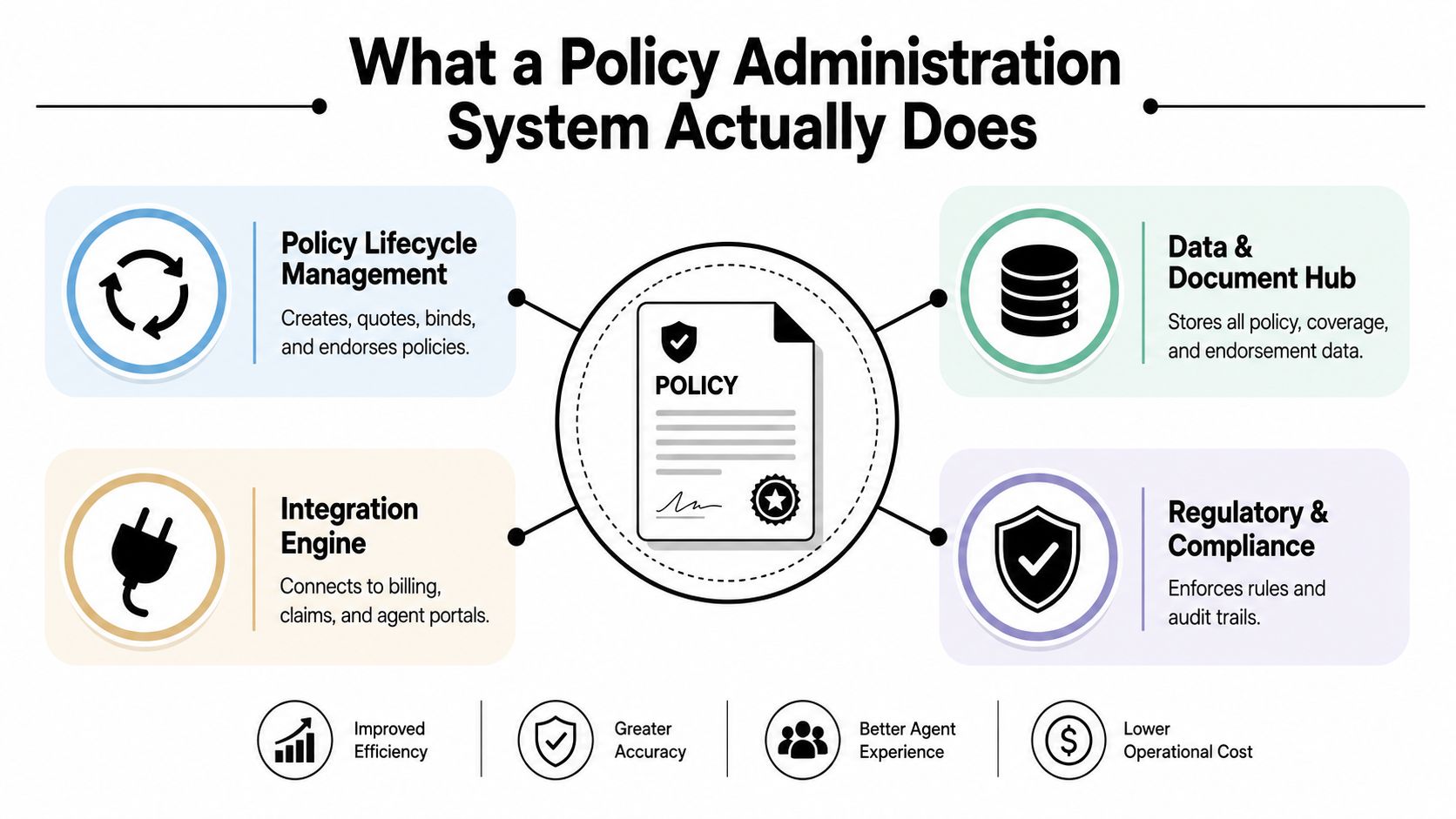
A Policy Administration System, or PAS, is the insurer's permanent policy ledger. It stores the contract's coverages, limits, conditions, exclusions, duration, and endorsements, so downstream teams can rely on one authoritative version of the truth (Sapiens PAS report). That's why claims, billing, and compliance teams care about it even when they don't touch it directly. A PAS is not just where policies live, it's where policy history becomes operationally usable.
The easiest way to spot a weak PAS is simple, ask whether it can reconstruct the contract exactly as it stood on the loss date.
Why the history matters
In a claim, “current” often isn't good enough. A reinstatement can change the answer, an endorsement can change the limit, and a cancellation can change whether a file should even have been open. The PAS has to keep those transitions intact because claims handlers, coverholders, and delegated-authority teams often need to rebuild the policy state as it existed at the time of loss.
That's why the industry language around PAS keeps returning to the same idea, single source of policy truth. Decerto describes modern platforms as spanning the full policy lifecycle and serving underwriting, claims, billing, and reinsurance from one place, with real-time API connections to surrounding systems (Decerto PAS overview). The practical takeaway is straightforward. If policy data can't be trusted, every downstream decision gets slower and more defensive.
For readers who want the broader digital context, Nolana's overview of connected insurance platforms adds useful background in digital insurance platforms.
The Policy Lifecycle From Quote to Reinstatement
A PAS doesn't handle policy events as isolated screens. It treats them as one continuous record, with each step adding to the same policy story. That's the difference between a system that supports insurance operations and one that merely stores transactions.
Quote, bind, issue
The lifecycle usually starts with a quote, where the PAS captures the risk, the selected coverage, and the rating inputs that support the offer. Once the policy binds, the system creates the authoritative policy record and issues the contract. Boost Insurance describes the PAS as the place where policy transactions trigger actions such as quote generation and document production, which is exactly what you want when frontline teams need fast, consistent output (Boost PAS guide).
At this stage, the system is already shaping claims readiness. If the issued wording, billing references, and endorsement structure are not aligned, later claim work gets messy. That's why underwriting and administration can't be separated cleanly in practice.
Endorse, renew, cancel, reinstate
Mid-term endorsements are where the lifecycle logic gets tested. A broker submits a change, the PAS records the transaction, and the policy history keeps both the old state and the new one. Renewal extends the record into the next term, cancellation closes it, and reinstatement opens it again without erasing what came before. The system has to preserve those transitions because effective-dated transactions are what let teams answer, “What was true on that day?”
Practical rule: if your PAS can't show the contract version that was active on the loss date, claims handling will eventually have to reconstruct it by hand.
That's why change control is part of PAS design, not an afterthought. If delegated authority teams, brokers, and internal ops staff all touch the same policy, the platform has to keep the ledger consistent while the business keeps moving. For a deeper view of adjacent automation, Nolana's material on automated underwriting systems is a useful companion read.
How PAS Architectures Actually Differ
The architecture question is where many projects succeed or fail. Two PAS products can look similar in a demo, then behave very differently once claims, billing, and reporting all need the same policy update at the same time.
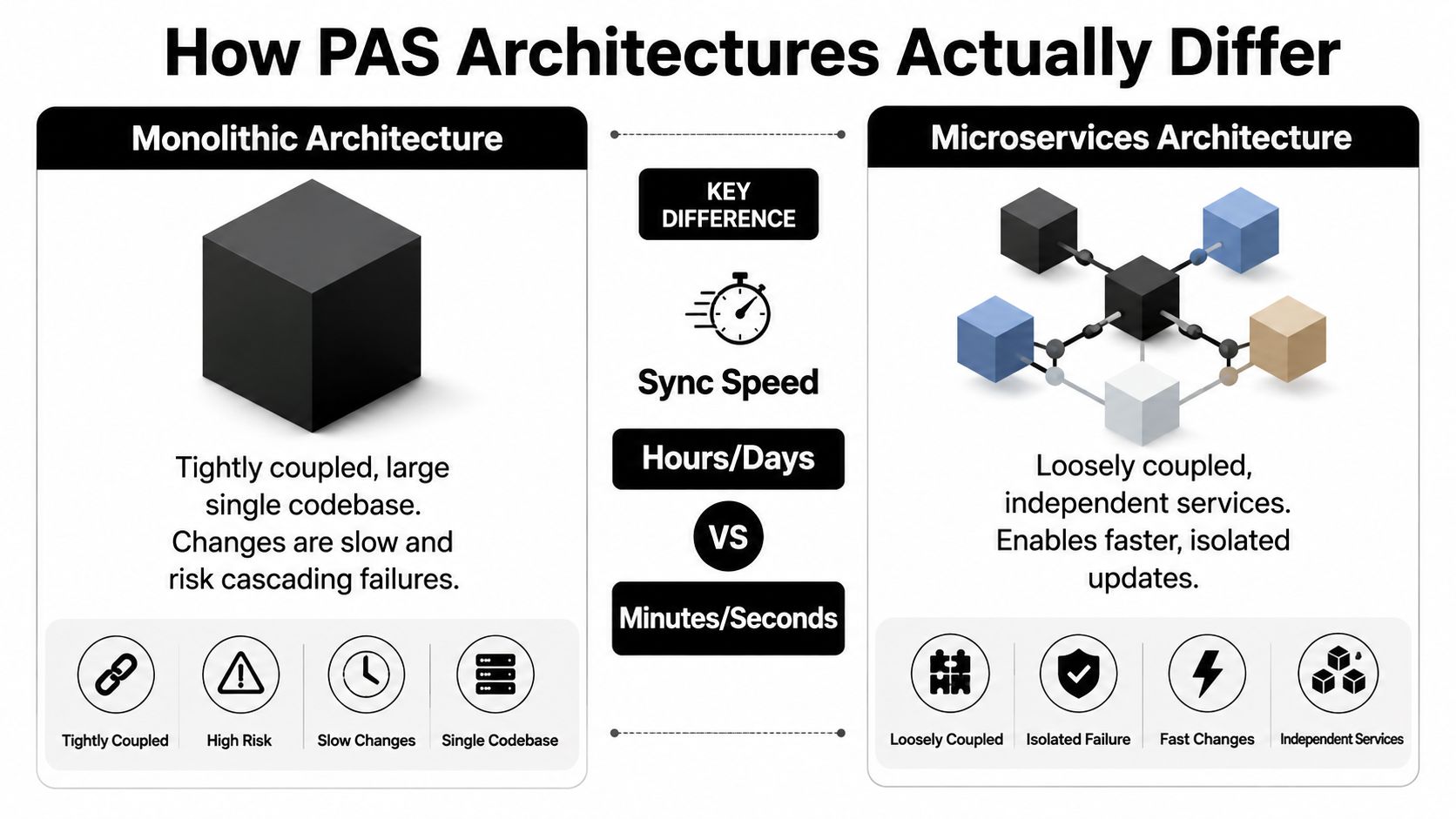
Oracle's Insurance Policy Administration Architecture Guide describes OIPA as a multi-tier J2EE server-side application, with presentation, business logic, and data access separated inside a single JVM, managed with Spring (Oracle architecture guide). That kind of structure gives you strong transactional consistency and a familiar deployment model. It also creates coupling. When everything lives under one runtime boundary, scaling and releasing changes tend to move together.
Monolithic control versus event-driven flow
That traditional model is useful when consistency matters more than release flexibility. A rating update, a document rule, and a policy transaction can all be controlled in one place, which is why many insurers kept this pattern for years. The trade-off is that deployment becomes heavier, and downstream systems often wait for batch updates rather than receiving immediate policy events.
Modern PAS patterns lean the other way. In an event-driven, API-first model, a policy-issued event can trigger rating, document generation, billing, CRM synchronization, and claims notifications as separate services. That reduces hard dependencies and makes policy changes available to adjacent systems faster. It also means the insurer has to be disciplined about observability, versioned APIs, and data governance, because loose coupling only works if the policy history stays clean.
What to ask vendors
If you're reading an architecture diagram, ask three questions. Can the platform keep a consistent policy history? Can claims and billing see changes in near real time? Can a product update move without a full-system release?
For a more technical breakdown of service decomposition, Nolana's article on microservices architecture patterns is a sensible companion. The core judgment is simple, monolithic PAS designs can be stable, but event-driven designs usually give insurers more room to change without turning every release into a platform event.
How PAS Hands Off to Claims and Billing
The cleanest way to understand PAS integration is to follow one policy change across the operating stack. A broker sends a mid-term endorsement, the PAS records the new version, billing recalculates if needed, and claims systems receive the current policy state without a manual rekey. That handoff only works if the PAS is the authoritative source and the rest of the stack consumes it as such.
What downstream systems need
Claims teams don't just need a policy number. They need the effective date, the active wording, the limits, and the version that applies to the loss date. Billing needs the premium impact of the endorsement. Reinsurance may need the same update to keep treaty exposure aligned. If those systems are fed from nightly files, the business is already behind by the time a file lands.
That's why modern PAS vendors emphasize API exposure rather than batch-only integration. Decerto notes that real-time API integration supports synchronization with external systems and regulatory reporting tied to NAIC standards, state DOI requirements, and ACORD data formats (Decerto PAS overview). In practice, that means claims automation can query the policy truth directly instead of waiting for a file drop.
Why synchronization beats replacement
Insurers don't usually replace every connected system at once. They synchronize. The PAS stays in charge of the policy record, while claims platforms, billing engines, and reinsurance tools subscribe to the changes they need. That's the operating model that keeps delegated authority workable, especially when a coverholder or broker needs a fast answer on a live file.
If you're mapping claims automation on top of that model, how to automate claims processing is a useful external reference for the broader workflow picture. For teams running Guidewire-heavy environments, Nolana's note on Guidewire ClaimCenter integrations fits the same logic. The system of record doesn't disappear. It becomes the source that every other workflow has to respect.
Modernization Timelines and Adoption Signals
The market data says PAS modernization is no longer a niche IT project. One estimate places the global life insurance policy administration systems market at US$6.8 billion in 2026, rising to US$15.3 billion by 2033 at a 12.2% CAGR, after a 9.7% historical CAGR (Persistence Market Research). Another estimate projects the same broader market at US$20.3 billion by 2034, from US$6.5 billion in 2024, with North America holding more than 35% of revenue in 2024 and generating about US$2.2 billion (Persistence Market Research). Those numbers don't tell you what to buy, but they do show where insurers are spending their modernization budgets.
Reading the adoption signals
The more practical signal is behavior. A market report says more than 68% of insurers had moved at least one legacy workflow into a modern policy administration environment, 64% had implemented policy data automation, and 59% were using straight-through processing (Market Growth Reports). The same source says 72% of insurers use at least one system to manage 5 to 15 products, and 47% use these platforms for more than 5 product lines at the same time. This is the key insight. Modern PAS work is about complexity management, not just replacement.
For teams comparing a migration roadmap to a 2026 cloud modernization strategy, the timeline matters as much as the feature list.
Modern PAS Adoption Signals Worth Tracking | Share of Insurers | What It Tells You |
|---|---|---|
Legacy workflow moved into modern PAS | More than 68% | Modernization is already underway, even if only in stages |
Policy data automation | 64% | Manual rekeying is being reduced where insurers can justify it |
Straight-through processing | 59% | Insurers are pushing policy transactions toward automation |
Managing 5 to 15 products in one system | 72% | Product complexity is now a standard PAS requirement |
Managing more than 5 product lines concurrently | 47% | Multi-line orchestration is a real operating need |
Implementation scope is not small. In property and casualty, one market guide values the segment at $4.2 billion and says modern platforms can launch products in 6 to 8 weeks instead of 18 to 24 months on legacy systems, with 65% faster launch cycles and about 30% lower operating costs (Market Growth Reports). It also says tier-one implementations typically take 18 to 36 months and can cost $5 million to $50 million (Market Growth Reports). That's a multi-year operating decision, not a software purchase.
Why Faster Releases Are the Real Bottleneck
Most vendors sell PAS modernization as if the feature set is the hard part. In practice, the hard part is deciding how fast the business can safely change a rate, rule, or product without breaking auditability. If that question isn't answered, APIs and cloud hosting don't deliver much operational value.
The hidden constraint is governance
The most overlooked problem is change control. Public content often celebrates cloud delivery, workflow automation, and self-service, but buyers still need to know how a release is approved, logged, tested, and evidenced. One industry guide frames any change cycle longer than 48 hours as a warning sign and recommends prioritizing audit trails for every AI-driven decision (Celent report excerpt). That's a useful threshold because it shifts the conversation away from “Can the platform do it?” toward “Can we prove we did it correctly?”
What usually slows a release down
Data fragmentation is one culprit. If policy, billing, and claims each carry their own version of the truth, every release needs extra validation. Compliance evidence is another. If the system can't show who changed what, when, and why, the insurer spends more time assembling proof than moving work forward.
A modern PAS is only as fast as the release process around it.
That's why PAS modernization is really a sequencing problem. First the insurer needs a trustworthy source of policy truth. Then it needs governance that can support safe, repeatable change. Only after that does AI or automation start compounding real value instead of adding another layer of operational risk.
Where AI Claims Automation Fits on Top of the PAS
Claims automation gets much stronger when it sits on top of an authoritative PAS instead of trying to replace it. The PAS knows the policy truth. AI handles the intake, extraction, triage, and routing work that handlers shouldn't have to do by hand. That division of labor is what makes the workflow both fast and auditable.

Where the PAS stays in control
A claim starts with an email, a portal submission, or a delegated-authority notification. The AI layer can capture the FNOL, extract documents, and route the file, but it still has to ask the PAS what coverage is in force. That's the source of truth, and the AI should defer to it.
Nolana is one option in this layer. It automates FNOL intake, triage, document processing, delegated authority checks, and cross-channel orchestration while keeping handlers in control with human oversight and audit-ready logging. In a Lloyd's or London Market context, that matters because brokers, managing agents, and coverholders all need synchronized updates without losing the policy record that governs the claim.
Why the handoff matters
The point isn't to bolt AI on top of a broken core. It's to let AI do the repetitive work around the PAS while the PAS continues to anchor the contract facts. That's how you get the operational gains people talk about, shorter handling cycles, cleaner routing, and fewer manual touches, without sacrificing governance.
For teams evaluating the automation layer itself, Nolana's claims AI overview shows how intake, triage, and document handling can sit above existing systems. The strongest implementation pattern is the one that keeps the PAS authoritative and lets AI work as the execution layer around it.
A Practical PAS Readiness Checklist

Before you fund another modernization project, check five things. First, confirm you have a single source of truth for policy history. Second, test whether claims and billing can query policy status in real time through APIs. Third, measure how long a safe release cycle really takes, not how long the vendor says it should take. Fourth, ask whether audit trails are strong enough for delegated authority and AI-assisted decisions. Fifth, trace one incoming claim back to the policy record and see whether every downstream update stays consistent.
If any of those steps break, claims automation will inherit the weakness. PAS modernization only pays off when the policy record is trustworthy enough to support faster decisions, cleaner routing, and better operational control.
Nolana AI helps insurance teams automate claims work on top of existing systems, including FNOL intake, triage, document processing, and delegated authority workflows, while keeping human handlers in control. If you're connecting PAS modernization to claims readiness, visit Nolana AI and see how an agentic layer can work with your current policy and claims stack.
You know the moment, a claims handler is staring at a mid-term endorsement, a broker wants an answer fast, and everyone is looking at the policy record to decide whether the loss sits inside coverage or not. If that record is stale, fragmented, or buried in a legacy screen, the delay doesn't stay in policy administration. It shows up in claims, billing, reinsurance, and the audit trail that has to survive the next review.
Insurance policy administration systems are the quiet system that decides whether the rest of the insurance operation can move with confidence. They're the insurer's system of record for policy-level data, and they have to preserve the full history of a policy from issuance through renewal, cancellation, termination, and reinstatement (Majesco PAS overview). That's a very different job from a simple database of current coverage. It's more like a ledger than a form builder, and the difference matters when a claim lands months after an endorsement changed the contract.
What a Policy Administration System Actually Does
A handler doesn't usually think about policy administration until a file gets complicated. The email says the policy was endorsed mid-term, the claims note says the loss date sits near the change, and someone needs to know which wording applied at that exact moment. If the system only shows the latest policy snapshot, the handler is guessing. If the PAS keeps effective-dated history, the answer is there.
A Policy Administration System, or PAS, is the insurer's permanent policy ledger. It stores the contract's coverages, limits, conditions, exclusions, duration, and endorsements, so downstream teams can rely on one authoritative version of the truth (Sapiens PAS report). That's why claims, billing, and compliance teams care about it even when they don't touch it directly. A PAS is not just where policies live, it's where policy history becomes operationally usable.
The easiest way to spot a weak PAS is simple, ask whether it can reconstruct the contract exactly as it stood on the loss date.
Why the history matters
In a claim, “current” often isn't good enough. A reinstatement can change the answer, an endorsement can change the limit, and a cancellation can change whether a file should even have been open. The PAS has to keep those transitions intact because claims handlers, coverholders, and delegated-authority teams often need to rebuild the policy state as it existed at the time of loss.
That's why the industry language around PAS keeps returning to the same idea, single source of policy truth. Decerto describes modern platforms as spanning the full policy lifecycle and serving underwriting, claims, billing, and reinsurance from one place, with real-time API connections to surrounding systems (Decerto PAS overview). The practical takeaway is straightforward. If policy data can't be trusted, every downstream decision gets slower and more defensive.
For readers who want the broader digital context, Nolana's overview of connected insurance platforms adds useful background in digital insurance platforms.
The Policy Lifecycle From Quote to Reinstatement
A PAS doesn't handle policy events as isolated screens. It treats them as one continuous record, with each step adding to the same policy story. That's the difference between a system that supports insurance operations and one that merely stores transactions.
Quote, bind, issue
The lifecycle usually starts with a quote, where the PAS captures the risk, the selected coverage, and the rating inputs that support the offer. Once the policy binds, the system creates the authoritative policy record and issues the contract. Boost Insurance describes the PAS as the place where policy transactions trigger actions such as quote generation and document production, which is exactly what you want when frontline teams need fast, consistent output (Boost PAS guide).
At this stage, the system is already shaping claims readiness. If the issued wording, billing references, and endorsement structure are not aligned, later claim work gets messy. That's why underwriting and administration can't be separated cleanly in practice.
Endorse, renew, cancel, reinstate
Mid-term endorsements are where the lifecycle logic gets tested. A broker submits a change, the PAS records the transaction, and the policy history keeps both the old state and the new one. Renewal extends the record into the next term, cancellation closes it, and reinstatement opens it again without erasing what came before. The system has to preserve those transitions because effective-dated transactions are what let teams answer, “What was true on that day?”
Practical rule: if your PAS can't show the contract version that was active on the loss date, claims handling will eventually have to reconstruct it by hand.
That's why change control is part of PAS design, not an afterthought. If delegated authority teams, brokers, and internal ops staff all touch the same policy, the platform has to keep the ledger consistent while the business keeps moving. For a deeper view of adjacent automation, Nolana's material on automated underwriting systems is a useful companion read.
How PAS Architectures Actually Differ
The architecture question is where many projects succeed or fail. Two PAS products can look similar in a demo, then behave very differently once claims, billing, and reporting all need the same policy update at the same time.
Oracle's Insurance Policy Administration Architecture Guide describes OIPA as a multi-tier J2EE server-side application, with presentation, business logic, and data access separated inside a single JVM, managed with Spring (Oracle architecture guide). That kind of structure gives you strong transactional consistency and a familiar deployment model. It also creates coupling. When everything lives under one runtime boundary, scaling and releasing changes tend to move together.
Monolithic control versus event-driven flow
That traditional model is useful when consistency matters more than release flexibility. A rating update, a document rule, and a policy transaction can all be controlled in one place, which is why many insurers kept this pattern for years. The trade-off is that deployment becomes heavier, and downstream systems often wait for batch updates rather than receiving immediate policy events.
Modern PAS patterns lean the other way. In an event-driven, API-first model, a policy-issued event can trigger rating, document generation, billing, CRM synchronization, and claims notifications as separate services. That reduces hard dependencies and makes policy changes available to adjacent systems faster. It also means the insurer has to be disciplined about observability, versioned APIs, and data governance, because loose coupling only works if the policy history stays clean.
What to ask vendors
If you're reading an architecture diagram, ask three questions. Can the platform keep a consistent policy history? Can claims and billing see changes in near real time? Can a product update move without a full-system release?
For a more technical breakdown of service decomposition, Nolana's article on microservices architecture patterns is a sensible companion. The core judgment is simple, monolithic PAS designs can be stable, but event-driven designs usually give insurers more room to change without turning every release into a platform event.
How PAS Hands Off to Claims and Billing
The cleanest way to understand PAS integration is to follow one policy change across the operating stack. A broker sends a mid-term endorsement, the PAS records the new version, billing recalculates if needed, and claims systems receive the current policy state without a manual rekey. That handoff only works if the PAS is the authoritative source and the rest of the stack consumes it as such.
What downstream systems need
Claims teams don't just need a policy number. They need the effective date, the active wording, the limits, and the version that applies to the loss date. Billing needs the premium impact of the endorsement. Reinsurance may need the same update to keep treaty exposure aligned. If those systems are fed from nightly files, the business is already behind by the time a file lands.
That's why modern PAS vendors emphasize API exposure rather than batch-only integration. Decerto notes that real-time API integration supports synchronization with external systems and regulatory reporting tied to NAIC standards, state DOI requirements, and ACORD data formats (Decerto PAS overview). In practice, that means claims automation can query the policy truth directly instead of waiting for a file drop.
Why synchronization beats replacement
Insurers don't usually replace every connected system at once. They synchronize. The PAS stays in charge of the policy record, while claims platforms, billing engines, and reinsurance tools subscribe to the changes they need. That's the operating model that keeps delegated authority workable, especially when a coverholder or broker needs a fast answer on a live file.
If you're mapping claims automation on top of that model, how to automate claims processing is a useful external reference for the broader workflow picture. For teams running Guidewire-heavy environments, Nolana's note on Guidewire ClaimCenter integrations fits the same logic. The system of record doesn't disappear. It becomes the source that every other workflow has to respect.
Modernization Timelines and Adoption Signals
The market data says PAS modernization is no longer a niche IT project. One estimate places the global life insurance policy administration systems market at US$6.8 billion in 2026, rising to US$15.3 billion by 2033 at a 12.2% CAGR, after a 9.7% historical CAGR (Persistence Market Research). Another estimate projects the same broader market at US$20.3 billion by 2034, from US$6.5 billion in 2024, with North America holding more than 35% of revenue in 2024 and generating about US$2.2 billion (Persistence Market Research). Those numbers don't tell you what to buy, but they do show where insurers are spending their modernization budgets.
Reading the adoption signals
The more practical signal is behavior. A market report says more than 68% of insurers had moved at least one legacy workflow into a modern policy administration environment, 64% had implemented policy data automation, and 59% were using straight-through processing (Market Growth Reports). The same source says 72% of insurers use at least one system to manage 5 to 15 products, and 47% use these platforms for more than 5 product lines at the same time. This is the key insight. Modern PAS work is about complexity management, not just replacement.
For teams comparing a migration roadmap to a 2026 cloud modernization strategy, the timeline matters as much as the feature list.
Modern PAS Adoption Signals Worth Tracking | Share of Insurers | What It Tells You |
|---|---|---|
Legacy workflow moved into modern PAS | More than 68% | Modernization is already underway, even if only in stages |
Policy data automation | 64% | Manual rekeying is being reduced where insurers can justify it |
Straight-through processing | 59% | Insurers are pushing policy transactions toward automation |
Managing 5 to 15 products in one system | 72% | Product complexity is now a standard PAS requirement |
Managing more than 5 product lines concurrently | 47% | Multi-line orchestration is a real operating need |
Implementation scope is not small. In property and casualty, one market guide values the segment at $4.2 billion and says modern platforms can launch products in 6 to 8 weeks instead of 18 to 24 months on legacy systems, with 65% faster launch cycles and about 30% lower operating costs (Market Growth Reports). It also says tier-one implementations typically take 18 to 36 months and can cost $5 million to $50 million (Market Growth Reports). That's a multi-year operating decision, not a software purchase.
Why Faster Releases Are the Real Bottleneck
Most vendors sell PAS modernization as if the feature set is the hard part. In practice, the hard part is deciding how fast the business can safely change a rate, rule, or product without breaking auditability. If that question isn't answered, APIs and cloud hosting don't deliver much operational value.
The hidden constraint is governance
The most overlooked problem is change control. Public content often celebrates cloud delivery, workflow automation, and self-service, but buyers still need to know how a release is approved, logged, tested, and evidenced. One industry guide frames any change cycle longer than 48 hours as a warning sign and recommends prioritizing audit trails for every AI-driven decision (Celent report excerpt). That's a useful threshold because it shifts the conversation away from “Can the platform do it?” toward “Can we prove we did it correctly?”
What usually slows a release down
Data fragmentation is one culprit. If policy, billing, and claims each carry their own version of the truth, every release needs extra validation. Compliance evidence is another. If the system can't show who changed what, when, and why, the insurer spends more time assembling proof than moving work forward.
A modern PAS is only as fast as the release process around it.
That's why PAS modernization is really a sequencing problem. First the insurer needs a trustworthy source of policy truth. Then it needs governance that can support safe, repeatable change. Only after that does AI or automation start compounding real value instead of adding another layer of operational risk.
Where AI Claims Automation Fits on Top of the PAS
Claims automation gets much stronger when it sits on top of an authoritative PAS instead of trying to replace it. The PAS knows the policy truth. AI handles the intake, extraction, triage, and routing work that handlers shouldn't have to do by hand. That division of labor is what makes the workflow both fast and auditable.
Where the PAS stays in control
A claim starts with an email, a portal submission, or a delegated-authority notification. The AI layer can capture the FNOL, extract documents, and route the file, but it still has to ask the PAS what coverage is in force. That's the source of truth, and the AI should defer to it.
Nolana is one option in this layer. It automates FNOL intake, triage, document processing, delegated authority checks, and cross-channel orchestration while keeping handlers in control with human oversight and audit-ready logging. In a Lloyd's or London Market context, that matters because brokers, managing agents, and coverholders all need synchronized updates without losing the policy record that governs the claim.
Why the handoff matters
The point isn't to bolt AI on top of a broken core. It's to let AI do the repetitive work around the PAS while the PAS continues to anchor the contract facts. That's how you get the operational gains people talk about, shorter handling cycles, cleaner routing, and fewer manual touches, without sacrificing governance.
For teams evaluating the automation layer itself, Nolana's claims AI overview shows how intake, triage, and document handling can sit above existing systems. The strongest implementation pattern is the one that keeps the PAS authoritative and lets AI work as the execution layer around it.
A Practical PAS Readiness Checklist
Before you fund another modernization project, check five things. First, confirm you have a single source of truth for policy history. Second, test whether claims and billing can query policy status in real time through APIs. Third, measure how long a safe release cycle really takes, not how long the vendor says it should take. Fourth, ask whether audit trails are strong enough for delegated authority and AI-assisted decisions. Fifth, trace one incoming claim back to the policy record and see whether every downstream update stays consistent.
If any of those steps break, claims automation will inherit the weakness. PAS modernization only pays off when the policy record is trustworthy enough to support faster decisions, cleaner routing, and better operational control.
Nolana AI helps insurance teams automate claims work on top of existing systems, including FNOL intake, triage, document processing, and delegated authority workflows, while keeping human handlers in control. If you're connecting PAS modernization to claims readiness, visit Nolana AI and see how an agentic layer can work with your current policy and claims stack.


All systems operational
1 Lime Street, London EC3M 7HA | 222E 3rd Street, New York 10009
Copyright © 2026, Nolana. All rights reserved
All systems operational
1 Lime Street, London EC3M 7HA | 222E 3rd Street, New York 10009
Copyright © 2026, Nolana. All rights reserved
All systems operational
1 Lime Street, London EC3M 7HA | 222E 3rd Street, New York 10009
Copyright © 2026, Nolana. All rights reserved
All systems operational
1 Lime Street, London EC3M 7HA | 222E 3rd Street, New York 10009
Copyright © 2026, Nolana. All rights reserved