Insurance Policy Lifecycle: Stages, Systems, and Automation
Insurance Policy Lifecycle: Stages, Systems, and Automation
Master the insurance policy lifecycle from quote to claims. Explore stages, systems, and how agentic AI automates operations for the Lloyd's market.

A claim can be “in the system” and still be going nowhere. The FNOL has been received, the policy document is attached, and the handler can see an open task, yet the file sits while someone searches for the current endorsement, waits for a missing statement, or confirms which party has authority to act. For the policyholder, the insurance policy lifecycle feels like silence. For the operations team, it's dormant time hidden between completed tasks.
That gap is why a policy lifecycle shouldn't be managed as a neat diagram from quote to renewal. It's a connected operating model spanning policy data, documents, billing, claims, delegated authority, communications, and audit evidence. The strongest modernization programs don't replace every core platform. They connect the gaps, make work visible, and give people the right next action before a file becomes stale.
The Reality of the Insurance Policy Lifecycle
Most lifecycle diagrams imply that work moves cleanly from enquiry to quotation, binding, administration, claims, renewal, or cancellation. A claims operations leader sees something different. A broker emails a loss notification, a claims administrator creates a record, a policy administrator confirms the schedule, and a handler later discovers that a mid-term adjustment changed the insured location or coverage terms. Every team has completed an activity, but the claim still lacks a reliable decision path.
That's the operational reality of the insurance policy lifecycle. It's a chain of states, but it's also a data ecosystem. Risk information, premium and financial records, client and insurer identifiers, policy versions, document references, and audit trails must remain connected as the policy changes. If one transition loses context, the problem may not appear until a customer asks for payment or a handler needs to establish coverage.
Practical rule: Treat every lifecycle transition as a controlled handoff, not a status update.
The dormant-time problem deserves more attention than the stage labels themselves. A file may be technically open and actively assigned while no meaningful progress occurs. The delay can sit after FNOL, between document receipt and extraction, during coverage verification, or in an unowned email thread. Traditional workflow systems often record what happened, but not what should happen next or why the next action hasn't occurred.
The historical move toward measurable oversight reflects this challenge. An APRA published report tracked 47,069 claims, with 66% of received claims finalized within the reporting window and another published outcome measure showing 83% of received claims reaching a recorded outcome in the reported period. Those figures come from APRA's life insurance claims and disputes statistics, and their operational lesson is broader than the reported market: once volumes become material, insurers need measurable control over receipt, decisioning, outcomes, and disputes.
The lifecycle therefore has two dimensions. The first is the contractual journey of the policy. The second is the flow of evidence and decisions through the operating model. Modern automation has value only when it improves both.
Core Stages of Policy Administration
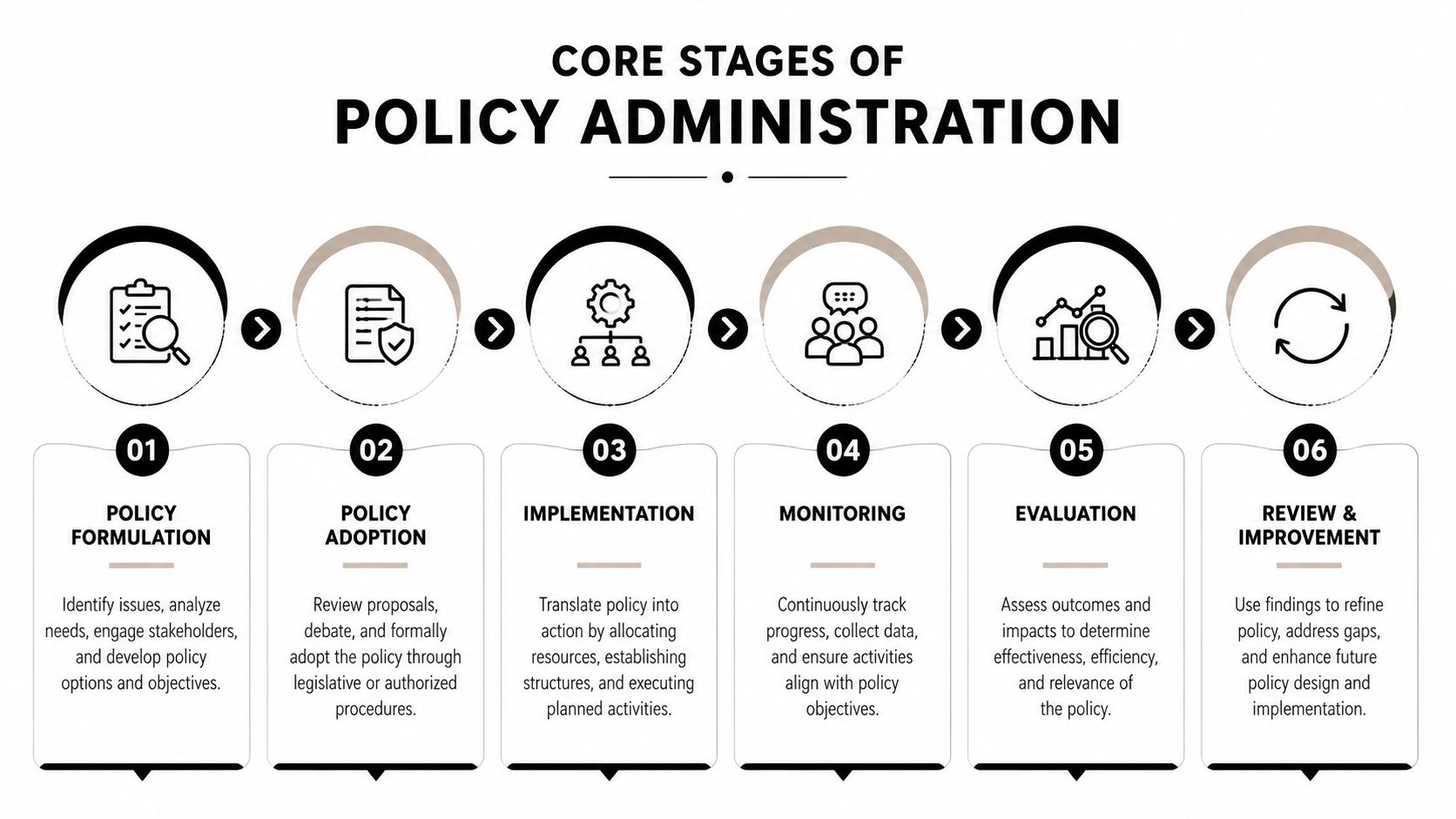
Policy administration works when each state carries enough information for the next state to act without reconstructing the record. The standard sequence includes enquiry, quotation, binding, documentation issuance, in-force administration, mid-term adjustments, renewal, and cancellation. These aren't isolated boxes. Each one changes the data that downstream teams rely on.
Start with a dependable policy record
At enquiry, the organization captures the initial risk and client context. Quotation adds terms, limits, pricing inputs, and underwriting decisions. Binding turns an accepted offer into active coverage, while documentation issuance creates the records that brokers, policyholders, claims teams, and auditors will use.
A weak bind-stage record creates operational debt. If identifiers are inconsistent, a document is stored outside the expected record, or the bound terms don't align with billing data, a future handler has to reconcile systems under pressure. That's why a policy administration system should preserve version history and audit trails rather than merely display the latest value.
A practical lifecycle data model should retain:
Risk data: Exposure details, insured assets, locations, classifications, and applicable terms.
Financial data: Premium information, billing references, adjustments, and transaction history.
Party identifiers: Client, broker, insurer, coverholder, and other relevant participants.
Document references: Schedules, endorsements, correspondence, evidence, and approvals.
Version and audit history: What changed, when it changed, who approved it, and which record supported the change.
Keep servicing and MTAs connected
In-force administration covers routine maintenance, billing coordination, document requests, and policyholder or broker changes. Mid-term adjustments, often called MTAs, are more consequential because they can alter the risk, premium, coverage, location, or parties associated with the policy.
The MTA must update the policy record, financial treatment, documentation, and any downstream claims context together. If claims teams see an old schedule while billing reflects a newer endorsement, the organization has a continuity problem, not merely a user-interface problem. Guidance on structuring these dependencies is available in this policy administration systems resource.
Renewal should inherit the right history, including prior changes, claims context, and policy performance. Cancellation must record the effective date, reason, communications, and financial consequences. Across both events, the system needs clear triggers, required data, validations, and communications.
A policy administration platform can't compensate for missing ownership at the point of change. The workflow needs both a reliable record and a named decision-maker.
Automation built on incomplete or contradictory policy data will move errors faster. The foundation comes first, then orchestration.
The Claims Lifecycle as a Parallel Journey
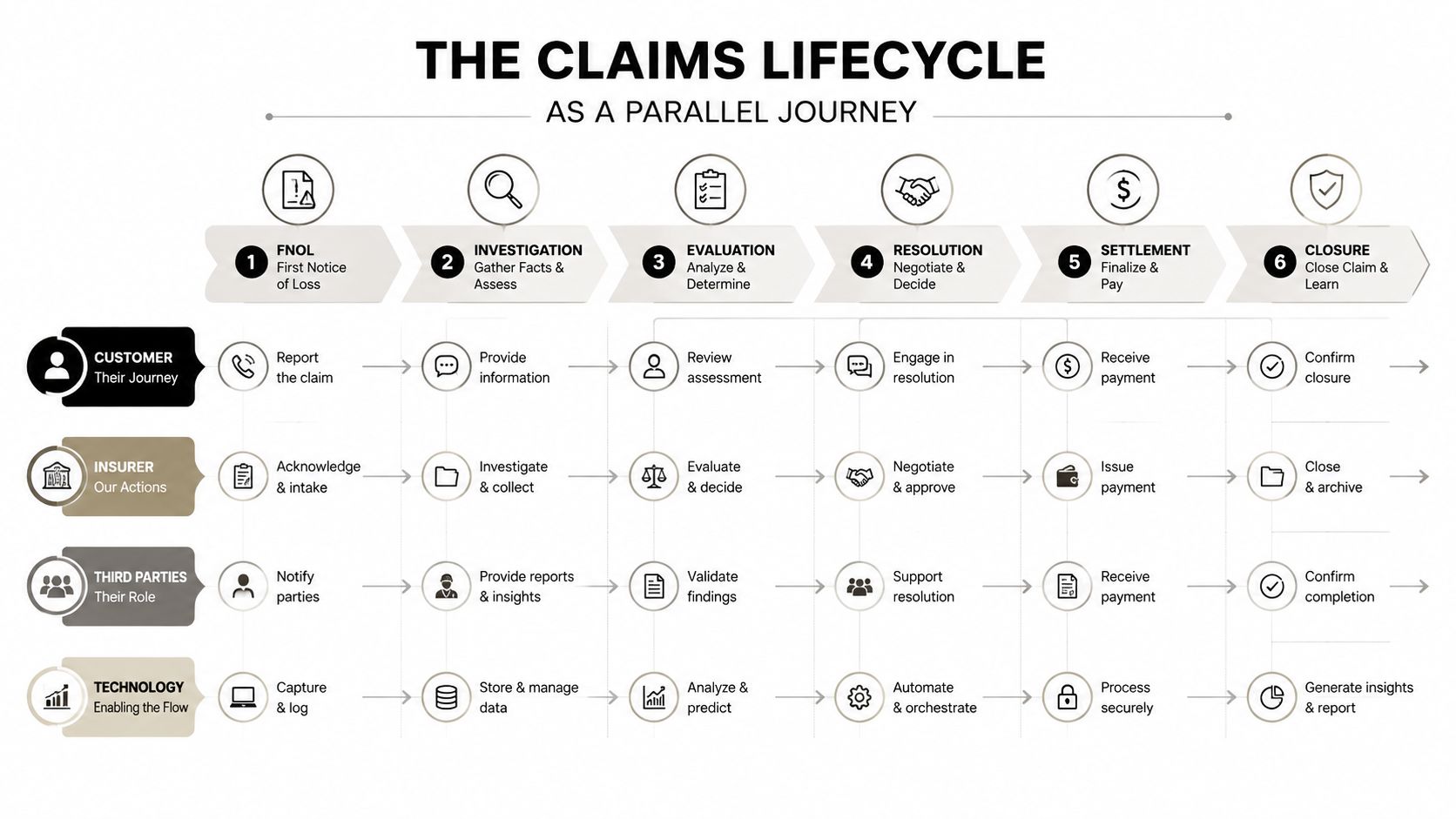
A claim doesn't wait for the policy lifecycle to finish. It activates while the policy is in force and introduces its own controlled sequence: FNOL, triage, coverage verification, reserving, investigation, decisioning, settlement, and closure. The claims team must establish what happened, whether coverage applies, what evidence is required, who has authority, and what action should follow.
Verify before investigating deeply
The first control is simple and frequently mishandled: confirm that the policy is in force before committing significant adjustment effort. That means checking the relevant policy version, effective dates, insured parties, coverage, exclusions, and applicable changes. India First Life's explanation of the life insurance claim process also shows why document completeness matters, noting a benchmark for settling or rejecting non-investigated claims within 15 days after all mandatory documents are received.
That benchmark is operationally useful because it links speed to evidence quality. If the intake process doesn't identify missing documents early, the file can appear active while the handler waits. A good claims workbench should expose the missing requirement, request it through the appropriate channel, and preserve the response against the claim record.
The parallel relationship looks like this:
Policy lifecycle dependency | Claims consequence |
|---|---|
Current policy version | The handler evaluates the correct coverage terms |
MTA and endorsement history | The loss is assessed against the relevant change |
Party and authority data | The file reaches the correct participant |
Document references | Evidence can be found and reviewed |
Billing and status records | Coverage and financial context remain consistent |
The claim then moves through triage, investigation, assessment, decisioning, settlement, and closure. Each stage creates tasks and evidence that should remain visible to the policy record without forcing teams to duplicate data manually.
Watch the claims journey in context:
A claims management system guide can help teams assess whether their current workbench supports this synchronization. The practical test isn't whether the platform has a claims status field. It's whether the handler can see the policy context, outstanding evidence, authority position, next action, and audit history without reconstructing the file across email, spreadsheets, and disconnected portals.
Measuring the Gap Between Expectations and Reality
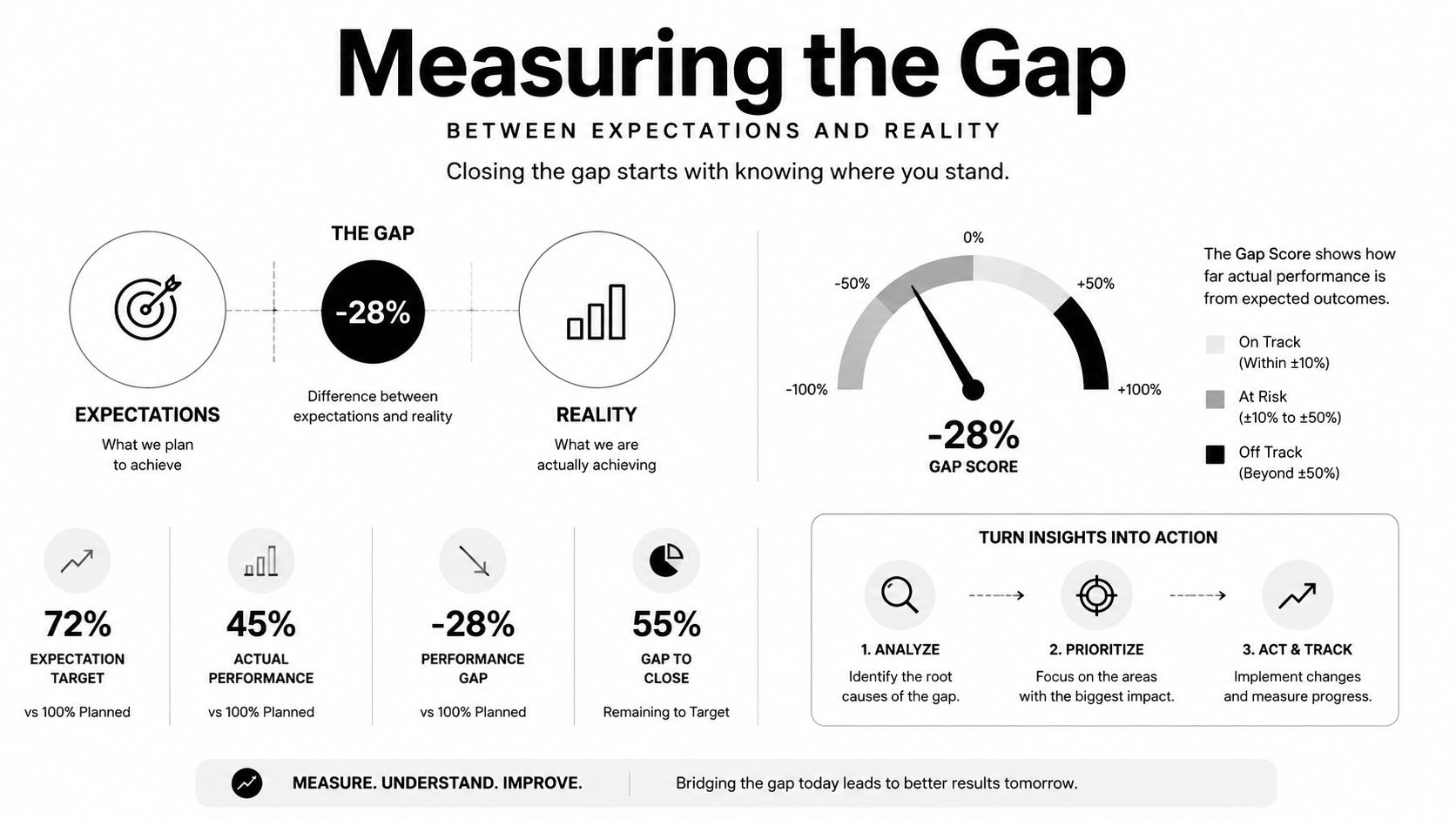
Cycle time gives leaders a starting point, but the average alone doesn't explain dissatisfaction. The more useful question is: where does time stop producing progress after FNOL?
Industry benchmarks cited in 2026 sources place the average claims cycle at 23.9 days, while policyholders expect resolution in 11 days and digital-first carriers can close claims in about 15 days. These figures are documented in claims cycle time benchmarks. Personal auto claims are commonly reported in the 15 to 30 day range, property claims in the 20 to 40 day range, and catastrophe-event claims in the 30 to 90-plus day range.
Find the dormant intervals
Property claims make the gap particularly visible. One cited industry report placed average property claims cycle time at 32.4 days in 2025, with some claims exceeding 44 days from FNOL to final payment, while a 2026 update placed the average at 40.7 days. Those figures appear in the claims automation market report. The differences between benchmarks don't remove the operational lesson. Complexity expands the lifecycle, and unexplained inactivity makes the experience worse.
Break the file into measurable intervals:
Intake to triage: How long does it take to capture the loss, identify missing information, and assign the appropriate route?
Triage to coverage confirmation: How much time passes before the team verifies the in-force policy and applicable terms?
Evidence request to receipt: Which documents are outstanding, and how many follow-ups happen before they arrive?
Receipt to decision: Does someone have to rekey information or manually compare documents before deciding?
Decision to settlement: Are authority, payment, approvals, and communications moving in one workflow?
A customer portal may reduce the friction of submitting a claim, but it doesn't automatically resolve the work that follows. If a human still downloads attachments, reads each email, copies values into a core system, and searches for an endorsement, the organization has digitized intake without automating the lifecycle.
Measurement discipline: Track elapsed time between decisions and dependencies, not only the date the claim opened and closed.
The guide to measuring operational efficiency is relevant here because leaders need visibility into queues, rework, handoffs, and dormant cases. The objective isn't to make every claim follow the same path. It's to distinguish necessary investigation from avoidable waiting.
The Automation Gap in Modern Insurance
The insurance industry has plenty of digital activity, but digital activity isn't the same as autonomous workflow execution. A portal can collect a form. OCR can extract text. An integration can copy a field. None of those capabilities, on their own, decides what should happen next, checks whether the required evidence is complete, routes the claim, and records why a human intervention was needed.
Recent industry commentary says true end-to-end AI remains rare, with most live deployments limited to isolated tasks rather than the full policy and claims lifecycle. A 2025 survey cited in that commentary ranked improving claims processing efficiency as a priority for 72% of claims professionals and reducing cycle times as a priority for 64%. The figures and context are available in insurance AI trends commentary.
Digitization versus orchestration
The distinction matters in daily operations.
Digitized workflow | Agentic workflow |
|---|---|
Receives a document | Determines what the document means in the claim context |
Extracts a field | Validates the field against policy and claim data |
Creates a task | Selects the next task based on rules, evidence, and authority |
Sends a message | Follows up, records the response, and updates the workflow |
Shows a status | Detects inactivity and proposes a next best action |
Basic OCR still has a role. It reduces manual reading for predictable documents and can populate structured fields. But agents add context and orchestration. They can interpret a policyholder's input, request missing information, compare documents with policy records, and route a file according to defined rules.
The Lloyd's market demonstrates why this orchestration must include governance. Its open-market claims journey materials describe rules-engine triage that creates claim tasks, routes them to relevant participants, verifies coverage against placement data, and supports API-based collaboration.
That model points to a sensible modernization pattern. Put intelligence around existing systems, make every action traceable, and reserve authority-sensitive decisions for configured controls and human review. More detail on the difference between task automation and coordinated decision support appears in this intelligent automation in insurance article.
Governance and Oversight in Delegated Authority
Speed has no operational value if the organization can't explain who acted, under which authority, using which evidence. That standard becomes especially important in delegated authority, where managing agents, coverholders, brokers, and Delegated Claims Administrators share responsibility across a distributed operating model.
Lloyd's Delegated Authority Guidance emphasizes high standards and consistency in auditing coverholders and DCAs. Lloyd's also maintains a Delegated Audit Manager system for managing and monitoring audits of coverholders and claims TPAs. This is a useful reminder that audit tracking is an established market mechanism, not an administrative extra added after automation.
Authority must be explicit
Lloyd's states that managing agents aren't permitted to appoint a DCA to determine claims unless that DCA has been approved by Lloyd's. The implication for technology is direct. An automated workflow must understand authority boundaries, escalate exceptions, and preserve the evidence supporting each action.
Bordereaux discipline creates another control point. Lloyd's managing-agent guidance recommends submitting bordereaux as early as possible after month-end, ideally within the first four working days, to avoid delays in downstream processing and monthly reconciliation. The relevant requirements are set out in Lloyd's delegated claims administrator guidance.
A useful audit record should show:
Input: The email, form, document, policy record, or placement data that entered the workflow.
Interpretation: The extracted facts and confidence or validation result.
Rule: The authority, coverage, routing, or completeness rule applied.
Action: The update, request, approval, rejection, or escalation performed.
Human control: The person who reviewed, amended, approved, or overrode the result.
Outcome: The final disposition and supporting evidence.
Lloyd's delegated audit materials describe structured task types and workflow management for evidence collection, response handling, audit recommendations, and central monitoring. That operating model supports integration-first automation. An AI layer should write back to the existing workbench, retain audit-ready logs, and make review easier.
Forcing every participant into a replacement platform often creates resistance, duplicated records, and new reconciliation work. Layering controlled automation over current claims and policy systems respects the market's operating reality while improving speed where manual handoffs create the most risk.
Strategic Implementation of Agentic AI
Agentic AI implementation should begin with the work that consumes handler attention without requiring unrestricted autonomy. The strongest candidates are repetitive, evidence-heavy, and governed by clear escalation rules.
Assess the operating path
Map the lifecycle from FNOL to closure, then identify where files wait. Review email intake, document classification, policy lookup, coverage checks, authority routing, follow-ups, diary management, and settlement preparation. Measure ownership and elapsed time at each point rather than treating the claim as one undifferentiated queue.

Layer agents over the workbench
Keep the core policy and claims systems as the system of record. Add agents through APIs and controlled integrations for FNOL intake, document processing, task creation, missing-information requests, dormant-case detection, and next-best-action recommendations.
Nolana AI is one example of this approach. Its agents handle FNOL intake, claims triage, static claims management, and document processing, while the SOC 2-certified platform integrates with and sits on top of existing claims and policy systems. It's designed for managing agents, brokers, and coverholders, with human oversight and auditability throughout.
For broader terminology and implementation considerations, consult this agentic AI guide. Teams evaluating unfamiliar documentation or ownership records can also use a practical Cararam branded title guide as an example of how precise source context matters when an automated workflow interprets records.
Pilot, monitor, and expand
Start with a bounded workflow, such as inbound FNOL classification or document extraction. Define escalation conditions before deployment, review agent actions with experienced handlers, and monitor dormant cases, rework, data quality, and audit exceptions. Expand only when the agent performs reliably within the agreed authority and evidence boundaries.
The aim isn't to remove judgment from claims. It's to remove avoidable waiting so handlers can apply judgment where it matters.
Nolana AI helps Lloyd's market participants automate FNOL intake, triage, document processing, and claims lifecycle follow-up while keeping human handlers in control. Visit Nolana AI to see how an integration-first agentic layer can reduce dormant work across your existing policy and claims systems.
A claim can be “in the system” and still be going nowhere. The FNOL has been received, the policy document is attached, and the handler can see an open task, yet the file sits while someone searches for the current endorsement, waits for a missing statement, or confirms which party has authority to act. For the policyholder, the insurance policy lifecycle feels like silence. For the operations team, it's dormant time hidden between completed tasks.
That gap is why a policy lifecycle shouldn't be managed as a neat diagram from quote to renewal. It's a connected operating model spanning policy data, documents, billing, claims, delegated authority, communications, and audit evidence. The strongest modernization programs don't replace every core platform. They connect the gaps, make work visible, and give people the right next action before a file becomes stale.
The Reality of the Insurance Policy Lifecycle
Most lifecycle diagrams imply that work moves cleanly from enquiry to quotation, binding, administration, claims, renewal, or cancellation. A claims operations leader sees something different. A broker emails a loss notification, a claims administrator creates a record, a policy administrator confirms the schedule, and a handler later discovers that a mid-term adjustment changed the insured location or coverage terms. Every team has completed an activity, but the claim still lacks a reliable decision path.
That's the operational reality of the insurance policy lifecycle. It's a chain of states, but it's also a data ecosystem. Risk information, premium and financial records, client and insurer identifiers, policy versions, document references, and audit trails must remain connected as the policy changes. If one transition loses context, the problem may not appear until a customer asks for payment or a handler needs to establish coverage.
Practical rule: Treat every lifecycle transition as a controlled handoff, not a status update.
The dormant-time problem deserves more attention than the stage labels themselves. A file may be technically open and actively assigned while no meaningful progress occurs. The delay can sit after FNOL, between document receipt and extraction, during coverage verification, or in an unowned email thread. Traditional workflow systems often record what happened, but not what should happen next or why the next action hasn't occurred.
The historical move toward measurable oversight reflects this challenge. An APRA published report tracked 47,069 claims, with 66% of received claims finalized within the reporting window and another published outcome measure showing 83% of received claims reaching a recorded outcome in the reported period. Those figures come from APRA's life insurance claims and disputes statistics, and their operational lesson is broader than the reported market: once volumes become material, insurers need measurable control over receipt, decisioning, outcomes, and disputes.
The lifecycle therefore has two dimensions. The first is the contractual journey of the policy. The second is the flow of evidence and decisions through the operating model. Modern automation has value only when it improves both.
Core Stages of Policy Administration
Policy administration works when each state carries enough information for the next state to act without reconstructing the record. The standard sequence includes enquiry, quotation, binding, documentation issuance, in-force administration, mid-term adjustments, renewal, and cancellation. These aren't isolated boxes. Each one changes the data that downstream teams rely on.
Start with a dependable policy record
At enquiry, the organization captures the initial risk and client context. Quotation adds terms, limits, pricing inputs, and underwriting decisions. Binding turns an accepted offer into active coverage, while documentation issuance creates the records that brokers, policyholders, claims teams, and auditors will use.
A weak bind-stage record creates operational debt. If identifiers are inconsistent, a document is stored outside the expected record, or the bound terms don't align with billing data, a future handler has to reconcile systems under pressure. That's why a policy administration system should preserve version history and audit trails rather than merely display the latest value.
A practical lifecycle data model should retain:
Risk data: Exposure details, insured assets, locations, classifications, and applicable terms.
Financial data: Premium information, billing references, adjustments, and transaction history.
Party identifiers: Client, broker, insurer, coverholder, and other relevant participants.
Document references: Schedules, endorsements, correspondence, evidence, and approvals.
Version and audit history: What changed, when it changed, who approved it, and which record supported the change.
Keep servicing and MTAs connected
In-force administration covers routine maintenance, billing coordination, document requests, and policyholder or broker changes. Mid-term adjustments, often called MTAs, are more consequential because they can alter the risk, premium, coverage, location, or parties associated with the policy.
The MTA must update the policy record, financial treatment, documentation, and any downstream claims context together. If claims teams see an old schedule while billing reflects a newer endorsement, the organization has a continuity problem, not merely a user-interface problem. Guidance on structuring these dependencies is available in this policy administration systems resource.
Renewal should inherit the right history, including prior changes, claims context, and policy performance. Cancellation must record the effective date, reason, communications, and financial consequences. Across both events, the system needs clear triggers, required data, validations, and communications.
A policy administration platform can't compensate for missing ownership at the point of change. The workflow needs both a reliable record and a named decision-maker.
Automation built on incomplete or contradictory policy data will move errors faster. The foundation comes first, then orchestration.
The Claims Lifecycle as a Parallel Journey
A claim doesn't wait for the policy lifecycle to finish. It activates while the policy is in force and introduces its own controlled sequence: FNOL, triage, coverage verification, reserving, investigation, decisioning, settlement, and closure. The claims team must establish what happened, whether coverage applies, what evidence is required, who has authority, and what action should follow.
Verify before investigating deeply
The first control is simple and frequently mishandled: confirm that the policy is in force before committing significant adjustment effort. That means checking the relevant policy version, effective dates, insured parties, coverage, exclusions, and applicable changes. India First Life's explanation of the life insurance claim process also shows why document completeness matters, noting a benchmark for settling or rejecting non-investigated claims within 15 days after all mandatory documents are received.
That benchmark is operationally useful because it links speed to evidence quality. If the intake process doesn't identify missing documents early, the file can appear active while the handler waits. A good claims workbench should expose the missing requirement, request it through the appropriate channel, and preserve the response against the claim record.
The parallel relationship looks like this:
Policy lifecycle dependency | Claims consequence |
|---|---|
Current policy version | The handler evaluates the correct coverage terms |
MTA and endorsement history | The loss is assessed against the relevant change |
Party and authority data | The file reaches the correct participant |
Document references | Evidence can be found and reviewed |
Billing and status records | Coverage and financial context remain consistent |
The claim then moves through triage, investigation, assessment, decisioning, settlement, and closure. Each stage creates tasks and evidence that should remain visible to the policy record without forcing teams to duplicate data manually.
Watch the claims journey in context:
A claims management system guide can help teams assess whether their current workbench supports this synchronization. The practical test isn't whether the platform has a claims status field. It's whether the handler can see the policy context, outstanding evidence, authority position, next action, and audit history without reconstructing the file across email, spreadsheets, and disconnected portals.
Measuring the Gap Between Expectations and Reality
Cycle time gives leaders a starting point, but the average alone doesn't explain dissatisfaction. The more useful question is: where does time stop producing progress after FNOL?
Industry benchmarks cited in 2026 sources place the average claims cycle at 23.9 days, while policyholders expect resolution in 11 days and digital-first carriers can close claims in about 15 days. These figures are documented in claims cycle time benchmarks. Personal auto claims are commonly reported in the 15 to 30 day range, property claims in the 20 to 40 day range, and catastrophe-event claims in the 30 to 90-plus day range.
Find the dormant intervals
Property claims make the gap particularly visible. One cited industry report placed average property claims cycle time at 32.4 days in 2025, with some claims exceeding 44 days from FNOL to final payment, while a 2026 update placed the average at 40.7 days. Those figures appear in the claims automation market report. The differences between benchmarks don't remove the operational lesson. Complexity expands the lifecycle, and unexplained inactivity makes the experience worse.
Break the file into measurable intervals:
Intake to triage: How long does it take to capture the loss, identify missing information, and assign the appropriate route?
Triage to coverage confirmation: How much time passes before the team verifies the in-force policy and applicable terms?
Evidence request to receipt: Which documents are outstanding, and how many follow-ups happen before they arrive?
Receipt to decision: Does someone have to rekey information or manually compare documents before deciding?
Decision to settlement: Are authority, payment, approvals, and communications moving in one workflow?
A customer portal may reduce the friction of submitting a claim, but it doesn't automatically resolve the work that follows. If a human still downloads attachments, reads each email, copies values into a core system, and searches for an endorsement, the organization has digitized intake without automating the lifecycle.
Measurement discipline: Track elapsed time between decisions and dependencies, not only the date the claim opened and closed.
The guide to measuring operational efficiency is relevant here because leaders need visibility into queues, rework, handoffs, and dormant cases. The objective isn't to make every claim follow the same path. It's to distinguish necessary investigation from avoidable waiting.
The Automation Gap in Modern Insurance
The insurance industry has plenty of digital activity, but digital activity isn't the same as autonomous workflow execution. A portal can collect a form. OCR can extract text. An integration can copy a field. None of those capabilities, on their own, decides what should happen next, checks whether the required evidence is complete, routes the claim, and records why a human intervention was needed.
Recent industry commentary says true end-to-end AI remains rare, with most live deployments limited to isolated tasks rather than the full policy and claims lifecycle. A 2025 survey cited in that commentary ranked improving claims processing efficiency as a priority for 72% of claims professionals and reducing cycle times as a priority for 64%. The figures and context are available in insurance AI trends commentary.
Digitization versus orchestration
The distinction matters in daily operations.
Digitized workflow | Agentic workflow |
|---|---|
Receives a document | Determines what the document means in the claim context |
Extracts a field | Validates the field against policy and claim data |
Creates a task | Selects the next task based on rules, evidence, and authority |
Sends a message | Follows up, records the response, and updates the workflow |
Shows a status | Detects inactivity and proposes a next best action |
Basic OCR still has a role. It reduces manual reading for predictable documents and can populate structured fields. But agents add context and orchestration. They can interpret a policyholder's input, request missing information, compare documents with policy records, and route a file according to defined rules.
The Lloyd's market demonstrates why this orchestration must include governance. Its open-market claims journey materials describe rules-engine triage that creates claim tasks, routes them to relevant participants, verifies coverage against placement data, and supports API-based collaboration.
That model points to a sensible modernization pattern. Put intelligence around existing systems, make every action traceable, and reserve authority-sensitive decisions for configured controls and human review. More detail on the difference between task automation and coordinated decision support appears in this intelligent automation in insurance article.
Governance and Oversight in Delegated Authority
Speed has no operational value if the organization can't explain who acted, under which authority, using which evidence. That standard becomes especially important in delegated authority, where managing agents, coverholders, brokers, and Delegated Claims Administrators share responsibility across a distributed operating model.
Lloyd's Delegated Authority Guidance emphasizes high standards and consistency in auditing coverholders and DCAs. Lloyd's also maintains a Delegated Audit Manager system for managing and monitoring audits of coverholders and claims TPAs. This is a useful reminder that audit tracking is an established market mechanism, not an administrative extra added after automation.
Authority must be explicit
Lloyd's states that managing agents aren't permitted to appoint a DCA to determine claims unless that DCA has been approved by Lloyd's. The implication for technology is direct. An automated workflow must understand authority boundaries, escalate exceptions, and preserve the evidence supporting each action.
Bordereaux discipline creates another control point. Lloyd's managing-agent guidance recommends submitting bordereaux as early as possible after month-end, ideally within the first four working days, to avoid delays in downstream processing and monthly reconciliation. The relevant requirements are set out in Lloyd's delegated claims administrator guidance.
A useful audit record should show:
Input: The email, form, document, policy record, or placement data that entered the workflow.
Interpretation: The extracted facts and confidence or validation result.
Rule: The authority, coverage, routing, or completeness rule applied.
Action: The update, request, approval, rejection, or escalation performed.
Human control: The person who reviewed, amended, approved, or overrode the result.
Outcome: The final disposition and supporting evidence.
Lloyd's delegated audit materials describe structured task types and workflow management for evidence collection, response handling, audit recommendations, and central monitoring. That operating model supports integration-first automation. An AI layer should write back to the existing workbench, retain audit-ready logs, and make review easier.
Forcing every participant into a replacement platform often creates resistance, duplicated records, and new reconciliation work. Layering controlled automation over current claims and policy systems respects the market's operating reality while improving speed where manual handoffs create the most risk.
Strategic Implementation of Agentic AI
Agentic AI implementation should begin with the work that consumes handler attention without requiring unrestricted autonomy. The strongest candidates are repetitive, evidence-heavy, and governed by clear escalation rules.
Assess the operating path
Map the lifecycle from FNOL to closure, then identify where files wait. Review email intake, document classification, policy lookup, coverage checks, authority routing, follow-ups, diary management, and settlement preparation. Measure ownership and elapsed time at each point rather than treating the claim as one undifferentiated queue.
Layer agents over the workbench
Keep the core policy and claims systems as the system of record. Add agents through APIs and controlled integrations for FNOL intake, document processing, task creation, missing-information requests, dormant-case detection, and next-best-action recommendations.
Nolana AI is one example of this approach. Its agents handle FNOL intake, claims triage, static claims management, and document processing, while the SOC 2-certified platform integrates with and sits on top of existing claims and policy systems. It's designed for managing agents, brokers, and coverholders, with human oversight and auditability throughout.
For broader terminology and implementation considerations, consult this agentic AI guide. Teams evaluating unfamiliar documentation or ownership records can also use a practical Cararam branded title guide as an example of how precise source context matters when an automated workflow interprets records.
Pilot, monitor, and expand
Start with a bounded workflow, such as inbound FNOL classification or document extraction. Define escalation conditions before deployment, review agent actions with experienced handlers, and monitor dormant cases, rework, data quality, and audit exceptions. Expand only when the agent performs reliably within the agreed authority and evidence boundaries.
The aim isn't to remove judgment from claims. It's to remove avoidable waiting so handlers can apply judgment where it matters.
Nolana AI helps Lloyd's market participants automate FNOL intake, triage, document processing, and claims lifecycle follow-up while keeping human handlers in control. Visit Nolana AI to see how an integration-first agentic layer can reduce dormant work across your existing policy and claims systems.


All systems operational
1 Lime Street, London EC3M 7HA | 222E 3rd Street, New York 10009
Copyright © 2026, Nolana. All rights reserved
All systems operational
1 Lime Street, London EC3M 7HA | 222E 3rd Street, New York 10009
Copyright © 2026, Nolana. All rights reserved
All systems operational
1 Lime Street, London EC3M 7HA | 222E 3rd Street, New York 10009
Copyright © 2026, Nolana. All rights reserved
All systems operational
1 Lime Street, London EC3M 7HA | 222E 3rd Street, New York 10009
Copyright © 2026, Nolana. All rights reserved