Insurance Policy Management Systems: A Modern Buyer's Guide
Insurance Policy Management Systems: A Modern Buyer's Guide
Explore how insurance policy management systems work, core features, integration points, and selection criteria for insurers and MGAs modernizing operations.

Most buyers start with the wrong question. They ask which platform has the longest feature list, then wonder why operations still bog down in renewals, endorsements, and cancellations. The better question is harsher and more useful, which system can preserve one authoritative policy record when changes arrive from mixed channels, legacy cores, and people who still have to rekey details by hand.
That matters because insurance policy management systems are no longer niche back-office tools. One recent market study valued the sector at USD 5.48 billion in 2025 and projected it to reach USD 13.85 billion by 2032, a 14.15% CAGR over the forecast period, while another analysis estimated the policy administration systems software market at USD 329.47 million in 2026, rising to USD 696.75 million by 2035 at 7.8% CAGR global market study. The buying mistake is treating that growth like proof that more features solve the core problem. They don't.
Why Feature Checklists Miss What Actually Breaks in Production
The feature matrix looks tidy on paper. In production, it hides the mess that burns time and creates errors. The most expensive failures in policy operations usually aren't missing screens or missing modules, they're version conflicts, manual rekeying, and brittle handoffs when an endorsement touches billing, service, and downstream reporting in different systems.
A mature PAS is supposed to be the carrier's system of record, not just a document vault. That means it stores policy-level data such as coverages, limits, conditions, exclusions, duration, and endorsements, then lets underwriting, servicing, and renewals rely on the same authoritative record Celent policy administration guide. If your teams still jump across screens, spreadsheets, and email threads to resolve a change, you don't have a feature problem. You have a record integrity problem.
Where the system actually breaks: change handling
Policy changes expose the weak points fast. An underwriter updates terms, a service rep changes an address, billing needs the new premium, and claims should not see stale data. If those events do not reconcile cleanly, people spend their day fixing the system instead of serving the insured.
Practical rule: If a vendor demo doesn't show how one endorsement updates every dependent workflow without rekeying, you're looking at a marketing demo, not an operating model.
That is why the buying decision should be framed around continuity, not breadth. A platform with fewer flashy modules can still outperform a “complete” suite if it preserves one clean policy history across channels and does not force a full core replacement to do it. That trade-off matters even more for large insurers and MGAs with mixed books, because legacy architecture can block automation and personalization long before anyone notices the missing feature button. For a clear breakdown of how policy administration platforms are structured, see this overview of insurance policy administration systems.
Core Components of Modern Policy Management Systems
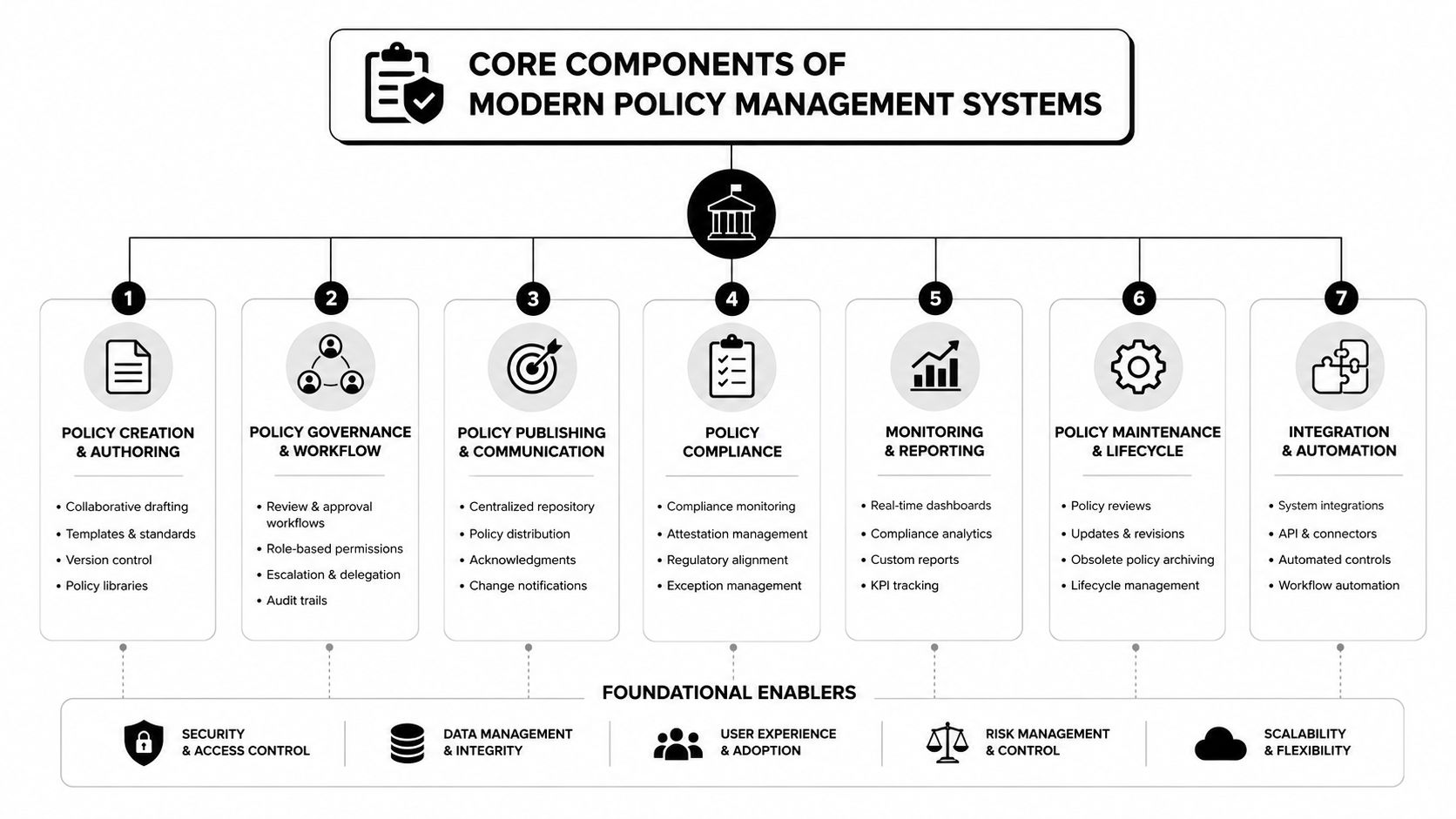
A modern PAS is modular by design, a control tower with specialized desks, each one handling a different part of the policy journey, but all of them reading from the same master record. That structure is what allows the platform to act as the system of record rather than a loose collection of functions.
The simplest way to understand it is to separate the record layer from the decision layer. The record layer stores policy data, while the decision layer applies rating and underwriting logic. The first keeps the facts straight. The second decides what can be issued, changed, or referred.
What each module actually does
A PAS usually includes new business intake, rating, rules, issuance, endorsements, renewals, and cancellations PAS basics. The rating engine handles multi-variable pricing logic. The rules engine enforces underwriting thresholds. That separation matters because quote speed and referral rates often depend on whether the system can make the right decision without pushing everything to manual review.
The lifecycle is broader than issuance. Industry guides describe PAS platforms as handling quoting, underwriting, renewals, cancellations, policy changes, and even claims-facing access to policy information policy administration overview. In practice, that means the platform should support the full chain from first intake to final cancellation without fragmenting the record.
Why the architecture matters in production
A good PAS behaves like a ledger, not a folder. When a policy changes, the system should update one authoritative record so the rest of the organization doesn't improvise its own version. That's the only way to keep accuracy, compliance, and scale intact across a large book of business.
For a deeper vendor overview, see the policy administration systems guide. It helps frame how the pieces fit without pretending every carrier needs the same deployment pattern.
Policy Management Versus Policy Administration Explained
Buyers use these terms loosely, then regret the confusion during implementation. Policy administration is narrower and more operational. Policy management is broader and often includes orchestration across underwriting, billing, claims, and customer service. Those aren't interchangeable if you're designing integrations or replacing a core.
Aspect | Policy Administration | Policy Management |
|---|---|---|
Primary role | System of record for policies | Orchestrates policy-related work across functions |
Typical scope | Rating, issuance, endorsements, renewals, cancellations | Policy events plus coordination with billing, claims, and service |
Data responsibility | Maintains the authoritative policy record | Keeps multiple teams aligned on that record |
Implementation risk | Core replacement and migration complexity | Workflow overlap and integration sprawl |
Best fit | Carriers that need a strict operational core | Organizations that need broader coordination around policy activity |
A modern system has to act like a single source of truth. Every policy event should update one authoritative record instead of spawning conflicting versions across departments. That's the difference between a clean operating model and a pile of reconciliations.
Where the distinction shows up
The distinction matters most when claims, billing, and customer service all need the same answer. If the policy system says one thing and the service desk says another, the customer experience deteriorates fast. If the PAS coordinates the policy journey from quote through claims, all functions stay in sync instead of drifting into their own local truths policy journey coordination.
That's also why you can't judge a platform only by front-end usability. A slick interface won't fix a fragmented back end. For vendors that sit higher in the stack, the Guidewire software overview is a useful reminder that implementation design matters as much as product branding.
A clean interface on top of a broken record model only hides the problem longer.
Integration Architecture and API-First Design
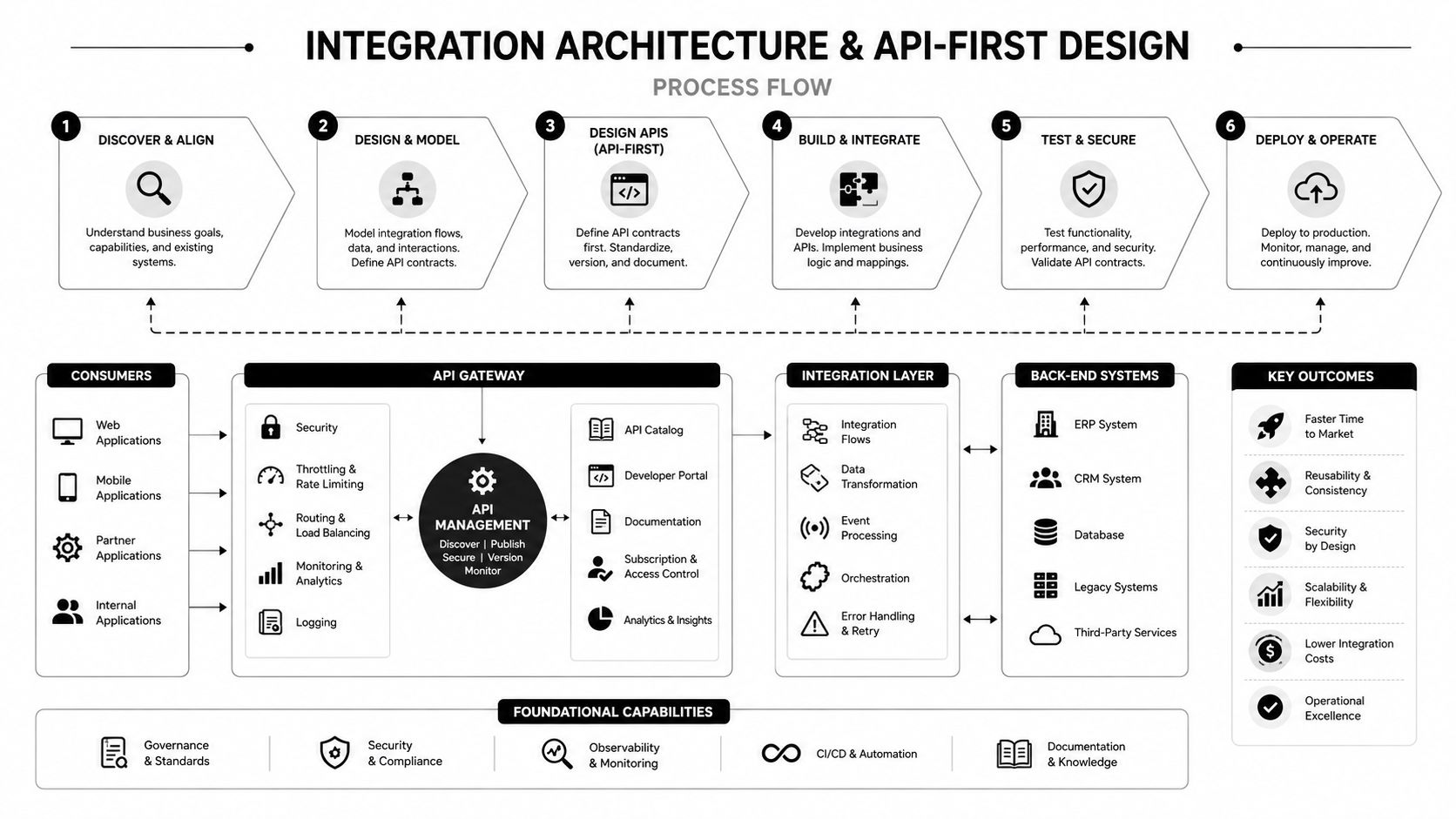
Policy systems fail in production when every change has to pass through a chain of brittle handoffs. Policy, billing, claims, and notifications need to stay decoupled enough to change independently, while still sharing one operational record. That is the value of microservices and API-first integration. They cut the coupling that forces teams to wait for a full release just to update one product rule or one transaction path.
A technical insurance architecture paper describes a pattern that works effectively. Microservices and API-first design let teams trigger downstream actions like premium calculation, document generation, CRM synchronization, and invoicing through event-driven orchestration, instead of brittle batch jobs. Batch jobs hide failures until someone notices a mismatch. Event-driven workflows surface breakpoints faster, which matters when policy changes are moving across multiple systems and every rekeyed field creates another chance for conflict.
Why API-first changes the buying math
The integration decision gets harder when one platform has to support multiple product lines. A recent market analysis notes that many insurers manage several products through a single policy administration environment market analysis. That is not a simple deployment pattern. It is a sign that carriers are dealing with reuse, exceptions, and overlapping workflows that cannot be maintained cleanly if the same business logic is copied into multiple systems.
API-first design helps because it lets carriers keep existing claims workbenches and internal tools while exposing policy events in a controlled way. The system becomes the coordination layer, not another silo. Teams keep working in the tools they already know, and the integration layer handles the policy event flow without forcing a wholesale operating reset.
That matters most where policy changes touch outside systems. Endorsements, renewals, cancellations, billing updates, and customer notifications all need to move in sync. If one of those paths drifts, the carrier ends up reconciling records instead of servicing policies. For teams that want a clearer view of how modular service boundaries are usually organized, the microservices architecture patterns guide is a useful reference.
The integration test that matters
Do not ask whether the platform “integrates.” Ask what it integrates without breaking.
If a vendor cannot show clean behavior across policy, billing, claims, notifications, and customer data, the architecture is not ready for production scale. The buying question is whether policy changes can travel through the stack without creating version conflicts, duplicate entries, or manual rekeying. For external implementation guidance on disciplined integration work, branded1 is a solid reference on how custom API design should be approached.
Selection Criteria for Insurers and MGAs
Skip the generic checklist. The buying decision is whether the platform can keep a single authoritative policy record intact while endorsements, renewals, cancellations, and billing updates arrive from different channels. If it cannot do that without forcing a core replacement, it will create more operational drag than it removes.
A recent industry report highlighted a steady move toward modern policy environments, with carriers automating more of the policy lifecycle and pushing more work into straight-through processing. The point is simple. Buyers are not buying software just to digitize forms. They are buying control over issuance, servicing, and renewal, without paying for constant rekeying and record cleanup.
What to evaluate first
Start with change handling. Then test how the system behaves when something goes wrong. Then ask what it needs from your current architecture to work well.
Legacy tolerance: Can it sit alongside old cores, or does it force a risky rip-and-replace program?
Workflow fidelity: Does it preserve one policy record when changes come from different channels, or does each channel create its own version?
Automation depth: Can AI or RPA support actual policy changes, or does it only handle reminders and notifications?
Vendor dependency: Does the platform lock you into proprietary services for every change, or can your team run it without constant vendor help?
Product flexibility: Can it handle multiple product lines from one configurable base without rewriting rules every time?
Buying rule: If every hard question gets answered with “we'll customize that later,” keep looking.
The sharper test is operational, not architectural. The best system is usually the one that removes the most manual reconciliation, not the one with the flashiest demo. That matters for large insurers and MGAs because mixed-channel servicing and complex books of business create hidden cost long before a feature gap shows up.
For a broader modernization view, the digital insurance platforms guide shows how policy systems fit inside the wider stack.
Automation Opportunities with Human Oversight
Insurance automation fails the moment it hides the work. The right setup shows handlers exactly what changed, why it changed, and who approved it. That is the standard carriers and MGAs should enforce, because speed without control just creates faster mistakes in policy operations and claims.
Agentic AI platforms are already handling FNOL intake, claims triage, static claims management, and document processing while keeping full human oversight and auditability in place. They belong on top of existing claims and policy systems, not inside a risky core replacement program. That approach removes repetitive administration while keeping judgment with experienced staff, which is where production value comes from.
Where the gains show up
The cleanest gains come from reducing handoffs. Cross-channel orchestration keeps communications and updates aligned across email, web, chat, voice, and call center. That matters because a policy file gets corrupted fast when one channel records one version of a change and another channel records something different.
The same pattern works in London Market operations, where coverholders, brokers, and managing agents need traceable updates instead of black-box decisions. A system that extracts policy or claim details, routes them against authority thresholds, and logs the result is worth more than one that only drafts a polished summary.
Documented outcome ranges on the publisher's site include up to 50× faster cycle times, up to 30% higher handler throughput, and up to 5% lower loss ratio, depending on context. Treat those as site-reported ranges, not universal promises intelligent automation in insurance.
The right automation layer does not replace handlers. It strips out repetitive work, keeps the audit trail intact, and lets people focus on judgment calls.
For teams evaluating how to layer AI over current operations, the intelligent automation in insurance guide is a useful technical companion.
Practical Next Steps for System Modernization
The cleanest modernization programs I've seen all started the same way. The carrier or MGA mapped where policy changes came from, where they broke, and who had to fix them. Once that was visible, the buying decision got easier because the team stopped arguing about features and started talking about workflow failures.
A good first move is to identify the policy events that trigger the most manual work, then trace each one through underwriting, service, billing, and claims. If rekeying shows up in multiple places, don't assume the answer is a bigger user interface. It usually means the underlying architecture can't keep one authoritative record intact.
A sensible implementation sequence
Map the current state. List the systems that touch policy changes, the handoffs between them, and the places where teams re-enter data.
Classify the pain. Separate true core gaps from integration gaps. Those are not the same problem.
Decide what stays. If a legacy core can still serve as the system of record, layer automation on top instead of forcing a replacement.
Prioritize multi-line fit. Modern carriers don't live inside one product. The platform has to handle property, specialty lines, liability, and reinsurance without becoming a custom project every quarter.
Phase the rollout. Use a release sequence that protects operations while proving value early. A disciplined release planning playbook is a smart companion for that work.
One practical scenario stands out. A mid-sized MGA doesn't always need a full core replacement to get real value. If the record stays authoritative and the workflow layer absorbs the messy change handling, the team can reduce vendor dependence without destabilizing the business. That approach is boring, and boring is good when compliance and auditability are on the line.
The final test is simple. If the system improves control, reduces rekeying, and keeps humans in charge of exceptions, it's worth serious consideration. If it only makes demos prettier, it won't survive contact with production.
Nolana AI helps insurers and Lloyd's market participants automate claims work while keeping handlers in control, which is exactly the kind of operating model modern policy systems should support around the edges. If you want an AI layer that sits on top of existing claims and policy systems and preserves auditability, visit Nolana AI and see how it fits into your modernization plan.
Most buyers start with the wrong question. They ask which platform has the longest feature list, then wonder why operations still bog down in renewals, endorsements, and cancellations. The better question is harsher and more useful, which system can preserve one authoritative policy record when changes arrive from mixed channels, legacy cores, and people who still have to rekey details by hand.
That matters because insurance policy management systems are no longer niche back-office tools. One recent market study valued the sector at USD 5.48 billion in 2025 and projected it to reach USD 13.85 billion by 2032, a 14.15% CAGR over the forecast period, while another analysis estimated the policy administration systems software market at USD 329.47 million in 2026, rising to USD 696.75 million by 2035 at 7.8% CAGR global market study. The buying mistake is treating that growth like proof that more features solve the core problem. They don't.
Why Feature Checklists Miss What Actually Breaks in Production
The feature matrix looks tidy on paper. In production, it hides the mess that burns time and creates errors. The most expensive failures in policy operations usually aren't missing screens or missing modules, they're version conflicts, manual rekeying, and brittle handoffs when an endorsement touches billing, service, and downstream reporting in different systems.
A mature PAS is supposed to be the carrier's system of record, not just a document vault. That means it stores policy-level data such as coverages, limits, conditions, exclusions, duration, and endorsements, then lets underwriting, servicing, and renewals rely on the same authoritative record Celent policy administration guide. If your teams still jump across screens, spreadsheets, and email threads to resolve a change, you don't have a feature problem. You have a record integrity problem.
Where the system actually breaks: change handling
Policy changes expose the weak points fast. An underwriter updates terms, a service rep changes an address, billing needs the new premium, and claims should not see stale data. If those events do not reconcile cleanly, people spend their day fixing the system instead of serving the insured.
Practical rule: If a vendor demo doesn't show how one endorsement updates every dependent workflow without rekeying, you're looking at a marketing demo, not an operating model.
That is why the buying decision should be framed around continuity, not breadth. A platform with fewer flashy modules can still outperform a “complete” suite if it preserves one clean policy history across channels and does not force a full core replacement to do it. That trade-off matters even more for large insurers and MGAs with mixed books, because legacy architecture can block automation and personalization long before anyone notices the missing feature button. For a clear breakdown of how policy administration platforms are structured, see this overview of insurance policy administration systems.
Core Components of Modern Policy Management Systems
A modern PAS is modular by design, a control tower with specialized desks, each one handling a different part of the policy journey, but all of them reading from the same master record. That structure is what allows the platform to act as the system of record rather than a loose collection of functions.
The simplest way to understand it is to separate the record layer from the decision layer. The record layer stores policy data, while the decision layer applies rating and underwriting logic. The first keeps the facts straight. The second decides what can be issued, changed, or referred.
What each module actually does
A PAS usually includes new business intake, rating, rules, issuance, endorsements, renewals, and cancellations PAS basics. The rating engine handles multi-variable pricing logic. The rules engine enforces underwriting thresholds. That separation matters because quote speed and referral rates often depend on whether the system can make the right decision without pushing everything to manual review.
The lifecycle is broader than issuance. Industry guides describe PAS platforms as handling quoting, underwriting, renewals, cancellations, policy changes, and even claims-facing access to policy information policy administration overview. In practice, that means the platform should support the full chain from first intake to final cancellation without fragmenting the record.
Why the architecture matters in production
A good PAS behaves like a ledger, not a folder. When a policy changes, the system should update one authoritative record so the rest of the organization doesn't improvise its own version. That's the only way to keep accuracy, compliance, and scale intact across a large book of business.
For a deeper vendor overview, see the policy administration systems guide. It helps frame how the pieces fit without pretending every carrier needs the same deployment pattern.
Policy Management Versus Policy Administration Explained
Buyers use these terms loosely, then regret the confusion during implementation. Policy administration is narrower and more operational. Policy management is broader and often includes orchestration across underwriting, billing, claims, and customer service. Those aren't interchangeable if you're designing integrations or replacing a core.
Aspect | Policy Administration | Policy Management |
|---|---|---|
Primary role | System of record for policies | Orchestrates policy-related work across functions |
Typical scope | Rating, issuance, endorsements, renewals, cancellations | Policy events plus coordination with billing, claims, and service |
Data responsibility | Maintains the authoritative policy record | Keeps multiple teams aligned on that record |
Implementation risk | Core replacement and migration complexity | Workflow overlap and integration sprawl |
Best fit | Carriers that need a strict operational core | Organizations that need broader coordination around policy activity |
A modern system has to act like a single source of truth. Every policy event should update one authoritative record instead of spawning conflicting versions across departments. That's the difference between a clean operating model and a pile of reconciliations.
Where the distinction shows up
The distinction matters most when claims, billing, and customer service all need the same answer. If the policy system says one thing and the service desk says another, the customer experience deteriorates fast. If the PAS coordinates the policy journey from quote through claims, all functions stay in sync instead of drifting into their own local truths policy journey coordination.
That's also why you can't judge a platform only by front-end usability. A slick interface won't fix a fragmented back end. For vendors that sit higher in the stack, the Guidewire software overview is a useful reminder that implementation design matters as much as product branding.
A clean interface on top of a broken record model only hides the problem longer.
Integration Architecture and API-First Design
Policy systems fail in production when every change has to pass through a chain of brittle handoffs. Policy, billing, claims, and notifications need to stay decoupled enough to change independently, while still sharing one operational record. That is the value of microservices and API-first integration. They cut the coupling that forces teams to wait for a full release just to update one product rule or one transaction path.
A technical insurance architecture paper describes a pattern that works effectively. Microservices and API-first design let teams trigger downstream actions like premium calculation, document generation, CRM synchronization, and invoicing through event-driven orchestration, instead of brittle batch jobs. Batch jobs hide failures until someone notices a mismatch. Event-driven workflows surface breakpoints faster, which matters when policy changes are moving across multiple systems and every rekeyed field creates another chance for conflict.
Why API-first changes the buying math
The integration decision gets harder when one platform has to support multiple product lines. A recent market analysis notes that many insurers manage several products through a single policy administration environment market analysis. That is not a simple deployment pattern. It is a sign that carriers are dealing with reuse, exceptions, and overlapping workflows that cannot be maintained cleanly if the same business logic is copied into multiple systems.
API-first design helps because it lets carriers keep existing claims workbenches and internal tools while exposing policy events in a controlled way. The system becomes the coordination layer, not another silo. Teams keep working in the tools they already know, and the integration layer handles the policy event flow without forcing a wholesale operating reset.
That matters most where policy changes touch outside systems. Endorsements, renewals, cancellations, billing updates, and customer notifications all need to move in sync. If one of those paths drifts, the carrier ends up reconciling records instead of servicing policies. For teams that want a clearer view of how modular service boundaries are usually organized, the microservices architecture patterns guide is a useful reference.
The integration test that matters
Do not ask whether the platform “integrates.” Ask what it integrates without breaking.
If a vendor cannot show clean behavior across policy, billing, claims, notifications, and customer data, the architecture is not ready for production scale. The buying question is whether policy changes can travel through the stack without creating version conflicts, duplicate entries, or manual rekeying. For external implementation guidance on disciplined integration work, branded1 is a solid reference on how custom API design should be approached.
Selection Criteria for Insurers and MGAs
Skip the generic checklist. The buying decision is whether the platform can keep a single authoritative policy record intact while endorsements, renewals, cancellations, and billing updates arrive from different channels. If it cannot do that without forcing a core replacement, it will create more operational drag than it removes.
A recent industry report highlighted a steady move toward modern policy environments, with carriers automating more of the policy lifecycle and pushing more work into straight-through processing. The point is simple. Buyers are not buying software just to digitize forms. They are buying control over issuance, servicing, and renewal, without paying for constant rekeying and record cleanup.
What to evaluate first
Start with change handling. Then test how the system behaves when something goes wrong. Then ask what it needs from your current architecture to work well.
Legacy tolerance: Can it sit alongside old cores, or does it force a risky rip-and-replace program?
Workflow fidelity: Does it preserve one policy record when changes come from different channels, or does each channel create its own version?
Automation depth: Can AI or RPA support actual policy changes, or does it only handle reminders and notifications?
Vendor dependency: Does the platform lock you into proprietary services for every change, or can your team run it without constant vendor help?
Product flexibility: Can it handle multiple product lines from one configurable base without rewriting rules every time?
Buying rule: If every hard question gets answered with “we'll customize that later,” keep looking.
The sharper test is operational, not architectural. The best system is usually the one that removes the most manual reconciliation, not the one with the flashiest demo. That matters for large insurers and MGAs because mixed-channel servicing and complex books of business create hidden cost long before a feature gap shows up.
For a broader modernization view, the digital insurance platforms guide shows how policy systems fit inside the wider stack.
Automation Opportunities with Human Oversight
Insurance automation fails the moment it hides the work. The right setup shows handlers exactly what changed, why it changed, and who approved it. That is the standard carriers and MGAs should enforce, because speed without control just creates faster mistakes in policy operations and claims.
Agentic AI platforms are already handling FNOL intake, claims triage, static claims management, and document processing while keeping full human oversight and auditability in place. They belong on top of existing claims and policy systems, not inside a risky core replacement program. That approach removes repetitive administration while keeping judgment with experienced staff, which is where production value comes from.
Where the gains show up
The cleanest gains come from reducing handoffs. Cross-channel orchestration keeps communications and updates aligned across email, web, chat, voice, and call center. That matters because a policy file gets corrupted fast when one channel records one version of a change and another channel records something different.
The same pattern works in London Market operations, where coverholders, brokers, and managing agents need traceable updates instead of black-box decisions. A system that extracts policy or claim details, routes them against authority thresholds, and logs the result is worth more than one that only drafts a polished summary.
Documented outcome ranges on the publisher's site include up to 50× faster cycle times, up to 30% higher handler throughput, and up to 5% lower loss ratio, depending on context. Treat those as site-reported ranges, not universal promises intelligent automation in insurance.
The right automation layer does not replace handlers. It strips out repetitive work, keeps the audit trail intact, and lets people focus on judgment calls.
For teams evaluating how to layer AI over current operations, the intelligent automation in insurance guide is a useful technical companion.
Practical Next Steps for System Modernization
The cleanest modernization programs I've seen all started the same way. The carrier or MGA mapped where policy changes came from, where they broke, and who had to fix them. Once that was visible, the buying decision got easier because the team stopped arguing about features and started talking about workflow failures.
A good first move is to identify the policy events that trigger the most manual work, then trace each one through underwriting, service, billing, and claims. If rekeying shows up in multiple places, don't assume the answer is a bigger user interface. It usually means the underlying architecture can't keep one authoritative record intact.
A sensible implementation sequence
Map the current state. List the systems that touch policy changes, the handoffs between them, and the places where teams re-enter data.
Classify the pain. Separate true core gaps from integration gaps. Those are not the same problem.
Decide what stays. If a legacy core can still serve as the system of record, layer automation on top instead of forcing a replacement.
Prioritize multi-line fit. Modern carriers don't live inside one product. The platform has to handle property, specialty lines, liability, and reinsurance without becoming a custom project every quarter.
Phase the rollout. Use a release sequence that protects operations while proving value early. A disciplined release planning playbook is a smart companion for that work.
One practical scenario stands out. A mid-sized MGA doesn't always need a full core replacement to get real value. If the record stays authoritative and the workflow layer absorbs the messy change handling, the team can reduce vendor dependence without destabilizing the business. That approach is boring, and boring is good when compliance and auditability are on the line.
The final test is simple. If the system improves control, reduces rekeying, and keeps humans in charge of exceptions, it's worth serious consideration. If it only makes demos prettier, it won't survive contact with production.
Nolana AI helps insurers and Lloyd's market participants automate claims work while keeping handlers in control, which is exactly the kind of operating model modern policy systems should support around the edges. If you want an AI layer that sits on top of existing claims and policy systems and preserves auditability, visit Nolana AI and see how it fits into your modernization plan.


All systems operational
1 Lime Street, London EC3M 7HA | 222E 3rd Street, New York 10009
Copyright © 2026, Nolana. All rights reserved
All systems operational
1 Lime Street, London EC3M 7HA | 222E 3rd Street, New York 10009
Copyright © 2026, Nolana. All rights reserved
All systems operational
1 Lime Street, London EC3M 7HA | 222E 3rd Street, New York 10009
Copyright © 2026, Nolana. All rights reserved
All systems operational
1 Lime Street, London EC3M 7HA | 222E 3rd Street, New York 10009
Copyright © 2026, Nolana. All rights reserved