Shift Technologies Insurance: A 2026 Explainer for Claims
Shift Technologies Insurance: A 2026 Explainer for Claims
Learn how shift technologies insurance transforms claims management in 2026. A must-read guide for claims leaders.

If you're running claims right now, you already know the pain. FNOL keeps stacking up, inbound documents arrive in half a dozen formats, adjusters chase missing facts across email and portals, and the claims workbench becomes a dumping ground for manual rekeying and follow-ups. In that environment, shift technologies insurance gets attention for a simple reason, it doesn't ask you to replace the core and start over, it offers an AI layer that sits on top of what you already run, which is usually where bottlenecks live.
That matters because most carriers don't need another grand transformation pitch. They need fewer touches, better triage, faster document handling, and clearer control over who sees what and when. If your team spends too much time moving files between systems instead of deciding claims, you're in the zone where an AI claims layer deserves a hard look.
Why Claims Operations Leaders Are Looking at AI Layers in 2026
A claims leader doesn't wake up wanting a vendor demo. They wake up to a queue full of FNOLs, a pile of medical bills, repair estimates, emails from brokers, and a dashboard that says “in progress” far too often. The pressure isn't just volume, it's the way work fragments across channels, because every handoff creates another place for delay, rework, and missed context.
That's why an AI layer is more interesting than another core replacement story. It can sit above the claims and policy systems you already trust, extract data from inbound documents, route work, and keep handlers in their existing workbench instead of forcing a migration. If you want a broader view of how these systems behave in practice, the publisher's overview of agentic AI is a useful framing point.
What the day actually looks like
A normal claims day has a lot of low-value motion. Someone opens a file, retypes policy data, checks coverage, sends for missing evidence, and waits. Then another person does the same thing again in a different channel, because the customer replied by email, the broker called in, and the portal note never made it into the case file.
Practical rule: if your handlers spend more time assembling a claim than adjudicating it, you've got an automation problem, not a staffing problem.
That's also why brokers and frontline service teams keep asking for tools that reduce the back-and-forth before a file even reaches a handler. The article on practical AI for insurance brokers is a good reminder that intake quality shapes everything downstream, especially when the first notice is incomplete or inconsistent.
The strategic question is simple. Do you need a new system of record, or do you need a smarter layer on top of the one you already have? For many large carriers, especially in P&C and Lloyd's-style operating models, the answer is the second one.
What Shift Technologies Actually Does and How the Platform Is Built
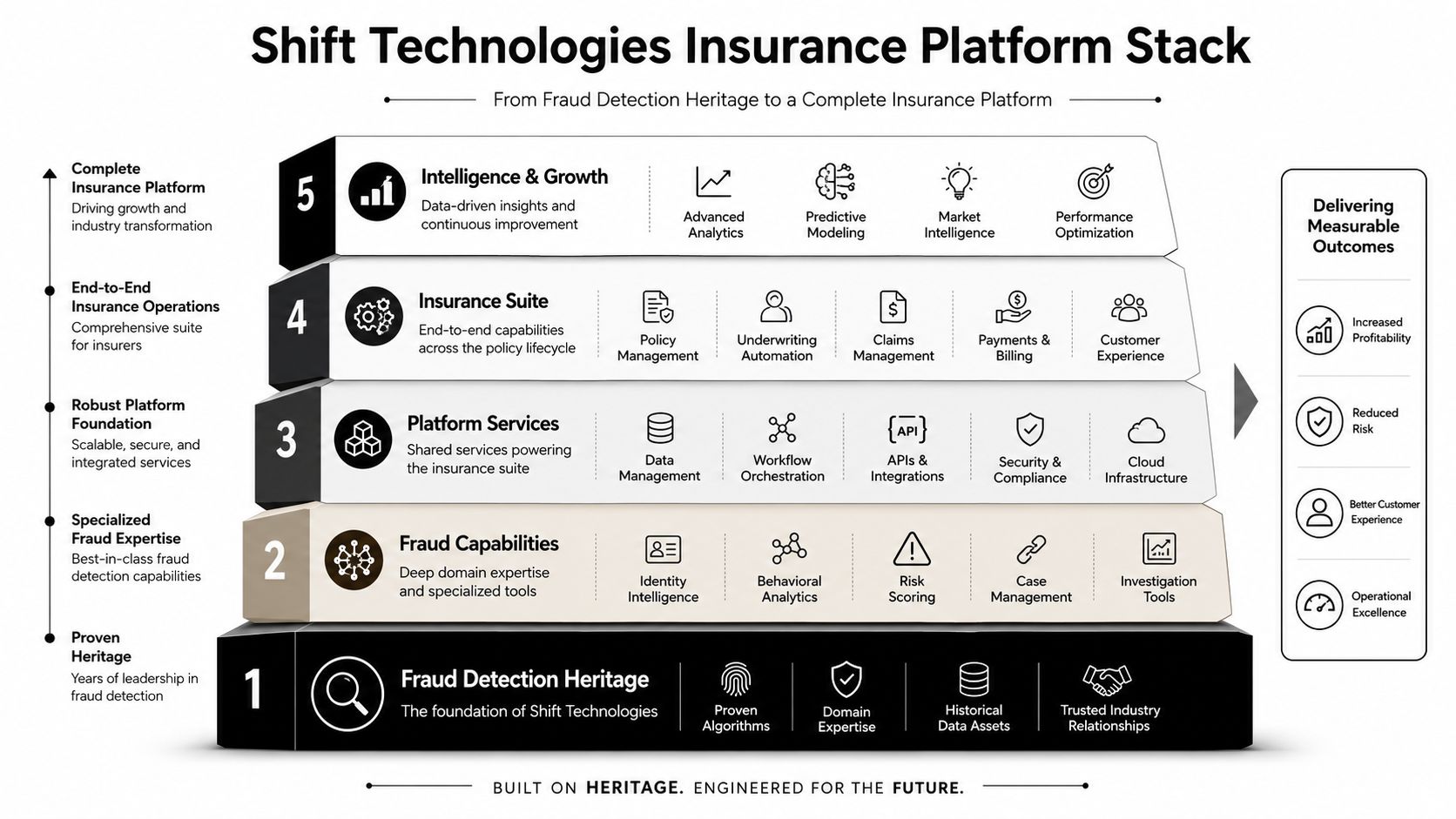
Shift built its name in insurance through fraud and suspicious-claim analysis, but that is only the starting point. The platform now looks more like a claims decisioning stack than a single-purpose fraud tool, with document extraction, triage, subrogation support, and decision support layered on top of its original detection capabilities. For shift technologies insurance, the useful frame is an AI orchestration layer that helps claims teams decide what happens next, not just spot bad actors.
Start with the architecture, not the marketing
The platform sits on top of existing claims and policy systems, which is the right design for a carrier that cannot afford a core replacement project. Shift's own materials describe machine-learning OCR and layout detection that turn inbound documents into structured data, so handlers do not have to manually review and rekey everything, and they describe automation from FNOL through settlement with augmented adjustment inside the claims management system. Shift Insurance Suite product sheet
That architecture matters more than any single feature. The claims handler stays in the same workbench while the AI layer handles extraction, prioritization, and recommended actions in the background. In practice, that cuts down swivel-chair work and keeps the human in control of the decision.
What the Major Building Blocks Do
Here is the cleanest way to map the stack to claim activity:
Machine-learning OCR and layout detection pull key fields out of PDFs, scans, and forms, which is what you want when document review is the bottleneck.
Cause-and-effect scoring ranks claims for urgency or exposure, which helps when you need to decide which files deserve immediate attention.
Agentic claims workflows route work either to straight-through processing or to a human handler, depending on claim complexity and completeness. Shift has said these workflows assess complexity, score claims for urgency or exposure, and route work accordingly.
That is the core mental model. The platform does not replace claims staff. It sorts, prepares, and speeds up claims so the right person touches the right file at the right time.
If you are evaluating the platform, read it as a workflow engine with intelligence attached. Then decide whether your biggest pain is intake, extraction, triage, or downstream routing. For carriers that are building around existing systems, the broader context in insurance software development helps explain why integration work usually decides whether a claims AI project pays off or stalls.
Why the fraud heritage still matters
The fraud angle is not a footnote. It is the reason the vendor has credibility in high-volume, document-heavy, abuse-prone claims environments. The mature use case is broader now, and the carrier should evaluate it that way. Fraud detection is still there, but the larger operational value sits in claims decision support, file orchestration, and reducing manual handling.
The question is not whether the platform can spot suspicious claims. The question is whether it helps your adjusters handle every other claim faster without losing control.
Where Shift Fits Across the Claims Lifecycle
The cleanest way to evaluate shift technologies insurance is to stop talking about “AI for claims” in general and map it to four actual moments in a file. That's where the platform either earns its keep or becomes another layer of noise. The strongest fit is not everywhere at once, it's in the places where claims work slows down because data arrives late, incomplete, or in the wrong format.
First notice and triage
At FNOL, the platform can score claim complexity and route work toward straight-through handling or a human queue. That's especially useful in auto or property intake, where the difference between a clean file and a messy one often shows up in the first few minutes. If the claim is simple and well-documented, the system should help move it. If it's messy, it should make that obvious immediately.
The related Nolana explainer on first notice of loss is useful here because it shows how much damage a poor intake creates downstream. A carrier that solves FNOL badly usually pays for it twice, once in rework and again in cycle time.
Document and communication processing
The platform quickly becomes practical. Inbound medical statements, repair estimates, police reports, and legal correspondence can be turned into structured fields, which means the claim file stops being a document graveyard. The point is not to create a prettier inbox, it's to remove manual review from the workflow where the data can be extracted reliably.
Cross-channel synchronization is also part of the value. Shift's approach is built to work across email, web, chat, voice, and call center activity, so the same claim context doesn't get lost when the customer changes channels. For a claims team, that kind of consistency is often more valuable than another dashboard.
Lifecycle monitoring and next actions
Dormant claims are a hidden drag on service quality. A platform like this can flag files that have gone quiet and recommend the next action, which matters when a handler has too many files and not enough time to chase every one. The win here is not magical prediction, it's better queue hygiene and fewer forgotten files.
Operational rule: dormant claims don't resolve themselves. If a system can reliably surface them before they age out, it's doing real work.
Subrogation and recovery
This is the part many vendors underplay, and Shift shouldn't. The platform's claims AI also extends into liability determination and recovery workflows, which is where structured data and decision support can shorten the distance between a claim event and downstream recovery action. A subrogation file with a clear liability view is a very different operational problem from a front-door FNOL.
Use that as your filter. If you run a carrier operation where FNOL, documents, dormant files, and subrogation all hurt, the platform can fit across the lifecycle. If only one of those hurts, a narrower tool may be enough.
The Numbers Behind Shift Technologies Insurance and What They Prove
Vendor decks get slippery fast. They throw out headline claims, but you are left without the basics, what was measured, which claims population was used, and how much of the result came from cleaner data versus better automation. With shift technologies insurance, the useful way to read the numbers is to separate pilot outcomes, longer-term industry trends, and marketing language.
What the pilot numbers mean
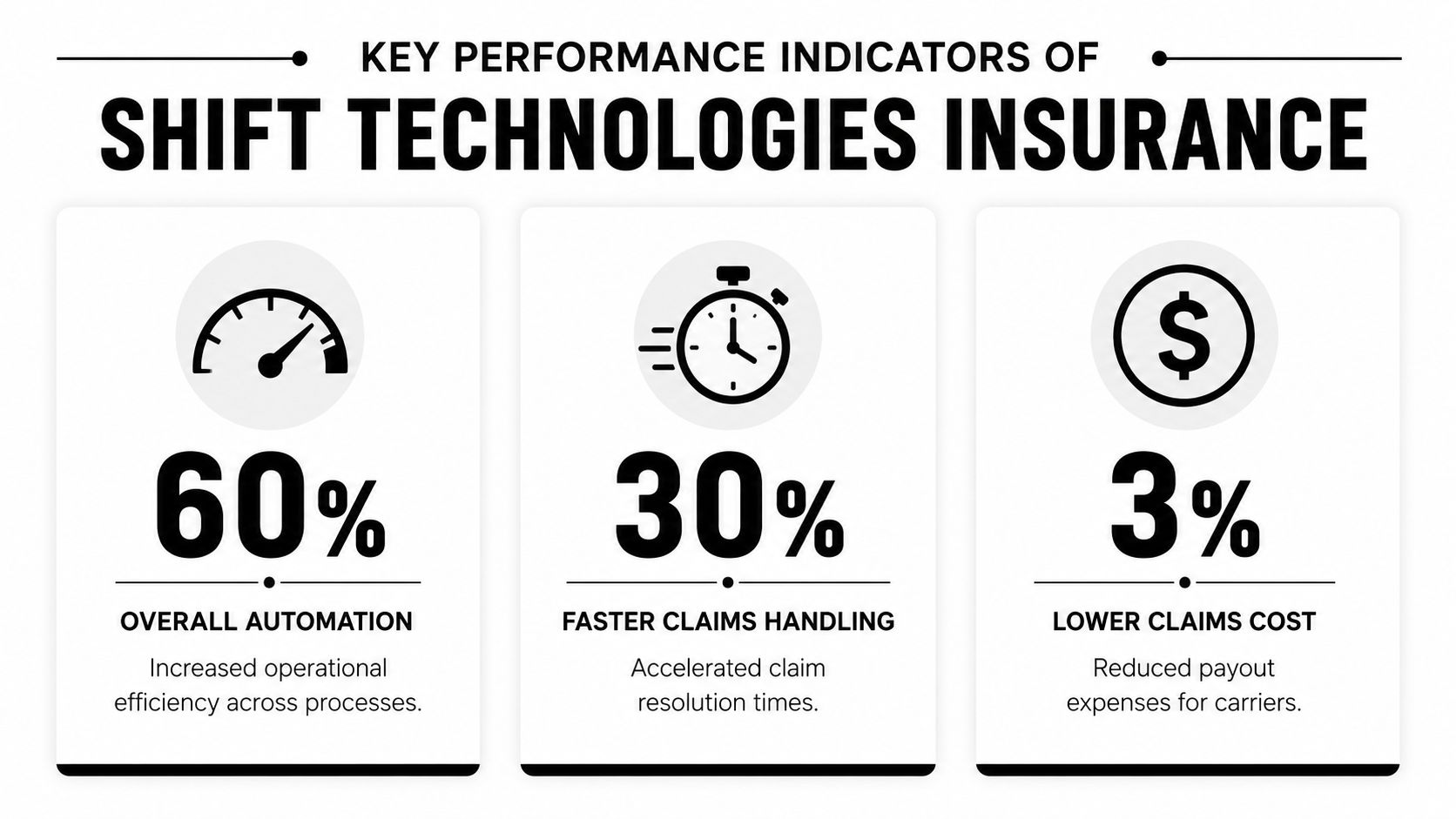
Shift says early adopters have reported 60% overall automation, 30% faster claims handling, 3% lower claims losses, and more than 99% accuracy in claims assessment. Those figures are useful, but they are not a default expectation for every carrier. They describe specific implementations where process quality, data quality, and integration depth were strong enough to support those outcomes.
The generative AI release also reports over 95% accuracy in extracting key information from documents, and over 90% accuracy for liability determination in subrogation and recovery workflows. That is strong performance, but it is still a workflow metric, not a promise that every carrier will see the same result across every line. A claims leader should treat those numbers as pilot targets to validate, not as a warranty.
What the longitudinal data says
Shift's own insurance research gives a broader benchmark. Over five years, the average time to settle an auto claim dropped from approximately seven months to five months, U.S. carriers reduced the average lifetime of a claim by approximately 60%, and European carriers cut processing times by approximately 5%. In the same report, 17% of auto claims and 16% of home/property claims are settled within one week, with the U.S. at 28% and Europe at 12%. Shift Insurance Perspectives, Vol. 1
That matters because claims processing has already improved materially in the market, just not evenly. A vendor pilot does not create that trend from scratch. It usually adds incremental gains on top of a carrier's current maturity, and the size of that lift depends on how disciplined the operating model already is.
What these figures do not prove
They do not prove that every line of business will behave the same way. They do not prove that a messy document set will deliver the same extraction accuracy as a clean one. They do not prove that your workflow redesign is good enough to realize the claimed speedup. They also do not tell you how much of the lift came from straight-through automation versus better triage and fewer handler touches.
Read the numbers this way:
Treat 95% plus extraction accuracy as a ceiling to test, not a promise to assume.
Treat 30% faster handling as realistic only where the workflow is clean and integration is deep.
Treat 3% lower claims losses as a result that likely depends on line, maturity, and loss type.
The market has already moved, but the lift is still operational, not magical. If a vendor cannot show you where the gains came from, the headline is not enough.
How Shift Compares With Other Claims Automation and Decisioning Platforms
A serious buying decision isn't about who has the flashiest AI demo. It's about integration posture, auditability, control, and whether the vendor fits your operating model. On those dimensions, shift technologies insurance is materially different from a core replacement vendor and different again from a narrow document AI point solution.
The architecture choice is the real differentiator
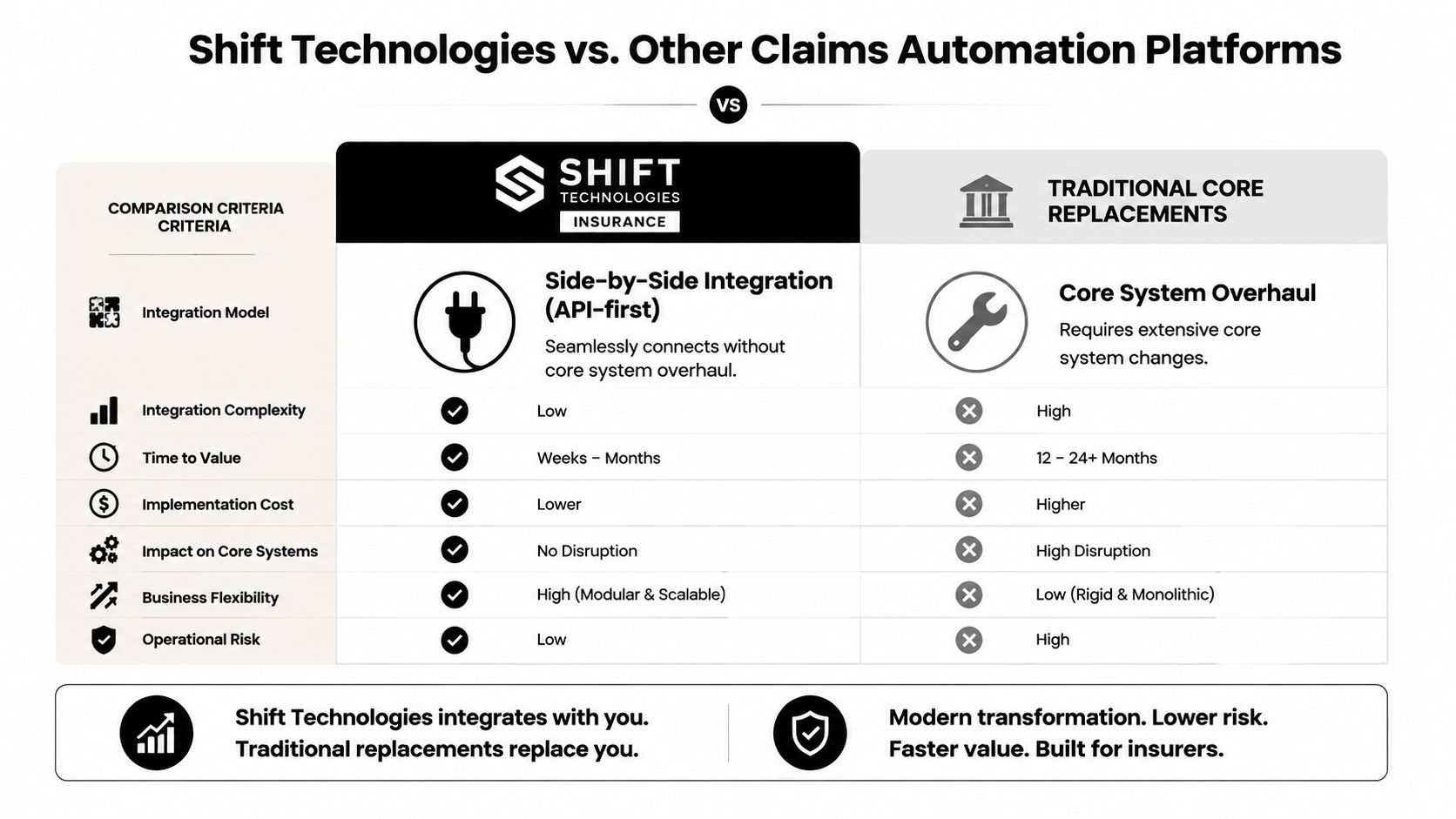
Shift is a side-by-side integration play. That means it overlays existing claims and policy systems through APIs rather than forcing a rip-and-replace migration. For a large carrier, that's a practical advantage because the claims team keeps the workbench it already knows, while the AI layer handles extraction, triage, and recommendations in the background.
That posture matters in regulated claims operations. It preserves auditability and lets you keep human-in-the-loop controls visible. If your business needs a full core overhaul, Shift is not trying to be that answer, and that's fine. Most carriers need less change, not more.
Where it differs from other vendor types
There are three broad alternatives.
Platform-native AI inside incumbent systems. This works when your core claims stack already has meaningful AI depth and you want fewer vendors.
Point solutions for document AI. These can be useful when your bottleneck is narrow, but they often stop at extraction and don't help with downstream decisioning.
Market-specific platforms. For Lloyd's and London Market participants, a platform built around delegated authority and broker workflows can be more aligned than a generalist claims tool.
That's also where the London Market angle matters. If you're comparing claim platforms in that world, the article on AI insurance companies helps frame the difference between generic automation and workflow models built for real insurance operations.
Why the funding and scale matter
Shift's $220 million Series D in 2021 brought total funding to roughly $320 million and pushed its valuation to more than $1 billion. Builtin Boston coverage of the Series D That doesn't make the product better by default, but it does mean the vendor is operating as a late-stage infrastructure provider, not a fragile point startup.
That scale matters for carrier risk. Large claims environments want vendors that can survive procurement scrutiny, support enterprise integrations, and sustain product investment over time. A small proof-of-concept vendor may be clever. A heavily capitalized platform is easier to trust when the workflow touches core operations.
When a Carrier Should Pilot Shift and When a Different Path Makes More Sense
The best time to pilot shift technologies insurance is when the workflow pain is broad, document-heavy, and repetitive enough to justify automation. If your operation already knows where the friction is, the decision gets easier. If not, you'll waste time proving what your handlers already know.
Strong-fit carriers
Shift is a strong fit for high-volume personal lines and commercial P&C carriers with rich document flows, because those are the environments where extraction, triage, and lifecycle orchestration can remove meaningful manual work. It also fits carriers that want to keep their existing claims workbench, since the platform is designed to sit on top of current systems instead of replacing them. Lloyd's and London Market participants with delegated authority complexity should also take a hard look, because broker and coverholder workflows benefit from structured orchestration rather than another portal.
It's also a sensible option if you want a fraud-plus-decisioning partner, not just a document AI tool. That combination matters when suspicious claims and routine operational bottlenecks live in the same workflow.
Weak-fit carriers
Small carriers with low document volume usually won't generate enough impact to justify integration effort. If your claims team can handle the intake load comfortably without automation, a lighter tool may be enough. Highly bespoke specialty lines are another caution zone, especially where human underwriting judgment dominates and the file structure varies too much for repeatable automation.
A carrier that has already standardized on a single core platform with strong native AI should also be careful. If the incumbent stack already handles extraction, triage, and routing well, adding a second decisioning layer can create more complexity than value.
The fairness question most vendors skip
The hard question is whether AI-driven claims handling helps all claimants equally. Public discussion often frames automation as faster and more efficient, but that doesn't answer whether digitally fluent customers benefit more than people who struggle with portals, structured uploads, or language-heavy workflows. The insurance inclusion research points to the upside of broader access, while the risk is obvious, automation can create a new exclusion layer if the claimant can't easily provide the evidence the model wants. Insurance inclusion research
My view is direct. If you can't explain how the system treats low-data, low-tech, or complex claims, you're not ready to scale it.
Go, conditional-go, and no-go
Use this rule set:
Go. Large P&C, rich documents, clear bottlenecks, existing workbenches, and a need for claims decisioning plus fraud support.
Conditional-go. Specialty or mixed portfolios where one line is a fit and another isn't, or where the integration team is thin.
No-go. Low volume, low document complexity, or a commitment to core replacement instead of side-by-side augmentation.
If your operation fits the first bucket, a pilot makes sense. If it doesn't, you're probably buying ambition, not value.
A 90 to 120 Day Pilot Framework for Evaluating Shift Technologies
A useful pilot starts narrow. Pick one line of business and two or three lifecycle stages where the bottleneck is measurable, then keep the scope tight enough that the results are hard to argue with. If you want help defining the operational baseline, the Nolana guide on how to measure operational efficiency is a solid planning reference.
What to test
Focus on one of these combinations:
FNOL intake and triage.
Document extraction and routing.
Dormant-file monitoring and next-best-action recommendations.
Subrogation or recovery support.
Don't try to prove the whole claims transformation story in one pilot. You'll just blur the evidence.
What to measure
Track stage-level cycle time, straight-through processing rate, handler throughput, document accuracy, and a fairness check across claimant segments. Also require a live review of the audit log, because good claims automation needs traceability, not just speed. If a vendor can't show you how it documented each action, the pilot isn't ready for production.
What good looks like
The integration should connect to the existing claims workbench through APIs, not through a parallel process that people hate using. The platform should perform acceptably on real documents, not just the cleaned-up samples used in a sales demo. Human-in-the-loop checkpoints should be explicit, model change management should be documented, and SOC 2 evidence should be available for procurement and risk review.
If the vendor can't survive a review by claims, risk, and the CCO in the same room, it's not ready for your production stack.
Close the pilot with hard exit criteria. If extraction accuracy drops on real files, if latency hurts the flow, or if fairness looks uneven across claimant groups, stop. If the platform improves stage-level handling, keeps auditors happy, and reduces handler friction without breaking governance, you've got something worth scaling.
Nolana AI automates claims operations from FNOL through settlement while keeping handlers in control, so teams can extract documents, route work, and recommend next actions inside the systems they already use. If you're evaluating shift technologies insurance or any other claims AI layer, visit Nolana AI to see how an agentic platform is built for Lloyd's and large P&C claims workflows.
If you're running claims right now, you already know the pain. FNOL keeps stacking up, inbound documents arrive in half a dozen formats, adjusters chase missing facts across email and portals, and the claims workbench becomes a dumping ground for manual rekeying and follow-ups. In that environment, shift technologies insurance gets attention for a simple reason, it doesn't ask you to replace the core and start over, it offers an AI layer that sits on top of what you already run, which is usually where bottlenecks live.
That matters because most carriers don't need another grand transformation pitch. They need fewer touches, better triage, faster document handling, and clearer control over who sees what and when. If your team spends too much time moving files between systems instead of deciding claims, you're in the zone where an AI claims layer deserves a hard look.
Why Claims Operations Leaders Are Looking at AI Layers in 2026
A claims leader doesn't wake up wanting a vendor demo. They wake up to a queue full of FNOLs, a pile of medical bills, repair estimates, emails from brokers, and a dashboard that says “in progress” far too often. The pressure isn't just volume, it's the way work fragments across channels, because every handoff creates another place for delay, rework, and missed context.
That's why an AI layer is more interesting than another core replacement story. It can sit above the claims and policy systems you already trust, extract data from inbound documents, route work, and keep handlers in their existing workbench instead of forcing a migration. If you want a broader view of how these systems behave in practice, the publisher's overview of agentic AI is a useful framing point.
What the day actually looks like
A normal claims day has a lot of low-value motion. Someone opens a file, retypes policy data, checks coverage, sends for missing evidence, and waits. Then another person does the same thing again in a different channel, because the customer replied by email, the broker called in, and the portal note never made it into the case file.
Practical rule: if your handlers spend more time assembling a claim than adjudicating it, you've got an automation problem, not a staffing problem.
That's also why brokers and frontline service teams keep asking for tools that reduce the back-and-forth before a file even reaches a handler. The article on practical AI for insurance brokers is a good reminder that intake quality shapes everything downstream, especially when the first notice is incomplete or inconsistent.
The strategic question is simple. Do you need a new system of record, or do you need a smarter layer on top of the one you already have? For many large carriers, especially in P&C and Lloyd's-style operating models, the answer is the second one.
What Shift Technologies Actually Does and How the Platform Is Built
Shift built its name in insurance through fraud and suspicious-claim analysis, but that is only the starting point. The platform now looks more like a claims decisioning stack than a single-purpose fraud tool, with document extraction, triage, subrogation support, and decision support layered on top of its original detection capabilities. For shift technologies insurance, the useful frame is an AI orchestration layer that helps claims teams decide what happens next, not just spot bad actors.
Start with the architecture, not the marketing
The platform sits on top of existing claims and policy systems, which is the right design for a carrier that cannot afford a core replacement project. Shift's own materials describe machine-learning OCR and layout detection that turn inbound documents into structured data, so handlers do not have to manually review and rekey everything, and they describe automation from FNOL through settlement with augmented adjustment inside the claims management system. Shift Insurance Suite product sheet
That architecture matters more than any single feature. The claims handler stays in the same workbench while the AI layer handles extraction, prioritization, and recommended actions in the background. In practice, that cuts down swivel-chair work and keeps the human in control of the decision.
What the Major Building Blocks Do
Here is the cleanest way to map the stack to claim activity:
Machine-learning OCR and layout detection pull key fields out of PDFs, scans, and forms, which is what you want when document review is the bottleneck.
Cause-and-effect scoring ranks claims for urgency or exposure, which helps when you need to decide which files deserve immediate attention.
Agentic claims workflows route work either to straight-through processing or to a human handler, depending on claim complexity and completeness. Shift has said these workflows assess complexity, score claims for urgency or exposure, and route work accordingly.
That is the core mental model. The platform does not replace claims staff. It sorts, prepares, and speeds up claims so the right person touches the right file at the right time.
If you are evaluating the platform, read it as a workflow engine with intelligence attached. Then decide whether your biggest pain is intake, extraction, triage, or downstream routing. For carriers that are building around existing systems, the broader context in insurance software development helps explain why integration work usually decides whether a claims AI project pays off or stalls.
Why the fraud heritage still matters
The fraud angle is not a footnote. It is the reason the vendor has credibility in high-volume, document-heavy, abuse-prone claims environments. The mature use case is broader now, and the carrier should evaluate it that way. Fraud detection is still there, but the larger operational value sits in claims decision support, file orchestration, and reducing manual handling.
The question is not whether the platform can spot suspicious claims. The question is whether it helps your adjusters handle every other claim faster without losing control.
Where Shift Fits Across the Claims Lifecycle
The cleanest way to evaluate shift technologies insurance is to stop talking about “AI for claims” in general and map it to four actual moments in a file. That's where the platform either earns its keep or becomes another layer of noise. The strongest fit is not everywhere at once, it's in the places where claims work slows down because data arrives late, incomplete, or in the wrong format.
First notice and triage
At FNOL, the platform can score claim complexity and route work toward straight-through handling or a human queue. That's especially useful in auto or property intake, where the difference between a clean file and a messy one often shows up in the first few minutes. If the claim is simple and well-documented, the system should help move it. If it's messy, it should make that obvious immediately.
The related Nolana explainer on first notice of loss is useful here because it shows how much damage a poor intake creates downstream. A carrier that solves FNOL badly usually pays for it twice, once in rework and again in cycle time.
Document and communication processing
The platform quickly becomes practical. Inbound medical statements, repair estimates, police reports, and legal correspondence can be turned into structured fields, which means the claim file stops being a document graveyard. The point is not to create a prettier inbox, it's to remove manual review from the workflow where the data can be extracted reliably.
Cross-channel synchronization is also part of the value. Shift's approach is built to work across email, web, chat, voice, and call center activity, so the same claim context doesn't get lost when the customer changes channels. For a claims team, that kind of consistency is often more valuable than another dashboard.
Lifecycle monitoring and next actions
Dormant claims are a hidden drag on service quality. A platform like this can flag files that have gone quiet and recommend the next action, which matters when a handler has too many files and not enough time to chase every one. The win here is not magical prediction, it's better queue hygiene and fewer forgotten files.
Operational rule: dormant claims don't resolve themselves. If a system can reliably surface them before they age out, it's doing real work.
Subrogation and recovery
This is the part many vendors underplay, and Shift shouldn't. The platform's claims AI also extends into liability determination and recovery workflows, which is where structured data and decision support can shorten the distance between a claim event and downstream recovery action. A subrogation file with a clear liability view is a very different operational problem from a front-door FNOL.
Use that as your filter. If you run a carrier operation where FNOL, documents, dormant files, and subrogation all hurt, the platform can fit across the lifecycle. If only one of those hurts, a narrower tool may be enough.
The Numbers Behind Shift Technologies Insurance and What They Prove
Vendor decks get slippery fast. They throw out headline claims, but you are left without the basics, what was measured, which claims population was used, and how much of the result came from cleaner data versus better automation. With shift technologies insurance, the useful way to read the numbers is to separate pilot outcomes, longer-term industry trends, and marketing language.
What the pilot numbers mean
Shift says early adopters have reported 60% overall automation, 30% faster claims handling, 3% lower claims losses, and more than 99% accuracy in claims assessment. Those figures are useful, but they are not a default expectation for every carrier. They describe specific implementations where process quality, data quality, and integration depth were strong enough to support those outcomes.
The generative AI release also reports over 95% accuracy in extracting key information from documents, and over 90% accuracy for liability determination in subrogation and recovery workflows. That is strong performance, but it is still a workflow metric, not a promise that every carrier will see the same result across every line. A claims leader should treat those numbers as pilot targets to validate, not as a warranty.
What the longitudinal data says
Shift's own insurance research gives a broader benchmark. Over five years, the average time to settle an auto claim dropped from approximately seven months to five months, U.S. carriers reduced the average lifetime of a claim by approximately 60%, and European carriers cut processing times by approximately 5%. In the same report, 17% of auto claims and 16% of home/property claims are settled within one week, with the U.S. at 28% and Europe at 12%. Shift Insurance Perspectives, Vol. 1
That matters because claims processing has already improved materially in the market, just not evenly. A vendor pilot does not create that trend from scratch. It usually adds incremental gains on top of a carrier's current maturity, and the size of that lift depends on how disciplined the operating model already is.
What these figures do not prove
They do not prove that every line of business will behave the same way. They do not prove that a messy document set will deliver the same extraction accuracy as a clean one. They do not prove that your workflow redesign is good enough to realize the claimed speedup. They also do not tell you how much of the lift came from straight-through automation versus better triage and fewer handler touches.
Read the numbers this way:
Treat 95% plus extraction accuracy as a ceiling to test, not a promise to assume.
Treat 30% faster handling as realistic only where the workflow is clean and integration is deep.
Treat 3% lower claims losses as a result that likely depends on line, maturity, and loss type.
The market has already moved, but the lift is still operational, not magical. If a vendor cannot show you where the gains came from, the headline is not enough.
How Shift Compares With Other Claims Automation and Decisioning Platforms
A serious buying decision isn't about who has the flashiest AI demo. It's about integration posture, auditability, control, and whether the vendor fits your operating model. On those dimensions, shift technologies insurance is materially different from a core replacement vendor and different again from a narrow document AI point solution.
The architecture choice is the real differentiator
Shift is a side-by-side integration play. That means it overlays existing claims and policy systems through APIs rather than forcing a rip-and-replace migration. For a large carrier, that's a practical advantage because the claims team keeps the workbench it already knows, while the AI layer handles extraction, triage, and recommendations in the background.
That posture matters in regulated claims operations. It preserves auditability and lets you keep human-in-the-loop controls visible. If your business needs a full core overhaul, Shift is not trying to be that answer, and that's fine. Most carriers need less change, not more.
Where it differs from other vendor types
There are three broad alternatives.
Platform-native AI inside incumbent systems. This works when your core claims stack already has meaningful AI depth and you want fewer vendors.
Point solutions for document AI. These can be useful when your bottleneck is narrow, but they often stop at extraction and don't help with downstream decisioning.
Market-specific platforms. For Lloyd's and London Market participants, a platform built around delegated authority and broker workflows can be more aligned than a generalist claims tool.
That's also where the London Market angle matters. If you're comparing claim platforms in that world, the article on AI insurance companies helps frame the difference between generic automation and workflow models built for real insurance operations.
Why the funding and scale matter
Shift's $220 million Series D in 2021 brought total funding to roughly $320 million and pushed its valuation to more than $1 billion. Builtin Boston coverage of the Series D That doesn't make the product better by default, but it does mean the vendor is operating as a late-stage infrastructure provider, not a fragile point startup.
That scale matters for carrier risk. Large claims environments want vendors that can survive procurement scrutiny, support enterprise integrations, and sustain product investment over time. A small proof-of-concept vendor may be clever. A heavily capitalized platform is easier to trust when the workflow touches core operations.
When a Carrier Should Pilot Shift and When a Different Path Makes More Sense
The best time to pilot shift technologies insurance is when the workflow pain is broad, document-heavy, and repetitive enough to justify automation. If your operation already knows where the friction is, the decision gets easier. If not, you'll waste time proving what your handlers already know.
Strong-fit carriers
Shift is a strong fit for high-volume personal lines and commercial P&C carriers with rich document flows, because those are the environments where extraction, triage, and lifecycle orchestration can remove meaningful manual work. It also fits carriers that want to keep their existing claims workbench, since the platform is designed to sit on top of current systems instead of replacing them. Lloyd's and London Market participants with delegated authority complexity should also take a hard look, because broker and coverholder workflows benefit from structured orchestration rather than another portal.
It's also a sensible option if you want a fraud-plus-decisioning partner, not just a document AI tool. That combination matters when suspicious claims and routine operational bottlenecks live in the same workflow.
Weak-fit carriers
Small carriers with low document volume usually won't generate enough impact to justify integration effort. If your claims team can handle the intake load comfortably without automation, a lighter tool may be enough. Highly bespoke specialty lines are another caution zone, especially where human underwriting judgment dominates and the file structure varies too much for repeatable automation.
A carrier that has already standardized on a single core platform with strong native AI should also be careful. If the incumbent stack already handles extraction, triage, and routing well, adding a second decisioning layer can create more complexity than value.
The fairness question most vendors skip
The hard question is whether AI-driven claims handling helps all claimants equally. Public discussion often frames automation as faster and more efficient, but that doesn't answer whether digitally fluent customers benefit more than people who struggle with portals, structured uploads, or language-heavy workflows. The insurance inclusion research points to the upside of broader access, while the risk is obvious, automation can create a new exclusion layer if the claimant can't easily provide the evidence the model wants. Insurance inclusion research
My view is direct. If you can't explain how the system treats low-data, low-tech, or complex claims, you're not ready to scale it.
Go, conditional-go, and no-go
Use this rule set:
Go. Large P&C, rich documents, clear bottlenecks, existing workbenches, and a need for claims decisioning plus fraud support.
Conditional-go. Specialty or mixed portfolios where one line is a fit and another isn't, or where the integration team is thin.
No-go. Low volume, low document complexity, or a commitment to core replacement instead of side-by-side augmentation.
If your operation fits the first bucket, a pilot makes sense. If it doesn't, you're probably buying ambition, not value.
A 90 to 120 Day Pilot Framework for Evaluating Shift Technologies
A useful pilot starts narrow. Pick one line of business and two or three lifecycle stages where the bottleneck is measurable, then keep the scope tight enough that the results are hard to argue with. If you want help defining the operational baseline, the Nolana guide on how to measure operational efficiency is a solid planning reference.
What to test
Focus on one of these combinations:
FNOL intake and triage.
Document extraction and routing.
Dormant-file monitoring and next-best-action recommendations.
Subrogation or recovery support.
Don't try to prove the whole claims transformation story in one pilot. You'll just blur the evidence.
What to measure
Track stage-level cycle time, straight-through processing rate, handler throughput, document accuracy, and a fairness check across claimant segments. Also require a live review of the audit log, because good claims automation needs traceability, not just speed. If a vendor can't show you how it documented each action, the pilot isn't ready for production.
What good looks like
The integration should connect to the existing claims workbench through APIs, not through a parallel process that people hate using. The platform should perform acceptably on real documents, not just the cleaned-up samples used in a sales demo. Human-in-the-loop checkpoints should be explicit, model change management should be documented, and SOC 2 evidence should be available for procurement and risk review.
If the vendor can't survive a review by claims, risk, and the CCO in the same room, it's not ready for your production stack.
Close the pilot with hard exit criteria. If extraction accuracy drops on real files, if latency hurts the flow, or if fairness looks uneven across claimant groups, stop. If the platform improves stage-level handling, keeps auditors happy, and reduces handler friction without breaking governance, you've got something worth scaling.
Nolana AI automates claims operations from FNOL through settlement while keeping handlers in control, so teams can extract documents, route work, and recommend next actions inside the systems they already use. If you're evaluating shift technologies insurance or any other claims AI layer, visit Nolana AI to see how an agentic platform is built for Lloyd's and large P&C claims workflows.


All systems operational
1 Lime Street, London EC3M 7HA | 222E 3rd Street, New York 10009
Copyright © 2026, Nolana. All rights reserved
All systems operational
1 Lime Street, London EC3M 7HA | 222E 3rd Street, New York 10009
Copyright © 2026, Nolana. All rights reserved
All systems operational
1 Lime Street, London EC3M 7HA | 222E 3rd Street, New York 10009
Copyright © 2026, Nolana. All rights reserved
All systems operational
1 Lime Street, London EC3M 7HA | 222E 3rd Street, New York 10009
Copyright © 2026, Nolana. All rights reserved