What Is Straight Through Processing: A Complete Guide
What Is Straight Through Processing: A Complete Guide
What is straight through processing - Learn what straight through processing is, how it automates claims from FNOL to settlement, and how AI agents boost STP
Straight-through processing is the end-to-end automation of a transaction or insurance claim from initiation to settlement without manual intervention. Yet the global average STP rate for international transactions was only 26% in 2023, so significant manual exception handling remains the norm. IBM defines STP across initiation, validation, enrichment, routing, fulfillment, and settlement, but real operations rarely move every item through that path without a human touch.
That gap matters most in claims. A workflow can look digital while handlers still rekey information from emails, chase missing documents, check authority limits, reconcile inconsistent records, and decide which exceptions deserve escalation. The practical answer to what is straight through processing is therefore more demanding than “automation from start to finish.” STP is a controlled operating model that decides which work can move automatically, which work needs review, and how both paths remain visible and auditable.
The Reality Behind Straight Through Processing Rates
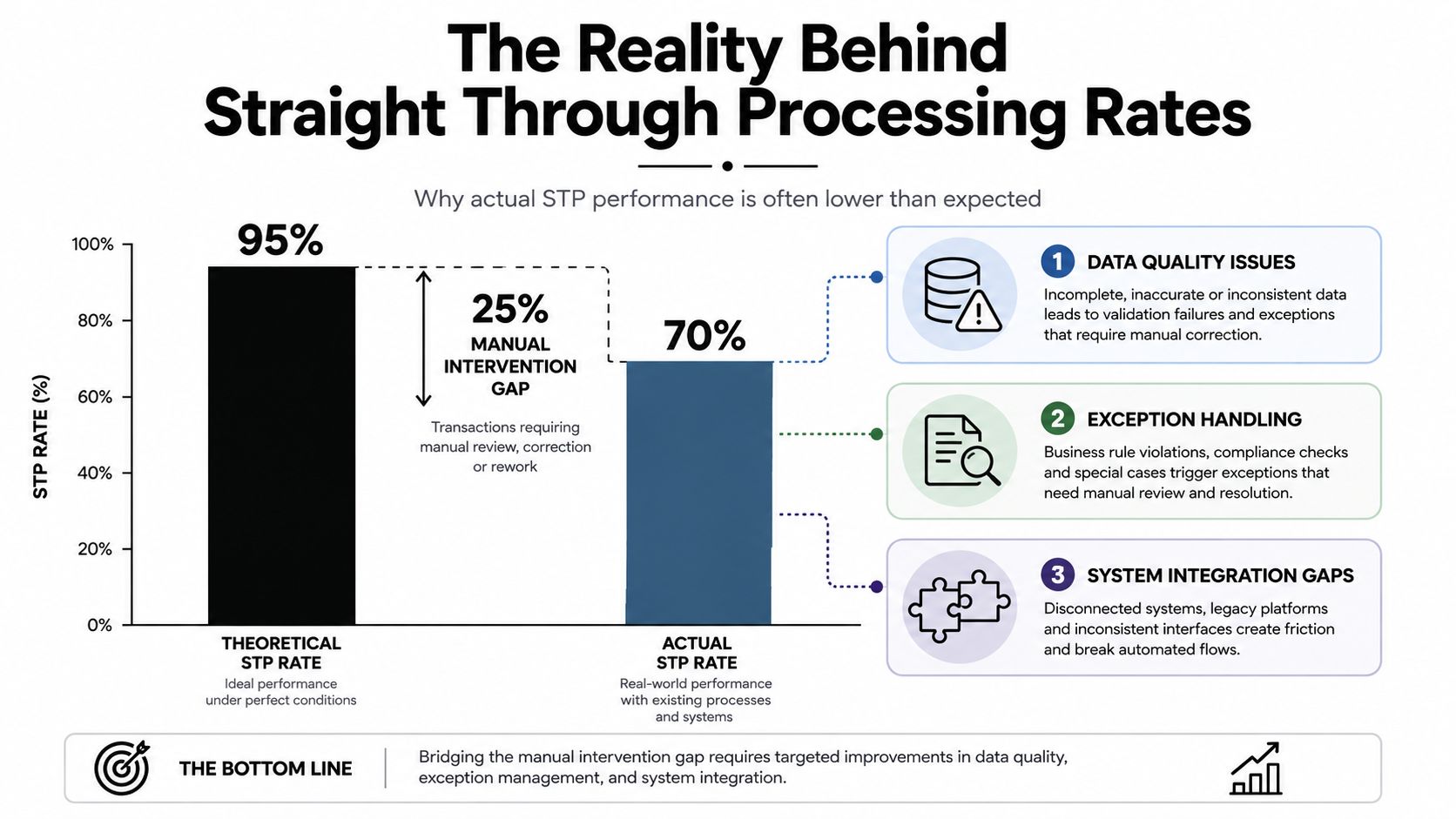
The global average STP rate for international transactions was 26% as of 2023, according to an industry source. Most cross-border transactions therefore still involve some manual handling, despite years of digitisation and standardisation. The STP overview on Wikipedia defines the concept as processing a transaction from initiation through validation, enrichment, routing, fulfilment, and settlement without human intervention.
That gap does not mean automation has failed. STP is a useful operating benchmark because it shows the distance between the intended workflow and the work employees still perform behind the scenes. A low rate may point to incomplete data, disconnected systems, inconsistent formats, manual compliance checks, or exception rules set too broadly for safe automation.
STP is a spectrum, not a switch
Operations teams often classify work as automated or manual. That framing misses the intermediate steps that determine whether automation produces value. A claim may be captured digitally and triaged automatically, then stop because a document is unreadable. Another may reach payment without an examiner opening the file, while still creating a finance reconciliation task.
The useful measure is the STP rate, the share of transactions or claims that complete a defined journey automatically. That journey must be specified before the rate is reported. Counting only automated intake can produce a healthy-looking figure while handlers complete the substantive work later.
STP has significant automation potential in mature environments, as described in IBM's explanation of STP. That potential increases the importance of process design. Every unclear eligibility rule can become a recurring exception, so teams need explicit gates for data quality, authority, document confidence, and compliance review.
Why manual intervention changes the economics
A summary citing Bank for International Settlements data reports that 60% of cross-border business-to-business payments still require manual intervention, with each intervention taking 15 to 20 minutes. Investopedia's explanation of straight-through processing connects those figures with the operational burden created by exceptions.
Insurance has the same pattern, although its failure points differ. A missing policy number, incomplete loss description, document sent to the wrong mailbox, or claim outside delegated authority can interrupt the automated path. One manual touch may appear minor. Across a portfolio, repeated touches create queues, rekeying, inconsistent decisions, and delayed settlement.
Claims leaders should use STP as a diagnostic measure, not a universal automation target. A falling rate may expose poorly designed intake forms, unstructured broker communications, uncoded authority rules, or a front end that was automated without redesigning downstream work. In complex markets such as Lloyd's, segmentation and governance determine which delegated authority workflows can proceed automatically and which exceptions require accountable human review. Teams assessing AI claims operations can include document intake, exception handling, and audit controls in that review.
How Straight Through Processing Works End to End
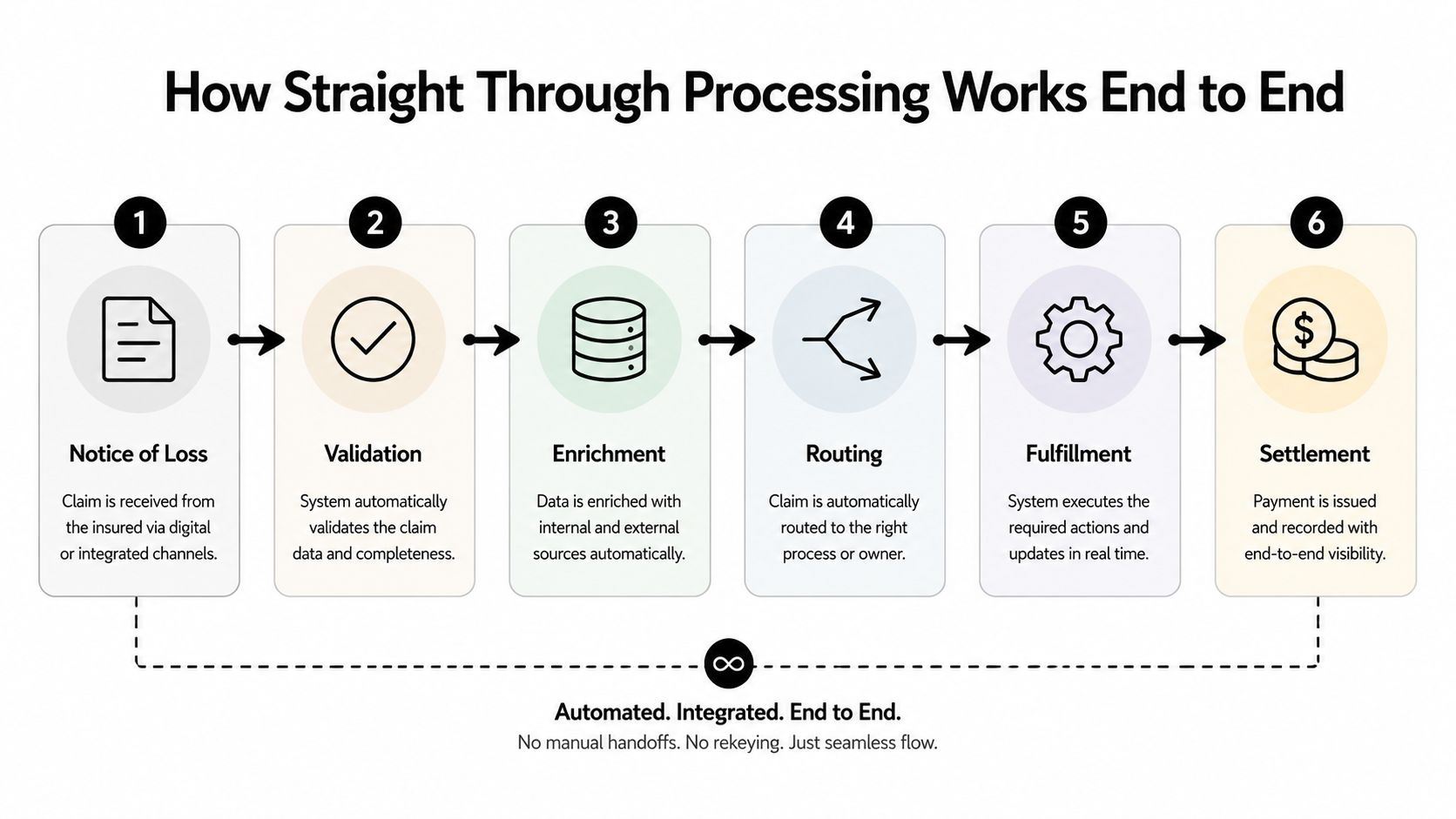
A reliable STP workflow begins with a defined transaction or claim event and ends only after every required downstream action is complete. For insurance, the path typically runs from first notice of loss through validation, adjudication, payment, reconciliation, and audit capture. Claims that fail the eligibility criteria need an explicit route to accountable human review.
The operating sequence is:
Notice of loss or initiation: The system receives a claim, payment instruction, or transaction through a supported channel.
Validation: It checks completeness, identity, policy or account details, required fields, and control conditions.
Enrichment: It retrieves information from connected policy, customer, payment, or reference systems.
Routing: Rules send the item to the appropriate queue, authority level, settlement path, or exception team.
Fulfillment: The system completes approved actions, such as creating records, issuing instructions, or preparing payment.
Settlement: The transaction completes, records are updated, and the workflow stores the relevant audit information.
The six stages provide a practical control model. They also expose where automation stops being safe. A claim can pass intake and validation yet require human judgement during coverage, liability, authority, or payment review.
The eligibility gate determines the path
STP should segment work rather than force every item through automation. An eligibility gate checks whether the claim has the required information, coverage conditions, authority, and risk characteristics. Claims that clear the gate continue automatically. Claims that fail it move to a human queue with a recorded reason.
That diversion is a control, not an automation defect. Ambiguous coverage, conflicting evidence, unusual liability, or an authority threshold should stop the automated path when the operating rules require it. In complex markets such as Lloyd's, delegated authority workflows need explicit limits, escalation ownership, and an audit trail. Agentic AI can assist with document intake, extract evidence from varied submissions, and assemble an exception context, but the workflow still needs defined permissions and human accountability.
Standardised data keeps the path moving
Automation performs best when inputs are predictable. Structured FNOL forms, consistent policy identifiers, recognised document types, and clear authority data give the workflow reliable signals. Unstructured emails and scanned documents require extraction, confidence checks, and escalation logic before processing can continue.
Payment integration is part of the same design. If a workflow approves a claim but a handler must copy the decision into another payment platform, the process is not fully straight through. The payment instruction, reserve or ledger update, notification, reconciliation, and audit record must align with the operating definition. That makes claims payment processing an STP design concern, not a separate back-office task.
Measuring STP Rate and Hidden Manual Rework
A high STP rate can be misleading if the organisation measures only the first automated event. Claims operations should define the complete unit of work before setting the metric. For example, the unit might begin at FNOL and end when the claim is paid, reconciled, communicated to the relevant parties, and recorded in the core system.
A basic STP rate is calculated as the share of eligible items that complete the defined journey without manual intervention. The word complete carries most of the meaning. If a claim is automatically classified but later requires manual document indexing, payment correction, or compliance review, it shouldn't be counted as fully straight through under a strict operating definition.
Measure the leakage, not only the headline rate
Exception leakage occurs when work appears automated but resurfaces elsewhere. Common signs include:
Rekeying after extraction: A handler corrects or re-enters fields because the source document wasn't interpreted reliably.
Untracked follow-up: A team member contacts a broker or policyholder outside the workflow, so the system doesn't show why progress stopped.
Downstream reconciliation: Finance or operations manually matches records that the claims workflow marked as complete.
Silent review: A supervisor checks every automatically approved item without that review appearing in the STP metric.
Queue substitution: The workflow removes intake work but creates a larger exception queue that another team must absorb.
This is why measuring operational efficiency requires more than counting automated actions. Leaders need to connect STP performance with exception volume, rework, ageing, handler time, payment accuracy, and control outcomes.
Speed and control must be evaluated together
The fastest route isn't always the strongest route. Removing a review step can shorten cycle time, but it can also allow weak data, uncertain coverage, or an inappropriate authority decision to pass without sufficient scrutiny. Conversely, a cautious gate may send too much work to handlers and reduce the value of automation.
Measurement rule: Count a claim as straight through only when the defined outcome is complete, not when the first automated task succeeds.
A mature dashboard separates eligible claims from total claims, records the reason for every diversion, identifies rework after apparent completion, and shows which rules create the most exceptions. That evidence lets teams refine the process rather than just pressure handlers to clear queues faster.
From Rules-Based Automation to Agentic AI
Traditional STP depends on deterministic rules. If the system receives a complete form, finds a matching policy, confirms the claim meets the configured conditions, and sees no conflicting signal, it can continue automatically. This model works well for standardised, high-volume work.
It breaks down when the input is messy or the decision depends on context. Specialty claims often arrive through email with attachments, broker commentary, schedules, endorsements, photographs, and previous correspondence. A rule can identify a field in a known format. It struggles when the meaning is distributed across several documents or when the next action depends on the relationship between them.
What rules do well
Rules remain valuable because they provide consistency and clear boundaries. They can enforce required fields, authority limits, routing conditions, payment controls, and escalation triggers. They also make testing easier when the input and output are predictable.
A rules engine should handle the parts of the process that are deterministic. It shouldn't be forced to interpret every document or resolve every ambiguity. Doing so usually creates one of two problems, either excessive rejection or unsafe pass-through.
What agentic systems add
Agentic AI can coordinate several tasks around the claim rather than executing one isolated rule. It can receive an email, identify the claim context, extract information from attachments, compare that information with policy data, request missing material, update the claims system, and recommend a next action. The human handler still needs visibility into what the agent found, what it changed, and why it escalated.
A typical insurance document workflow includes upload or email submission, AI field extraction, review and validation, then integration into the claims system, as described by DigiParser's insurance workflow. That sequence becomes more useful when the system also manages the surrounding communication and task state.
Agentic AI doesn't eliminate the need for rules. It expands the range of inputs those rules can act on by converting documents and conversations into structured, reviewable information. For a deeper explanation of the model, see what agentic AI means.
The practical boundary
The strongest design assigns agents the administrative and interpretive work that supports a decision, while reserving judgment-heavy decisions for authorised people. The agent might gather the evidence, identify a coverage question, check a delegated authority threshold, and present the recommended route. It should not make an irreversible decision when the evidence is incomplete or contradictory.
That boundary is especially important in Lloyd's workflows. Brokers, managing agents, and coverholders may exchange information across different systems and authority arrangements. An agent that can orchestrate the work across those channels is useful only when every action remains traceable.
STP in Action Across Banking and Insurance
STP looks different depending on the predictability of the work. A routine personal-lines claim may have standard data, clear eligibility conditions, and a familiar payment path. A marine or energy claim may involve several parties, layered coverage, complex evidence, and decisions that require specialist judgement.
Independent insurance research reports that adoption is highest in personal lines and individual life, while complex claims remain harder to automate. It also finds that mature programmes achieve materially higher automation on simple, high-volume claim types than across the full portfolio, as described in insurance STP research from Datos Insights.
Personal lines provide the cleanest starting point
A simple personal auto claim can often be assessed against structured policy information, a defined loss type, known coverage conditions, and a limited authority range. The workflow can capture the loss, identify missing information, route the file, and progress payment when the evidence and rules align.
Individual life can offer similar opportunities where eligibility and underwriting conditions are clear. The important qualification is that the automation applies to a segment, not automatically to every claim in the line. Exceptions still need a separate path for disputed facts, unusual circumstances, or incomplete records.
Specialty lines require orchestration
Marine, aviation, energy, construction, liability, and reinsurance claims contain more variables and more stakeholders. A broker may send a narrative email with several attachments. A coverholder may need to operate within delegated authority. A claims handler may need to compare policy wording, endorsements, correspondence, and loss evidence before deciding what can happen next.
In those environments, STP often means automating the movement and preparation of work, even when the final judgement remains human. The system can extract claim details, identify the relevant authority, request missing documents, create tasks, and escalate a file with an evidence trail. That reduces administrative drag without pretending the claim is routine.
Banking shows the same principle
Cross-border payments offer a clear parallel. Payment data must be validated, enriched, routed, checked, fulfilled, and settled. Yet the manual-intervention figures cited earlier show that international payment automation remains incomplete, particularly where data quality, compliance, or receiving-party requirements interrupt the path.
The lesson for claims leaders is direct. Don't benchmark STP against a theoretical end state. Benchmark it against the specific claim or transaction segments your organisation can control, then examine why items leave the automatic route. A narrow, reliable path usually creates more durable value than a broad promise that sends uncertain work into ungoverned automation.
Governance and Compliance Trade-Offs
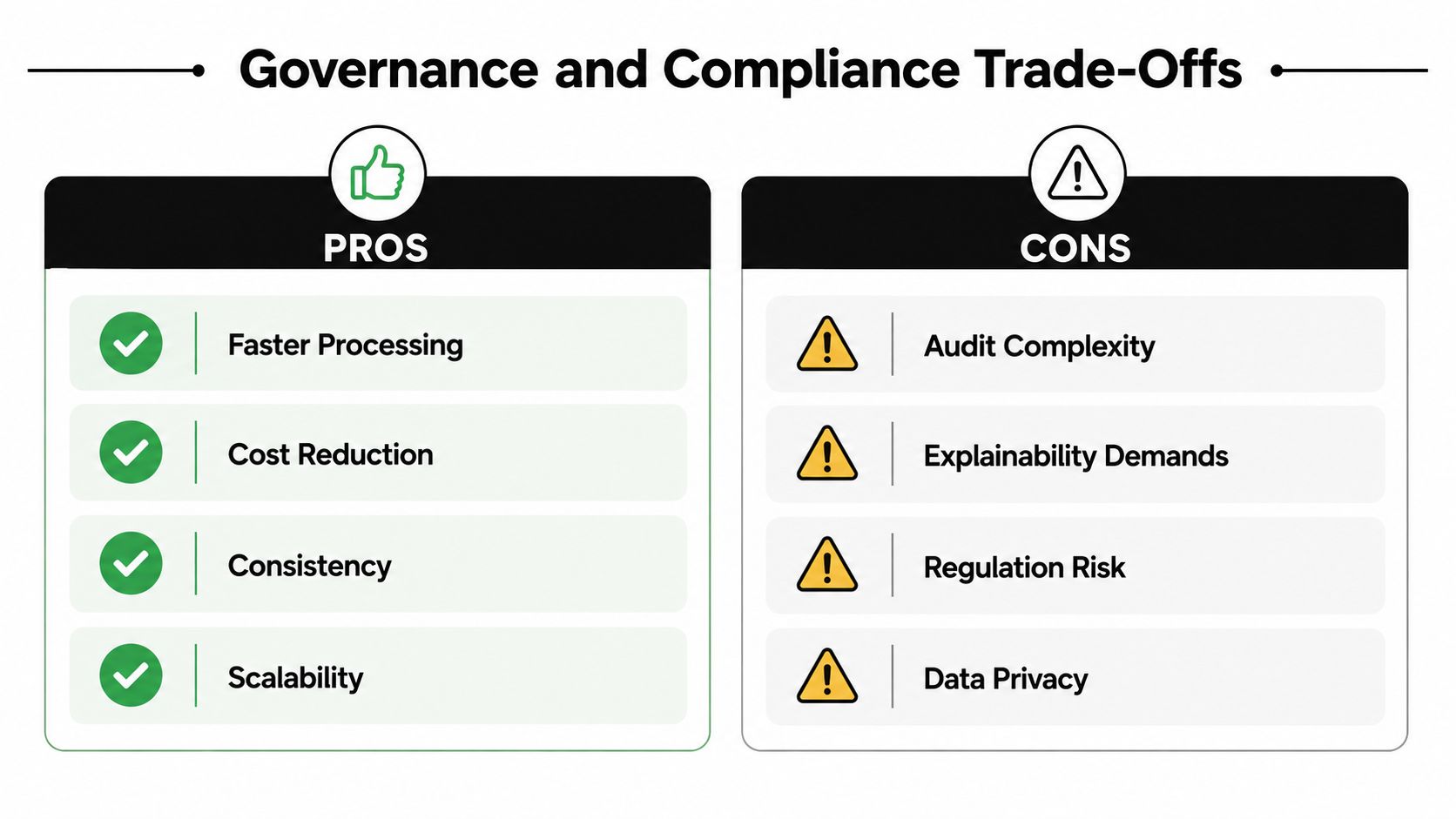
Higher STP isn't automatically better. An organisation can increase its automated completion rate by weakening eligibility rules, suppressing exceptions, or excluding difficult cases from the denominator. That may improve a dashboard while increasing leakage, complaints, payment errors, or regulatory exposure.
The right operating question is whether the workflow makes a defensible decision with appropriate evidence and control. In insurance, that means the system must distinguish routine processing from decisions that require interpretation, discretion, or specialist review.
Control principle: Automation should make the safe path faster, not make the uncertain path invisible.
Assured's insurance coverage of STP describes STP as an operating model in which automation handles routine decisions while adjusters intervene for exceptions or judgment-heavy cases. That distinction separates responsible automation from a simplistic “zero humans” target.
Controls that must exist before scale
A governed STP programme needs more than a model or workflow diagram. It needs operational evidence that people can inspect and challenge.
Eligibility controls: Define which claim types, data conditions, authority levels, and outcomes qualify for automatic handling.
Exception controls: Record the reason for diversion and assign the case to an accountable team.
Decision evidence: Preserve the input, extracted fields, rules applied, recommendations, approvals, and resulting actions.
Human oversight: Give authorised handlers a practical way to review, correct, override, or stop an automated action.
Access and privacy controls: Limit data access according to role and retain only what the process and obligations require.
Change governance: Test rule, prompt, integration, and model changes before they affect live claims.
Lloyd's and London Market participants also need to consider delegated authority, broker interactions, coverholder notifications, and audit expectations. A workflow that works in a closed insurer environment may fail when responsibility is distributed across several organisations.
Explainability is operational, not cosmetic
A handler needs to know why a claim was routed, why a document was rejected, why an authority threshold was triggered, or why a payment was held. A generic confidence score won't answer those questions. The record should show the source information and the sequence of actions that produced the outcome.
Teams building controls around regulated workflows can use regulatory compliance in financial services as a reference point for the broader governance context. The implementation standard should remain practical: every automated outcome needs an owner, a reason, and a recoverable path when the system gets it wrong.
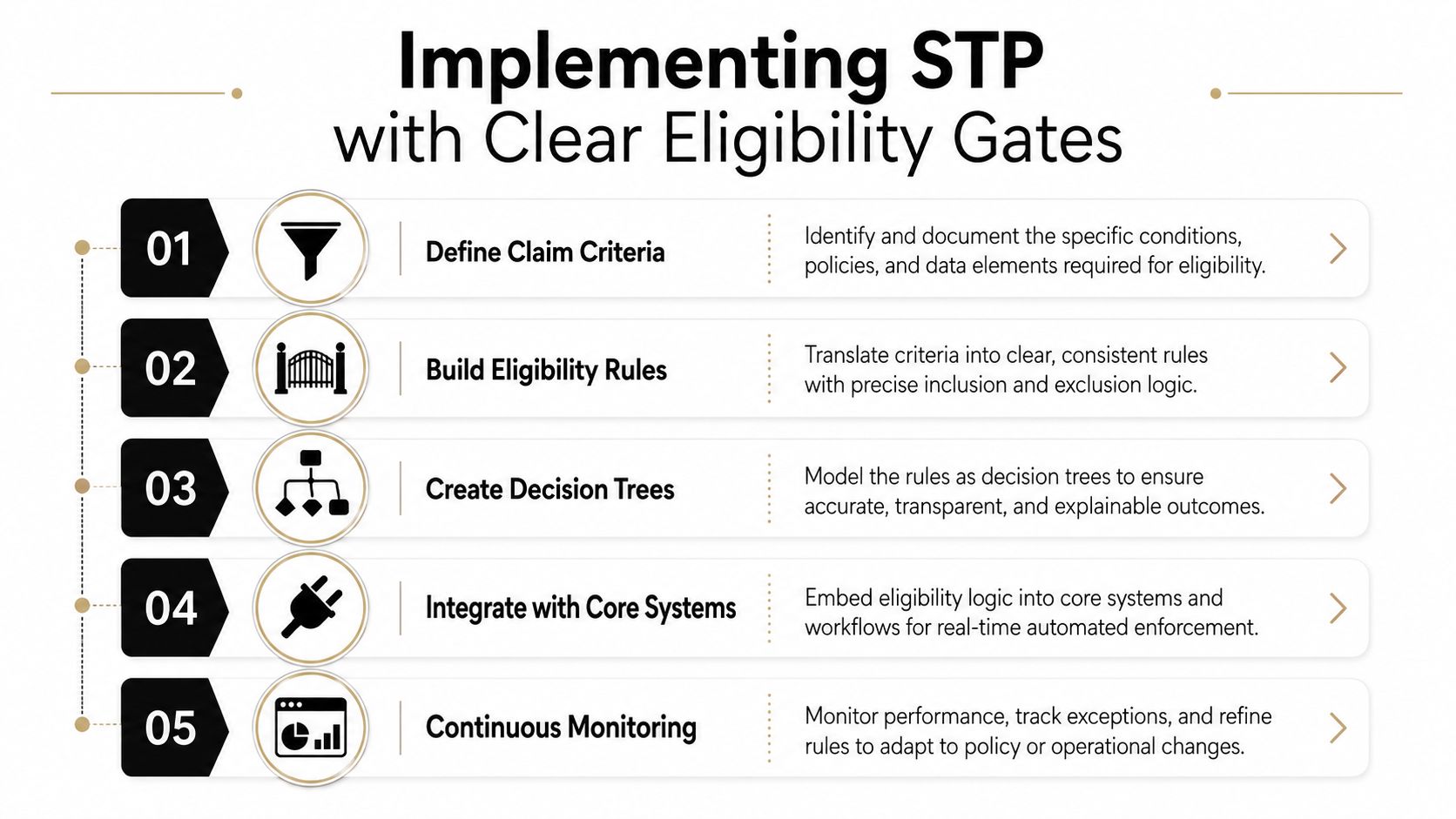
Implementing STP with Clear Eligibility Gates
Implementation works best as a controlled progression rather than a single transformation project. Start by selecting a claim segment with repeatable inputs, clear authority, and a manageable exception profile. Don't begin with the most complex line merely because it has the largest theoretical administrative burden.
A practical roadmap has five parts:
Define claim criteria: Specify the claim types, coverage conditions, channels, documents, authority thresholds, and outcomes that belong in the candidate population.
Build eligibility rules: Translate those criteria into checks the workflow can evaluate consistently, including missing data and conflicting information.
Create decision trees: Set the automatic route, the escalation route, and the reason each exception should leave STP.
Integrate core systems: Connect the claims workbench, policy administration platform, document repositories, payment services, and communication channels.
Monitor continuously: Review completion, exception reasons, rework, ageing, handler intervention, and control outcomes, then refine the design.
Make the gate explicit
The gate should be visible to operations, technology, compliance, and audit teams. Five Sigma Labs describes the operating rule clearly: eligible claims move automatically from intake to payment settlement only when they clear the gate, while exceptions go to manual handling.
That rule prevents scope creep. It also helps handlers trust the system because a diverted claim isn't an unexplained failure. The workflow should show which condition stopped automation, what information is missing, and what the handler needs to decide.
Integrate before adding complexity
An STP layer that sits outside the claims ecosystem creates another portal and another reconciliation burden. Integration should update existing records, preserve correspondence, and synchronise decisions with the systems people already use. Document workflows may need to accept PDFs, scans, photographs, and email-forwarded files, then extract structured fields for claims platforms through an API, as described by insurance claims OCR workflow guidance.
For Lloyd's market participants, the same principle applies to delegated authority. The workflow should extract claim details from broker or coverholder communications, check authority conditions, approve or escalate according to those conditions, update core systems, and notify the relevant party.
Improve the route through evidence
Monitor more than the headline STP rate. Review where claims stop, how often handlers correct extracted data, which channels generate the most exceptions, and whether automated decisions produce downstream rework. Use that evidence to improve forms, document handling, rules, integrations, and human review points.
Nolana AI offers an agentic platform for Lloyd's claims operations that supports FNOL intake, triage, document processing, lifecycle management, delegated authority workflows, and integrations over existing claims and policy systems. Its SOC 2-certified platform keeps human oversight and auditability in the workflow, which fits the central STP requirement: automate eligible work while preserving control over exceptions.
Nolana AI can help claims teams automate work from FNOL through settlement, including document extraction, triage, follow-ups, delegated authority checks, and updates across existing systems. Visit Nolana AI to assess how a governed, human-supervised STP model could fit your claims operation.
Straight-through processing is the end-to-end automation of a transaction or insurance claim from initiation to settlement without manual intervention. Yet the global average STP rate for international transactions was only 26% in 2023, so significant manual exception handling remains the norm. IBM defines STP across initiation, validation, enrichment, routing, fulfillment, and settlement, but real operations rarely move every item through that path without a human touch.
That gap matters most in claims. A workflow can look digital while handlers still rekey information from emails, chase missing documents, check authority limits, reconcile inconsistent records, and decide which exceptions deserve escalation. The practical answer to what is straight through processing is therefore more demanding than “automation from start to finish.” STP is a controlled operating model that decides which work can move automatically, which work needs review, and how both paths remain visible and auditable.
The Reality Behind Straight Through Processing Rates
The global average STP rate for international transactions was 26% as of 2023, according to an industry source. Most cross-border transactions therefore still involve some manual handling, despite years of digitisation and standardisation. The STP overview on Wikipedia defines the concept as processing a transaction from initiation through validation, enrichment, routing, fulfilment, and settlement without human intervention.
That gap does not mean automation has failed. STP is a useful operating benchmark because it shows the distance between the intended workflow and the work employees still perform behind the scenes. A low rate may point to incomplete data, disconnected systems, inconsistent formats, manual compliance checks, or exception rules set too broadly for safe automation.
STP is a spectrum, not a switch
Operations teams often classify work as automated or manual. That framing misses the intermediate steps that determine whether automation produces value. A claim may be captured digitally and triaged automatically, then stop because a document is unreadable. Another may reach payment without an examiner opening the file, while still creating a finance reconciliation task.
The useful measure is the STP rate, the share of transactions or claims that complete a defined journey automatically. That journey must be specified before the rate is reported. Counting only automated intake can produce a healthy-looking figure while handlers complete the substantive work later.
STP has significant automation potential in mature environments, as described in IBM's explanation of STP. That potential increases the importance of process design. Every unclear eligibility rule can become a recurring exception, so teams need explicit gates for data quality, authority, document confidence, and compliance review.
Why manual intervention changes the economics
A summary citing Bank for International Settlements data reports that 60% of cross-border business-to-business payments still require manual intervention, with each intervention taking 15 to 20 minutes. Investopedia's explanation of straight-through processing connects those figures with the operational burden created by exceptions.
Insurance has the same pattern, although its failure points differ. A missing policy number, incomplete loss description, document sent to the wrong mailbox, or claim outside delegated authority can interrupt the automated path. One manual touch may appear minor. Across a portfolio, repeated touches create queues, rekeying, inconsistent decisions, and delayed settlement.
Claims leaders should use STP as a diagnostic measure, not a universal automation target. A falling rate may expose poorly designed intake forms, unstructured broker communications, uncoded authority rules, or a front end that was automated without redesigning downstream work. In complex markets such as Lloyd's, segmentation and governance determine which delegated authority workflows can proceed automatically and which exceptions require accountable human review. Teams assessing AI claims operations can include document intake, exception handling, and audit controls in that review.
How Straight Through Processing Works End to End
A reliable STP workflow begins with a defined transaction or claim event and ends only after every required downstream action is complete. For insurance, the path typically runs from first notice of loss through validation, adjudication, payment, reconciliation, and audit capture. Claims that fail the eligibility criteria need an explicit route to accountable human review.
The operating sequence is:
Notice of loss or initiation: The system receives a claim, payment instruction, or transaction through a supported channel.
Validation: It checks completeness, identity, policy or account details, required fields, and control conditions.
Enrichment: It retrieves information from connected policy, customer, payment, or reference systems.
Routing: Rules send the item to the appropriate queue, authority level, settlement path, or exception team.
Fulfillment: The system completes approved actions, such as creating records, issuing instructions, or preparing payment.
Settlement: The transaction completes, records are updated, and the workflow stores the relevant audit information.
The six stages provide a practical control model. They also expose where automation stops being safe. A claim can pass intake and validation yet require human judgement during coverage, liability, authority, or payment review.
The eligibility gate determines the path
STP should segment work rather than force every item through automation. An eligibility gate checks whether the claim has the required information, coverage conditions, authority, and risk characteristics. Claims that clear the gate continue automatically. Claims that fail it move to a human queue with a recorded reason.
That diversion is a control, not an automation defect. Ambiguous coverage, conflicting evidence, unusual liability, or an authority threshold should stop the automated path when the operating rules require it. In complex markets such as Lloyd's, delegated authority workflows need explicit limits, escalation ownership, and an audit trail. Agentic AI can assist with document intake, extract evidence from varied submissions, and assemble an exception context, but the workflow still needs defined permissions and human accountability.
Standardised data keeps the path moving
Automation performs best when inputs are predictable. Structured FNOL forms, consistent policy identifiers, recognised document types, and clear authority data give the workflow reliable signals. Unstructured emails and scanned documents require extraction, confidence checks, and escalation logic before processing can continue.
Payment integration is part of the same design. If a workflow approves a claim but a handler must copy the decision into another payment platform, the process is not fully straight through. The payment instruction, reserve or ledger update, notification, reconciliation, and audit record must align with the operating definition. That makes claims payment processing an STP design concern, not a separate back-office task.
Measuring STP Rate and Hidden Manual Rework
A high STP rate can be misleading if the organisation measures only the first automated event. Claims operations should define the complete unit of work before setting the metric. For example, the unit might begin at FNOL and end when the claim is paid, reconciled, communicated to the relevant parties, and recorded in the core system.
A basic STP rate is calculated as the share of eligible items that complete the defined journey without manual intervention. The word complete carries most of the meaning. If a claim is automatically classified but later requires manual document indexing, payment correction, or compliance review, it shouldn't be counted as fully straight through under a strict operating definition.
Measure the leakage, not only the headline rate
Exception leakage occurs when work appears automated but resurfaces elsewhere. Common signs include:
Rekeying after extraction: A handler corrects or re-enters fields because the source document wasn't interpreted reliably.
Untracked follow-up: A team member contacts a broker or policyholder outside the workflow, so the system doesn't show why progress stopped.
Downstream reconciliation: Finance or operations manually matches records that the claims workflow marked as complete.
Silent review: A supervisor checks every automatically approved item without that review appearing in the STP metric.
Queue substitution: The workflow removes intake work but creates a larger exception queue that another team must absorb.
This is why measuring operational efficiency requires more than counting automated actions. Leaders need to connect STP performance with exception volume, rework, ageing, handler time, payment accuracy, and control outcomes.
Speed and control must be evaluated together
The fastest route isn't always the strongest route. Removing a review step can shorten cycle time, but it can also allow weak data, uncertain coverage, or an inappropriate authority decision to pass without sufficient scrutiny. Conversely, a cautious gate may send too much work to handlers and reduce the value of automation.
Measurement rule: Count a claim as straight through only when the defined outcome is complete, not when the first automated task succeeds.
A mature dashboard separates eligible claims from total claims, records the reason for every diversion, identifies rework after apparent completion, and shows which rules create the most exceptions. That evidence lets teams refine the process rather than just pressure handlers to clear queues faster.
From Rules-Based Automation to Agentic AI
Traditional STP depends on deterministic rules. If the system receives a complete form, finds a matching policy, confirms the claim meets the configured conditions, and sees no conflicting signal, it can continue automatically. This model works well for standardised, high-volume work.
It breaks down when the input is messy or the decision depends on context. Specialty claims often arrive through email with attachments, broker commentary, schedules, endorsements, photographs, and previous correspondence. A rule can identify a field in a known format. It struggles when the meaning is distributed across several documents or when the next action depends on the relationship between them.
What rules do well
Rules remain valuable because they provide consistency and clear boundaries. They can enforce required fields, authority limits, routing conditions, payment controls, and escalation triggers. They also make testing easier when the input and output are predictable.
A rules engine should handle the parts of the process that are deterministic. It shouldn't be forced to interpret every document or resolve every ambiguity. Doing so usually creates one of two problems, either excessive rejection or unsafe pass-through.
What agentic systems add
Agentic AI can coordinate several tasks around the claim rather than executing one isolated rule. It can receive an email, identify the claim context, extract information from attachments, compare that information with policy data, request missing material, update the claims system, and recommend a next action. The human handler still needs visibility into what the agent found, what it changed, and why it escalated.
A typical insurance document workflow includes upload or email submission, AI field extraction, review and validation, then integration into the claims system, as described by DigiParser's insurance workflow. That sequence becomes more useful when the system also manages the surrounding communication and task state.
Agentic AI doesn't eliminate the need for rules. It expands the range of inputs those rules can act on by converting documents and conversations into structured, reviewable information. For a deeper explanation of the model, see what agentic AI means.
The practical boundary
The strongest design assigns agents the administrative and interpretive work that supports a decision, while reserving judgment-heavy decisions for authorised people. The agent might gather the evidence, identify a coverage question, check a delegated authority threshold, and present the recommended route. It should not make an irreversible decision when the evidence is incomplete or contradictory.
That boundary is especially important in Lloyd's workflows. Brokers, managing agents, and coverholders may exchange information across different systems and authority arrangements. An agent that can orchestrate the work across those channels is useful only when every action remains traceable.
STP in Action Across Banking and Insurance
STP looks different depending on the predictability of the work. A routine personal-lines claim may have standard data, clear eligibility conditions, and a familiar payment path. A marine or energy claim may involve several parties, layered coverage, complex evidence, and decisions that require specialist judgement.
Independent insurance research reports that adoption is highest in personal lines and individual life, while complex claims remain harder to automate. It also finds that mature programmes achieve materially higher automation on simple, high-volume claim types than across the full portfolio, as described in insurance STP research from Datos Insights.
Personal lines provide the cleanest starting point
A simple personal auto claim can often be assessed against structured policy information, a defined loss type, known coverage conditions, and a limited authority range. The workflow can capture the loss, identify missing information, route the file, and progress payment when the evidence and rules align.
Individual life can offer similar opportunities where eligibility and underwriting conditions are clear. The important qualification is that the automation applies to a segment, not automatically to every claim in the line. Exceptions still need a separate path for disputed facts, unusual circumstances, or incomplete records.
Specialty lines require orchestration
Marine, aviation, energy, construction, liability, and reinsurance claims contain more variables and more stakeholders. A broker may send a narrative email with several attachments. A coverholder may need to operate within delegated authority. A claims handler may need to compare policy wording, endorsements, correspondence, and loss evidence before deciding what can happen next.
In those environments, STP often means automating the movement and preparation of work, even when the final judgement remains human. The system can extract claim details, identify the relevant authority, request missing documents, create tasks, and escalate a file with an evidence trail. That reduces administrative drag without pretending the claim is routine.
Banking shows the same principle
Cross-border payments offer a clear parallel. Payment data must be validated, enriched, routed, checked, fulfilled, and settled. Yet the manual-intervention figures cited earlier show that international payment automation remains incomplete, particularly where data quality, compliance, or receiving-party requirements interrupt the path.
The lesson for claims leaders is direct. Don't benchmark STP against a theoretical end state. Benchmark it against the specific claim or transaction segments your organisation can control, then examine why items leave the automatic route. A narrow, reliable path usually creates more durable value than a broad promise that sends uncertain work into ungoverned automation.
Governance and Compliance Trade-Offs
Higher STP isn't automatically better. An organisation can increase its automated completion rate by weakening eligibility rules, suppressing exceptions, or excluding difficult cases from the denominator. That may improve a dashboard while increasing leakage, complaints, payment errors, or regulatory exposure.
The right operating question is whether the workflow makes a defensible decision with appropriate evidence and control. In insurance, that means the system must distinguish routine processing from decisions that require interpretation, discretion, or specialist review.
Control principle: Automation should make the safe path faster, not make the uncertain path invisible.
Assured's insurance coverage of STP describes STP as an operating model in which automation handles routine decisions while adjusters intervene for exceptions or judgment-heavy cases. That distinction separates responsible automation from a simplistic “zero humans” target.
Controls that must exist before scale
A governed STP programme needs more than a model or workflow diagram. It needs operational evidence that people can inspect and challenge.
Eligibility controls: Define which claim types, data conditions, authority levels, and outcomes qualify for automatic handling.
Exception controls: Record the reason for diversion and assign the case to an accountable team.
Decision evidence: Preserve the input, extracted fields, rules applied, recommendations, approvals, and resulting actions.
Human oversight: Give authorised handlers a practical way to review, correct, override, or stop an automated action.
Access and privacy controls: Limit data access according to role and retain only what the process and obligations require.
Change governance: Test rule, prompt, integration, and model changes before they affect live claims.
Lloyd's and London Market participants also need to consider delegated authority, broker interactions, coverholder notifications, and audit expectations. A workflow that works in a closed insurer environment may fail when responsibility is distributed across several organisations.
Explainability is operational, not cosmetic
A handler needs to know why a claim was routed, why a document was rejected, why an authority threshold was triggered, or why a payment was held. A generic confidence score won't answer those questions. The record should show the source information and the sequence of actions that produced the outcome.
Teams building controls around regulated workflows can use regulatory compliance in financial services as a reference point for the broader governance context. The implementation standard should remain practical: every automated outcome needs an owner, a reason, and a recoverable path when the system gets it wrong.
Implementing STP with Clear Eligibility Gates
Implementation works best as a controlled progression rather than a single transformation project. Start by selecting a claim segment with repeatable inputs, clear authority, and a manageable exception profile. Don't begin with the most complex line merely because it has the largest theoretical administrative burden.
A practical roadmap has five parts:
Define claim criteria: Specify the claim types, coverage conditions, channels, documents, authority thresholds, and outcomes that belong in the candidate population.
Build eligibility rules: Translate those criteria into checks the workflow can evaluate consistently, including missing data and conflicting information.
Create decision trees: Set the automatic route, the escalation route, and the reason each exception should leave STP.
Integrate core systems: Connect the claims workbench, policy administration platform, document repositories, payment services, and communication channels.
Monitor continuously: Review completion, exception reasons, rework, ageing, handler intervention, and control outcomes, then refine the design.
Make the gate explicit
The gate should be visible to operations, technology, compliance, and audit teams. Five Sigma Labs describes the operating rule clearly: eligible claims move automatically from intake to payment settlement only when they clear the gate, while exceptions go to manual handling.
That rule prevents scope creep. It also helps handlers trust the system because a diverted claim isn't an unexplained failure. The workflow should show which condition stopped automation, what information is missing, and what the handler needs to decide.
Integrate before adding complexity
An STP layer that sits outside the claims ecosystem creates another portal and another reconciliation burden. Integration should update existing records, preserve correspondence, and synchronise decisions with the systems people already use. Document workflows may need to accept PDFs, scans, photographs, and email-forwarded files, then extract structured fields for claims platforms through an API, as described by insurance claims OCR workflow guidance.
For Lloyd's market participants, the same principle applies to delegated authority. The workflow should extract claim details from broker or coverholder communications, check authority conditions, approve or escalate according to those conditions, update core systems, and notify the relevant party.
Improve the route through evidence
Monitor more than the headline STP rate. Review where claims stop, how often handlers correct extracted data, which channels generate the most exceptions, and whether automated decisions produce downstream rework. Use that evidence to improve forms, document handling, rules, integrations, and human review points.
Nolana AI offers an agentic platform for Lloyd's claims operations that supports FNOL intake, triage, document processing, lifecycle management, delegated authority workflows, and integrations over existing claims and policy systems. Its SOC 2-certified platform keeps human oversight and auditability in the workflow, which fits the central STP requirement: automate eligible work while preserving control over exceptions.
Nolana AI can help claims teams automate work from FNOL through settlement, including document extraction, triage, follow-ups, delegated authority checks, and updates across existing systems. Visit Nolana AI to assess how a governed, human-supervised STP model could fit your claims operation.


All systems operational
1 Lime Street, London EC3M 7HA | 222E 3rd Street, New York 10009
Copyright © 2026, Nolana. All rights reserved
All systems operational
1 Lime Street, London EC3M 7HA | 222E 3rd Street, New York 10009
Copyright © 2026, Nolana. All rights reserved
All systems operational
1 Lime Street, London EC3M 7HA | 222E 3rd Street, New York 10009
Copyright © 2026, Nolana. All rights reserved
All systems operational
1 Lime Street, London EC3M 7HA | 222E 3rd Street, New York 10009
Copyright © 2026, Nolana. All rights reserved